Mobile reports and market data
Documents

Unlocking Attribution with TikTok and AppsFlyer
The mobile marketing landscape is undergoing a fundamental transition as traditional last-click attribution models prove increasingly inadequate for capturing the complexities of modern consumer journeys.
- The industry is moving away from last-click attribution models, which favor intent-based search platforms and fail to accurately measure the impact of interest-based channels like TikTok.
- Advertisers should adopt a holistic measurement framework that integrates incrementality testing and media mix modeling to account for multi-touch interactions and full-funnel ad performance.
- To navigate tightening privacy regulations, companies must transition from deterministic tracking to privacy-safe signal capturing methods, including conversion APIs and data clean rooms.
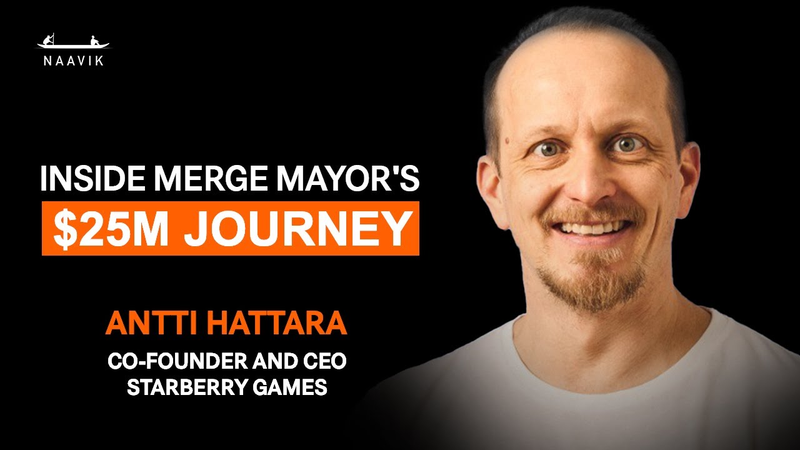
Mastering Merge: How StarBerry Built a Merge-2 Hit
StarBerry Games has successfully navigated the highly competitive Merge-2 mobile gaming market by pivoting from idle titles to a community-centric development model.
- StarBerry Games generated over $25 million in lifetime revenue from Merge Mayor by utilizing a lean team of only 22 employees.
- The studio prioritizes long-term retention by integrating social connectivity directly into the gameplay loop rather than relying on high-budget user acquisition.
- A 50,000-member Discord community serves as a primary source for qualitative insights, which the studio balances against quantitative data to refine live-ops and seasonal content.

Week in Mobile Games E39 - Mobile's hot new releases and the loot box investigation unpacked
The mobile gaming industry is currently undergoing a structural transformation defined by the rise of high-fidelity, cross-platform titles that bridge the gap between mobile and console experiences.
- Nexon’s 'Dungeon and Fighter Mobile' generated over $1 billion in iOS revenue in China within six months, highlighting the massive financial potential of successful mobile titles.
- The mobile industry is shifting toward high-fidelity, cross-platform experiences like 'Infinity Nikki' and 'Delta Force' that emphasize cross-progression to bridge the gap between mobile and console.
- Investors are increasingly prioritizing daily active user counts over traditional retention metrics, seeking shorter return on investment windows of two to three years.

Ad placements & Ad monetization trends in Mobile Games - November 2024
The mobile gaming landscape is undergoing a significant shift toward ultra-casual titles that prioritize high-volume ad monetization over traditional in-app purchases.
- Top-performing ultra-casual mobile games are generating daily ad revenues between $25,000 and $100,000 by prioritizing high-volume ad monetization over in-app purchases.
- Developers are successfully scaling titles to millions of daily active users by utilizing short, low-friction gameplay loops that mimic the consumption patterns of short-form video content.
- Vietnamese studios are currently leading the market by blending viral social media trends with aggressive ad placements, including banners, interstitials, and frequent rewarded ads.

Transforming UA Creatives Through AI (with Reforged Labs)
The mobile gaming industry is undergoing a fundamental shift in user acquisition strategy, moving away from manual, labor-intensive creative production toward automated, AI-driven experimentation.
- AI-driven creative engines are replacing manual production by deconstructing high-performing ads to generate large volumes of personalized video assets at scale.
- The integration of AI platforms has reduced the production cost of individual ad units to approximately $50, significantly lowering the barrier to entry for smaller studios.
- Reforged Labs and similar platforms are shifting the marketing professional's role from repetitive asset creation to high-level strategic optimization and data-backed validation.

TWIG #311 Musk Enters the Game, Archero 2 Aims for the Bullseye, PlayStation Goes Portable
The gaming industry is undergoing a fundamental shift in consumer behavior, as engagement with gaming-related content now surpasses active playtime, with users averaging 8.5 hours of viewing versus 7.4 hours of playing per week.
- Consumer engagement with gaming content has overtaken active playtime, with users averaging 8.5 hours of viewing per week compared to 7.4 hours of playing.
- The live-service model is facing significant instability, evidenced by the closure of titles like XDefiant and the financial struggles of major consolidators such as Embracer Group.
- Success in the current market requires rigorous data-driven strategies, specifically focusing on hybrid-casual monetization and validating retention metrics before full-scale product launches.

Games in India and China -Two Elephants in Two Rooms | BITKRAFT Summit 2024
The gaming landscapes of China and India represent two distinct developmental trajectories within the global market.
- China’s $50 billion gaming market, supported by 720 million players, is shifting its strategic focus from mobile dominance toward high-quality PC and console development for global export.
- India’s gaming sector is currently transitioning from a focus on low-cost live operations toward original game development and social gaming, driven by increased foreign direct investment and a wave of IPOs.
- The rapid integration of 5G technology and the UPI digital payment infrastructure in India is acting as a primary catalyst for the country's high-growth ecosystem.

From Casual to Complex: Trends that Shaped Gaming in 2024
The gaming industry is undergoing a fundamental transformation, moving away from traditional user acquisition strategies toward a product-centric model defined by hybrid monetization and lean, data-driven execution.
- Competitive advantage has shifted from manual marketing optimization to product-centric design, where engagement loops and monetization mechanics are integrated at the project's inception.
- Studios must transition to a hybrid gaming model that combines the accessibility of hyper-casual titles with the complex retention loops characteristic of high-production RPGs.
- Sustainable growth now requires deep organizational integration between marketing, product, and data teams to replace siloed workflows and combat rising acquisition costs.

Archero 2 Review: The Evolution of gaming & Habby template perfection
Archero 2 represents the latest iteration of Habby’s highly successful game design framework, effectively refining the mechanics that defined its predecessor and other hits like Survivor.io.
- Archero 2 features a more complex and fleshed-out core gameplay loop compared to its predecessor, incorporating expanded progression layers like a 10-slot rune system that allows players to modify skill abilities.
- The game is currently following an Asian-centric soft launch strategy, with significant traction in markets like South Korea, China, and Taiwan, generating approximately 100,000 downloads per day.
- Unlike the original Archero, which relied heavily on ad revenue, Archero 2 has significantly reduced ad placements, limiting users to roughly four rewarded ad opportunities per 24-hour cycle.

Digital Market Index: Q4 2024
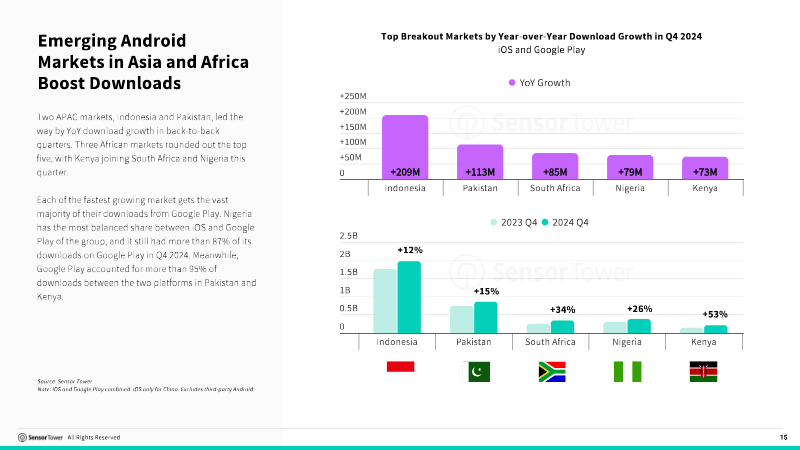
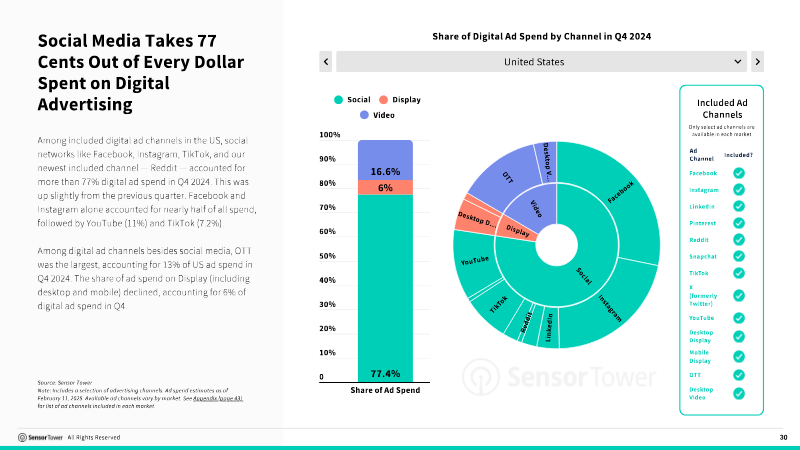
Sensor Tower's Q4 2024 Digital Market Index describes a mobile and digital advertising economy at record levels, with growth driven increasingly by non-game apps.
- Global in-app purchase revenue reached a record $39.4 billion in Q4 2024, bolstered by a 28.2% year-over-year surge in non-game application spending.
- TikTok became the first application to surpass $6 billion in annual revenue, highlighting the massive monetization potential of non-game platforms.
- The iOS ecosystem captured 70% of total revenue, while Google Play maintained its dominance in scale by facilitating nearly 75% of the 34.1 billion global downloads.

2024 Global Mobile Games Marketing Trends & Insights
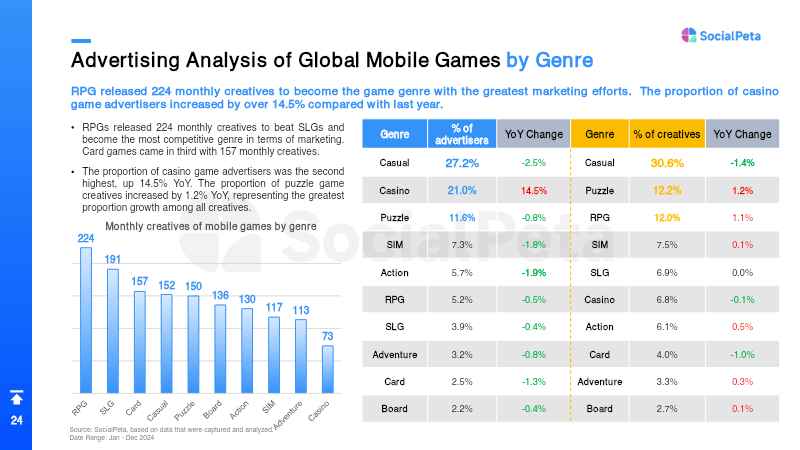
Mobile game marketing in 2024 was shaped by market concentration, rising acquisition costs, and rapid creative experimentation.
- The top 50 publishers now control 70% of total global mobile gaming revenue, driving a market-wide shift toward hybrid-casual models that combine ad-based revenue with in-app purchases.
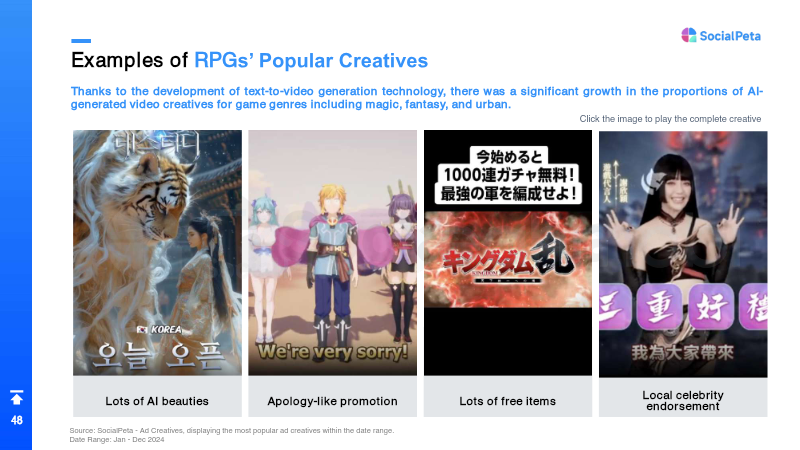
- Advertising activity surged by 60% year-over-year in 2024, with 250,000 advertisers deploying 46.2 million creative assets despite a decline in new market entrants.
- Short-form video has become the dominant engagement driver, accounting for up to 81% of impressions in the Puzzle and Simulation genres.

Week in Mobile Games E38 - Xbox and Adjust mishandle their PR and Supercell's culture revolution
Microsoft’s strategic pivot toward a proprietary mobile store has encountered significant friction, exacerbated by a U.S. court decision to pause Google Play remedies and a widely criticized communication strategy.
- Supercell is abandoning its traditional small-team structure in favor of a dual-model approach that integrates larger live-game teams and formal management to combat creative stagnation.
- Microsoft’s attempt to launch a proprietary mobile store is facing significant setbacks due to a U.S. court decision pausing Google Play remedies and a poorly received communication strategy that alienated key partners.
- Mobile measurement firm Adjust is undergoing internal instability following abrupt leadership changes and workforce reductions, allowing competitors like Singular to capture market share and talent.
Writers
Games and companies
Games