Naavik
Research4 documents
Documents

Article
India's State of Play
The Indian gaming market is undergoing a significant maturation phase, transitioning from a focus on scale to a more robust ecosystem defined by rising player spending and diversified content. The primary thesis posits that India has become a compelling global gaming hub, driven by improved digital infrastructure, increased smartphone penetration, and a shifting regulatory landscape. While the Real Money Gaming (RMG) sector has historically dominated, recent regulatory changes are successfully redirecting capital and consumer interest toward non-RMG gaming and broader entertainment segments.
Market data indicates that the non-RMG mobile gaming sector generated $1.1 billion in revenue through 2025, with projections estimating growth to $2.4 billion by 2029. This expansion is supported by a local industry comprising over 2,000 gaming companies and a workforce of 130,000 professionals. These entities are increasingly focused on mobile development, LiveOps, infrastructure, and the creation of original intellectual property, signaling a move toward higher-value production capabilities.
The analysis, authored by Naavik for MIXI Global Investments, utilizes data from Sensor Tower, AppsFlyer, and Google to evaluate the current state of the Indian market. By examining the interplay between evolving consumer habits and the reallocation of capital from the $3.7 billion RMG sector, the findings highlight a unique opportunity for sustained growth. The industry is effectively leveraging its massive user base to increase average revenue per user, positioning India as a critical player in the global gaming landscape through 2029.
- The Indian non-RMG mobile gaming sector is projected to grow from $1.1 billion in 2025 to $2.4 billion by 2029.
- Regulatory shifts are successfully redirecting capital and consumer interest away from the $3.7 billion Real Money Gaming (RMG) sector toward broader entertainment and non-RMG gaming.
- India’s gaming ecosystem now comprises over 2,000 companies and a workforce of 130,000 professionals.
- Industry focus is shifting toward higher-value production capabilities, specifically mobile development, LiveOps, infrastructure, and the creation of original intellectual property.
- The market is transitioning from a focus on user scale to increasing the average revenue per user (ARPU) to solidify India's position as a global gaming hub.
+1
NaavikJul 2026

Article
The State of UGC Games (2026)
The user-generated content (UGC) gaming sector reached a pivotal stage of professionalization and consolidation in 2025, characterized by a 47% year-over-year increase in developer payouts to approximately $2.2 billion. This growth underscores a fundamental shift in the industry, where UGC has transitioned from a niche hobbyist pursuit into a core, scalable live-service strategy for major studios. The landscape is currently defined by a winner-take-most dynamic, where dominant platforms like Roblox and Fortnite leverage massive network effects, AI-driven creation tools, and sophisticated monetization models to secure long-term player retention.
Roblox remains the primary engine of this growth, successfully scaling its ecosystem through aggressive international expansion, particularly in the APAC region, and the professionalization of its developer base. By integrating advanced technical optimizations and AI-moderation, the platform has effectively transformed regulatory challenges regarding child safety into a competitive moat. Simultaneously, Fortnite Creative has matured into a highly competitive environment where success is increasingly contingent upon external user acquisition and the stacking of diverse revenue streams, such as in-island transactions and sponsored discovery, rather than organic discovery alone.
Beyond these primary platforms, the modding ecosystem has emerged as a critical pillar of industry sustainability. Platforms like Overwolf have successfully professionalized modding, enabling AAA studios to utilize UGC as a cost-effective mechanism for extending game lifecycles. This trend toward "UGC-as-a-service" is further evidenced by the decline of independent, greenfield platform development in favor of integrating UGC tools into existing, high-scale titles. As venture funding for new platforms wanes, the industry is bifurcating; while Western studios remain cautious, Chinese developers are aggressively embedding UGC into flagship titles to drive engagement, signaling that platform scale and AI-powered infrastructure will be the primary determinants of competitive advantage in the coming years.
- The UGC gaming sector has professionalized into a core live-service strategy, evidenced by a 47% year-over-year increase in developer payouts to $2.2 billion in 2025.
- Roblox maintains its market dominance through international expansion in the APAC region and the use of AI-driven moderation to turn safety compliance into a competitive advantage.
- Fortnite Creative has shifted from organic discovery to a model requiring external user acquisition and diversified revenue streams, including sponsored discovery and in-island transactions.
- The industry is moving toward a 'UGC-as-a-service' model, where AAA studios increasingly integrate UGC tools into existing titles rather than building independent, greenfield platforms.
- Professionalized modding ecosystems, exemplified by platforms like Overwolf, have become essential for extending the lifecycles of AAA games.
+2
NaavikMar 2026
Report7 pages
Vietnam's Mobile Dev Opportunity
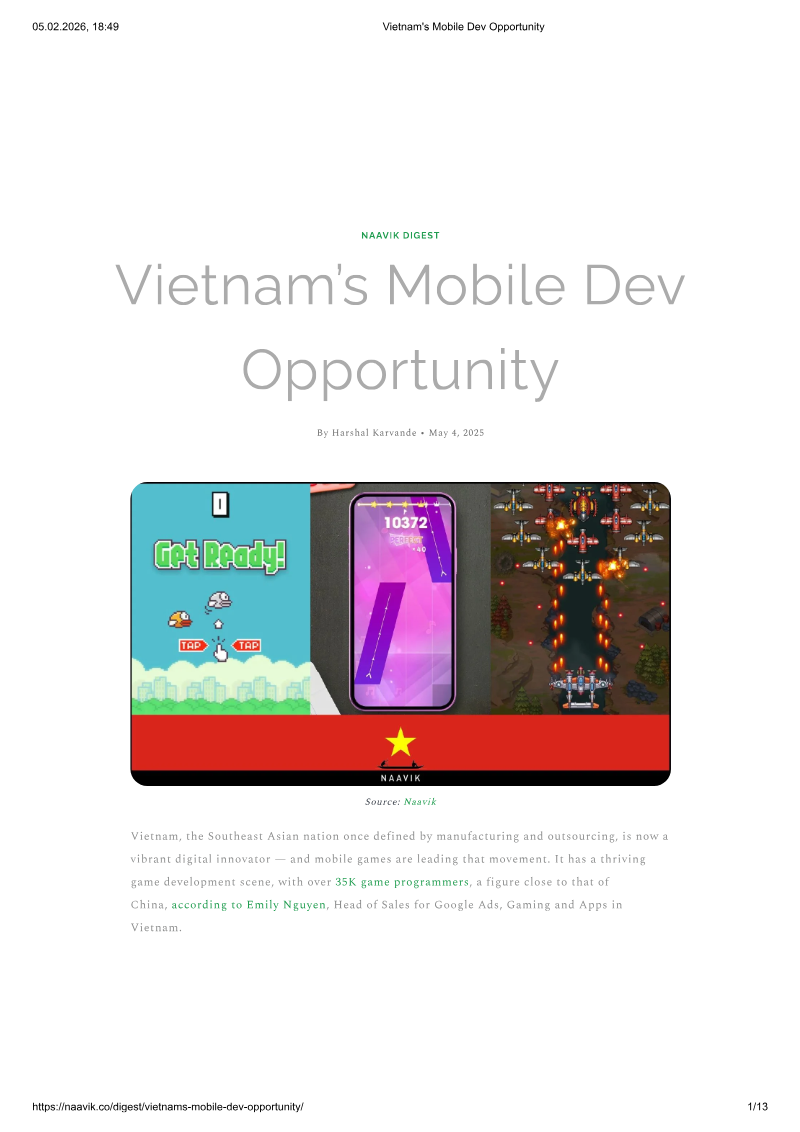
Vietnam’s mobile game sector has evolved from a consumer‑centric market into a burgeoning production hub, driven by a skilled talent pool forged through outsourcing, stringent regulatory frameworks that forced local publishing entities to emerge, and the explosive rise of mobile gaming. The country now hosts over 35 000 game programmers—comparable to China’s workforce—and more than 300 active mobile publishers headquartered in Vietnam. In 2024, five Vietnamese studios ranked among the world’s top 25 publishers by downloads, contributing nearly 2.4 billion downloads and $133 million in revenue—a 67 % increase in downloads and an 82 % rise in earnings since 2020. Key titles such as Car Race, Wood Nuts & Bolts Puzzle, and Hair Salon: Beauty Salon Game illustrate the domestic IP pipeline, while globally recognized titles like Sky Garden: Farming Paradise, Magic Tiles 3, and Axie Infinity showcase the country’s capacity for high‑impact releases.
The transformation accelerated after 2013 when Vietnamese solo developer Nguyen Ha Dong’s Flappy Bird achieved worldwide chart dominance, proving that local talent could produce globally successful mobile games with limited resources. This success spurred a wave of small studios and startups, many of which transitioned from outsourcing or publishing roles to independent IP creation. Vietnam’s high smartphone penetration (84 %) and a youthful, digitally native demographic further underpin market growth.
Regulatory challenges remain: stricter limits on gaming time for minors, mandatory Ministry of Information and Communications approvals, and content censorship can constrain creative expression and international appeal. Future success will hinge on navigating the shift from hypercasual to more complex casual and social mobile games while adapting to evolving regulatory constraints. Despite these hurdles, Vietnam’s established talent base, rapid growth trajectory, and increasing foreign investment position it as a rising contender for global mobile game leadership over the next decade.
- Vietnam has emerged as a major global mobile development hub with over 35,000 game programmers and more than 300 active local publishers.
- In 2024, five Vietnamese studios ranked among the world’s top 25 publishers, generating 2.4 billion downloads and $133 million in revenue.
- Since 2020, the sector has experienced significant growth, marked by a 67% increase in downloads and an 82% rise in earnings.
- The industry’s transition from outsourcing to independent IP creation was catalyzed by the 2013 global success of Flappy Bird, which proved that local talent could achieve international chart dominance.
- Domestic market strength is supported by a digitally native population and an 84% smartphone penetration rate.
+2
NaavikFeb 2026
Report59 pages
The State of Web3 Gaming 2024
The Web3 gaming market entered a phase of maturation in 2024, marked by a strategic pivot from rapid expansion to ecosystem stability. While new game announcements decreased by 36%, project discontinuations plummeted by 84%, signaling a more resilient landscape. Indie developers currently drive over 90% of new launches, though technical integration remains a significant hurdle, with only 34% of titles successfully incorporating blockchain infrastructure. To combat the inflationary failures of earlier economic models, the industry is shifting toward "Play-to-Airdrop" mechanics to foster more sustainable player engagement.
Geographically, the APAC region and the United States remain the primary hubs for development, collectively hosting the majority of active teams. Genre dominance continues to favor RPG, Casual, and Action titles, which also attract the bulk of stabilized venture capital funding. A notable shift in distribution is underway as Telegram emerged as a powerhouse platform, capturing 21% of new game launches, while the Epic Games Store expanded its Web3 portfolio to nearly 100 titles. This evolution in accessibility is mirrored by a technical migration toward Layer 2 and Layer 3 solutions, which now account for 57% of new game launches.
Infrastructure is becoming increasingly specialized, with 64% of new blockchains designed specifically for gaming. Although the Ethereum Virtual Machine ecosystem maintains its dominance, high-growth frameworks like Arbitrum Orbit and Immutable are driving a record number of migrations as developers seek more efficient environments. Despite a 200% surge in token launches, investors maintain a conservative outlook, prioritizing high-quality game content over foundational infrastructure. This growth occurs against a fragmented regulatory backdrop, where developers must navigate the rigorous enforcement of the U.S. SEC alongside more structured frameworks in Asia and the European Union.
- The Web3 gaming sector is maturing, evidenced by a 36% decrease in new game announcements alongside an 84% reduction in project discontinuations.
- Indie developers now account for over 90% of new launches, though technical integration remains a challenge with only 34% of titles successfully implementing blockchain infrastructure.
- Telegram has emerged as a major distribution channel, capturing 21% of new game launches, while the Epic Games Store has expanded its Web3 portfolio to nearly 100 titles.
- Infrastructure is shifting toward efficiency, with 57% of new games utilizing Layer 2 or Layer 3 solutions and 64% of new blockchains being purpose-built for gaming.
- Despite a 200% surge in token launches, venture capital remains conservative, prioritizing high-quality content in RPG, Casual, and Action genres over foundational infrastructure.
+1
Game7 ResearchJan 2024