Report2 pages
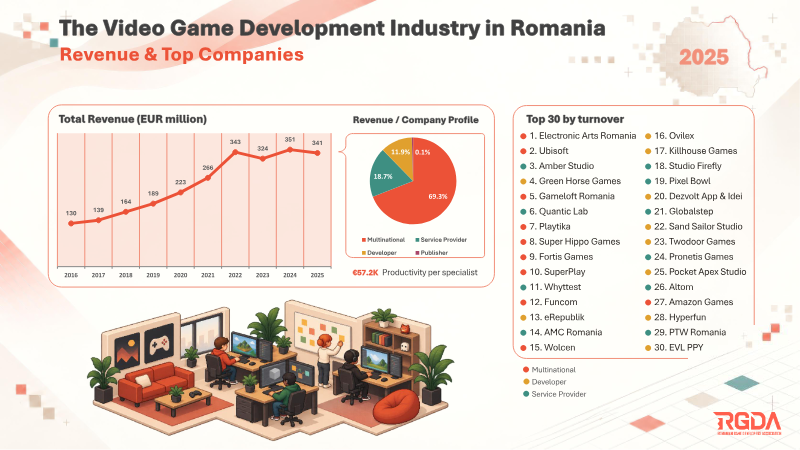
Revenue & Top Companies: Romania 2025
The Romanian video game industry has demonstrated significant resilience and structural evolution, reaching a total revenue of 351 million EUR by 2025. While the sector experienced a post-pandemic contraction that impacted service providers, the market has pivoted toward a surge in creative output. This shift is evidenced by a 2.5-fold increase in game releases over the past two years, signaling a robust expansion within the independent development sector. The industry currently maintains a productivity rate of 57,200 EUR per specialist, supported by a workforce of 6,000 professionals.
Geographically, the industry remains heavily concentrated in major urban hubs, with Bucharest serving as the primary center of operations, hosting 46 percent of all studios. Cluj, Iași, Timiș, and Brașov follow as secondary clusters, collectively accounting for 28 percent of the ecosystem. The current landscape comprises 234 active studios, ranging from multinational corporations to independent developers and service providers. Among the top 30 companies by turnover are major international players such as Electronic Arts Romania, Ubisoft, and Gameloft, alongside a diverse array of specialized local studios.
The industry ecosystem is supported by a domestic player base of 8.6 million individuals. The transition from a service-heavy model to a more balanced mix of development and publishing has fostered a more sustainable environment for local talent. By diversifying its operational focus, the Romanian gaming sector has successfully navigated recent economic pressures, positioning itself as a key European hub for both large-scale multinational production and agile, independent game creation.
- The Romanian video game industry reached a total revenue of 351 million EUR in 2025, supported by a workforce of 6,000 professionals.
- The sector has shifted from a service-heavy model to a balanced mix of development and publishing, resulting in a 2.5-fold increase in game releases over the last two years.
- The industry is comprised of 234 active studios, with major international players like Electronic Arts Romania, Ubisoft, and Gameloft ranking among the top 30 companies by turnover.
- Geographic concentration remains high, with 46 percent of all studios located in Bucharest and an additional 28 percent distributed across Cluj, Iași, Timiș, and Brașov.
- The industry maintains a productivity rate of 57,200 EUR per specialist.
RGDA – Romanian Game Developers Association

Whitepaper38 pages
White Paper on Spanish Videogame Development 2025
The Spanish video game industry stands at a pivotal juncture, characterized by steady growth alongside significant structural vulnerabilities. Comprising 820 studios and employing over 10,500 professionals, the sector generated €1.464 billion in 2024. Despite this output, the industry remains highly consolidated, with 78 percent of total revenue concentrated among a small group of large-scale studios. A pervasive reliance on external financing, affecting 80 percent of companies, underscores the fragility of the current ecosystem, particularly as nearly half of all studios report negative impacts from recent economic instability, including project cancellations and workforce reductions.
To secure long-term viability and global competitiveness, the industry must transition toward a model that prioritizes the retention of intellectual property and the scaling of mid-sized enterprises. Strategic objectives include quadrupling annual turnover and doubling high-quality employment through a framework of five core pillars. These initiatives emphasize the necessity of robust tax incentives, expanded public funding, and the cultivation of a national investment ecosystem. Furthermore, while generative artificial intelligence has been adopted by 53 percent of studios, the lack of consensus regarding its utility suggests that future growth depends on balanced, responsible technological integration rather than uncritical adoption.
Ultimately, the sector’s evolution requires deeper collaboration between local creators and international platforms to bridge the gap between creative potential and financial sustainability. By fostering stronger ties between academic institutions, professional organizations, and independent developers, the industry aims to solidify its position within the global market. The path forward necessitates a coordinated policy approach that mitigates economic risks while providing the capital and infrastructure required to transform Spain into a premier hub for high-value digital entertainment production.
- The Spanish video game industry generated €1.464 billion in 2024 across 820 studios, but 78 percent of this revenue is concentrated within a small group of large-scale companies.
- Eighty percent of studios rely on external financing, leaving the sector vulnerable to economic instability, which has already caused project cancellations and workforce reductions for nearly half of all firms.
- The industry employs over 10,500 professionals and has set strategic goals to quadruple annual turnover and double high-quality employment through improved tax incentives and public funding.
- While 53 percent of Spanish studios have adopted generative artificial intelligence, there is no industry consensus on its utility, signaling a need for cautious and balanced technological integration.
- Long-term viability depends on transitioning toward a model that prioritizes the retention of intellectual property and the scaling of mid-sized enterprises.
+1
Asociación Española de Empresas Productoras y Desarrolladoras de Videojuegos

Report87 pages
Libro Blanco del Desarrollo Español de Videojuegos 2025
The Spanish video game industry stands at a critical juncture, characterized by resilience and creative output despite a global climate of economic instability. As of 2024, the sector generated €1,464 million in turnover and sustained over 10,500 direct jobs, with Catalonia and Madrid serving as the primary hubs for development. While the industry maintains a stable core—with 72% of studios operating for over five years—it faces a notable slowdown in growth. Currently, 820 active studios operate within the country, yet approximately 200 of these entities remain at risk of closure due to project cancellations and workforce reductions, reflecting a broader vulnerability to international market volatility.
Structural challenges persist, particularly regarding the industry's reliance on self-financing and self-publishing models. Most studios operate on a small scale, often managing only one project at a time, which complicates the transition toward complex "games as a service" models. While 53% of companies have begun integrating generative artificial intelligence into their workflows, adoption remains cautious and technically experimental. Furthermore, the industry continues to depend heavily on international sales, which account for 52% of revenue, highlighting a need for stronger domestic investment ecosystems and more robust collaboration with international platforms to retain intellectual property within Spain.
To ensure long-term competitiveness, the sector requires a strategic shift toward institutional support. Key priorities include the implementation of targeted tax incentives, the consolidation of public funding, and improved professional training programs to address the persistent shortage of experienced talent in programming and design. By fostering a more sustainable financial environment and bridging the gap between small-scale production and global market demands, the industry aims to transition from a fragmented landscape of small studios to a more scalable, technologically advanced, and strategically recognized pillar of the Spanish economy.
- The Spanish video game industry generated €1,464 million in turnover and supports over 10,500 direct jobs, with Catalonia and Madrid acting as the primary development hubs.
- Approximately 200 of the 820 active studios are currently at risk of closure due to project cancellations and workforce reductions, signaling significant vulnerability to international market volatility.
- While 72% of studios have been operational for over five years, the industry faces a growth slowdown and a structural reliance on self-financing and single-project development models.
- International sales account for 52% of total revenue, underscoring a critical need for stronger domestic investment and strategies to retain intellectual property within Spain.
- 53% of Spanish studios have begun integrating generative artificial intelligence into their workflows, though current adoption remains in an experimental and cautious phase.
+2
Asociación Española de Empresas Productoras y Desarrolladoras de Videojuegos

Report38 pages
Libro Blanco del Desarrollo Español de Videojuegos 2025
The Spanish video game industry serves as a critical engine for national innovation, currently comprising 820 studios that generate 1,464 million euros in annual revenue and employ over 10,500 professionals. Despite this robust footprint, the sector faces a period of significant volatility, with nearly half of all studios reporting negative impacts from the current economic climate, including project cancellations and workforce reductions. While the industry remains characterized by a highly educated, young workforce and a strong specialization in PC development via the Unity engine, the reliance on internal self-financing remains a structural vulnerability that hinders the scaling of larger, more sustainable AAA projects.
Human talent remains the primary driver of the industry, even as the integration of generative artificial intelligence becomes more prevalent. Although 53 percent of studios have adopted AI tools, widespread skepticism regarding their reliability persists, reinforcing the necessity of human expertise in programming and design. The industry is currently navigating a transition where the ease of hiring has improved, yet the demand for experienced, specialized talent remains unmet. To address these challenges, the sector is prioritizing the retention of intellectual property and economic value within Spain, aiming to shift away from a reliance on international operators toward a more self-sustaining national ecosystem.
Strategic efforts are now focused on securing legislative recognition to integrate game development into national audiovisual tax incentive programs. By fostering a coalition of developers, technology partners, and academic institutions, the industry is implementing a roadmap through 2026 that emphasizes international promotion and professional networking. These initiatives are designed to mitigate the current crisis by expanding public funding and creating a more favorable investment climate, ultimately ensuring that the Spanish gaming sector can compete effectively on the global stage while maintaining its long-term economic viability.
- The Spanish video game industry comprises 820 studios generating 1,464 million euros in annual revenue and employing over 10,500 professionals.
- Nearly 50% of studios report negative economic impacts, including project cancellations and workforce reductions, highlighting a vulnerability caused by a reliance on internal self-financing.
- The industry is lobbying for legislative changes to integrate game development into national audiovisual tax incentive programs to improve investment and long-term sustainability.
- While 53% of studios have adopted generative AI, widespread skepticism regarding tool reliability maintains a strong reliance on human expertise in programming and design.
- The sector is executing a strategic roadmap through 2026 focused on international promotion, professional networking, and retaining intellectual property within Spain.
+2
Asociación Española de Empresas Productoras y Desarrolladoras de Videojuegos
Report72 pages
Cyprus Video Game Industry Report 2025
Cyprus has emerged as the world’s most efficient video game development ecosystem, functioning as a critical hub within the $263.7 billion global gaming market. By 2025, the island’s industry comprised over 400 companies and a workforce exceeding 4,300 employees, contributing approximately €1.15 billion directly to the national GDP. This rapid expansion, which saw the number of firms more than double between 2019 and 2024, is underpinned by a mobile-first strategy, a favorable IP Box tax regime, and a high concentration of mobile game installs per capita. Despite its small population, Cyprus ranks third globally in mobile downloads and eleventh in mobile in-app revenue, reflecting a mature, export-oriented sector.
The ecosystem’s financial health is characterized by significant capital activity, including €2.76 billion in M&A and €137 million in equity funding between 2020 and 2025. A unique feature of this landscape is the prevalence of user-acquisition financing, which provided €128.3 million in non-dilutive capital in 2025, allowing studios to maintain agility. Furthermore, Cyprus-based developers are at the forefront of the industry-wide shift toward direct-to-consumer (D2C) sales models. By bypassing traditional platform fees and securing direct access to player data, these studios have gained a distinct competitive advantage in an increasingly saturated global market that now prioritizes profitability and player relationship management over rapid, unchecked expansion.
Despite these successes, the industry faces structural challenges regarding long-term sustainability. While the tax framework is highly competitive for established studios, there is a notable deficit in dedicated early-stage grants and seed funding for startups. Additionally, the talent pipeline remains a bottleneck; although the nation hosts a large student population, the annual output of graduates specifically trained for game development is insufficient to meet current demand. Future growth will depend on closing these funding and educational gaps, as exemplified by upcoming initiatives like the 2026 Plug&Play accelerator, which aim to solidify Cyprus’s position as a premier global gaming destination.
- By 2025, Cyprus's video game industry became a critical global hub, comprising over 400 companies and 4,300 employees, contributing approximately €1.15 billion directly to the national GDP.
- The industry's rapid expansion, with firms more than doubling between 2019 and 2024, is driven by a mobile-first strategy, a favorable IP Box tax regime, and high mobile game installs per capita.
- Cyprus ranks third globally in mobile downloads and eleventh in mobile in-app revenue, reflecting a mature, export-oriented sector.
- The ecosystem's financial health is strong, with €2.76 billion in M&A and €137 million in equity funding between 2020 and 2025, alongside €128.3 million in user-acquisition financing in 2025.
- Cyprus-based developers are leading the shift to direct-to-consumer (D2C) sales models, gaining competitive advantage by bypassing platform fees and accessing player data.
+1
Cyprus Game Makers Association
Report33 pages
Annual Report of the German Games Industry 2023
The German games industry demonstrated remarkable resilience throughout 2022, maintaining a stable market valuation of 9.87 billion euros despite global economic headwinds, inflationary pressures, and hardware supply constraints. This performance represents a 1% growth rate, bucking international trends of market decline. The sector’s expansion is further evidenced by a 15.5% increase in the number of companies and a 7% rise in the workforce over the past year. Mobile gaming continues to dominate revenue streams, while digital distribution has solidified its position as the primary purchasing method for PC users and younger demographics.
Despite this growth, the industry faces structural challenges that threaten its long-term international competitiveness. A critical shortage of skilled labor in programming, technical art, and production persists, exacerbated by bureaucratic hurdles that impede the recruitment of international talent. Furthermore, the intermittent availability of federal funding has created an environment of instability, hindering strategic planning. To address these issues, the industry is advocating for a transition toward tax-based incentives, improved educational standards, and the establishment of specialized academic institutions to foster domestic expertise.
Beyond economic metrics, the sector is increasingly focused on professionalizing its ecosystem and enhancing its global footprint. Events such as Gamescom and the devcom Developer Conference have reinforced Germany’s status as a central hub for digital innovation, attracting significant international attention and political engagement. Simultaneously, the industry is prioritizing sustainability through climate-neutral initiatives and strengthening youth protection frameworks to ensure a safe gaming environment. By aligning advocacy efforts with a commitment to diversity and educational outreach, the German games sector aims to secure its position as a leading global player in the digital economy.
- The German games market remained resilient in 2022 with a valuation of 9.87 billion euros, achieving 1% growth despite global economic pressures.
- The industry saw significant structural expansion, marked by a 15.5% increase in the number of companies and a 7% rise in the total workforce.
- Mobile gaming remains the primary revenue driver, while digital distribution has become the standard purchasing method for PC users and younger demographics.
- A persistent shortage of skilled labor in programming, technical art, and production is currently hindering the industry's long-term international competitiveness.
- Industry advocates are pushing for a shift from intermittent federal funding to a more stable system of tax-based incentives to improve strategic planning.
+1
game – Verband der deutschen Games-Branche e. V.

Whitepaper24 pages
A Deep Dive into Deep Links: The All-in-One Handbook for Mobile App Marketers, Developers, and Product Managers
Deep linking serves as a foundational strategy for mobile growth, functioning as a critical mechanism to bridge the gap between web and app environments. By directing users to specific in-app content rather than generic landing pages, this approach effectively minimizes friction throughout the user funnel. The primary thesis posits that a robust, standardized linking infrastructure is essential for modern mobile marketing, as it directly correlates with higher activation, improved retention rates, and more precise attribution across diverse digital touchpoints.
The current landscape of mobile marketing faces significant technical fragmentation, exacerbated by the recent deprecation of legacy services like Google’s Firebase Dynamic Links. To address these challenges, centralized solutions such as Adjust’s TrueLink provide a scalable framework for managing direct, deferred, and contextual links. These tools enable automated link generation and sophisticated cross-platform routing, ensuring that user journeys remain uninterrupted whether they originate on mobile, desktop, or connected television environments. By standardizing these interactions, organizations can maintain consistent performance and data integrity across the entire ecosystem.
These strategies are particularly impactful within high-growth verticals such as e-commerce, gaming, and finance, where the quality of the initial user experience dictates long-term engagement. Data indicates that implementing comprehensive linking platforms not only streamlines the transition for brands migrating from deprecated services but also enhances the granular measurement capabilities required for data-driven decision-making. Ultimately, the integration of a unified linking architecture is a prerequisite for scaling app growth, as it transforms fragmented traffic sources into cohesive, high-converting user experiences that support sustained business objectives.
- Deep linking significantly improves app performance, with CleverTap data showing that users attributed to deep links achieve 81% higher activation rates, 2.5x higher retention rates, and 2x higher conversion rates compared to those using standard links.
- Deep linking technology functions by routing users directly to specific in-app content or screens upon clicking an ad or link, utilizing standards such as Apple Universal Links, Android App Links, and URI schemes.
- Deferred deep linking drives user acquisition by directing individuals who have not yet installed the app to the appropriate app store landing page, thereby reducing friction in the installation process.
- Modern deep linking solutions like Adjust's TrueLink provide comprehensive management features, including branded short links, localized landing pages in 11 languages, and automated UTM tag translation for unified campaign measurement.
- Deep linking supports diverse marketing use cases across verticals, such as enabling level-specific gaming campaigns, offline-to-app transitions via QR codes, and personalized re-engagement through push notifications.
+2
Adjust

Report98 pages
La Industria del Videojuego en España: Anuario 2025
The Spanish video game industry in 2025 stands as a vital cultural and technological pillar, characterized by a maturing ecosystem that balances robust consumer engagement with complex economic and regulatory challenges. With a player base of 22.8 million individuals—spanning demographics up to 75 years of age—the sector generated 2.293 billion euros in revenue. While this represents a 3.2% decline compared to the previous year, largely attributed to a contraction in digital content spending, the market remains dominated by digital sales, which account for 61.9% of total revenue. Mobile devices lead platform preference with 18 million users, followed by consoles and PC, with an average weekly playtime of over eight hours.
Strategic growth is currently driven by international expansion, the integration of specialized academic training, and a focus on niche-oriented development. Initiatives such as the DEVIUM platform and collaborations between global publishers and local studios underscore a commitment to professionalizing the workforce and bridging the gap between emerging talent and industry requirements. Furthermore, the sector is actively navigating the ethical and legal implications of generative artificial intelligence, emphasizing the necessity of human-in-the-loop protocols to protect intellectual property and maintain the long-term capital value of creative assets.
Beyond economic metrics, the industry is prioritizing social responsibility and digital literacy. Through programs like The Good Gamer and PlayEquall, stakeholders are promoting inclusive gaming environments, accessibility, and the integration of video games into educational frameworks. As the sector faces an increasingly stringent European regulatory landscape regarding monetization and child protection, it continues to advocate for institutional support modeled after successful international frameworks, such as those in the United Kingdom and South Korea. By leveraging standardized data analytics and fostering public-private partnerships, the Spanish industry aims to solidify its position as a strategic, sustainable, and innovative contributor to the national economy.
- The Spanish video game industry generated 2.293 billion euros in 2025, a 3.2% year-over-year decline driven by a contraction in digital content spending.
- Digital sales remain the primary revenue driver, accounting for 61.9% of total market income.
- The sector serves a player base of 22.8 million people, with mobile devices being the most popular platform, reaching 18 million users.
- Average weekly playtime across the Spanish market exceeds eight hours, with a demographic reach extending up to 75 years of age.
- Industry stakeholders are prioritizing the implementation of human-in-the-loop protocols for generative AI to protect intellectual property and creative asset value.
+1
AEVI
Report104 pages
State of the Polish Video Game Industry: 2017
The Polish video game industry has matured into a globally recognized sector, characterized by a robust ecosystem of over 300 studios and a growing presence on the Warsaw Stock Exchange. While the industry experienced a temporary revenue dip in 2016 following a record-breaking 2015, it remains a vital component of the national economy, supported by institutional initiatives like the GameINN program. The sector’s primary thesis centers on its successful transition from a local market to a global powerhouse, driven by high-profile AAA titles and a burgeoning mobile development scene that increasingly targets international audiences.
Market dynamics within Poland reflect broader global trends, including a decisive shift toward digital distribution and the dominance of mobile platforms, which now account for nearly half of the domestic market value. While physical media remains resilient due to console adoption, consumer behavior is evolving toward Free-to-Play models and microtransactions. Despite this growth, the industry faces structural challenges, including a significant talent shortage for specialized roles like programming and design, as well as bureaucratic hurdles and complex tax laws. Employers report that recent university graduates often lack the practical skills required for immediate integration, forcing firms to seek foreign talent despite logistical difficulties.
Looking ahead, the industry is navigating the experimental stages of VR and AR while solidifying its status as a hub for eSports. Although Polish developers are increasingly competitive, they must contend with stiff international pressure from German and Asian firms. To sustain long-term growth, the sector is prioritizing "Games as a Service" models to mitigate piracy and enhance player engagement. Ultimately, the industry’s trajectory is defined by a move toward professionalization, where success is increasingly contingent upon effective brand management, international partnerships, and the ability to overcome domestic infrastructure and payment-trust limitations.
- The Polish video game industry comprises over 300 studios and has successfully transitioned from a local market to a global powerhouse driven by AAA titles and international mobile development.
- Mobile platforms now account for nearly half of the domestic market value, reflecting a broader consumer shift toward digital distribution, Free-to-Play models, and microtransactions.
- The sector faces a critical talent shortage for specialized programming and design roles, as university graduates often lack the practical skills required for immediate industry integration.
- Institutional support, such as the GameINN program, remains a vital component for the industry, which maintains a significant presence on the Warsaw Stock Exchange despite a revenue dip in 2016 following a record 2015.
- To ensure long-term growth and combat piracy, developers are increasingly prioritizing 'Games as a Service' models to enhance player engagement.
+1
Polish Games Association
Report1 pages
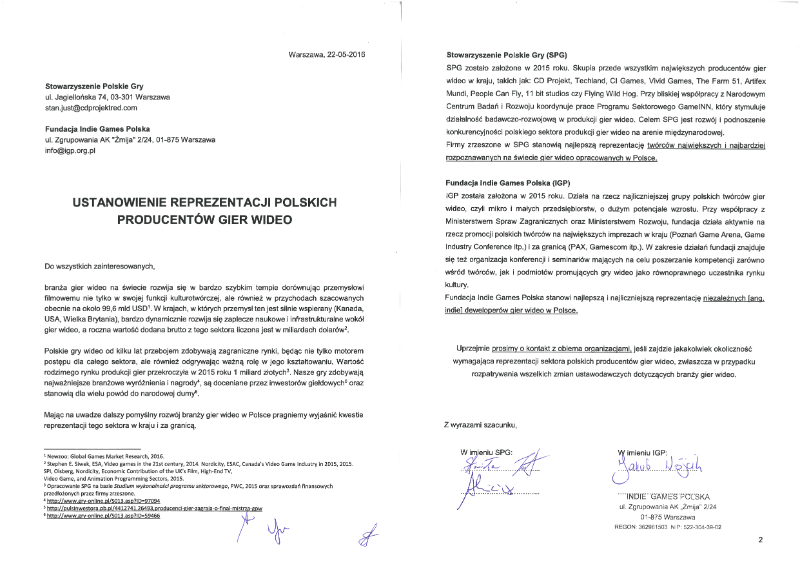
Stowarzyszenie Polskie Gry: Member Overview
The Polish video game industry is represented by two primary organizations established in 2015: Stowarzyszenie Polskie Gry (SPG) and Fundacja Indie Games Polska (IGP). SPG focuses on the country’s largest developers, such as CD Projekt, Techland, and 11 bit studios, aiming to enhance the international competitiveness of the sector through research and development initiatives like the GameINN program. Conversely, IGP serves as the representative body for micro and small independent developers, focusing on promotional activities, industry networking, and professional development through conferences and seminars.
The sector has experienced significant growth, with the value of domestic game production exceeding 1 billion PLN in 2015. This expansion mirrors global trends, where the video game market has reached an estimated value of 99.6 billion USD, rivaling the film industry in both cultural impact and economic contribution. Countries that provide robust institutional support, such as Canada, the United States, and the United Kingdom, have successfully leveraged this industry to foster scientific and infrastructural development, resulting in billions of dollars in annual gross value added.
These organizations collectively advocate for the interests of Polish game developers, particularly regarding legislative changes and the need for a unified voice in national and international forums. By bridging the gap between large-scale commercial studios and independent creators, these entities seek to sustain the momentum of a sector that has become a source of national pride, attracting significant investor interest and earning prestigious global accolades. The collaborative efforts of SPG and IGP are intended to ensure the continued professionalization and strategic growth of the Polish gaming ecosystem.
- The Polish video game industry is supported by two primary organizations established in 2015: Stowarzyszenie Polskie Gry (SPG), representing major studios like CD Projekt, Techland, and 11 bit studios, and Fundacja Indie Games Polska (IGP), which supports micro and small independent developers.
- Domestic game production in Poland exceeded 1 billion PLN in value as of 2015.
- The global video game market has reached an estimated value of 99.6 billion USD, positioning it as a significant economic and cultural rival to the film industry.
- SPG focuses on enhancing international competitiveness through R&D initiatives such as the GameINN program, while IGP prioritizes networking, professional development, and promotional activities.
- Institutional support models from countries like Canada, the US, and the UK serve as benchmarks for Poland to leverage the gaming sector for scientific and infrastructural development.
Stowarzyszenie Polskie Gry

Report6 pages
The Alumni Effect: Studios Founded by Ex-Activision, Blizzard, and King Employees
The analysis examines venture capital activity directed toward studios founded by former Activision Blizzard employees between 2020 and 2024. It identifies 30 such startups that secured a total of approximately $0.7 billion across 45 VC‑led funding rounds, compared with 27 alumni studios from Riot Games that raised $0.5 billion in 38 rounds. Funding is concentrated in early‑stage rounds, with an average check size of $15.8 million for ex‑Activision studios versus $13.1 million for ex‑Riot ventures, and a notable skew toward PC & console and multiplatform projects. Web3 gaming represents a smaller share of the portfolio.
The study highlights a “first‑round momentum” effect: ex‑Activision studios are roughly twice as likely to secure a second round of financing within the same calendar year as other VC‑backed gaming startups. In 2021, 43 % of ex‑Activision studios raised a subsequent round versus only 9 % of peers; by 2023 the gap narrowed to 33 % versus 8 %. This pattern suggests stronger investor confidence in alumni teams during the 2021‑2022 peak.
Key investors include gaming‑focused funds such as GRIFFIN, PARTNERS COLLECTIVE, and SSSU, which together accounted for more than half of the capital deployed. Notable portfolio companies include Mythical Games (Series C, $262 million), Second Enap (Series B, $100 million), and TheoryCraft (Series A, $87.5 million). While many projects remain in development, releases such as Marvel Snap and Stormgate demonstrate commercial viability, whereas titles like Lightforge’s Project O.R.C.S. were shut down due to lack of traction.
Overall, the report underscores a robust investment climate for studios led by former Activision Blizzard talent, driven by early‑stage funding success and a higher likelihood of follow‑on rounds compared to broader gaming startup cohorts.
- Between 2020 and 2024, 30 studios founded by former Activision Blizzard employees secured approximately $0.7 billion in venture capital across 45 funding rounds.
- Ex-Activision studios demonstrate a 'first-round momentum' effect, being roughly four times more likely than peer startups to secure a second round of financing within the same calendar year.
- Investor confidence in alumni teams peaked in 2021, when 43% of ex-Activision studios raised a subsequent round compared to only 9% of broader gaming startups.
- Funding for ex-Activision alumni is primarily concentrated in early-stage rounds for PC, console, and multiplatform projects, with an average check size of $15.8 million.
- GRIFFIN, PARTNERS COLLECTIVE, and SSSU are the primary investors in this sector, collectively deploying more than 50% of the total capital.
+2
InvestGame

Report11 pages
Game Data: Building vs Buying
The document evaluates the trade‑offs between building an in‑house data pipeline and purchasing a third‑party solution for game analytics, using GameAnalytics’ PipelineIQ Pro as the primary example. It argues that while custom pipelines offer full control, they demand significant upfront investment in infrastructure, skilled personnel, and ongoing maintenance. The cost of hiring a data team—engineers, scientists, analysts—and cloud services (ingestion, storage, query, visualization) can reach nearly $50 k per month for a mid‑size studio with 5 million MAU, with human capital accounting for 89 % of the expense. In contrast, a vendor‑managed pipeline costs approximately $5.9 k per month, with the same headcount but lower operational overhead; human capital represents 78 % of that budget. The analysis highlights additional benefits of third‑party solutions, such as standardized event schemas, economies of scale in storage, rapid deployment (hours to days versus months), scalability without knowledge silos, and delegated privacy compliance. Methodologically, the comparison uses a hypothetical studio scenario to calculate total cost of ownership (TCO), breaking down monthly allocations into human, storage, query, and visualization costs. Geographic scope is global, with no regional restrictions noted; the time frame covers current market conditions and projected growth. The conclusion favors purchasing a proven pipeline for studios that lack the resources or urgency to build internally, citing lower TCO, faster time‑to‑insight, and reduced risk of technical debt.
- Building an in-house data pipeline for a studio with 5 million MAU costs approximately $50,000 per month, compared to $5,900 per month for a third-party solution like GameAnalytics’ PipelineIQ Pro.
- Human capital is the primary cost driver for both approaches, accounting for 89% of the budget for in-house builds and 78% for vendor-managed pipelines.
- Third-party solutions offer significantly faster deployment timelines, ranging from hours to days, whereas custom in-house pipelines typically require months to implement.
- Purchasing a proven pipeline reduces the risk of technical debt and eliminates knowledge silos that often occur when studios rely on internal engineering teams to maintain custom infrastructure.
- Vendor-managed solutions provide operational advantages including standardized event schemas, economies of scale in storage, and delegated responsibility for privacy compliance.
+1
InvestGame

Report23 pages
Game Analytics 100: The Retention Curve
The analysis demonstrates that player retention in mobile games can be accurately modeled with a power‑law curve, expressed either as \(r(n)=a\,b^n\) or \(r(n)=a\,n^{b}\). By fitting the curve to a limited set of cohort data—typically day‑1, day‑3, and day‑7 retention—analysts can derive the parameters \(a\) (initial retention level) and \(b\) (decay exponent). Excel’s LINEST function on logged values provides a straightforward method for estimating these coefficients, yielding representative curves such as \(r(n)=0.396\,n^{-0.472}\).
Once fitted, the curve serves multiple forecasting purposes. It predicts daily active users for any future day through a recurrence relation that incorporates the retention rate and cumulative DAU. It also enables calculation of player duration by summing \(r(n)\) over time, which feeds directly into lifetime value (LTV) estimates. For instance, with an average revenue per daily active user of \$1.00, the model projects LTV90 around 7.65 and LTV180 near 10.17, illustrating how early retention translates into long‑term monetization.
The methodology extends to benchmarking against industry standards. By comparing a studio’s day‑1, day‑7, day‑30, and day‑90 retention figures to genre‑specific percentiles provided by GameAnalytics, developers can identify performance gaps and prioritize optimization efforts. The approach is applicable across mobile game segments worldwide and covers the entire post‑install period, offering a scalable tool for forecasting, monetization planning, and competitive analysis.
- Mobile game retention follows a predictable power-law curve, modeled as r(n)=an^b, which allows analysts to forecast long-term player behavior using only day-1, day-3, and day-7 cohort data.
- Fitting retention curves enables precise lifetime value (LTV) projections; for example, an average revenue of $1.00 per daily active user results in an LTV90 of 7.65 and an LTV180 of 10.17.
- Analysts can derive the initial retention level (a) and decay exponent (b) by applying the LINEST function to logged cohort values in Excel, yielding representative curves such as r(n)=0.396n^-0.472.
- The retention model facilitates accurate daily active user (DAU) forecasting by applying a recurrence relation to the calculated retention rates and cumulative DAU figures.
- Developers can identify performance gaps by benchmarking their day-1, day-7, day-30, and day-90 retention metrics against genre-specific percentiles provided by GameAnalytics.
+2
East Side Games

Report20 pages
A Shortcut to Your Own Game Insights Platform
The guide presents a turnkey solution for game studios to build an in‑house data pipeline without the high costs of custom engineering. It introduces two core offerings: Player Warehouse, a pre‑aggregated data hub delivered in SQL or Parquet to BigQuery, Redshift, Snowflake, or Spark; and Raw Export, a real‑time JSON stream that preserves all custom event fields for unstructured analysis. The document emphasizes that these services eliminate the need for proprietary SDKs, ETL development, and ongoing infrastructure maintenance, offering a cost‑effective alternative to building a data lake from scratch.
Key findings highlight that Player Warehouse provides daily refreshed event and player‑level tables, enabling analysts to run advanced SQL queries, blend data from mediation or attribution sources, and retain up to one year of historical data. Raw Export supports real‑time analytics, custom dashboards, and long‑term enrichment through AWS S3 or BigQuery exports. The guide cites case studies—such as a VR MMO that leveraged Player Warehouse to boost engagement and a publisher that increased LTV by 50% across 19 titles using Raw Export—illustrating tangible ROI gains.
The scope covers global game studios, with examples from iOS, Android, Steam, and VR platforms. Timeframes referenced include daily updates for Player Warehouse and real‑time streaming for Raw Export, while the data pipeline supports integration with major BI tools (Looker, Power BI, Data Studio) and mediation/attribution services. Methodologically, the platform handles data ingestion via SDKs, normalizes events, and stores them in a cloud warehouse, abstracting SQL handling from end users. The document concludes by positioning GameAnalytics as a privacy‑first, ISO‑27001 and SOC 2 compliant partner that delivers rapid deployment—hours rather than months—for studios seeking scalable, customizable analytics.
- GameAnalytics provides a turnkey data pipeline that eliminates the need for custom ETL development, proprietary SDKs, and ongoing infrastructure maintenance.
- The platform offers two primary data delivery methods: Player Warehouse for daily refreshed, SQL-ready event tables and Raw Export for real-time JSON streaming.
- A publisher utilizing Raw Export achieved a 50% increase in lifetime value (LTV) across 19 titles, while a VR MMO leveraged Player Warehouse to improve player engagement.
- The solution integrates with major BI tools like Looker, Power BI, and Data Studio, and supports data blending from external mediation and attribution sources.
- Player Warehouse supports up to one year of historical data retention and delivers data directly to BigQuery, Redshift, Snowflake, or Spark.
+1
InvestGame

Whitepaper10 pages
Your Data Tracking Plan: A Step-by-Step Guide for GameAnalytics
GameAnalytics presents a structured framework for designing and implementing data tracking within games, emphasizing the creation of a comprehensive tracking plan that aligns analytics teams with development stakeholders. The guide outlines five sequential steps: first, brainstorming core questions about player behavior and business objectives; second, translating those questions into specific events using predefined categories such as Session, Business, Resource, Progression, Error, Ads, and Impression; third, defining dimensions and attributes to contextualize events with user identifiers, device details, and custom fields; fourth, integrating the plan through GameAnalytics SDKs tailored to various platforms; and fifth, maintaining an iterative process that revisits questions and updates events as the game evolves. Key recommendations include limiting custom events to a maximum of 50 unique identifiers, adopting a Category > Sub‑Action framework for clarity, and ensuring rigorous validation to avoid duplicate or misleading data. The document stresses the importance of consistent documentation, ownership assignment, and cross‑functional collaboration to prevent redundant data collection and maintain analytical integrity. By following this step‑by‑step methodology, developers can establish a reliable data pipeline that supports accurate KPI measurement and informed decision‑making throughout the game’s lifecycle.
- Establish a structured tracking plan by aligning business objectives and player behavior questions with seven predefined event categories: Session, Business, Resource, Progression, Error, Ads, and Impression.
- Limit custom events to a maximum of 50 unique identifiers to maintain data integrity and prevent system clutter.
- Adopt a consistent Category > Sub-Action naming framework to ensure clarity and prevent redundant or misleading data collection.
- Contextualize all events by defining specific dimensions and attributes, including user identifiers, device details, and custom fields.
- Assign clear ownership and maintain rigorous validation processes to ensure the analytical pipeline remains accurate throughout the game's lifecycle.
+1
GameAnalytics

Presentation89 pages
Capital Markets Event 2025: Coffee Stain Group
Capital Markets Event 2025 showcases the Coffee Stain Group’s strategy of building a portfolio around small, autonomous teams that prioritize gameplay quality and community engagement. Ninety percent of net sales derive from a handful of flagship titles—most notably Goat Simulator, Deep Rock Galactic and Satisfactory—which consistently achieve high review scores (above 96 %) and generate lifetime sales up to SEK 2 bn. The company’s partnership model, publishing and investing in niche‑focused games, sustains long‑term value through continuous content updates and a symbiotic developer‑player relationship.
The global gaming market is projected to grow at 3 % CAGR across all platforms, driven by rising consumer spend and the expansion of Steam, mobile, Game Pass and PlayStation Plus. Despite saturation and increased competition for player attention, Coffee Stain maintains a strong presence; its titles enjoy high review counts (over 500 k for Goat Simulator) and retain players through regular updates, platform expansions and community‑driven development. Innovation, creative gameplay and long‑term support are core to the firm’s approach.
Strategic collaborations reinforce this model. The partnership with Tuxedo Labs leverages the proprietary Teardown physics engine, producing a highly engaged community (10 000+ mods, 20 major updates) and peak concurrent users of 60 k for Deep Rock Galactic seasons. The studio’s headcount grew from six to 47 FTEs over five years, illustrating the scalability of open development and a “make happy decisions” culture that drives both critical acclaim (e.g., 9.5/10 reviews) and commercial success.
Coffee Stain’s Roblox title, Welcome to Bloxburg, exemplifies a successful free‑to‑play transition. With 791 k daily active users and SEK 1.35 bn in lifetime net sales, the monetization mix of currency purchases, optional unlocks and a premium subscription maintains a non‑pay‑to‑win stance while rebuilding player trust. The company’s lean cost base and strong cash generation are amplified by launch‑driven sales spikes from new content releases and strategic stakes such as its 30 % share in Iron Gate’s Valheim publishing.
Financially, the group reports a net‑sales CAGR of 34 % to SEK 1.2 bn and a cash EBIT margin of 44 %. Cash reserves reach SEK 472 m in 2025, with no external debt, providing flexibility for capital allocation and potential M&A. The lean, autonomous team model underpins low overheads, high cash conversion (≈120 %) and a focus on developing existing IPs while selectively pursuing new opportunities across platforms and partnerships.
- Coffee Stain Group maintains strong financial health with a 34% net-sales CAGR to SEK 1.2 bn, a 44% cash EBIT margin, and 120% cash conversion.
- The company holds SEK 472 m in cash reserves with zero external debt, providing significant flexibility for future M&A and capital allocation.
- Ninety percent of net sales are generated by a core portfolio of flagship titles—Goat Simulator, Deep Rock Galactic, and Satisfactory—which consistently maintain review scores above 96%.
- The Roblox title Welcome to Bloxburg has achieved 791,000 daily active users and SEK 1.35 bn in lifetime net sales following its transition to a free-to-play model.
- Strategic partnerships and investments, such as a 30% stake in Valheim publisher Iron Gate and the collaboration with Tuxedo Labs, serve as key drivers for long-term value and IP expansion.
+3
Coffee Stain Group AB

Report75 pages
Playing for the Planet: Untangling the Carbon Complexities of the Video Gaming Industry
The analysis demonstrates that the video‑gaming sector remains fragmented in its approach to carbon accounting, with only a minority of companies—12 out of 222 surveyed—committed to science‑based targets. This shortfall stems largely from uncertainty around measuring Scope 3 emissions, particularly in categories such as purchased goods and product use. The report underscores a growing industry momentum: the Playing for the Planet Alliance now includes 42 members, and initiatives like the Green Games Guide and Ubisoft’s Climate School illustrate a shift toward embedding climate action within both operations and game content. Concrete progress is evident, for example, the Games Consoles Voluntary Agreement’s 54 TWh energy savings and the documented dominance of Scope 3 categories 1 (purchased goods) and 11 (use of sold products) in studios’ footprints.
Carbon intensity across the supply chain varies markedly by hardware, display technology, and regional electricity mix. Current‑generation consoles draw 150–200 W during gameplay, while PCs can reach 100–300 W; mobile devices consume only a few watts. A high‑end 4K TV can match console power when running HDR, and the carbon intensity of 200 Wh ranges from ≈13 gCO₂e in France to ≈81 gCO₂e in the United States. These disparities highlight opportunities for reducing emissions through hardware efficiency, extended device lifetimes, and the adoption of renewable electricity or green tariffs.
The report calls for consistent, industry‑aligned reporting frameworks—particularly the GHG Protocol Scope 3 categories—and greater granularity by business unit or product. It recommends iterative, data‑quality‑driven methods for estimating Category 1 and 2 emissions, prioritising primary supplier data for high‑spend items while applying spend‑based factors elsewhere. For Category 7 (employee commuting) and Category 11 (use‑phase emissions), detailed calculation examples illustrate the need to account for lifetime usage, regional grid intensity, and potential double‑counting. Real‑time accounting of use‑phase emissions is identified as a critical research gap, with cloud and CDN providers’ inconsistent reporting underscoring the need for standardized data.
Overall, the sector is moving toward greater transparency and actionable climate messaging, yet significant gaps remain in measurement, reporting consistency, and the integration of emerging technologies such as cloud gaming and AI. Addressing these challenges will be essential for credible net‑zero pathways across the global video‑gaming industry.
- Only 12 out of 222 surveyed gaming companies have committed to science-based carbon reduction targets, highlighting a significant industry-wide gap in formal climate accountability.
- Scope 3 emissions—specifically purchased goods (Category 1) and the use of sold products (Category 11)—represent the dominant share of the industry's total carbon footprint.
- Energy consumption during gameplay varies significantly by hardware, with current-generation consoles drawing 150–200W and PCs reaching up to 300W, compared to only a few watts for mobile devices.
- The carbon intensity of gaming is highly dependent on regional electricity grids, with 200Wh of consumption resulting in approximately 13gCO2e in France versus 81gCO2e in the United States.
- The Games Consoles Voluntary Agreement has successfully achieved 54 TWh in energy savings, demonstrating the efficacy of hardware efficiency standards.
Playing for the Planet Alliance

Report12 pages
The Rise and Reset of Sweden's $19B Gaming Capital Machine
The analysis demonstrates that Sweden’s gaming sector has evolved into a $19 billion capital ecosystem, with 1,100 companies and 202 firms engaging in tracked transactions since 2014. Sweden contributes roughly 20 % of Steam’s projected 2025 gross revenue, and its developers produced five of the platform’s global top‑10 bestsellers in 2024–25. Capital flows have shifted from early‑stage seed rounds to late‑stage growth and acquisition deals, reflecting a maturation of the pipeline. Private investment rebounded in 2024 after a pullback; late‑stage rounds now dominate, with Aonic’s $157 million growth round and Arrowhead’s $80 million investment illustrating investor preference for studios with proven commercial traction. Early‑stage deal counts have normalized from 2021’s peak, indicating a steady but active pipeline.
M&A activity peaked in 2021–22, with ESL’s $1.05 billion sale to Savvy marking the cycle’s apex; subsequent deals have become more selective. Three transactions—King ($5.9 billion), Mojang ($2.5 billion), and ESL ($1.05 billion)—account for 93 % of total M&A value, underscoring the premium paid by global acquirers for Sweden’s IP and engineering talent. Public market activity has shifted from equity‑fueled growth to defensive debt financing; Embracer’s $4.4 billion raised through fixed income and PIPE in 2020–22 exemplifies this trend. Capital concentration is high, with the top ten private rounds comprising over $495 million of an $811 million total.
The data, sourced from InvestGame and market‑cap records through December 2025, cover Sweden’s entire gaming industry—mobile, PC & console, VR/AR, esports, and platforms—from 2014 to the present. Methodology includes tracking VC rounds, public offerings, PIPEs, and M&A transactions across all segments. The findings illustrate a resilient ecosystem that has transitioned from early‑stage bootstrapping to mature, high‑value capital flows driven by proven studios and strategic consolidation.
- Sweden’s gaming sector has matured into a $19 billion ecosystem comprising 1,100 companies, with Swedish developers producing five of Steam’s global top-10 bestsellers in 2024–25.
- Swedish studios contribute approximately 20% of Steam’s projected 2025 gross revenue, cementing the country's status as a dominant global gaming hub.
- M&A activity is highly concentrated, with three major deals—King ($5.9 billion), Mojang ($2.5 billion), and ESL ($1.05 billion)—accounting for 93% of the total transaction value.
- Investment trends have shifted toward late-stage growth, evidenced by significant 2024 capital injections such as Aonic’s $157 million round and Arrowhead’s $80 million investment.
- Capital concentration remains high, as the top ten private funding rounds account for $495 million of the $811 million total tracked investment.
+3
InvestGame

Whitepaper41 pages
What Good Are AI NPCs?: Lessons from a Large-scale Player Study
The study demonstrates that generative AI‑driven non‑player characters can deliver deeply engaging, emotionally resonant gameplay. In a 122‑hour experiment with 68 participants, the “Dead Meat” demo achieved high immersion scores—97 % UES reward and 94 % focused attention—while keeping mental demand low (NASA‑TLX scores of 64.7 for demand and 52.7 for performance). Qualitative interviews consistently cited the NPCs’ human‑like dialogue and narrative depth as key contributors to player enjoyment.
Quantitative data confirm widespread satisfaction: 96 % of players rated overall enjoyment as high, and 90 % praised the creative freedom afforded by the open‑ended design. Subscale analysis of the GUESS instrument revealed that 60 % achieved a top score for Creative Freedom, 65 % for Personal Gratification, and 80 % for Play Engrossment. Thematic coding identified freedom of expression, challenge‑driven motivation, and immersive conversation as primary drivers of satisfaction, indicating that the game successfully balances agency with sufficient guidance.
Player behavior analysis uncovered seven distinct strategic approaches—such as “Good Cop/Bad Cop” interrogation, “Rule Bender End Justifies the Means,” and “Smart Arse” manipulation—often combined within a single session. Participants responded equally to voiced and text‑based NPCs, and the 20‑minute session length encouraged replayability through role‑playing different characters. Although the brief duration limited long‑term insight, emergent strategies were viewed as a feature rather than a flaw. Future research will explore how authorial adjustments influence player responses across demographic groups, reinforcing the potential of AI NPCs to enrich narrative gameplay on a broad scale.
- Generative AI NPCs drive high player engagement, with 97% of participants reporting high immersion and 96% rating their overall enjoyment as high.
- The integration of AI NPCs maintains a balance between agency and guidance, as evidenced by 80% of players achieving top scores for play engrossment and 90% praising the creative freedom of the open-ended design.
- Cognitive load remains manageable during AI-driven interactions, with participants reporting NASA-TLX mental demand scores of 64.7 and performance scores of 52.7.
- Players adopt diverse, emergent interaction strategies, including interrogation, manipulation, and rule-bending, which suggests that AI NPCs support complex, role-playing-heavy gameplay.
- Player satisfaction is consistent across communication formats, as participants responded equally well to both voiced and text-based AI NPC interactions.
+2
University of Bristol
Report22 pages
The 2026 State of Web Gaming Report: A Study of Developer and Gamer Perceptions
The study demonstrates that web gaming has evolved from a niche, low‑quality outlet into a central discovery and revenue engine for the industry. Across 2,000 gamers and 400 developers surveyed in 2026, data reveal that 62 % of players discover new titles via the web and 53 % spend more than $50 monthly on games, underscoring a highly engaged, high‑spending audience. Ninety percent of players find games online, yet only 53 % of studios plan to port mobile titles to browsers within a year, highlighting a perception gap between consumer enthusiasm and developer adoption.
Web games thrive in an attention‑saturated media environment because they are short, low‑friction, and can be updated instantly to capture cultural moments. More than half of players listen to music or watch shows while gaming, and 38 % use social media simultaneously, positioning web games as a complementary entertainment layer. Developers cite discoverability (46 %) and gateway potential to other platforms (44 %) as key strengths, while rapid iteration and zero‑install access drive engagement and revenue. Monetisation maturity remains a barrier, yet the medium’s ability to reach players at the top of the purchase funnel is clear.
The data also show that web gaming no longer represents a low‑quality channel; 92 % of players rate HTML5 titles as high quality, and 37 % play multiple times a day. Web platforms drive discovery for 62 % of players, and high‑spending consumers are increasingly found online. Consequently, developers who omit web distribution risk missing a growing, engaged, and monetisable audience that now sits at the forefront of the purchase funnel.
- Web gaming is a significant discovery channel: 62% of web gamers have downloaded or purchased a game after discovering it on the web, and 53% of developers see it as a means to reach new players.
- Web gamers are highly engaged and valuable: 37% play multiple times per day, 86% play at least a few times a week, and 53% spend over $50 on gaming purchases monthly.
- Developers are increasingly embracing web gaming, with 27% planning to port mobile games to browsers in the next 12 months, and 56% agreeing it's a growing channel.
- There's a disconnect between some developer perceptions and reality: 32% of developers believe web gaming is a 'low-quality channel' despite 92% of consumers rating HTML5 web games as 'quite' or 'very' high quality.
- Web gaming offers low-friction access and high convenience, with 71% of respondents reporting stable or increasing web gaming time relative to social media, and 58% playing because games are free.
+1
PokiJun 2026