Tencent
Game Co.34 documents
World's largest gaming company by revenue. Annual and interim reports contain detailed gaming segment data (revenue, DAUs, MAUs).
Documents

Financial28 pages
Tencent Second Quarter 2026 Results Presentation: China
Tencent’s second quarter 2026 results demonstrate sustained financial growth and a strategic pivot toward artificial intelligence integration across its core business segments. The company reported total revenue of 204.8 billion RMB, an 11% increase year-over-year, supported by strong performance in domestic gaming, marketing services, and fintech. Net profit attributable to equity holders reached 68.4 billion RMB on a non-IFRS basis, reflecting a 9% increase compared to the same period in 2025.
The company’s growth is underpinned by its dominant position in the Chinese market, where it maintains leadership in mobile community engagement, digital content, and productivity software. Domestic gaming revenue rose 17% to 47.3 billion RMB, driven by the success of titles such as Delta Force and VALORANT. Simultaneously, marketing services saw a 22% year-over-year revenue increase, bolstered by enhanced ad-targeting capabilities and the expansion of Video Accounts. FinTech and business services also contributed significantly, with cloud revenue growth accelerating due to rising demand for AI-related infrastructure and services.
A central focus of the current strategy is the aggressive deployment of the Hy foundation model and associated AI products, including WorkBuddy, CodeBuddy, and Xiaowei. These initiatives are designed to enhance productivity and user engagement within the existing Tencent ecosystem. While the company has significantly increased capital expenditure—up 176% year-over-year to 52.8 billion RMB—to support AI infrastructure and GPU procurement, management emphasizes that these investments provide a foundation for future monetization and operational efficiency. The company continues to prioritize shareholder returns, executing 14.7 billion RMB in share repurchases and distributing 41.6 billion RMB in cash dividends during the quarter.
- Tencent reported Q2 2026 total revenue of 204.8 billion RMB, an 11% year-over-year increase, with non-IFRS net profit rising 9% to 68.4 billion RMB.
- Capital expenditure surged 176% year-over-year to 52.8 billion RMB, primarily driven by heavy investment in AI infrastructure and GPU procurement.
- Domestic gaming revenue grew 17% to 47.3 billion RMB, fueled by the performance of titles including Delta Force and VALORANT.
- Marketing services revenue increased 22% year-over-year, supported by the expansion of Video Accounts and improved ad-targeting capabilities.
- The company is aggressively deploying its Hy foundation model alongside AI-integrated products such as WorkBuddy, CodeBuddy, and Xiaowei to drive ecosystem productivity.
+1
Tencent
Financial25 pages
Tencent 2026 First Quarter Results Presentation
The first quarter 2026 results for Tencent Holdings Limited demonstrate sustained financial growth and a strategic pivot toward agentic artificial intelligence. Total revenue reached 196.5 billion RMB, representing a 9% year-over-year increase. The company reported a net profit attributable to equity holders of 67.9 billion RMB on a non-IFRS basis, an 11% increase compared to the same period in 2025. These results reflect a stable non-IFRS operating margin of 38.5%, supported by growth across core segments including domestic games, marketing services, and fintech.
The company’s performance was bolstered by a 6% year-over-year increase in domestic game revenue and a 13% rise in international game revenue, driven by titles such as Peacekeeper Elite and VALORANT Mobile. Marketing services saw significant momentum with a 20% year-over-year revenue increase, aided by enhanced ad recommendation models and increased inventory in Video Accounts. Additionally, the fintech and business services segment grew by 9%, with cloud services benefiting from rising demand for AI-related infrastructure and international expansion.
A central focus of the period was the development and deployment of the Hy large language model and associated agentic AI tools, including CodeBuddy and WorkBuddy. These products are being integrated across the company’s ecosystem to drive productivity and user engagement. The company has re-architected its infrastructure to support these AI initiatives, reporting high retention rates among early adopters and a virtuous feedback loop where increased AI usage drives higher token consumption on Tencent Cloud.
The reporting period covers the first quarter of 2026, with financial figures presented in Renminbi and converted to US dollars at an exchange rate of 6.9194. The company maintains a strong liquidity position, reporting 533.7 billion RMB in total cash and a net cash position of 146.9 billion RMB. These results underscore a transition toward AI-centric operations while maintaining leadership in China’s mobile community and digital content markets.
- Tencent reported Q1 2026 total revenue of 196.5 billion RMB, a 9% year-over-year increase, with non-IFRS net profit rising 11% to 67.9 billion RMB.
- The company is strategically pivoting toward agentic AI, deploying the Hy large language model and productivity tools like CodeBuddy and WorkBuddy to drive cloud consumption and ecosystem engagement.
- Gaming performance remained strong with domestic revenue up 6% and international revenue up 13%, bolstered by titles such as Peacekeeper Elite and VALORANT Mobile.
- Marketing services revenue grew 20% year-over-year, driven by improved ad recommendation models and increased inventory within Video Accounts.
- Fintech and business services revenue increased by 9%, supported by rising demand for AI-related infrastructure and international cloud expansion.
+1
Tencent
Financial116 pages
Annual Report 2005
Tencent Holdings reported a robust 2005 performance, with revenue rising 24.7 % to RMB1.426 billion driven by a 79.2 % increase in Internet value‑added services and a 105.9 % jump in online advertising, while mobile‑telecom services declined 19.3 %. Net profit climbed 10 % to RMB485 million, yielding earnings per share of RMB0.274 (basic) and RMB0.267 (diluted). The QQ instant‑messaging platform expanded to over 200 million active users, and new services such as Qzone, QQ Pet, and the MMOG QQ Fantasy contributed to revenue growth. Operating profit margin improved modestly to 33.8 % in Q4, though full‑year operating profit increased only 3.3 % due to higher selling, marketing and general administrative costs.
Financially, the group’s assets grew from RMB2.863 billion to RMB3.427 billion, largely through increases in cash and held‑to‑maturity investments. R&D expenditure surged to RMB162.5 million, while employee‑benefit costs more than doubled to RMB344.5 million. A net tax benefit of RMB48.3 million offset a modest tax expense, reflecting favorable Chinese enterprise income‑tax incentives. The company recorded a foreign‑exchange loss of RMB47 million on U.S. dollar investments, and no dividends were paid to equity holders during the year.
Governance structures remained transparent: a balanced board of five directors, independent audit and remuneration committees, and compliance with Hong Kong listing rules (except for the chairman/CEO dual role). Share‑option schemes were detailed, allowing up to 40.5 million shares post‑IPO with a ten‑year life and board‑determined vesting periods. No material conflicts of interest or significant director‑held contracts were disclosed.
The report covered IFRS adoption, noting minimal impact from revised standards; IAS 39 reclassified certain financial assets to fair value, IFRS 2 introduced share‑based compensation charges, and IAS 38 governed goodwill from acquisitions. Accounting policies for financial instruments, derivatives, inventory, receivables, and employee benefits were outlined, ensuring consistency with IFRS. Overall, Tencent’s 2005 results demonstrate strong growth in core internet services, disciplined financial management, and robust corporate governance within the Chinese market.
- Tencent’s 2005 revenue grew 24.7% to RMB1.426 billion, fueled by a 79.2% surge in Internet value-added services and a 105.9% increase in online advertising, despite a 19.3% decline in mobile-telecom services.
- Net profit rose 10% to RMB485 million, while the QQ instant-messaging platform reached over 200 million active users, supported by the introduction of Qzone, QQ Pet, and the MMOG QQ Fantasy.
- Operating profit growth was constrained to 3.3% for the full year due to rising operational costs, including a more than doubling of employee-benefit expenses to RMB344.5 million and increased R&D spending to RMB162.5 million.
- The company’s total assets increased to RMB3.427 billion, bolstered by higher cash reserves and held-to-maturity investments, while a net tax benefit of RMB48.3 million was realized through Chinese enterprise income-tax incentives.
- Tencent recorded a RMB47 million foreign-exchange loss on U.S. dollar investments and maintained a policy of paying no dividends to equity holders during the 2005 fiscal year.
+2
Tencent
Financial122 pages
Tencent Holdings Limited Annual Report 2006
Tencent Holdings Limited’s 2006 annual report demonstrates a dramatic expansion of its internet‑based business, with total revenues rising 96.3 % to RMB 2,800 million and net profit increasing 119 % to RMB 1.06 billion. Growth is driven primarily by a 132 % increase in Internet value‑added services and a 136 % jump in online advertising, while mobile/telecom services also contributed significantly. Operating profit surged to RMB 1.16 billion, and the net margin improved from 34 % to 38 %. Cash and investments totaled RMB 3.22 billion, largely in U.S. dollar‑denominated assets that expose the group to Renminbi appreciation risk.
The company’s financial health is reinforced by a strong balance sheet: total assets rose to RMB 1.77 billion, and the group maintained no interest‑bearing borrowings as of year‑end. Shareholder value initiatives included a final dividend of HKD 0.12 per share, the repurchase and cancellation of 18.4 million shares during 2006, and a cumulative share buyback of over 32 million shares since its IPO. Governance structures feature a board with executive, non‑executive and independent directors, audit and remuneration committees, and compliance with Hong Kong listing rules. Key executives hold significant share positions through BVI entities, while Naspers‑controlled MIH QQ holds 35.6 % of issued shares.
Geographically, operations are concentrated in mainland China (≈70 % of segment assets), with subsidiaries and customers spread across Asia, Africa, and the Mediterranean under Naspers’ umbrella. The report covers fiscal year 2006, detailing revenue streams from internet services, mobile telecoms, and online advertising, and outlines accounting policies such as IAS 39 adoption, fair‑value measurement for available‑for‑sale securities, and share‑based compensation recognition. Overall, Tencent’s 2006 performance reflects rapid scaling of core digital services, robust profitability, and a commitment to shareholder returns within a growing but still low‑penetration Chinese internet market.
- Tencent experienced rapid financial growth in 2006, with total revenues rising 96.3% to RMB 2,800 million and net profit increasing 119% to RMB 1.06 billion.
- Revenue expansion was primarily driven by a 132% increase in Internet value-added services and a 136% surge in online advertising.
- The company maintained a strong financial position with no interest-bearing borrowings and a net profit margin that improved from 34% to 38%.
- Tencent prioritized shareholder returns in 2006 by issuing a final dividend of HKD 0.12 per share and repurchasing 18.4 million shares.
- MIH QQ, controlled by Naspers, remained the largest shareholder with a 35.6% stake in the company.
+2
Tencent

Financial170 pages
2008 Annual Report
Tencent Holdings Limited delivered a landmark year in 2008, with total revenues surging 87 % to RMB 7.15 billion and operating profit more than doubling to RMB 3.25 billion, reflecting a 45 % operating margin. Growth was concentrated in Internet value‑added services (95 % rise) and mobile/telecom services (73 % increase), while online advertising also expanded 68 %. The instant‑messaging platform QQ grew to 376.6 million active users, and portal traffic peaked during high‑profile events such as the Beijing Olympics. Despite a global financial downturn that pressured ad spend, Tencent’s diversified platform model and robust user base insulated it from broader market volatility.
Profit attributable to equity holders rose 78 % to RMB 2.78 billion, supported by a strong cash position of RMB 5.13 billion and no interest‑bearing debt. Capital expenditures climbed to RMB 1.45 billion, and the company repurchased 9.22 million shares to enhance shareholder value. Share‑based compensation and dividend payouts increased equity outflows, yet the company maintained a healthy liquidity profile with cash equivalents of RMB 3.06 billion and minimal credit exposure.
Governance structures remained solid, with a balanced board of executive, non‑executive and independent directors overseeing strategy, audit and remuneration committees. Internal controls aligned with COSO principles passed review without material discrepancies, and the audit committee maintained independence from external auditors. The company adhered to IFRS updates, with no significant changes anticipated for 2008, and prepared for forthcoming standards.
Overall, Tencent’s 2008 performance underscored its dominant position in China’s internet and mobile services market, delivering robust revenue growth, profitability, and shareholder returns amid a challenging macroeconomic backdrop.
- Tencent achieved significant financial growth in 2008, with total revenue rising 87% to RMB 7.15 billion and operating profit increasing by over 100% to RMB 3.25 billion.
- The company maintained a 45% operating margin and a profit attributable to equity holders of RMB 2.78 billion, a 78% increase over the previous year.
- Growth was driven by a 95% surge in Internet value-added services, a 73% increase in mobile/telecom services, and a 68% expansion in online advertising.
- The QQ instant-messaging platform reached 376.6 million active users, providing a stable user base that insulated the company from the global financial downturn.
- Tencent ended 2008 with a strong balance sheet featuring RMB 5.13 billion in cash, no interest-bearing debt, and RMB 3.06 billion in cash equivalents.
Tencent
Financial193 pages
Annual Report 2010: Tencent Holdings Limited
Tencent Holdings Limited delivered a robust fiscal year in 2010, reporting consolidated revenue of RMB 19.65 billion—an increase of nearly 58% over 2009—and net profit attributable to equity holders of RMB 8.05 billion, up 56% year‑on‑year. Growth was driven primarily by the online gaming segment, which generated RMB 15.48 billion in revenue (up 62%) and by a rapidly expanding user base, with instant‑messaging accounts reaching 647.6 million and Qzone users at 492 million. Mobile services, value‑added telecom offerings, and advertising also contributed to the revenue mix, while operating margins improved to 50% of earnings.
Liquidity and capital structure remained strong. Total financial resources rose to RMB 22.1 billion, with cash and equivalents at RMB 10.4 billion and net financial resources of RMB 17.8 billion after short‑term borrowings. Capital expenditures doubled to RMB 2.01 billion, reflecting investment in infrastructure and new platforms. Share‑based compensation was significant; the company granted 4.85 million award shares in 2010, with no director awards, and maintained a share‑option pool of roughly 43 million shares. Governance structures were reinforced through independent remuneration, audit, and investment committees, and the board maintained a majority of non‑executive directors.
Financial risk exposure was dominated by foreign‑exchange and interest‑rate sensitivities, with a 5 % currency swing estimated to affect profit by RMB 83 million. The gearing ratio increased from 30% to 39%, driven largely by bank borrowings, while fair‑value assets—primarily equity securities—remained level 2 instruments. Overall, Tencent’s 2010 performance underscored its ability to scale user engagement and diversify revenue streams while maintaining solid liquidity, disciplined capital allocation, and robust governance practices.
- Tencent reported 2010 consolidated revenue of RMB 19.65 billion, a 58% increase over 2009, with net profit rising 56% to RMB 8.05 billion.
- Online gaming served as the primary growth engine, generating RMB 15.48 billion in revenue, representing a 62% year-on-year increase.
- User engagement scaled significantly, with instant-messaging accounts reaching 647.6 million and Qzone users totaling 492 million.
- The company maintained strong liquidity with RMB 22.1 billion in total financial resources, including RMB 10.4 billion in cash and equivalents.
- Capital expenditures doubled to RMB 2.01 billion in 2010, reflecting strategic investments in infrastructure and new platform development.
+1
Tencent
Financial274 pages
Annual Report 2019: Tencent Holdings Limited
Tencent Holdings Limited delivered a strong 2019 performance, reporting revenue of RMB 377.3 billion and net profit attributable to equity holders of RMB 93.3 billion, reflecting 20 % and 19 % year‑over‑year growth respectively. The group’s core digital ecosystem—encompassing WeChat, online gaming, and value‑added services—continued to expand, with monthly active users reaching 1.16 billion and subscription revenue rising to RMB 180 million. FinTech and Cloud segments accounted for 27 % of total revenue, up 39 %, driven by a billion‑transaction daily average in mobile payments and cloud revenues surpassing RMB 17 billion. Operating profit surged 52 % to RMB 28.6 billion in Q4, while gross margin improved to 56 %. Adjusted EBITDA rose to RMB 147.4 billion, and free cash flow for the quarter reached RMB 37.9 billion.
Governance structures remained robust, with a nine‑member board comprising executive, non‑executive and independent directors supported by five committees overseeing audit, risk, investment, nomination and remuneration. Share‑option programmes granted over 112 million options to directors, employees and consultants, with a weighted average fair value of USD 6.00 per share. The company maintained strong liquidity, with cash and short‑term deposits totaling RMB 65.9 billion and a debt‑to‑EBITDA ratio of 1.50, while long‑term borrowings increased modestly to RMB 109.9 billion.
ESG initiatives highlighted energy‑efficient data centres, a 1.26–1.52 PUE average and significant coal‑consumption reductions, alongside employee welfare programmes that earned consecutive best‑employer awards. The company also intensified anti‑fraud, privacy and supplier governance measures, deploying a 400 GB anti‑DDoS platform and expanding its Healthy Gameplay System. Overall, Tencent’s 2019 results demonstrate continued revenue diversification, disciplined capital allocation and a commitment to sustainable, compliant growth across its global operations.
- Tencent reported strong 2019 financial growth with RMB 377.3 billion in revenue and RMB 93.3 billion in net profit, representing year-over-year increases of 20% and 19% respectively.
- The FinTech and Cloud segments emerged as major growth drivers, accounting for 27% of total revenue with a 39% year-over-year increase and cloud revenues exceeding RMB 17 billion.
- Tencent’s core digital ecosystem, anchored by WeChat and online gaming, reached 1.16 billion monthly active users and generated RMB 180 million in subscription revenue.
- Profitability improved significantly in Q4 2019, with operating profit surging 52% to RMB 28.6 billion and gross margin reaching 56%.
- The company maintained a stable financial position with RMB 65.9 billion in cash and short-term deposits, a debt-to-EBITDA ratio of 1.50, and long-term borrowings of RMB 109.9 billion.
+1
Tencent
Financial61 pages
Interim Report 2005
Tencent demonstrated robust financial health and operational expansion during the first half of 2005, characterized by a strategic pivot toward Internet value-added services. Total revenues reached RMB 634.1 million, representing a 20.1% year-over-year increase, while net profit for the period climbed to RMB 283.9 million. This profitability was bolstered by a significant one-time deferred tax credit of RMB 88.6 million and a 92.8% quarter-over-quarter profit surge in the second quarter. These gains effectively offset a decline in mobile and telecommunications value-added services, which faced headwinds from regulatory shifts and billing adjustments.
The company’s growth was underpinned by massive user engagement, with registered instant messaging accounts reaching 438.4 million and peak simultaneous online users hitting 16.2 million. To support this scale, the organization doubled its workforce to 1,648 employees, leading to a corresponding doubling of remuneration costs to RMB 134 million. Increased investments in research and development and new product launches remained central to the company’s strategy, even as operating expenses rose. The financial reporting for this period marked a transition to International Financial Reporting Standards, specifically adopting IFRS 2 to account for share-based compensation via the Black-Scholes model.
Geographically focused on the Chinese market, the company navigated a changing macroeconomic landscape, including the decoupling of the RMB from the USD in July 2005, which introduced new foreign exchange risks. Corporate governance remained stable, with MIH QQ (BVI) Limited maintaining its position as the largest shareholder. Although the company deviated from standard governance practices by unifying the Chairman and CEO roles, the board maintained that this structure was essential for maintaining agility and operational stability within the rapidly evolving information technology sector.
- Tencent reported RMB 634.1 million in total revenue for the first half of 2005, a 20.1% year-over-year increase, with a net profit of RMB 283.9 million bolstered by an RMB 88.6 million one-time deferred tax credit.
- The company experienced a 92.8% quarter-over-quarter profit surge in the second quarter, which helped offset revenue declines in mobile and telecommunications value-added services caused by regulatory shifts.
- User engagement reached massive scale with 438.4 million registered instant messaging accounts and 16.2 million peak simultaneous online users.
- Operational costs rose significantly as the company doubled its workforce to 1,648 employees, resulting in remuneration expenses of RMB 134 million.
- Tencent transitioned to International Financial Reporting Standards (IFRS), specifically adopting IFRS 2 to account for share-based compensation using the Black-Scholes model.
+1
Tencent
Financial48 pages
Interim Results: 2004
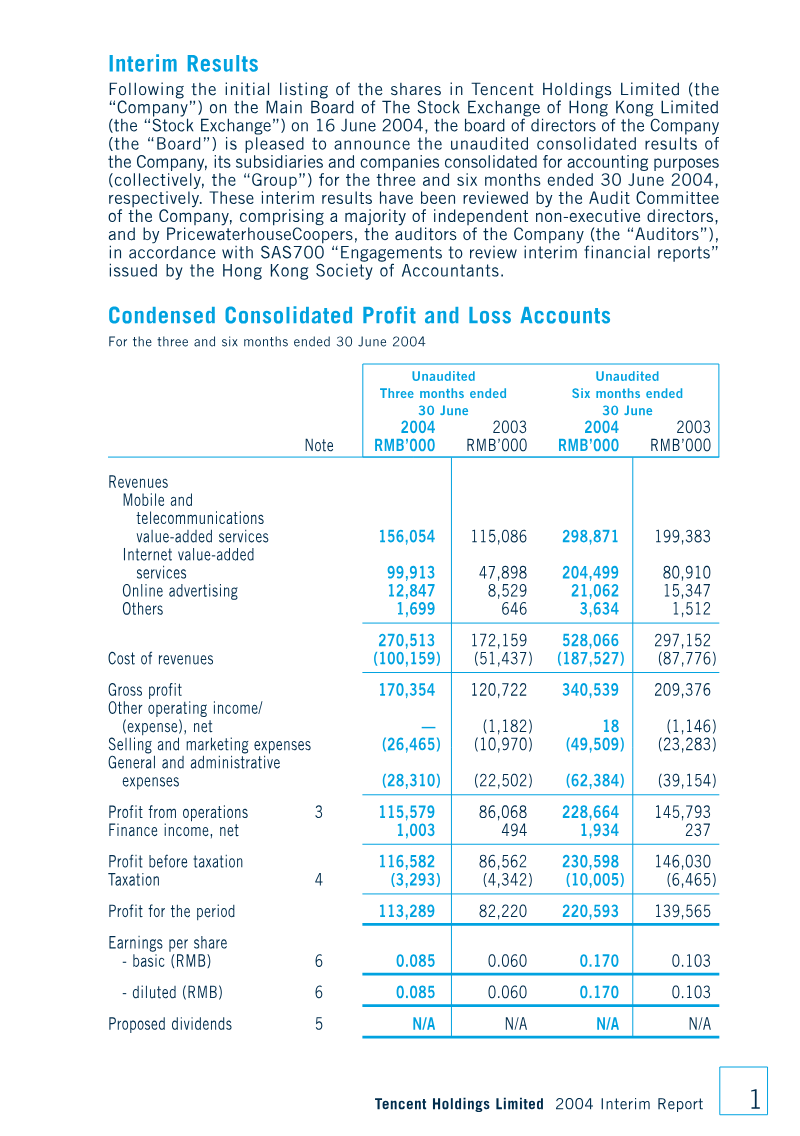
Tencent Holdings Limited experienced a period of rapid expansion during the first half of 2004, characterized by substantial revenue growth and a successful transition to a publicly traded entity. Total revenues for the six-month period ending June 30, 2004, reached RMB 528.1 million, representing a 77.7% increase over the previous year. This financial momentum was largely fueled by the robust performance of mobile, telecommunications, and internet value-added services, which remain the core pillars of the company’s business model. Profit for the period rose by 58.1% to RMB 220.6 million, reflecting a strong operational foundation despite rising costs associated with bandwidth, server capacity, and revenue-sharing agreements.
The company’s strategic position was significantly bolstered by its initial public offering on June 16, 2004, which raised RMB 1,656.7 million and resulted in cash and cash equivalents totaling RMB 1.95 billion by the end of the half-year. While the second quarter saw a slight contraction in certain internet value-added services due to the proactive removal of inactive user accounts, the overall growth trajectory remained positive. The company also demonstrated significant organizational scaling, more than doubling its workforce to 804 employees to support its expanding operations.
Looking ahead, management intends to leverage its strengthened capital position to drive further growth through the diversification of payment channels, the expansion of QQ-based value-added services, and the pursuit of strategic acquisitions. By maintaining a focus on corporate governance and operational efficiency, the company aims to sustain its market leadership within the Chinese internet and mobile services sectors. These results underscore a pivotal phase of institutional development, setting the stage for continued investment in infrastructure and service innovation.
- Tencent’s total revenue for the first half of 2004 reached RMB 528.1 million, a 77.7% increase compared to the same period in 2003.
- The company successfully completed its initial public offering on June 16, 2004, raising RMB 1,656.7 million and ending the half-year with RMB 1.95 billion in cash and cash equivalents.
- Profit for the first half of 2004 rose by 58.1% to RMB 220.6 million, despite increased operational costs related to bandwidth, server capacity, and revenue-sharing.
- The company more than doubled its workforce to 804 employees during the first half of 2004 to support its rapid operational scaling.
- Growth was primarily driven by mobile, telecommunications, and internet value-added services, which remain the core pillars of the business model.
Tencent
Financial60 pages
Interim Report 2006: Tencent Holdings Limited
Tencent Holdings Limited demonstrated robust financial expansion during the first half of 2006, characterized by a 112.9% year-over-year revenue increase to RMB 1.35 billion. This growth was primarily fueled by the rapid scaling of internet value-added services and online advertising, which offset rising operational costs. By the end of June 2006, the company’s market reach expanded significantly, with registered instant messaging accounts climbing to 549 million. Net profit for the six-month period reached RMB 517.6 million, reflecting the successful integration of strategic acquisitions like the Joymax group and the continued monetization of the QQ.com portal.
Operational expenditures rose to RMB 801.6 million during this period, driven by intensified investments in research and development, staff benefits, and infrastructure requirements such as bandwidth and server custody. Despite these costs and a notable increase in share-based compensation expenses, the company maintained a strong liquidity position with RMB 2.7 billion in cash and investments. Capital management remained a priority, evidenced by the repurchase and cancellation of 18.3 million shares to bolster long-term shareholder value, alongside the issuance of 10.3 million shares through existing option schemes.
While the company achieved substantial gains across its core segments, it acknowledged a more challenging outlook for its wireless value-added services due to shifting regulatory policies from China Mobile. Nevertheless, the firm’s diversified revenue model and commitment to corporate governance standards provide a stable foundation for navigating these industry headwinds. By balancing aggressive R&D investment with disciplined financial management and strategic acquisitions, the company solidified its position as a dominant force in the Chinese internet services market throughout the first half of 2006.
- Tencent reported a 112.9% year-over-year revenue increase to RMB 1.35 billion for the first half of 2006, driven by internet value-added services and online advertising.
- Net profit for the six-month period reached RMB 517.6 million, supported by the monetization of the QQ.com portal and the integration of the Joymax group.
- The company’s user base grew to 549 million registered instant messaging accounts by the end of June 2006.
- Operational expenditures rose to RMB 801.6 million due to increased investments in R&D, infrastructure, and staff benefits.
- Tencent maintained a strong liquidity position with RMB 2.7 billion in cash and investments while repurchasing 18.3 million shares to enhance shareholder value.
Tencent
Financial78 pages
2008 Interim Report: Tencent Holdings Limited
Tencent Holdings Limited demonstrated robust financial expansion during the first half of 2008, characterized by an 84.8% year-over-year revenue increase to RMB 3.03 billion. This growth was underpinned by a significant rise in active user accounts, which reached 341.9 million by mid-year. Profit for the period climbed to RMB 1.19 billion, reflecting a strong 40.8% profit margin. The company’s performance was primarily driven by the scaling of internet value-added services, particularly online gaming and community platforms, alongside sustained growth in mobile telecommunications and online advertising.
Operational scaling necessitated increased investment in human capital and infrastructure, leading to higher employee benefit costs and research and development expenditures. The workforce expanded to 5,168 employees, with total remuneration costs reaching RMB 593.6 million. Despite these rising operational expenses and the transition to a unified 25% PRC enterprise income tax rate, the company maintained a solid balance sheet with total assets of RMB 8.20 billion and a stable gearing ratio of 24%. Strategic initiatives during this period included the acquisition of mobile value-added service providers and equity interests in various international and domestic gaming entities, further diversifying the company's portfolio.
The company navigated a complex macroeconomic environment, including the appreciation of the RMB against the USD and HKD, which resulted in exchange losses, and potential headwinds from a slowing Chinese economy. Governance remained stable, with MIH China (BVI) Limited serving as the largest shareholder at 35.08%. Through a combination of share repurchases and a share award scheme, the company continued to manage its capital structure and incentivize staff, ensuring alignment with long-term growth objectives while adhering to International Accounting Standard 34.
- Tencent achieved an 84.8% year-over-year revenue increase to RMB 3.03 billion for the first half of 2008, driven by growth in online gaming, community platforms, and mobile services.
- Profit for the period reached RMB 1.19 billion, representing a 40.8% profit margin despite the transition to a unified 25% PRC enterprise income tax rate.
- Active user accounts grew to 341.9 million by mid-2008, supporting the company's expansion in internet value-added services and online advertising.
- Operational expenses rose as the workforce expanded to 5,168 employees, resulting in total remuneration costs of RMB 593.6 million and increased R&D investment.
- The company maintained a stable financial position with total assets of RMB 8.20 billion and a gearing ratio of 24%, while managing exchange losses caused by the appreciation of the RMB.
+1
Tencent
Financial92 pages
Interim Report 2009: Tencent Holdings Limited
Tencent Holdings Limited demonstrated exceptional financial performance during the first half of 2009, characterized by robust revenue growth and a significant expansion of its user base. Total revenues reached RMB 5.38 billion, representing a 77.5% increase over the same period in 2008, while profit attributable to equity holders rose to RMB 2.23 billion. This growth was primarily fueled by the strong performance of Internet value-added services, mobile telecommunications, and online advertising. Specifically, the successful monetization of licensed online games such as DNF and Cross Fire served as a primary catalyst for second-quarter gains, helping the company maintain a healthy net margin of 41.8% despite rising operational costs associated with bandwidth, revenue sharing, and research and development.
The company’s operational scale grew in tandem with its financial success, with active user accounts reaching 448 million by June 2009. To support this trajectory, the workforce expanded to 6,421 employees, leading to increased remuneration costs. Management maintained a disciplined approach to capital structure and liquidity, ending the period with RMB 4.06 billion in cash and cash equivalents and a stable gearing ratio of 31%. While the broader economic environment remained challenging, the company demonstrated strategic foresight by prioritizing long-term content quality, opting to delay the launch of two in-house massively multiplayer online games until 2010.
Corporate governance and shareholder value remained central to the company’s strategy throughout this period. Tencent continued to utilize share-based compensation schemes, including a 15-year extension of its Share Award Scheme, to incentivize staff and align employee interests with long-term growth. Furthermore, the company actively managed its equity through share repurchases and the exercise of options, while maintaining transparent reporting on tax obligations and financial liabilities. With major shareholders like MIH China (BVI) Limited providing stable backing, the company concluded the first half of 2009 in a strong position to navigate future market demands.
- Tencent achieved RMB 5.38 billion in revenue for the first half of 2009, a 77.5% increase over the same period in 2008, with a net profit of RMB 2.23 billion.
- The company maintained a strong net profit margin of 41.8% despite rising operational costs related to R&D, bandwidth, and revenue sharing.
- Growth was primarily driven by Internet value-added services and the successful monetization of licensed online games, specifically DNF and Cross Fire.
- Active user accounts reached 448 million by June 2009, supported by a workforce that expanded to 6,421 employees.
- Tencent ended the period with a stable financial position, holding RMB 4.06 billion in cash and cash equivalents and a gearing ratio of 31%.
Tencent