
Report17 pages
The Future of Gaming Infrastructure: 2026-2028
The gaming industry is currently undergoing a critical architectural transition as live-service titles face a trilemma of escalating operational demands: the need for sub-10ms AI-driven decision-making, strict regulatory compliance, and rising cloud egress costs. The primary thesis is that legacy, fragmented backend architectures—which rely on separate databases, caches, and search layers—are no longer capable of supporting modern, high-velocity live-ops. To remain competitive, studios must shift toward unified, AI-native data planes that co-locate compute and data to ensure deterministic performance.
Key findings indicate that optimizing real-time matchmaking through low-latency infrastructure can drive a 4% to 15% uplift in player retention. However, achieving this requires moving away from asynchronous batch processing toward millisecond-level inference. This shift is further necessitated by the 2027 EU Data Act, which mandates the removal of cloud switching fees, and the EU AI Act, which classifies algorithmic matchmaking and personalization as high-risk systems requiring transparency, explainability, and immutable audit logs. Currently, only 5% of studios successfully implement player-facing AI, largely due to the latency bottlenecks inherent in traditional, multi-hop network architectures.
The industry is responding by adopting hybrid deployment models that combine self-hosted infrastructure with cloud resources to stabilize operating margins against unpredictable egress fees. By collapsing fragmented stacks into a single, coherent execution layer, studios can eliminate redundant systems and network round-trips. This consolidation allows for atomic, event-driven transactions that satisfy both performance requirements and emerging regulatory mandates.
Spanning the 2026–2028 period, this analysis highlights a fundamental shift in infrastructure strategy. As decision-making complexity grows—with matchmaking engines now processing hundreds of thousands of micro-decisions per second—the ability to execute logic directly on the data plane has become a primary competitive advantage. Studios that fail to modernize their backends risk both top-line revenue losses from poor engagement and bottom-line margin erosion caused by inefficient, legacy cloud consumption.
- Studios must transition from fragmented legacy backends to unified, AI-native data planes that co-locate compute and data to overcome latency bottlenecks and support high-velocity live-ops.
- Optimizing real-time matchmaking through low-latency infrastructure can increase player retention by 4% to 15%.
- Regulatory compliance with the 2027 EU Data Act and EU AI Act requires studios to implement immutable audit logs and transparent, explainable algorithmic systems for matchmaking and personalization.
- Only 5% of studios currently implement player-facing AI successfully, primarily due to latency issues caused by traditional, multi-hop network architectures.
- To stabilize operating margins against rising cloud egress costs, studios are increasingly adopting hybrid deployment models that combine self-hosted infrastructure with cloud resources.
+2
InvestGame
Report4 pages
Market Model Reports: Asia & MENA
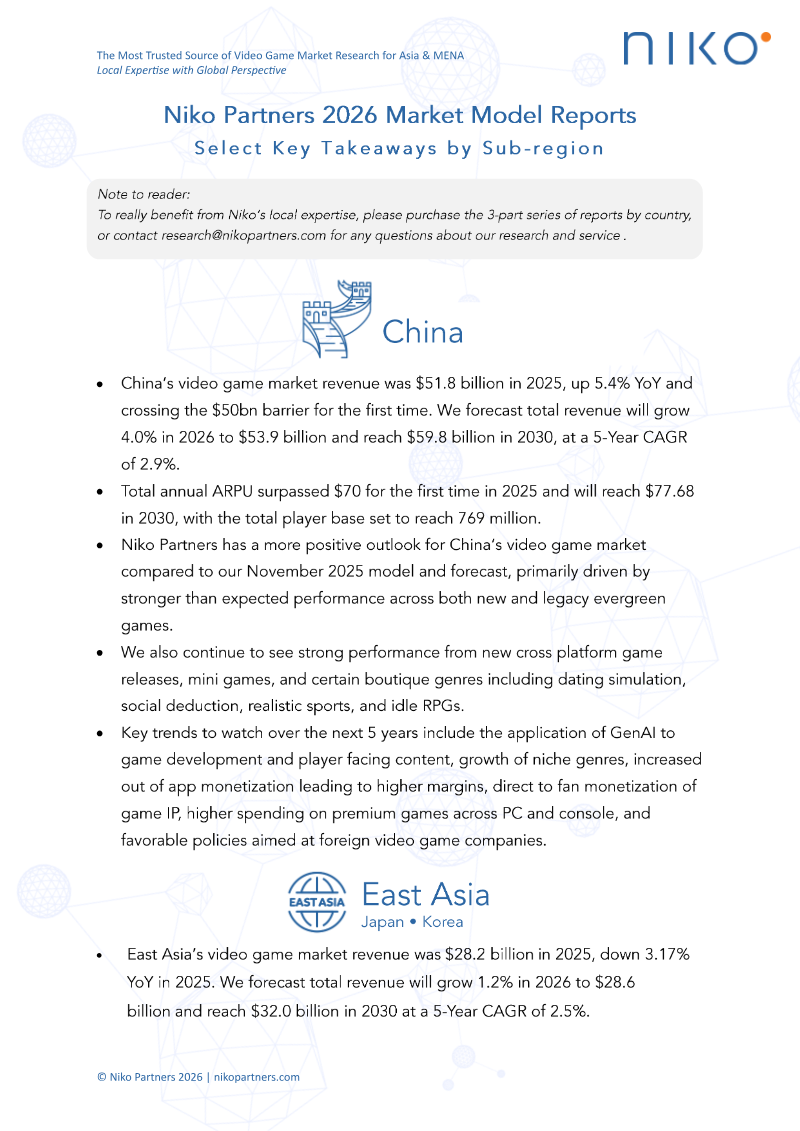
The 2026 Market Model Reports provide a comprehensive analysis of video game industry performance and growth projections across Asia and the Middle East and North Africa (MENA). Covering China, East Asia, India, Southeast Asia, and the MENA-3 region (Egypt, Saudi Arabia, and the UAE), the research evaluates revenue trends, player demographics, and macroeconomic influences through 2030. The analysis utilizes proprietary market modeling, player survey data, and regional expertise to assess the evolving landscape of mobile, PC, and console gaming.
Key findings highlight significant regional disparities in growth and maturity. China remains a dominant force, with 2025 revenue reaching $51.8 billion and a projected 2.9% CAGR through 2030. India emerges as the fastest-growing market, having surpassed $1 billion in revenue in 2025 with an expected 11.2% CAGR. Conversely, East Asia experienced a 3.17% revenue decline in 2025 due to macroeconomic pressures in Japan, though South Korea shows signs of recovery. Southeast Asia continues to expand, driven by mobile adoption and internet penetration, while the MENA-3 region benefits from strong government support and rising disposable income, despite potential geopolitical headwinds.
The research identifies several critical industry drivers, including the integration of generative AI, the rise of niche genres, and increased government regulation across Southeast Asia. Higher average revenue per user (ARPU) remains a focal point, particularly in East Asia, which maintains the highest regional spending levels. Overall, the findings suggest that while short-term volatility persists due to economic and geopolitical factors, the broader outlook for these markets remains positive, supported by increased localization, infrastructure development, and shifting consumer spending toward digital entertainment.
- China’s video game market reached $51.8 billion in 2025 and is projected to grow at a 2.9% CAGR to reach $59.8 billion by 2030.
- India is the fastest-growing market tracked, with 2025 revenue of $1.04 billion and a projected 11.2% CAGR through 2030, supported by a player base expected to reach 707 million.
- East Asia remains the region with the highest ARPU, though 2025 revenue declined 3.17% to $28.2 billion due to Japanese market stagnation and macroeconomic conditions.
- Southeast Asia’s market revenue hit $5.63 billion in 2025 and is forecast to grow at a 4.8% CAGR, with Thailand, the Philippines, and Indonesia identified as the fastest-growing sub-markets.
- The MENA-3 region (Egypt, Saudi Arabia, UAE) generated $2.15 billion in 2025 and is expected to see the strongest ARPU growth, reaching $38 by 2030 despite potential geopolitical instability.
+3
Niko PartnersJun 2026

Report28 pages
Mobile Gaming by Genre: Hypercasual
The hypercasual segment continues to dominate mobile gaming revenue, with the top 100 titles achieving 5.48 billion downloads and $345 million in in‑app purchase (IAP) revenue during the first half of 2025—double the figures from 2024 and the highest ever recorded for this genre. Leading publishers such as AZUR GAMES, Supersonic Studios, and Voodoo have secured billions of lifetime downloads and are increasingly adopting hybrid monetization models that blend advertising with growing IAP streams. This shift signals a clear trend toward revenue diversification while maintaining the ultra‑light, rapid‑development ethos that characterizes hypercasual games.
Projected revenue for 2025 is expected to reach $690 million across the top 100 titles, a doubling of the H1 figure and an increase from $403 million in 2024. The analysis attributes this surge to the genre’s evolution toward hybrid‑casual, where light meta‑progression and deeper monetization extend player engagement beyond the typical 30–60 second sessions. Key performance indicators remain ultra‑low cost per install (CPI), high Day‑1 retention around 40 %, and creative‑driven user acquisition. Hybrid titles aim to lift Day‑7 retention into the teens, thereby boosting lifetime value (LTV).
Case studies of Mob Control, Color Block Jam, and Pizza Ready illustrate successful pivots to hybrid‑casual models. Each title combined strong user experience design, staged monetization (ads plus IAPs), and data‑driven acquisition strategies. Tactics such as adaptive market positioning, psychological ad hooks like the Zeigarnik effect, and seamless ad integration into gameplay produced multi‑million installs, daily revenues exceeding $250 k, and sustained top‑chart performance. These examples underscore that balancing simplicity with depth, timing releases to genre trends, and iterating creatives regionally are critical for scaling hybrid‑casual titles.
- Hypercasual revenue for the top 100 titles is projected to reach $690 million in 2025, a significant increase from $403 million in 2024.
- H1 2025 performance for the top 100 hypercasual titles hit record highs of 5.48 billion downloads and $345 million in IAP revenue, doubling the figures from the same period in 2024.
- Leading publishers like AZUR GAMES, Supersonic Studios, and Voodoo are shifting toward hybrid-casual models that blend traditional advertising with deeper IAP monetization to extend player engagement.
- Hybrid-casual titles aim to improve Day-7 retention into the teens and increase lifetime value by incorporating light meta-progression into the standard 30–60 second hypercasual session.
- Successful titles like Mob Control, Color Block Jam, and Pizza Ready have demonstrated that hybrid-casual models can generate daily revenues exceeding $250,000.
+5
Gamesforum

Report52 pages
Middle East & Africa Gaming Review 2025
The Middle East and Africa gaming landscape is poised for rapid expansion, with market value projected to rise from US $7.4 billion in 2024 to over US $19.4 billion by 2033, reflecting an 11 % CAGR driven largely by mobile-first adoption and a vibrant startup ecosystem. Key hubs—Saudi Arabia, UAE, Turkey, Israel, and emerging African markets—are attracting substantial investment, hosting record‑setting esports events such as Saudi Arabia’s $70 million World Cup, and positioning the region as a growing share of the global gaming economy. Mobile dominance, government‑backed visions, and esports infrastructure are reshaping competitive dynamics across the region.
Funding flows reveal a highly concentrated investment landscape dominated by global players and regional leaders. Israel leads with nearly US $1 billion raised across 146 startups, followed by Turkey’s $961 million and Nigeria’s $371 million. The UAE lags behind but is rapidly scaling, with Dubai Vision 2033 earmarking $1 billion for talent and tech to achieve a $200 billion GDP contribution by 2033. Turkey’s “unicorn factory” status is underscored by Peak Games’ $1.8 billion acquisition and Dream Games’ record $2.6 billion raise, while Saudi Arabia’s Vision 2030 funding fuels a burgeoning local ecosystem that could produce future unicorns.
Digital payment adoption and Web3 innovation are accelerating growth, particularly in the UAE where blockchain publishing and VR/Metaverse platforms such as Fenix Games and True Gamers are attracting capital. In Africa, mobile-first adoption has driven revenue to $1.8 billion in 2024, with Egypt, South Africa and Nigeria dominating startup activity. The continent’s youthful demographics and entrepreneurial momentum position it as a dynamic frontier, with African studios like Sea Monster gaining traction through capital, mentorship and infrastructure support.
Legacy hardware sales remain a key revenue driver, with story‑rich single‑player titles and console sales generating multi‑billion dollar revenues. However, the rise of subscription models, microtransactions and expansion packs is reshaping monetisation strategies across all segments. Overall, the Middle East and Africa are emerging as a mobile‑first, VC‑backed powerhouse with significant potential for global influence in gaming and esports.
- The Middle East and Africa gaming market is projected to grow from $7.4 billion in 2024 to over $19.4 billion by 2033, representing an 11% CAGR driven by mobile-first adoption.
- Investment is highly concentrated, with Israel leading at nearly $1 billion raised across 146 startups, followed by Turkey at $961 million and Nigeria at $371 million.
- Turkey has established itself as a 'unicorn factory' through major deals, including Peak Games’ $1.8 billion acquisition and Dream Games’ $2.6 billion capital raise.
- The UAE is aggressively scaling its gaming sector via the Dubai Vision 2033 initiative, which earmarks $1 billion for talent and technology to boost GDP contribution.
- Africa’s gaming revenue reached $1.8 billion in 2024, with Egypt, South Africa, and Nigeria serving as the primary hubs for startup activity and entrepreneurial momentum.
+3
Lucidity Insights

Report29 pages
Investing and Financial Management App Market and Advertising Trends 2025
Investment‑management and crypto trading applications have accelerated growth in 2025, with global downloads rising 12 % to about five billion. The surge is driven primarily by mobile‑first trading platforms and cryptocurrency apps that attract tens of millions of new users annually, reshaping consumer access to worldwide financial markets. Market fragmentation is evident: U.S. and Japanese users prefer established brokerages, whereas India and Southeast Asian consumers gravitate toward local, mobile‑centric services.
User demographics reveal a pronounced male bias across all regions, ranging from 70 % to over 90 % in crypto apps. Mature economies such as the U.S., Japan, and South Korea show a more balanced gender split (25–38 % female), while high‑growth markets like India and Vietnam have only 13–17 % female users. Age distribution centers on the 25‑44 cohort, with advanced markets featuring a larger share of users aged 35–54 and emerging markets attracting more 18‑24 year olds. Crypto platforms skew even younger, with up to 30 % of users aged 18‑24.
Advertising strategies mirror these demographic patterns. In the U.S., large brokerages allocate substantial budgets to capture a mature market, whereas Indian platforms such as Groww and Angel One generate over 120 billion global impressions through low‑fee, mobile‑first experiences and relatable storytelling. In Japan and South Korea, digital‑first brokers dominate via high‑impact video and social media campaigns that align with local cultural preferences.
Sensor Tower, a global mobile‑market intelligence provider headquartered in North America, Europe, and Asia, supplies four core products—App Intelligence, Store Intelligence, Ad Intelligence, and Usage Intelligence—to marketers, developers, and analysts seeking competitive insights across these rapidly evolving markets.
- Global downloads for investment and crypto trading apps rose 12% in 2025, reaching approximately five billion total downloads.
- User demographics are heavily male-skewed, with crypto apps reaching over 90% male users and emerging markets like India and Vietnam reporting only 13–17% female participation.
- Market preferences are geographically fragmented: U.S. and Japanese users favor established brokerages, while consumers in India and Southeast Asia prioritize local, mobile-centric platforms.
- Indian platforms Groww and Angel One have achieved significant scale, generating over 120 billion global ad impressions through low-fee, mobile-first strategies.
- The core user base is aged 25–44, though crypto platforms attract a younger demographic with up to 30% of users falling into the 18–24 age bracket.
+2
Sensor Tower

Report93 pages
Die Games - Branche in Deutschland 2025
The study evaluates the German games industry in 2025, building on earlier reports to assess economic performance, employment, and the influence of federal funding. It surveys 343 companies—28 % of a population of 1,205—and integrates primary data with secondary sources such as gamesmap and DLR. The sector has expanded rapidly, doubling core‑market firms from 619 in 2018 to roughly 1,200 by mid‑2025 and nearly doubling the extended core market. Revenue rose from €3.06 bn in 2018 to €3.73 bn in 2024, a 22 % increase, with development‑sector sales growing 148 %. Despite this growth, the market remains highly fragmented: three‑quarters of firms employ fewer than ten people and only 19 % belong to foreign conglomerates. Export earnings dominate, accounting for 76 % of revenue, largely within the EU and North America/Asia.
Employment data reveal a clear link between company size and workforce composition. Larger firms (>€25 M revenue) employ 85 % full‑time staff, whereas micro‑enterprises rely heavily on owners and freelancers. Female representation has risen to nearly one‑third of the workforce, and international talent now constitutes 35 % of employees. Technical and creative roles dominate, while commercial positions have declined. Salaries average €62 k annually, with lead‑level pay ranging from €50–80 k and a strong correlation between company size and remuneration.
Federal funding has been pivotal, with 71 % of developers receiving or planning to receive support. In 2023, €70 million in subsidies generated €277 million of investment and €453 million of total value‑creation, yielding a multiplier of 6.5 for output and 2.5 for fiscal impact. However, high personnel costs remain a significant challenge, with 57 % of respondents rating them as “very bad.” The industry also serves as a talent magnet and innovation catalyst, with 70 % of spill‑overs stemming from game engines, gamification, and AR/VR technologies adopted across automotive, architecture, film, training, AI, and other sectors.
- The German games industry has nearly doubled its core-market presence since 2018, growing from 619 to approximately 1,200 firms by mid-2025.
- Federal funding acts as a major economic driver, where €70 million in 2023 subsidies generated €453 million in total value-creation, representing a 6.5x output multiplier.
- Industry revenue reached €3.73 billion in 2024, a 22% increase since 2018, with the development sector specifically surging by 148%.
- Export earnings are the primary revenue driver, accounting for 76% of total sales, with key markets located in the EU, North America, and Asia.
- The sector is highly fragmented, with 75% of companies employing fewer than ten people and only 19% of firms owned by foreign conglomerates.
gameApr 2026

Report54 pages
FY2023 Presentation Material
October 2022 to September 2023 The future information, such as earnings forecast, written in this document is based on our expectations and assumptions as of the date the forecast was made. Our actual results could differ materially from those described in this forecast because of various risks and uncertainties. 1. FY2023 Full Year Results (October 2022-September 2023) 2. FY2024 Forecast (October 2023-September 2024) 3. Internet Advertisement Business 6. Medium to Long-Term Strategy 7.
- Consolidated sales for FY2023 reached 720.2 billion yen, a 1.4% increase year-over-year, marking 26 consecutive years of sales growth since inception.
- Operating profit for FY2023 significantly declined by 64.5% to 24.557 billion yen, with the operating profit margin dropping from 9.7% to 3.4%, primarily due to large investments in the Media business (ABEMA) including the FIFA World Cup.
- Net profit for FY2023 decreased by 78.0% to 5.332 billion yen.
- ABEMA, the Media business segment, saw its Weekly Active Users (WAU) grow by 2.4 million year-over-year, reaching an average of 18.79 million in Q4 FY2023, driven by events like the FIFA World Cup.
- The company plans to release more than three new games in FY2024, including "Jujutsu Kaisen Phantom Parade" in late November, and will open a new production studio in Japan to leverage AI and computer graphics.
+1
CyberAgent
Report2 pages
Financial Highlights: FY2015
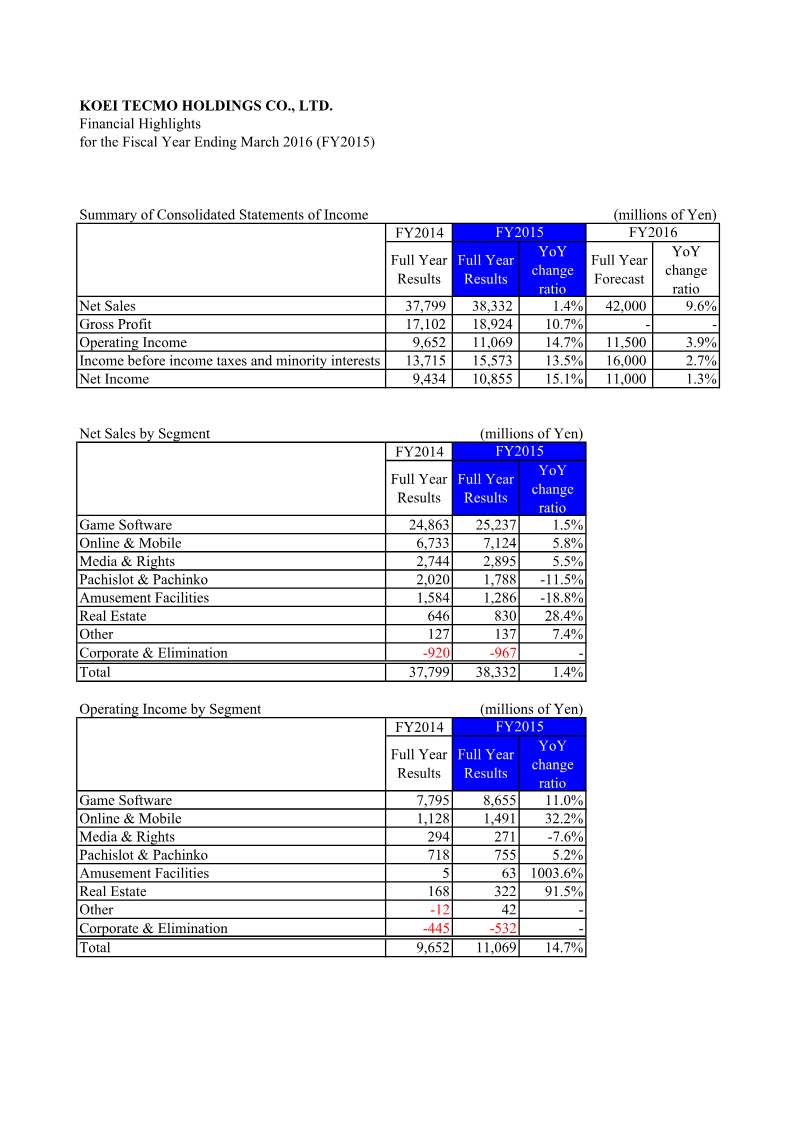
Financial highlights for the fiscal year ending March 2016 show KOEI TECMO HOLDINGS CO., LTD. achieved modest revenue growth of 1.4 % to ¥38,332 million, driven mainly by a 5.8 % increase in Online & Mobile sales and a 1.5 % rise in Game Software revenue, while Pachislot & Pachinko and Amusement Facilities segments declined by 11.5 % and 18.8 %, respectively. Gross profit expanded 10.7 % to ¥18,924 million, and operating income grew 14.7 % to ¥11,069 million, reflecting higher profitability in the Online & Mobile and Real Estate segments. Net income increased 15.1 % to ¥10,855 million, with a net profit margin of approximately 28.3 %.
On the balance‑sheet side, total assets decreased from ¥115,216 million to ¥110,925 million, largely due to a reduction in investment securities and intangible assets. Current assets rose slightly to ¥27,430 million, supported by higher cash and time deposits. Total liabilities fell from ¥14,543 million to ¥12,219 million, driven by a significant drop in long‑term liabilities and deferred tax obligations. Shareholders’ equity increased to ¥99,045 million, bolstered by retained earnings and a reduction in treasury stock.
The data cover Japan‑based operations for FY2015, with financial statements prepared under Japanese GAAP. No survey methodology is involved; figures derive from audited consolidated accounts, reflecting the company’s performance across game software, online/mobile, media rights, and ancillary segments.
- KOEI TECMO HOLDINGS CO., LTD. achieved a net income of ¥10,855 million for FY2015, representing a 15.1% increase and a strong net profit margin of approximately 28.3%.
- Operating income grew by 14.7% to ¥11,069 million, driven by improved profitability within the Online & Mobile and Real Estate business segments.
- Total revenue reached ¥38,332 million, a modest 1.4% year-over-year increase supported by growth in Online & Mobile (5.8%) and Game Software (1.5%) sales.
- Performance was negatively impacted by significant declines in the Pachislot & Pachinko and Amusement Facilities segments, which fell by 11.5% and 18.8% respectively.
- The company strengthened its balance sheet by reducing total liabilities from ¥14,543 million to ¥12,219 million while increasing shareholders’ equity to ¥99,045 million.
+1
Koei Tecmo
Report2 pages
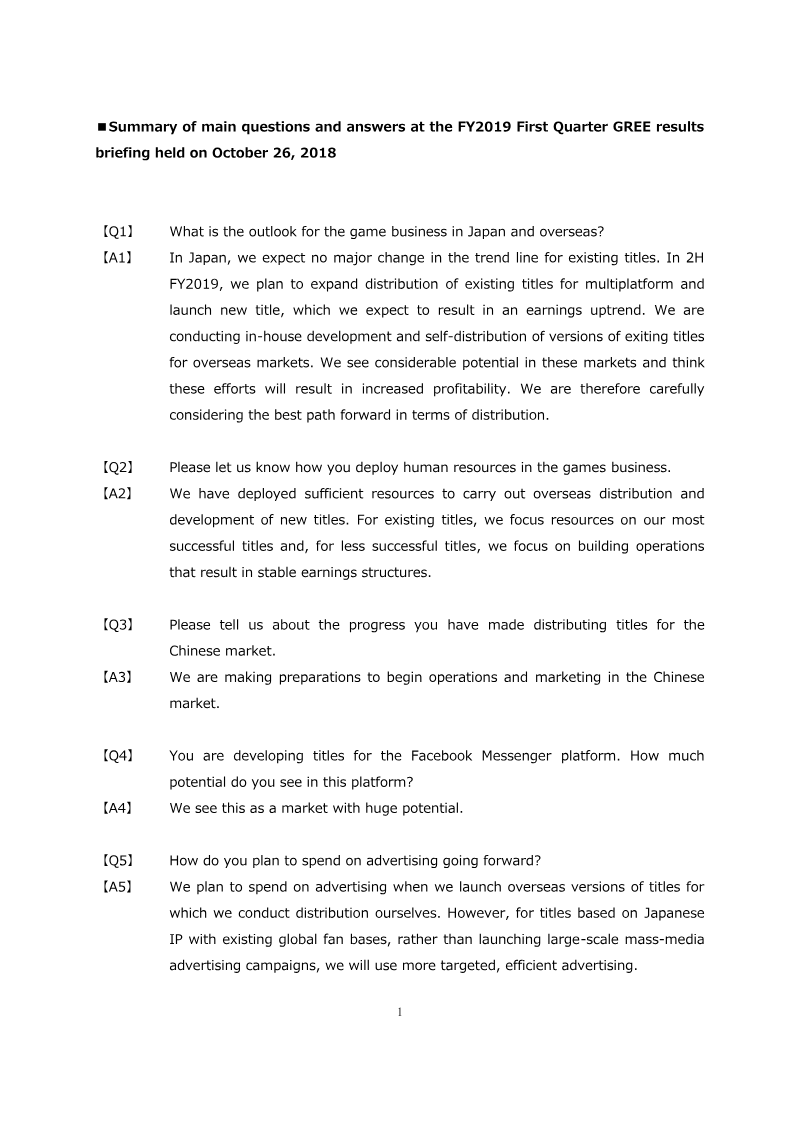
Summary of main questions and answers at the FY2019 First Quarter GREE results briefing held on October 26, 2018
The briefing clarified GREE’s strategic outlook for FY2019, emphasizing a steady domestic game portfolio while pursuing growth overseas. In Japan, the company expects no major shift in performance for existing titles but plans to broaden multiplatform distribution and launch new releases in the second half of FY2019, projecting an earnings uptrend. Internationally, GREE is developing and self‑distributing overseas versions of current titles, targeting markets with high profitability potential. Human resource allocation reflects this focus: sufficient staff are dedicated to overseas distribution and new title development, while existing titles receive concentrated support for top performers and operational stability for less successful ones.
China is identified as a priority market, with preparations underway to initiate operations and marketing. The company also highlights the Facebook Messenger platform as a high‑potential channel for new titles, indicating an expansion into social media gaming. Advertising strategy will be selective; overseas launches of self‑distributed titles will receive targeted, efficient campaigns rather than broad mass media spend.
Regulatory compliance and consumer protection are addressed through company‑wide measures to prevent gacha system issues, including strengthened evaluation protocols and employee training. The REALITY livestreaming platform for VTubers is in an exploratory phase, with ongoing data collection on technology, planning, and marketing to build know‑how for future content expansion. Overall, GREE’s FY2019 strategy balances domestic stability with aggressive international diversification and platform innovation.
- GREE is prioritizing international expansion by self-distributing existing titles in high-profitability markets, with China identified as a key target for upcoming operations and marketing.
- The company plans to drive an earnings uptrend in the second half of FY2019 through new title releases and expanded multiplatform distribution in Japan.
- GREE is diversifying its distribution channels by targeting social media gaming, specifically highlighting Facebook Messenger as a high-potential platform for new releases.
- Advertising strategy for overseas launches will shift away from mass media spend in favor of targeted, efficient campaigns for self-distributed titles.
- Human resource allocation is being restructured to concentrate support on top-performing domestic titles while maintaining operational stability for lower-performing ones.
+5
GREE
Report1 pages
Prognozy dla 11 bit studios S.A. Wybranych Danych Finansowych na lata 2011-2013
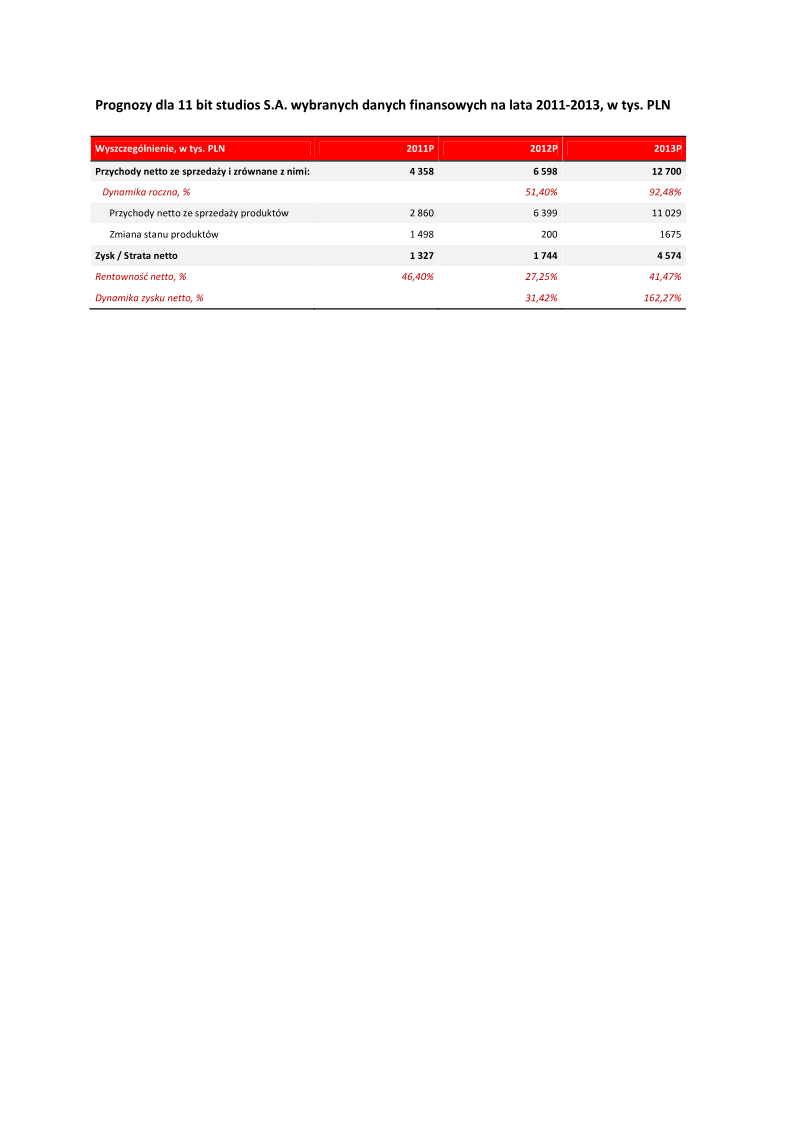
The forecast presents projected financial performance for 11 bit Studios S.A. over the years 2011‑2013, expressed in thousands of Polish zloty. Net sales revenue is expected to rise from 4 358 in 2011 to 12 700 by 2013, reflecting annual growth rates of 51.40 % and 92.48 %. Net sales from product sales alone are projected to increase from 2 860 to 11 029, while changes in product inventory contribute an additional 1 498, 200, and 1 675 respectively. Net profit is projected to grow from 1 327 in 2011 to 4 574 in 2013, with profitability margins moving from 46.40 % to 41.47 %. The net profit growth rate accelerates sharply, from 31.42 % in the first year to an impressive 162.27 % in the second.
The scope covers a single company within the video‑game development sector, focusing on selected financial metrics over a three‑year horizon. The methodology is implicit: the figures represent forecasted values rather than historical data, likely derived from internal projections or market analysis. No explicit sample size or external data sources are cited; the report appears to be an internal financial planning document. The analysis underscores a strong projected expansion in both revenue and profitability, driven largely by product sales growth and inventory management.
- 11 bit studios S.A. projects net sales revenue to grow from 4,358 thousand PLN in 2011 to 12,700 thousand PLN by 2013.
- Net profit is forecasted to increase from 1,327 thousand PLN in 2011 to 4,574 thousand PLN in 2013, representing a significant acceleration in growth.
- The company expects a sharp rise in the net profit growth rate, climbing from 31.42% in the first year to 162.27% by the second year of the forecast period.
- Annual revenue growth rates are projected at 51.40% and 92.48% respectively across the 2011–2013 timeframe.
- Product sales are the primary driver of revenue expansion, with projections rising from 2,860 thousand PLN in 2011 to 11,029 thousand PLN in 2013.
11 bit studios
Report2 pages
2021-22 Annual Sales: Audited Consolidated Results
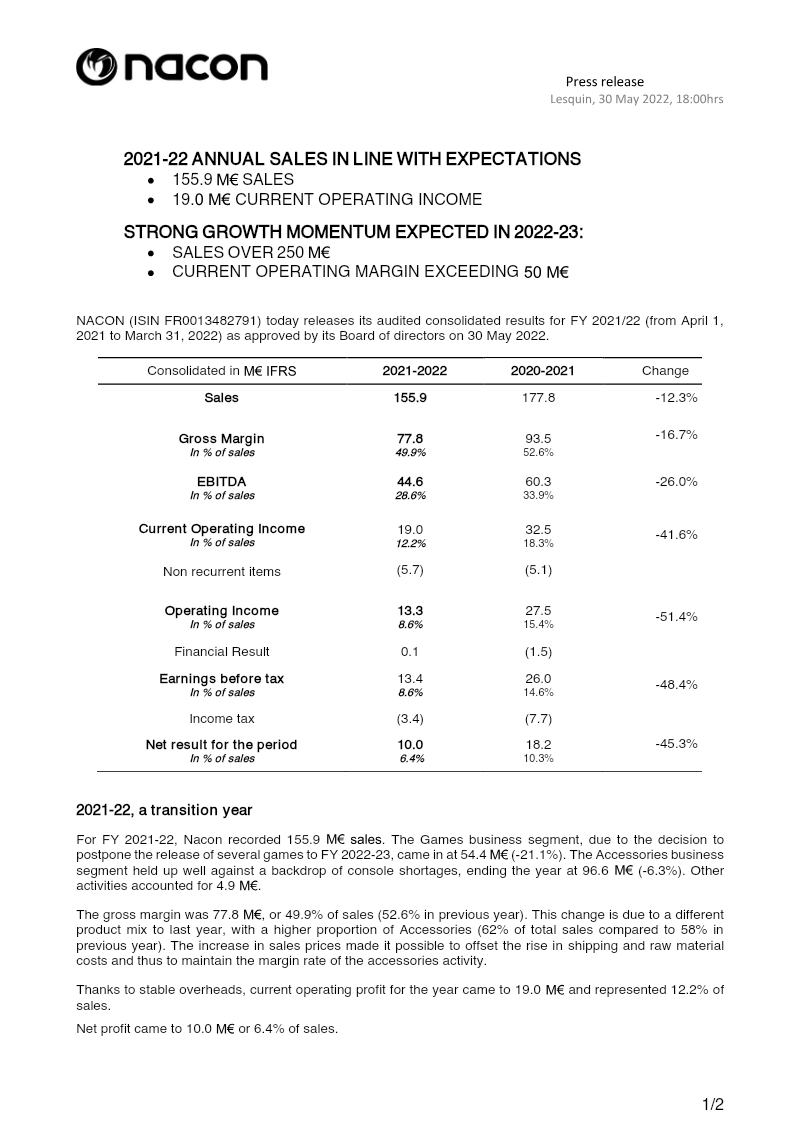
Nacon’s audited consolidated results for the fiscal year ending 31 March 2022 show sales of €155.9 million, a decline of 12.3 % from the previous year’s €177.8 million, driven largely by a 21.1 % drop in the Games segment after postponing several releases to FY 2022‑23. The Accessories segment, however, remained resilient amid global console shortages, recording €96.6 million in sales (down 6.3 %) and contributing a higher proportion of revenue (62 % versus 58 % previously). Gross margin fell to €77.8 million (49.9 % of sales) from €93.5 million (52.6 %) due to the altered product mix, though price increases offset rising shipping and raw‑material costs. EBITDA contracted 26 % to €44.6 million (28.6 % of sales), and current operating income dropped 41.6 % to €19.0 million (12.2 % of sales). Net profit fell 45.3 % to €10.0 million (6.4 % of sales).
The balance sheet reflects significant investment activity: shareholders’ equity rose to €228.4 million, new bank debt of €52.5 million was issued at sub‑1 % interest, and net debt remained low at €10.4 million. Working capital increased by €8.7 million due to higher inventories, while operating cash flow reached €32.4 million and intangible CAPEX totaled €57.4 million. Over the past two years, Nacon has invested over €100 million in game development and acquired nine studios, expanding its pipeline to 46 titles from 33.
Management projects a sharp rebound in FY 2022‑23, targeting sales above €250 million and a current operating margin exceeding €50 million, supported by new releases such as Vampire: The Masquerade®‑Swansong and The Lord of the Rings Gollum. The company will continue external growth through studio acquisitions, notably Midgar Studio and Daedalic Entertainment.
- Nacon reported FY 2021-22 sales of €155.9 million, a 12.3% decline from the previous year, primarily due to a 21.1% drop in the Games segment following the postponement of several titles.
- Management projects a significant rebound for FY 2022-23 with a sales target exceeding €250 million and an operating margin above €50 million, driven by releases like 'Vampire: The Masquerade – Swansong' and 'The Lord of the Rings: Gollum'.
- Net profit fell 45.3% to €10.0 million, while current operating income dropped 41.6% to €19.0 million, reflecting the impact of the altered product mix and increased operational costs.
- The Accessories segment proved resilient despite global console shortages, generating €96.6 million in sales and increasing its share of total revenue to 62%.
- Nacon has aggressively expanded its development pipeline to 46 titles, supported by over €100 million in development investment and the acquisition of nine studios, including Midgar Studio and Daedalic Entertainment, over the past two years.
+2
Nacon
Report53 pages
Results Presentation: Q3 for the Fiscal Year Ending March 2026
Q3 for the Fiscal Year Ending March 2026 The market forecasts, performance outlooks, plans, strategies, and other forward-looking statements contained in this document are based on information available to the Company and the judgment of its management at the time this material was created. They do not constitute a guarantee of future performance.
- The company recognized impairment losses of approximately 229 million euros (31.3 billion yen) on Rovio's goodwill and other intangible assets, primarily due to reduced sales forecasts for existing and new game titles.
- Q3 FY2026/3 operating income was 19.8 billion yen, a significant decrease from 43.7 billion yen in Q3 FY2025/3. The full-year operating income forecast for FY2026/3 was revised down to 40.0 billion yen from 53.0 billion yen.
- Rovio's performance significantly underperformed initial forecasts, with existing key titles declining more than expected and new titles failing to meet target KPIs or experiencing development delays/cancellations.
- The Entertainment Contents segment's operating income for Q3 FY2026/3 was 23.7 billion yen, down from 34.6 billion yen in Q3 FY2025/3, and its full-year forecast was revised down to 30.5 billion yen from 39.5 billion yen.
- The company plans to improve Rovio's profit margins by actively increasing external payment usage to 30% for Rovio titles within five years, and by optimizing UA costs through marketing strategy updates and AI in development.
+1
Sega Sammy Holdings

Report14 pages
UnitedHealth Group: First Quarter 2025 Results and Revised Guidance
alth Group Reports First Quarter 20a UnitedHealth Group Reports First Quarter 2025 Results and Revises Full Year Guidance • Revised 2025 Earnings Outlook to $24.65 to $25.15 Per Share, Adjusted Earnings • First Quarter Earnings were $6.85 Per Share, Adjusted Earnings $7.20 Per Share • Revenues of $109.6 Billion Grew $9.8 Billion Year-Over-Year • Consumers Served by UnitedHealthcare Increased by 780,000 Year to Date • Optum Health Continues to Expect to Serve 650,000 New Value...
- UnitedHealth Group revised its 2025 earnings outlook to $24.65-$25.15 per share (net) and $26-$26.50 per share (adjusted), following first-quarter adjusted earnings of $7.20 per share.
- First-quarter 2025 revenues grew by $9.8 billion year-over-year to $109.6 billion, with earnings from operations reaching $9.1 billion.
- The company returned nearly $5 billion to shareholders in Q1 2025 through dividends and share repurchases, achieving a 26.8% return on equity.
- UnitedHealthcare increased its consumers served by 780,000 year-to-date, while Optum Health expects to serve 650,000 new value-based care patients in 2025.
- The medical care ratio increased to 84.8% in Q1 2025 from 84.3% in Q1 2024, primarily due to Medicare funding reductions and higher senior care activity, partially offset by Medicare Part D program changes.
+2
UnitedHealth Group
Report2 pages
Q1 2026 Market Themes to Watch
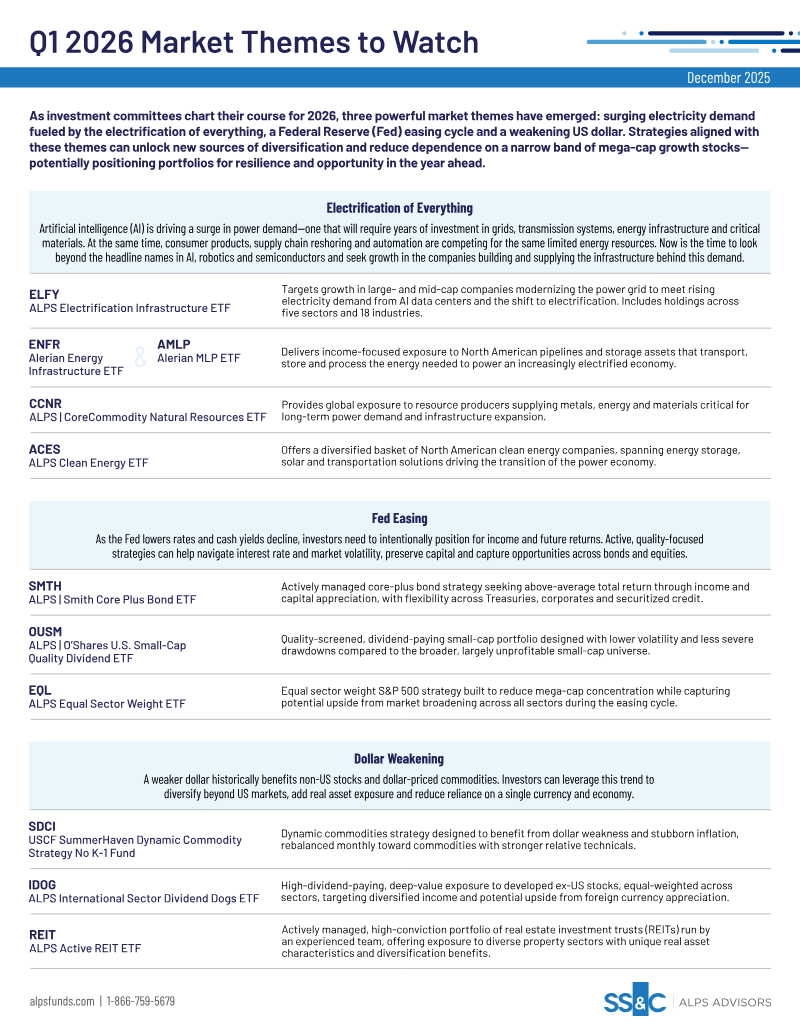
Investment committees navigating the 2026 landscape are advised to pivot toward three primary market themes: the widespread electrification of the global economy, the Federal Reserve’s interest rate easing cycle, and the depreciation of the US dollar. These trends offer a strategic framework for diversifying portfolios beyond the narrow concentration of mega-cap growth stocks, potentially enhancing resilience and capturing emerging opportunities across various asset classes.
The surge in power demand, driven by artificial intelligence, data center expansion, and industrial automation, necessitates significant capital allocation toward infrastructure. Rather than focusing solely on headline technology firms, investors are encouraged to target the underlying grid modernization, energy transmission, and critical material supply chains. This thematic shift encompasses North American energy pipelines, clean energy solutions, and global natural resource producers, all of which are essential to sustaining an increasingly electrified economy.
Simultaneously, the transition toward lower interest rates requires a shift in focus toward quality-oriented income strategies. As cash yields decline, active management in fixed income and the inclusion of quality-screened, dividend-paying small-cap equities can help mitigate volatility and reduce reliance on unprofitable market segments. Furthermore, the anticipated weakening of the US dollar provides a catalyst for diversifying into non-US developed markets and real assets, such as commodities and real estate investment trusts. By rebalancing toward these sectors, investors can hedge against currency risk and inflation while positioning for broader market participation across international and domestic landscapes.
- Investors should pivot from mega-cap growth stocks toward infrastructure assets that support the electrification of the economy, including grid modernization, energy transmission, and critical material supply chains.
- The surge in power demand driven by AI, data centers, and industrial automation necessitates capital allocation into North American energy pipelines, clean energy solutions, and global natural resource producers.
- The Federal Reserve’s interest rate easing cycle requires a shift toward quality-oriented income strategies, such as active fixed-income management and dividend-paying small-cap equities, to replace declining cash yields.
- Anticipated depreciation of the US dollar creates a strategic opportunity to diversify portfolios into non-US developed markets to hedge against currency risk.
- Real assets, including commodities and real estate investment trusts (REITs), should be utilized to hedge against inflation and capture broader market participation as the dollar weakens.
+2
GameVault System
Report7 pages
Video Games Ecosystem Report: Cyprus 2025
The report outlines a rapidly expanding video‑games ecosystem in Cyprus, projecting market revenue to surge from $1.2 billion in 2023 to $6.7 billion by 2025, with a compound annual growth rate of 5.96 % through 2030. The growth is driven by a growing number of tech firms relocating to the island, with 282 startups reported in July 2025—39 funded, 15 in Series A rounds, and one unicorn. Over 600 companies of varying sizes now operate locally, benefiting from Cyprus’s favorable tax regime, EU membership, and supportive regulatory framework.
Key success stories highlight local studios such as MY.GAMES and Ludus, whose mobile titles have achieved multi‑million downloads and cross‑platform revenue streams exceeding $2 million. The mobile segment dominates, with Playrix, Easybrain, and Outfit7 leading in casual and puzzle games; yet PC and console titles from Wargaming and Digital Vortex Entertainment demonstrate a growing presence in the market. Cross‑platform development and cloud gaming are emerging trends, offering opportunities for developers skilled across mobile and PC.
The island’s advantages include competitive corporate tax rates, strategic positioning between Europe and the Middle East, a growing talent pool enriched by relocation of experienced developers, and increasing investment in esports and blockchain gaming. The report also promotes the WN Conference Cyprus (September 2025) as a networking and market‑entry platform, anticipating attendance of 700+ participants. Overall, the data portray Cyprus as an attractive hub for game development and investment, poised for continued expansion through 2030.
- Cyprus's video game market revenue is projected to grow from $1.2 billion in 2023 to $6.7 billion by 2025, with a compound annual growth rate of 5.96% through 2030.
- The local ecosystem has expanded to over 600 companies, including 282 startups as of July 2025, with 39 funded, 15 in Series A rounds, and one unicorn.
- Mobile gaming remains the dominant segment, led by major players such as Playrix, Easybrain, and Outfit7, while PC and console development is represented by firms like Wargaming and Digital Vortex Entertainment.
- Local studios such as MY.GAMES and Ludus have successfully leveraged cross-platform development, with individual titles generating revenue exceeding $2 million.
- The industry is supported by a favorable tax regime, EU membership, and a strategic geographic position between Europe and the Middle East.
InvestGameMar 2026

Report94 pages
The PC & Console Gaming Report 2025
The global PC and console gaming market is projected to reach $92.7 billion by 2027, driven by a significant recovery in the console sector. While PC growth remains modest at a 2.6% CAGR, the console segment is expected to expand by 7.0%, fueled by the anticipated launch of the Nintendo Switch 2 and blockbuster releases such as Grand Theft Auto VI. Despite a revenue dip in 2024 due to a lighter premium release schedule, total playtime grew by 6%, signaling robust engagement even as market dynamics shift toward a "near zero-sum" competition for player attention.
Player behavior is increasingly characterized by "calcification," where engagement is concentrated into a shrinking pool of established "forever games." Titles aged six years or older now command over 60% of playtime on PC and nearly half on consoles. This consolidation is most visible on PC, where just five legacy titles account for 30% of annual hours. While PlayStation has emerged as a growth leader with a 21% increase in playtime since 2021, the broader trend across all platforms shows players becoming more "unreachable," with a rising share of the audience engaging with only one to three games per year.
To combat stagnation, publishers are increasingly leveraging "recursive nostalgia" by reintroducing classic maps and mechanics. While this strategy yielded massive engagement spikes for Fortnite, its effectiveness varies, often serving as a short-term boost rather than a long-term retention tool unless structured as a permanent gameplay mode. Furthermore, the discoverability crisis has intensified as annual releases on Steam approached 19,000 in 2024. With the impact of traditional seasonal sales declining fourfold since 2019, success now requires a shift toward targeted global events, external traffic generation, and product differentiation to break through a market dominated by AAA franchises and entrenched free-to-play titles.
- The global PC and console market is projected to reach $92.7 billion by 2027, with the console segment expected to grow at a 7.0% CAGR driven by the Nintendo Switch 2 launch and Grand Theft Auto VI.
- Player engagement is increasingly 'calcified,' as titles aged six years or older now account for over 60% of PC playtime and nearly 50% of console playtime.
- Market competition for player attention has become a near zero-sum game, with a rising percentage of the audience now limiting their engagement to only one to three games per year.
- On PC, market consolidation is extreme, with just five legacy titles responsible for 30% of total annual hours played.
- Despite a 2024 revenue dip caused by a light release schedule, total player engagement grew by 6%, indicating that playtime remains robust even as monetization becomes more difficult.
+2
NewzooFeb 2026

Report18 pages
Vietnam Mobile Gaming 2025: The Next Billion-Dollar Frontier in Southeast Asia
The report argues that Vietnam’s mobile gaming sector will reach a billion‑dollar valuation by 2025, driven by an expanding user base and high spending per download. In 2023, 1.1 billion mobile users and 900 million mid‑core players generated gross revenue of approximately US$1.3 billion, with a compound annual growth rate of 9.8 % across all platforms. The analysis attributes this surge to rapid mobile penetration, widespread 5G coverage (average speed 75.7 Mbps), and a growing banking‑linked payment ecosystem that facilitates in‑app purchases.
A key finding is the regulatory shift that began in 2025, when Apple introduced a mandatory license field and the Vietnamese government revoked 1,081 unlicensed titles. This crackdown reduced total downloads by 13.7 % but created a more favorable environment for compliant mid‑core games, which now dominate the market. The report’s methodology involved surveying 250 representative titles with significant download volumes, measuring D1 and D7 retention, playtime, and revenue. Data were cross‑validated with internal tools and third‑party analytics to correct discrepancies common in the local market.
Geographically, the study focuses on Vietnam but benchmarks against other Southeast Asian markets. It notes that while daily playtime is rising across the region, Vietnam’s revenue per download exceeds that of the Philippines by at least 28 %. The report concludes that early licensing and a focus on social, competitive, and narrative‑rich mid‑core experiences—particularly 4X strategy, MOBA, squad RPG, MMORPG, and battle royale genres—will be critical for publishers seeking sustainable growth in the Vietnamese market.
- Vietnam's mobile gaming market is projected to reach a billion-dollar valuation by 2025, supported by a 9.8% compound annual growth rate.
- A 2025 regulatory crackdown resulted in the removal of 1,081 unlicensed titles, leading to a 13.7% decline in total downloads but fostering a more stable environment for compliant mid-core games.
- Vietnam demonstrates strong monetization potential, with revenue per download exceeding that of the Philippines by at least 28%.
- Market growth is underpinned by robust infrastructure, including widespread 5G coverage with average speeds of 75.7 Mbps and an expanding banking-linked payment ecosystem.
- In 2023, the market supported 1.1 billion mobile users and 900 million mid-core players, generating approximately US$1.3 billion in gross revenue.
+4
InvestGameFeb 2026
Report82 pages
Vietnam Gaming Outlook 2026: Building Sustainable Growth
Vietnam’s mobile gaming landscape is rapidly evolving from a download‑centric, ad‑driven model to a hybrid ecosystem that prioritizes in‑app purchases (IAP) and subscription revenue. In 2024, the country led global Google Play downloads with 6.1 billion installs yet generated only about $430 million, underscoring the profitability ceiling of pure advertising. Rising acquisition costs, privacy‑driven signal loss, and a plateauing average revenue per user (ARPU) have forced studios to adopt IAP‑first, hybrid casual titles that deliver deeper engagement and predictable cash flows. Global IAP and subscription revenue reached $150 billion in 2025, up 13%, while Vietnam’s IAP growth surged 65 %, positioning hybrids as the default blueprint for sustainable growth by 2026.
The transition hinges on data‑centric monetization strategies. AI‑driven programmatic advertising and hybrid supply‑side platforms help studios navigate privacy constraints, while sophisticated IAP systems require clean player‑behavior analytics and structured measurement frameworks. Localized pricing—using purchasing power parity tiers, local currency endings, and one‑tap tokenised payments—can lift conversion by over 20 % and reduce checkout abandonment by up to 30 %. Integrating multi‑currency settlement through a single provider such as Airwallex adds 2–5 % to net margin without altering game design.
A phased rollout model enables Vietnamese studios to pilot in core markets, expand regionally through configuration rather than new vendor projects, and scale into high‑value markets like the US for top‑line growth and FX savings. Premium ad formats on TikTok, when matched to specific spending barriers, can boost transaction values by 20–30 % and shift campaigns from cost‑per‑install to return‑on‑ad‑spend metrics. Case studies, such as Falcon Game Studio’s pivot to a hybrid model with 60–70 % day‑one retention and a 3–5 % global payer rate, illustrate the tangible benefits of this approach.
Overall, Vietnam’s mobile gaming sector is poised to compete globally by leveraging robust payment partners, privacy‑first acquisition tactics, and a disciplined IAP strategy that unlocks higher lifetime value and sustainable studio growth through 2026.
- Vietnam’s mobile gaming sector is shifting from an ad-driven model to hybrid-casual titles prioritizing in-app purchases (IAP) and subscriptions, following a 65% surge in local IAP growth in 2025.
- While Vietnam led global Google Play downloads with 6.1 billion installs in 2024, the market generated only $430 million, highlighting the profitability ceiling of pure advertising models.
- Localized pricing strategies, including purchasing power parity tiers and one-tap tokenized payments, can increase conversion rates by over 20% and reduce checkout abandonment by up to 30%.
- Integrating multi-currency settlement through providers like Airwallex can improve net margins by 2–5% without requiring changes to game design.
- Falcon Game Studio’s transition to a hybrid model demonstrates the viability of this strategy, achieving 60–70% day-one retention and a 3–5% global payer rate.
+3
InvestGameFeb 2026
Report13 pages
Aream & Co. Gaming CEO Survey 2025
The survey, conducted by Aream & Co., gauges executive optimism regarding consumer spending on gaming in 2025 across multiple channels and functional areas. Overall, 49 % of respondents view spending as “more optimistic,” another 49 % see it as unchanged, and only 2 % are less optimistic. When broken down by platform, mobile spending is perceived as more optimistic (49 %) while PC and console views are split between “more” (15–33 %) and “about the same.” In‑app purchases are viewed as more optimistic (80 %) versus in‑app advertising (41 %).
Key challenges identified include content saturation and over‑supply, with 33 % citing these as concerns; marketing environment issues affect 49 %, and macro conditions are a worry for 17 %. Despite these, 54 % anticipate more new games in 2025, and 37 % expect higher average budgets. Marketing spend is expected to rise for 48 %, while engineering and game development are seen as more optimistic (71 % and 42 %).
The survey also highlights a strong appetite for mergers and acquisitions, with 71 % expecting more M&A activity. Advanced integration across multiple functions is viewed as more optimistic (49 %) but limited implementation remains a concern.
The data derive from a global sample of gaming CEOs, reflecting perspectives across mobile, PC, console, and various functional departments. The findings suggest a cautiously optimistic outlook for 2025, tempered by supply‑side pressures and marketing challenges.
- Industry sentiment for 2025 is largely stable or positive, with 98% of CEOs reporting that consumer spending will be either unchanged (49%) or more optimistic (49%).
- M&A activity is expected to accelerate, with 71% of executives anticipating an increase in deal-making throughout 2025.
- In-app purchases are the primary revenue driver, with 80% of respondents optimistic about growth compared to only 41% for in-app advertising.
- Investment in development remains a priority, as 71% of CEOs are optimistic about engineering budgets and 42% about game development, with 37% expecting higher average project budgets.
- Marketing remains a critical pain point, with 49% of executives citing the current marketing environment as a major challenge despite 48% planning to increase their marketing spend.
+4
Aream & CoFeb 2026

Report128 pages
Key Insights and Data: 2023–2025
Mobile gaming drives the global industry’s growth through 2025, accounting for more than half of worldwide revenue and over eighty percent of players. Global gaming income is projected to reach $197 billion in 2025, a 7.5 % year‑over‑year rise largely powered by mobile and PC segments, while console expansion remains modest. The sector’s resilience is most pronounced in emerging markets where Android and iOS user volumes surge, yet revenue concentration persists in Western regions—particularly the United States and the United Kingdom—where iOS dominates acquisition spend.
Competitive dynamics sharpen as the top ten to fifty titles on Google Play and Apple’s App Store capture an increasing share of revenue, creating a winner‑take‑all environment. Hyper‑casual and match‑3 games concentrate U.S. spend, whereas Android strategy titles spread more evenly across Japan, Korea, and Taiwan. Sub‑genres such as chess, ludo, hidden object RPGs, and slots thrive in China, India, Brazil, and Southeast Asia, collectively commanding 15–20 % of global spend. Across most categories, day‑one retention has slipped from roughly 80 % to about 60 %, underscoring a broader challenge of sustaining early engagement.
Download patterns reveal Android’s volume advantage—about 70 % of global downloads—with the United States, India, Brazil, and Indonesia leading. iOS, though smaller in volume (30 %), delivers higher per‑download revenue, especially in China and the U.S. iOS penetration is rising in emerging markets such as Brazil and Vietnam, while Android’s share in India climbs from 18.8 % to 21.3 %. Genre‑level analysis shows modest growth (10–30 %) across most mobile categories, with occasional outliers and declines in specific niches. Overall, the landscape is characterized by rapid mobile expansion, concentrated monetization power, and shifting geographic priorities that shape strategic opportunities for developers and marketers.
- Global gaming revenue is projected to reach $197 billion in 2025, representing a 7.5% year-over-year increase driven primarily by mobile and PC segments.
- Mobile gaming remains the dominant force in the industry, accounting for over 50% of global revenue and more than 80% of the total player base.
- The mobile market is increasingly a winner-take-all environment, with the top 10 to 50 titles on Google Play and the Apple App Store capturing a growing share of total revenue.
- Android maintains a 70% share of global downloads, while iOS accounts for 30% but continues to generate significantly higher revenue per download in key markets like the U.S. and China.
- Sustaining early player engagement is becoming more difficult, as day-one retention rates have declined from approximately 80% to 60% across most categories.
+3
InvestGameJan 2026