Unity
Technology31 documents
Documents
Financial12 pages
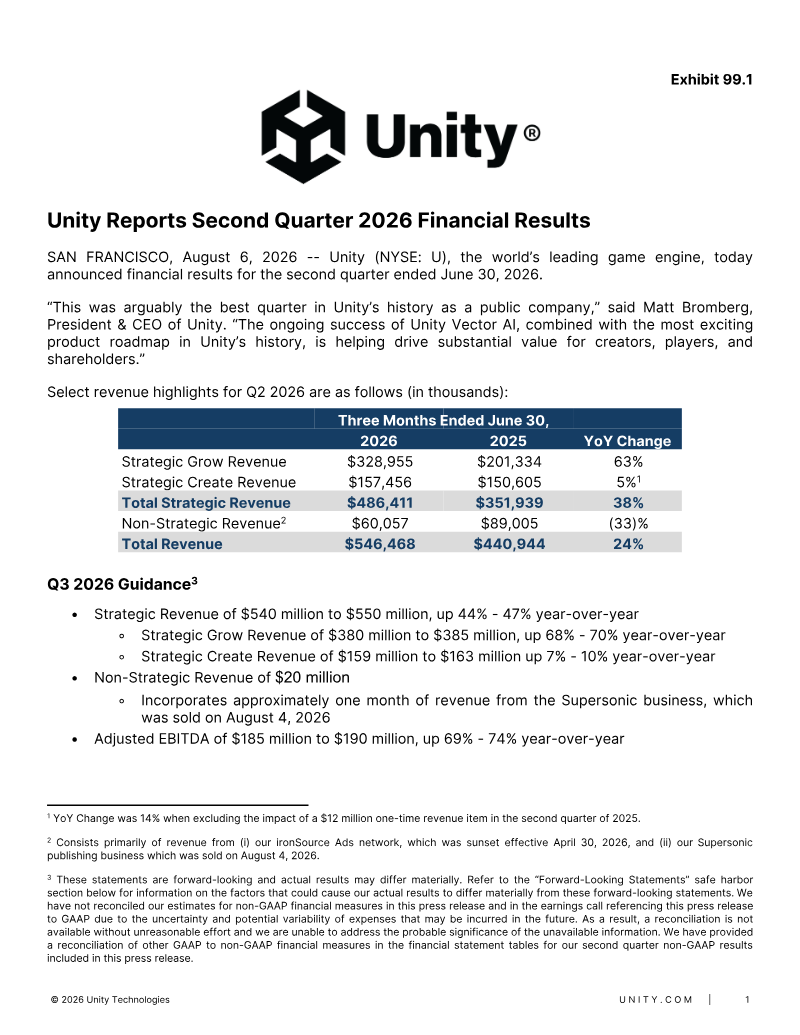
Unity Reports Second Quarter 2026 Financial Results
Unity reported its second quarter 2026 financial results, marking a period of significant growth and operational improvement for the company. Total revenue reached $546 million, representing a 24% increase year-over-year. This performance was largely driven by the success of the company’s strategic initiatives, particularly the Unity Vector AI tool, which bolstered the Grow Solutions segment. Strategic revenue climbed 38% year-over-year to $486 million, while Create Solutions revenue saw a modest 2% increase to $158 million, supported by subscription growth despite a portfolio reset in cloud and hosting services.
Profitability metrics showed substantial gains, with the company reporting an adjusted EBITDA of $160 million, a 29% margin compared to 21% in the same period of 2025. Net loss narrowed significantly to $23 million from $107 million in the prior year, and free cash flow rose to $202 million. These results reflect the company’s ongoing efforts to exercise cost discipline and realign its business model, which included the sunsetting of the ironSource Ads Network and the divestiture of the Supersonic publishing business in early August 2026.
The company maintains a positive outlook for the third quarter of 2026, projecting strategic revenue between $540 million and $550 million. Management continues to focus on long-term value creation through its product roadmap and artificial intelligence integration. As of June 30, 2026, the company held $2.36 billion in cash and cash equivalents, providing a stable liquidity position as it moves toward its goal of achieving GAAP profitability. These financial outcomes underscore a strategic shift toward core growth areas and enhanced operational efficiency within the global game engine and interactive development industry.
- Unity reported Q2 2026 total revenue of $546 million, a 24% year-over-year increase driven by the success of the Unity Vector AI tool.
- Adjusted EBITDA reached $160 million with a 29% margin, up from 21% in Q2 2025, while net loss narrowed to $23 million from $107 million.
- Strategic revenue grew 38% year-over-year to $486 million, significantly outpacing the 2% growth in Create Solutions revenue, which totaled $158 million.
- Free cash flow rose to $202 million, supported by a cash and cash equivalents balance of $2.36 billion as of June 30, 2026.
- Operational restructuring included the sunsetting of the ironSource Ads Network and the divestiture of the Supersonic publishing business in early August 2026.
+1
Unity
Article
Form 10-Q: Unity Q2 2026
Unity Software is currently undergoing a significant strategic pivot aimed at streamlining operations and refocusing on its core Create and Grow solutions. By sunsetting the ironSource Ads Network and divesting the Supersonic game publishing business, the company is actively shedding non-core assets to improve long-term operational efficiency. These restructuring efforts, while necessary for long-term alignment, have introduced short-term volatility, including revenue attrition and operational uncertainty that pose ongoing risks to the company’s path toward sustained profitability.
Financial performance for the first half of 2026 reflects this transition, characterized by a total revenue increase to $1.05 billion compared to $876 million in the prior-year period. Despite this growth, the company recorded a net loss of $371.2 million for the six-month period, heavily impacted by $270.5 million in impairment charges related to the aforementioned divestitures. However, the second quarter showed signs of stabilization, with a net loss narrowing to $23.6 million and adjusted EBITDA climbing to $160.2 million, up from $90.5 million in the second quarter of 2025.
The company maintains a stable liquidity position, with sufficient capital to meet working capital requirements and debt obligations over the next 12 months. Capital structure remains defined by $2.2 billion in outstanding unsecured convertible notes, while internal cost-control measures have included the suspension of the Employee Stock Purchase Plan. As the company moves past the August 2026 finalization of the Supersonic sale, management continues to navigate a complex transition period, marked by both executive leadership changes and a disciplined effort to optimize its core business segments for future growth.
- Unity reported a net loss of $369.6 million for the first half of 2026, significantly higher than the $185.3 million loss recorded in the same period of 2025.
- The company recorded $271 million in impairment charges during the first half of 2026, primarily affecting 'Developed technology' ($225 million) and 'Customer relationships' ($46 million) intangible assets.
- Unity shortened the estimated useful life of certain intangible assets, primarily developed technology, from 2–3 years down to 1–2 years effective April 1, 2026, due to plans to exit specific business lines.
- As of June 30, 2026, Unity holds $2.24 billion in total convertible note debt, with $557.2 million of the 2026 Notes classified as current liabilities.
- The company maintains a full valuation allowance against its deferred tax assets due to a history of losses, with $184.6 million in gross unrecognized tax benefits as of June 30, 2026.
+1
UnityAug 2026
Article
Form 10-Q: Q1 2026
Unity Software Inc. experienced a period of significant strategic transition and financial volatility during the first quarter of 2026. While the company achieved top-line growth with revenue reaching $508.2 million, up from $435 million in the prior-year period, this expansion was overshadowed by a substantial net loss of $346.9 million. The primary driver of this deficit was a $279 million impairment charge linked to the sunsetting of the ironSource Ads Network and the divestiture of the Supersonic game publishing business. These structural changes caused a sharp decline in gross profit margins, which fell to 31% from 74% in the same quarter of 2025.
Despite these accounting losses, the company maintains a stable liquidity position with $2.1 billion in cash and cash equivalents, supporting its ability to meet obligations over the next 12 months. Operational performance remains supported by growth in the Unity Ad Network and Create Solutions subscription revenue, alongside an improved adjusted EBITDA of $138.3 million. However, the company continues to carry an accumulated deficit of $4.5 billion and faces $3.1 billion in total contractual commitments, largely comprised of convertible notes and data center hosting agreements.
Looking forward, the organization is aggressively pivoting toward artificial intelligence integration to maintain market relevance. This strategic shift introduces new risks, including reliance on third-party AI models, escalating infrastructure costs, and a complex global regulatory environment. The company’s long-term stability depends on the successful execution of its current restructuring efforts and its ability to navigate competitive pressures in the software development sector. Given the high costs associated with these technological investments, the company may require additional capital or debt financing to sustain its growth trajectory and fulfill its AI-centric roadmap.
- Unity reported a GAAP net loss of $346.9 million for Q1 2026, significantly higher than the $77.9 million loss in Q1 2025, driven largely by a $278.7 million impairment of long-lived intangible assets.
- Despite the GAAP net loss, the company achieved an Adjusted EBITDA of $138.3 million for the quarter, up from $83.9 million in the same period last year.
- As of March 31, 2026, Unity held $2.2 billion in total outstanding unsecured convertible notes, including $690 million in 2030 Notes, $1.0 billion in 2027 Notes, and $558 million in 2026 Notes.
- The company maintains a strong liquidity position with $2.14 billion in cash and cash equivalents as of March 31, 2026, compared to $2.06 billion at the end of 2025.
- General and administrative expenses decreased year-over-year in Q1 2026, primarily due to reduced personnel costs following headcount reductions and lower allocated overhead.
+2
UnityMay 2026
Financial11 pages
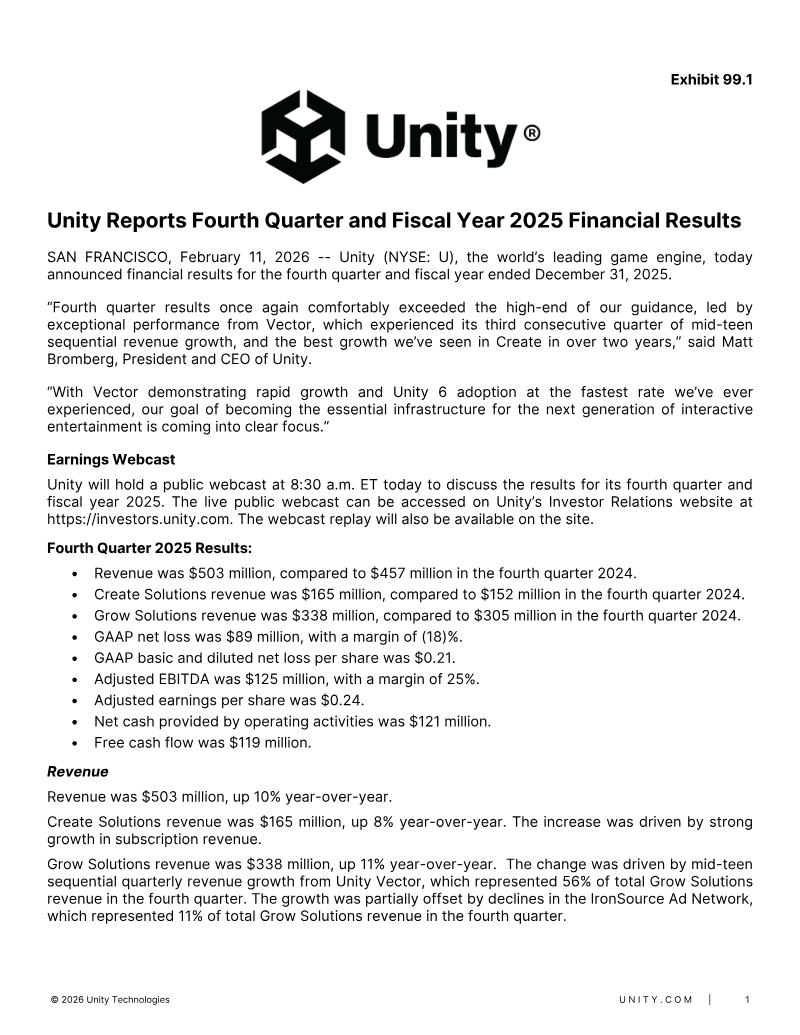
Unity Fourth Quarter and Fiscal Year 2025 Financial Results
Unity reported fourth‑quarter and full‑year 2025 financial results that surpassed guidance, driven largely by growth in its Vector platform and the Create segment. Revenue rose 10 % year‑over‑year to $503 million, with Create Solutions up 8 % to $165 million and Grow Solutions up 11 % to $338 million; Vector contributed 56 % of Grow revenue and delivered mid‑teen sequential growth. GAAP net loss narrowed to $89 million, a margin of –18 %, compared with –27 % in the prior year. Adjusted EBITDA reached $125 million, a 25 % margin versus 23 % previously, and adjusted EPS improved to $0.24 from $0.20.
Cash flow metrics strengthened: operating cash inflows climbed to $121 million, and free cash flow rose to $119 million. Cash balances increased by $536 million to $2.064 billion, supported by operating cash and proceeds from stock‑option exercise, offset by debt refinancing outflows. The company maintained a robust balance sheet with $3.34 billion in total liabilities and $3.24 billion in equity.
For Q1 2026, Unity projected revenue of $480–$490 million, flat growth in Grow, and double‑digit year‑over‑year growth in Create. The guidance reflects continued emphasis on Vector adoption and AI‑driven tools, positioning Unity as a core infrastructure provider for next‑generation interactive entertainment across mobile, PC, console, and extended reality platforms.
- Unity exceeded financial guidance for Q4 2025, achieving $503 million in revenue, a 10% year-over-year increase.
- Profitability improved as GAAP net loss narrowed to $89 million (–18% margin) and adjusted EBITDA grew to $125 million, representing a 25% margin.
- Revenue growth was driven by the Create segment (up 8% to $165 million) and the Grow segment (up 11% to $338 million), with the Vector platform contributing 56% of Grow revenue.
- The company strengthened its liquidity position, ending the year with $2.064 billion in cash, an increase of $536 million from the previous period.
- Free cash flow reached $119 million for the quarter, supported by $121 million in operating cash inflows.
+1
UnityFeb 2026
Financial1 pages
Unity 10-Q — Q3 FY2025
Unity Software Inc.’s Q3 FY2025 10‑Q demonstrates continued revenue growth amid persistent investment‑heavy spending. Revenue rose to $470.6 million, a 4% increase over the prior quarter and a 2% decline versus the nine‑month period, driven by expansion in Grow Solutions and subscription upgrades while Create Solutions services contracted. Gross profit margins improved modestly, yet operating losses widened slightly to a net loss of $126.8 million, reflecting higher interest expense from new convertible‑note issuances and ongoing workforce reductions.
Cash‑flow dynamics show a healthier liquidity position. Operating cash flow increased by $381 million, and financing activities generated $76.1 million in the quarter after a prior year outflow of $357.7 million, largely from convertible‑note proceeds and equity sales. Net cash used in investing activities fell to $18.3 million from $35.97 million a year earlier, and the company’s cash, cash equivalents, and restricted cash rose to $1.91 billion from $1.53 billion, supported by favorable foreign‑exchange effects.
Capital structure remains leveraged, with $2.23 billion in convertible notes and a total equity deficit of $4.05 million. No notes were converted during the period, and the company executed repurchase transactions that generated pre‑tax gains recorded as interest income. Capped call agreements to mitigate dilution incurred net costs of $92.5 million across 2026 and 2030 notes.
Adjusted EBITDA improved to $109 million from $91 million, and the dollar‑based net expansion rate climbed to 103% versus 94% a year earlier, indicating stronger customer retention and upsell. Despite these gains, the accumulated deficit of $4.0 billion signals ongoing operating losses and a likely need for future capital infusions to sustain growth initiatives. The company maintains unchanged critical accounting policies, market‑risk exposure, and internal controls, with no new material risks identified for the quarter.
- Unity reported a Q3 FY2025 net loss of $126.8 million, driven by increased interest expenses from convertible notes and ongoing workforce reduction costs.
- Revenue reached $470.6 million, representing a 4% sequential increase, though the company faces a 2% decline over the nine-month period due to contraction in Create Solutions.
- Liquidity improved significantly, with cash and cash equivalents rising to $1.91 billion from $1.53 billion, supported by $381 million in increased operating cash flow.
- Adjusted EBITDA grew to $109 million from $91 million, while the dollar-based net expansion rate improved to 103%, up from 94% in the prior year.
- The company maintains a leveraged capital structure with $2.23 billion in convertible notes and an accumulated deficit of $4.0 billion, suggesting a potential need for future capital infusions.
UnityNov 2025
Article
Unity 10‑Q – Q2 FY2025
Unity Software’s Q2 FY2025 filing demonstrates a mixed financial performance amid strategic shifts toward AI‑driven offerings and cost discipline. Consolidated revenue reached $1.12 billion, an 18% year‑over‑year increase largely driven by growth in the Unity Engine and cloud services segments, while six‑month revenue slipped 1.6% to $440 million due to a decline in Grow Solutions sales. Operating income rose 35% to $210 million, and the net loss narrowed to $45 million for the full year, though a six‑month net loss of $185 million persisted, reflecting higher operating expenses from R&D and sales‑marketing initiatives. Gross margin remained stable around 74% of revenue, with adjusted EBITDA improving to $90 million from $113 million in the prior year.
Cash flow dynamics show a net operating cash inflow of $146 million, supported by depreciation/amortization and stock‑based compensation adjustments. Investing cash use was modest ($14 million), while financing activities generated a net inflow of $22 million after significant convertible note repayments. Cash and restricted balances increased to $1.70 billion, providing a 12‑month liquidity cushion despite ongoing debt obligations and capped‑call purchases that limited dilution.
Debt remains substantial, with fair values of 2027, 2026, and 2030 notes ranging from $520 million to $1.1 billion; no conversions occurred, and interest expense was modest ($6–$11.9 million). Legal proceedings are largely resolved, though potential AI‑related regulatory and IP risks persist. Overall, Unity balances growth in core engine services with disciplined cost management while maintaining sufficient liquidity to support near‑term capital needs.
- Unity reported Q2 FY2025 consolidated revenue of $1.12 billion, marking an 18% year-over-year increase driven by growth in the Unity Engine and cloud services.
- Operating income rose by 35% to $210 million, while the annual net loss narrowed to $45 million despite a $185 million net loss recorded over the first six months.
- The company maintains a strong liquidity position with $1.70 billion in cash and restricted balances, providing a 12-month cushion for operations and debt obligations.
- Adjusted EBITDA improved to $90 million, supported by a stable gross margin of approximately 74% and disciplined cost management.
- Six-month revenue declined by 1.6% to $440 million, primarily attributed to a downturn in the Grow Solutions business segment.
UnityAug 2025
Financial1 pages
Unity 10-Q — Q1 FY2025 (May 2025)
Unity Software’s Q1 FY2025 filing presents a mixed financial picture amid strategic realignment. Revenue declined 4 % to $435 million, largely due to weaker Create Solutions professional‑services and consumption streams, while Grow Solutions revenue slipped under competitive pressure and a shift toward the company’s new AI platform. Operating expenses fell 35 % to $449 million, driven by workforce reductions and lower R&D and sales‑marketing costs, resulting in a net loss of $77.9 million versus a $291.5 million loss the prior year. The dollar‑based net expansion rate dropped to 97 % from 101 %, reflecting the impact of reduced Grow Solutions performance despite subscription growth.
Deferred revenue and future commitments remain substantial. As of January 1, 2025, $78.7 million of revenue recognized in Q1 was still deferred, and $309 million in unrecognized commitments—primarily Create Solutions subscriptions, Enterprise Support, and Strategic Partnerships—are expected to be recognized over the next 12 months. These commitments span one to five years and represent a significant portion of Unity’s projected revenue stream.
Cash‑flow dynamics improved markedly. Operating activities generated $13.0 billion of cash, a sharp turnaround from the $7.4 billion loss in 2024, while investing outflows of $5.7 billion were largely due to property and equipment purchases. Financing activities supplied a record $12.2 billion, driven by convertible‑note proceeds and equity issuances that offset debt repayments. Free cash flow rose to $7.3 billion, supported by a $1.5 billion cash balance and new debt issuances used for note repurchases.
Risk disclosures emphasize macro‑economic uncertainty, high interest rates, market volatility, and trade policy risks that could constrain funding access or materially affect financial condition. The company’s convertible senior notes program—$690 million issued in 2025 and over $3.4 billion total—poses potential dilution and liquidity challenges if converted or repaid, potentially impacting working capital and takeover prospects.
- Unity reported a 4% revenue decline to $435 million in Q1 FY2025, driven by underperformance in Create Solutions professional services and competitive pressures within Grow Solutions.
- Operating losses narrowed significantly to $77.9 million from $291.5 million in the prior year, supported by a 35% reduction in operating expenses following workforce cuts and lower R&D spending.
- Cash flow dynamics improved substantially, with operating activities generating $13.0 billion compared to a $7.4 billion loss in 2024, and free cash flow rising to $7.3 billion.
- The dollar-based net expansion rate fell to 97% from 101%, signaling a decline in existing customer spending despite growth in subscription volume.
- Unity holds $309 million in unrecognized revenue commitments expected to be recognized over the next 12 months, primarily tied to Create Solutions subscriptions and enterprise partnerships.
UnityMay 2025

Financial1 pages
Unity 2024 FY Annual Report
Unity Software Inc.’s FY 2024 Form 10‑K presents a comprehensive view of the company’s financial health, strategic priorities, and risk landscape. The report records revenue of $1.813 billion—an 18 % decline from the prior year—driven by a 27 % drop in Create Solutions and a 10 % decline in Grow Solutions. Gross margin improved to 73 %, yet operating expenses rose to $2.088 billion, resulting in a net loss of $664 million and an accumulated deficit of $3.7 billion. Despite these losses, operating cash flow reached $315 million and free cash flow $286 million, leaving a $1.5 billion cash cushion that supports ongoing investment in product innovation and AI integration.
Strategically, Unity has executed a portfolio reset, eliminating non‑strategic revenue streams and shifting to a subscription model. Workforce reductions incurred $214 million in separation costs, while R&D, sales‑marketing, and G&A expenses fell in absolute terms. The company’s capital structure includes $2.24 billion of convertible notes, with a recent $415 million repurchase generating a pre‑tax gain. Share‑based compensation rose to $596 million, reflecting continued equity‑funding and employee retention efforts.
Risk disclosures emphasize dependence on gaming customers, platform innovation, and cross‑selling of Create and Grow solutions. Competitive pressures, privacy‑policy shifts by Apple and Google, regulatory compliance across multiple jurisdictions, and geopolitical tensions—particularly in China—are highlighted as material uncertainties. Cyber‑security threats, intellectual‑property protection, and potential litigation over open‑source licensing further compound operational risk. The company’s net operating loss carryforwards, subject to expiration and ownership limits, may constrain future tax benefits. Overall, Unity’s FY 2024 performance underscores a challenging revenue environment tempered by disciplined cost management and significant cash reserves, while strategic risks remain pronounced across technology, regulatory, and market domains.
- Unity reported $1.813 billion in FY 2024 revenue, an 18% year-over-year decline driven by a 27% drop in Create Solutions and a 10% decline in Grow Solutions.
- The company recorded a net loss of $664 million and carries an accumulated deficit of $3.7 billion, despite achieving a 73% gross margin.
- Operating cash flow reached $315 million and free cash flow hit $286 million, providing a $1.5 billion cash cushion to fund AI integration and product innovation.
- Unity executed a portfolio reset and workforce reduction, incurring $214 million in separation costs while reducing absolute spending in R&D, sales-marketing, and G&A.
- The company holds $2.24 billion in convertible notes, having recently executed a $415 million repurchase to generate a pre-tax gain.
UnityFeb 2025
Report41 pages
Mobile Growth and Monetization Report 2023
The report establishes that mobile game monetization is most effective when focused on early‑stage conversion and strategic ad placement. Analysis of 31 billion in‑app purchase events shows that 77 % of players who convert do so within the first two weeks, with currencies and limited‑time sales accounting for 22–23 % and 15–20 % of revenue respectively. Pricing the first purchase between $1 and $5 maximizes conversion efficiency, while targeting tier‑2 markets and deploying offerwalls can further enhance retention.
Rewarded‑ad data, derived from 31 billion monthly impressions and 158 million installs, identifies high‑engagement placements between levels, in the IAP store, and lobby screens. Extra‑reward, currency, and gacha offers drive the greatest engagement. Offerwalls contribute roughly 33 % of total ad revenue, delivering about $4.68 per converted user; multi‑reward offers generate 60–82 % of conversions and can yield up to $68 per completion. These insights suggest that placing high‑visibility rewarded ads and integrating offerwalls can simultaneously boost retention and monetization.
Complementary tactics such as custom store pages further improve player engagement. Offerwall conversions can increase day‑7 to day‑120 retention by up to fivefold, especially for high‑engagement segments. Custom store pages allow developers to align in‑game messaging with ad creatives, reducing resource costs and enhancing conversion rates. Targeting genre‑specific markets—sports in Japan or trivia in South Korea—can lift click‑through rates above tier‑2 averages, underscoring the importance of data‑driven audience and creative optimization.
Overall, the findings emphasize a focused strategy: early conversion pricing, strategic rewarded‑ad placement, offerwall integration, and tailored store experiences. These combined tactics deliver measurable gains in retention, revenue, and campaign efficiency across iOS and Google Play platforms worldwide.
- 77% of players who make in-app purchases convert within the first two weeks, with the highest conversion efficiency achieved by pricing initial offers between $1 and $5.
- Offerwalls contribute approximately 33% of total ad revenue and can increase day-7 to day-120 player retention by up to fivefold.
- Multi-reward offerwall campaigns generate 60–82% of conversions and can yield up to $68 per completion, while delivering an average of $4.68 per converted user.
- In-app currencies account for 22–23% of revenue, while limited-time sales contribute 15–20%.
- High-engagement rewarded ad placements are most effective when positioned between game levels, within the IAP store, or on lobby screens.
+2
UnityJan 2025
Article
Unity Q3 2024 Financial Results
Unity’s third‑quarter fiscal 2024 filing reports a sharp revenue contraction to $446 million, down 16 % from the prior year’s $544 million. The decline is driven primarily by lower sales in Grow Solutions and the loss of a Wētā FX subscription, while core engine and cloud subscriptions continue to grow. Operating expenses rose to $462 million, resulting in a Q3 operating loss of $127 million and a net loss of $125 million. Despite the cumulative loss of $3.61 billion, cash balances remain robust at $1.41 billion, sufficient to fund ongoing operations and strategic initiatives for at least a year.
Cash‑flow analysis shows net outflows of $188 million, largely due to financing activities: a $415 million convertible‑note sale and a $250 million common‑stock repurchase. Operating cash generation improved to $203 million, and investing outflows fell to $36 million. Adjusted gross profit rose to $374 million, with an adjusted margin of 84 %. Adjusted EBITDA fell to $91.7 million, and free cash flow for the nine months ended September 30 reached $180 million.
Strategically, Unity is executing a portfolio reset that has eliminated non‑core businesses and cut 25 % of staff in early 2024, concentrating resources on the Unity Engine, Cloud, and Monetization solutions. The company cautions that failure to achieve cost savings or timely product releases could jeopardize profitability, while rapid technological change and competitive pressures—particularly from AI and platform policy shifts—pose ongoing risks.
Risk disclosures highlight significant uncertainties in expanding beyond gaming, regulatory compliance across multiple jurisdictions, and exposure to cybersecurity threats, intellectual‑property litigation, and currency fluctuations. The company’s convertible debt structure also presents liquidity and dilution risks that could materially affect future financing or takeover prospects.
- Unity reported a 16% year-over-year revenue decline to $446 million in Q3 2024, driven by weakness in Grow Solutions and the loss of the Wētā FX subscription.
- The company recorded a Q3 operating loss of $127 million and a net loss of $125 million, despite maintaining an adjusted gross margin of 84%.
- Unity holds $1.41 billion in cash, which management expects will fund operations and strategic initiatives for at least the next 12 months.
- Operational cash generation reached $203 million, contributing to a year-to-date free cash flow of $180 million as of September 30.
- The company is undergoing a portfolio reset that included a 25% staff reduction in early 2024 to focus resources on the Unity Engine, Cloud, and Monetization solutions.
+2
UnityNov 2024
Article
Unity 10‑Q: Q2 FY2024
Unity Software’s Q2 FY2024 filing reports a sharp decline in operating performance, with revenue falling 13 % YoY to $1.12 billion and a net loss of $0.58 billion, compared with a $0.32 billion loss in the prior year’s quarter. Cash burn accelerated to $1.07 billion, driven by higher R&D and SG&A expenses, reducing the cash balance to $1.45 billion from $2.12 billion at year‑end FY2023. The company’s debt restructuring included a $415 million repayment of 2026 notes, generating a pre‑tax gain and triggering capped call transactions that cost $48.1 million and issued 5.6 million shares, thereby mitigating dilution while creating potential future equity pressure.
Revenue drivers shifted: Create Solutions revenue dropped 15 % YoY to $449 million due to the loss of a key subscription and reduced professional‑services income, while Grow Solutions revenue slipped amid intensified advertising competition. Adjusted gross margin improved to 84 % and adjusted EBITDA rose to $113 million, reflecting lower stock‑based compensation and restructuring costs. Operating losses widened to $125 million, yet operating cash flow remained positive at $81 million, largely from non‑cash items. Free cash flow fell to $65 million after capital expenditures of $15.9 billion, leaving a cash balance of $1.3 billion and $750 million available under the share‑repurchase program.
The filing underscores significant uncertainty in growth prospects, citing limited historical data at current scale, integration risks from the ironSource acquisition, and competitive pressures in both gaming and advertising. Regulatory exposure is highlighted across privacy, data‑security, AI, and export controls, with potential tax implications from digital service taxes and OECD Pillar rules. Geopolitical instability, cyber‑attack risk, and third‑party platform disruptions are identified as operational threats that could impair service delivery and increase costs. Unity stresses the need for disciplined cost management, robust risk mitigation, and continued investment in platform reliability to navigate these challenges and restore profitability.
- Unity reported a 13% YoY revenue decline to $1.12 billion and a net loss of $0.58 billion, nearly doubling the $0.32 billion loss recorded in the same quarter last year.
- Cash reserves dropped significantly to $1.45 billion from $2.12 billion at the end of FY2023, driven by accelerated cash burn and high R&D and SG&A expenses.
- Create Solutions revenue fell 15% YoY to $449 million due to the loss of a major subscription contract and lower professional-services income, while Grow Solutions revenue also declined amid increased advertising competition.
- The company executed a $415 million debt repayment of 2026 notes, resulting in a $48.1 million cost for capped call transactions and the issuance of 5.6 million shares.
- Despite wider operating losses of $125 million, the company achieved an adjusted EBITDA of $113 million and maintained positive operating cash flow of $81 million through reduced stock-based compensation and restructuring costs.
UnityAug 2024
Financial1 pages
Unity 10-Q — Q1 FY2024
Unity Software’s first‑quarter FY2024 filing outlines a company in transition, grappling with persistent operating losses while pursuing portfolio realignment and cost discipline to achieve GAAP profitability. Revenue declined 8 % year‑over‑year to $460 million, with Create Solutions down 12 % and Grow Solutions slightly lower at $297 million. Operating expenses rose to $691 million, driven largely by a $266 million increase in stock‑based compensation and $193 million of employee separation costs, resulting in a net loss of $291 million. Cash and cash equivalents fell to $1.19 billion, while unrecognized long‑term performance obligations of $357 million—primarily for Create Solutions and Enterprise Support—are expected to be recognized over the next 12 months.
The company maintains a full valuation allowance against deferred tax assets in multiple jurisdictions, leaving $184 million of unrecognized tax benefits that could materially affect the effective tax rate if realized. Interest expense decreased due to reduced amortization from convertible note repurchases, whereas interest income rose sharply following a $61 million gain on debt repurchase. Legal exposure remains significant, with pending securities class actions and derivative suits, while integration of ironSource adds further uncertainty.
Risk disclosures emphasize competitive pressure from internal rival development and lower‑priced alternatives, regulatory challenges across privacy, AI, gambling, and export controls—particularly in China—and cyber‑security threats highlighted by past Log4j incidents. Credit, liquidity, and currency risks are noted alongside potential dilution from future equity issuances and the absence of dividend policy. The filing concludes that failure to execute restructuring plans, realize synergies, or navigate evolving regulatory and technological landscapes could materially harm Unity’s financial performance and market position.
- Unity reported a net loss of $291 million for Q1 FY2024, driven by $691 million in operating expenses that included $266 million in stock-based compensation and $193 million in employee separation costs.
- Total revenue declined 8% year-over-year to $460 million, with the Create Solutions segment falling 12% and Grow Solutions revenue totaling $297 million.
- Cash and cash equivalents decreased to $1.19 billion, while the company holds $357 million in unrecognized long-term performance obligations expected to be recognized over the next 12 months.
- The company faces significant legal exposure from pending securities class actions and derivative suits, alongside integration uncertainties following the acquisition of ironSource.
- Unity maintains a full valuation allowance against deferred tax assets, with $184 million in unrecognized tax benefits that could materially impact the effective tax rate if realized.
UnityMay 2024