User Acquisition reports and market data
1,364 game industry reports, presentations and talks about user acquisition from writers such as PocketGamer.biz, Two & a Half Gamers and Deconstructor of Fun, newest from 2026. Every document has a summary and key insights with the page they come from, and 3,211 charts and tables are extracted as data.
Key figures
Video content dominates user acquisition, comprising 73.7% of all advertising creatives, with a shift toward mid-length formats featuring live-action hooks and AI-generated visuals.
SocialPeta, 2026 · 2026 Southeast Asia Mobile Game Marketing Report, p. 10
Vietnam's mobile IAP revenue grew by 3.13% MoM in May 2026, driven by strong monetization in long-lifecycle genres like Battle Royale, MOBA, and Sim Sports rather than new user acquisition.
Gamota, 2026 · Vietnam Game Industry Monthly Report: May 2026, p. 5
Global mobile user acquisition (UA) spend reached $78 billion in 2025, representing a 13% year-on-year increase.
InvestGame, 2026 · The Essential UA Financing Guide: 2026, p. 2
User acquisition competition is intensifying, evidenced by a 50% increase in Target ROAS spending and a 57% rise in Target CPE spending, particularly within Utilities and Entertainment.
Mintegral, 2026 · 2026 Global Non‑Gaming App Trends Report, p. 13
82% of developers report that reward-based user acquisition (UA) campaigns outperform traditional non-rewarded methods.
Almedia, 2026 · Rewarded Returns: The Developer Perspective, p. 3
Documents

🚨📢BREAKING NEWS: BioWare Shutdown 😱, PEGI 16 rating on lootboxes, Griffin Gaming film studio
The current landscape of the gaming industry is marked by significant structural shifts, including major corporate restructuring, regulatory tightening, and evolving investment strategies.
- Electronic Arts has initiated a major restructuring that includes the closure of the BioWare studio following the underperformance of Dragon Age: The Veilguard.
- Apple’s App Store review process is facing significant delays, with wait times extending to several weeks due to an influx of over 50,000 AI-generated submissions per day.
- The Pan European Game Information (PEGI) agency has implemented a new policy requiring a 16+ rating for games featuring paid loot boxes, a mandate that now applies to titles like Pokémon TCG Pocket.

TWIG #406: What if Roblox Goes Private and Which Games Get Kicked by GTA VI
The global gaming industry is currently navigating a period of intense structural adjustment, characterized by a shift toward sustainable development models and the challenges of balancing creative ambition with public market expectations.
- Grand Theft Auto VI poses a significant market threat, with 69% of adult gamers intending to play the title at launch, likely displacing competitive shooters and sports games.
- Roblox may need to transition to a private company to escape quarterly earnings pressure and resolve the conflict between its low-fidelity content model and public market demands for AAA-quality experiences.
- The gaming industry is shifting away from high-frequency content models toward system-driven designs to improve player retention and operational efficiency.

🧙 Solo Dev Journey #2: Am I Making ANY Money?
This analysis examines the financial mechanics of mobile game user acquisition (UA) through the lens of a solo developer managing the title One Mage Army.
- Profitability in mobile UA is driven by the relationship between CPI and LTV over a defined payback window rather than immediate day-zero returns.
- The developer achieved a 103% return on ad spend (ROAS) over a 30-day period by scaling daily UA expenditure from $200 to $2,500.
- Aggressive paid UA scaling creates a compounding effect by boosting organic install volume alongside paid acquisition.

Why Use Tenjin’s MCP Server?
Tenjin’s Model Context Protocol (MCP) server serves as a bridge between AI assistants like Claude and live mobile measurement partner (MMP) tools.
- Tenjin’s Model Context Protocol (MCP) server enables AI assistants like Claude to perform both read and write operations, moving beyond passive reporting to active execution of mobile measurement tasks.
- The platform allows users to manage technical infrastructure, including creating applications, configuring callbacks, and setting up tracking links, directly through natural language commands.
- By automating routine account management and API chains across ad networks and analytics tools, the system eliminates the need for manual dashboard navigation and reduces data fragmentation.

🚨📢BREAKING NEWS: New Adnetwork AdSURGE is here, Supercell Kills Squad Busters, Ubisoft Quits Mobile
The mobile gaming industry is currently experiencing a significant shift characterized by the emergence of new ad-tech infrastructure and a wave of high-profile project cancellations.
- Miniclip, in partnership with Tencent and Easybrain, has launched AdSurge, a new ad network leveraging first-party data to compete in the mediation and ad-tech space currently dominated by AppLovin and Unity.
- Supercell is shutting down Squad Busters, with the game being pulled from stores on December 1 and servers closing on December 14, marking a rare global launch failure for the studio.
- Ubisoft is exiting mobile game development in Europe, highlighted by the closure of its Helsinki-based studio RedLynx and the cancellation of Rainbow Six Mobile.

🎯 20 years' experience: Luis de la Camara on WHY the networks know your users better than YOU!
Mobile game developers must shift their user acquisition strategy from adversarial competition with ad networks to a collaborative model that leverages the superior data capabilities of demand-side platforms.
- Mobile developers must transition from adversarial competition with ad networks to a collaborative model that leverages the superior user-behavior data held by demand-side platforms (DSPs).
- Studios should prioritize direct-response performance marketing over broad awareness campaigns to avoid the risks associated with inflated cost-per-install (CPI) metrics.
- Analyzing eCPM decay curves allows developers to distinguish between players driven by in-app purchases and those driven by ad-based revenue, enabling more precise audience segmentation.
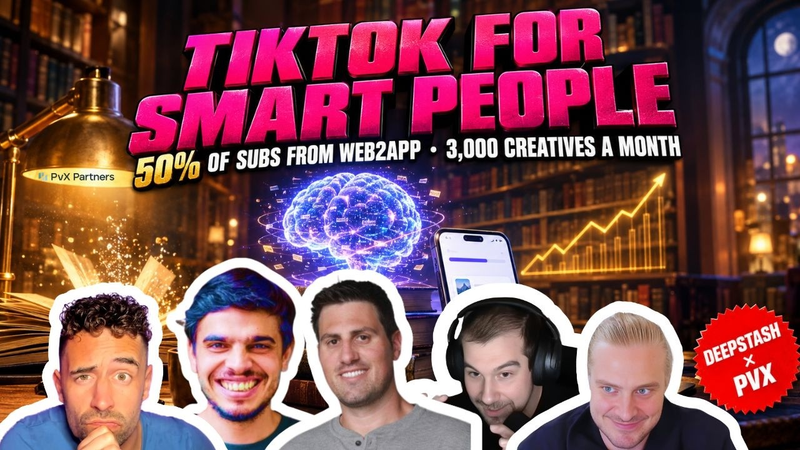
🧠 How Deepstash gets 50% of subscribers from Web2App & 3,000 creatives a month
Deepstash has established a highly effective growth model by positioning microlearning as a gamified, subscription-based alternative to passive social media consumption.
- Deepstash acquires over 50% of its paid subscribers through a Web2App funnel, leveraging microlearning as a gamified, subscription-based alternative to social media.
- Deepstash's cross-promotion ecosystem with niche educational apps achieves conversion rates 10x higher than standard advertising channels.
- A 30-person team generates 3,000 creative assets monthly, utilizing AI-driven automation to maintain rapid testing and cultural relevance.

The Solo Developer Making Seven Figures From Free Browser Games
Abe Train has established a highly profitable independent game studio by focusing on daily, browser-based educational titles that cater to a niche, highly engaged audience.
- Abe Train, founder of Trainwreck Labs, transitioned from a business intelligence role at HelloFresh to a successful solo developer by launching daily browser games like Globle, which peaked at over one million daily players.
- The developer prioritizes building a small, obsessive core audience over a large, casual one, noting that highly engaged players provide valuable feedback that improves game accessibility and longevity.
- Monetization through ads resulted in negligible player backlash, as users generally expect ads on the web; the developer now complements this with a subscription model that removes ads and adds multiplayer functionality.
2026 Southeast Asia Mobile Game Marketing Report
The Southeast Asian mobile gaming landscape in 2026 reflects a maturing ecosystem defined by a 19.7% year-over-year increase in active advertisers.
- The Southeast Asian mobile gaming market saw a 19.7% year-over-year increase in active advertisers in 2026, signaling a rapidly maturing ecosystem.
- Video content dominates user acquisition, comprising 73.7% of all advertising creatives, with a shift toward mid-length formats featuring live-action hooks and AI-generated visuals.
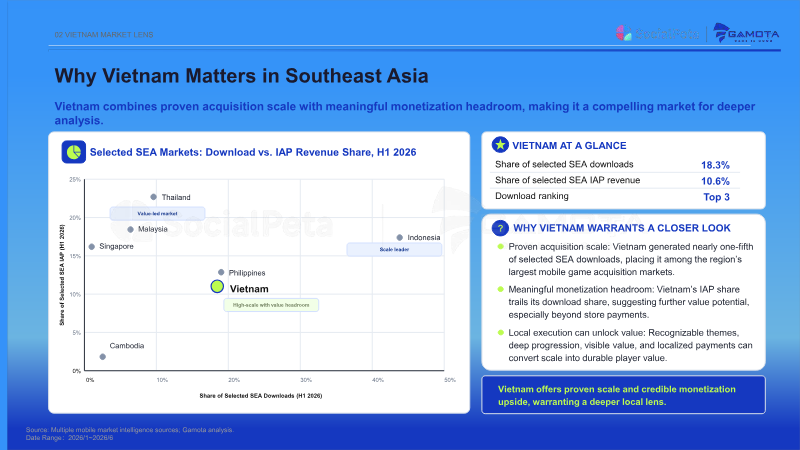
- Indonesia leads the region in total download volume, while Thailand maintains the highest revenue per user through in-app purchases.

💍 Rotate Rings was a FAKE ad for a YEAR. Now it's a GAME With 1M DAU in 2 Weeks
Rotate Rings, a mobile puzzle game, has achieved rapid market penetration within two weeks of its launch, reaching 1 million daily active users (DAU) and generating 500,000 to 600,000 downloads per day.
- Rotate Rings achieved 1 million daily active users (DAU) and 500,000 to 600,000 daily downloads within two weeks of its launch by converting a proven high-performing UA creative into a standalone game.
- The game’s development strategy relied on over a year of testing the core physics-based mechanic as an advertisement within other titles like Tasty Travels and Century Games projects.
- Monetization is intentionally conservative, generating $45,000 to $50,000 in daily ad revenue by delaying interstitial ads to prioritize long-term user retention over immediate profit.

Mobile & F2P | Marek Pasieczny | ASO Meets AI: The LLM Advantage | Digital Dragons 2026
The landscape of mobile application discovery is undergoing a fundamental transformation, shifting from traditional, keyword-centric search models toward intent-driven, conversational interactions powered by Large Language Models.
- Large Language Models (LLMs) are shifting user behavior from traditional keyword-based searches to intent-driven, conversational prompts, requiring ASO strategies to evolve beyond simple metadata optimization.
- App stores are increasingly integrating AI-driven algorithms; Apple updated its search algorithm on April 22, 2026, to better align with user intent, while Google Play introduced core updates in late March 2026 to prioritize social proof and conversational relevance.
- To improve visibility in AI-generated shortlists, developers should focus on high-authority external content such as comparison pages, review accelerators like Capterra and G2, and community-driven platforms like Reddit, which LLMs actively scrape.

🐌 Voodoo's mid-core ERA: Draft Showdown is Battle Legion with the friction removed
Voodoo is successfully transitioning into the mid-core market by applying a hybrid-casual philosophy to complex genres, most notably through the auto-battler Draft Showdown.
- Voodoo’s auto-battler Draft Showdown currently generates $120,000 in daily revenue with 400,000 daily active users, with projections estimating a peak of $200,000 to $300,000 as the title matures.
- The game successfully scales mid-core mechanics by applying a hybrid-casual philosophy, specifically removing complex unit placement friction and integrating roguelite elements to prioritize active, counter-based gameplay.
- Monetization is driven by a high-volume strategy featuring seven distinct rewarded ad placements and a double-dipping interstitial system, supplemented by a Draft Pass for in-app purchases.