Report26 pages
China Steam & PC Gaming Market Report: 2025
The Chinese PC gaming market has reached a valuation of approximately $11–12 billion within a broader national gaming industry worth RMB 350.78 billion. Steam maintains a dominant position, commanding an 87% market share, though the broader distribution landscape remains highly fragmented. Developers must navigate a complex ecosystem where traditional storefront metrics are often obscured by grey-market and cross-region transactions. Consequently, pricing strategies must account for local market realities, as Steam titles in China are consistently priced 21% to 37% lower than Western benchmarks to align with regional purchasing power and consumer expectations.
Success in this market is increasingly predicated on community-led discovery rather than traditional store-page traffic. Platforms such as Bilibili, TapTap, Heybox, and Sonkwo serve as essential hubs for user-generated content, creator-driven promotion, and player engagement. The rise of a sophisticated fan economy further underscores this shift, as hit titles are now built through long-term community hype and viral social media resonance. Specialized offline events, such as WePlay Expo and G-Fusion, have proven more effective for reaching core PC and indie gaming audiences than mass-market trade shows.
International developers looking to penetrate this sector must prioritize local content ecosystems over conventional marketing funnels. Because discovery and validation are driven primarily by streamers and community influencers, go-to-market strategies require deep integration with Chinese digital platforms. Navigating these unique cultural and commercial dynamics necessitates specialized local expertise to effectively manage community engagement and optimize commercialization efforts within this distinct, high-growth environment.
- Steam dominates the Chinese PC gaming market with an 87% share, contributing to a total PC gaming valuation of approximately $11–12 billion.
- Pricing for Steam titles in China must be adjusted 21% to 37% lower than Western benchmarks to align with local purchasing power and consumer expectations.
- Market discovery is driven by community-led engagement on platforms like Bilibili, TapTap, Heybox, and Sonkwo rather than traditional store-page traffic.
- Successful market entry requires deep integration with local digital ecosystems and influencer-driven promotion rather than conventional marketing funnels.
- Specialized offline events such as WePlay Expo and G-Fusion are more effective for reaching core PC and indie gaming audiences than mass-market trade shows.
+1
Asia GameDev
Report4 pages
Market Model Reports: Asia & MENA
The 2026 Market Model Reports provide a comprehensive analysis of video game industry performance and growth projections across Asia and the Middle East and North Africa (MENA). Covering China, East Asia, India, Southeast Asia, and the MENA-3 region (Egypt, Saudi Arabia, and the UAE), the research evaluates revenue trends, player demographics, and macroeconomic influences through 2030. The analysis utilizes proprietary market modeling, player survey data, and regional expertise to assess the evolving landscape of mobile, PC, and console gaming.
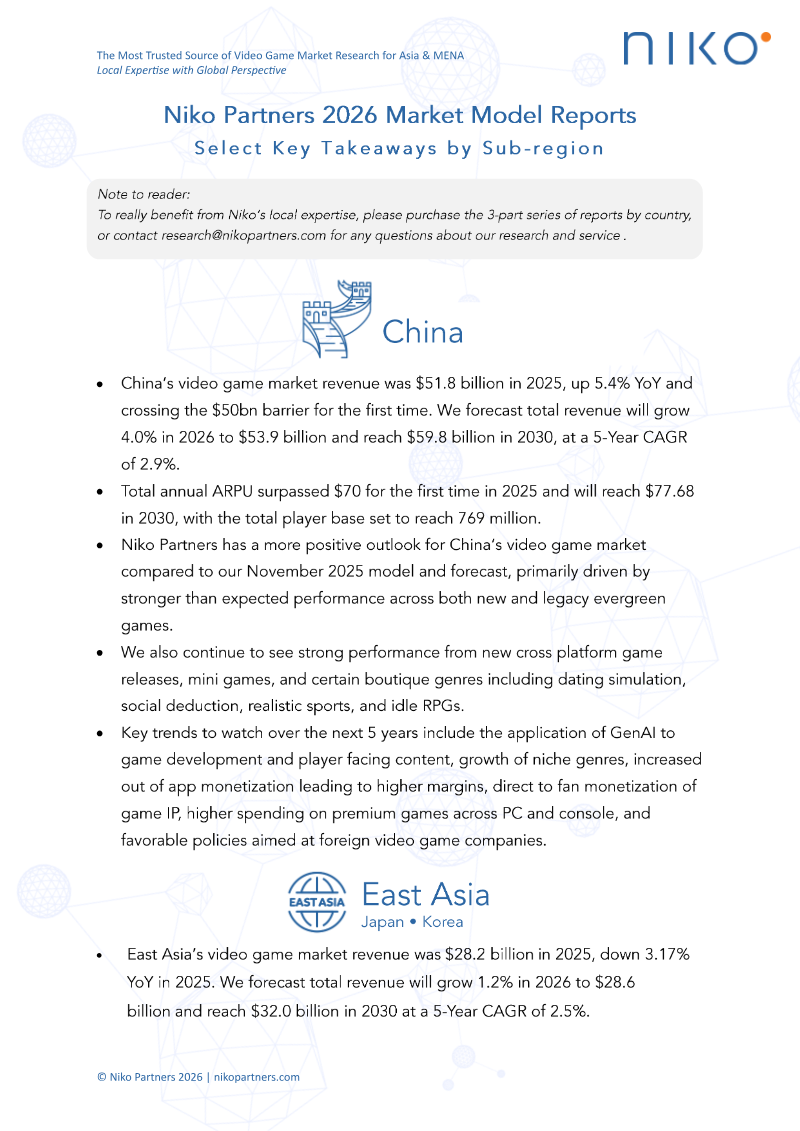
Key findings highlight significant regional disparities in growth and maturity. China remains a dominant force, with 2025 revenue reaching $51.8 billion and a projected 2.9% CAGR through 2030. India emerges as the fastest-growing market, having surpassed $1 billion in revenue in 2025 with an expected 11.2% CAGR. Conversely, East Asia experienced a 3.17% revenue decline in 2025 due to macroeconomic pressures in Japan, though South Korea shows signs of recovery. Southeast Asia continues to expand, driven by mobile adoption and internet penetration, while the MENA-3 region benefits from strong government support and rising disposable income, despite potential geopolitical headwinds.
The research identifies several critical industry drivers, including the integration of generative AI, the rise of niche genres, and increased government regulation across Southeast Asia. Higher average revenue per user (ARPU) remains a focal point, particularly in East Asia, which maintains the highest regional spending levels. Overall, the findings suggest that while short-term volatility persists due to economic and geopolitical factors, the broader outlook for these markets remains positive, supported by increased localization, infrastructure development, and shifting consumer spending toward digital entertainment.
- China’s video game market reached $51.8 billion in 2025 and is projected to grow at a 2.9% CAGR to reach $59.8 billion by 2030.
- India is the fastest-growing market tracked, with 2025 revenue of $1.04 billion and a projected 11.2% CAGR through 2030, supported by a player base expected to reach 707 million.
- East Asia remains the region with the highest ARPU, though 2025 revenue declined 3.17% to $28.2 billion due to Japanese market stagnation and macroeconomic conditions.
- Southeast Asia’s market revenue hit $5.63 billion in 2025 and is forecast to grow at a 4.8% CAGR, with Thailand, the Philippines, and Indonesia identified as the fastest-growing sub-markets.
- The MENA-3 region (Egypt, Saudi Arabia, UAE) generated $2.15 billion in 2025 and is expected to see the strongest ARPU growth, reaching $38 by 2030 despite potential geopolitical instability.
+3
Niko PartnersJun 2026
Report2 pages
Summary of Main Supplementary Explanations Questions and Answers: FY2023 Second Quarter
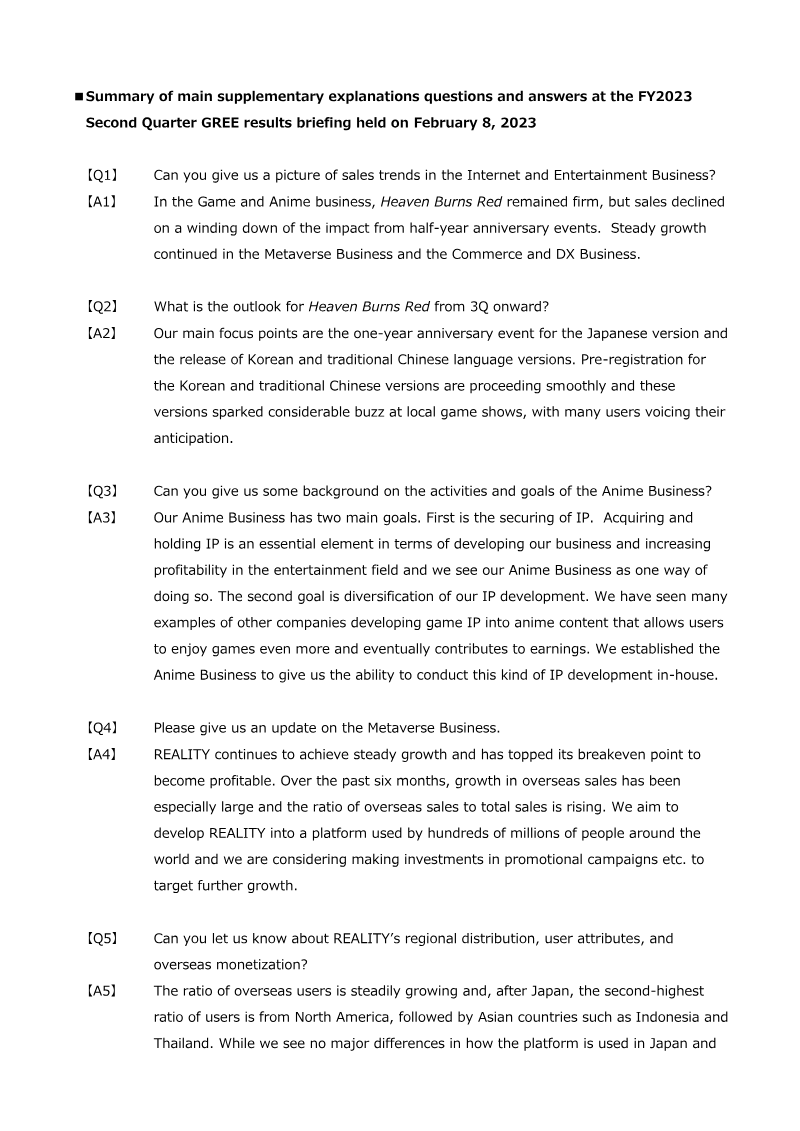
The briefing outlines GREE’s performance and strategic outlook for the second quarter of FY2023, focusing on its Internet and Entertainment Business. Sales in the Game and Anime segment remained steady for “Heaven Burns Red,” though revenue tapered after the half‑year anniversary promotion; growth continued in Metaverse and Commerce & DX divisions. The company anticipates a one‑year anniversary event for the Japanese version of Heaven Burns Red and imminent releases in Korean and traditional Chinese, with pre‑registrations already generating significant buzz at local game shows. The Anime Business is positioned to secure and diversify intellectual property, enabling in‑house development of game‑to‑anime adaptations that can enhance user engagement and revenue.
Metaverse operations, branded as REALITY, have surpassed the break‑even point and achieved profitability. Over the past six months, overseas sales grew markedly, with North America leading after Japan, followed by Indonesia and Thailand. User demographics skew female and Generation Z, with a strong preference for private communication features. Monetization streams—live‑stream gifting, avatar sales, and in‑game purchases—are expanding consistently across regions.
Advertising spend is expected to rise in the third quarter, driven by anniversary events and new language releases for Heaven Burns Red, as well as intensified promotion of REALITY. Operating income projections for the Internet and Entertainment Business in Q3 FY2023 range from ¥1.0 billion to ¥1.5 billion, contingent on the performance of the Korean and Chinese versions.
The Investment and Incubation Business remains cautious, with potential short‑term losses anticipated due to market conditions. However, diversified investment timing and targets are projected to stabilize contributions over the medium‑to‑long term.
- GREE projects Q3 FY2023 operating income for its Internet and Entertainment Business to range between ¥1.0 billion and ¥1.5 billion, heavily dependent on the performance of new Korean and traditional Chinese releases of 'Heaven Burns Red'.
- The 'REALITY' metaverse platform has achieved profitability, with significant overseas growth led by North America, followed by Indonesia and Thailand.
- GREE is scaling marketing spend in Q3 to support the one-year anniversary of 'Heaven Burns Red' and the international expansion of the 'REALITY' platform.
- The 'REALITY' user base is primarily composed of Gen Z females who prioritize private communication features, driving consistent monetization through gifting, avatar sales, and in-game purchases.
- The Anime Business is shifting toward an in-house model to develop game-to-anime adaptations, aiming to diversify intellectual property and increase long-term user engagement.
+4
GREE
Report7 pages
Next Day Disclosure Return: XD Inc.
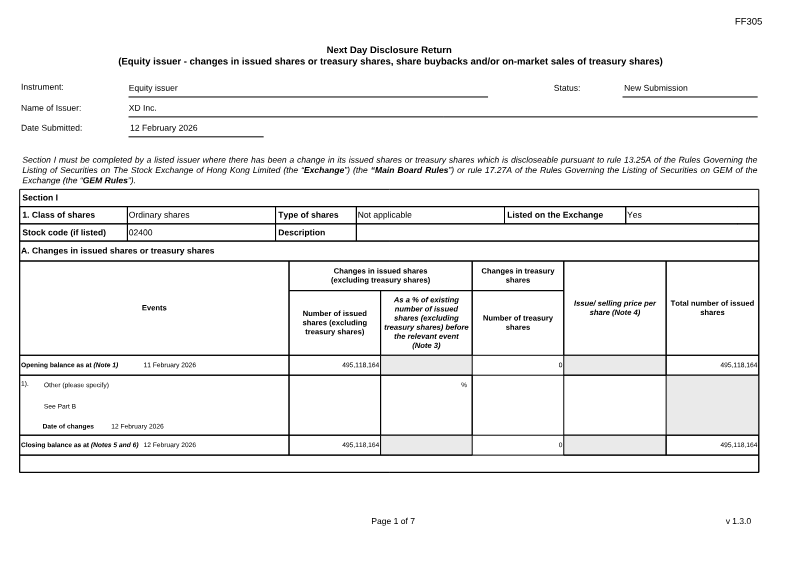
The filing reports a series of share repurchase activities by XD Inc., a Hong Kong-listed company (stock code 02400). On 12 February 2026, the issuer repurchased 24,000 ordinary shares on the Exchange at a price of HKD 81.65 per share, with an aggregate outlay of HKD 1,923,420. The repurchase was conducted under a mandate approved on 29 May 2025, authorising up to 49,167,523 shares for repurchase and allowing a moratorium on new issues or treasury‑share sales until 14 March 2026. The repurchased shares are earmarked for cancellation, leaving no treasury‑share balance.
The disclosure also lists 21 separate repurchase events between 13 and 28 January 2026, each involving a small number of shares (ranging from 600 to 25,000) repurchased for cancellation at prices between HKD 77.8 and HKD 87.39 per share. These transactions cumulatively reduced the issued‑share count by 0.004–0.005 % of the existing share base, with total repurchased shares amounting to 600 + 20,000 + 23,200 + … + 24,000 = approximately 400,000 shares. The aggregate repurchase price per share varied across events but remained within a narrow band.
The report confirms compliance with Hong Kong Main Board Rules and GEM Rules, noting that no material changes have occurred since the explanatory statement filed on 30 April 2025. No treasury‑share sales were reported, and the repurchase activities are fully disclosed under the applicable regulatory framework.
- XD Inc. (02400) repurchased 24,000 ordinary shares on 12 February 2026 at HKD 81.65 per share, totaling an outlay of HKD 1,923,420.
- Between 13 and 28 January 2026, XD Inc. executed 21 separate repurchase events, acquiring approximately 400,000 shares in total.
- All repurchased shares are designated for cancellation rather than treasury holding, resulting in a direct reduction of the company's issued share base.
- The January repurchase activity reduced the total issued-share count by approximately 0.004% to 0.005%.
- Repurchase prices during the January period fluctuated within a narrow range between HKD 77.80 and HKD 87.39 per share.
XD
Report110 pages
2021 Interim Report
Incorporated in the Cayman Islands with limited liability 3 Financial Performance Highlights 3 Financial Performance Highlights 9 Management Discussion and Analysis 9 Management Discussion and Analysis 23 Report on Review of Interim Financial Information Report on Review of Interim Financial Information 24 Consolidated Income Statement 25 Consolidated Statement of Comprehensive Income 26 Consolidated Statement of Financial Position 29 Consolidated Statement o...
- Tencent's FinTech and Business Services revenue significantly increased, reaching RMB 80,920 million for the six months ended June 30, 2021, up from RMB 56,337 million in the same period of 2020.
- The company experienced a shift from net cash of RMB 5.6 billion as of March 31, 2021, to net debt of RMB 21.0 billion as of June 30, 2021, primarily due to M&A activities and dividend payments, partially offset by RMB 17.3 billion in free cash flow.
- Tencent's Value Added Services (VAS) revenue grew to RMB 144,456 million for the six months ended June 30, 2021, compared to RMB 127,431 million in the prior year, with games contributing RMB 86,620 million and social networks RMB 57,836 million.
- Online Advertising revenue increased to RMB 44,653 million for the six months ended June 30, 2021, up from RMB 36,265 million in the same period of 2020, driven by social and other advertising.
- Selling and marketing expenses rose by 17% quarter-on-quarter to RMB 10.0 billion in Q2 2021, mainly due to seasonality and increased spending on digital content, games, and Business Services.
+2
Tencent
Report122 pages
2025 Interim Report
Incorporated in the Cayman Islands with limited liability smart communication inspires 2025 E Interim Report 33 Financial Performance Highlights Financial Performance Highlights 88 Management Discussion and Analysis 22 Report on Review of Interim Financial Information 23 Condensed Consolidated Income Statement 24 Condensed Consolidated Statement of Comprehensive Income 24 Condensed Consolidated Statement of Comprehensive Income 25 Condensed Consolidated S...
- Tencent's investment portfolio significantly grew to RMB948.3 billion as of June 30, 2025, up from RMB817.7 billion at the end of 2024, with listed associate investments alone increasing to RMB165.3 billion from RMB149.6 billion.
- The company completed the acquisition of a game company for USD1.2 billion (RMB8.8 billion) during the first half of 2025, resulting in RMB5.2 billion in goodwill.
- Gross profit for Marketing Services increased by 16% quarter-on-quarter to RMB20.6 billion, with gross margin improving to 58% from 56%.
- Gross profit for FinTech and Business Services rose by 5% quarter-on-quarter to RMB29.0 billion, with gross margin increasing to 52% from 50%.
- Net cash decreased to RMB74.6 billion as of June 30, 2025, from RMB90.2 billion as of March 31, 2025.
+1
Tencent
Report282 pages
2023 Annual Report: Tencent Holdings
7 MANAGEMENT DISCUSSION AND ANALYSIS 85 CORPORATE GOVERNANCE REPORT 85 CORPORATE GOVERNANCE REPORT 119 INDEPENDENT AUDITOR'S REPORT 119 INDEPENDENT AUDITOR’S REPORT 128 CONSOLIDATED INCOME STATEMENT 128 CONSOLIDATED INCOME STATEMENT 129 CONSOLIDATED STATEMENT OF COMPREHENSIVE INCOME 130 CONSOLIDATED STATEMENT OF FINANCIAL POSITION 133 CONSOLIDATED STATEMENT OF CHANGES IN EQUITY 137 CONSOLIDATED STATEMENT OF CASH FLOWS 139 NOTES TO THE CONSOLIDATED FINANCIAL STATEMENTS 1...
- Tencent's revenues for Q4 2023 remained broadly stable quarter-on-quarter at RMB155.2 billion.
- International Games revenues increased by 5% quarter-on-quarter to RMB13.9 billion, driven by PUBG Mobile and Clash of Clans.
- Domestic Games revenues decreased by 18% quarter-on-quarter to RMB27.0 billion due to seasonally lower revenue accruals in Q4.
- Online Advertising revenues increased by 16% to RMB29.8 billion, attributed to advertising platform upgrades benefiting Video Accounts, the mobile ad network, and Weixin Moments.
- Social Networks revenues decreased by 5% to RMB28.2 billion due to lower revenue accruals from app-based game virtual item sales.
+1
Tencent
Report122 pages
2024 Interim Report
Incorporated in the Cayman Islands with limited liability smart communication inspires 2024 P Interim Report 33 Financial Performance Highlights Financial Performance Highlights 88 Management Discussion and Analysis 22 Report on Review of Interim Financial Information 23 Condensed Consolidated Income Statement 23 Condensed Consolidated Income Statement 24 Condensed Consolidated Statement of Comprehensive Income 24 Condensed Consoli...
- Tencent's profit for Q2 2024 significantly increased to RMB 48,366 million, up from RMB 27,023 million in Q2 2023.
- Revenues for Q2 2024 grew to RMB 161,117 million, compared to RMB 149,208 million in Q2 2023.
- The company's net cash position decreased from RMB 92.5 billion as of March 31, 2024, to RMB 71.8 billion as of June 30, 2024, primarily due to share repurchases and dividend payments.
- Tencent's employee count slightly increased to 105,506 as of June 30, 2024, from 104,503 as of June 30, 2023.
- The weighted average fair value of employee share options granted in the first six months of 2024 was HKD 103.11 per share (RMB 93.53), a decrease from HKD 132.11 per share (RMB 115.67) in the same period of 2023.
+1
Tencent

Report10 pages
Take Rates in China
The analysis evaluates how take‑rate structures shape mobile game monetisation in China and whether higher‑quality development can outweigh the pressure of traditional distribution fees. It contrasts Apple’s uniform 30 % commission with the far steeper charges imposed by domestic Android app stores, many of which demand up to 50 % of in‑app purchase revenue, and examines the emerging shift toward direct‑to‑consumer distribution and community‑driven platforms.
Apple’s 30 % rate applies to the roughly 25 % of Chinese gamers who use iOS, who nonetheless generate about 40 % of mobile game revenue. In the Android segment, the absence of Google Play has led to a fragmented ecosystem dominated by manufacturer‑backed stores such as those from Huawei, Oppo and Vivo, and by Tencent’s MyApp. These stores justify 50 % take rates by bundling distribution, marketing and cross‑store integration, a model that yields high internet‑service margins for hardware makers—Xiaomi reports a 64.7 % gross profit on services versus 7.2 % on devices. Large publishers like NetEase and Tencent have occasionally negotiated lower fees, but most developers accept the 50 % level to reach a broad audience.
A growing number of developers are bypassing high‑fee stores, opting for direct distribution or leveraging community platforms that charge little or no commission. Duoyi’s “Shenwu” achieved a 95 % gross profit on Android by selling directly, while its iOS version retained a 70 % margin after Apple’s cut. Similar success is seen with Lilith Games’ “Rise of Kingdoms,” which generated roughly $100 million in its launch month without major Android store presence, and miHoYo’s “Genshin Impact,” which combined a $100 million development budget with fan‑driven channels such as TapTap (0 % take rate) and Bilibili to secure millions of pre‑registrations. These cases illustrate that high‑quality titles paired with intensive marketing and community engagement can sustain profitability even when forgoing traditional store exposure.
The study’s scope covers the Chinese mobile gaming market from 2020 through 2021, focusing on iOS and Android distribution channels, take‑rate policies, and developer responses. Insights draw on Niko
- Chinese Android app stores, dominated by manufacturers like Huawei, Oppo, and Vivo, typically charge a 50% commission on in-app purchases, significantly higher than Apple’s 30% rate.
- Hardware manufacturers rely heavily on these high take rates for profitability; for example, Xiaomi reports a 64.7% gross profit margin on services compared to only 7.2% on hardware sales.
- While iOS users account for only 25% of the Chinese gaming population, they generate approximately 40% of total mobile game revenue.
- High-quality titles are increasingly bypassing traditional Android stores to avoid 50% fees, with developers like Duoyi achieving a 95% gross profit on Android by utilizing direct distribution.
- Community-driven platforms like TapTap, which charge a 0% take rate, are becoming viable alternatives for major releases, as demonstrated by miHoYo’s successful launch of Genshin Impact.
Niko PartnersFeb 2026
Report24 pages
China WeChat Mini Games Industry Report 2026
The WeChat Mini Games industry in China has emerged as a dominant, high-growth sector within the broader digital ecosystem. As of 2026, the market is characterized by a rapid shift from simple casual titles toward mid-to-hardcore genres, including strategy, RPG, and tower defense games. This evolution is underscored by a significant increase in paid user acquisition, with over 51,000 games actively running advertisements in 2025, a figure that substantially outpaces traditional mobile game growth.
Market data indicates that the Mini Games sector generated RMB 53.535 billion (approximately $7.65 billion) in 2025, representing a 34.39% year-over-year increase, with projections exceeding RMB 70 billion for 2026. Revenue is primarily driven by in-app purchases, which account for 68.11% of total earnings, while advertising monetization contributes the remaining 31.89%. WeChat maintains a leadership position among competing platforms, boasting a 51.5% penetration rate and an industry-wide monthly active user base of 571 million as of August 2025.
User engagement remains high, with the average daily playtime exceeding 60 minutes and a daily session frequency of approximately 5.1 times. The core demographic is aged 24–40, with a majority residing in tier-3 cities or below. Successful titles increasingly utilize hybrid gameplay mechanics, such as combining MMORPG elements with idle or strategy features, to maintain player retention.
For international developers, the market presents significant opportunities but requires navigating complex regulatory and technical barriers. Successful entry necessitates partnering with local Chinese publishers to manage ISBN licensing, payment integration, and platform-specific performance optimizations. Technical requirements are stringent, as games must typically load in under 10 seconds and adhere to strict package size limits, often requiring the use of specialized engines like Cocos or Laya to ensure compatibility within the WeChat environment.
- The WeChat Mini Games market reached RMB 53.535 billion in 2025, a 34.39% year-over-year increase, with projections exceeding RMB 70 billion for 2026.
- WeChat dominates the sector with a 51.5% platform penetration rate and 571 million monthly active users as of August 2025.
- Revenue is primarily driven by in-app purchases (68.11%), supplemented by advertising monetization (31.89%).
- The industry is shifting toward mid-to-hardcore genres like RPG and strategy, supported by over 51,000 games actively running paid advertisements in 2025.
- Core user engagement is high, averaging over 60 minutes of daily playtime across 5.1 daily sessions, primarily among users aged 24–40 in tier-3 cities or below.
+2
Meridian PlayJan 2026
Report20 pages
Games Industry Region Report China
The China Region Report provides a comprehensive analysis of the Chinese games market as of July 2025, positioning it as the most lucrative and influential territory in the global industry. The central thesis asserts that while China presents significant regulatory and cultural hurdles for Western companies, its domestic firms have evolved into global leaders through rapid innovation, sophisticated live operations, and a mobile-first development philosophy.
Key findings indicate that the Chinese market generated approximately $48.7 billion in 2024, representing nearly 30% of global games revenue. Data from AppMagic and Newzoo highlight that while the domestic App Store saw a slight peak in 2021, the broader ecosystem remains robust, supported by over 701 million players. The report identifies a significant shift in industry capabilities, noting that 14 of the top 30 grossing games worldwide in early 2025 were developed or owned by Chinese entities. Furthermore, the success of titles like Black Myth: Wukong signals China’s successful expansion from mobile dominance into the premium triple-A PC and console sectors.
The scope of the analysis covers major industry segments including mobile, PC, and the emerging HTML5 mini-game market on platforms like WeChat, which boasts 500 million monthly active users. It profiles dominant publishers such as Tencent, NetEase, and HoYoverse, detailing their global investment strategies and internal development successes. Methodology relies on market intelligence from AppMagic and Newzoo, supplemented by expert interviews with regional executives.
The report concludes that the regulatory environment has stabilized, offering a more transparent licensing process for international partners. Future growth is expected to be driven by AI integration in development and the continued export of original Chinese intellectual property, further blurring the lines between Eastern and Western gaming markets.
- The Chinese games market generated $48.7 billion in 2024, accounting for approximately 30% of total global industry revenue.
- Chinese entities now dominate the global landscape, owning or developing 14 of the top 30 highest-grossing games worldwide as of early 2025.
- The market supports a massive player base of over 701 million, with a significant shift occurring as domestic firms expand from mobile dominance into premium triple-A PC and console development.
- HTML5 mini-games on platforms like WeChat have emerged as a major segment, currently reaching 500 million monthly active users.
- The regulatory environment for international partners has stabilized, resulting in a more transparent and predictable licensing process.
PocketGamer.bizJul 2025
Report20 pages
Games Industry Region Report: China 2025
China maintains its position as the world’s most lucrative and influential gaming market, generating $48.7 billion in total revenue during 2024. While the domestic landscape has faced challenges such as stringent regulatory licensing, rising production costs, and intense competition, the industry has successfully transitioned from a mobile-centric model toward the development of high-end, triple-A intellectual property. This evolution is underscored by the global success of titles like Black Myth: Wukong and the fact that Chinese companies or their subsidiaries now account for 14 of the top 30 highest-grossing games worldwide.
The financial performance of the sector remains robust, with mobile App Store revenue reaching $15.6 billion and PC gaming experiencing significant growth bolstered by platforms like Steam. Although domestic App Store downloads have receded from their 2020 peak, Chinese publishers have effectively offset this by expanding their international footprint, generating over $18.5 billion in worldwide gross revenue. Furthermore, the ecosystem is diversifying through the rise of accessible platforms such as WeChat Mini Games, which provide unique avenues for engagement alongside traditional gaming segments.
Looking toward the future, the Chinese games industry is poised to lead in the integration of artificial intelligence and the export of original, globally recognized content. As regulatory barriers show signs of easing, the market is increasingly fostering international collaboration, positioning itself as a strategic gateway for Western studios. By balancing domestic market saturation with aggressive global expansion, the region is cementing its role as a primary architect of the modern gaming landscape, moving beyond its historical reliance on mobile titles to become a comprehensive powerhouse of interactive entertainment.
- The Chinese gaming market generated $48.7 billion in total revenue in 2024, maintaining its status as the world's most lucrative region.
- Chinese publishers generated $18.5 billion in international gross revenue, successfully offsetting a decline in domestic App Store downloads from their 2020 peak.
- Chinese companies or their subsidiaries now account for 14 of the top 30 highest-grossing games worldwide, signaling a shift toward high-end, triple-A intellectual property.
- Mobile App Store revenue reached $15.6 billion in 2024, while PC gaming experienced significant growth supported by platforms like Steam.
- The domestic market is diversifying through the rise of WeChat Mini Games, which offer new engagement avenues alongside traditional gaming segments.
+1
PocketGamer.bizJan 2025
Report3 pages
2025 Half-Year Market Model Update: Asia & MENA
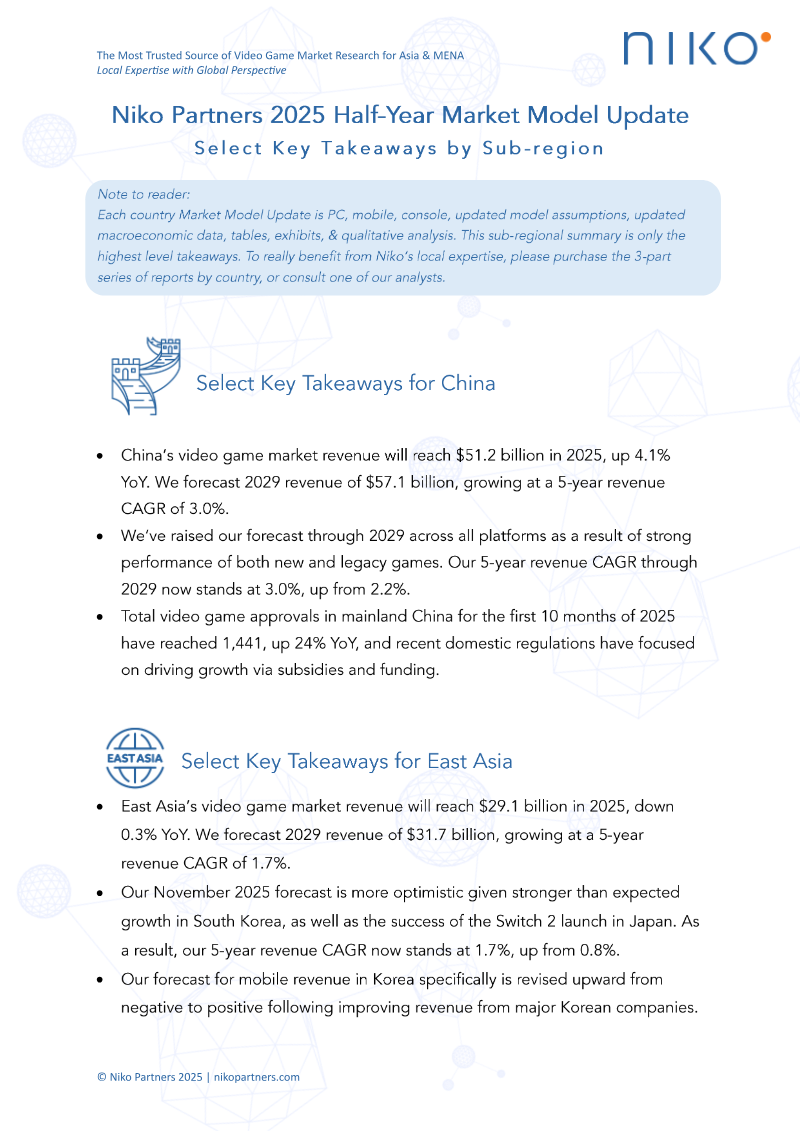
The 2025 Half-Year Market Model Update provides a comprehensive assessment of the video game industry across Asia and the Middle East and North Africa (MENA) region. By synthesizing macroeconomic data, platform-specific performance metrics, and regulatory developments, the analysis offers updated revenue forecasts through 2029 for key markets, including China, East Asia, India, Southeast Asia, and the MENA-3 region. The primary objective is to adjust long-term growth expectations based on recent industry performance, government policy shifts, and evolving consumer behavior.
Regional performance varies significantly, with India emerging as a high-growth market, projected to reach $1.1 billion in 2025 with a robust 12.9% five-year compound annual growth rate (CAGR). China remains the dominant market, with 2025 revenue expected to hit $51.2 billion, supported by a 24% year-over-year increase in game approvals. Conversely, East Asia and Southeast Asia show more moderate growth trajectories, with five-year CAGRs of 1.7% and 3.5%, respectively. The MENA-3 region is forecasted to reach $2.2 billion in 2025, though long-term projections have been tempered by economic headwinds in Egypt and slower mobile growth in Saudi Arabia and the UAE.
Methodologically, these insights are derived from proprietary market models that integrate platform-specific data for PC, mobile, and console segments. The analysis highlights the critical role of government intervention, such as the PROG act in India and regulatory subsidies in China, in shaping market expansion. By updating previous forecasts to reflect current fiscal realities and hardware cycles, such as the Switch 2 launch in Japan, the findings offer a refined outlook for stakeholders navigating the complex regulatory and economic landscapes of these diverse geographic segments.
- China remains the dominant regional market with projected 2025 revenue of $51.2 billion, bolstered by a 24% year-over-year increase in game approvals.
- India is positioned as a high-growth market expected to reach $1.1 billion in 2025 with a 12.9% five-year compound annual growth rate (CAGR).
- The MENA-3 region is forecasted to reach $2.2 billion in 2025, though long-term growth is tempered by economic headwinds in Egypt and slowing mobile performance in Saudi Arabia and the UAE.
- East Asia and Southeast Asia exhibit moderate growth trajectories, with five-year CAGRs of 1.7% and 3.5%, respectively.
- Market expansion across these regions is increasingly driven by government policy, including the PROG act in India and regulatory subsidies in China.
+5
Niko PartnersJan 2025

Report10 pages
Take Rates in China: Will Quality Development Beat Out Traditional Distribution?
The Chinese mobile gaming market is currently undergoing a significant shift in distribution dynamics as developers increasingly challenge the traditional 50% take rates imposed by domestic Android app stores. While global discourse remains focused on the 30% take rate standard contested in the Epic v. Apple litigation, Chinese developers face a more restrictive domestic environment where smartphone manufacturers and major tech firms consolidate power through the Mobile Hardcore Alliance and the Global Developer Service Alliance. These entities justify high fees by providing integrated marketing and distribution services, yet these costs have become a primary point of contention for major studios.
To circumvent these high fees, prominent developers such as miHoYo, Lilith Games, and NetEase are increasingly adopting direct-to-consumer distribution models. By leveraging high-quality intellectual property, substantial marketing budgets, and community-driven platforms like TapTap and Bilibili, these studios can bypass traditional stores entirely. This strategy allows developers to retain significantly higher gross profit margins—often exceeding 95%—compared to the 50% margin typically realized through standard distribution channels. The success of these titles has begun to force concessions, as evidenced by Xiaomi offering reduced take rates to high-profile games like Genshin Impact.
The industry landscape is bifurcated, as smaller developers often remain dependent on traditional stores for the reach and infrastructure necessary to sustain their operations, viewing the 50% fee as an acceptable cost of doing business. However, the rise of direct distribution and community-centric marketing signals a broader trend where quality content and brand loyalty are becoming more influential than traditional store placement. As developers continue to prioritize direct engagement and alternative platforms, the dominance of traditional Android app stores in China faces mounting pressure, potentially reshaping the economic model of the global mobile gaming industry.
- Major Chinese developers like miHoYo, Lilith Games, and NetEase are bypassing traditional Android app stores to achieve gross profit margins exceeding 95%, compared to the 50% margin typical of standard distribution.
- The Chinese mobile gaming market is dominated by a 50% take rate imposed by smartphone manufacturers and tech firms organized under the Mobile Hardcore Alliance and the Global Developer Service Alliance.
- High-profile titles are successfully leveraging direct-to-consumer models and community platforms like TapTap and Bilibili to circumvent traditional distribution fees.
- The shift toward direct distribution has forced some concessions from traditional stores, such as Xiaomi offering reduced take rates for high-profile games like Genshin Impact.
- The market is bifurcated, as smaller developers remain dependent on traditional stores for necessary infrastructure and reach, accepting the 50% fee as a standard cost of business.
+2
NikoJan 2025
Report35 pages
Guide to Growing Chinese Gaming Apps Overseas
Chinese gaming developers are aggressively expanding their global footprint by leveraging sophisticated monetization models and high-volume, AI-driven marketing strategies. The primary objective for these publishers is to balance the high revenue potential of mature markets like the United States, Japan, and South Korea against the rising costs of user acquisition. By prioritizing video advertising, which currently yields the highest Day 7 return on ad spend at 21%, developers are successfully capturing market share in competitive strategy and RPG segments.
Success in these international territories is increasingly predicated on hyper-localization and technological integration. Publishers are utilizing generative AI to streamline the production of localized ad creatives, voice-overs, and performance-tested copy, allowing for rapid iteration and regional customization. Leading titles demonstrate that high-engagement gameplay loops—such as the inclusion of social hangout spaces, customizable home systems, and minigame integrations—are essential for sustaining long-term retention. These efforts are further bolstered by strategic partnerships with local influencers and the implementation of innovative, time-limited gacha mechanics.
To maintain consistent growth, developers are diversifying their engagement tactics through gamified live events, including seasonal collections and interactive board-style challenges. These features, combined with trial character systems, allow publishers to cater to varied player motivations while maintaining a steady revenue stream. By synthesizing competitive intelligence with agile content updates, Chinese gaming apps are effectively navigating the complexities of global expansion, ensuring that both monetization and user interest remain high across diverse geographic regions.
- Video advertising is the most effective monetization channel for Chinese developers in mature markets, currently yielding a 21% Day 7 return on ad spend.
- Generative AI is being deployed at scale to automate the production of localized ad creatives, voice-overs, and performance-tested copy to reduce costs and speed up regional market entry.
- Long-term player retention is increasingly driven by integrating social hangout spaces, customizable home systems, and minigames into core gameplay loops.
- Developers are prioritizing expansion into high-revenue mature markets, specifically the United States, Japan, and South Korea, to offset rising global user acquisition costs.
- Engagement is being sustained through gamified live events, such as seasonal collections and interactive board-style challenges, alongside trial character systems.
+6
EAJan 2025

Report13 pages
China Game Industry Report 2025
The China Game Industry Report for 2025 presents a comprehensive assessment of the domestic and overseas gaming markets, highlighting sustained growth driven by youth protection initiatives, technological innovation, and cross‑sector integration. In 2025, China’s self‑developed mobile games generated US$20.455 billion in overseas revenue, a 10.23% year‑on‑year increase and the sixth consecutive year surpassing RMB 100 billion. Strategy games, including SLG, dominated overseas earnings at 49.97%, followed by shooters (9.69%) and RPGs (9.39%). The United States remains the largest market, contributing 32.31% of overseas revenue, with Japan (16.35%) and South Korea (9.15%) also significant.
Domestically, mobile games accounted for 73.29% of total sales, with MOBA leading at 19.45%, followed by shooting (18.29%) and RPG (15.10%). The domestic console market expanded sharply, reaching RMB 8.362 billion (US$1.18 billion) in 2025, a 37.38% year‑on‑year rise, driven by both software and hardware sales.
Global market projections indicate the worldwide gaming industry will reach RMB 130.17 billion in 2025, with mobile gaming contributing RMB 66.69 billion—a growth rate of 4.93%, slower than previous years but still positive.
Methodologically, the report aggregates data from CADPA’s industry surveys and market analyses, covering 2020‑2025 for domestic sales and 2019‑2025 for overseas performance. The findings underscore a resilient Chinese gaming sector, poised to maintain strong export growth while deepening domestic diversification across mobile and console platforms.
- Chinese self-developed mobile games generated US$20.455 billion in overseas revenue in 2025, marking a 10.23% year-on-year increase and the sixth consecutive year exceeding RMB 100 billion.
- The United States remains the primary overseas market for Chinese games, accounting for 32.31% of total export revenue, followed by Japan at 16.35% and South Korea at 9.15%.
- Strategy games (SLG) dominate the overseas market, capturing 49.97% of earnings, significantly outpacing shooters at 9.69% and RPGs at 9.39%.
- The domestic Chinese console market experienced a sharp 37.38% year-on-year growth in 2025, reaching a total value of RMB 8.362 billion (US$1.18 billion).
- Mobile gaming continues to lead the domestic market, representing 73.29% of total sales, with MOBA (19.45%), shooting (18.29%), and RPG (15.10%) as the top-performing genres.
+4
Meridian PlayJan 2025
Report35 pages
Guide to Growing Chinese Gaming Apps Overseas: 2024
Chinese gaming applications continue to exert a dominant influence on the global stage, particularly within the strategy and role-playing game segments in mature markets such as the United States, Japan, and South Korea. While these regions offer substantial revenue potential, they are characterized by intense competition and elevated costs per install. To navigate these challenges, successful publishers are shifting toward hyper-localized strategies that tailor art styles to regional aesthetic preferences—favoring manga-inspired visuals in Japan and realistic or cartoon aesthetics in Western markets—while utilizing local influencers to establish brand credibility.
Technological innovation serves as a primary driver for operational efficiency and user acquisition. The integration of generative AI has become essential for the rapid localization of ad creative, voice-overs, and marketing copy, ensuring both speed and brand compliance. High-performing titles currently leverage high-volume, innovative campaigns that incorporate minigames and AI-enhanced visuals to capture player attention. Beyond acquisition, long-term retention is increasingly supported by the implementation of social hangout spaces, home-building systems, and character trial models that balance accessibility with monetization.
Monetization strategies have evolved to prioritize engagement through sophisticated, time-limited mechanics. Publishers are frequently employing box gachas, pull-milestone rewards, and gamified event structures such as diceboards and bingo to incentivize spending. Furthermore, the consistent deployment of diverse live events remains a critical requirement for maintaining player interest and competitive viability. By combining these aggressive monetization tactics with a commitment to continuous content updates, Chinese developers are effectively sustaining growth and deepening their footprint across the global gaming landscape throughout 2024.
- Chinese publishers are maintaining global dominance in strategy and RPG segments by shifting to hyper-localized art styles, specifically manga-inspired visuals for Japan and realistic or cartoon aesthetics for Western markets.
- Generative AI is now a core operational requirement for rapid, compliant localization of ad creative, voice-overs, and marketing copy to manage high costs per install in mature markets like the U.S., Japan, and South Korea.
- High-performing user acquisition campaigns are increasingly utilizing minigames and AI-enhanced visuals to capture player attention in highly competitive environments.
- Long-term player retention is being driven by the integration of social hangout spaces, home-building systems, and character trial models that balance game accessibility with monetization.
- Monetization strategies have shifted toward sophisticated, time-limited mechanics such as box gachas, pull-milestone rewards, and gamified event structures like diceboards and bingo.
+5
LiftoffJan 2024

Report33 pages
Developer's Guide to the Chinese Market
DEVELOPER'S Table of contents Damian Jaskowski is a Chinese gaming market expert working as Expert PR Manager for East Asia at 1l bit studios and Chinese Market Coordinator at the Indie Games Poland Foundation. 3 PART II – A STEP BY STEP GUIDE TO PART III – REACHING OUT TO YOUR FANBASE 20 4 MARKET 12 3.1 Chines...
- The Chinese gaming market reached 668 million players by June 2023, constituting roughly half of the Chinese population. Sales revenue for the first half of 2023 was 144.263 billion Chinese yuan ($20.23 billion), showing a 22.2% increase QoQ, indicating market recovery.
- PC/console games should prioritize global distribution with local PR, while mobile games require local distribution due to Google Play's unavailability and the App Store's ISBN requirement in Mainland China.
- Localization is crucial and involves translating into Simplified Chinese (ZHCN), localizing the game's title, and adapting game features by removing inaccessible foreign services (e.g., Facebook, Instagram, Google services) and adding local payment methods.
- The Chinese console gaming market had 16.7 million gamers by the end of 2022, generating $2.3 billion in hardware and software, with Niko Partners projecting growth to 23 million gamers by 2027.
- Hiring a Chinese native-speaker with game promotion experience is recommended once annual revenue from the Chinese market reaches around $180,000, with average salaries ranging from 20,000 to 30,000 CNY ($2,800 to $4,200) per month.
+2
Indie Games Poland FoundationJan 2023
Report29 pages
Analyzing the Consumer and Market Impacts of Chinese Games Market Policies
China’s gaming market, the largest in the world by revenue and player count, is currently defined by a complex and increasingly restrictive regulatory environment. Primary governmental concerns center on minor protection and the mitigation of gaming addiction, which officials often characterize as a negative social influence. Key mandates include strict playtime limits for users under 18—restricted to one hour on weekend and holiday evenings—and the implementation of mandatory real-name verification systems. While minor spending accounts for less than 2% of revenue for major firms like Tencent and NetEase, these regulations threaten long-term market growth by reducing the future pipeline of engaged players and esports talent.
The administrative process for securing game licenses has become a significant barrier to entry. Following a nine-month freeze on approvals ending in early 2022, the government has adopted a rigorous scoring system that evaluates titles on societal values, cultural propagation, and original design. Foreign entities face additional hurdles, as they must partner with local publishers and navigate an approval process that is often slower than that for domestic titles. Consequently, many developers have shifted focus toward multi-platform releases, as a single license now covers mobile, PC, and console versions, streamlining the path to market.
Despite these restrictions, a robust grey market persists. Players frequently utilize virtual private networks (VPNs) and game accelerators to access international platforms like Steam, while console users often purchase hardware and software from overseas markets to bypass local content limitations. Additionally, some mobile developers utilize ad-based monetization models to operate without formal licenses, though regulators have recently begun cracking down on this practice.
In response to domestic pressures, Chinese gaming giants are aggressively expanding internationally. This strategy involves establishing overseas development studios, acquiring global talent, and launching international publishing labels. By leveraging their expertise in free-to-play mechanics and live operations, Chinese companies are successfully capturing market share in Western and other Asian markets, effectively diversifying their revenue streams away from the unpredictable regulatory landscape at home.
- Chinese gaming giants like Tencent and NetEase are aggressively expanding internationally through studio acquisitions and global publishing labels to mitigate domestic regulatory volatility.
- Government regulations restrict users under 18 to one hour of gaming on weekend and holiday evenings, a policy that threatens the long-term pipeline of players and esports talent despite minor spending accounting for less than 2% of major firms' revenue.
- The game licensing process now utilizes a rigorous scoring system evaluating societal values and cultural propagation, following a nine-month approval freeze that ended in early 2022.
- Foreign developers face significant barriers to entry, requiring local publishing partners and navigating a slower approval process compared to domestic titles.
- Developers are increasingly utilizing multi-platform releases to streamline market entry, as a single license now covers mobile, PC, and console versions.
+1
NewzooNov 2022
Report29 pages
Analyzing the Consumer and Market Impacts of Chinese Games Market Policies: China
China continues to dominate the global gaming market, yet a series of regulatory tightening measures—particularly anti‑addiction rules for minors and an expanded licensing framework—have introduced significant uncertainty and higher operational costs for both domestic and foreign developers. The new minor‑protection law caps playtime, limits in‑game spending, and restricts live‑streaming access for users under 18, while the licensing system now demands detailed content reviews and real‑name verification. These requirements are projected to dampen player engagement and increase investment risk over the long term.
Regulators enforce licensing through a complex approval process, yet many unlicensed titles persist on platforms such as Steam, VR services, cloud gaming, and mobile ad‑only games. Enforcement remains uneven; fines are issued but monitoring is inconsistent. Console and live‑streaming services often circumvent restrictions via overseas purchases, backdoors, or content renaming, creating a regulatory environment that is difficult to monitor and enforce uniformly.
The revised licensing regime now permits a single license for multiplatform releases, encouraging developers to produce cross‑platform titles and streamlining the approval process. The market remains dominated by free‑to‑play mobile games, with LiveOps and regular content updates sustaining high retention. In 2021, half of the top 50 grossing mobile games were launched before 2019. Chinese studios are increasingly exporting their expertise, establishing international studios and publishing arms to tap global markets while leveraging IP‑based mobile games to penetrate China’s competitive scene.
- China’s regulatory environment has tightened through strict anti-addiction laws for minors, which now cap playtime, limit in-game spending, and restrict live-streaming access for users under 18.
- The licensing framework now requires detailed content reviews and real-name verification, increasing operational costs and long-term investment risks for both domestic and foreign developers.
- While the licensing process is complex, a new policy allowing a single license for multiplatform releases is incentivizing developers to prioritize cross-platform title development.
- Regulatory enforcement remains inconsistent, with many unlicensed titles continuing to operate on platforms like Steam, VR services, and cloud gaming despite the official approval requirements.
- The Chinese mobile market is characterized by high maturity and retention, evidenced by the fact that 50% of the top 50 grossing mobile games in 2021 were released prior to 2019.
NewzooJan 2022