
Report3 pages
Korea's Game Exports: Reading Beyond the Aggregate Numbers
The South Korean game industry serves as the nation’s primary content export engine, generating an estimated USD 8.60 billion in 2025 and accounting for 57.7% of total content export value. While Korea ranks as the world’s fourth-largest game market, it maintains a unique position with a high concentration index and per-capita spending approximately eleven times the global average. Despite these strong aggregate figures, growth remains heavily skewed toward a small number of high-performing titles rather than reflecting broad-based success across the entire studio ecosystem.
Market dynamics shifted significantly in 2024, characterized by a 1.3% rise in total export value and a notable geographic realignment. North America emerged as a growing destination, gaining 4.7 percentage points in export share, while Japan experienced a 5.4 percentage point decline. Platform trends also show internal divergence; while mobile remains the dominant revenue driver at USD 5.51 billion, the console segment is experiencing rapid expansion. Console exports grew by 15.1% in 2024, and the associated workforce has more than doubled since 2021, signaling a strategic pivot in development capacity.
Data for these findings are derived from the 2025 Game Industry White Paper and the 2025 Fourth-Quarter Content Industry Trend Analysis Report, which utilize surveys of domestic production and distribution companies. Although the industry reported record revenue growth in the fourth quarter of 2025, business sentiment for early 2026 remains cautious, hovering slightly below the neutral threshold. Consequently, stakeholders are advised to look beyond industry-wide aggregates and evaluate individual studios and specific titles to accurately identify growth opportunities within the evolving Korean market.
- The South Korean game industry generated USD 8.60 billion in exports in 2025, representing 57.7% of the nation's total content export value.
- Console game exports grew by 15.1% in 2024, supported by a workforce that has more than doubled since 2021 as studios pivot development capacity.
- Mobile gaming remains the primary revenue driver, accounting for USD 5.51 billion of the industry's export total.
- Geographic export shares shifted in 2024, with North America gaining 4.7 percentage points while Japan saw a 5.4 percentage point decline.
- Despite high aggregate figures and record Q4 2025 revenue, industry growth is heavily concentrated in a small number of high-performing titles rather than broad-based studio success.
Korea Creative Content Agency

Report3 pages
Korea's Game Studios: Where the Next Breakout Title Is Actually Built
The South Korean gaming landscape is currently defined by a significant structural shift toward small-scale, high-impact development studios. While industry-wide averages are often skewed by a few massive publishers, the reality of the market is that 69.4% of development-only firms employ fewer than ten people. This segment has been bolstered since 2024 by an influx of experienced talent departing major publishers, creating a robust ecosystem of indie teams capable of producing breakout titles. Data indicates that these smaller studios are increasingly efficient, with some teams of as few as four people reaching one million copies sold in just three and a half months.
The domestic market serves as a vital testing ground for these developers, as over 30% of players in their twenties and thirties actively engage with indie games, prioritizing original subject matter over pricing. Despite this creative success, these studios often face limitations in funding and marketing capacity. Consequently, the commercialization of these titles is frequently decoupled from development, with major publishers managing localization, quality assurance, and platform relations. Half of all exporting companies in this sector currently generate less than USD 1 million in annual export value, highlighting a vast, untapped middle market.
For international buyers and stakeholders, the primary takeaway is the necessity of looking beyond the largest, most visible firms. Successful acquisition and partnership strategies require engaging with studios that exceed the five-person median while simultaneously negotiating with the Korean publishers who handle the commercial infrastructure. Because the time-to-market for breakout hits has accelerated significantly, early engagement is essential. Buyers should evaluate development and commercialization capabilities as distinct entities to mitigate the risks associated with the limited operational resources of smaller indie teams.
- The South Korean gaming industry is shifting from a concentration of large-scale publishers to a decentralized ecosystem dominated by studios with fewer than ten employees.
- A significant migration of experienced talent from major publishers to smaller indie teams accelerated in late 2023, directly improving the quality and marketability of independent projects.
- Small, agile studios are now identified as the primary engine for innovation and the most likely source of the next generation of globally competitive Korean titles.
- The 2025 Game Industry White Paper indicates that the traditional large-studio-centric model is being replaced by a more sustainable growth model driven by specialized, small-scale development.
- International stakeholders must pivot their engagement strategies away from exclusive focus on major publishers to identify and support high-potential, smaller development firms.
Korea Creative Content Agency

Report3 pages
Korea's Game Developers and AI: What Changes in Licensing Contracts
Generative artificial intelligence has become a foundational element of the South Korean game industry, with adoption rates reaching 70 percent, significantly outpacing all other content sectors. Based on data from 2025 industry reports, including a survey of 2,524 content companies, the research highlights that nearly half of these game developers have integrated AI tools company-wide. This widespread deployment is particularly pronounced in technical domains, where the use of coding assistance and video generation tools occurs at more than double the rate of the broader content industry.
Despite the high level of integration, the tangible financial impact of these technologies remains limited. Approximately 92.4 percent of adopting firms report no change in revenue, and 95.8 percent report no change in export value since implementing AI. Instead, the primary benefit identified by developers is operational efficiency, with firms consistently reporting shorter working hours. While high-profile companies like KRAFTON and NCSOFT are successfully utilizing AI for persona-based characters and development platforms, these productivity gains have not yet translated into widespread commercial growth.
For international buyers and stakeholders, these findings necessitate a shift in licensing and due diligence practices. Because AI is now a standard component of the development lifecycle, contracts must explicitly address the ownership of AI-generated assets and the provenance of training data to mitigate legal and ethical risks. Furthermore, buyers should exercise caution by decoupling productivity claims from revenue projections, as the current industry data suggests that AI adoption is currently a tool for internal optimization rather than a direct driver of increased market performance.
- As of 2025, 70% of South Korean game companies have integrated generative AI into their development workflows, making the gaming sector the leader in AI adoption among all Korean content industries.
- Half of all Korean game companies have moved beyond departmental experimentation to full company-wide deployment of AI, marking a permanent shift in production methodologies.
- The widespread use of AI-generated assets has created significant legal complexities regarding copyright ownership and potential intellectual property infringement.
- International buyers acquiring Korean game titles must now implement rigorous due diligence checklists to mitigate legal risks associated with AI-generated content.
- Standard licensing contracts in the Korean game industry require reevaluation to address the specific legal challenges introduced by AI-driven development.
Korea Creative Content Agency
Report19 pages
Global Gaming Report: Q1 2025
The global gaming industry experienced a robust recovery in the first quarter of 2025, characterized by a resurgence in capital deployment and strategic consolidation. Total merger and acquisition activity reached $4.4 billion across 48 deals, anchored by the significant $3.5 billion acquisition of Niantic’s games division by Scopely. Simultaneously, private placement markets remained active, recording $3.5 billion in funding across 149 deals, heavily influenced by a $3 billion investment in Infinite Reality. These figures signal a stabilizing market environment, though later-stage studio financing continues to face structural headwinds.
Technological integration remains a primary driver of industry strategy, with generative artificial intelligence and machine learning serving as focal points for product development and audience targeting. Major strategic players and venture capital firms, including Bitkraft, Tencent, and Krafton, are prioritizing investments in tech platforms and blockchain infrastructure to secure long-term growth. This shift reflects a broader industry trend where value is increasingly concentrated in platform-agnostic tools and AI-driven efficiency rather than traditional content production alone.
Market performance during this period exhibited significant divergence across segments. While the Drake Star Gaming Index posted a 16.37% return, individual outcomes varied drastically, with hardware and platform-oriented companies like NVIDIA and AppLovin commanding superior valuation multiples compared to smaller developers. Mobile-focused entities continue to navigate complex growth trajectories, and while some firms achieved triple-digit gains, others faced substantial declines. Ultimately, the industry is transitioning toward a model where valuation is increasingly tethered to technological scalability and platform dominance rather than purely creative output.
- Q1 2025 saw $4.4 billion in M&A activity across 48 deals, headlined by Scopely’s $3.5 billion acquisition of Niantic’s games division.
- Private placement markets recorded $3.5 billion in funding across 149 deals, with a single $3 billion investment in Infinite Reality accounting for the vast majority of that capital.
- The Drake Star Gaming Index returned 16.37% in Q1 2025, though valuations diverged significantly between hardware-oriented firms like NVIDIA and AppLovin and smaller, struggling developers.
- Industry investment is shifting away from traditional content production toward platform-agnostic tools, generative AI, and blockchain infrastructure to drive long-term scalability.
- Major industry players including Bitkraft, Tencent, and Krafton are prioritizing capital deployment into tech platforms and AI-driven efficiency to secure competitive advantages.
Drake Star
Report32 pages
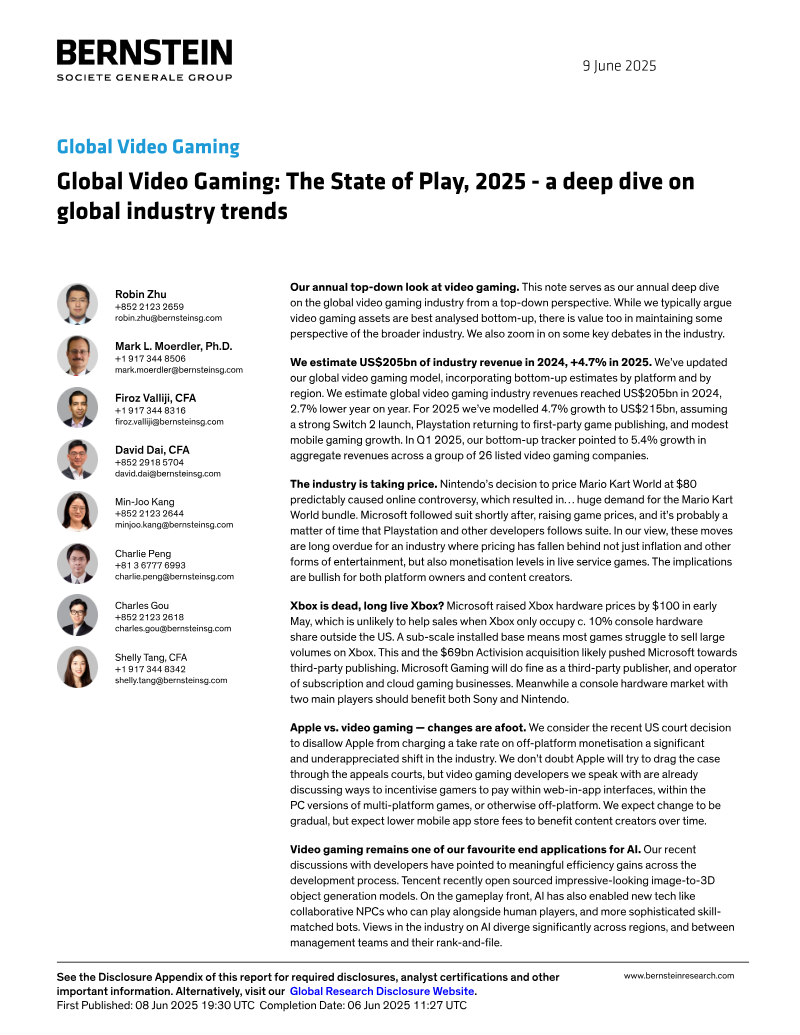
Global Video Gaming: The State of Play, 2025
The global video gaming industry is entering a phase of stabilization and renewed growth, with total revenue projected to reach US$215 billion in 2025, representing a 4.7% increase following a 2.7% decline in 2024. This recovery is underpinned by strategic pricing adjustments for software and subscription services, alongside the anticipated launch of new console hardware. While the mobile gaming sector shows signs of modest growth and the console market faces a period of recalibration, the PC gaming ecosystem, particularly Steam, has emerged as a critical driver of industry expansion.
A significant structural shift is currently underway as major industry players reevaluate their hardware-centric strategies. Microsoft, for instance, is pivoting toward a third-party publishing model, prioritizing the reach of its Game Pass and cloud gaming services over the expansion of its proprietary console installed base. This transition reflects a broader trend where companies are leveraging cloud infrastructure and generative AI to enhance development efficiency and maximize software distribution across diverse platforms. Although developer sentiment regarding AI remains varied, its integration into production pipelines is increasingly viewed as a necessary evolution for operational sustainability.
Despite short-term headwinds, such as the delayed release of major titles, the industry’s long-term earnings outlook remains positive. The balance of power between platform owners and content creators continues to evolve, influenced by landmark legal rulings that may reduce mobile app store fees. These findings are intended for institutional investors, supported by rigorous analytical frameworks that account for the complex financial relationships and regulatory environments governing major entities like Sony, Tencent, and Square Enix. The industry is effectively transitioning from a post-pandemic contraction toward a more diversified, software-led growth model.
- The global video gaming industry is projected to reach $215 billion in revenue in 2025, marking a 4.7% recovery following a 2.7% decline in 2024.
- Major industry players are shifting from hardware-centric models to software-led growth, exemplified by Microsoft’s pivot toward third-party publishing and the expansion of Game Pass and cloud services.
- The PC gaming ecosystem, led by Steam, has emerged as a primary driver of industry expansion, offsetting the recalibration occurring within the console market.
- Generative AI is being integrated into production pipelines as a necessary evolution for operational sustainability, despite varied sentiment among developers.
- Industry revenue growth is being supported by strategic pricing adjustments for software and subscriptions, alongside the anticipated launch of new console hardware.
Societe Generale Group

Report29 pages
Global Gaming Report 2025
The 2025 Global Gaming Report characterizes the gaming industry as a capital-intensive, scale-driven sector where competitive advantage is increasingly defined by platform ownership, intellectual property (IP) aggregation, and long-term strategic positioning rather than individual title performance. The industry experienced a year of mega-deal consolidation, with approximately $147 billion in announced M&A value. This activity was heavily skewed toward the second half of the year, anchored by transformational transactions such as the $83 billion Netflix-Warner Bros. deal and the $55 billion take-private of Electronic Arts.
Market data indicates a widening valuation dispersion, with strategically positioned players commanding premium EV/EBITDA multiples exceeding 25x. While overall deal volume moderated throughout 2025, capital deployment became more concentrated, reflecting high-conviction investments in defensible growth platforms. Private placement activity followed a similar trend, dominated by a limited number of large-scale, infrastructure-led rounds—notably in AI-driven simulation and development tools—which attracted over $100 million per transaction. Public market activity was strongest in the first half of the year, shifting toward smaller, more disciplined strategic raises as regulatory and market conditions evolved.
Geographically, North America dominated both M&A and private placement deal values, while the Asia-Pacific region maintained a significant presence in public market capital raises. The report utilizes data sourced from CapIQ and internal research to analyze these trends across global gaming segments, including multimedia streaming, entertainment software, and virtual reality. Looking ahead to 2026, the industry anticipates a content-led growth phase driven by major IP sequels and hardware transitions, such as the rollout of the Nintendo Switch 2, as companies pivot toward service-led, recurring revenue models to ensure long-term stability.
- The gaming industry saw $147 billion in M&A activity in 2025, headlined by the $83 billion Netflix-Warner Bros. merger and the $55 billion take-private acquisition of Electronic Arts.
- Market valuation is increasingly driven by platform ownership and IP aggregation, with top-tier strategic players now commanding EV/EBITDA multiples exceeding 25x.
- Capital deployment has become highly concentrated, with private placement rounds for AI-driven simulation and development tools consistently exceeding $100 million per transaction.
- While North America led in total M&A and private placement value, the Asia-Pacific region remained the primary driver for public market capital raises.
- Industry strategy is shifting toward service-led, recurring revenue models to ensure long-term financial stability.
SP2 Analytics
Report20 pages
Global Gaming Report Q1 2026
The global gaming industry experienced a complex start to 2026, characterized by a sharp divergence between high-level strategic consolidation and broader market volatility. While the Drake Star Gaming Index recorded a 1.8 percent decline, reflecting underlying weakness in Western markets and the mobile gaming sector, the landscape for large-scale capital deployment remained exceptionally aggressive. Total merger and acquisition activity reached a 15-month peak, with 51 transactions valued at over $100 billion. This surge was anchored by transformative industry shifts, most notably the acquisition of Warner Bros. Discovery by Paramount and the purchase of Moonton by Savvy Games Group.
Private financing maintained steady momentum throughout the first quarter, totaling $785 million across 106 deals. Investor interest shifted decisively toward infrastructure and immersive technology, as evidenced by the three largest funding rounds being secured by companies specializing in AR/XR hardware. Furthermore, significant Series A and C rounds for firms such as Ares Interactive, VAST, and ZBD underscore a continued appetite for innovation within the development and platform ecosystems. Despite these pockets of growth, public market performance remained inconsistent, with hardware and platform providers like NVIDIA and AppLovin significantly outperforming traditional game publishers.
Geographically, the industry faced a fragmented recovery, as modest growth in Asian markets and the PC/Console segment failed to offset the downturns observed in Western mobile gaming. Looking forward, the sector is positioned for continued M&A activity, with market momentum expected to rely heavily on the success of upcoming high-profile game releases and the potential for new public offerings. The variance in EBITDA multiples and stock returns across regions suggests that while capital remains available, investors are increasingly selective, favoring hardware-centric platforms over legacy publishing models.
- M&A activity reached a 15-month peak in Q1 2026 with 51 transactions totaling over $100 billion, headlined by the Paramount acquisition of Warner Bros. Discovery and Savvy Games Group's purchase of Moonton.
- Private financing remained steady with $785 million raised across 106 deals, showing a clear investor preference for AR/XR hardware and infrastructure over traditional software.
- The Drake Star Gaming Index declined by 1.8 percent, driven by market weakness in Western regions and the mobile gaming sector.
- Public market performance is bifurcated, with hardware and platform providers like NVIDIA and AppLovin significantly outperforming legacy game publishers.
- Geographic recovery is fragmented, as modest growth in Asian markets and the PC/Console segment was insufficient to offset the downturn in Western mobile gaming.
Drake Star

Report24 pages
2019 Essential Facts About the Computer and Video Game Industry
The 2019 Essential Facts About the Computer and Video Game Industry provides a comprehensive overview of the American gaming landscape, highlighting the industry's record-breaking performance and the diverse demographics of its player base. With total industry sales reaching $43.4 billion in 2018, the report establishes that video games have become a pervasive element of American life, with 75% of households containing at least one gamer. The primary purpose of the analysis is to profile the modern gamer, debunking stereotypes by illustrating that players represent a broad cross-section of the population across all ages, genders, and ethnicities.
The research, conducted by Ipsos through a survey of over 4,000 Americans, reveals that the average age of a gamer is 33, with 46% of the gaming population identifying as female. Beyond demographics, the data emphasizes the social and psychological benefits of gaming, as 79% of players report that games provide mental stimulation and 78% cite relaxation and stress relief. Furthermore, the findings indicate that gamers are civically engaged and socially active, often participating in creative hobbies and maintaining healthy lifestyles comparable to non-gamers.
The report also examines the role of gaming within families, noting that 74% of parents view games as educational and 57% engage in weekly play with their children. High levels of awareness regarding the Entertainment Software Rating Board (ESRB) ratings—with 90% of parents paying attention to them—suggest a responsible approach to family gaming. Commercially, the industry continues to shift toward digital distribution, which accounted for 83% of physical and digital format sales in 2018. These insights confirm that the industry is in a period of sustained growth, driven by a highly engaged and diverse audience.
- The U.S. video game industry generated $43.4 billion in total sales during 2018.
- Digital distribution dominated the market in 2018, accounting for 83% of all physical and digital format sales.
- Gaming is a pervasive household activity, with 75% of American households containing at least one gamer.
- The modern gaming demographic is diverse, with an average player age of 33 and 46% of the gaming population identifying as female.
- Parental involvement is high, as 57% of parents play games with their children weekly and 90% report paying attention to ESRB ratings.
Entertainment Software Association

Whitepaper63 pages
State of the Industry 2019: Mental Health in the Game Industry
The 2019 assessment of the global game industry identifies systemic organizational failures as the primary drivers of a pervasive mental health crisis among developers. The industry is currently defined by a culture of chronic overwork, known as crunch, which is frequently normalized as a marker of professional passion despite its role in fostering burnout, physical illness, and project failure. This instability is compounded by frequent layoffs and a lack of job security, creating a high-stress environment that threatens the long-term sustainability of the workforce.
Beyond operational stressors, the industry struggles with significant deficits in diversity and inclusion. The predominantly white, male-dominated workforce often fosters environments where women, LGBTQ+ individuals, people of color, and neurodivergent employees face harassment and microaggressions. These exclusionary practices are not merely social issues but design imperatives; they stifle team creativity and limit the quality of game content. Furthermore, developers face secondary stressors from public stigmas surrounding gaming, including debates over violence and addiction, which complicate the professional identity of those creating the products.
Addressing these challenges requires a fundamental shift in management practices and corporate policy. While the report notes that current research remains insufficient to classify gaming as a formal addiction or to definitively link loot boxes to gambling, it emphasizes that the industry must prioritize mental health literacy and structural reform. By moving away from toxic management styles and actively fostering inclusive, supportive workplaces, studios can mitigate burnout and improve retention. Ultimately, the long-term health of the industry depends on replacing outdated, exclusionary norms with sustainable, transparent, and equitable professional standards.
- Systemic organizational failures, specifically the normalization of chronic overwork known as crunch, are the primary drivers of a pervasive mental health crisis and burnout among game developers.
- Job instability caused by frequent layoffs and a lack of professional security creates a high-stress environment that threatens the long-term sustainability of the industry workforce.
- Exclusionary workplace cultures—characterized by harassment and microaggressions toward women, LGBTQ+ individuals, people of color, and neurodivergent employees—stifle team creativity and degrade the quality of game content.
- Public stigmas surrounding gaming, including ongoing debates regarding violence and addiction, act as secondary stressors that complicate the professional identity of developers.
- While current research is insufficient to classify gaming as a formal addiction or definitively link loot boxes to gambling, the industry must prioritize mental health literacy and structural management reform.
Take This

Report9 pages
Gaming Trendz to Watch in 2025 and Beyond: Comprehensive Player Support Strategies
The video game industry is poised for a significant rebound in 2025 following a period of contraction characterized by layoffs and project cancellations. The sector is currently transitioning toward a mobile-first, cloud-enabled future where hardware-independent gaming is becoming the standard. This shift is supported by the rapid growth of mobile gaming, which now accounts for 55% of the total market, and the increasing ubiquity of cloud technology that allows for cross-platform accessibility. Regional analysis indicates robust expansion, with Africa’s market growing six times faster than the global average and the Asia-Pacific region maintaining a strong compound annual growth rate of 10.9% through 2030.
To navigate this evolving landscape, the industry must prioritize sophisticated player support strategies that balance technological efficiency with human-centric engagement. Data suggests that providing a diverse range of contact options increases player loyalty by 41%. While AI-driven personalization is essential for managing complex, data-heavy environments, human advisors remain critical for resolving sensitive billing issues, enforcing community guidelines, and moderating player interactions to prevent toxicity.
The analysis draws on a variety of industry data sources, including the 2024 Global Insights Survey, market forecasts from Newzoo and Grand View Research, and reports from regional gaming organizations. The findings emphasize that as gaming becomes a primary social venue—with 81% of players reporting that the medium facilitates connections they would not otherwise form—the responsibility of developers to foster safe, inclusive, and empathetic environments has become a core business imperative. Ultimately, the industry’s long-term success depends on integrating high-quality technical support with a commitment to community health and human-led judgment.
- The gaming industry is shifting toward a mobile-first, hardware-independent model, with mobile gaming now capturing 55% of the total market share.
- Providing a diverse range of contact options for player support increases customer loyalty by 41%.
- The Asia-Pacific region is projected to maintain a 10.9% compound annual growth rate through 2030, while Africa’s market is expanding six times faster than the global average.
- 81% of players view gaming as a primary social venue, making the creation of safe and inclusive environments a core business imperative for developers.
- While AI-driven personalization is necessary for managing complex data environments, human advisors remain essential for sensitive tasks like billing, guideline enforcement, and toxicity moderation.
GameVault System

Report21 pages
Global Gaming Report: Q2 2026
The global gaming industry experienced a period of financial divergence during the second quarter of 2026, characterized by robust private capital formation despite broader equity market volatility. While the Drake Star Gaming Index recorded an overall decline of 2.3 percent, the landscape remained bifurcated, with Western gaming stocks achieving a 4.8 percent gain that was offset by significant downturns of 11.6 percent in mobile gaming and 6.4 percent in Asian markets. This performance reflects a complex environment where regional and segment-specific headwinds persist despite strong underlying investment activity.
Private financing reached its highest level in the past year, with 96 deals generating over $2.5 billion in capital. This surge was driven largely by intense interest in artificial intelligence, as evidenced by major funding rounds for platforms such as AppsFlyer, General Intuition, and Tripo AI. Furthermore, the successful raising of over $2 billion in new gaming-focused funds underscores a sustained commitment from institutional investors toward indie project financing and long-term content strategies. M&A activity remained steady, with 51 deals totaling $1.4 billion, featuring strategic acquisitions by prominent entities including TPG, Atari, and Supercell.
Looking forward, the industry maintains a cautious but optimistic outlook. The concentration of capital in AI-driven infrastructure and tools suggests a structural shift toward efficiency and automated development processes. As the market prepares for the highly anticipated release of major titles such as GTA 6 in late 2026, analysts expect continued momentum in merger and acquisition activity. This anticipated catalyst, combined with the current influx of private capital, positions the sector for a potential stabilization in gaming equities as firms prioritize content quality and technological integration to navigate ongoing market fluctuations.
- Private gaming financing reached a one-year high in Q2 2026, with 96 deals generating over $2.5 billion in capital.
- Institutional investors committed over $2 billion to new gaming-focused funds, signaling sustained interest in indie projects and long-term content strategies.
- The gaming market showed significant divergence, as Western gaming stocks rose 4.8% while mobile gaming and Asian markets declined by 11.6% and 6.4% respectively.
- M&A activity remained steady with 51 deals totaling $1.4 billion, featuring strategic acquisitions by firms including TPG, Atari, and Supercell.
- Investment is heavily concentrated in AI-driven infrastructure and tools, with major funding rounds secured by companies such as AppsFlyer, General Intuition, and Tripo AI.
Drake Star

Report52 pages
State of the Game Industry 2026
The global game industry is currently navigating a period of profound instability characterized by widespread labor volatility and shifting technological paradigms. Over the past two years, 28 percent of industry professionals have experienced layoffs, a trend driven by aggressive restructuring, project cancellations, and budget tightening within major AAA studios. This economic contraction has created a precarious environment for entry-level talent, as students and educators report diminishing career prospects. Compounding these challenges, the industry faces significant operational strain from persistent labor demands, with 87 percent of full-time employees reporting regular overtime or crunch, often exceeding 50 hours per week.
Technological adoption remains a point of intense friction, particularly regarding generative AI. While over one-third of developers utilize AI for coding and brainstorming, sentiment has soured, with a majority now viewing the technology as a threat to job security and ethical standards. Infrastructure preferences are also evolving, as Unreal Engine has surpassed Unity as the primary development tool, and the PC remains the dominant platform, bolstered by the rising popularity of the Steam Deck. Meanwhile, the investment landscape has tightened, forcing many developers to rely on self-funding as regulatory pressures regarding age verification and payment processing create additional hurdles for independent creators.
In response to these systemic pressures, there is a marked shift in labor relations and workplace culture. Support for unionization has reached 82 percent among US-based professionals, reflecting a desire for greater collective bargaining power amidst ongoing burnout. Furthermore, the industry is grappling with the intersection of global policy and internal culture, as US immigration and social regulations complicate international business, and marginalized workers report significant changes to diversity, equity, and inclusion initiatives. Despite these headwinds, the sector continues to prioritize accessibility, with one-third of developers actively integrating inclusive design features into their projects.
- The industry is experiencing significant labor instability, with 28 percent of professionals facing layoffs over the past two years due to AAA studio restructuring and budget cuts.
- Workplace burnout remains critical, as 87 percent of full-time employees report regular crunch periods exceeding 50 hours per week.
- Support for unionization has surged to 82 percent among US-based professionals as a direct response to ongoing labor volatility and burnout.
- Generative AI adoption is widespread, with over one-third of developers using it for coding and brainstorming, yet a majority now perceive the technology as a threat to job security and ethics.
- Unreal Engine has overtaken Unity as the primary development tool, while the PC remains the dominant platform, further strengthened by the success of the Steam Deck.
Informa

Report167 pages
The State of Video Gaming in 2026: Growth and Where to Find It
The global video game industry in 2026 stands at a critical juncture, characterized by record-high consumer spending that masks deep structural instability. While top-line revenue has reached new peaks, operating income for major publishers remains stagnant, hampered by a 55% decline in private funding and the cumulative impact of 44,000 layoffs. The industry is no longer a monolithic growth engine; instead, it is experiencing a sharp bifurcation where traditional console and PC markets in Western regions face declining participation and intense competition from alternative digital sectors like iGaming, social media, and AI-driven applications.
Growth is increasingly concentrated, driven not by broad market expansion but by a small number of dominant franchises and aggressive monetization of a shrinking player base. Chinese developers and platforms like Roblox have become the primary engines of global expansion, capturing roughly half of all industry growth since 2021. As user acquisition costs rise and engagement plateaus in mature markets, publishers are pivoting toward emerging economies in Southeast Asia, Latin America, and the broader APAC region. These markets, which have seen a 41% surge in value since 2022, now dictate a shift toward low-end device optimization and culturally specific content over traditional Western-centric design models.
To preserve margins amidst rising costs, the industry is undergoing a fundamental operational transformation. Publishers are increasingly bypassing platform fees through direct-to-consumer billing and webshops, while simultaneously relying on outsourcing for 35% of development tasks to maintain flexibility. Furthermore, the integration of ad-supported models across all platforms signals a move to monetize non-spending users as a core strategy. Ultimately, the industry’s future depends on its ability to adapt to these fragmented, high-scale emerging markets and the adoption of leaner, more efficient development and monetization frameworks that prioritize long-term engagement over the diminishing returns of legacy business models.
- The industry is experiencing a sharp bifurcation where record-high revenue masks structural instability, evidenced by a 55% decline in private funding and 44,000 industry layoffs.
- Growth is increasingly concentrated in emerging markets like Southeast Asia, Latin America, and the broader APAC region, which have seen a 41% surge in value since 2022.
- Chinese developers and platforms like Roblox are the primary drivers of global expansion, accounting for approximately 50% of all industry growth since 2021.
- To combat rising user acquisition costs and stagnant operating income, publishers are outsourcing 35% of development tasks to maintain operational flexibility.
- Publishers are shifting away from traditional Western-centric design models toward low-end device optimization and culturally specific content to capture growth in emerging economies.
Epyllion

Report15 pages
State of the Industry Report 1999
The 1999 State of the Industry Report provides a comprehensive overview of the interactive entertainment sector, documenting its rapid evolution into a dominant force in the global home entertainment market. The primary thesis posits that the industry has transitioned from a niche hobby for adolescents into a mainstream, high-growth economic sector characterized by broadening demographics, technological innovation, and a commitment to self-regulation.
Key findings highlight significant financial growth, with industry sales reaching $5.5 billion in the United States by 1998, marking the third consecutive year of double-digit expansion. By the end of 1999, total software sales were projected to rival the box office revenue of the motion picture industry. The report notes a shift in player demographics, as adults now constitute the majority of frequent gamers, with 69 percent of PC players and 54 percent of console players aged 18 or older. Furthermore, the industry serves as a major economic engine, directly employing 50,000 workers in the U.S. and contributing over $16 billion to the national economy.
The scope of the report is primarily focused on the U.S. market, though it addresses global trends, international piracy challenges, and future growth potential in regions like the United Kingdom and Germany. Data is derived from industry surveys, including the 1998 Interactive Entertainment Attitude and Usage study, research from the NPD Group, and an executive survey of industry CEOs.
The report also emphasizes the industry's proactive stance on content management through the Entertainment Software Ratings Board (ESRB). With 75 percent of parents identifying the rating system as helpful, the industry advocates for continued self-regulation over government intervention. Despite this success, the report identifies software piracy as a critical threat, noting $3.2 billion in annual losses, and outlines ongoing efforts to combat intellectual property theft through international enforcement and legislative advocacy.
- The U.S. interactive entertainment industry reached $5.5 billion in sales by 1998, marking three consecutive years of double-digit growth and positioning software revenue to rival motion picture box office receipts by the end of 1999.
- The industry is a significant economic driver, directly employing 50,000 workers in the U.S. and contributing over $16 billion to the national economy.
- Gaming has shifted to a mainstream adult demographic, with individuals aged 18 or older now comprising 69 percent of PC players and 54 percent of console players.
- Software piracy represents a major financial threat to the sector, resulting in $3.2 billion in annual losses and necessitating increased international enforcement and legislative advocacy.
- The Entertainment Software Ratings Board (ESRB) has successfully established industry self-regulation, with 75 percent of parents reporting that the rating system is helpful.
Interactive Digital Software Association

Report29 pages
2024 Recap and 2025 Predictions
The global gaming industry transitioned in 2024 from a period of opportunistic deal-making toward a strategy defined by long-term growth and structural stabilization. This shift reflects a broader recovery in late-stage venture capital and private equity, which have increasingly prioritized platform-level technologies and infrastructure providers over traditional studio acquisitions. While early-stage venture funding faced persistent downward pressure throughout the year, the overall market demonstrated resilience, bolstered by a robust consumer sector where independent titles on Steam and mobile gaming initiatives led by Asian developers maintained steady performance.
Looking toward 2025, the industry is positioned for sustained momentum in mergers and acquisitions. Anticipated macroeconomic improvements, including lower interest rates and stronger public market conditions, are expected to facilitate a resurgence in initial public offerings. Strategic investment is increasingly gravitating toward the integration of artificial intelligence and web3 technologies, signaling a pivot toward high-utility innovation. Investors are moving away from speculative studio bets in favor of "picks and shovels" companies that provide the essential tools and frameworks for the next generation of digital entertainment.
These trends underscore a maturing investment landscape that emphasizes capital efficiency and technological scalability. By tracking total deal volume and value across the entire spectrum of financial instruments—from venture capital to debt and public offerings—it is clear that the industry is moving past the volatility of previous years. The current trajectory suggests a period of consolidation and strategic expansion, where the focus remains on sustainable growth models and the underlying infrastructure that supports the global gaming ecosystem.
- Investment strategy has shifted from speculative studio acquisitions toward platform-level technologies and infrastructure providers that offer long-term scalability.
- The 2025 outlook anticipates a resurgence in initial public offerings (IPOs) driven by expected macroeconomic improvements, including lower interest rates and stronger public market conditions.
- Capital allocation is increasingly prioritizing high-utility innovation, specifically the integration of artificial intelligence and web3 technologies, over traditional content-focused bets.
- The 2024 market demonstrated resilience through steady performance in the consumer sector, led by independent titles on Steam and mobile gaming initiatives from Asian developers.
- While the broader industry is stabilizing, early-stage venture funding remains under persistent downward pressure.
GameVault System

Report117 pages
State of Gaming & Influencer Marketing 2025
The global gaming industry is currently navigating a transition from a period of stagnation between 2022 and 2024 toward a more resilient, diversified future. While early-stage venture capital has receded from its 2021 peak, the sector is stabilizing through increased merger and acquisition activity and a projected expansion of the global player base to nearly 4 billion by 2027. Mobile gaming remains the primary revenue driver, accounting for 55 percent of market growth and generating $80.9 billion in 2024, even as download volumes face slight contraction. Concurrently, the PC and console markets are evolving, with software revenues increasingly reliant on subscription models and add-on content rather than traditional full-game sales.
The influencer marketing landscape is undergoing a parallel transformation, projected to reach a valuation of $32.55 billion by 2025. Brands are moving away from broad, reach-based promotional tactics toward long-term, narrative-driven partnerships that prioritize authentic community engagement. This shift is supported by the rise of nano-influencers, who currently command engagement rates exceeding 10 percent on platforms like TikTok, and the integration of advanced AI tools for campaign management and data-driven targeting. The emergence of new streaming platforms, such as the rapid growth of Kick and the regional expansion of Chzzk, further underscores the need for multi-channel strategies.
Ultimately, the industry is defined by a strategic pivot toward cross-platform experiences and creative excellence. Success in this environment requires a balanced approach that leverages both established platforms like Steam and emerging social channels to foster lasting player loyalty. As studios and brands move toward more targeted, value-driven content, the integration of generative AI and the professionalization of the creator economy will remain central to sustaining growth and navigating the complexities of a global, multi-device gaming ecosystem.
- Mobile gaming remains the dominant sector, generating $80.9 billion in 2024 and accounting for 55 percent of total market growth.
- The global player base is projected to expand to nearly 4 billion people by 2027, signaling a recovery from the industry stagnation observed between 2022 and 2024.
- The influencer marketing industry is forecast to reach a $32.55 billion valuation by 2025, with brands shifting toward long-term partnerships over broad reach.
- Nano-influencers are becoming critical to engagement strategies, currently achieving interaction rates exceeding 10 percent on platforms like TikTok.
- PC and console revenue models are shifting away from traditional full-game sales toward recurring subscription services and add-on content.
InvestGame

Report45 pages
The Xsolla Report: State of Play – Q1 2025
The global gaming industry is entering a period of sustained expansion, with total revenue projected to reach $522 billion by 2025 and a forecasted annual growth rate of 7.25% through 2029. This growth is underpinned by the maturation of the mobile sector and a robust rebound in PC and console software. As the market evolves, developers are increasingly prioritizing direct-to-consumer strategies and web-based storefronts to circumvent traditional platform fees, improve profit margins, and foster deeper, more personalized relationships with their player bases.
A fundamental transformation is occurring in how content is produced and consumed, driven largely by Gen Z and Gen Alpha. These cohorts are shifting the industry paradigm from passive consumption to active participation through user-generated content and in-game development tools. This transition toward player-driven ecosystems is supported by the integration of advanced data analytics, artificial intelligence, and blockchain technology, which collectively enhance digital authenticity and operational transparency. Furthermore, regulatory shifts allowing for alternative app stores and hybrid billing models are providing studios with the flexibility to diversify revenue streams and optimize monetization through mobile-specific tools like SDKs and offerwalls.
Long-term industry stability relies on the convergence of inclusive design, proactive community engagement, and technical innovation. By adopting hyper-personalized experiences and robust anti-fraud measures, developers are better positioned to navigate rising user acquisition costs and market saturation. Ultimately, the industry is moving toward a more symbiotic model where diverse leadership and player-centric distribution strategies serve as the primary catalysts for innovation, ensuring that developers can effectively capture the attention of digital-native generations while maximizing lifetime player value in an increasingly competitive global landscape.
- The global gaming industry is projected to reach $522 billion in revenue by 2025, with a forecasted annual growth rate of 7.25% through 2029.
- Developers are increasingly adopting direct-to-consumer strategies and web-based storefronts to bypass traditional platform fees and improve profit margins.
- The industry is shifting from passive consumption to active participation, driven by Gen Z and Gen Alpha’s preference for user-generated content and in-game development tools.
- Regulatory changes permitting alternative app stores and hybrid billing models are enabling studios to diversify revenue streams through mobile-specific tools like SDKs and offerwalls.
- Market growth is underpinned by a maturing mobile sector alongside a robust rebound in PC and console software performance.
Xsolla

Report46 pages
The Global State of Game Publishing and Marketing 2025
The global game publishing market is undergoing a fundamental transformation, projected to expand from $117.4 billion in 2025 to $150.5 billion by 2030. This growth is underpinned by a strategic pivot toward cross-platform accessibility, live-service models, and the integration of advanced data analytics. As the industry matures, the traditional publishing paradigm is being supplanted by a hybrid ecosystem that favors self-publishing, community-centric engagement, and "publishing-as-a-service" structures. This evolution is a direct response to a saturated market where rising development and user acquisition costs necessitate more efficient, long-term monetization strategies.
Digital transformation remains the primary catalyst for this shift, with digital sales now comprising over 95% of total industry revenue. Developers are increasingly bypassing traditional gatekeepers, utilizing influencer-led marketing and community-building initiatives to reach audiences directly. Data indicates that 40% of gaming enthusiasts rely on creator recommendations for purchasing decisions, highlighting the transition from transactional sales to the curation of immersive, social experiences. To manage this complexity, studios are adopting AI-powered moderation and real-time analytics to optimize player retention, safety, and personalized gameplay.
Looking toward 2030, the industry will be defined by the rapid expansion of live-service games, which are expected to reach $18.7 billion, and the continued professionalization of esports, with media rights projected to hit $2.3 billion. While narrative-driven, one-time purchase titles maintain a niche, the broader market is prioritizing multi-device ubiquity and transmedia opportunities to sustain player interest. Ultimately, success in this competitive landscape requires a delicate balance of technological innovation, such as AI integration, and a commitment to fostering inclusive, active communities that extend a game's lifecycle well beyond its initial launch.
- The global game publishing market is projected to grow from $117.4 billion in 2025 to $150.5 billion by 2030, driven by a shift toward cross-platform accessibility and live-service models.
- Digital sales now account for over 95% of total industry revenue, fueling a transition toward self-publishing and direct-to-consumer engagement strategies.
- Influencer-led marketing is a critical driver of sales, with 40% of gaming enthusiasts relying on creator recommendations to make purchasing decisions.
- Live-service games are expected to reach $18.7 billion in market value by 2030, while esports media rights are projected to grow to $2.3 billion.
- Studios are increasingly integrating AI-powered moderation and real-time analytics to manage player retention, safety, and personalized gameplay in a saturated market.
GameVault System
Report39 pages
Video Games in the 21st Century: The 2026 Economic Impact Report
The United States video game industry serves as a robust engine for national economic growth, generating a total economic impact of $95.8 billion and contributing $65.5 billion to the national GDP as of 2025. By supporting over 250,000 jobs across all 50 states, the sector demonstrates a significant multiplier effect, where each direct position sustains approximately two additional roles throughout the broader economy. Beyond employment, the industry provides substantial fiscal support to the public sector, contributing over $12 billion in combined federal, state, and local tax revenues.
The industry’s workforce, totaling 82,930 direct employees across nearly 9,000 locations, is primarily anchored in the software development sector, which accounts for 76% of all roles. While the industry maintains a presence in every state, it exhibits high geographic concentration, with California, Washington, Texas, New York, and Florida hosting 74% of the total workforce. Labor dynamics are also evolving, as 17% of the industry now operates in fully remote capacities, complemented by a widespread transition toward hybrid office models.
These findings are derived from a comprehensive 2025 database that synthesized proprietary firm-level data from sources including PitchBook, Dun & Bradstreet, and LinkedIn Talent Insights. By cross-referencing these inputs with industry-specific registries, the analysis provides a conservative yet accurate assessment of the sector’s footprint. Member companies of the Entertainment Software Association remain central to this ecosystem, accounting for 42% of total employment and 45% of the industry's overall economic output. This data underscores the video game sector's role as a critical, high-growth component of the modern American economy.
- The U.S. video game industry generated a total economic impact of $95.8 billion and contributed $65.5 billion to the national GDP in 2025.
- The sector supports over 250,000 jobs nationwide, with each direct position sustaining approximately two additional roles in the broader economy.
- The industry contributes over $12 billion in combined federal, state, and local tax revenues annually.
- There are 82,930 direct employees across nearly 9,000 locations, with 76% of these roles concentrated in software development.
- Industry employment is highly concentrated, with 74% of the workforce located in California, Washington, Texas, New York, and Florida.
Entertainment Software Association

Report230 pages
Türkiye Game Market 2022 Report
The 2022 Türkiye Game Market report provides a comprehensive analysis of a gaming ecosystem undergoing a significant transition from rapid, speculative growth toward a more mature, quality-focused model. Despite global economic headwinds and domestic currency depreciation that reduced total market revenue from $1.2 billion to $625 million, the industry demonstrated remarkable resilience. The core thesis of the report suggests that while the sector faced a cooling period in startup formation and a decline in consumer purchasing power, it successfully pivoted toward professionalization, international investment, and a strategic shift from hyper-casual mobile titles toward hybrid-casual, PC, and console development.
The data highlights a robust digital landscape, with 44 million players and a highly active mobile gaming culture. Investment activity remained a major bright spot, with record-breaking funding rounds and $424.7 million in total deal value, cementing Istanbul’s status as a premier global gaming hub. The professionalization of the industry is further evidenced by the official recognition of the Turkish Esports Federation, the growth of university-level game design programs, and the expansion of serious games in sectors like aviation and defense. While the market ranking shifted globally, the domestic ecosystem remains deeply integrated into the international gaming economy.
Looking forward, the industry is prioritizing long-term sustainability over short-term gains. Stakeholders are increasingly focused on talent development, the integration of advanced technologies such as AI and Web3, and the creation of high-quality intellectual property. By moving away from the saturation of the hyper-casual market and fostering stronger ties between academic institutions and development studios, the Turkish gaming sector is positioning itself for sustained growth and global competitiveness through 2026.
- Despite a decline in total market revenue from $1.2 billion to $625 million in 2022, the Turkish gaming sector secured $424.7 million in total investment deal value.
- The industry is undergoing a strategic pivot away from hyper-casual mobile titles toward hybrid-casual, PC, and console development to ensure long-term sustainability.
- Türkiye maintains a robust gaming ecosystem with 44 million active players and an increasingly professionalized infrastructure centered in Istanbul.
- Industry professionalization is supported by the official recognition of the Turkish Esports Federation and the expansion of university-level game design programs.
- Development studios are diversifying beyond entertainment, integrating game design into sectors such as aviation and defense.
InvestGame