Technology3 documents
Documents

Article
The H5 Gaming Audience in 2026
The H5 gaming landscape in 2026 reflects a robust, cross-platform ecosystem where browser-based gaming serves as a significant engagement layer for a broad demographic. Based on a survey of approximately 7,500 individuals aged 13–55 across the US, Canada, Brazil, the UK, Germany, South Korea, Japan, and India, the findings indicate that 46% of internet users in these regions engaged with H5 games within the month prior to the study. The audience is evenly split by gender, though regional preferences vary, with younger users—particularly those aged 13–20—showing the highest engagement levels.
The research highlights that H5 gaming is rarely a standalone activity; 96% of browser gamers also participate in traditional mobile, console, or PC gaming. While H5 games generally command less weekly time than dedicated mobile apps, they are valued for their accessibility, lack of required downloads, and ease of discovery. Players primarily access these games through dedicated platforms (70%), social media (60%), and general websites (45%). Smartphones remain the dominant device for 83% of players, though younger demographics are more likely to utilize multiple devices compared to older cohorts.
Monetization strategies in the H5 sector rely heavily on advertising, which 94% of players have encountered. While 43% of users express dislike for ads, a majority prefer a free, ad-supported model over paid alternatives. Players are most receptive to rewarded ads, such as those offering a second life, and are generally willing to pay to remove ads or purchase in-game currency. The data suggests that browser games effectively increase the total time users spend on host websites, with a notable portion of the audience expressing a willingness to subscribe to platforms that offer a premium, ad-free experience.
- H5 gaming reaches 46% of internet users aged 13–55 across surveyed regions, with the highest penetration in South Korea (54%), India (53%), and Brazil (52%).
- Browser games significantly underperform mobile apps in engagement, with users aged 13–20 spending 3.7 hours weekly on H5 games compared to 4.9 hours on mobile apps, and the 41–55 segment showing a wider gap of 3.2 versus 6.6 hours.
- While Google and Newzoo suggest industry growth, external data from Sensor Tower indicates that browser game site traffic grew only slightly in H1 2026 to 9.45 billion, with all growth concentrated in Asia while European traffic declined.
- Smartphone dominance is clear, with 83% of players using mobile devices for H5 games, though younger players (13–30) are more likely to use multiple devices compared to 60% of the 41–55 age group who stick to one.
- Discovery is primarily driven by search engines, which 45% of players use to find specific game types, while only 23% of users navigate directly to known gaming portals.
+2
GoogleSept 2026
Report56 pages
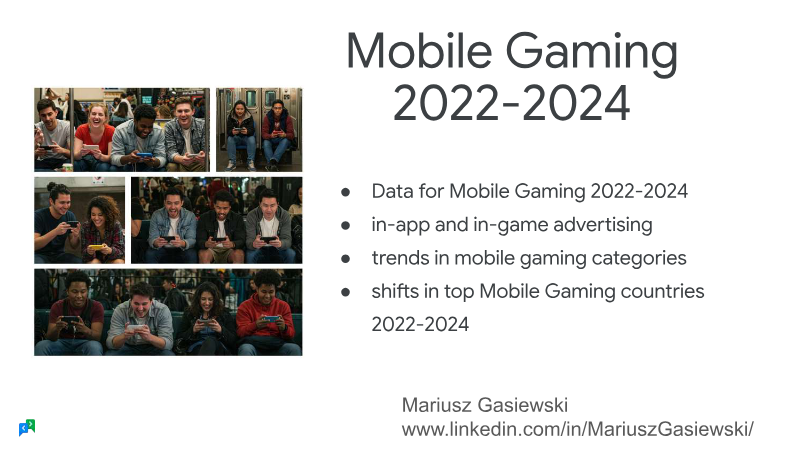
Mobile Gaming 2022-2024
The analysis tracks mobile‑gaming dynamics from 2022 through 2024, arguing that the sector’s financial expansion now exceeds its ability to attract new users. Revenue on Google Play rose roughly 10 % year‑on‑year in 2023‑24 while download volumes stagnated or slipped slightly, and iOS revenue grew about 12 % against an 8 % rise in downloads. Despite this divergence, the concentration of earnings among the top ten publishers has held steady, indicating that market power remains entrenched even as overall spend accelerates.
Consumer‑device preferences reveal a near‑universal reliance on smartphones, with 97 % of Brazilian gamers using mobile phones in 2024 and personal PCs ranking as the only other significant platform; console usage is negligible. Across the United States and Brazil, the primary incentives for trying a new title are free‑to‑play pricing, recognizable brands or characters, and easy access through subscription services. Gender nuances appear modest: men place greater value on non‑pay‑to‑win structures and strong single‑player experiences, whereas women are drawn to customizable avatars and peer recommendations.
Behavioral data show a pronounced tendency toward deep engagement with a single game. Approximately half of respondents in Brazil, Germany, Japan and the United States report completing one title before moving to the next, suggesting that the market favors sustained, title‑centric play rather than rapid turnover. The findings collectively underscore a maturing mobile‑gaming ecosystem where revenue growth is driven by monetisation depth and brand loyalty rather than sheer user acquisition.
- Mobile gaming revenue growth is decoupling from user acquisition, with Google Play revenue rising 10% and iOS revenue growing 12% in 2023–2024 despite stagnant or slowing download volumes.
- Market power remains highly concentrated, as the top ten publishers continue to capture the vast majority of earnings despite the overall acceleration in consumer spending.
- The mobile ecosystem is shifting toward a maturity model where revenue increases are driven by monetization depth and brand loyalty rather than the expansion of the total user base.
- Approximately 50% of gamers in major markets like the U.S., Germany, Japan, and Brazil prefer deep, sustained engagement with a single title rather than rapid game turnover.
- Consumer acquisition is primarily driven by free-to-play pricing, recognizable IP, and accessibility through subscription services.
+1
Mariusz Gasiewski (Google)Jan 2025
Report56 pages
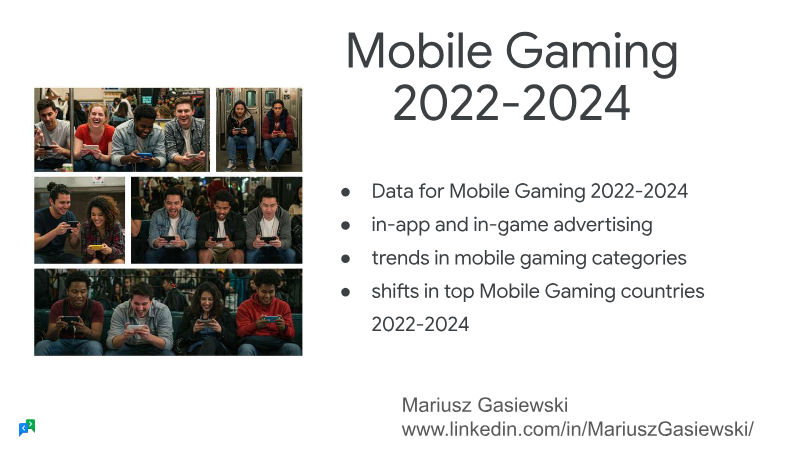
Data for Mobile Gaming 2022-2024
Mobile gaming maintains its position as the primary driver of industry expansion, fueled by widespread smartphone adoption and consistent engagement across both emerging and established markets. Between 2022 and 2024, the sector has demonstrated a clear trend where revenue growth consistently outpaces download volume on both iOS and Android platforms. This financial trajectory is increasingly supported by a strategic shift toward in-game advertising, which is currently outpacing traditional in-app purchases as a primary revenue stream.
Global market dynamics remain anchored by the United States, China, and Japan, which continue to serve as the most significant revenue generators. However, emerging markets are playing an increasingly critical role in the industry’s growth, particularly in regions like Brazil, where smartphone gaming penetration has surpassed 90% across all demographics. In these regions, player behavior is heavily influenced by free-to-play accessibility, narrative depth, and social recommendations. Furthermore, data from the U.S. and U.K. confirms that younger demographics prioritize smartphones over consoles and PCs, solidifying the mobile device as the central hub for modern gaming.
Despite the proliferation of available titles, the global player base exhibits a preference for focused engagement, with many users choosing to dedicate their time to a single game rather than managing multiple titles simultaneously. While market concentration among top-tier publishers remains stable, the rapid expansion of the advertising sector suggests a fundamental change in how developers monetize their audiences. Ultimately, the industry is transitioning toward a model that prioritizes long-term retention and diversified revenue streams over simple volume-based growth, ensuring that mobile gaming remains the most influential segment of the broader interactive entertainment landscape.
- Mobile gaming revenue growth is consistently outpacing download volume across iOS and Android platforms between 2022 and 2024.
- In-game advertising has overtaken traditional in-app purchases as the primary revenue stream for mobile developers.
- The United States, China, and Japan remain the dominant global revenue generators, while Brazil has reached over 90% smartphone gaming penetration across all demographics.
- Younger demographics in the U.S. and U.K. are increasingly prioritizing smartphones over consoles and PCs as their primary gaming platform.
- Player behavior is shifting toward focused engagement, with users increasingly dedicating their time to a single title rather than managing multiple games.
+2
GoogleJan 2022