Report2 pages
Revenue & Top Companies: Romania 2025
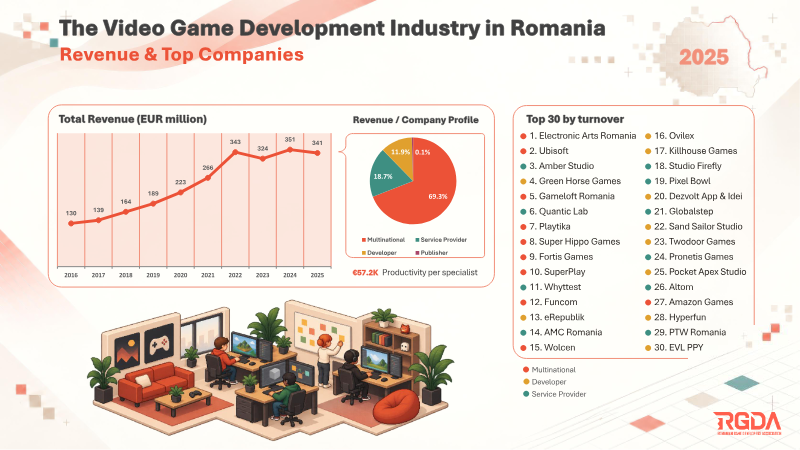
The Romanian video game industry has demonstrated significant resilience and structural evolution, reaching a total revenue of 351 million EUR by 2025. While the sector experienced a post-pandemic contraction that impacted service providers, the market has pivoted toward a surge in creative output. This shift is evidenced by a 2.5-fold increase in game releases over the past two years, signaling a robust expansion within the independent development sector. The industry currently maintains a productivity rate of 57,200 EUR per specialist, supported by a workforce of 6,000 professionals.
Geographically, the industry remains heavily concentrated in major urban hubs, with Bucharest serving as the primary center of operations, hosting 46 percent of all studios. Cluj, Iași, Timiș, and Brașov follow as secondary clusters, collectively accounting for 28 percent of the ecosystem. The current landscape comprises 234 active studios, ranging from multinational corporations to independent developers and service providers. Among the top 30 companies by turnover are major international players such as Electronic Arts Romania, Ubisoft, and Gameloft, alongside a diverse array of specialized local studios.
The industry ecosystem is supported by a domestic player base of 8.6 million individuals. The transition from a service-heavy model to a more balanced mix of development and publishing has fostered a more sustainable environment for local talent. By diversifying its operational focus, the Romanian gaming sector has successfully navigated recent economic pressures, positioning itself as a key European hub for both large-scale multinational production and agile, independent game creation.
- The Romanian video game industry reached a total revenue of 351 million EUR in 2025, supported by a workforce of 6,000 professionals.
- The sector has shifted from a service-heavy model to a balanced mix of development and publishing, resulting in a 2.5-fold increase in game releases over the last two years.
- The industry is comprised of 234 active studios, with major international players like Electronic Arts Romania, Ubisoft, and Gameloft ranking among the top 30 companies by turnover.
- Geographic concentration remains high, with 46 percent of all studios located in Bucharest and an additional 28 percent distributed across Cluj, Iași, Timiș, and Brașov.
- The industry maintains a productivity rate of 57,200 EUR per specialist.
RGDA – Romanian Game Developers Association
Report29 pages
Gaming Report 2026: Choose Your Player
The leadership team of Bain & Company's Global Gaming Sector practice prepared this report, with special direction from Anders Christofferson, partner and Global Gaming Sector lead, and Brandon Rogers, Media practice manager. The authors would like to thank Danielle Schwenker, Aman Sharma, Gunjan Dawar, Shray Arora, Rohan Doomra, Shagun Jain, and Christoffer Karlsmose for their contributions to this work.
- The gaming market has shifted from a supply-constrained environment to one of infinite choice, where success now requires deep engagement with specific player segments rather than broad, unfocused appeal.
- Focused games—those designed for a specific, identifiable audience—achieved an 83% commercial success rate, significantly outperforming the 50% success rate of unfocused titles.
- Player preferences are highly fragmented, with no single experience type (such as story-driven, sandbox, or multiplayer) capturing more than 26% of the market, and two-thirds of gamers preferring to stick to familiar franchises or existing habits.
- Nearly half of all gamers now purchase content directly from developer web stores at least once a year, and 75% of top-grossing mobile games currently operate their own direct-to-consumer storefronts, up from just 12% in 2019.
- Studios should adopt AI-driven, real-time personalization—specifically contextual bandit algorithms—to optimize individual player experiences, as the highest-spending segment of the market accounts for approximately 75% of total gaming revenue.
+2
Bain & Company
Report33 pages
Annual Report of the German Games Industry 2023
The German games industry demonstrated remarkable resilience throughout 2022, maintaining a stable market valuation of 9.87 billion euros despite global economic headwinds, inflationary pressures, and hardware supply constraints. This performance represents a 1% growth rate, bucking international trends of market decline. The sector’s expansion is further evidenced by a 15.5% increase in the number of companies and a 7% rise in the workforce over the past year. Mobile gaming continues to dominate revenue streams, while digital distribution has solidified its position as the primary purchasing method for PC users and younger demographics.
Despite this growth, the industry faces structural challenges that threaten its long-term international competitiveness. A critical shortage of skilled labor in programming, technical art, and production persists, exacerbated by bureaucratic hurdles that impede the recruitment of international talent. Furthermore, the intermittent availability of federal funding has created an environment of instability, hindering strategic planning. To address these issues, the industry is advocating for a transition toward tax-based incentives, improved educational standards, and the establishment of specialized academic institutions to foster domestic expertise.
Beyond economic metrics, the sector is increasingly focused on professionalizing its ecosystem and enhancing its global footprint. Events such as Gamescom and the devcom Developer Conference have reinforced Germany’s status as a central hub for digital innovation, attracting significant international attention and political engagement. Simultaneously, the industry is prioritizing sustainability through climate-neutral initiatives and strengthening youth protection frameworks to ensure a safe gaming environment. By aligning advocacy efforts with a commitment to diversity and educational outreach, the German games sector aims to secure its position as a leading global player in the digital economy.
- The German games market remained resilient in 2022 with a valuation of 9.87 billion euros, achieving 1% growth despite global economic pressures.
- The industry saw significant structural expansion, marked by a 15.5% increase in the number of companies and a 7% rise in the total workforce.
- Mobile gaming remains the primary revenue driver, while digital distribution has become the standard purchasing method for PC users and younger demographics.
- A persistent shortage of skilled labor in programming, technical art, and production is currently hindering the industry's long-term international competitiveness.
- Industry advocates are pushing for a shift from intermittent federal funding to a more stable system of tax-based incentives to improve strategic planning.
+1
game – Verband der deutschen Games-Branche e. V.
Report104 pages
State of the Polish Video Game Industry: 2017
The Polish video game industry has matured into a globally recognized sector, characterized by a robust ecosystem of over 300 studios and a growing presence on the Warsaw Stock Exchange. While the industry experienced a temporary revenue dip in 2016 following a record-breaking 2015, it remains a vital component of the national economy, supported by institutional initiatives like the GameINN program. The sector’s primary thesis centers on its successful transition from a local market to a global powerhouse, driven by high-profile AAA titles and a burgeoning mobile development scene that increasingly targets international audiences.
Market dynamics within Poland reflect broader global trends, including a decisive shift toward digital distribution and the dominance of mobile platforms, which now account for nearly half of the domestic market value. While physical media remains resilient due to console adoption, consumer behavior is evolving toward Free-to-Play models and microtransactions. Despite this growth, the industry faces structural challenges, including a significant talent shortage for specialized roles like programming and design, as well as bureaucratic hurdles and complex tax laws. Employers report that recent university graduates often lack the practical skills required for immediate integration, forcing firms to seek foreign talent despite logistical difficulties.
Looking ahead, the industry is navigating the experimental stages of VR and AR while solidifying its status as a hub for eSports. Although Polish developers are increasingly competitive, they must contend with stiff international pressure from German and Asian firms. To sustain long-term growth, the sector is prioritizing "Games as a Service" models to mitigate piracy and enhance player engagement. Ultimately, the industry’s trajectory is defined by a move toward professionalization, where success is increasingly contingent upon effective brand management, international partnerships, and the ability to overcome domestic infrastructure and payment-trust limitations.
- The Polish video game industry comprises over 300 studios and has successfully transitioned from a local market to a global powerhouse driven by AAA titles and international mobile development.
- Mobile platforms now account for nearly half of the domestic market value, reflecting a broader consumer shift toward digital distribution, Free-to-Play models, and microtransactions.
- The sector faces a critical talent shortage for specialized programming and design roles, as university graduates often lack the practical skills required for immediate industry integration.
- Institutional support, such as the GameINN program, remains a vital component for the industry, which maintains a significant presence on the Warsaw Stock Exchange despite a revenue dip in 2016 following a record 2015.
- To ensure long-term growth and combat piracy, developers are increasingly prioritizing 'Games as a Service' models to enhance player engagement.
+1
Polish Games Association
Report9 pages
Kodeks Dobrych Praktyk w Sprawie Stosowania Ratingu Gier Wideo: Polska
The Kodeks Dobrych Praktyk w Sprawie Stosowania Ratingu Gier Wideo (Code of Good Practice for Video Game Rating in Poland), established in November 2016 by the Stowarzyszenie Polskie Gry and the Indie Games Polska foundation, serves as a self-regulatory framework for the Polish video game industry. Its primary objective is to protect minors from exposure to inappropriate content by standardizing the information provided to consumers regarding age-appropriate game classifications. The code functions as an industry-wide commitment to transparency, ensuring that producers, publishers, and distributors clearly label games regardless of the platform or distribution method.
The framework establishes five distinct age-based categories—3+, 7+, 12+, 16+, and 18+—which align closely with the established Pan European Game Information (PEGI) system. These categories define acceptable levels of violence, language, sexual content, and fear-inducing elements. By adopting these standards, participating entities agree to provide clear, legible, and accessible age ratings on all digital and physical product packaging. The code emphasizes that responsibility for accurate labeling lies with the producers and publishers, who are required to assess the effectiveness of their rating practices at least every two years.
Enforcement of these standards is managed through an internal Sąd Koleżeński (Peer Court), which oversees compliance and adjudicates potential violations. While the code is a voluntary, industry-led initiative, it is designed to complement existing Polish consumer protection laws and European Union directives regarding the protection of minors in digital environments. By formalizing these ethical and professional norms, the industry aims to foster greater social trust and ensure that consumers, particularly parents, can make informed purchasing decisions. Entities that choose to adopt the code must formally register their commitment, and any false claims of adherence are subject to scrutiny under national regulations concerning unfair market practices.
- The Kodeks Dobrych Praktyk, established in November 2016 by Stowarzyszenie Polskie Gry and Indie Games Polska, serves as the self-regulatory framework for age-appropriate game labeling in Poland.
- The framework utilizes five age-based categories—3+, 7+, 12+, 16+, and 18+—which are aligned with the Pan European Game Information (PEGI) system to standardize content warnings for violence, language, sexual content, and fear.
- Producers and publishers hold the primary responsibility for accurate labeling and are required to assess the effectiveness of their rating practices at least every two years.
- Compliance and potential violations are managed through an internal Peer Court (Sąd Koleżeński), which oversees the industry-led initiative.
- While participation is voluntary, the code complements existing Polish consumer protection laws and EU directives, with false claims of adherence subject to scrutiny under national unfair market practice regulations.
Stowarzyszenie Polskie Gry
Report1 pages
Stowarzyszenie Polskie Gry: Member Overview
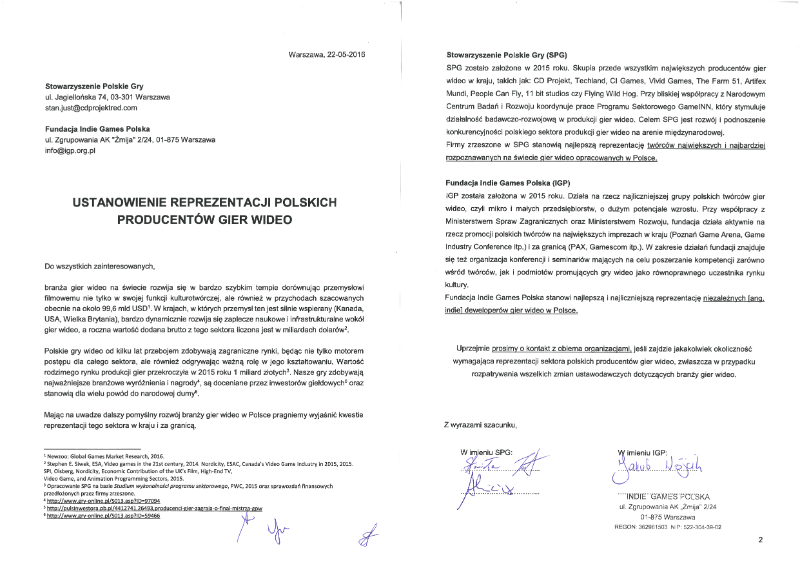
The Polish video game industry is represented by two primary organizations established in 2015: Stowarzyszenie Polskie Gry (SPG) and Fundacja Indie Games Polska (IGP). SPG focuses on the country’s largest developers, such as CD Projekt, Techland, and 11 bit studios, aiming to enhance the international competitiveness of the sector through research and development initiatives like the GameINN program. Conversely, IGP serves as the representative body for micro and small independent developers, focusing on promotional activities, industry networking, and professional development through conferences and seminars.
The sector has experienced significant growth, with the value of domestic game production exceeding 1 billion PLN in 2015. This expansion mirrors global trends, where the video game market has reached an estimated value of 99.6 billion USD, rivaling the film industry in both cultural impact and economic contribution. Countries that provide robust institutional support, such as Canada, the United States, and the United Kingdom, have successfully leveraged this industry to foster scientific and infrastructural development, resulting in billions of dollars in annual gross value added.
These organizations collectively advocate for the interests of Polish game developers, particularly regarding legislative changes and the need for a unified voice in national and international forums. By bridging the gap between large-scale commercial studios and independent creators, these entities seek to sustain the momentum of a sector that has become a source of national pride, attracting significant investor interest and earning prestigious global accolades. The collaborative efforts of SPG and IGP are intended to ensure the continued professionalization and strategic growth of the Polish gaming ecosystem.
- The Polish video game industry is supported by two primary organizations established in 2015: Stowarzyszenie Polskie Gry (SPG), representing major studios like CD Projekt, Techland, and 11 bit studios, and Fundacja Indie Games Polska (IGP), which supports micro and small independent developers.
- Domestic game production in Poland exceeded 1 billion PLN in value as of 2015.
- The global video game market has reached an estimated value of 99.6 billion USD, positioning it as a significant economic and cultural rival to the film industry.
- SPG focuses on enhancing international competitiveness through R&D initiatives such as the GameINN program, while IGP prioritizes networking, professional development, and promotional activities.
- Institutional support models from countries like Canada, the US, and the UK serve as benchmarks for Poland to leverage the gaming sector for scientific and infrastructural development.
Stowarzyszenie Polskie Gry

Report17 pages
Direct-to-Consumer: A $17 Billion Market for Mobile Gaming
The mobile gaming industry is undergoing a fundamental structural shift toward direct-to-consumer (DTC) distribution models, a transition that has already established a $17 billion market. By bypassing traditional app store ecosystems, publishers are successfully reclaiming profit margins previously lost to platform fees while simultaneously securing ownership of first-party player data. This evolution represents a strategic pivot from passive reliance on third-party storefronts to the active cultivation of proprietary, data-driven player relationships that foster long-term retention and competitive differentiation.
While the transition presents significant hurdles regarding technical infrastructure and player acquisition, the industry is increasingly adopting a hybrid model. This approach balances internal, player-facing strategies with specialized external partnerships for payment processing and regulatory compliance. Early adopters of these DTC frameworks are already demonstrating superior revenue growth and improved engagement metrics, creating a widening performance gap between firms that have integrated these channels and those that remain tethered to traditional distribution methods.
Looking toward the next decade, the broader digital economy is poised to mirror the success of mobile gaming, with the global in-app purchase market projected to reach $721.4 billion by 2034. DTC strategies are no longer the exclusive domain of large-scale enterprises; they have become a scalable imperative for developers of all sizes. By leveraging personalized experiences and sophisticated marketing analytics, firms can achieve higher year-over-year growth and greater valuation stability. Ultimately, the ability to control the end-to-end user experience has emerged as the primary driver of economic sustainability and long-term success in the modern mobile landscape.
- The mobile gaming direct-to-consumer (DTC) market has reached a valuation of $17 billion as publishers shift away from traditional app store ecosystems to reclaim platform fees.
- The global in-app purchase market is projected to grow to $721.4 billion by 2034, signaling a long-term shift toward DTC distribution across the digital economy.
- DTC models allow publishers to secure ownership of first-party player data, which is being used to drive long-term retention and competitive differentiation.
- Early adopters of DTC frameworks are currently outperforming competitors by demonstrating superior revenue growth and improved engagement metrics.
- Developers are increasingly adopting hybrid models that combine internal player-facing strategies with specialized external partnerships for payment processing and regulatory compliance.
+2
Appcharge

Report14 pages
Gamescom Awesome Indies Show: 2025 by the Numbers
The Gamescom Awesome Indies Show serves as a premier international platform for independent developers, studios, and publishers to debut new titles, gameplay, and trailers. By highlighting creative and emerging projects, the event functions as a high-visibility showcase within the broader Gamescom ecosystem. The 2025 iteration successfully engaged a global audience, demonstrating the significant reach of indie-focused programming through a combination of live streaming and on-demand content.
Performance metrics for the 2025 event underscore its substantial digital footprint. The showcase featured 24 indie titles and generated 36,500 hours of watch time during the live broadcast. Audience engagement remained strong, peaking at 44,000 concurrent viewers, while the event was supported by 116 co-streams. Furthermore, the program achieved 57,800 views on video-on-demand (VOD) platforms, confirming sustained interest in the showcased content beyond the initial live window.
To sustain and expand these efforts, the event offers structured sponsorship opportunities for the 2026 cycle. These commercial tiers range from $10,000 for spotlight trailers to $50,000 for official product partnerships, which include product placement and custom content integration. The sponsorship model is designed to integrate brands directly into the broadcast through branded snipes, developer interviews, and booth tours. By leveraging IGN Entertainment’s production capabilities and established digital channels, these partnerships provide brands with direct access to a dedicated gaming audience, ensuring that the showcase remains a viable and professional vehicle for industry promotion.
- The 2025 Gamescom Awesome Indies Show featured 24 independent titles and reached a peak of 44,000 concurrent viewers during its live broadcast.
- The event generated 36,500 hours of live watch time and secured 57,800 views on video-on-demand platforms, indicating strong sustained interest.
- The broadcast achieved significant distribution through 116 co-streams, amplifying the reach of the indie-focused content.
- Sponsorship tiers for the 2026 cycle range from $10,000 for spotlight trailers to $50,000 for official product partnerships.
- Commercial partnerships for 2026 include integrated brand opportunities such as product placement, branded snipes, developer interviews, and booth tours.
+1
IGN EntertainmentJul 2026

Report4 pages
Is There a Shift from Content to Tech Startups Among Gaming VCs?
The analysis examines venture capital activity in the gaming sector from 2020 to early 2024, focusing on whether investment priorities are shifting from traditional content creation and publishing toward technology‑driven startups. Data show that, across all stages, content creators and publishers continue to dominate VC allocations, representing over half of both capital deployed (≈$1.76 billion) and the number of deals in early‑, mid‑, and late‑stage rounds. However, a closer look at seed and Series A financing reveals a notable trend: PC and console studios now secure more funding than mobile startups, indicating a pivot toward higher‑budget, platform‑centric projects.
In the last twelve months, gaming‑focused VC funds have increased their exposure to technology and platform companies. Capital deployed by select funds such as VENTURES, BEHOLD Venture, and Lightspeed Lvp. rose from roughly $1.3 billion in early 2020 to over $2.4 billion by H1 2024, while the number of rounds led by these funds grew from 67 to 289. This shift is evident across multiple funds, with several moving a larger share of their capital into tech‑centric ventures rather than pure content studios.
Geographically, the data encompass global markets with a concentration in North America and Europe, covering all major gaming segments—mobile, PC, console, and emerging platform technologies. The methodology aggregates publicly disclosed VC‑led rounds from 2020 through H1 2024, using capital deployed and round counts as primary metrics. The findings suggest that while content remains the core focus, gaming VCs are progressively allocating more resources to technology and platform innovations, reflecting an evolving investment landscape in the industry.
- Content creators and publishers remain the primary focus of gaming VC, accounting for over half of all capital deployed (approximately $1.76 billion) and the majority of deal volume across all stages.
- Gaming-focused VC funds, including VENTURES, BEHOLD Venture, and Lightspeed Lvp., significantly increased their activity between 2020 and H1 2024, with capital deployed rising from $1.3 billion to over $2.4 billion.
- The number of VC-led funding rounds grew substantially from 67 in early 2020 to 289 by H1 2024, reflecting an overall increase in investment activity.
- While content dominates total funding, there is a clear strategic pivot among VCs toward technology and platform-centric startups, particularly within seed and Series A financing.
- Within the content sector, investment is shifting toward higher-budget, platform-centric projects, as evidenced by PC and console studios now securing more funding than mobile startups.
+3
InvestGame

Report7 pages
Public Mobile Gaming Publishers: Resilience & Adaptation in a Shifting Landscape
The analysis examines the post‑IDFA mobile gaming landscape, focusing on revenue dynamics, user acquisition spending, profitability trends, and market valuation shifts across key publishers. Data reveal that annual reported revenue growth has slowed markedly, with many companies experiencing negative organic revenue and overall declines in 2023‑24. User acquisition expenses have surged, reaching peaks of $40 million for some firms, yet returns from these campaigns have weakened, driving higher operating expenses and compressing EBITDA margins. Consequently, publishers are pivoting from aggressive scaling toward profitability, reflected in tighter cost controls and a renewed emphasis on player retention and lifetime value.
Daily active user metrics illustrate the broader market contraction, with average DAU figures falling across the sector. Valuation impacts are stark: aggregate market capitalisation for major publishers has fallen by more than 50 % since January 2022, and most stocks remain below their pre‑IDFA peaks. An exception is MTG, whose disciplined mergers and acquisitions strategy and operational efficiency yielded 9 % organic growth in Q4 2024, translating into a 50 %+ share price increase and outperforming the S&P 500.
The study covers global mobile gaming publishers over a 2022‑2025 timeframe, drawing on quarterly financial statements and market data. Methodology includes analysis of reported revenue, user acquisition spend, EBITDA adjustments for capitalised development costs, and market cap changes. The findings underscore a sector in transition, where resilience hinges on profitability focus, retention strategies, and disciplined capital allocation.
- Aggregate market capitalization for major mobile gaming publishers has plummeted by more than 50% since January 2022, with most stocks remaining below pre-IDFA valuation peaks.
- User acquisition costs have surged to as high as $40 million per firm, while diminishing returns on these campaigns have compressed EBITDA margins and forced a shift toward cost control.
- MTG outperformed the broader market with a 50%+ share price increase and 9% organic growth in Q4 2024, driven by disciplined M&A and operational efficiency.
- Annual revenue growth across the sector has slowed significantly, with many publishers reporting negative organic revenue and overall declines throughout 2023 and 2024.
- The mobile gaming sector is experiencing a broad contraction in engagement, evidenced by a decline in average daily active user (DAU) metrics across the industry.
+3
InvestGame

Report11 pages
Game Data: Building vs Buying
The document evaluates the trade‑offs between building an in‑house data pipeline and purchasing a third‑party solution for game analytics, using GameAnalytics’ PipelineIQ Pro as the primary example. It argues that while custom pipelines offer full control, they demand significant upfront investment in infrastructure, skilled personnel, and ongoing maintenance. The cost of hiring a data team—engineers, scientists, analysts—and cloud services (ingestion, storage, query, visualization) can reach nearly $50 k per month for a mid‑size studio with 5 million MAU, with human capital accounting for 89 % of the expense. In contrast, a vendor‑managed pipeline costs approximately $5.9 k per month, with the same headcount but lower operational overhead; human capital represents 78 % of that budget. The analysis highlights additional benefits of third‑party solutions, such as standardized event schemas, economies of scale in storage, rapid deployment (hours to days versus months), scalability without knowledge silos, and delegated privacy compliance. Methodologically, the comparison uses a hypothetical studio scenario to calculate total cost of ownership (TCO), breaking down monthly allocations into human, storage, query, and visualization costs. Geographic scope is global, with no regional restrictions noted; the time frame covers current market conditions and projected growth. The conclusion favors purchasing a proven pipeline for studios that lack the resources or urgency to build internally, citing lower TCO, faster time‑to‑insight, and reduced risk of technical debt.
- Building an in-house data pipeline for a studio with 5 million MAU costs approximately $50,000 per month, compared to $5,900 per month for a third-party solution like GameAnalytics’ PipelineIQ Pro.
- Human capital is the primary cost driver for both approaches, accounting for 89% of the budget for in-house builds and 78% for vendor-managed pipelines.
- Third-party solutions offer significantly faster deployment timelines, ranging from hours to days, whereas custom in-house pipelines typically require months to implement.
- Purchasing a proven pipeline reduces the risk of technical debt and eliminates knowledge silos that often occur when studios rely on internal engineering teams to maintain custom infrastructure.
- Vendor-managed solutions provide operational advantages including standardized event schemas, economies of scale in storage, and delegated responsibility for privacy compliance.
+1
InvestGame

Report75 pages
Playing for the Planet: Untangling the Carbon Complexities of the Video Gaming Industry
The analysis demonstrates that the video‑gaming sector remains fragmented in its approach to carbon accounting, with only a minority of companies—12 out of 222 surveyed—committed to science‑based targets. This shortfall stems largely from uncertainty around measuring Scope 3 emissions, particularly in categories such as purchased goods and product use. The report underscores a growing industry momentum: the Playing for the Planet Alliance now includes 42 members, and initiatives like the Green Games Guide and Ubisoft’s Climate School illustrate a shift toward embedding climate action within both operations and game content. Concrete progress is evident, for example, the Games Consoles Voluntary Agreement’s 54 TWh energy savings and the documented dominance of Scope 3 categories 1 (purchased goods) and 11 (use of sold products) in studios’ footprints.
Carbon intensity across the supply chain varies markedly by hardware, display technology, and regional electricity mix. Current‑generation consoles draw 150–200 W during gameplay, while PCs can reach 100–300 W; mobile devices consume only a few watts. A high‑end 4K TV can match console power when running HDR, and the carbon intensity of 200 Wh ranges from ≈13 gCO₂e in France to ≈81 gCO₂e in the United States. These disparities highlight opportunities for reducing emissions through hardware efficiency, extended device lifetimes, and the adoption of renewable electricity or green tariffs.
The report calls for consistent, industry‑aligned reporting frameworks—particularly the GHG Protocol Scope 3 categories—and greater granularity by business unit or product. It recommends iterative, data‑quality‑driven methods for estimating Category 1 and 2 emissions, prioritising primary supplier data for high‑spend items while applying spend‑based factors elsewhere. For Category 7 (employee commuting) and Category 11 (use‑phase emissions), detailed calculation examples illustrate the need to account for lifetime usage, regional grid intensity, and potential double‑counting. Real‑time accounting of use‑phase emissions is identified as a critical research gap, with cloud and CDN providers’ inconsistent reporting underscoring the need for standardized data.
Overall, the sector is moving toward greater transparency and actionable climate messaging, yet significant gaps remain in measurement, reporting consistency, and the integration of emerging technologies such as cloud gaming and AI. Addressing these challenges will be essential for credible net‑zero pathways across the global video‑gaming industry.
- Only 12 out of 222 surveyed gaming companies have committed to science-based carbon reduction targets, highlighting a significant industry-wide gap in formal climate accountability.
- Scope 3 emissions—specifically purchased goods (Category 1) and the use of sold products (Category 11)—represent the dominant share of the industry's total carbon footprint.
- Energy consumption during gameplay varies significantly by hardware, with current-generation consoles drawing 150–200W and PCs reaching up to 300W, compared to only a few watts for mobile devices.
- The carbon intensity of gaming is highly dependent on regional electricity grids, with 200Wh of consumption resulting in approximately 13gCO2e in France versus 81gCO2e in the United States.
- The Games Consoles Voluntary Agreement has successfully achieved 54 TWh in energy savings, demonstrating the efficacy of hardware efficiency standards.
Playing for the Planet Alliance
Report15 pages
Vietnam Domestic Gaming Industry Report: 2025
The Vietnamese mobile gaming market represents a significant growth sector in Southeast Asia, reaching a valuation of approximately $825 million in 2025. With an estimated 54 to 58.5 million mobile gamers and a year-on-year revenue growth rate of 9.16%, the market is characterized by high engagement, with users averaging 2.5 hours of daily gameplay. The industry is supported by a robust digital infrastructure, serving 79.8 million internet users, and is projected to exceed $1 billion in annual revenue by 2030.
Market performance is dominated by specific genres, with MMORPGs leading at 23.12% of total revenue, followed by team battle and 4X strategy games. Payment ecosystems are heavily localized, with e-wallets, bank transfers, and domestic card schemes—primarily through the NAPAS network—accounting for the vast majority of transactions. This preference for local financial infrastructure necessitates strategic partnerships for international entities seeking to enter the region.
Regulatory compliance remains the most critical barrier to entry for foreign developers. Under Decree No. 147/2024/ND-CP, all game distribution requires a formal license, and foreign companies must operate through a local legal entity or a licensed domestic publisher. Mandatory requirements include strict KYC identity verification, a 180-minute daily playtime limit for minors, and the physical hosting of server systems within Vietnam. Furthermore, upcoming advertising regulations effective in 2026 will mandate shorter, user-friendly ad formats, prompting a shift toward rewarded ads and enhanced in-app purchase strategies. To navigate these complexities, stakeholders are increasingly relying on local advisory and publishing ecosystems to manage licensing, legal documentation, and market-specific operational requirements.
- The Vietnamese mobile gaming market reached $825 million in 2025, growing 9.16% year-on-year with 54 million mobile gamers and 4.9 billion annual downloads.
- Foreign developers cannot publish directly and must partner with a local entity or establish a local office to comply with Decree No. 147/2024/ND-CP, which mandates local server hosting and 100% player KYC via mobile numbers.
- MMORPGs are the dominant revenue driver at 23.12% of the market, followed by Team Battle (17.05%) and 4X Battle (15.05%) genres.
- Payment infrastructure is heavily localized, with 86% of transactions utilizing local schemes and 31% of users preferring e-wallets, while card payments account for 27%.
- New advertising regulations effective February 15, 2026, will restrict ad formats by requiring one-tap close buttons and capping skip-wait times at 5 seconds, forcing a shift toward rewarded ads and IAP-focused monetization.
+1
Ocean Entertainment GroupMay 2026
Report9 pages
ESG Fact Sheet: FY 2023/24
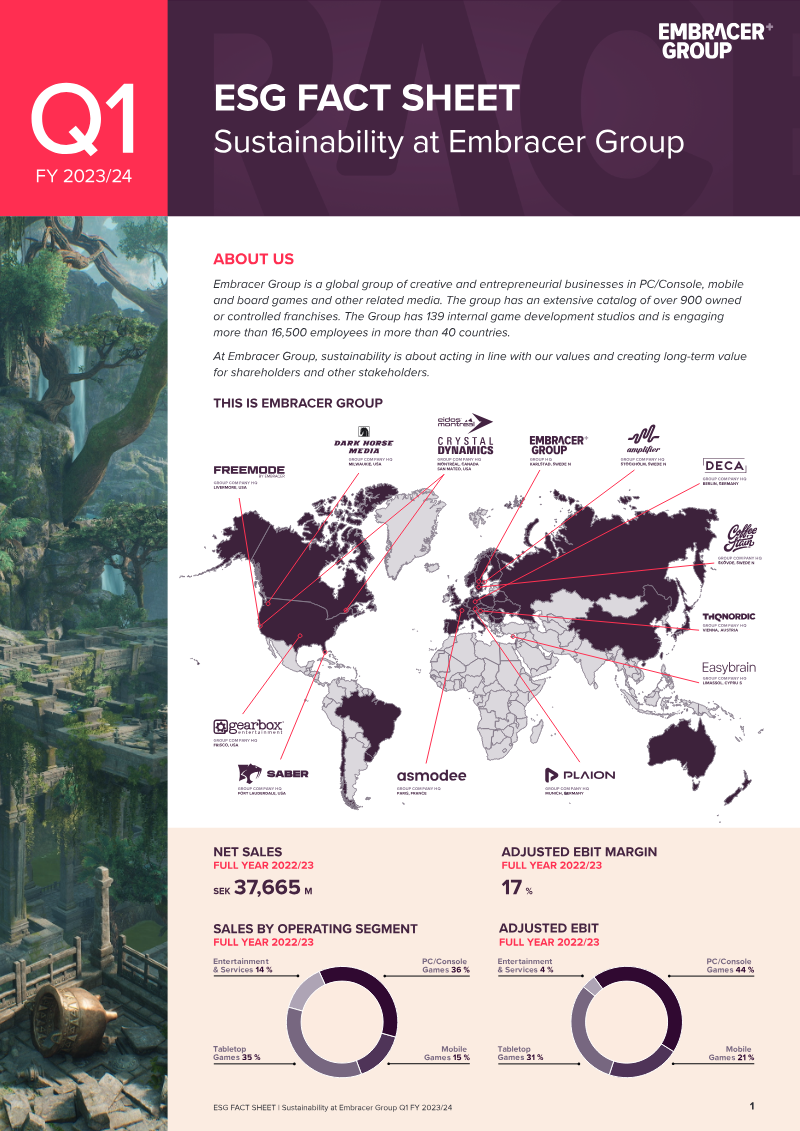
Embracer Group’s FY 2023/24 ESG Fact Sheet outlines the company’s sustainability framework, titled Smarter Business, which focuses on three core pillars: Great People, Solid Work, and Our Planet. Operating across more than 40 countries with 139 internal studios, the organization aims to integrate ethical governance and long-term value creation into its global operations. The company’s sustainability strategy is supported by 16 group policies and 12 guidelines, with oversight provided by the Audit and Sustainability Committee and an internal Ambassador Group.
Key performance indicators for the 2022/23 financial year highlight both progress and areas for development. Within the Great People pillar, the company reported a 26% female representation rate and an employee satisfaction score (eNPS) of +29. To foster leadership diversity, the board has committed to doubling the number of female managing directors and studio heads by 2025. Regarding environmental impact, the company has conducted a comprehensive greenhouse gas inventory, reporting total emissions of 687,102 tCO2e. The firm has aligned its climate strategy with the Paris Agreement, targeting a 45% reduction in carbon emissions by 2030 compared to a 2021/22 baseline.
The company utilizes a structured methodology for tracking progress, including annual global employee surveys and standardized sustainability due diligence during acquisitions. Furthermore, the organization actively participates in industry-wide initiatives such as the UN Global Compact, Women in Games, and PlayCreateGreen. By integrating these partnerships with internal training programs on privacy and ethics, the company seeks to manage operational risks while promoting digital well-being and accessibility across its portfolio of over 900 franchises.
- Embracer Group has committed to a 45% reduction in total carbon emissions by 2030, using the 2021/22 financial year as its baseline.
- The company reported total greenhouse gas emissions of 687,102 tCO2e for the 2022/23 financial year.
- Female representation across the organization stands at 26%, with a board-level mandate to double the number of female managing directors and studio heads by 2025.
- The organization maintains an employee satisfaction score (eNPS) of +29 across its 139 internal studios.
- Sustainability oversight is managed through 16 group policies and 12 guidelines, with governance provided by an Audit and Sustainability Committee and an internal Ambassador Group.
+3
Embracer Group
Report3 pages
Modern Slavery Statement
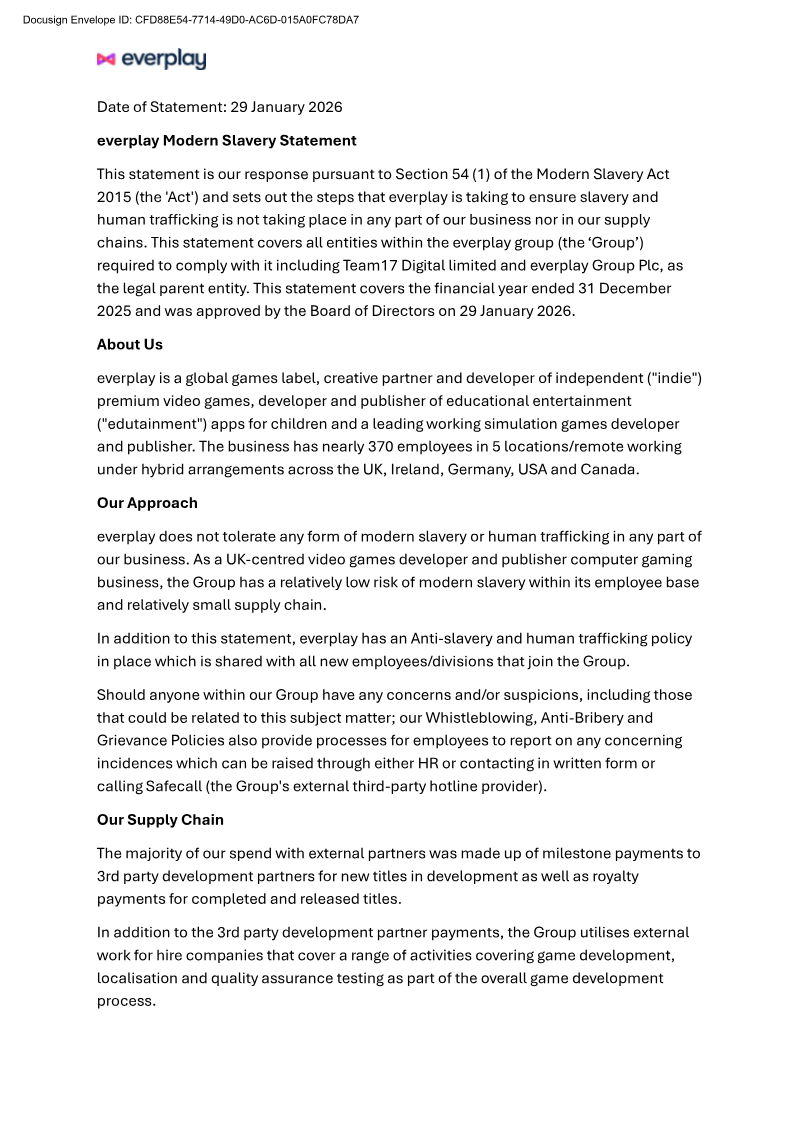
Everplay, a global video game developer and publisher, maintains a firm commitment to preventing modern slavery and human trafficking across its operations and supply chains. Covering the financial year ending December 31, 2025, this statement fulfills the requirements of the Modern Slavery Act 2015. The organization operates with approximately 370 employees across the UK, Ireland, Germany, the USA, and Canada, maintaining a business model that relies primarily on intellectual property and digital services rather than physical manufacturing, which inherently limits its exposure to modern slavery risks.
The company’s supply chain is primarily composed of third-party development partners, royalty recipients, and external service providers for localization and quality assurance. While the overall risk profile is considered low, the organization identifies quality assurance and localization as areas requiring heightened vigilance. To mitigate these risks, Everplay mandates that all new and renewing contracts include specific clauses requiring supplier compliance with the Act, granting the company the right to terminate agreements in the event of a breach.
Governance of these efforts is overseen by the Audit Committee, which reports to the Board of Directors at least twice annually. The company utilizes a multi-layered approach to risk management, incorporating internal policies, annual risk register reviews, and an external third-party whistleblowing hotline to ensure transparency and accountability. To date, these measures have proven effective, with no reported incidents of modern slavery. Everplay continues to prioritize employee and stakeholder awareness through ongoing training and the integration of anti-slavery protocols into its broader corporate governance framework.
- Everplay employs approximately 370 staff across the UK, Ireland, Germany, the USA, and Canada, operating a business model focused on intellectual property and digital services.
- The company mandates that all new and renewing contracts include specific anti-slavery compliance clauses, granting Everplay the right to terminate agreements for breaches.
- While the overall risk profile is considered low, the company identifies third-party localization and quality assurance providers as the primary areas requiring heightened vigilance.
- Governance of anti-slavery efforts is managed by the Audit Committee, which reports to the Board of Directors at least twice annually.
- Risk management is supported by annual risk register reviews and an external third-party whistleblowing hotline to ensure transparency.
+1
Everplay
Report9 pages
Ubisoft Reports Third-Quarter 2025-26 Sales
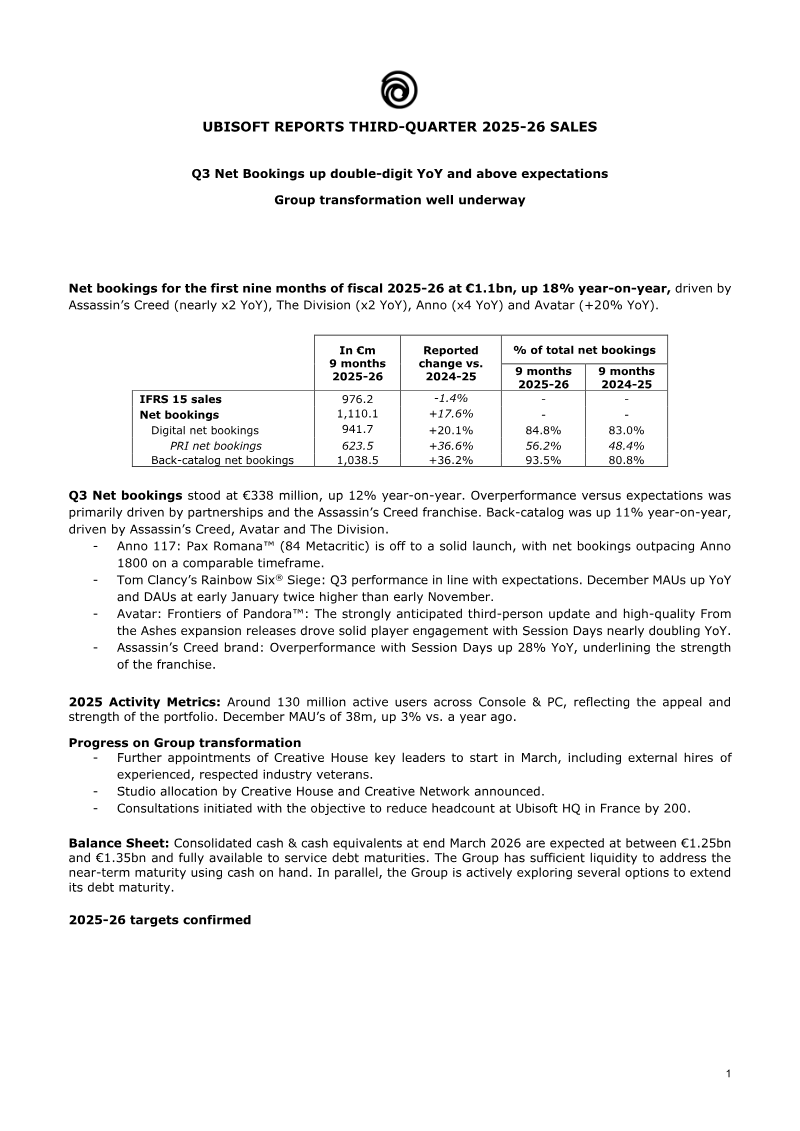
Ubisoft announced that net bookings for the first nine months of fiscal 2025‑26 reached €1.11 billion, an 18 % year‑on‑year increase driven by strong performance from Assassin’s Creed, The Division, Anno 117: Pax Romana and Avatar. Digital net bookings rose 20 % to €941.7 million, while back‑catalog sales grew 36 % to €1.04 billion, reflecting sustained demand for legacy titles and new releases such as Assassin’s Creed Shadows on Switch 2 and the Avatar: Frontiers of Pandora expansion. The third‑quarter figure of €338 million exceeded guidance by 12 %, with partnerships and franchise sales contributing most to the lift. Player activity metrics remained robust, with 130 million unique active users in 2025 and December MAUs at 38 million, up 3 % YoY.
The Group’s transformation continues, with the new Creative House operating model taking shape through studio reallocation and senior leadership appointments. Headcount reductions of 200 positions at Ubisoft HQ France are underway to streamline operations. Financially, consolidated cash stands between €1.25 billion and €1.35 billion, sufficient to cover near‑term debt maturities while the Group explores extensions of its debt profile.
Outlook for 2025‑26 confirms net bookings near €1.5 billion, non‑IFRS EBIT around –€1 billion, and free cash flow between –€400 million and –€500 million. Q4 launches include Rainbow Six Mobile, scheduled for February 23, and The Division Resurgence, with additional content planned across the franchise portfolio. Geographic revenue shares show Europe at 40 %, Northern America 46 %, and the rest of the world 14 %. Platform distribution remains dominated by consoles (55 %) and PCs (28 %), with mobile contributing 7 %.
- Ubisoft reported nine-month net bookings of €1.11 billion, an 18% year-on-year increase, with third-quarter results of €338 million exceeding guidance by 12%.
- Back-catalog sales grew 36% to €1.04 billion, driven by sustained demand for legacy titles and new releases like the Avatar: Frontiers of Pandora expansion and Assassin’s Creed Shadows.
- The company maintains a consolidated cash position between €1.25 billion and €1.35 billion while undergoing a restructuring that includes 200 headcount reductions at its French headquarters.
- Full-year 2025-26 outlook projects net bookings near €1.5 billion, with non-IFRS EBIT expected at –€1 billion and free cash flow between –€400 million and –€500 million.
- Player engagement remains strong with 130 million unique active users in 2025 and December monthly active users (MAUs) reaching 38 million, a 3% year-on-year increase.
+1
Ubisoft
Report7 pages
Ubisoft announces a major organizational, operational and portfolio reset to reclaim creative leadership and restore sustainable growth
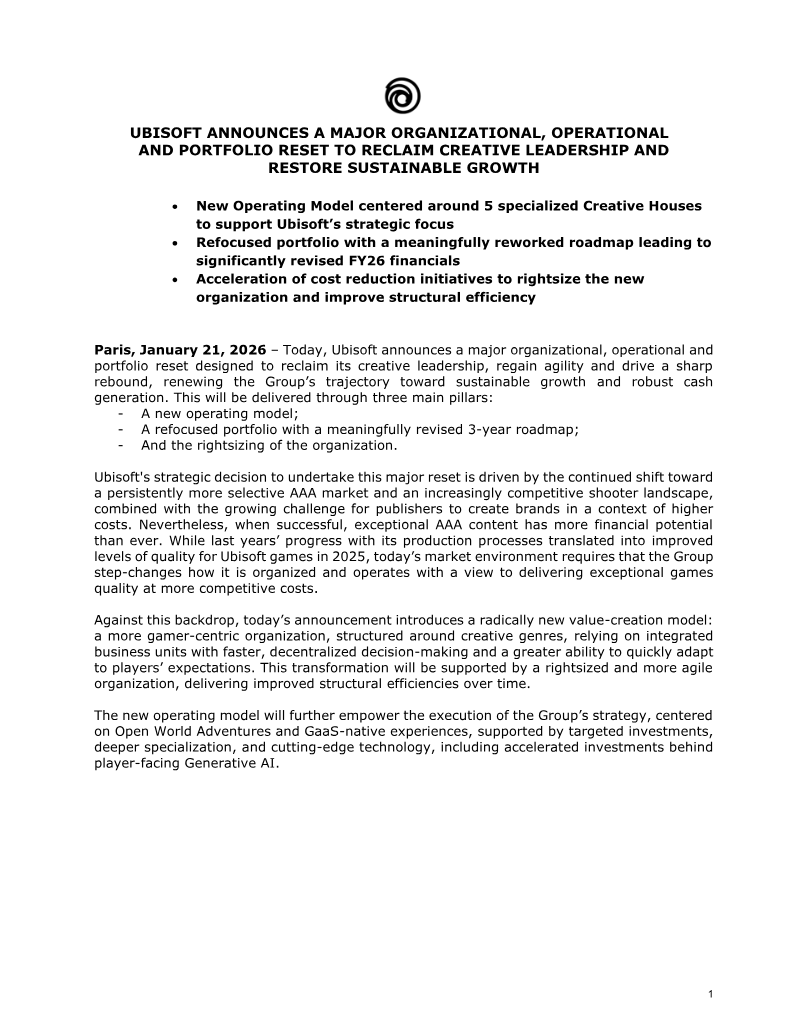
Ubisoft announces a comprehensive reset aimed at restoring creative leadership and sustainable growth amid a more selective AAA market. The strategy centers on three pillars: a new operating model, a refocused portfolio with an updated three‑year roadmap, and organizational rightsizing. The operating model introduces five Creative Houses—each genre‑focused, fully responsible for development, publishing, and financial performance—supported by a Creative Network of studios and shared Core Services. This structure is intended to accelerate decision‑making, deepen specialization in Open World Adventures and GaaS‑native experiences, and embed generative AI initiatives.
Portfolio adjustments include discontinuing six titles that fail new quality thresholds, extending development timelines for seven games to meet higher standards, and reallocating resources toward high‑potential IPs such as “March of Giants.” These changes are expected to reduce net bookings for FY26 by roughly €330 million and push non‑IFRS EBIT into the negative, reflecting one‑off depreciation costs. Free cash flow is projected between –€400 million and –€500 million, with net debt rising to €150–250 million.
Cost‑reduction efforts target a total fixed‑cost savings of approximately €500 million since FY22, with an accelerated €100 million cut already achieved by March 2026 and a further €200 million planned over the next two years, bringing fixed costs to about €1.25 billion by March 2028. The reset is set to take effect in early April, with a revised FY26–27 financial outlook to be released in May.
- Ubisoft is restructuring into five genre-focused 'Creative Houses' to accelerate decision-making and specialize in Open World Adventures and GaaS-native experiences.
- The company is discontinuing six titles and extending development timelines for seven others to meet new quality thresholds, resulting in a projected €330 million reduction in FY26 net bookings.
- Financial projections for FY26 include negative non-IFRS EBIT, free cash flow between –€400 million and –€500 million, and a net debt increase to €150–250 million.
- Fixed-cost reduction targets aim to bring total costs to approximately €1.25 billion by March 2028, with an additional €200 million in cuts planned over the next two years.
- The organizational reset includes the integration of generative AI initiatives and a strategic resource reallocation toward high-potential IPs such as 'March of Giants.'
+1
Ubisoft

Report6 pages
GungHo Business Report Vol. 42
GungHo Online Entertainment’s Vol. 42 report outlines the company’s strategic focus on expanding its two flagship intellectual properties—Puzzle & Dragons and Ragnarok—into global markets while sustaining robust financial performance. The report highlights that Puzzle & Dragons, launched in 2012, has achieved over 63 million downloads worldwide and continues to drive user engagement through frequent events, cross‑media collaborations, and a 13th‑anniversary release in May 2025. The Ragnarok franchise, managed by subsidiary Gravity Co., Ltd., has expanded from its original PC MMORPG roots to mobile and console titles, with recent releases such as Ragnarok X (PC/Android/iOS) and LUNAR Remastered Collection targeting Latin America, Southeast Asia, and other regions.
Financially, consolidated net sales rose from ¥125.3 billion in 2022 to ¥103.6 billion in 2024, with operating profit increasing from ¥27.9 billion to ¥17.5 billion over the same period. Overseas sales ratio climbed from 39.3 % in 2022 to 47.7 % in 2024, reflecting successful international penetration. The company maintained a dividend payout ratio above 30 % and executed treasury‑share repurchases totaling ¥9.86 billion in 2024, underscoring a commitment to shareholder value.
Methodologically, the report aggregates data from internal analytics on downloads, MAU, and revenue across more than 150 countries in 11 languages. It also references quarterly performance metrics and event‑based user activity to gauge engagement. Overall, the document presents a cohesive narrative of sustained growth through IP expansion, diversified platform presence, and disciplined financial management.
- GungHo’s overseas sales ratio grew from 39.3% in 2022 to 47.7% in 2024, signaling a successful shift toward international market penetration.
- Consolidated net sales decreased from ¥125.3 billion in 2022 to ¥103.6 billion in 2024, with operating profit declining from ¥27.9 billion to ¥17.5 billion over the same period.
- The flagship title Puzzle & Dragons has surpassed 63 million global downloads since its 2012 launch and is preparing for a 13th-anniversary release in May 2025.
- Subsidiary Gravity Co., Ltd. is actively diversifying the Ragnarok franchise across PC, mobile, and console platforms, specifically targeting growth in Latin America and Southeast Asia.
- The company maintains a commitment to shareholder returns, evidenced by a dividend payout ratio exceeding 30% and ¥9.86 billion in treasury-share repurchases during 2024.
+4
GungHo Online Entertainment

Report2 pages
Ragnarok Online 3: Service to Begin in Japan
Ragnarok Online 3 is announced as a free‑to‑play smartphone and PC MMORPG that will launch in Japan on February 13, 2026. Developed by Gravity Co., Ltd. and Lee MyoungJin (studio DTDS) under GungHo Online Entertainment’s publishing umbrella, the title preserves core elements of the original Ragnarok series—job system, classic content, and atmospheric design—while introducing a modern art style and restructured systems that support global interaction and cooperative play. Seasonal updates will refresh status, skill building, and siege battles, offering continuous new experiences for both veteran players and newcomers.
The service will be available on iOS, Android, and PC (planned), with in‑game purchases. Distribution is managed by a consolidated subsidiary of Gravity, excluding certain regions, and preparations for the Japanese launch are underway. GungHo emphasizes its commitment to high‑quality content and global expansion, aligning with its philosophy of pursuing new challenges and product creation.
GungHo Online Entertainment, headquartered in Chiyoda‑ku, Tokyo, was founded in 1998 and reported paid‑in capital of ¥5.338 billion as of December 31, 2025. The announcement includes standard legal and trademark notices for Apple, Google, and related brands. Press inquiries are directed to GungHo’s IR group via [email protected].
- Gravity Co., Ltd. and studio DTDS will launch Ragnarok Online 3 in Japan on February 13, 2026, as a free-to-play MMORPG.
- The title will be available across iOS, Android, and PC platforms, featuring in-game purchases and a business model focused on seasonal content updates.
- GungHo Online Entertainment will publish the game, which retains core series elements like the job system and atmospheric design while introducing a modernized art style.
- The game is designed to support global interaction and cooperative play through restructured systems and recurring updates to skills, status, and siege battles.
- Distribution is managed by a consolidated subsidiary of Gravity, with the Japanese launch serving as a key component of GungHo’s broader global expansion strategy.
+2
GungHo Online Entertainment
Report40 pages
3Q FY2020 Presentation Material: Japan
3Q FY2020 Presentation Material The future information, such as earnings forecast, written in this document is based on our expectations and assumptions as of the date the forecast was made. Our actual results could differ materially from those described in this forecast because of various 1. Quarterly Results (April - June 2020) 3. Internet Advertisement Business FY2020 Results were in line with the forecast despite COVID-19 Q3 impact.
- Overall FY2020 results were in line with forecasts despite COVID-19, with Q3 sales down 0.7% year-over-year to 112.8 billion yen and operating profit down 12.3% to 8.2 billion yen.
- ABEMA's Weekly Active Users (WAU) remained stable after the lifting of stay-at-home requests, with Media sales up 19.2% year-over-year to 13.3 billion yen, though operating profit was a loss of 4.0 billion yen.
- Advertising sales remained flat year-over-year at 64.3 billion yen (up 0.01%) despite COVID-19, with operating profit down 6.0% to 4.7 billion yen, by focusing on advertisers with strong stay-at-home consumer demand.
- Game sales declined 4.0% year-over-year to 36.7 billion yen in Q3, with operating profit down 9.5% to 7.5 billion yen, as quarterly revenue declined after anniversaries of game releases.
- The company's total employee headcount was 5,467 at the end of June, including 295 new graduates who joined in April.
+3
CyberAgent