Report35 pages
The Gaming App Insights Report: 2026 Edition
The mobile gaming industry is undergoing a fundamental strategic transition, moving away from a reliance on high-volume user acquisition toward a model centered on long-term retention and high-value player engagement. This shift is driven by a challenging economic environment characterized by a 33% increase in global cost-per-click and a 30% rise in cost-per-install throughout 2025. To mitigate these rising expenses, studios are consolidating their marketing efforts, reducing the average number of advertising partners per application to focus on high-performing channels that promise superior return on investment.
Technological innovation serves as a primary lever for this transformation, with generative artificial intelligence and machine learning now integral to creative production and audience targeting. These tools allow developers to optimize ad performance and refine engagement tactics in an era where data privacy remains a critical factor. Notably, App Tracking Transparency opt-in rates on iOS reached 39% in early 2026, providing studios with more reliable data to fuel their direct-to-consumer strategies. This data-driven approach is increasingly vital as the industry seeks to balance the dominance of hyper-casual titles, which still account for 29.1% of installs, with the superior session-to-install ratios found in action and puzzle genres.
The global landscape reflects a maturing market where session lengths and day-1 retention rates remain stable despite the broader cost pressures. While hyper-casual games maintain the largest share of installs, the industry is clearly pivoting toward hybrid monetization and cross-platform experiences to sustain growth. By prioritizing long-term progression over rapid acquisition, developers are successfully navigating a period of rising costs, ensuring that engagement remains robust even as the industry shifts toward more sustainable, value-based growth models.
- Global gaming app CPC rose 33% from $0.03 to $0.04 between 2024 and 2025, while global CPM increased 20% from $3.63 to $4.34.
- Hyper-casual games maintained the largest market share of installs at 29.1% in 2025, while action games dominated session share at 17.1%.
- Strategy games saw the most significant increase in session length, growing 18% to 37.51 minutes, and experienced a 133% surge in CPC from $0.03 to $0.07.
- Over 90% of game developers now utilize AI to automate and streamline core production tasks, including playtesting, localization, and game balancing.
- North America recorded the highest regional CPC at $0.12 in 2025, representing a 71% increase, with the U.S. market specifically rising 86% to $0.13.
+3
Adjust
Report26 pages
China Steam & PC Gaming Market Report: 2025
The Chinese PC gaming market has reached a valuation of approximately $11–12 billion within a broader national gaming industry worth RMB 350.78 billion. Steam maintains a dominant position, commanding an 87% market share, though the broader distribution landscape remains highly fragmented. Developers must navigate a complex ecosystem where traditional storefront metrics are often obscured by grey-market and cross-region transactions. Consequently, pricing strategies must account for local market realities, as Steam titles in China are consistently priced 21% to 37% lower than Western benchmarks to align with regional purchasing power and consumer expectations.
Success in this market is increasingly predicated on community-led discovery rather than traditional store-page traffic. Platforms such as Bilibili, TapTap, Heybox, and Sonkwo serve as essential hubs for user-generated content, creator-driven promotion, and player engagement. The rise of a sophisticated fan economy further underscores this shift, as hit titles are now built through long-term community hype and viral social media resonance. Specialized offline events, such as WePlay Expo and G-Fusion, have proven more effective for reaching core PC and indie gaming audiences than mass-market trade shows.
International developers looking to penetrate this sector must prioritize local content ecosystems over conventional marketing funnels. Because discovery and validation are driven primarily by streamers and community influencers, go-to-market strategies require deep integration with Chinese digital platforms. Navigating these unique cultural and commercial dynamics necessitates specialized local expertise to effectively manage community engagement and optimize commercialization efforts within this distinct, high-growth environment.
- Steam dominates the Chinese PC gaming market with an 87% share, contributing to a total PC gaming valuation of approximately $11–12 billion.
- Pricing for Steam titles in China must be adjusted 21% to 37% lower than Western benchmarks to align with local purchasing power and consumer expectations.
- Market discovery is driven by community-led engagement on platforms like Bilibili, TapTap, Heybox, and Sonkwo rather than traditional store-page traffic.
- Successful market entry requires deep integration with local digital ecosystems and influencer-driven promotion rather than conventional marketing funnels.
- Specialized offline events such as WePlay Expo and G-Fusion are more effective for reaching core PC and indie gaming audiences than mass-market trade shows.
+1
Asia GameDev
Report17 pages
Direct-to-Consumer: A $17 Billion Market for Mobile Gaming
The mobile gaming industry is undergoing a fundamental structural shift toward direct-to-consumer (DTC) distribution models, a transition that has already established a $17 billion market. By bypassing traditional app store ecosystems, publishers are successfully reclaiming profit margins previously lost to platform fees while simultaneously securing ownership of first-party player data. This evolution represents a strategic pivot from passive reliance on third-party storefronts to the active cultivation of proprietary, data-driven player relationships that foster long-term retention and competitive differentiation.
While the transition presents significant hurdles regarding technical infrastructure and player acquisition, the industry is increasingly adopting a hybrid model. This approach balances internal, player-facing strategies with specialized external partnerships for payment processing and regulatory compliance. Early adopters of these DTC frameworks are already demonstrating superior revenue growth and improved engagement metrics, creating a widening performance gap between firms that have integrated these channels and those that remain tethered to traditional distribution methods.
Looking toward the next decade, the broader digital economy is poised to mirror the success of mobile gaming, with the global in-app purchase market projected to reach $721.4 billion by 2034. DTC strategies are no longer the exclusive domain of large-scale enterprises; they have become a scalable imperative for developers of all sizes. By leveraging personalized experiences and sophisticated marketing analytics, firms can achieve higher year-over-year growth and greater valuation stability. Ultimately, the ability to control the end-to-end user experience has emerged as the primary driver of economic sustainability and long-term success in the modern mobile landscape.
- The mobile gaming direct-to-consumer (DTC) market has reached a valuation of $17 billion as publishers shift away from traditional app store ecosystems to reclaim platform fees.
- The global in-app purchase market is projected to grow to $721.4 billion by 2034, signaling a long-term shift toward DTC distribution across the digital economy.
- DTC models allow publishers to secure ownership of first-party player data, which is being used to drive long-term retention and competitive differentiation.
- Early adopters of DTC frameworks are currently outperforming competitors by demonstrating superior revenue growth and improved engagement metrics.
- Developers are increasingly adopting hybrid models that combine internal player-facing strategies with specialized external partnerships for payment processing and regulatory compliance.
+2
Appcharge

Report16 pages
Rewarded UA Handbook: 2026
Rewarded user acquisition (UA) has evolved into a foundational component of the mobile marketing mix, serving as a critical solution to the industry’s ongoing challenges of rising acquisition costs and high user churn. As the global mobile gaming market matures and user growth plateaus, rewarded UA provides a mechanism to drive long-term engagement and retention by incentivizing users to reach specific in-game milestones. The practice is now standard, with 93% of surveyed developers across 10 tier-1 markets currently utilizing rewarded channels, and 61% planning to increase their budget allocations in 2026.
The methodology behind this analysis involved an online survey of 912 mobile game developers conducted between December 2025 and January 2026, supplemented by performance data from over 1,200 advertisers on the Freecash platform. Findings indicate that successful campaigns are no longer treated as experimental, with 31% of studios classifying rewarded UA as an always-on, core channel. High-performing studios typically allocate between 11% and 50% of their total UA budget to these efforts, often managing a portfolio of four or more channels to optimize reach and performance.
Strategic implementation requires a shift toward long-term event architecture. Data shows that campaigns optimizing for multiple, layered events—such as daily streaks, VIP tiers, and repeat purchases—consistently outperform single-event models. By extending reward structures to 90 or 180 days, developers can significantly improve retention and return on ad spend (ROAS). Furthermore, the industry is increasingly adopting automated bidding technologies, such as dynamic ROAS-based bidding, to replace fixed cost-per-install models. While gaming remains the primary sector, the model is rapidly expanding into non-gaming verticals like fintech and e-commerce, where gamification features are being leveraged to drive similar habit-forming behaviors and sustainable user value.
- Rewarded UA is now a core marketing channel, with 61% of surveyed studios planning to increase their budget in 2026 and 65% of studios allocating between 11% and 50% of their total UA spend to the channel.
- Extending reward structures beyond traditional short-term windows is critical for retention; for example, Candivore increased their Match Masters reward structure from 50 to 90 days, resulting in a 50% increase in D60 retention and a 70% uplift in D90 ROAS.
- Campaigns that layer multiple event types outperform single-event campaigns, with IAP/hybrid games utilizing an average of 3.25 distinct event types per campaign to drive long-term engagement.
- Automation is a primary industry focus, as evidenced by Almedia’s MaxROAS system, which has delivered up to a 35% ROAS uplift and a 100% increase in spending for participating advertisers since December 2025.
- Rewarded UA is increasingly viewed as a go-to-market strategy, with 93% of studios launching rewarded campaigns within the first year of their game's lifecycle and 46% implementing them within the first three months of global launch.
+3
AlmediaJun 2026
Report4 pages
Market Model Reports: Asia & MENA
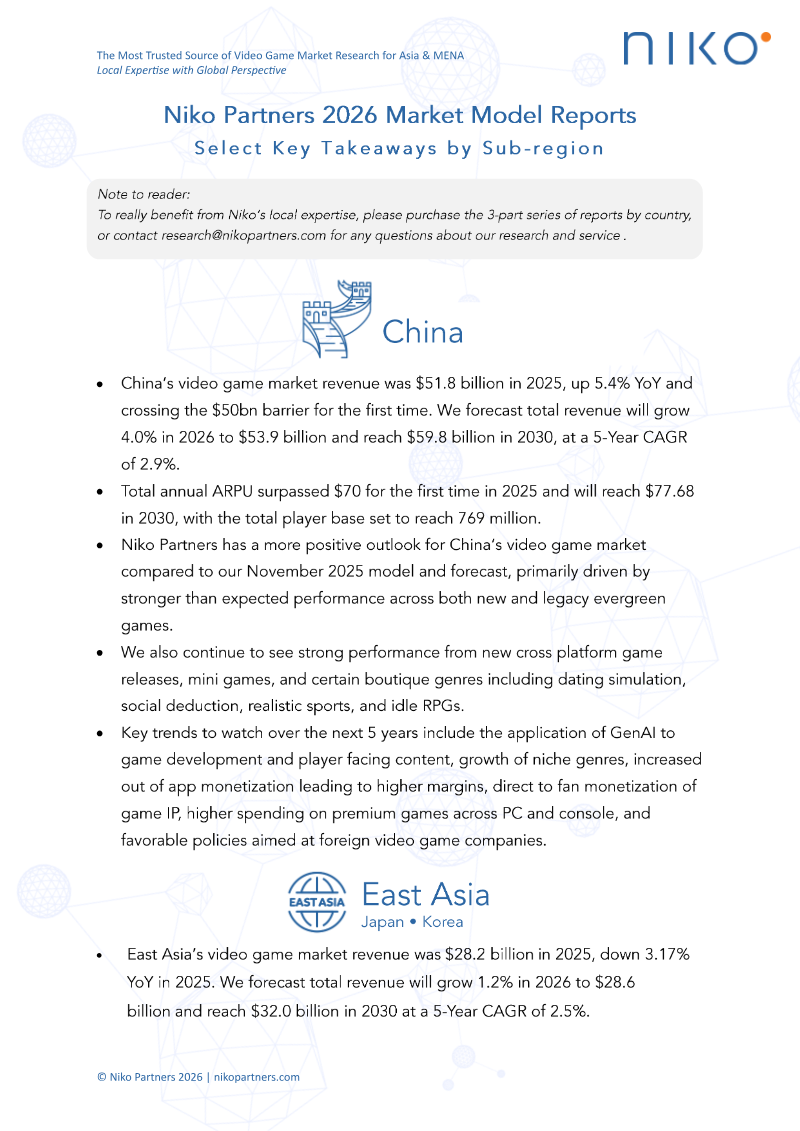
The 2026 Market Model Reports provide a comprehensive analysis of video game industry performance and growth projections across Asia and the Middle East and North Africa (MENA). Covering China, East Asia, India, Southeast Asia, and the MENA-3 region (Egypt, Saudi Arabia, and the UAE), the research evaluates revenue trends, player demographics, and macroeconomic influences through 2030. The analysis utilizes proprietary market modeling, player survey data, and regional expertise to assess the evolving landscape of mobile, PC, and console gaming.
Key findings highlight significant regional disparities in growth and maturity. China remains a dominant force, with 2025 revenue reaching $51.8 billion and a projected 2.9% CAGR through 2030. India emerges as the fastest-growing market, having surpassed $1 billion in revenue in 2025 with an expected 11.2% CAGR. Conversely, East Asia experienced a 3.17% revenue decline in 2025 due to macroeconomic pressures in Japan, though South Korea shows signs of recovery. Southeast Asia continues to expand, driven by mobile adoption and internet penetration, while the MENA-3 region benefits from strong government support and rising disposable income, despite potential geopolitical headwinds.
The research identifies several critical industry drivers, including the integration of generative AI, the rise of niche genres, and increased government regulation across Southeast Asia. Higher average revenue per user (ARPU) remains a focal point, particularly in East Asia, which maintains the highest regional spending levels. Overall, the findings suggest that while short-term volatility persists due to economic and geopolitical factors, the broader outlook for these markets remains positive, supported by increased localization, infrastructure development, and shifting consumer spending toward digital entertainment.
- China’s video game market reached $51.8 billion in 2025 and is projected to grow at a 2.9% CAGR to reach $59.8 billion by 2030.
- India is the fastest-growing market tracked, with 2025 revenue of $1.04 billion and a projected 11.2% CAGR through 2030, supported by a player base expected to reach 707 million.
- East Asia remains the region with the highest ARPU, though 2025 revenue declined 3.17% to $28.2 billion due to Japanese market stagnation and macroeconomic conditions.
- Southeast Asia’s market revenue hit $5.63 billion in 2025 and is forecast to grow at a 4.8% CAGR, with Thailand, the Philippines, and Indonesia identified as the fastest-growing sub-markets.
- The MENA-3 region (Egypt, Saudi Arabia, UAE) generated $2.15 billion in 2025 and is expected to see the strongest ARPU growth, reaching $38 by 2030 despite potential geopolitical instability.
+3
Niko PartnersJun 2026
Report49 pages
Essential Facts about Video Games in Italy: 2025
In 2025, roughly 14.2 million Italians—about a third of the population aged six to seventy‑five—engage in video gaming, with a pronounced male bias and a concentration of players under 35. The industry’s total revenue remains steady at €2.4 billion, of which game sales account for 77 percent (€1.8 bn). Gaming time has risen to nearly eight hours per week, driven primarily by smart‑device play (22 percent reach, €929 m revenue) and console gaming (13 percent reach, €643 m). App‑based games now represent more than half of the market, dominated by freemium monetisation; only one percent of app revenue comes from upfront purchases.
Revenue distribution varies by platform. Smart‑device earnings are almost entirely from in‑app purchases (ARPU €84), while console sales lean heavily on digital downloads—65 percent of new game revenue comes from full‑game downloads (€502 m) and 21 percent from DLC (ARPU €99). PC revenue is largely driven by DLC (43 percent) and full‑game downloads (98 percent of console sales). Subscription services are pivotal: console ecosystem subscriptions contribute 59 percent of total gaming‑subscription revenue (€153 m), with mobile and single‑game franchises accounting for 6 percent and 35 percent respectively.
Player demographics reveal that smart devices attract a younger, male‑skewed audience (31 percent of 6–17‑year-olds), whereas console and PC gaming remain niche but heavily male‑skewed, concentrated among teens. Casual and sports titles dominate sales across all platforms, with subscription services such as PlayStation Plus and Xbox Game Pass driving a significant share of paid play. Engagement patterns show males spending the most hours on consoles (average seven hours per week), while PC gaming remains steady across age groups. Approximately one‑quarter of players follow gaming news on YouTube or vlogs, and 20 percent rely on social media or family discussions for information. The data derive from a nationally representative online survey of 3,000 respondents, weighted against an offline omnibus sample and calibrated to industry sales figures.
- The Italian video game market generated €2.4 billion in 2025, with game sales accounting for 77 percent (€1.8 billion) of total revenue.
- App-based gaming dominates the market, representing over half of total revenue with a freemium model where only one percent of earnings come from upfront purchases.
- Smart devices are the primary revenue driver at €929 million, while console gaming accounts for €643 million, supported by an average of eight hours of gameplay per week across the population.
- Console revenue is heavily reliant on digital distribution, with 65 percent of new game sales coming from full-game downloads and 21 percent from DLC.
- Console ecosystem subscriptions are the primary driver of the subscription market, contributing 59 percent (€153 million) of total subscription revenue.
+4
IIDEA – Italian Interactive Digital Entertainment Association

Report7 pages
Public Mobile Gaming Publishers: Resilience & Adaptation in a Shifting Landscape
The analysis examines the post‑IDFA mobile gaming landscape, focusing on revenue dynamics, user acquisition spending, profitability trends, and market valuation shifts across key publishers. Data reveal that annual reported revenue growth has slowed markedly, with many companies experiencing negative organic revenue and overall declines in 2023‑24. User acquisition expenses have surged, reaching peaks of $40 million for some firms, yet returns from these campaigns have weakened, driving higher operating expenses and compressing EBITDA margins. Consequently, publishers are pivoting from aggressive scaling toward profitability, reflected in tighter cost controls and a renewed emphasis on player retention and lifetime value.
Daily active user metrics illustrate the broader market contraction, with average DAU figures falling across the sector. Valuation impacts are stark: aggregate market capitalisation for major publishers has fallen by more than 50 % since January 2022, and most stocks remain below their pre‑IDFA peaks. An exception is MTG, whose disciplined mergers and acquisitions strategy and operational efficiency yielded 9 % organic growth in Q4 2024, translating into a 50 %+ share price increase and outperforming the S&P 500.
The study covers global mobile gaming publishers over a 2022‑2025 timeframe, drawing on quarterly financial statements and market data. Methodology includes analysis of reported revenue, user acquisition spend, EBITDA adjustments for capitalised development costs, and market cap changes. The findings underscore a sector in transition, where resilience hinges on profitability focus, retention strategies, and disciplined capital allocation.
- Aggregate market capitalization for major mobile gaming publishers has plummeted by more than 50% since January 2022, with most stocks remaining below pre-IDFA valuation peaks.
- User acquisition costs have surged to as high as $40 million per firm, while diminishing returns on these campaigns have compressed EBITDA margins and forced a shift toward cost control.
- MTG outperformed the broader market with a 50%+ share price increase and 9% organic growth in Q4 2024, driven by disciplined M&A and operational efficiency.
- Annual revenue growth across the sector has slowed significantly, with many publishers reporting negative organic revenue and overall declines throughout 2023 and 2024.
- The mobile gaming sector is experiencing a broad contraction in engagement, evidenced by a decline in average daily active user (DAU) metrics across the industry.
+3
InvestGame
Report28 pages
Mobile Gaming by Genre: Hypercasual
The hypercasual segment continues to dominate mobile gaming revenue, with the top 100 titles achieving 5.48 billion downloads and $345 million in in‑app purchase (IAP) revenue during the first half of 2025—double the figures from 2024 and the highest ever recorded for this genre. Leading publishers such as AZUR GAMES, Supersonic Studios, and Voodoo have secured billions of lifetime downloads and are increasingly adopting hybrid monetization models that blend advertising with growing IAP streams. This shift signals a clear trend toward revenue diversification while maintaining the ultra‑light, rapid‑development ethos that characterizes hypercasual games.
Projected revenue for 2025 is expected to reach $690 million across the top 100 titles, a doubling of the H1 figure and an increase from $403 million in 2024. The analysis attributes this surge to the genre’s evolution toward hybrid‑casual, where light meta‑progression and deeper monetization extend player engagement beyond the typical 30–60 second sessions. Key performance indicators remain ultra‑low cost per install (CPI), high Day‑1 retention around 40 %, and creative‑driven user acquisition. Hybrid titles aim to lift Day‑7 retention into the teens, thereby boosting lifetime value (LTV).
Case studies of Mob Control, Color Block Jam, and Pizza Ready illustrate successful pivots to hybrid‑casual models. Each title combined strong user experience design, staged monetization (ads plus IAPs), and data‑driven acquisition strategies. Tactics such as adaptive market positioning, psychological ad hooks like the Zeigarnik effect, and seamless ad integration into gameplay produced multi‑million installs, daily revenues exceeding $250 k, and sustained top‑chart performance. These examples underscore that balancing simplicity with depth, timing releases to genre trends, and iterating creatives regionally are critical for scaling hybrid‑casual titles.
- Hypercasual revenue for the top 100 titles is projected to reach $690 million in 2025, a significant increase from $403 million in 2024.
- H1 2025 performance for the top 100 hypercasual titles hit record highs of 5.48 billion downloads and $345 million in IAP revenue, doubling the figures from the same period in 2024.
- Leading publishers like AZUR GAMES, Supersonic Studios, and Voodoo are shifting toward hybrid-casual models that blend traditional advertising with deeper IAP monetization to extend player engagement.
- Hybrid-casual titles aim to improve Day-7 retention into the teens and increase lifetime value by incorporating light meta-progression into the standard 30–60 second hypercasual session.
- Successful titles like Mob Control, Color Block Jam, and Pizza Ready have demonstrated that hybrid-casual models can generate daily revenues exceeding $250,000.
+5
Gamesforum

Report26 pages
Mobile Gaming: Casual
The analysis demonstrates that casual mobile gaming has entered a phase of mature monetization and strategic diversification. Download volumes peaked at 17.3 billion in 2020, dipped to 15.5 billion by 2024, and are projected to rebound to 16.4 billion in 2025, while in‑app purchase (IAP) revenue has risen from $16.8 billion to an expected $22.9 billion by year‑end 2025, indicating a higher revenue per user. Leading titles now blend advertising, IAPs, and brand partnerships to create multiple income streams, with celebrity‑driven campaigns further amplifying user acquisition and lifetime value.
In early 2025, Royal Match topped the earnings list with $540 million in IAP revenue, followed by Monopoly Go! at $431 million and Candy Crush Saga at $421 million. These leaders illustrate divergent monetization models: Royal Match and Monopoly Go! rely exclusively on IAPs, whereas Candy Crush Saga incorporates ads. Playrix’s suite of games—Township, Gardenscapes, Homescapes, and Fishdom—collectively generated $554 million, underscoring the potency of hybrid strategies and the enduring value of established franchises.
Celebrity endorsements have proven effective at generating short‑term spikes. Royal Kingdom’s A‑list television campaign produced a 112 % download surge, while Supercell’s WWE‑inspired “Clashamania” yielded $2.15 million in single‑day IAP revenue for Clash of Clans. However, long‑term return on investment hinges on sustained engagement and lifetime value; Scopely’s “Friendship Pays” campaign achieved payback within 120 days, whereas Royal Kingdom’s lift suggests a longer monetization horizon. These findings highlight that high‑profile campaigns must be coupled with robust retention loops and rigorous LTV measurement to justify multi‑million dollar spend.
Overall, the casual mobile gaming sector is characterized by a shift toward higher monetization per download, diversified revenue models that combine ads and IAPs, and a strategic use of celebrity partnerships to accelerate growth. Success increasingly depends on balancing short‑term acquisition tactics with long‑term retention and monetization strategies across global markets, primarily in North America, Europe, and Asia-Pacific.
- Casual mobile gaming is shifting toward higher revenue per user, with IAP revenue projected to grow from $16.8 billion to $22.9 billion by the end of 2025 despite a fluctuating download volume.
- Market leaders demonstrate divergent monetization strategies: Royal Match ($540M) and Monopoly Go! ($431M) rely exclusively on IAPs, while Candy Crush Saga ($421M) successfully integrates advertising.
- Playrix’s portfolio approach, utilizing a suite of titles like Township and Gardenscapes, generated a combined $554 million, proving the effectiveness of hybrid monetization and established franchise management.
- Celebrity-driven marketing can trigger significant short-term growth, such as Royal Kingdom’s 112% download surge or Clash of Clans’ $2.15 million single-day IAP spike from the 'Clashamania' campaign.
- High-profile acquisition campaigns require rigorous LTV measurement and retention loops to be viable, as evidenced by Scopely’s 'Friendship Pays' campaign achieving payback within 120 days.
+3
Gamesforum

Report23 pages
Mobile Gaming by Genre: Midcore
The analysis demonstrates that midcore mobile games—those offering depth while remaining accessible on handheld devices—are experiencing a post‑pandemic rebound, with Q1 2025 downloads and revenue surpassing 2024 levels. Five‑year data (2020‑2024) reveal a temporary decline during the pandemic, followed by a steady uptick in 2024 and forecasts that growth will continue into 2025. The primary thesis is that monetization success in this segment hinges on data‑driven ad integration and player‑centric design.
Key findings show that midcore titles command higher eCPMs than casual games, yet player retention and in‑app purchase (IAP) conversion rates are sensitive to ad placement. A phased, A/B‑tested approach—beginning with limited rewarded videos and expanding based on performance metrics such as retention, playtime, and IAP conversions—maximizes revenue while preserving engagement. Case studies illustrate tangible benefits: Bytro Labs’ rewarded video strategy lifted average revenue per daily active user (ARPDAU) by 32.9 %, increased Day‑3 retention on iOS by 6.1 %, and achieved eCPMs of 23 (iOS) and 25 (Android). These results confirm that well‑timed ads can rival or complement IAP revenue when aligned with player incentives.
The scope covers the global midcore mobile market, focusing on 2025 performance and projecting trends through 2026. It emphasizes long‑term player value, streamlined gameplay, social hooks, and frequent content updates as critical success factors. The conclusions underscore that responsive development cycles, continuous data analysis, and fair live‑service practices are essential for sustaining growth in the competitive midcore landscape.
- Midcore mobile gaming is experiencing a post-pandemic rebound, with Q1 2025 revenue and download figures exceeding 2024 levels.
- Strategic rewarded video integration can significantly boost performance, as evidenced by Bytro Labs increasing ARPDAU by 32.9% and Day-3 iOS retention by 6.1%.
- Midcore titles achieve higher eCPMs than casual games, with Bytro Labs reaching eCPMs of 23 on iOS and 25 on Android through optimized ad placement.
- Monetization success in the midcore segment requires a phased, A/B-tested approach to ad integration to protect retention and in-app purchase conversion rates.
- Long-term growth in the midcore landscape depends on responsive development cycles, frequent content updates, and the implementation of social hooks.
+5
InvestGame

Report11 pages
Enabling Growth: Cohort User Acquisition Financing
Mobile gaming has rebounded from the downturn of 2022‑23, with a projected compound annual growth rate of 5.0% from 2020 to 2025, driven largely by a 16.2% rise in in‑app advertising and the continued popularity of casual puzzle titles. The sector’s resilience is underpinned by AI‑powered ad tech, rewarded advertising platforms, multiplatform releases that bypass app‑store fees, and strategic IP licensing collaborations. Despite this growth, venture capital remains cautious; VC deployments in mobile studios have plateaued while high‑profile exits such as King, Zynga, and Playtika illustrate that capital is still scarce. Mature studios reinvest roughly one‑third of revenue into user acquisition (UA), yet only a minority secure the $30 million+ funding needed to sustain such spend, and smaller studios often allocate 70% or more of net revenue to marketing.
PvX Partners’ cohort‑based UA financing addresses this gap by providing credit secured against future cohort revenues. The model offers up to 80% of monthly customer acquisition costs, recovers 80% of net revenues until repayment, and imposes a modest interest rate tied to Net Return on Ad Spend (ROAS). Case studies show that studios receiving this financing can increase monthly spend by 16–38% while boosting cash balances, achieving accelerated growth and faster exits—examples include Playtika’s acquisition of a $2 billion‑valued studio within 35 months.
Overall, the analysis suggests that cohort‑based UA financing can unlock scalable growth for mobile studios that lack traditional VC backing, potentially expanding the market’s total UA spend from $143 billion to an additional $3.2 billion by 2027, while maintaining equity and IP control for founders.
- Mobile gaming is projected to grow at a 5.0% CAGR from 2020 to 2025, supported by a 16.2% increase in in-app advertising and AI-driven ad tech.
- Cohort-based UA financing allows studios to fund up to 80% of monthly acquisition costs by leveraging future revenues, providing an alternative to scarce venture capital.
- Studios utilizing cohort-based financing have demonstrated the ability to increase monthly marketing spend by 16–38% while maintaining founder control over equity and IP.
- While mature studios typically reinvest one-third of revenue into UA, many struggle to secure the $30 million+ in funding required to sustain competitive growth.
- Cohort-based financing models have the potential to add $3.2 billion to the global UA market by 2027, helping studios scale without traditional VC backing.
+4
HPvX Partners
Report31 pages
The 2025 Benchmark Report: Roblox Platform Trends
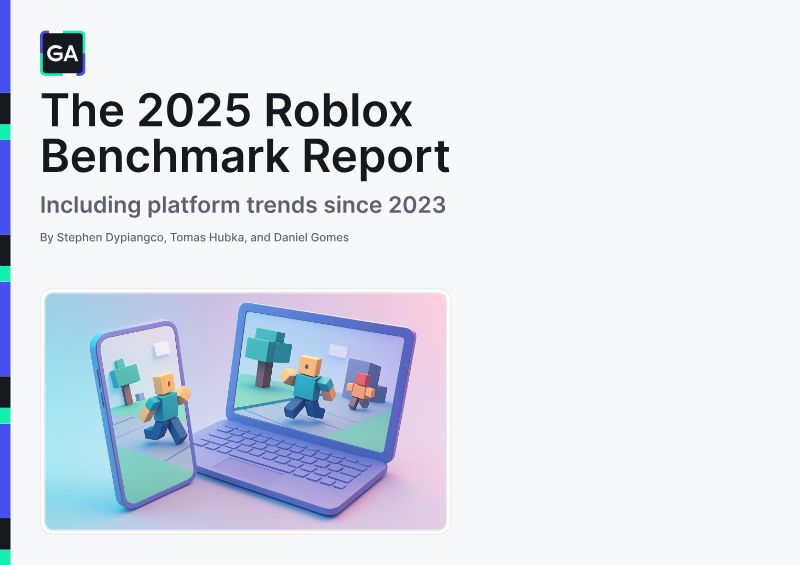
The report establishes that Roblox’s player base is sharply divided between casual users who spend only a few minutes per session and core players who log in multiple times daily, often exceeding 30‑minute sessions. Across 2023‑2025, titles that sustain longer playtimes achieve double‑digit retention rates and significantly higher monetization; the top 5 % of games generate over $20 per day from a single player. In contrast, games with median sessions under six minutes exhibit negligible Day‑1 retention (≈6 %) and ARPPU below $1, indicating that brief curiosity rarely translates into repeat play or meaningful spend.
Cross‑device usage remains high, with nearly 40 % of players alternating between PC and mobile. Daily session frequency has risen by roughly one third among the most active users, while median session length has fallen from 36 to 26 minutes. These dynamics underscore the importance of seamless PC‑mobile experiences and micro‑sessions that incorporate strong re‑entry hooks to capture the growing multi‑session behavior.
Platform discovery mechanisms reward repeat spending and long‑term engagement. Games that maintain 7‑day spend per user climb recommendation rankings, while low‑engagement titles (0–3 min) suffer from poor retention (<5 % Day 1, <2 % Day 7) and modest ARPPU (<$1). Conversely, higher‑engagement games achieve Day‑30 retention above 1 % at the upper percentiles and ARPPU exceeding $6, with average transaction values reaching $3–$4. These findings demonstrate that sustained engagement directly fuels higher per‑payer revenue and larger purchase sizes.
The overarching thesis is that success on Roblox follows a systematic progression rather than chance. Developers must align their game’s current stage with benchmark metrics, prioritizing clear early hooks, repeat‑play incentives, and engagement‑driven spend such as quests, streaks, or battle passes. Leveraging analytics tools like GameAnalytics to track custom events and player behavior enables studios to refine strategies, move from fragile prototypes toward million‑player hits, and capitalize on the platform’s reward structure for long‑term growth.
- Games with median session lengths under six minutes suffer from negligible Day-1 retention of approximately 6% and ARPPU below $1, while top-tier titles achieve ARPPU exceeding $6 with average transaction values of $3–$4.
- The top 5% of Roblox games generate over $20 per day from a single player, demonstrating that sustained engagement is the primary driver of high-value monetization.
- Platform discovery algorithms prioritize games with consistent 7-day spend and high engagement, causing low-engagement titles to fall below 5% Day-1 and 2% Day-7 retention.
- While median session lengths have decreased from 36 to 26 minutes between 2023 and 2025, daily session frequency among the most active users has increased by roughly one-third.
- Nearly 40% of the player base alternates between PC and mobile, necessitating seamless cross-device experiences to support the growing trend of multi-session play.
+3
InvestGame

Report9 pages
Beyond the Game: How Gamification is Becoming Mainstream
The analysis examines how gamification—applying game‑like mechanics such as streaks, leaderboards, and reward loops—to non‑gaming consumer apps has shifted the mobile app economy over a five‑year period (2020‑2025). Data from 208 transactions totaling $20.7 billion reveal that EdTech, Fitness & Wellness, and Entertainment & Social are the primary verticals, with deal value shares of roughly 40 %, 37 %, and 23 % respectively. EdTech dominates both deal volume (43 %) and exit activity, accounting for 45 % of exits and 34 % of exit value, indicating a mature market attractive to strategic buyers. Fitness & Wellness shows concentrated exits in two mega‑deals (Headspace $3 billion, Fitbit $2.1 billion) but a broader spread of capital across many platforms, suggesting growth potential beyond the top brands. Entertainment & Social receives steady, diversified investment; its exits lean toward IPOs (e.g., Reddit, NetEase Cloud Music) rather than M&A, reflecting limited strategic buyer appetite.
Capital flows peaked during the 2020‑21 COVID boom but recovered quickly for gamified apps, with 2024 stabilizing and 2025 YTD already surpassing full‑year 2024 figures. Seed and Series A rounds remain active, while late‑stage activity accelerated in 2025 following earlier Series A momentum. Early‑stage capital is evenly split between Fitness & Wellness and Entertainment & Social, highlighting a white‑space opportunity, whereas EdTech shows limited early‑stage activity due to market consolidation.
The report underscores that non‑gaming apps have overtaken mobile games in net revenue (Q2 '25: $21.2 billion vs. $19.8 billion) and are driving 24 % YoY mobile spend growth, while games stagnated. This structural shift signals that institutional capital increasingly targets gamified consumer apps across these three verticals, with strategic buyers actively consolidating the EdTech segment and exploring IPO pathways in Entertainment & Social.
- Gamified non-gaming apps have surpassed mobile games in net revenue, generating $21.2 billion in Q2 2025 compared to $19.8 billion for games.
- Gamified apps are driving a 24% year-over-year growth in mobile consumer spending, while traditional mobile gaming revenue has stagnated.
- EdTech, Fitness & Wellness, and Entertainment & Social account for $20.7 billion in transaction value, with EdTech dominating deal volume (43%) and exit activity (45%).
- Capital flow for gamified apps has recovered from the post-2021 decline, with 2025 year-to-date investment already exceeding the total figures for 2024.
- Fitness & Wellness shows high growth potential with capital spread across many platforms, despite being anchored by mega-deals like the $3 billion Headspace and $2.1 billion Fitbit acquisitions.
+2
InvestGame

Report9 pages
The Future of Ad Monetization: Insights from Industry Leaders
The panel “The Future of Ad Monetization” presented at Gamesforum Barcelona 2026 focuses on the evolving role of advertising within mobile game economies, arguing that ads are no longer ancillary revenue but integral to core gameplay loops. Experts from PlayPack, GameBiz Consulting, and Nekki highlight that by 2025 ad monetization has become one of the most challenging systems, requiring creative integration and data‑driven adaptivity. PlayPack’s Merge Away example illustrates how hybrid models combining rewarded ads and in‑app purchases can drive profitability, yet misaligned user cohorts can cause revenue drops of up to 30 %. The discussion stresses the necessity of real‑time visibility into ad source performance and the importance of designing ad moments as optional, rewarding side quests rather than punitive blockers.
GameBiz Consulting’s specialist notes that newer formats such as App Open, audio, and immersive ads have yet to achieve widespread adoption due to user experience friction and lower eCPMs. He recommends cautious experimentation, high price floors for intrusive formats, and pairing ads with “no‑ads” purchase offers to mitigate churn. The panel also emphasizes that the future lies in contextual, segmented ad experiences—matching the player’s motivation and session flow—to transform ads from interruptions into meaningful choices.
Nekki’s head of monetization projects that the most valuable in‑game currency will shift from virtual goods to player time, advocating for adaptive ad systems that respect individual player preferences. He foresees LiveOps integration of dynamic, data‑driven ad touchpoints tied to progression events. Overall, the panel concludes that sustainable revenue will stem from a balance of data insight, empathetic design, and adaptive monetization strategies that treat ads as living components of the game ecosystem.
- Hybrid monetization models that combine rewarded ads with in-app purchases are essential for profitability, but misaligned user cohorts can result in revenue losses of up to 30%.
- Ad monetization has evolved into a core gameplay component that requires real-time visibility into source performance and data-driven adaptivity to remain effective.
- Ad moments should be designed as optional, rewarding side quests rather than punitive blockers to maintain player retention and engagement.
- Newer ad formats like App Open, audio, and immersive ads currently face limited adoption due to high user experience friction and lower eCPMs.
- To mitigate churn, developers should pair intrusive ad formats with 'no-ads' purchase offers and implement high price floors for those formats.
+2
Gamesforum

Report20 pages
A Shortcut to Your Own Game Insights Platform
The guide presents a turnkey solution for game studios to build an in‑house data pipeline without the high costs of custom engineering. It introduces two core offerings: Player Warehouse, a pre‑aggregated data hub delivered in SQL or Parquet to BigQuery, Redshift, Snowflake, or Spark; and Raw Export, a real‑time JSON stream that preserves all custom event fields for unstructured analysis. The document emphasizes that these services eliminate the need for proprietary SDKs, ETL development, and ongoing infrastructure maintenance, offering a cost‑effective alternative to building a data lake from scratch.
Key findings highlight that Player Warehouse provides daily refreshed event and player‑level tables, enabling analysts to run advanced SQL queries, blend data from mediation or attribution sources, and retain up to one year of historical data. Raw Export supports real‑time analytics, custom dashboards, and long‑term enrichment through AWS S3 or BigQuery exports. The guide cites case studies—such as a VR MMO that leveraged Player Warehouse to boost engagement and a publisher that increased LTV by 50% across 19 titles using Raw Export—illustrating tangible ROI gains.
The scope covers global game studios, with examples from iOS, Android, Steam, and VR platforms. Timeframes referenced include daily updates for Player Warehouse and real‑time streaming for Raw Export, while the data pipeline supports integration with major BI tools (Looker, Power BI, Data Studio) and mediation/attribution services. Methodologically, the platform handles data ingestion via SDKs, normalizes events, and stores them in a cloud warehouse, abstracting SQL handling from end users. The document concludes by positioning GameAnalytics as a privacy‑first, ISO‑27001 and SOC 2 compliant partner that delivers rapid deployment—hours rather than months—for studios seeking scalable, customizable analytics.
- GameAnalytics provides a turnkey data pipeline that eliminates the need for custom ETL development, proprietary SDKs, and ongoing infrastructure maintenance.
- The platform offers two primary data delivery methods: Player Warehouse for daily refreshed, SQL-ready event tables and Raw Export for real-time JSON streaming.
- A publisher utilizing Raw Export achieved a 50% increase in lifetime value (LTV) across 19 titles, while a VR MMO leveraged Player Warehouse to improve player engagement.
- The solution integrates with major BI tools like Looker, Power BI, and Data Studio, and supports data blending from external mediation and attribution sources.
- Player Warehouse supports up to one year of historical data retention and delivers data directly to BigQuery, Redshift, Snowflake, or Spark.
+1
InvestGame
Report5 pages
East vs. West: Monetization Trends
The study examines how mobile gaming spending patterns differ between Eastern and Western markets, focusing on frequency of purchases, average spend per transaction, and motivational drivers. Findings reveal that Eastern gamers purchase in‑app items more often than Western players; 35 % of East spend frequently versus 36 % in the West, with a higher proportion of occasional and rare spenders in the West. When it comes to transaction size, Eastern users tend to pay more per purchase: 76 % spend over $10 compared with only 42 % of Western users, while a smaller share of East spend under $5 (30 %) versus 8 % in the West. Motivational analysis shows that Western gamers prioritize value and bundles, whereas Eastern players are more attracted to exclusivity, limited‑time items, new offers, and character acquisition. The research covers key markets in Asia—Korea and Japan—and Western regions including the United States, United Kingdom, and broader Europe. Data were collected through a survey of mobile gamers across these regions, with sample sizes sufficient to compare spending behaviors and motivations. The report concludes that monetization strategies should be tailored regionally: value‑based bundles may resonate better in the West, while exclusive content and limited editions could drive higher spend in Eastern markets.
- Eastern mobile gamers demonstrate a significantly higher propensity for large transactions, with 76% of purchases exceeding $10 compared to only 42% in Western markets.
- Western mobile gamers are more likely to make small-scale purchases, with 8% of spenders in the West opting for transactions under $5, contrasted with 30% in the East.
- Monetization strategies in the West should prioritize value-based bundles, as these resonate more effectively with the purchasing preferences of Western players.
- Eastern markets, specifically Korea and Japan, show a stronger consumer preference for exclusivity, limited-time offers, and character acquisition.
- Purchase frequency remains relatively balanced across regions, with 35% of Eastern gamers and 36% of Western gamers identified as frequent spenders.
+5
Mistplay

Report32 pages
Conversion Drivers in Videogames: Q1 2026
Marketing strategy and community sentiment serve as the primary determinants of conversion performance in the global video game industry as of early 2026. While pricing models like free-to-play and premium structures influence baseline metrics, the efficacy of acquisition campaigns depends more heavily on the alignment between marketing channels and specific player decision-making behaviors. Traditional last-click attribution models frequently undervalue high-funnel awareness efforts, necessitating a shift toward incrementality testing and extended retargeting windows to accurately capture the impact of early-stage engagement.
Player decision cycles vary significantly across industry segments, dictated largely by the social and cooperative dynamics inherent in different genres. Multiplayer and massively multiplayer online titles require longer conversion windows due to the complexity of social coordination, whereas single-player experiences benefit from strategies that emphasize urgency and individual-driven processes. Consequently, marketing efforts for multiplayer games should prioritize social proof and sustained community engagement, while single-player titles gain more traction through direct, time-sensitive calls to action.
Game quality and public perception act as critical multipliers for conversion, particularly within the premium sector. High Steam review scores, specifically those reaching the highest sentiment tiers, can nearly triple conversion rates for premium titles, whereas free-to-play conversion remains largely indifferent to such metrics. Because premium games involve extended evaluation periods, marketers must maintain consistent community-focused sentiment management to protect long-term conversion potential. By tailoring acquisition strategies to these distinct genre-based behaviors and moving beyond simplistic attribution, publishers can better optimize campaign performance and maximize player acquisition efficiency.
- Marketing execution is the primary driver of performance, with conversion rates for F2P games varying by 371x across different ad networks, dwarfing the 35% baseline advantage F2P titles hold over Premium games.
- Last-click attribution models undervalue upper-funnel awareness channels like YouTube, as 50% of the most popular demand-generating ad networks are not effectively captured by last-click metrics.
- Premium games priced above $40 require nearly twice the conversion window of mid-tier titles, and players take 27% longer to convert on Premium titles (141 hours) compared to F2P titles (111 hours).
- Steam review scores significantly impact Premium game performance, where moving from a 'Mixed' to 'Very Positive' rating can nearly triple conversion rates, whereas review scores show no measurable impact on F2P conversion.
- Multiplayer games exhibit longer decision cycles, taking 2.5x longer to convert than single-player titles, with MMO players requiring a median of 49.5 hours to convert compared to 21 hours for shooter players.
+3
GamesightMay 2026

Report57 pages
Digital Market Index: Q1 2026
The global digital economy experienced a significant structural transition during the first quarter of 2026, characterized by a pivot away from traditional mobile gaming toward generative artificial intelligence and short-form entertainment. While global in-app purchase revenue climbed 9.3% to $43.5 billion, this growth was primarily fueled by non-gaming sectors. Mobile gaming faced a notable contraction, with downloads falling 12% year-over-year, even as puzzle titles maintained their status as a primary revenue anchor. Conversely, the generative AI sector surged by 174%, signaling a shift in consumer engagement as users increasingly migrate from web-based interfaces to dedicated mobile applications.
Geographically, the market landscape is bifurcating between mature and emerging economies. The United States market exhibited signs of cooling, recording its lowest revenue growth rate at 3.5%, while India and Indonesia emerged as primary drivers of download volume. Despite the slowdown in U.S. consumer spending, the digital advertising sector remained resilient, growing 15% to $48 billion. This expansion was heavily supported by a 31% increase in software-related ad spend, as advertisers aggressively reallocated budgets from linear television toward targeted digital channels and retail media networks.
Retail media continues to evolve beyond the dominance of Amazon, with platforms like Walmart and Target capturing significant share by leveraging offsite social channels. This trend is particularly pronounced in essential categories such as personal care and food and beverages. As the industry matures, the competitive landscape for generative AI has also become more distributed, with market share spreading across multiple platforms like Gemini and Claude. These findings reflect a broader trend of digital consolidation, where mobile-first engagement and AI-driven utility define the current trajectory of the global digital marketplace.
- Global in-app purchase (IAP) revenue reached $43.5 billion in Q1 2026, marking 9% year-over-year growth and the 13th consecutive quarter of positive performance.
- US digital ad spend grew 15% year-over-year to $48 billion in Q1 2026, with Reddit emerging as the fastest-growing channel at 89% year-over-year growth.
- US mobile IAP revenue growth slowed to an all-time low of 3% year-over-year, recording two consecutive quarters of decline from its $15.1 billion peak.
- Generative AI advertising spend in the US surged to over $430 million in Q1 2026, more than triple the amount spent in Q1 2025, contributing to a 31% year-over-year increase in software ad spend.
- Retail media ad impressions in the US declined 3% year-over-year to 156 billion, driven by a 14% drop in Amazon impressions, even as Amazon maintained over 88 billion impressions and 4x the scale of Walmart.
+3
Sensor TowerMay 2026

Report63 pages
Why Players Play: The Psychology Behind Mobile Games
Mobile game development relies on the strategic alignment of product features with fundamental human psychological drivers to maximize player retention and monetization. By integrating core motivations such as mastery, curiosity, and social connection with defensive psychological triggers like loss aversion and the fear of missing out, developers create highly sticky ecosystems. The primary thesis posits that long-term success in the mobile sector is not merely a product of gameplay quality, but the result of a deliberate, evidence-based architecture that increases the perceived cost of player attrition.
The industry utilizes a sophisticated framework known as the Motivation Wheel to categorize game events and align them with specific business objectives, such as increasing average revenue per user or extending session duration. This approach sequences positive reinforcement—such as visible progress and reward systems—with negative motivators that compel action. By layering these mechanics, developers effectively transform natural session exit points into persistent hooks. Features like battle passes, streaks, and time-limited events leverage the sunk cost fallacy, shifting the player’s primary motivation from intrinsic enjoyment to a defensive necessity to protect accumulated progress.
This analytical approach to game design is prevalent across the global mobile gaming market, focusing on the intersection of behavioral psychology and product management. By systematically engineering these psychological deficits, developers ensure that engagement remains high even after the initial novelty of a game fades. Ultimately, the integration of these mechanics serves to minimize guesswork in product planning, allowing studios to foster deep, long-term player investment through the calculated application of urgency, social pressure, and the psychological weight of digital achievement.
- Social connection is the most effective retention mechanic because it creates a switching cost that prevents players from moving to competitors, as they cannot transfer their clan or community identity.
- Win streaks are the most powerful ARPU-driving mechanic because they simultaneously leverage progress, near-miss tension, loss aversion, urgency, and social pressure.
- Visible progress is essential for casual games; players require concrete proxies like progress maps, star counts, or numerical growth to feel a sense of competence and reward.
- Retention can be extended at natural session 'exit points' by using time-limited boosters or curiosity-driven teasers to convert a sense of completion into a new hook.
- Urgency and FOMO are most effective when the time-limited window is restricted to 5–20% of the total event duration, forcing players to choose between missing out or playing harder.
+3
Sensor TowerMay 2026

Report69 pages
State of Gaming 2026
The 2026 State of Gaming analysis demonstrates a shifting landscape in which mobile gaming remains the largest driver of downloads—approximately 50 billion in 2025—but its growth rate is slowing. Revenue, however, continues to climb as monetization models mature and lifetime value deepens, especially within hybrid‑casual titles that now generate the most incremental income. In contrast, PC and console platforms experience record revenue growth, with Steam’s premium segment up 32 % and blockbuster releases such as Battlefield 6 capturing significant market share from incumbents. Shooter downloads on these platforms have plateaued, suggesting new titles are primarily cannibalizing existing audiences rather than expanding the category.
Genre‑specific dynamics reveal that strategy games are the only mobile genre to grow in downloads, driven by 4X titles from Eastern developers. Action and shooter games dominate PC/console gains, while hyper‑casual remains the largest download engine but shows a notable lift in time spent, particularly in Tier 2 markets. Casual titles face declining day‑7 retention, indicating a stickiness challenge that could erode long‑term player value.
Live‑ops and acquisition strategies have evolved toward retention‑focused events, multi‑tier season passes, and expedition‑style rewards. These mechanisms now represent the most reliable revenue drivers across competitive genres such as RPG, action, and simulation. Advertising spend remains concentrated on social channels—YouTube, Facebook/Instagram—and high‑attention formats like video, playable, and rewarded ads. Battlefield 6’s pre‑launch spend surpassed Call of Duty titles, leveraging Facebook, Reddit, and desktop display, while its post‑launch strategy pivoted to YouTube with cinematic, celebrity‑hook creatives.
Geographically, the U.S. market shows a skew toward lifestyle and puzzle categories despite lower IAP shares, whereas casino titles exhibit higher spend‑to‑revenue efficiency. Overall, the industry is moving from acquisition toward deeper monetization per user, with indie shooters and simulation titles gaining traction amid intense competition in the shooter segment.
- PC and console platforms are seeing record revenue growth, highlighted by a 32% increase in Steam’s premium segment and the strong market performance of Battlefield 6.
- Mobile gaming growth is slowing despite reaching 50 billion downloads in 2025, with hybrid-casual titles now serving as the primary drivers of incremental revenue.
- Shooter games on PC and console have reached a download plateau, indicating that new releases are cannibalizing existing player bases rather than expanding the total market.
- Retention-focused live-ops, including multi-tier season passes and expedition-style rewards, have become the most reliable revenue drivers for RPG, action, and simulation genres.
- Strategy games are the only mobile genre experiencing download growth, fueled primarily by 4X titles from Eastern developers.
+1
Sensor TowerApr 2026