Mobile reports and market data
Documents

The Pregame | India F2P (Before the Conference Talk)
The Indian gaming landscape is currently undergoing a significant evolution, transitioning from a focus on low-risk, iterative projects toward the development of more ambitious, high-quality titles.
- The Indian gaming sector is shifting from low-risk, iterative projects toward high-quality, ambitious titles, leveraging a talent pool characterized by startup-driven agility and high enthusiasm.
- Global market success is increasingly driven by superior execution and emotional connection rather than rigid adherence to data-driven metrics or traditional genre saturation.
- Player preference is moving toward open-world social experiences that prioritize agency and role-playing over established formats like match-three or shooters.

PocketGamer.Biz with Sunday, RoundTables - What’s the secret of a successful hypercasual game?
The hypercasual gaming sector operates on a foundation of rapid iteration, data-driven validation, and a relentless focus on marketability.
- Hypercasual success depends on communicating the core mechanic within a three-second video advertisement to minimize cost-per-install.
- Development teams should remain lean, typically consisting of three to four people, to facilitate rapid prototyping and agile market testing.
- Developers must prioritize data-driven performance benchmarks over creative intuition, pivoting immediately to new concepts if retention and lifetime value metrics are not met.

SciPlay's Joe Byrne on Social Casino
The social casino industry is currently navigating a significant strategic shift, driven by the need for granular market intelligence and the operational challenges posed by the deprecation of IDFA.
- Social casino developers are shifting toward a higher volume of spenders with smaller transaction sizes, necessitating a focus on increasing average transaction value and session frequency.
- The deprecation of IDFA has forced companies like SciPlay to rely on granular market intelligence, including detailed taxonomy and competitive performance analysis, to guide product roadmaps and M&A activity.
- Social casino games are increasingly adopting meta-progression systems—such as progression maps, builder mechanics, and narrative-driven live operations—to improve player retention and engagement.

IDFA Loss: Real Data & Real Talk
The deprecation of the Identifier for Advertisers (IDFA) on iOS has fundamentally restructured the mobile gaming industry, resulting in a 15% to 20% decline in revenue across diverse portfolios.
- The deprecation of IDFA has caused a 15% to 20% decline in revenue across mobile gaming portfolios due to the collapse of granular tracking and lookalike audiences.
- Market efficiency has decreased as the loss of deterministic tracking leads to higher costs per mille and lower install quality.
- Niche, whale-dependent genres like social casino and strategy games have experienced the most significant disruptions, whereas broad-market titles remain more resilient.

TWIG 145: Why Rovio, the makers of Angry Birds, acquired a hyper-casual game studio Ruby Games
Rovio’s acquisition of the hyper-casual studio Ruby Games represents a strategic effort to bolster user acquisition, expand audience reach, and increase daily active users (DAU) in a post-IDFA landscape.
- Rovio acquired hyper-casual studio Ruby Games to bolster user acquisition and increase daily active users (DAU) in the post-IDFA landscape.
- The deal uses a conservative, multi-tranche payment structure spanning five years, tying final share acquisition to Ruby Games' future financial performance.
- Rovio intends to use shared device identification (IDFV) to improve cross-promotion efficiency, funneling players from hyper-casual titles into their core game portfolio.

Is the future of games Instant? (Lars Doucet, Emily Greer)
The rise of instant games—titles accessible via browsers or social media without significant download barriers—represents a strategic effort to bypass traditional app store gatekeepers and capture broader, non-traditional gaming audiences.
- Instant games serve as a strategic tool to bypass app store gatekeepers and reach non-traditional audiences by removing significant download barriers.
- The current distribution landscape is dominated by restrictive platform ecosystems that prioritize short-term rent-seeking over long-term developer sustainability.
- Unlike the decentralized Flash era, modern developers face high levels of platform lock-in, which limits their leverage over their own work and audience relationships.

TWIG 144: Riot makes $100M on mobile. Micenuts?
Riot Games has generated over $100 million in global mobile player spending across its portfolio, a figure that, while significant in isolation, represents a modest contribution relative to the publisher’s annual PC revenue of $1.5 billion to $2 billion.
- Riot Games has generated over $100 million in total mobile player spending, led by League of Legends: Wild Rift ($65 million), Teamfight Tactics ($28 million), and Legends of Runeterra ($16 million).
- Despite the $100 million mobile milestone, these earnings remain a modest fraction of Riot’s annual PC revenue, which typically ranges between $1.5 billion and $2 billion.
- Mobile adoption remains limited, with Wild Rift reaching 50 million installs, while Teamfight Tactics and Legends of Runeterra have only achieved 6 million and 3 million installs, respectively.

Mobile Game Genre Report: Puzzle Games
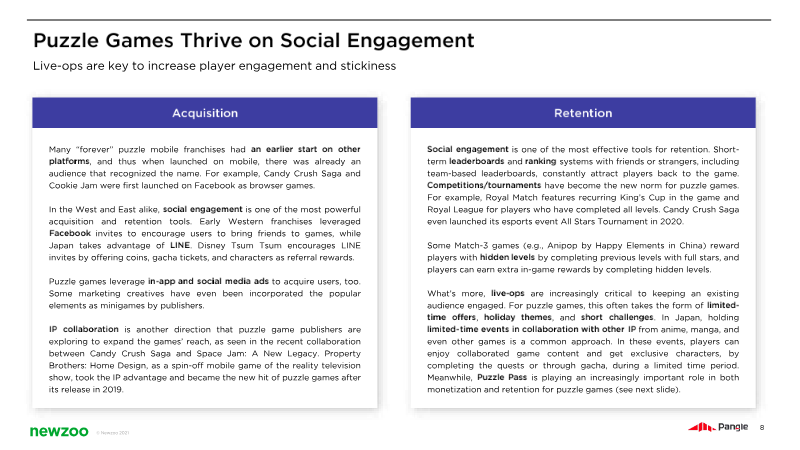
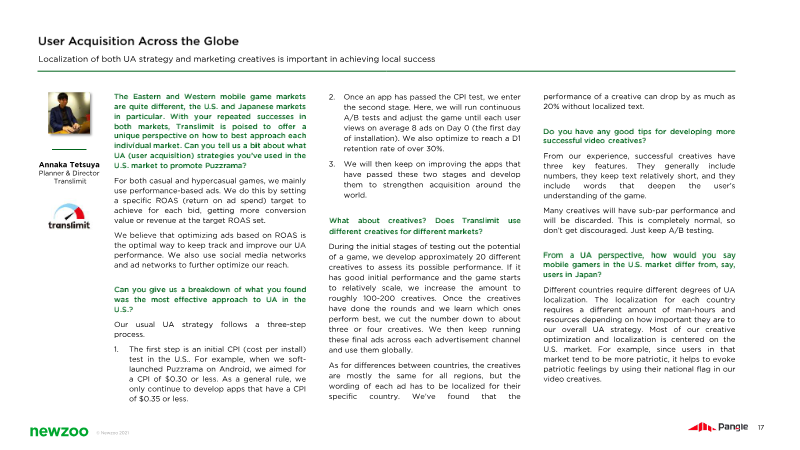
Mobile puzzle games are examined across Eastern and Western markets in this Pangle and Newzoo genre report, the first in a series that also covers role-playing and arcade titles.
- The global mobile puzzle game market generated $6.9 billion in 2020, with the United States leading at $2.0 billion, followed by Japan at $1.2 billion and China at $0.9 billion.
- Puzzle games account for 8% of total mobile game revenue and represent the most popular genre across the United States, United Kingdom, Japan, and South Korea.
- Western markets favor casual experiences and in-app advertising (IAA), whereas Eastern markets demonstrate a higher propensity for in-app purchases (IAP) and complex mechanics like gacha systems.

TWIG 143: Reactions to Tilting Point raising $235M
Tilting Point recently secured $235 million in equity financing, led by General Atlantic with participation from Red Ventures and Camar.
- Tilting Point secured $235 million in equity financing led by General Atlantic to scale its publishing model, co-development efforts, and studio acquisitions.
- The company provides infrastructure for live operations and user acquisition to a network of over 40 developer partners, acting as a growth engine for studios lacking those internal capabilities.
- Tilting Point’s business model is frequently compared to Scopely’s historical trajectory, though analysts note that the current market features higher valuations and stiffer competition for top-tier studios.

Panel: Best Practices in Design, Development & Distribution of Hypercasual Games
Hypercasual gaming functions as a high-velocity, data-centric sector of the mobile industry defined by accessible, single-mechanic gameplay and short session lengths.
- Hypercasual success relies on maintaining a positive spread between user acquisition costs and lifetime value, using metrics like cost per install and installs per mille to determine project viability.
- Developers must prioritize immediate player clarity by focusing on single-mechanic gameplay that is intuitive within seconds of the first engagement.
- The industry utilizes a rigorous prototyping framework that mandates the early abandonment of underperforming concepts to ensure resources are allocated only to high-potential titles.
Cheaters’ Secrets Unveiled – How Cheaters Operate in Mobile Games & How to Counteract Them
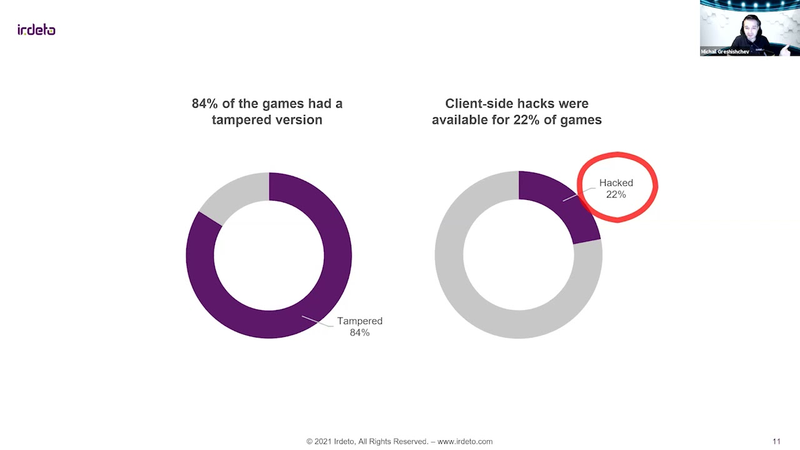
Mobile gaming faces a pervasive security crisis, as 86% of top-performing titles currently contend with accessible, up-to-date cheating tools.
- 86% of top-performing mobile games are currently affected by accessible and up-to-date cheating tools.
- Cheating primarily occurs through two vectors: the distribution of tampered applications with pre-installed hacks and the use of memory editors to manipulate critical data like currency and health values.
- Developers are increasingly moving core game logic to the server side to minimize the attack surface available for client-side manipulation.

What are Your Existing Users Worth & How to Extract Maximum Value
This presentation outlines methodologies for valuing existing game user cohorts and leveraging that value to optimize growth.
- Treat existing user cohorts as financial assets by modeling the 'area under the curve' to project future revenue and secure non-dilutive capital.
- Calculate the residual value of cohorts—the expected revenue after initial acquisition—to optimize user acquisition (UA) efficiency and align costs with projected lifetime value (LTV).
- Prioritize capital-efficient funding by stacking ad network credit and free cash flow before resorting to debt facilities or equity to avoid unnecessary dilution.
Writers
Games and companies
Games