Reports matching your filters
GameAnalytics presents a structured framework for designing and implementing data tracking within games, emphasizing the creation of a comprehensive tracking plan that aligns analytics teams with development stakeholders. The guide outlines five sequential steps: first, brainstorming core questions about player behavior and business objectives; second, translating those questions into specific events using predefined categories such as Session, Business, Resource, Progression, Error, Ads, and Impression; third, defining dimensions and attributes to contextualize events with user identifiers, device details, and custom fields; fourth, integrating the plan through GameAnalytics SDKs tailored to various platforms; and fifth, maintaining an iterative process that revisits questions and updates events as the game evolves. Key recommendations include limiting custom events to a maximum of 50 unique identifiers, adopting a Category > Sub‑Action framework for clarity, and ensuring rigorous validation to avoid duplicate or misleading data. The document stresses the importance of consistent documentation, ownership assignment, and cross‑functional collaboration to prevent redundant data collection and maintain analytical integrity. By following this step‑by‑step methodology, developers can establish a reliable data pipeline that supports accurate KPI measurement and informed decision‑making throughout the game’s lifecycle.
QUARTERLY REPORT OF 11 BIT STUDIOS FOR THE THREE MONTHS ENDED 31 MARCH DEAR SHAREHOLDERS AND INVESTORS, It is our pleasure to present to you the quarterly technical quality, balanced gameplay, and, of report of 11 bit studios S.A. for the three months course, a lot of excitement and entertainment. In ended 31 March 2025.
This analysis explores the current state and future trajectory of quality assurance (QA) within the video game industry, specifically focusing on the integration of artificial intelligence and automation. The central thesis posits that modern game development—characterized by the complexity of games-as-a-service and accelerated release cycles—has outpaced traditional manual QA capabilities. Consequently, there is a critical need for AI-driven solutions to bridge the gap between increasing content volume and stagnant testing budgets.
The findings are based on a September 2024 survey of 303 US-based game development professionals across various disciplines, including QA, production, and design, supplemented by interviews with industry experts from companies such as Netflix and Indium Play. Data indicates a significant strain on current resources: 77% of developers admit to conducting less QA than necessary for their most recent releases, and 50% believe budgets are failing to keep pace with game complexity. While 94% of studios use some form of non-AI automation, there is a near-unanimous consensus (94%) that AI will be essential for the future of the field.
Key statistics highlight a strong industry appetite for AI adoption, with 88% of respondents viewing AI as equal to or better than traditional methods for bug detection. Developers identify faster bug detection, automated reporting, and 24/7 testing as the primary advantages of the technology. However, a significant implementation gap exists; while 87% of studios feel "somewhat ready" for AI, only 18% feel fully prepared. Primary barriers to adoption include setup complexity, high initial costs, and a lack of skilled staff. The analysis concludes that while AI is vital for scalability and stress testing, it serves as a complement to—rather than a replacement for—human intuition and creative exploratory testing.
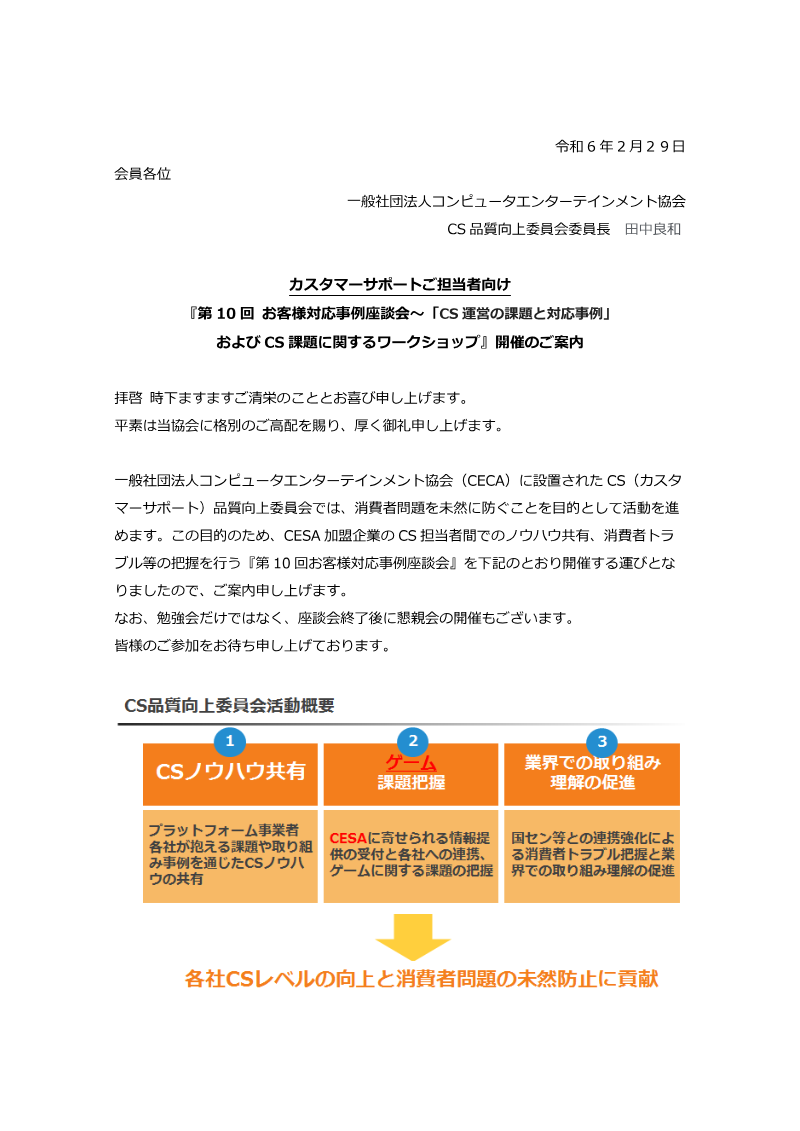
The announcement seeks to convene customer‑support managers from member firms of the Computer Entertainment Association (CECA) to exchange practical solutions for ongoing CS operational challenges. Its central aim is to foster preventive measures against consumer‑related issues by facilitating knowledge sharing on two focal topics: the integration of AI tools into support workflows and the management of customer harassment incidents.
The event is scheduled for March 19, 2024, running from 16:00 to 18:00, with a reception beginning at 15:30. It will be held simultaneously at the Shinjuku Sumitomo Sky Room in Tokyo and via Zoom, allowing both in‑person and online participation. Attendance is limited to CECA members, with pre‑registration required by March 8; excess demand may be redirected to the virtual format. The agenda includes opening remarks, case‑study presentations on AI adoption and harassment handling, and a workshop where groups of six to seven participants will discuss these issues in breakout rooms, followed by a plenary debrief. A networking reception follows, with an estimated fee of ¥5,000 per participant.
The scope is confined to the Japanese computer‑entertainment sector, targeting CS professionals active in 2024. While no empirical data are presented, the format emphasizes interactive discussion and peer‑learning rather than formal survey analysis, positioning the gathering as a practical forum for collective problem‑solving and the dissemination of best practices within the industry.
NCE Videojuegos Accesibles (Spanish Video Games Association): Arturo Monedero and Miriam Fdez Simon (Spanish National Organisation of the Blind Foundation: Juan Aguado Delgado and Enrique García Cortés (@kike_mep) Front and back cover illustration: Natalia Morillo (@heynatnatart) Illustrations of accessibility guidelines: Pablo Ruiz Moyano and Alba Martos Melero Laura Enciso Baringo and Pablo Pérez Ortega Introduction 1 star Context 3D audio .......