
Report4 pages
Is There a Shift from Content to Tech Startups Among Gaming VCs?
The analysis examines venture capital activity in the gaming sector from 2020 to early 2024, focusing on whether investment priorities are shifting from traditional content creation and publishing toward technology‑driven startups. Data show that, across all stages, content creators and publishers continue to dominate VC allocations, representing over half of both capital deployed (≈$1.76 billion) and the number of deals in early‑, mid‑, and late‑stage rounds. However, a closer look at seed and Series A financing reveals a notable trend: PC and console studios now secure more funding than mobile startups, indicating a pivot toward higher‑budget, platform‑centric projects.
In the last twelve months, gaming‑focused VC funds have increased their exposure to technology and platform companies. Capital deployed by select funds such as VENTURES, BEHOLD Venture, and Lightspeed Lvp. rose from roughly $1.3 billion in early 2020 to over $2.4 billion by H1 2024, while the number of rounds led by these funds grew from 67 to 289. This shift is evident across multiple funds, with several moving a larger share of their capital into tech‑centric ventures rather than pure content studios.
Geographically, the data encompass global markets with a concentration in North America and Europe, covering all major gaming segments—mobile, PC, console, and emerging platform technologies. The methodology aggregates publicly disclosed VC‑led rounds from 2020 through H1 2024, using capital deployed and round counts as primary metrics. The findings suggest that while content remains the core focus, gaming VCs are progressively allocating more resources to technology and platform innovations, reflecting an evolving investment landscape in the industry.
- Content creators and publishers remain the primary focus of gaming VC, accounting for over half of all capital deployed (approximately $1.76 billion) and the majority of deal volume across all stages.
- Gaming-focused VC funds, including VENTURES, BEHOLD Venture, and Lightspeed Lvp., significantly increased their activity between 2020 and H1 2024, with capital deployed rising from $1.3 billion to over $2.4 billion.
- The number of VC-led funding rounds grew substantially from 67 in early 2020 to 289 by H1 2024, reflecting an overall increase in investment activity.
- While content dominates total funding, there is a clear strategic pivot among VCs toward technology and platform-centric startups, particularly within seed and Series A financing.
- Within the content sector, investment is shifting toward higher-budget, platform-centric projects, as evidenced by PC and console studios now securing more funding than mobile startups.
+3
InvestGame
Report6 pages
The Alumni Effect: Studios Founded by Ex-Activision, Blizzard, and King Employees
The analysis examines venture capital activity directed toward studios founded by former Activision Blizzard employees between 2020 and 2024. It identifies 30 such startups that secured a total of approximately $0.7 billion across 45 VC‑led funding rounds, compared with 27 alumni studios from Riot Games that raised $0.5 billion in 38 rounds. Funding is concentrated in early‑stage rounds, with an average check size of $15.8 million for ex‑Activision studios versus $13.1 million for ex‑Riot ventures, and a notable skew toward PC & console and multiplatform projects. Web3 gaming represents a smaller share of the portfolio.
The study highlights a “first‑round momentum” effect: ex‑Activision studios are roughly twice as likely to secure a second round of financing within the same calendar year as other VC‑backed gaming startups. In 2021, 43 % of ex‑Activision studios raised a subsequent round versus only 9 % of peers; by 2023 the gap narrowed to 33 % versus 8 %. This pattern suggests stronger investor confidence in alumni teams during the 2021‑2022 peak.
Key investors include gaming‑focused funds such as GRIFFIN, PARTNERS COLLECTIVE, and SSSU, which together accounted for more than half of the capital deployed. Notable portfolio companies include Mythical Games (Series C, $262 million), Second Enap (Series B, $100 million), and TheoryCraft (Series A, $87.5 million). While many projects remain in development, releases such as Marvel Snap and Stormgate demonstrate commercial viability, whereas titles like Lightforge’s Project O.R.C.S. were shut down due to lack of traction.
Overall, the report underscores a robust investment climate for studios led by former Activision Blizzard talent, driven by early‑stage funding success and a higher likelihood of follow‑on rounds compared to broader gaming startup cohorts.
- Between 2020 and 2024, 30 studios founded by former Activision Blizzard employees secured approximately $0.7 billion in venture capital across 45 funding rounds.
- Ex-Activision studios demonstrate a 'first-round momentum' effect, being roughly four times more likely than peer startups to secure a second round of financing within the same calendar year.
- Investor confidence in alumni teams peaked in 2021, when 43% of ex-Activision studios raised a subsequent round compared to only 9% of broader gaming startups.
- Funding for ex-Activision alumni is primarily concentrated in early-stage rounds for PC, console, and multiplatform projects, with an average check size of $15.8 million.
- GRIFFIN, PARTNERS COLLECTIVE, and SSSU are the primary investors in this sector, collectively deploying more than 50% of the total capital.
+2
InvestGame

Report9 pages
Corporate Overhaul: Why Does CVC Play a Bigger Role Than Ever?
The analysis demonstrates that corporate venture capital (CVC) has become the dominant force in gaming investment from 2020 to 2024, accounting for more than half of all capital raised in the sector. CVC‑led rounds total $4.0 billion across 93 deals, while VC‑only and joint VC‑CVC rounds raise $3.5 billion in 80 deals, indicating a strategic shift toward co‑investment models that spread risk and access higher‑profile startups. Geographic focus is heavily weighted toward Asian strategics, with South Korean and Japanese firms such as Riot, NetEase, and Gigaom leading the pack; these investors collectively completed 105 deals worth $1.8 billion, surpassing Western peers in volume but not always in value.
The largest disclosed CVC‑led investments target mature gaming studios and multiplatform developers, with EPIC Games securing $2.0 billion in April 2022 and Roblox raising $150 million in February 2020. In contrast, VC‑CVC co‑investments concentrate on platform and technology (“picks and shovels”) startups, exemplified by GreenOak’s $500 million Series I in September 2021 and Samsung‑backed CENVID’s $113 million Series C in July 2021. Mobile segments have seen a decline, with CVC interest shifting toward PC and multiplatform titles; mobile deals now represent only 10–15 % of total CVC activity.
Methodologically, the study aggregates public funding announcements from 2020‑2024, categorizing deals by investor type (CVC only, VC only, or joint), segment (studio, platform/tech, mobile, PC/console), and geographic origin. Deal counts and capital raised are sourced from press releases, regulatory filings, and secondary databases, providing a comprehensive view of investment flows. The findings suggest that corporates are increasingly willing to share risk with traditional VCs, enabling larger funding rounds for gaming studios while maintaining strategic alignment and access to emerging technologies.
- Corporate venture capital (CVC) has become the dominant force in gaming investment from 2020 to 2024, accounting for over half of all capital raised with $4.0 billion across 93 CVC-led deals.
- Investment strategies have shifted toward co-investment models between CVCs and traditional VCs, which collectively raised $3.5 billion across 80 deals to spread risk and access high-profile startups.
- Asian firms, specifically from South Korea and Japan, are the most active investors, completing 105 deals worth $1.8 billion and surpassing Western peers in total deal volume.
- CVC-led investments prioritize mature studios and multiplatform developers, highlighted by major capital injections such as the $2.0 billion raised by Epic Games in April 2022.
- VC-CVC co-investments are primarily focused on 'picks and shovels' platform and technology startups, exemplified by the $500 million Series I round for GreenOak in September 2021.
+2
InvestGame

Report12 pages
The Great Mobile Reversal: Why Buyers Pay Billions for What VCs Abandoned
The analysis examines the evolution of mobile gaming investment and M&A activity from 2020 through the first half of 2025. Mobile platforms have dominated the sector, accounting for 61 % of total gaming deal value (excluding ATVI) and nearly all first‑half 2025 volume, driven by strategic and private‑equity deals. Venture capital enthusiasm peaked in 2021 with 137 rounds totaling $2.2 B, but post‑2021 the focus shifted toward profitability and sustainable unit economics, leading to a sharp decline in mid‑core deals—from 49 in 2021 to only eight by H1 25—while casual studios captured 65 % of all deals due to faster iteration and broader audience reach.
Geographically, Turkey led casual gaming with 27 % of deals, whereas Europe and Asia dominated mid‑core, contributing 66 % of transactions in 4X, RPGs, and shooters. Early‑stage activity remained steady at pre‑seed/seed levels, yet Series A and later rounds became rarer as scaling challenges intensified. Median early‑stage check sizes hovered around $10 M, with notable large rounds such as Spyke’s $55 M seed and Scopely’s $340 M Series E.
Strategic buyers intensified their presence, executing $7 B in mobile M&A across six deals within a year. The largest acquisitions include Af’s $12.7 B purchase of 2yga (casual) and Scopely’s $4.9 B takeover of GamesGroup (mid‑core). Overall, the data illustrate a market shift from VC‑led growth to strategic consolidation, with casual titles and recurring revenue models becoming the primary drivers of investment value.
- Mobile gaming accounted for 61% of total gaming deal value (excluding ATVI) between 2020 and H1 2025, with strategic buyers and private equity firms driving nearly all deal volume in the first half of 2025.
- Strategic consolidation has replaced VC-led growth, highlighted by $7 billion in mobile M&A activity across six major deals, including Af’s $12.7 billion acquisition of 2yga and Scopely’s $4.9 billion purchase of GamesGroup.
- Venture capital interest has shifted heavily toward casual gaming, which now captures 65% of all deals due to its broader audience reach and faster iteration cycles.
- Mid-core gaming investment has collapsed, with deal volume falling from 49 rounds in 2021 to only eight by H1 2025 as investors prioritize sustainable unit economics over high-growth scaling.
- While early-stage funding remains stable with median check sizes around $10 million, Series A and later-stage rounds have become increasingly rare due to heightened scaling challenges.
+3
InvestGame
Report11 pages
Enabling Growth: Cohort User Acquisition Financing
Mobile gaming has rebounded from the downturn of 2022‑23, with a projected compound annual growth rate of 5.0% from 2020 to 2025, driven largely by a 16.2% rise in in‑app advertising and the continued popularity of casual puzzle titles. The sector’s resilience is underpinned by AI‑powered ad tech, rewarded advertising platforms, multiplatform releases that bypass app‑store fees, and strategic IP licensing collaborations. Despite this growth, venture capital remains cautious; VC deployments in mobile studios have plateaued while high‑profile exits such as King, Zynga, and Playtika illustrate that capital is still scarce. Mature studios reinvest roughly one‑third of revenue into user acquisition (UA), yet only a minority secure the $30 million+ funding needed to sustain such spend, and smaller studios often allocate 70% or more of net revenue to marketing.
PvX Partners’ cohort‑based UA financing addresses this gap by providing credit secured against future cohort revenues. The model offers up to 80% of monthly customer acquisition costs, recovers 80% of net revenues until repayment, and imposes a modest interest rate tied to Net Return on Ad Spend (ROAS). Case studies show that studios receiving this financing can increase monthly spend by 16–38% while boosting cash balances, achieving accelerated growth and faster exits—examples include Playtika’s acquisition of a $2 billion‑valued studio within 35 months.
Overall, the analysis suggests that cohort‑based UA financing can unlock scalable growth for mobile studios that lack traditional VC backing, potentially expanding the market’s total UA spend from $143 billion to an additional $3.2 billion by 2027, while maintaining equity and IP control for founders.
- Mobile gaming is projected to grow at a 5.0% CAGR from 2020 to 2025, supported by a 16.2% increase in in-app advertising and AI-driven ad tech.
- Cohort-based UA financing allows studios to fund up to 80% of monthly acquisition costs by leveraging future revenues, providing an alternative to scarce venture capital.
- Studios utilizing cohort-based financing have demonstrated the ability to increase monthly marketing spend by 16–38% while maintaining founder control over equity and IP.
- While mature studios typically reinvest one-third of revenue into UA, many struggle to secure the $30 million+ in funding required to sustain competitive growth.
- Cohort-based financing models have the potential to add $3.2 billion to the global UA market by 2027, helping studios scale without traditional VC backing.
+4
HPvX Partners
Report9 pages
The Rise of the Financial Kingmakers: Private Equity’s $21B+ Bet on Gaming
The analysis demonstrates that private equity (PE) has increasingly positioned itself as a decisive force in the gaming sector, channeling more than $21 billion into acquisitions and growth investments from 2018 through the first half of 2025. Annual deal values consistently exceeded $1 billion, underscoring the industry’s institutional maturity and attracting a broad spectrum of PE participants. Control acquisitions dominate, accounting for roughly 60 % of total capital deployed, with notable deals such as Scopely’s $4.9 billion purchase of Games Group and ESL’s $1.5 billion takeover of Facet Games Group. Minority stake purchases, while smaller in dollar terms, remain significant for content and ecosystem players, exemplified by Vungle’s $0.8 billion control of an ecosystem firm.
Geographically, the focus is global but heavily weighted toward North America and Europe, with a growing presence in mobile and PC/console segments. The data reveal that content creation—particularly studios with strong IP portfolios—is the most attractive segment, receiving 42 of the 68 PE‑led deals. Ecosystem investments, including platform and service providers, constitute a substantial share of growth capital, reflecting PE’s strategy to build scalable ecosystems around core IP.
Methodologically, the study aggregates publicly disclosed transactions from 2018 to mid‑2025, classifying deals by type (control acquisition, minority stake, growth investment, add‑on) and segment. Deal values are sourced from press releases, SEC filings, and reputable financial databases, with exit returns estimated where available. The findings illustrate a shift toward platform‑building and ecosystem consolidation as the default PE playbook, positioning financial investors as key enablers of scale in a structurally fragmented gaming market.
- Private equity firms deployed over $21 billion into the gaming sector between 2018 and mid-2025, with annual deal values consistently surpassing $1 billion.
- Control acquisitions represent the primary investment strategy, accounting for approximately 60% of total capital deployed in the sector.
- Content creation studios holding strong IP portfolios are the most targeted assets, securing 42 of the 68 total private equity-led deals identified.
- Notable high-value transactions include Scopely’s $4.9 billion acquisition of Games Group and ESL’s $1.5 billion takeover of Facet Games Group.
- Private equity strategy is shifting toward platform-building and ecosystem consolidation to scale fragmented gaming markets, supported by minority stake investments in service and platform providers.
+2
InvestGame
Report15 pages
Gaming VC Trends: Q2 2025
The report examines global venture capital activity in the gaming sector through Q2 2025, highlighting a pronounced contraction in deal volume and value compared with the prior year. Total venture capital raised fell to $904.6 million across 113 closed rounds, a 27.2% QoQ decline and 47.6% YoY drop; the run‑rate projects a 31.1% annual pullback, marking the steepest deceleration since 2023. Deal concentration remains high, with late‑stage and venture‑growth rounds accounting for nearly 40% of transactions despite a historic low in early‑stage activity, which now represents just 61.1% of deals.
Median deal size rose 19% to $5 million, while pre‑money valuations climbed 41.7%, reaching $29.9 million YTD. Content development continues to dominate, capturing half of all deals and two‑thirds of exit value; it raised $261.5 million in Q2 versus $512.6 million for gametech/SaaS startups, yet exits remain sparse with only $347.7 million in VC‑ and PE‑backed deals YTD, the lowest run‑rate observed. Geographic focus shifted toward emerging markets—India, Singapore, Argentina, Brazil—where content studios secured multi‑million rounds.
Methodologically, data derive from PitchBook’s proprietary database, covering global transactions as of June 30 2025. The analysis aggregates quarterly and trailing‑12‑month figures, disaggregating by stage, segment, and geography to illustrate shifting investor sentiment amid rising development costs, saturated content supply, and regulatory pressures on platform fees.
- Global gaming venture capital plummeted in Q2 2025, with total funding falling to $904.6 million, representing a 27.2% quarterly decline and a 47.6% drop year-over-year.
- Median deal sizes increased by 19% to $5 million, while pre-money valuations surged 41.7% to $29.9 million year-to-date, signaling a shift toward higher-cost, later-stage investments.
- Early-stage deal activity has hit a historic low, now accounting for only 61.1% of transactions, while late-stage and venture-growth rounds have consolidated to represent nearly 40% of the market.
- Gametech and SaaS startups outperformed content development in capital raised, securing $512.6 million compared to $261.5 million for content studios in Q2.
- Exit activity remains at a record low, with only $347.7 million in VC- and PE-backed deals recorded year-to-date.
+1
PitchBook
Report9 pages
Where the UGC Dollars Flow: Mapping $9B Investments in Creator Economy
The analysis maps a $9 billion investment wave in user‑generated content (UGC) gaming from 2020 to 2025, covering roughly 80 companies and titles. Early‑stage rounds (pre‑seed to Series A) account for $0.5 billion, while late‑stage and corporate deals bring the total to $8.9 billion, including major platform names such as Roblox, Epic Games (Fortnite), Linden Lab, and Sandbox. Corporate venture capital and strategic investors contribute $3.5 billion, with notable commitments from Sony/Kirkbi ($2 billion in 2022) and Disney ($1.5 billion in 2024). Modding ecosystems—overwolf, mod.io, CurseForge—receive $0.4 billion in VC or M&A activity.
The report tracks engagement metrics, noting Roblox’s 73.5 billion logged hours in 2024 and a peak concurrent user base of 21 million, while Fortnite Creative stabilizes around 1.3 million concurrent users. Creator payouts have risen sharply, with Roblox and Fortnite together disbursing approximately $1.5 billion to developers in 2024, and quarterly earnings showing a 38 % increase from Q2 23 to Q3 23.
Funding follows a classic hype cycle: an initial surge during Roblox’s IPO and metaverse buzz (2020‑21), a pullback in 2022, and renewed strategic investment from incumbents in 2023‑24. Early‑stage rounds remain steady, averaging 12–15 deals per year, targeting “next Roblox/Fortnite” platforms and infrastructure. The largest early‑stage investments include $50 million raised by YAHAHA in 2020 and multiple $15–40 million Series A rounds for platforms such as ZAllbaba, Manticore, and Lighforge.
Overall, the data illustrate a mature UGC ecosystem that has evolved from hobbyist modding to professionalized creator economies, with sustained capital inflows and growing monetization pathways for both platforms and individual creators.
- The UGC gaming sector attracted $9 billion in total investment between 2020 and 2025, with $8.9 billion concentrated in late-stage and corporate deals.
- Strategic investment from industry incumbents is a primary driver, highlighted by Sony/Kirkbi’s $2 billion commitment in 2022 and Disney’s $1.5 billion investment in 2024.
- Creator monetization is scaling rapidly, with Roblox and Fortnite collectively disbursing approximately $1.5 billion to developers in 2024 and reporting a 38% quarterly earnings increase between Q2 and Q3 2023.
- Roblox remains the dominant platform with 73.5 billion logged hours in 2024 and 21 million peak concurrent users, while Fortnite Creative maintains a stable base of 1.3 million concurrent users.
- Early-stage funding remains consistent at 12–15 deals per year, focusing on infrastructure and platforms attempting to replicate the success of established leaders like Roblox and Fortnite.
+3
InvestGame
Report12 pages
The Rise and Reset of Sweden's $19B Gaming Capital Machine
The analysis demonstrates that Sweden’s gaming sector has evolved into a $19 billion capital ecosystem, with 1,100 companies and 202 firms engaging in tracked transactions since 2014. Sweden contributes roughly 20 % of Steam’s projected 2025 gross revenue, and its developers produced five of the platform’s global top‑10 bestsellers in 2024–25. Capital flows have shifted from early‑stage seed rounds to late‑stage growth and acquisition deals, reflecting a maturation of the pipeline. Private investment rebounded in 2024 after a pullback; late‑stage rounds now dominate, with Aonic’s $157 million growth round and Arrowhead’s $80 million investment illustrating investor preference for studios with proven commercial traction. Early‑stage deal counts have normalized from 2021’s peak, indicating a steady but active pipeline.
M&A activity peaked in 2021–22, with ESL’s $1.05 billion sale to Savvy marking the cycle’s apex; subsequent deals have become more selective. Three transactions—King ($5.9 billion), Mojang ($2.5 billion), and ESL ($1.05 billion)—account for 93 % of total M&A value, underscoring the premium paid by global acquirers for Sweden’s IP and engineering talent. Public market activity has shifted from equity‑fueled growth to defensive debt financing; Embracer’s $4.4 billion raised through fixed income and PIPE in 2020–22 exemplifies this trend. Capital concentration is high, with the top ten private rounds comprising over $495 million of an $811 million total.
The data, sourced from InvestGame and market‑cap records through December 2025, cover Sweden’s entire gaming industry—mobile, PC & console, VR/AR, esports, and platforms—from 2014 to the present. Methodology includes tracking VC rounds, public offerings, PIPEs, and M&A transactions across all segments. The findings illustrate a resilient ecosystem that has transitioned from early‑stage bootstrapping to mature, high‑value capital flows driven by proven studios and strategic consolidation.
- Sweden’s gaming sector has matured into a $19 billion ecosystem comprising 1,100 companies, with Swedish developers producing five of Steam’s global top-10 bestsellers in 2024–25.
- Swedish studios contribute approximately 20% of Steam’s projected 2025 gross revenue, cementing the country's status as a dominant global gaming hub.
- M&A activity is highly concentrated, with three major deals—King ($5.9 billion), Mojang ($2.5 billion), and ESL ($1.05 billion)—accounting for 93% of the total transaction value.
- Investment trends have shifted toward late-stage growth, evidenced by significant 2024 capital injections such as Aonic’s $157 million round and Arrowhead’s $80 million investment.
- Capital concentration remains high, as the top ten private funding rounds account for $495 million of the $811 million total tracked investment.
+3
InvestGame

Report7 pages
The Essential UA Financing Guide: 2026
The guide outlines a non‑dilutive financing model designed to fund mobile studios’ user acquisition (UA) campaigns by leveraging cohort performance data. It argues that the global UA spend reached $78 billion in 2025, rising 13% year‑on‑year, and that studios typically allocate 50–70 % of revenue to paid UA while financing through equity. The proposed solution offers capital without equity dilution, with repayment tied directly to user revenue and a lock‑step mechanism that scales cash flow alongside UA spend. The repayment schedule follows the cohort’s return on ad spend (ROAS) curve, beginning when ROAS reaches 100 %.
Eligibility criteria focus on predictability rather than speed of payback. Studios must demonstrate at least six months of clean ROAS curves, a history of trending toward transaction data, and an average monthly payback around $100 k attributable to predictable cohorts. The financing partner evaluates whether recent cohorts mirror historically profitable ones, using a benchmark tool that compares a studio’s cohort against over 5,000 mobile app cohorts. Key metrics include cohort margin of safety, tail risk, payer retention, volatility, and scalability.
The methodology involves sharing cohort data from platforms such as Appsflyer, Adjust, GCP, or Snowflake. Underwriters then size a facility, allowing studios to draw up to 80 % of their monthly UA spend per cohort. Repayment proceeds once the ROAS curve reaches breakeven, with downside shared if cohorts underperform. The guide targets mobile studios worldwide operating in 2026, offering a structured pathway to unlock growth capital while preserving equity.
- Global mobile user acquisition (UA) spend reached $78 billion in 2025, representing a 13% year-on-year increase.
- Studios can access non-dilutive financing to cover up to 80% of monthly UA spend per cohort, avoiding equity dilution while scaling growth.
- Repayment is tied directly to cohort performance, with the schedule beginning only once the return on ad spend (ROAS) reaches the 100% breakeven point.
- Eligibility requires a minimum of six months of clean ROAS data and an average monthly payback of $100,000 from predictable cohorts.
- Underwriters evaluate studio eligibility by benchmarking cohort data against a database of over 5,000 mobile app cohorts, focusing on metrics like margin of safety, volatility, and payer retention.
+3
InvestGameApr 2026
Report5 pages
Akt Notarialny: 11 Bit Studios
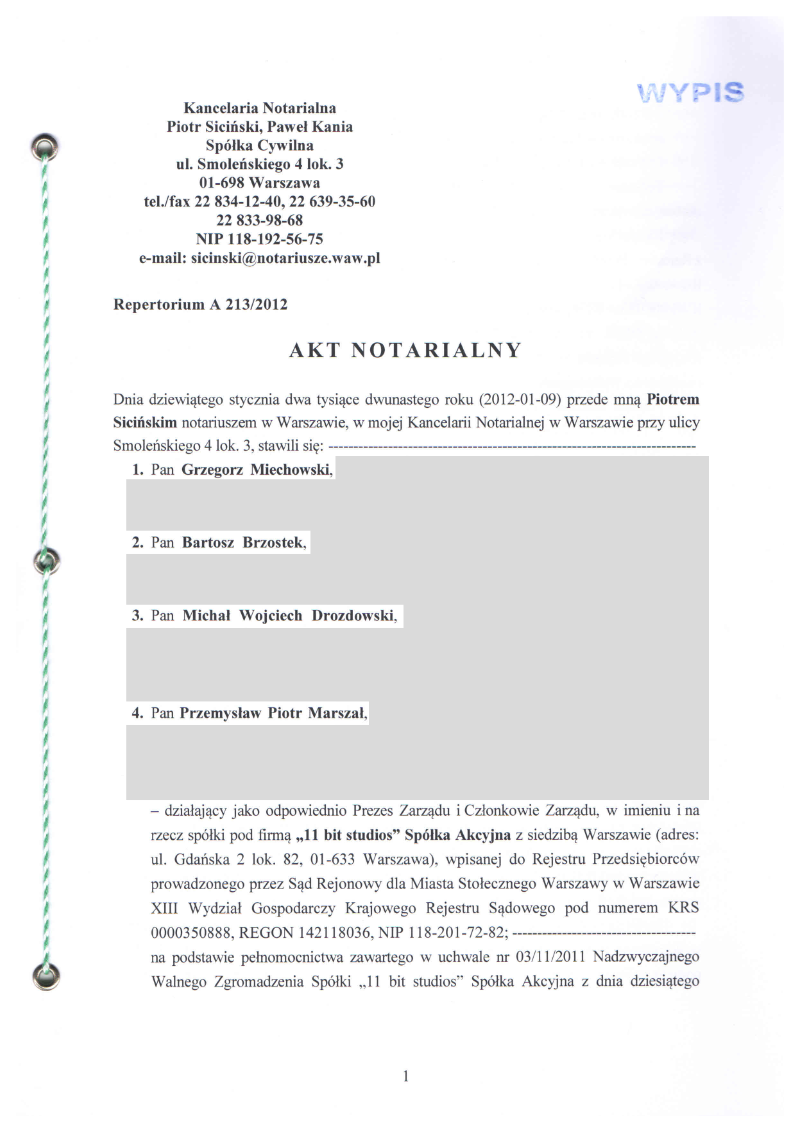
The notarized act dated January 9, 2012 records the formal approval by 11 Bit Studios’ board—Grzegorz Miechowski, Bartosz Brzostek, Przemysław Marszal, and Michał Drozdowski—of a capital increase for the Warsaw‑based public limited company. The board, empowered by Extraordinary General Meeting resolutions of November 10, 2011 (notary file A 7671/2011), authorized the issuance of up to 500,000 new ordinary shares (Series D) at a nominal value of PLN 0.10 each, raising the share capital from PLN 187,076.10 to a maximum of PLN 237,076.10. The resolution also amended the company’s statute to reflect a new share structure: 1,000,000 Series A shares, 494,200 Series B shares, 376,561 Series C shares, and up to 500,000 Series D shares.
By December 31, 2011 the board confirmed that 10 subscription agreements had been executed for a total of 40,938 Series D shares, amounting to PLN 4,093.80 in subscription proceeds. The act further specifies that the capital increase was fully paid in cash, with shares deposited into the company’s account before registration. It outlines provisions for voluntary share cancellation and issuance of utility certificates, as well as the allocation of costs: notarial fees, VAT at 23 %, and a civil‑law transaction tax.
The document is limited to Warsaw, Poland, covering the period from the November 2011 resolutions through the January 2012 notarization. It relies on statutory provisions under Polish commercial law (articles 431 §7, 310 §2, and related tax statutes) to validate the corporate actions. The act concludes with notarized signatures and fee details, confirming compliance with legal formalities for the capital increase.
- On January 9, 2012, 11 Bit Studios formally notarized a capital increase authorized by the board to issue up to 500,000 new Series D ordinary shares at a nominal value of PLN 0.10 each.
- The capital increase expanded the company's share capital from PLN 187,076.10 to a potential maximum of PLN 237,076.10.
- As of December 31, 2011, the company successfully executed 10 subscription agreements for 40,938 Series D shares, generating PLN 4,093.80 in cash proceeds.
- The company’s updated share structure now comprises 1,000,000 Series A shares, 494,200 Series B shares, 376,561 Series C shares, and the newly authorized pool of up to 500,000 Series D shares.
- The board of directors, including Grzegorz Miechowski, Bartosz Brzostek, Przemysław Marszal, and Michał Drozdowski, ratified these changes following resolutions passed at an Extraordinary General Meeting on November 10, 2011.
11 bit studios
Report3 pages
Zakończenie Subskrypcji Akcji Zwykłych na Okaziciela Serii D
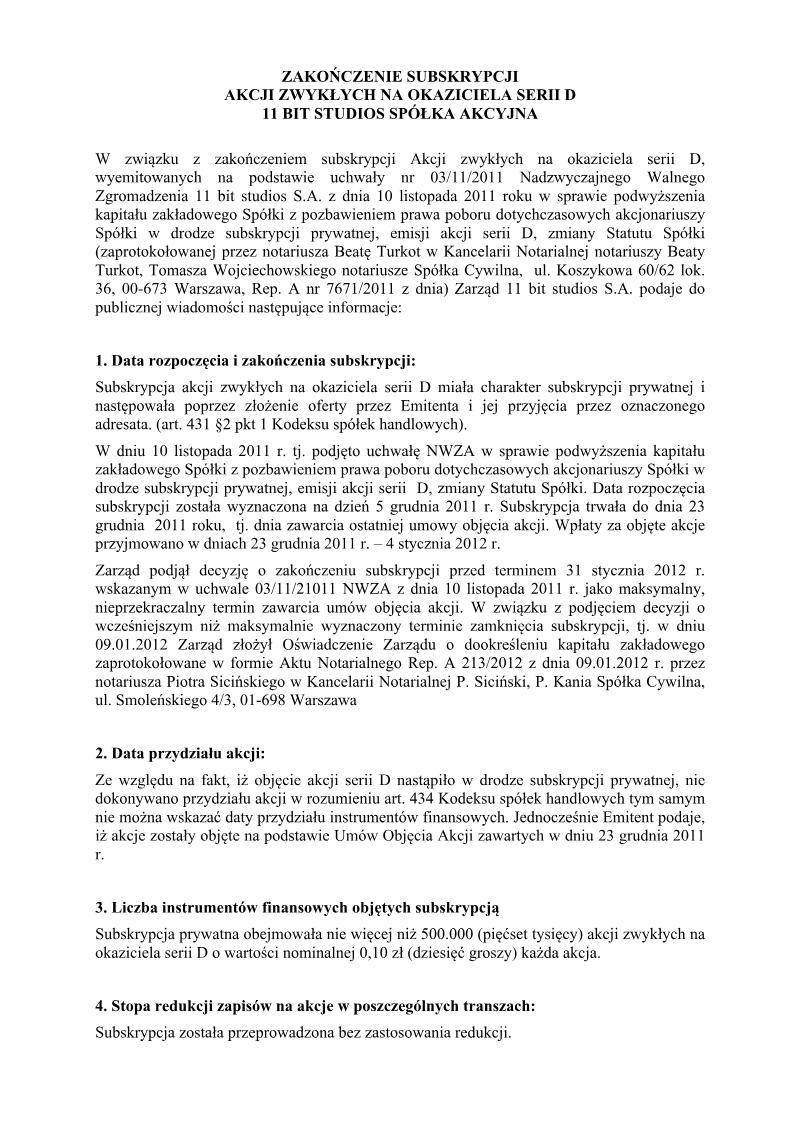
The announcement details the conclusion of a private subscription for ordinary bearer shares Series D issued by 11 Bit Studios S.A. The subscription, authorized on 10 November 2011 by a special general meeting to increase capital without existing shareholders’ subscription rights, commenced on 5 December 2011 and closed early on 9 January 2012, ahead of the originally stipulated 31 January deadline. The subscription capped at 500 000 shares, each with a nominal value of 0.10 zł.
A total of 40 938 shares were actually subscribed and issued on 23 December 2011, at an emission price of 9.00 zł per share. The offering attracted 64 investors, but only ten entered into subscription agreements on the closing date; no sub‑emission arrangements were made. The transaction incurred total costs of 46 722 zł, comprising 41 722 zł for preparation and execution (including notarial fees), 5 000 zł for advisory and informational documentation, with no remuneration paid to sub‑emitters or promotion expenses. These costs are recorded as interim expenses and will be expensed upon registration of the capital increase in accordance with Polish accounting regulations.
The report is confined to Poland, covering a single fiscal period (late 2011–early 2012) and the ordinary share segment of 11 Bit Studios. It follows statutory disclosure requirements under Polish corporate law and the Alternative Trading System regulations, providing a concise overview of subscription dates, share numbers, pricing, investor participation, and cost allocation.
- 11 Bit Studios S.A. concluded a private subscription for Series D ordinary bearer shares, issuing 40,938 shares out of a maximum authorized 500,000.
- The shares were issued on December 23, 2011, at an emission price of 9.00 zł per share, with a nominal value of 0.10 zł per share.
- The subscription period ran from December 5, 2011, to January 9, 2012, closing ahead of the original January 31, 2012 deadline.
- The offering attracted 64 total investors, though only ten finalized subscription agreements by the closing date.
- Total transaction costs amounted to 46,722 zł, consisting of 41,722 zł for preparation and notarial fees and 5,000 zł for advisory and documentation services.
+1
11 bit studios
Report2 pages
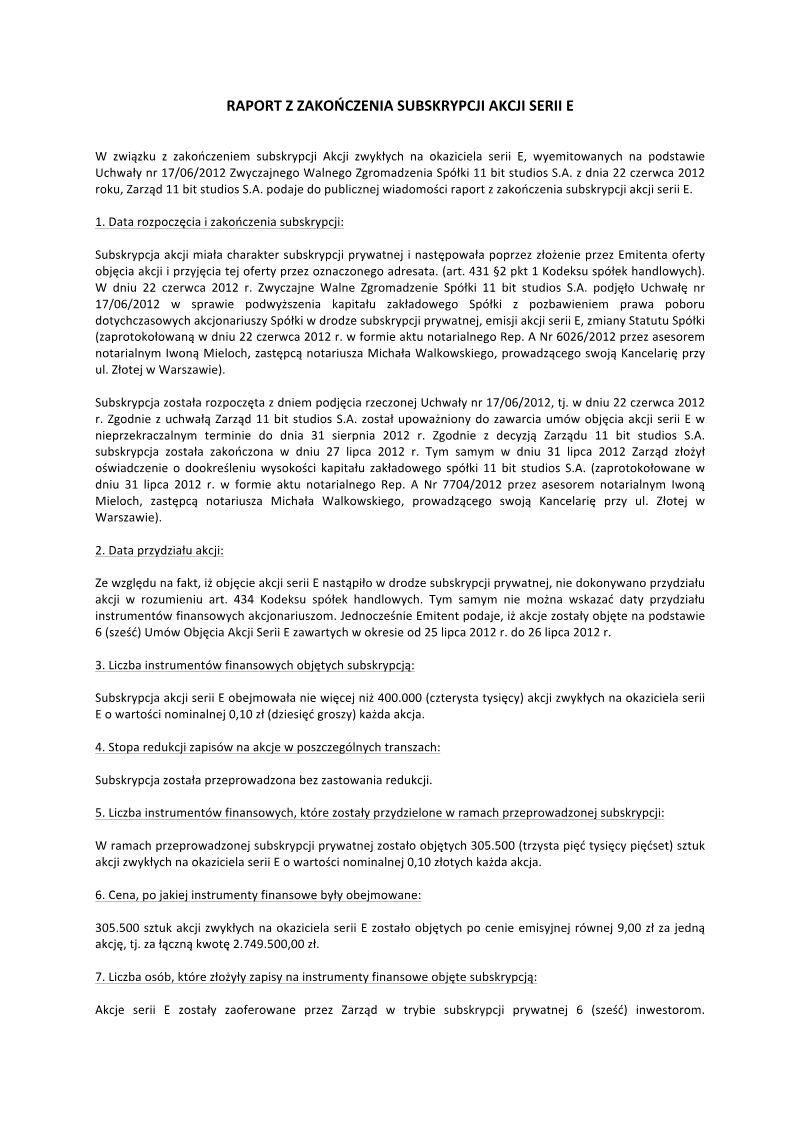
Report on the Completion of Series E Share Subscription
The report details the completion of a private subscription for Series E ordinary shares issued by 11 bit studios S.A. following the board’s resolution on 22 June 2012 to increase share capital without existing shareholders’ subscription rights. The subscription commenced on the resolution date and concluded on 27 July 2012, with the board filing a capital declaration on 31 July 2012. Six private investors entered into purchase agreements between 25 and 26 July 2012, acquiring a total of 305,500 shares at an issue price of PLN 9.00 per share, generating proceeds of PLN 2,749,500.
The subscription involved no reduction in nominal value and did not include any sub‑subscription agreements. The total number of shares offered was 400,000, but only 305,500 were ultimately subscribed. Costs associated with the issuance amounted to PLN 42,386, broken down into preparation and execution of the offer (PLN 20,000), informational document drafting and advisory fees (PLN 20,500), notarial and treasury charges (PLN 1,886), with no sub‑subscription or promotion expenses. These costs were recorded as interim expenses and will be capitalised in accordance with Polish accounting regulations.
The report confirms that the Series E shares were issued privately, without a public allocation date, and outlines the legal basis for reporting under the Alternative Trading System regulations. The capital increase was fully executed within the stipulated period, and all financial and procedural details comply with applicable corporate law provisions.
- 11 bit studios S.A. raised PLN 2,749,500 through a private subscription of 305,500 Series E ordinary shares.
- The shares were issued at a price of PLN 9.00 per share to six private investors between 25 and 26 July 2012.
- The capital increase fell short of the 400,000 shares originally offered, with 305,500 shares ultimately subscribed.
- Issuance costs totaled PLN 42,386, covering advisory, legal, and administrative fees, which will be capitalized under Polish accounting regulations.
- The subscription process was initiated by a board resolution on 22 June 2012 and concluded with a formal capital declaration on 31 July 2012.
11 bit studios
Report88 pages
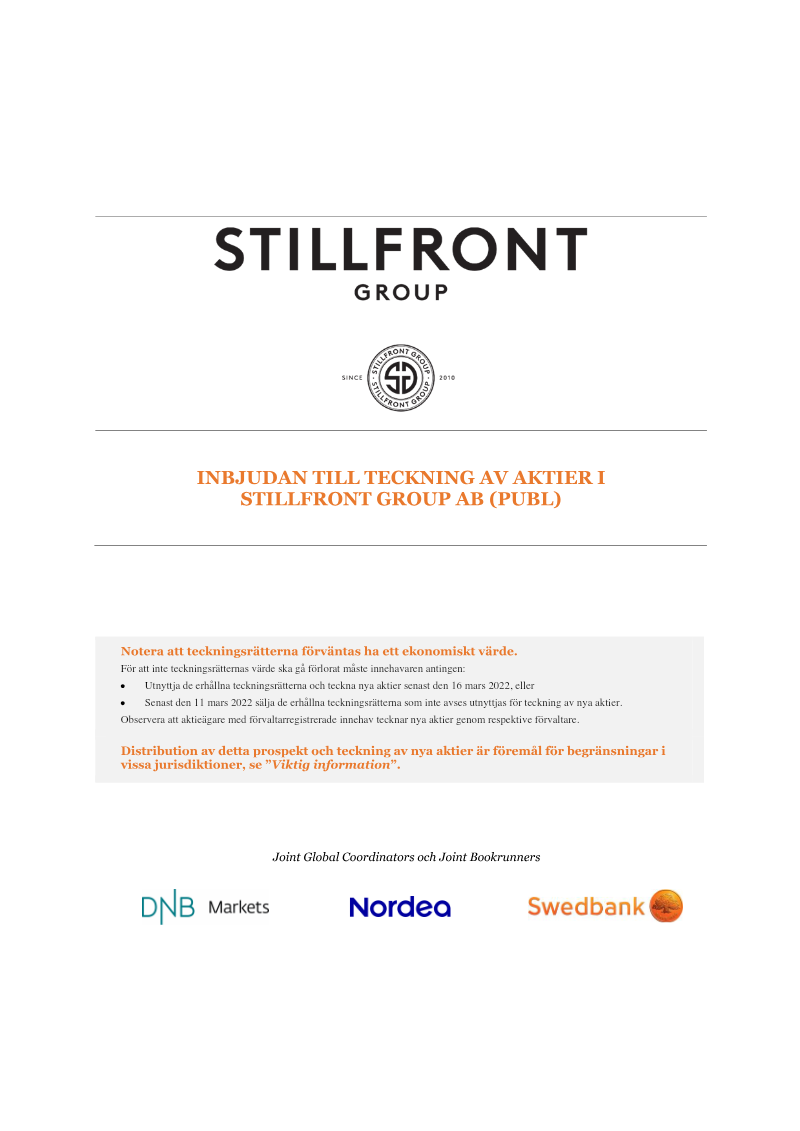
Invitation to Subscribe for Shares in Stillfront Group AB
INBJUDAN TILL TECKNING AV AKTIER I Notera att teckningsrätterna förväntas ha ett ekonomiskt värde. För att inte teckningsrätternas värde ska gå förlorat måste innehavaren antingen: • Utnyttja de erhållna teckningsrätterna och teckna nya aktier senast den 16 mars 2022, eller • Senast den 11 mars 2022 sälja de erhållna teckningsrätterna som inte avses utnyttjas för teckning av nya aktier.
- Stillfront Group AB is inviting subscriptions for shares, with subscription rights expected to have economic value. Holders must either utilize rights to subscribe for new shares by March 16, 2022, or sell them by March 11, 2022.
- Stillfront Group's proforma net sales for January 1 – December 31, 2021, were 6,536 MSEK, with an operating result of 1,008 MSEK and a period result of 374 MSEK, incorporating acquisitions like Super Free Games, Moonfrog Labs, Jawaker, and 6waves.
- The company's proforma total assets as of December 31, 2021, were 23,274 MSEK, with total equity at 11,882 MSEK.
- Stillfront Group's business model focuses on free-to-play online games, generating revenue through in-game purchases and advertising, with a strategy of continuous updates ('live-ops') to extend game lifecycles and retain users.
- Stillfront Group's shares were listed on Nasdaq First North Stockholm in December 2015, moved to First North Premier in June 2017, and have been listed on Nasdaq Stockholm since May 26, 2021.
Stillfront
Report19 pages
Results: What's Next - Focus on Cash Flow
The analysis outlines a strategic pivot toward cash‑flow optimization for the company, driven by recent shifts in the VR market and a need to secure additional financing. Revenue growth in 2024 reached PLN 190.4 million, largely supported by the launches of Project Maverick and Project Echo, as well as the January 2024 release of Bulletstorm VR. However, profitability suffered due to write‑offs of the Red and Bifrost projects and a decline in 2Q revenues linked to Gemini negotiations, resulting in an EBITDA of PLN 12.9 million and a net loss of PLN 175.3 million.
Operationally, the organization is trimming non‑essential spend and restructuring office space and team composition to reduce overhead. The workforce, which expanded from 612 employees in 2020 to 756 by the end of 2024, is being realigned with a focus on critical projects. The company has ceased further investment in VR development following the 2024 platform subsidy withdrawal, redirecting resources toward AAA and compact‑AAA titles.
Future initiatives include two new work‑from‑home projects with Sony Interactive Entertainment, the self‑publishing of Project Bison (the final VR title from PCF Group) slated for Q4 2025, and an early‑access release of Lost Rift in 2025. Krafton’s waiver of ROFO/ROFR rights for Bifrost and Victoria frees the company to seek external publishers. Scenario analysis is underway to identify additional funding sources, ensuring liquidity while maintaining a lean operational model across global studios in Warsaw, Montreal, Newcastle, Dublin, Katowice, and Rzeszów.
- The company reported 2024 revenue of PLN 190.4 million, but incurred a net loss of PLN 175.3 million and an EBITDA of PLN 12.9 million due to project write-offs and revenue declines.
- Management is pivoting away from VR development following the withdrawal of platform subsidies, shifting focus toward AAA and compact-AAA titles.
- The organization is implementing a cost-reduction strategy that includes restructuring office space and realigning the workforce, which had grown to 756 employees by the end of 2024.
- Krafton has waived its ROFO/ROFR rights for the Bifrost and Victoria projects, allowing the company to pursue external publishing partners for these titles.
- Future production includes two new projects with Sony Interactive Entertainment, the self-publishing of the final VR title Project Bison in Q4 2025, and an early-access release of Lost Rift in 2025.
+3
PCF Group
Report4 pages
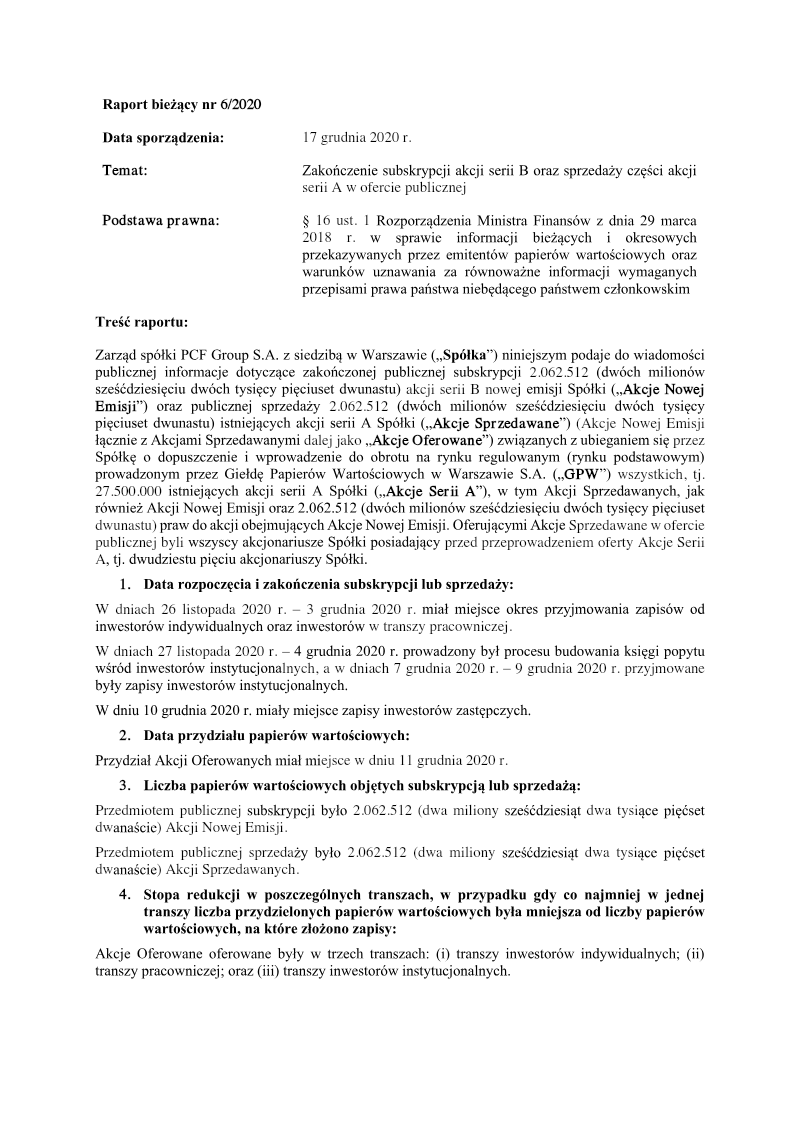
Zakończenie subskrypcji akcji serii B oraz sprzedaży części akcji serii A w ofercie publicznej
The report details the completion of PCF Group S.A.’s public subscription for 2,062,512 new Series B shares and the simultaneous sale of an equal number of existing Series A shares. The transaction aimed to secure listing on the Warsaw Stock Exchange and involved all 27,500,000 existing Series A shares. The subscription period ran from 26 November to 3 December 2020 for individual investors and employee‑shareholder tranches, while institutional investors were engaged from 27 November to 9 December. Allocation occurred on 11 December, with all offered shares fully distributed.
The offering was structured into three tranches: individual investors (price 46.00 PLN), employee‑shareholder tranches (41.40 PLN), and institutional investors (50.00 PLN). Employee‑shareholder bids were treated preferentially, and a 98.486 % reduction applied only to individual investor bids for new shares. Institutional investors received both new and existing shares, with 284 institutions subscribing to the sale of existing Series A shares.
Total subscription volume for new shares reached 42,310,783 bids across all tranches, while the sale of existing shares attracted exactly 2,062,512 bids from institutions. Allocation matched the offered quantities: 2,062,512 new shares and 2,062,512 existing shares were issued. The average price for new shares varied by tranche, with the institutional tranche at 50 PLN, resulting in a subscription value of approximately 100.29 million PLN and a sale value of about 103.13 million PLN.
The report notes that detailed cost breakdowns and final pricing will be disclosed in subsequent filings, as the company has not yet finalized all expense items. The transaction represents a significant capital‑raising effort, expanding the company’s share base and facilitating its entry onto Poland’s regulated market.
- PCF Group S.A. successfully completed a public offering of 2,062,512 new Series B shares and the sale of 2,062,512 existing Series A shares to facilitate its listing on the Warsaw Stock Exchange.
- The offering generated a subscription value of approximately 100.29 million PLN for new shares and a sale value of approximately 103.13 million PLN for existing shares.
- Shares were distributed across three tranches with varying prices: 46.00 PLN for individual investors, 41.40 PLN for employees, and 50.00 PLN for institutional investors.
- Demand for the new Series B shares significantly exceeded supply, resulting in a 98.486% reduction rate for individual investor bids.
- The institutional tranche was fully subscribed by 284 institutions, which acquired the entirety of the 2,062,512 existing Series A shares offered.
+1
PCF Group
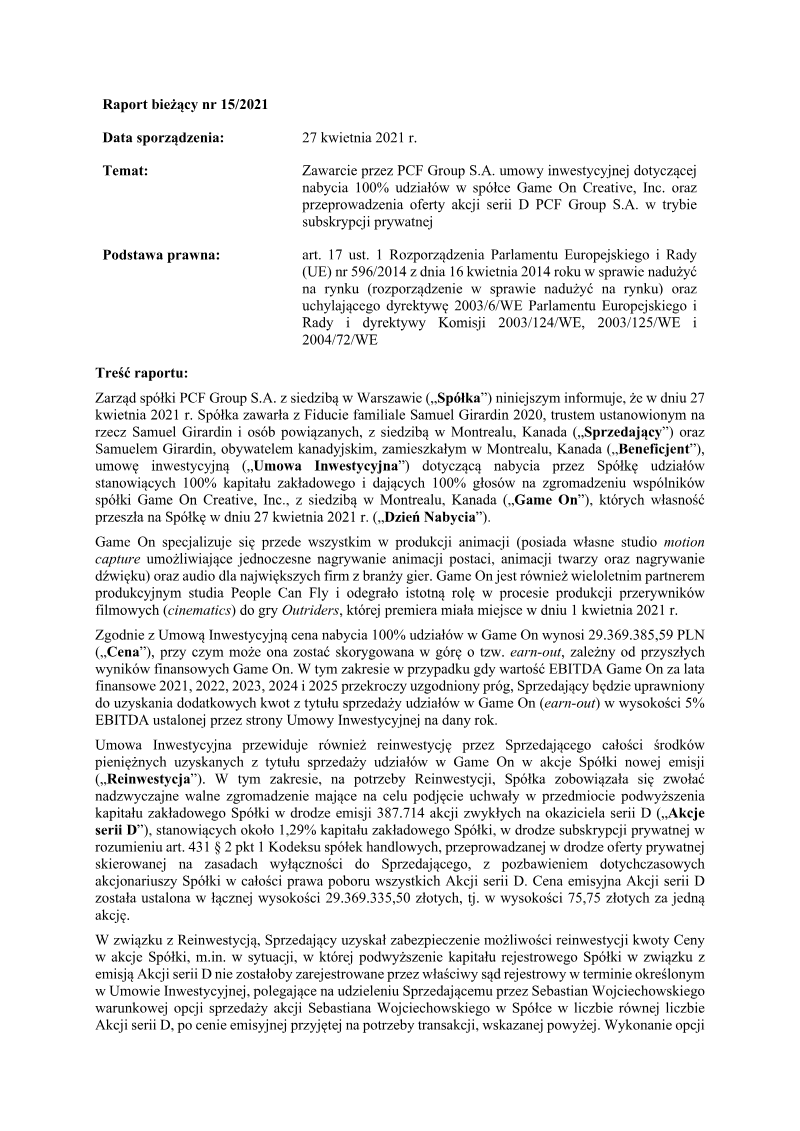
Report4 pages
Current Report No. 15/2021: Investment Agreement and Share Acquisition
PCF Group S.A. completed a strategic acquisition of Game On Creative, Inc., a Montreal‑based animation and audio studio that supplies high‑end cinematics for major gaming titles, including the recent Outriders release. The transaction, finalized on 27 April 2021, involved a trust and its beneficiary Samuel Girardin. PCF paid PLN 29 369 385,59 for 100 % of Game On’s equity, with a potential earn‑out of 5 % of EBITDA for the fiscal years 2021‑2025 if predefined thresholds are surpassed.
To secure the purchase price, PCF agreed to issue 387 714 Series D ordinary bearer shares—approximately 1.29 % of its capital—at PLN 75,75 each in a private placement exclusively offered to the seller. The Series D shares are subject to a lock‑up covering 85 % of the issue, with staggered release dates through April 2023 and December 2024. A conditional call option from Sebastian Wojciechowski allows the seller to reacquire shares at the issue price if the capital increase is not registered on time, with a 30 % pre‑payment provision before lock‑up expiry.
The agreement includes standard representations, warranties, and a pledge covering roughly 30 % of the Series D shares to secure potential claims. Non‑competition clauses bind both seller and beneficiary, while Samuel Girardin will assume leadership roles within People Can Fly Canada, Inc., reinforcing PCF’s AAA development capabilities. The deal aligns with PCF’s strategy to enhance animation and audio production for simultaneous multi‑project development.
- PCF Group S.A. acquired 100% of Montreal-based animation and audio studio Game On Creative, Inc. for PLN 29,369,385.59 on April 27, 2021.
- The acquisition includes a performance-based earn-out provision granting the seller 5% of Game On’s EBITDA for the 2021–2025 fiscal years if specific thresholds are met.
- PCF financed the purchase by issuing 387,714 Series D shares at PLN 75.75 per share, representing approximately 1.29% of the company's total capital.
- The issued shares are subject to a staggered lock-up period ending in December 2024, with 85% of the shares restricted and 30% pledged to secure potential claims.
- Samuel Girardin will join People Can Fly Canada, Inc. in a leadership capacity to support PCF’s strategy of scaling animation and audio production for multi-project development.
+1
PCF Group
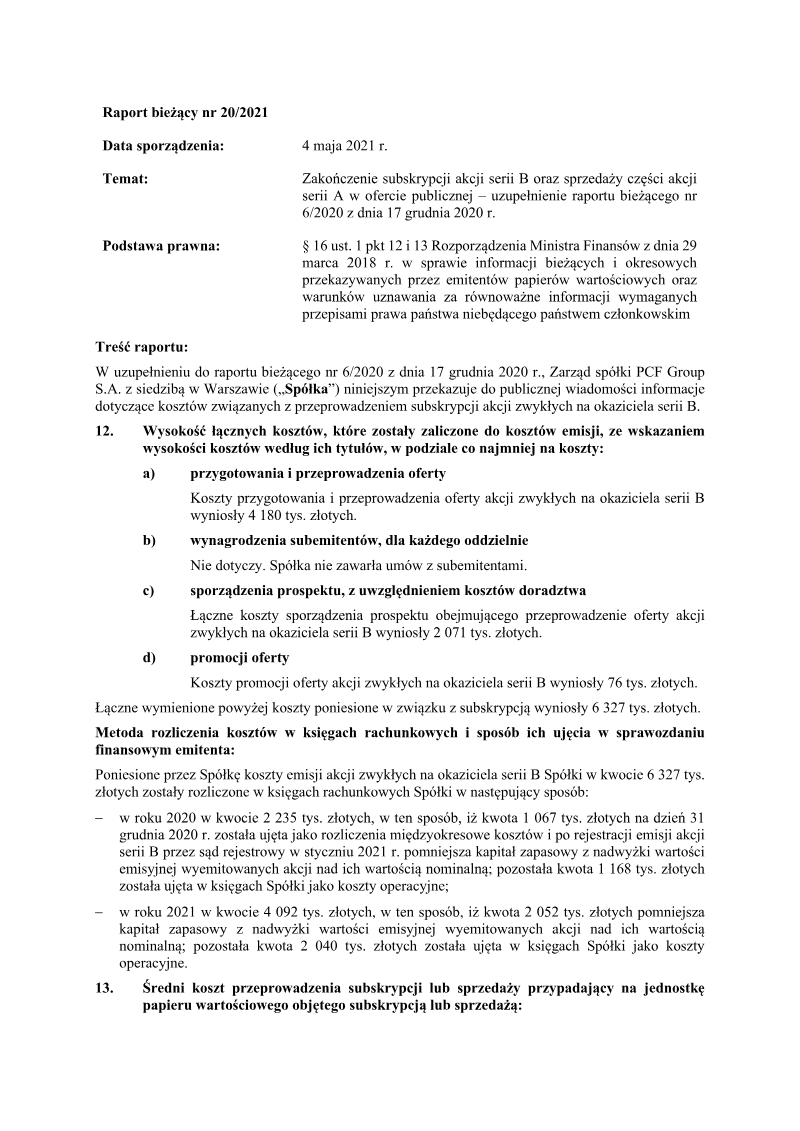
Report2 pages
Current Report No. 20/2021: Conclusion of Series B Share Subscription and Partial Series A Sale
The report details the completion of a Series B share subscription and partial sale of Series A shares by PCF Group S.A. The primary objective is to disclose the costs incurred during the Series B subscription, supplementing earlier information released in report No. 6/2020. Total emission costs amounted to 6,327 thousand PLN, broken down into preparation and execution of the offer (4,180 k), prospectus drafting and advisory services (2,071 k), and promotional expenses (76 k). No sub‑emitter fees applied.
Accounting treatment of these costs is outlined: in 2020, 2,235 k PLN were recorded, with 1,067 k PLN treated as inter‑period cost adjustments reducing the capital reserve from excess issue value over par, and 1,168 k PLN expensed operationally. In 2021, 4,092 k PLN were recorded similarly, with 2,052 k PLN reducing the capital reserve and 2,040 k PLN expensed.
The average cost per security issued or sold was calculated at 1.53 PLN. The report covers the Polish market, focusing on PCF Group’s public offerings during 2020–2021. No survey or external data sources are cited; the methodology relies on internal financial records and regulatory reporting requirements under Polish finance ministry regulations. The concise disclosure fulfills legal obligations for ongoing information to investors and regulators, providing transparency on the financial impact of the share issuance activities.
- PCF Group S.A. incurred total costs of 6,327 thousand PLN for the Series B share subscription and partial Series A share sale conducted between 2020 and 2021.
- The total issuance costs comprised 4,180 thousand PLN for offer preparation and execution, 2,071 thousand PLN for prospectus and advisory services, and 76 thousand PLN for promotional expenses.
- The average cost per security issued or sold during the offering process was 1.53 PLN.
- In 2020, PCF Group recorded 2,235 thousand PLN in costs, split between 1,067 thousand PLN charged to capital reserves and 1,168 thousand PLN expensed operationally.
- In 2021, the company recorded 4,092 thousand PLN in costs, with 2,052 thousand PLN reducing the capital reserve and 2,040 thousand PLN expensed operationally.
PCF Group
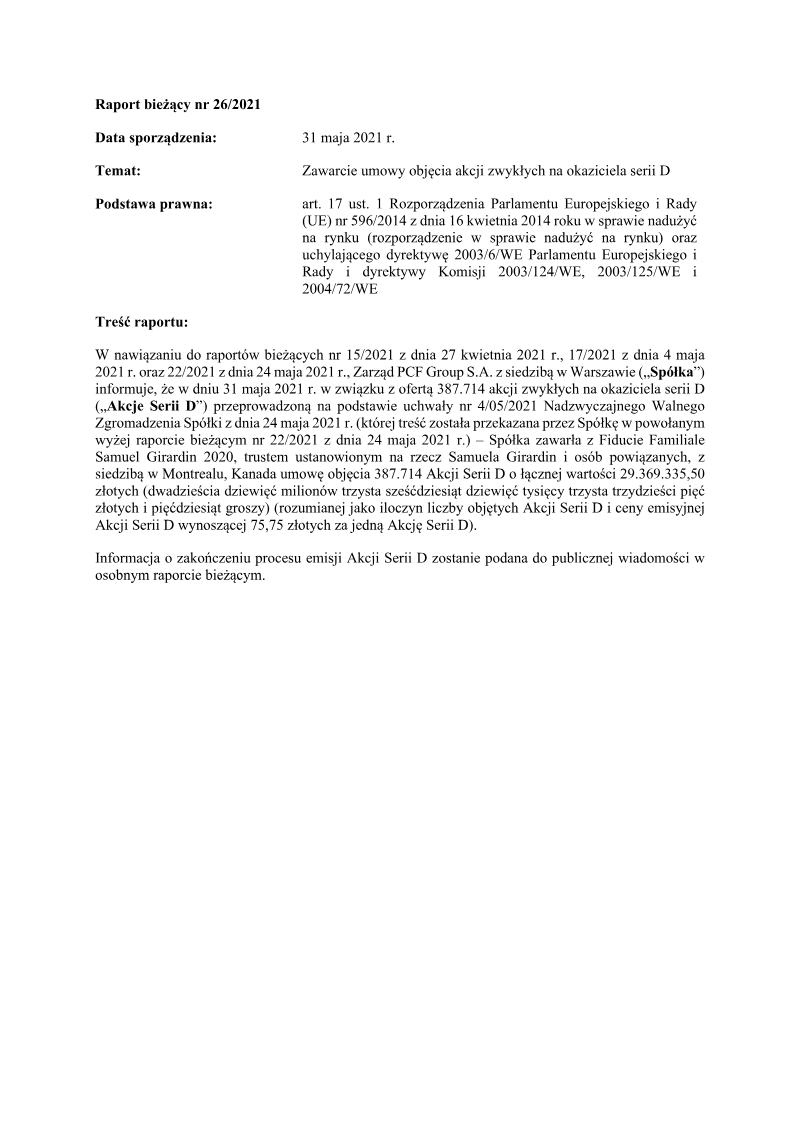
Report1 pages
Raport Bieżący Nr 26/2021: Zawarcie Umowy Objęcia Akcji Zwykłych na Okaziciela Serii D
The report announces that on 31 May 2021 the board of PCF Group S.A. entered into an agreement to acquire 387,714 ordinary shares of Series D from Fiducie Familiale Samuel Girardin 2020, a trust based in Montreal. The transaction was executed pursuant to the company’s extraordinary general meeting resolution dated 24 May 2021 and follows earlier interim reports issued on 27 April, 4 May, and 24 May 2021. The purchase price was set at PLN 75.75 per share, resulting in a total consideration of PLN 29,369,335.50 (twenty‑nine million three hundred sixty‑nine thousand three hundred thirty‑five zlotys and fifty groszy). The shares were acquired at the issue price, confirming that the company has fully subscribed the offering. The report states that a separate communication will be issued once the issuance process is complete, providing further details on the finalization of the Series D share offering. The information is provided under EU Regulation 596/2014 on market abuse, ensuring compliance with disclosure obligations for significant share transactions. The report covers the Polish jurisdiction and pertains specifically to PCF Group S.A.’s equity issuance activities within the stated period.
- PCF Group S.A. acquired 387,714 Series D ordinary shares from the Montreal-based trust Fiducie Familiale Samuel Girardin 2020 on 31 May 2021.
- The total consideration for the share acquisition amounted to PLN 29,369,335.50.
- The transaction was executed at a price of PLN 75.75 per share, matching the established issue price.
- This acquisition confirms that PCF Group S.A. has fully subscribed the Series D share offering.
- The share purchase was authorized by an extraordinary general meeting resolution passed on 24 May 2021.
PCF Group
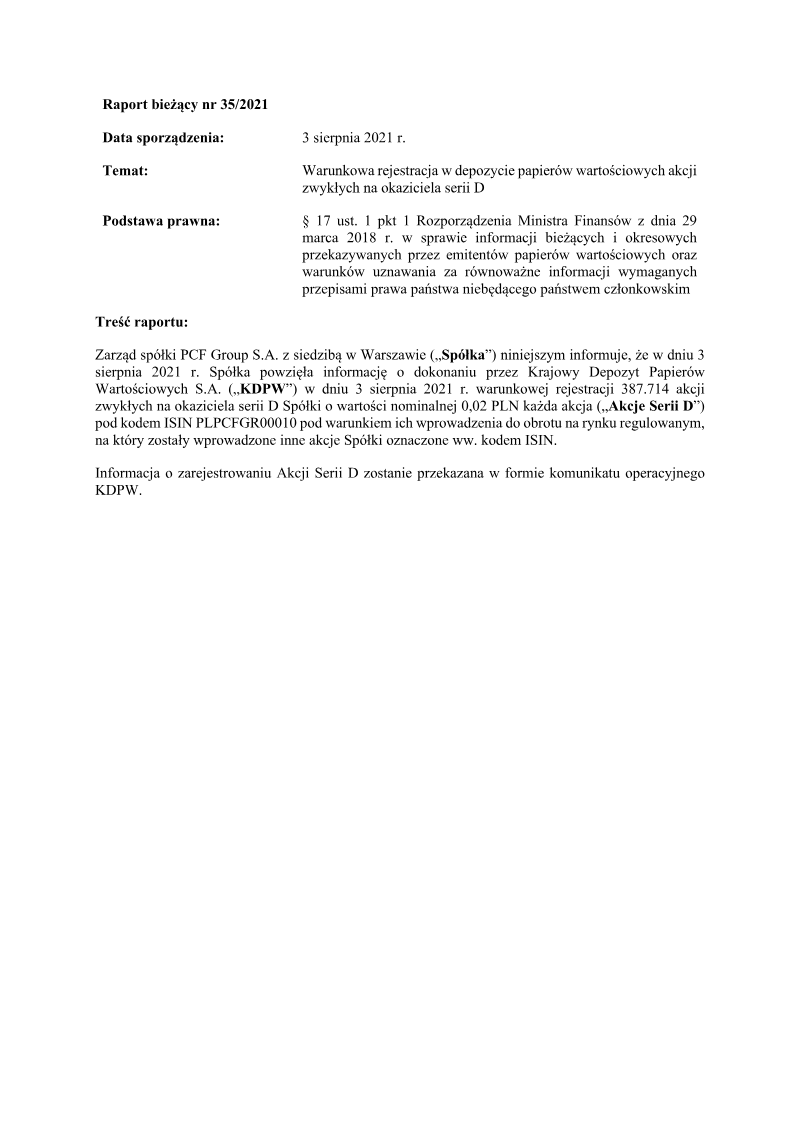
Report1 pages
Current Report No. 35/2021: Conditional Registration of Series D Bearer Shares
The report announces that on 3 August 2021 the National Securities Depository (KDPW) conditionally registered 387,714 bearer shares of Series D issued by PCF Group S.A., a Warsaw‑based company. Each share carries a nominal value of 0.02 PLN and is identified by the ISIN PLPCFGR00010. The registration is contingent upon the shares being listed on a regulated market, where other PCF Group shares under the same ISIN are already traded. The announcement follows § 17(1)(1) of the Minister of Finance Regulation dated 29 March 2018, which governs ongoing and periodic information disclosures by securities issuers. The company’s board confirms that the conditional registration will be communicated through a KDPW operational notice. This brief communication serves to inform market participants of the impending availability of Series D shares, subject to regulatory listing requirements, thereby ensuring transparency and compliance with Polish securities disclosure obligations.
- The National Securities Depository (KDPW) conditionally registered 387,714 Series D bearer shares for PCF Group S.A. on August 3, 2021.
- Each Series D share has a nominal value of 0.02 PLN and is identified by ISIN PLPCFGR00010.
- The registration of these shares is contingent upon their formal listing on a regulated market where PCF Group shares under the same ISIN are already traded.
- The issuance and registration process complies with the Minister of Finance Regulation dated March 29, 2018, regarding securities issuer disclosure obligations.
- Market participants will receive further details regarding the availability of these shares through a forthcoming KDPW operational notice.
PCF Group