1 free read left. Create a free account for unlimited reading + AI research.
Create free account
What are Your Existing Users Worth & How to Extract Maximum Value
Key insights
6 takeaways- 01Calculate the residual value of cohorts—the expected revenue after initial acquisition—to optimize user acquisition (UA) efficiency and align costs with projected lifetime value (LTV).
- 02Treat existing user cohorts as financial assets by modeling the 'area under the curve' to project future revenue and secure non-dilutive capital.
- 03Use cumulative LTV journey analysis to distinguish between verified accounts receivable and expected future revenue, providing a more stable valuation metric than volatile EBITDA.
- 04Prioritize capital-efficient funding by stacking ad network credit and free cash flow before resorting to debt facilities or equity to avoid unnecessary dilution.
- 05Implement these financial modeling strategies if your mobile game generates monthly revenue exceeding $25,000.
- 06Maintain rigorous cohort-level data and establish strong partnerships with mobile measurement providers to ensure the accuracy of financial projections.
Ask AI about this video
Transcript
we have um we have the wonderful martin macmillan uh of paul who's gonna be our first speaker be joining us shortly he's just popping in now um and he's going to give us uh an insight i believe into how to extract that sounds a bit hard extract maximum value from our users how to make the most money really which i don't think anyone's not going to be interested in i think it's pretty uh pretty much universal there he goes martin's already in blimey straight in he's he's opened up his uh opened up his screen share how are you doing martin uh i am good chris how you doing how's the show going i'm very good i'm very good you're in you're in that london are you or where are we i'm back yeah we moved back to london from the u.s last year so i'm in south west london but enough well it's it's a bit overcast in london today but uh but yeah it's it means you don't have to get up quite as early as if you're in the us i guess so that's good cool right well um i've you've queued up
your video which is fantastic gave a great uh introduction anyway and i'm sure you're now going to talk a bit more about um yeah talk about how how much your users are worth and how you can get the best value out of them right that's the the gist that's that's the ticket yeah cool great so thank you very much for uh for having us we would delight to be a sponsor of this um uh of of this track uh we're gonna go a little bit the title of this one is basically something that we get asked a lot about we've developed some methodologies and and the idea here is we're going to try to help you kind of figure out uh how much value is trapped in your existing users so hopefully you can see the screen um just give you a tiny bit of background into into what we do uh as video said before we provide flexible credit facilities to uh game developers to help them to help them grow we do that in a non-dilutive way so this is debt-based instrument rather than equity and they're basically completely elastic revolving credit lines based on um your accounts receivable but also how much value is is uh is is trapped so
we can we can typically lend somewhere between two and four times monthly revenues depending on on how this um how much value we can detect um our sort of higher purpose here is we're we're putting a lot of effort into trying to raise the financial literacy um of game developers really to help them make more informed choices so one of the things we do is we have a cfo resources page on our website and there's a lot of tools and calculators and content and stuff on there um with the idea of of helping you guys make more informed financial decisions but today we're going to focus on um we're going to focus on uh the the how much value is trapped in existing users just going to give a very quick insight most this is i'm sure is sort of pretty straightforward for most people but just to set the scene there's a few things we care about from a financial point of view um to set up about how we're actually gonna how we're gonna detect uh the value and price the value in existing users so just a quick refresher on on the ltv journey so the key things we really care
about are um how much in how much do you have to pay to acquire a user regarding whatever metric you are you care about um really important when you break even the the the day you break even i mean obviously if you break even is super important and set really sets the tone for some of the financial metrics of how the how the business can grow and then ultimately um where you cut off ltv how long do you think about it um as a as a journey basically is the end point in the journey do you do that is it 90 days 180 days 360 days totally depends on the game retention pattern and again on our cfo resources page we have some tools to help with that and our business pollen is all about curves right so we care about you know gradients of lines and and building curves and fitting curves and so on and this is basically just a you know an ltv curve where
the uh the key things we care about are when do i break even and then how long does it take to re to achieve what kind of return um on that uh so uh all about curves and again um something we love talking about so i'm going to introduce this this new kind of um concept or at least newish to us if you like around residual cohort value so this is basically how much value is trapped in your existing users and how can you basically price it um figure out a monetary value and then what can you do with that so that's really the key things we're going to explore today so residual cohort values so think about it like this if you stopped all user acquisition today how long would it be before the last player left the game now obviously um that's very kind of hard to price if you like but the the the concept is the same site you stop doing user acquisition and then basically all of these cohorts play out over time and how can you effectively what you're trying to do here is to
model the area under the curve so a couple of uh do's and don'ts first of all it's uh this kind of methodology would include the organics that are earned that are directly correlated to paid ua so your your k factor you acquire a user you get you know half a free user based on based on that if you can if you could attribute that back so those those organic users would be included in this methodology um what's not included in the methodology is if you just have fantastic user acquisition through a completely organic channel that you know you acquire a thousand users a day just through you know people searching for what you're doing then this wouldn't be and you need to kind of price that separately but again that should be um if it's uh if it's static it should be relatively easy to price it's a big question here why do you care um so first of all from the point of view of m a if you ever want to sell um if you ever want to sell one of your titles uh or you know sell the studio if
you've only got one game whatever it might be this is really really important to set the uh set the tone um and to give some sort of you know what's my studio worth or what's my game worth it gives some kind of baseline valuation mechanic um so this is uh you know pricing this uh even somewhat accurately is going to give you a really good um uh measure of value probably more relevant than a like an ebitda valuation metric because that can be very dependent on ongoing user acquisition zone as well um and also from an at just one point in ltv duration um which is the the time it takes to get you know your your money out obviously the more data you have the longer you can project so we'd always advise people to be super careful about projecting ltvs off where you don't have enough cohort level data to really project it um but obviously the the longer the data period you'd be able to acquire
then the more accurate you can be and the more sure you can be doing longer dated um ltv projections excuse me so the other thing that's important about your residual cohorts is think you can also think of them as an asset right so this is just revenue that you know this is a user that has been purchased right so there's not the question mark over the ua side but the money hasn't come out um the other end right so you have to you know provided you keep your live ops and your servers running and the rest of it you can predict with a with a fairly good degree of certainty that this revenue will be earned because you know what the cohort behavior pattern really looks like um and you know again this is something we've started recently doing at poland is we can lend against this residual value as an asset so again there's two things in our model we look at the the platform receivables and then also the residual value and we push these together um and use they use these two different assets to uh to to baseline the amount of credit um so i'm going to move on now uh talked
about talk about um cohorts a little bit because this is super important and again this is just a very simple very simple kind of model um if you look at you know a single cohort say the green one on the bottom that's basically um the the kind of revenues earned over time and then what you're doing is we've got you know whatever 10 cohorts here we're stacking them on top of each other new cohort every day and so by day 10 the 10th of january in this example you can see what our you know what our daily revenues are but you also know um that these are these are going to decay over time so basically this is just a bunch of retention curves really um layered on top of each other but it gives um hopefully an interesting kind of starting point around um how to uh how to stack these on top of each other this is the the overall financial picture um so next then if we were to look at just different ways of plotting cohort performance so this is a uh what we're looking at doing is is a
cumulative ltv journey so for each one of these cohorts it starts starts off its journey and will go towards you know different paths they won't all converge at the same ltv they'll all be they'll all be a little bit different some will be you know some will monetize quicker some won't monetize as quickly etc but each one of these um cohorts has a journey now the really important thing for you guys to monitor is a cohort level ltv and typically that's done through working with uh with a mobile measuring partner an mmp who can really help you understand the cohorts you're acquiring on particular channels and then to model the behavior of each of those but this in its own is just a bit of a mess so what i'm going to do now is to rebase all of these different curves um to you know time zero to day one whatever you want to call it right so this snag gives us uh gives us an idea of what um what these curves look like if they
were to be sort of stacked on top of each other at this at the same starting point this is this again is cumulative ltv on a cohort basis um now if we if we're trying to then estimate and this is obviously an oversimplification of it but just for illustration purposes you know how how you might start to think about this um you can run a simple regression analysis to fit a curve um based on all the different curves you have basically to look at and sorry i just realized we didn't name the axis here but this is this is basically uh you know revenue over time so it's basically it's an aggregation of all of these different um cohorts over time which is going to give you um a decent way to kind of project into the future so i'm gonna i'm gonna switch gears a little bit now and to talk about the um the the financial aspect of it and this is something that is very often kind of overlooked right so you've got to think of um each cohort is you know a journey to an ultimate ltv
and uh so i'm gonna and and these these three cohorts there can be uh if you know what the um what the the projection is likely to be then you can uh you can classify these in different ways depending on the age of the cohort and this is where this is where accounts receivable merges into uh the residual cohort value another way to think about residual cohorts is this is an expected receivable right so this is money that will be generated on the platforms and will ultimately be paid out to you so that's its journey so look at a the financial journey of a young cohort here so we've got let's say 180 day lifetime value cut off um and let's say for purposes of of uh this uh discussion we are 15 days into that cohort so if you look at the first um bit of uh the first the golden triangle there that's basically that's marked out as ar so that's money that has say been earned on you know on on one of
the ad networks or it's been earned since iap and it's say sitting in the bank of apple waiting to be paid out but you know you know you've banked that revenue effectively because you are you know because you can see it and it's verified but the rest of it is just an expected value so you hope that that is going to achieve that ultimate ltv over the next 165 days which is where you've done your calculation cut offs the next one is you you fast forward and you look at something that's that's mid-life right so here we've done 60 days so basically you can see that the 60-day part of the triangle again that's all in receivables right that could be all in the bank of um apple or or unity or iron source or any any of these guys here um it's a much bigger proportion it's a much bigger monetary amount um and then you have a you have the next 120 days instead of the next 165 days to figure out okay well here's where i've got to here's where i expect the you know the the ball to land
when i throw it out the window if you like so i'm still it but it's more certain is the point right so the more that the further into a cohort behavior the more certainty you have because you've you've either banked the money as we'll talk about in a second or you've actually you can see and verify the sales receipts sitting within the platform and there's less kind of there's less expected residual at that point and then you look at a mature cohort so you look at something that's in this case 120 days in so you look at the first 60 days the red triangle you've already seen the cash for it uh it's been sitting in the it's been sitting in the in the platform's bank account for 60 days then they've paid it out to you so that money is that money's gone you've taken it and banked it you have a smaller proportion of receivables and at this point you have a pretty small proportion of expected receivable right so this is the difference between 120 days 180 days that money is um you know you're way way further through so there's a greater degree of certainty
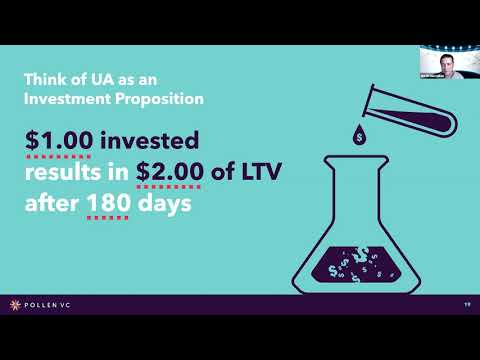
so basically the way to think about this is that every cohort you have is at a different stage in its maturity and its different life cycle um it's going to come back to something we talk about um a lot which is the concept of the the ua machine and this is um you know really simple things like do i have a machine how can i uh how can i fund my machine and how do i know when it's running at full capacity so as um as a company we just think about ua is an investment equation um so it's literally how much in when do i break even how much out and then how do you bring that back into sort of financial metrics of you know let's say so normally we look at like a monthly return on investment of the ad spend and then you once you once you've brought everything down to a to a comparison metric there is a lot of stuff you can do with it uh and it comes down to three things does ua work in the first place uh how am i going to fund it and how do i know when
i'm spending as much as i can on a daily or weekly basis and anything more is just going to be unprofitable so that's what we think of as the machine running at full capacity um so once you've identified which is probably the hardest part if you have a ua machine at all um the next question is how to fund it and this goes between uh and this is really a question for finance leads and uh leads right the the one of the the the best k the recipes for success is when finance and ua work together and in terms of trying to figure out how to fund this machine so um and it's again it's a very simple it's a dispassionate stack right so you've you've figured out that every dollar investor is going to invest you're going to get you a dollar fifty or two bucks whatever in ltv so how are you gonna fund that for the you know for as long as the well is open for drinking so you start off um you know if you have a credit facility from you know facebook or google or whoever um it always makes sense to use that
first it's effectively free money or the other way to think about it it's an ltv risk transfer from you to the ad network so if they're prepared to take it you should absolutely max that out first um then you look at your next best alternative so then you look at you know do i have a bunch of free cash flows sitting in the bank now there's a distinction here between free cash flow from a let's say another game that's uh that's cash flow positive and there's distinction between you know half sitting you know half of your venture capital rounds sitting in the bank um which obviously has a has a much higher cost because it's the equity capital so here really i'm talking about free cash flow cash that might be sitting in the bank earning like point something of a percent of interest um you can also play the credit card game as well so if you want to match interest-free periods on credit cards and take the air miles totally valid strategy you see or we see empirically a lot less people um playing this game because the risk of maxing out cards maxing out etc is just too too great so people are sort of moving away from this
next down the stack is credit facilities so the type of facilities that we provide here at pollen these are typically secured against either just accounts receivable or in our case accounts receivable and residual cohorts below that you've got revenue based loans and that's typically where someone will lend you an amount of money with the expectation you put it into user acquisition and then they'll take a revenue share off the back of it so it has a higher risk profile because it's not matched to your own you know specific stats it's about it's it's about something that's going to happen in the future as opposed to has happened already which is the distinction between you know users you've already acquired and users you are you plan to acquire uh and so typically that's at a higher cost um and then right at the bottom you have vc funding so fortunately we see a load less people now just raising venture capital and then and then uh spanking a lot of it on um on user acquisition people are starting to get the concept of capital
efficiency and using debt products to finance user acquisition rather than equity um and then lastly the kind of the the way that we think about this as well if you're uh if you're comparing your numbers at is break everything down into a into a simple return right so you know what your you know your ultimate ltv is work that back you know subtract your acquisition cost from your ltv and then work that back into a monthly return so what is your monthly return on it's not on the ad spend it's the roi on the ad spend um so let's say i turn a dollar into a dollar sixty after um 90 days uh that's giving me a 60 return after 90 days or 20 return after 30 days so my monthly return is is uh 20 now let's say i have to go and borrow the dollar to put into this equation and that cost me say one and a half percent for the time frame then it's still giving me after i subtract my cost of capital um my return my profit is 18.5
from 20 so i'm gonna keep burning through that for as long as i can whilst i'm generating profits that that meet my say my minimum hurdle rate or whatever so the trick is to know when this machine is running at full capacity and that's really something that's that's highly personal to every different uh game and and company out there because the economics will chop around so much um i'm going to do one more slide here and it's basically it's the concept of demand economics so this is basically you know your ltv and your acquisition cost is just the demand and supply curve you don't know what those curves look like are they you know are they exponential are they straight line it's going to be totally different so many different factors but ultimately if you go back to basic economic theory what you're looking at is the intersection where your acquisition costs equal your um equal your lifetime values that's the point that it doesn't make sense to buy anymore you know that you're going to be unprofitable you probably in a freemium world you
probably want to build that build in a minimum margin if you get your numbers wrong you don't want to be underwater but this is really just about sort of demand economics so kind of quick recap in terms of thinking about what value you've created in your in your business and how to how to extract as much value as possible think about not necessarily just the users you could acquire but think about the users you have acquired what they're worth and then how you can make them work for you whether that be setting a baseline valuation for uh you know for for an acquisition or um or indeed basically if you're if your ua machine is still working how can you extract the value from these guys to allow you to continue back on the on the ua journey um so that's probably about all we've got time for i don't know uh guys we've got time for any quick questions i know we're a few minutes late in starting no we we've plenty of time don't worry that was uh that was great that's great martin now we've got loads of questions in there i'm pulling through so i'm going to try
and answer ask a couple of them a lot of a lot of insight shared they really appreciate that a lot of um sort of practical uh information and um you know and and training a way to think of it i always learn things like this because i don't think i think of things in the same way so i i clearly need to it's uh it's very insightful so i'll i'll try and i'll try and combine a few of these uh [Music] together and and get through two or three questions um there's a couple of questions here that are around about um kind of the size and history of the business i i i whether when they become applicable for um the services like yours and and other financing so there's all about you know how long a track record do we need is there a minimum you know what's the minimum revenues we should be attaining to qualify for services like this uh as an indie company does this work with smaller budgets or you know so there's a all kind of uh you know the the approaching what at what point
you know do they they bring you in or come to you yeah and that and that's that's pretty easy so typically the economics only start to work if you're making above about say 25k per month um but the most interesting it's not nothing obviously but yeah yeah yeah it's but it's it's not you know you don't need to be multi-millions by any case and actually it's um uh the it's the most important thing is really the the ua machine is working right um and we actually we just helped a company grow well they started with us about 25k a month and they just got through two million dollars a month right so that's good growth yes and you do that for everyone right that's the that's your base level promise well sadly not because we're not we're not we don't control the ua thing but the the the point in that is basically that you know it can have a fairly low entry point but as long as the economics are good then it could the journey can go you know all the way up the curve um so typically you know and again we recognize that the you know these are often new companies
and stuff and they they've either raised a bit of seed or or maybe series a whatever but they just want to be efficient about how they use a capital so basically this would be um this would be something that uh um is you know we probably ideally look for it for a few months of uh of um business banking history but sometimes in this in the in the hyper casual space it's just a different different mechanic right so what we do is with hyper casual and we work with a bunch of hyper-casual studios and publishers um we look at basically we go through like a very simple diligence process you know is there any money in there to start the scaling process but recognizing these are very often kind of new games that appear in days or weeks rather than rather than months so we have an element of flexibility there um for hyper casual guys as long as there's some starting some budget to start the scale the great thing about this model for hyper casual you can take out the money and recycle it within you know we do that sometimes on a on a daily basis for uh for hyper casual developers so they can be super efficient with the amount of money they need to scale
and what we're seeing more of is people saying hey i'm going to self-publish my hyper-casual game with your capital as opposed to um use a publisher so that's an interesting direction of travel no fair enough that make that make sense um yeah there's a couple more here do you see um yeah let's have a look there's a couple kind of saying about drop-offs um i i i you know what happens if if you know you project a certain revenue and then you'll kind of uh you know think something happens like a random event and drop off i guess that's the same with any kind of credit i guess there's discussions that go on then but um a couple more are related to um whether there's nobody kind of uh changes your things you're obviously very plugged into the revenue side of the app store because you know you're learning knowing people about it so are you seeing any any drop-offs or flattening at all related to kind of covered restrictions is one question and the other question is does the idfa and privacy changes um impact the ability to forecast
incomes so that's that's a really good question and the the so we're talking specifically here about users you've already acquired right so if you've acquired them and they're on an iap monetization track it shouldn't affect it too much if they've you know if you're on in if you're on an ad monetization track then sure you may you may have a bit of a a bit of a reset there but to address you know a little bit of that question but also the drop-off one the way we think about this and why why we think this model is is really right-sized for for gaming is we're repricing this stuff every day so if your ua is working well and your residual cohorts are performing better the amount you can borrow just goes up and up and up if however the cohorts are not performing as well it gets gradually brought down it doesn't fall off a cliff but it gets gradually brought down to just you know theoretically that the bookend would be just the receivables piece right if there's increasingly less residual there then all you can borrow is
basically what's in what's in the the the platform's bank um so to that to that end we think it's a much kind of safer there's some inherent guard rails um to prevent people from continuing to spend on unprofitable ua that gets brought down um to ground over time um i've got two more questions i'll try and get through because we need to start a bit late and i think these are relevant would you work with a company which had revenue coming from only one or two territories would that matter at all um yeah the territory is not so important it's more who they you know who the uh who the payer is so you know if it's uh if all your customers are in the uk and it's apple that's paying then yeah that's it the bank of apple we're happy with yeah well that that's the thing right so we we look through the necessarily the territory we look through to you know who's ultimately responsible for paying and how can we verify it so that's kind of you know there's a and there's ways to structure around most things okay um i've got one more i'm going to get to it's a bit detailed so i i don't know if your charts only only
project without taking into account large organic growth do you think it's worth the company having multiple projections across their natural growth in order to see the highest lowest and average outcome possible absolutely the the more you can the better and this is all about trend i mean when we spoke about kind of fitting curves this isn't about picking the golden cohort and then thinking hey you know i imagine if every cohort performed like this would be you know billionaires right it's not it's about a measured approach and it's about you know having some of the kind of the modeling skills whatever um some of the some of the tools and things we use in-house to basically to build these curves and to do something that that is is workable the last thing you want to do is to you know to be spending a ton of money on ua and then finding out that it's you know unprofitable right so it's about keeping to super on top of the norm the numbers the whole time um to make this uh you know it's a it's a you know iterative process for sure cool one final question here is you say that uh pollen is all about financial literacy and supporting people which you know you've shared quite a lot
of useful insight there do you have any uh specific advice for someone that's just starting out maybe a smaller developer who's maybe maybe new to some of the financial implications of all this i mean maybe that goes back to your hyper-casual question a little bit do you is there anything any particular bit of advice or where to go or how to start just like just consider all your options just be aware of all the options possible research it and then only with knowledge can you make the right decisions so you you will need to raise equity capital how do you do that you will need you know you may want to raise debt capital as well but don't just you know don't just think hey this is there's only one way to do this there are lots of different ways there's pros and cons to each uh with knowledge comes power would say and there's you know if if there's stuff that's the burning questions that people have that's not up on cfo insights and we've got a we've got a really interesting roadmap of just content for that resource reach out to us and we'll see if we can help cool
you
Summary
This presentation outlines methodologies for valuing existing game user cohorts and leveraging that value to optimize growth. The core thesis posits that game developers should treat their existing user base as a financial asset, using data-driven modeling to project future revenue and secure non-dilutive capital. By accurately calculating the residual value of cohorts—the expected revenue from players after initial acquisition—developers can better manage their user acquisition (UA) machines and make informed financial decisions.
The methodology centers on modeling the "area under the curve" for various cohorts, accounting for retention patterns and organic growth correlated to paid UA. By analyzing cumulative lifetime value (LTV) journeys, developers can distinguish between verified accounts receivable and expected future revenue. As cohorts mature, the certainty of these projections increases, allowing for more precise financial planning. This approach provides a more stable valuation metric than traditional EBITDA, which is often heavily influenced by ongoing, volatile UA spend.
The presentation emphasizes that UA should be viewed as an investment equation where the goal is to identify the point of maximum efficiency—where acquisition costs align with projected LTV. Developers are encouraged to stack funding sources strategically, prioritizing ad network credit and free cash flow before utilizing debt facilities or equity. This capital-efficient model allows studios to scale without excessive dilution.
The scope of these financial strategies applies to mobile game developers, particularly those with monthly revenues exceeding $25,000. While the methodology is adaptable to various business models, including hyper-casual, it requires rigorous cohort-level data and a strong partnership with mobile measurement providers. Ultimately, the speaker advocates for increased financial literacy, urging developers to treat their games as portfolios of assets rather than relying solely on venture capital to fuel growth.

























Comments