Mobile reports and market data
Documents

Structured Mobile Marketing | The Ad Concept Model (Zynga + Consumer Acquisition)
The mobile user acquisition landscape has undergone a fundamental transformation following the deprecation of IDFA and the subsequent decline of lookalike audience efficacy.
- The deprecation of IDFA and the decline of lookalike audiences have caused a 30 percent margin compression across the mobile gaming industry.
- Success now requires a high-volume testing model where 20 to 50 new creative concepts must be evaluated to identify a single winning asset.
- Studios should transition from generic advertising to a granular strategy that maps a game’s core value propositions to specific player archetypes.
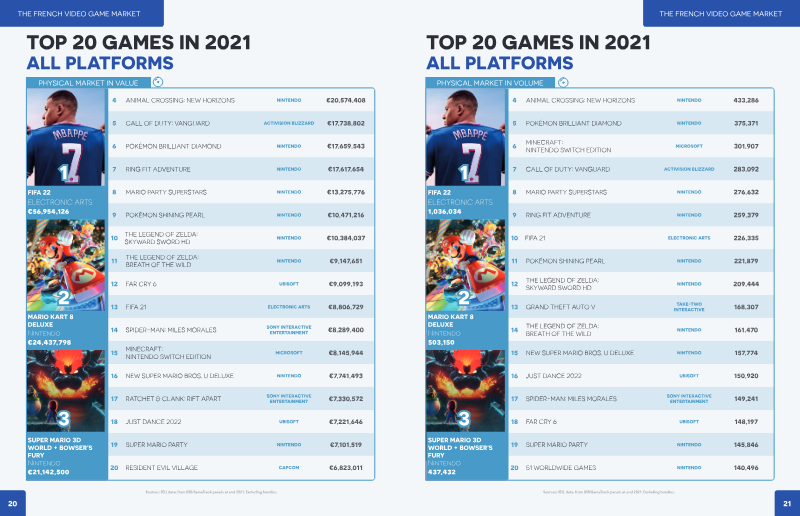
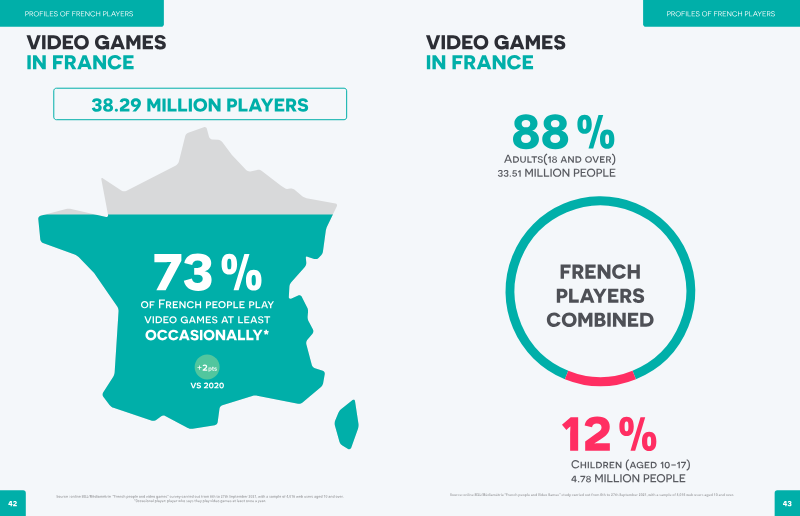

Essential Video Game News: French Market Report 2021
The publication is produced by SELL, the Union of Video Game Publishers, and covers the French video game market, its consumption and player behaviour, with figures for 2021 and comparisons to 2020.
- The French video game market reached 5.6 billion euros in 2021, up 1.6% on 2020, according to SELL's estimates.
- The console ecosystem grew 1% in 2021 and achieved its best performance since 2008, while the mobile ecosystem fell 1%.
- Hardware, covering console and gaming PC, generated 1.766 billion euros in 2021, 22% growth compared to 2020.
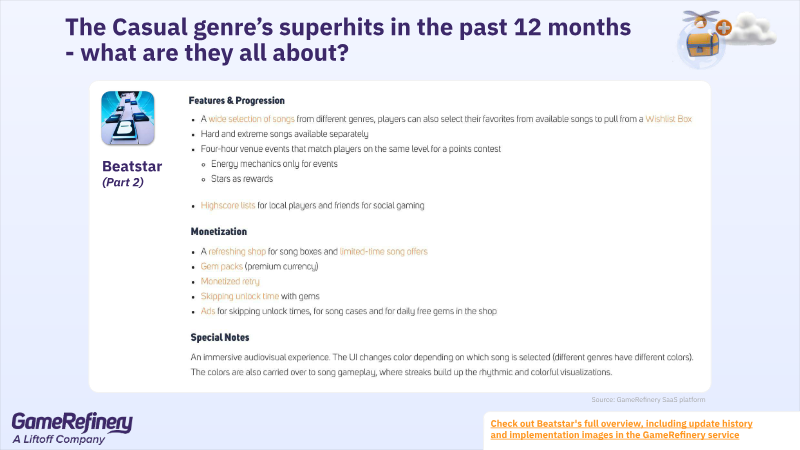
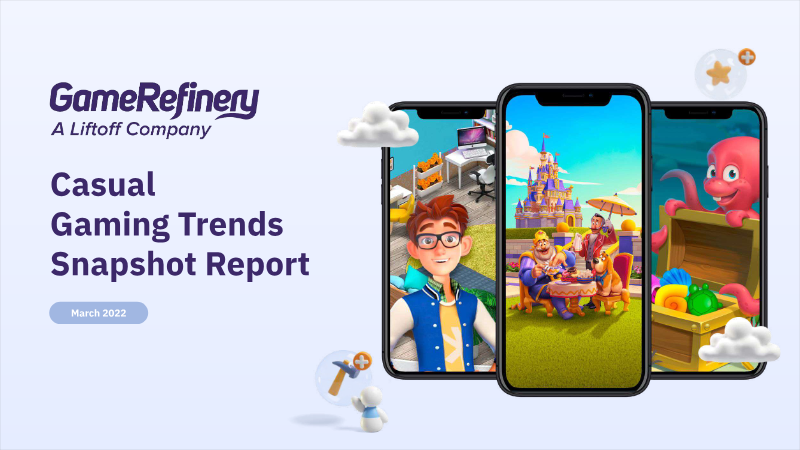
Casual Gaming Trends Snapshot Report
GameRefinery, a company that is part of Liftoff, published a March 2022 snapshot of Casual mobile gaming trends.
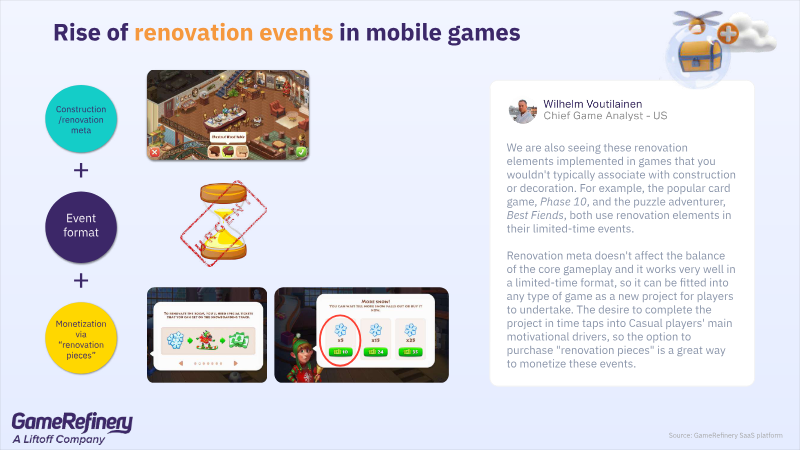
- Around 70% of the US top-100 grossing Match3 games feature meta elements, versus over 90% of such games lacking them over six years ago.
- Construction mechanics in top-100 grossing Match3 Puzzle games rose from 7% to 49% in just over six years.
- All US top-100 grossing Casual games released in the last two years utilize renovation elements.

Deconstructing Thetan Arena - the game that combines F2P and P2E
Thetan Arena serves as a critical case study for revitalizing underperforming free-to-play titles by integrating blockchain-based play-to-earn mechanics.
- Thetan Arena achieved 10 million downloads in two months by repurposing the codebase of the struggling game Hero Strike, which had only reached four million downloads over three years.
- Blockchain integration served as a powerful marketing catalyst for user acquisition, particularly in competitive markets like Brazil and the Philippines.
- The game's economic model faces sustainability issues due to inflationary pressure, as it relies on new capital inflows to subsidize the earnings of early adopters.

Smarter in-game ad integration with Tony Deane from AppLovin
Mobile marketing platforms play a critical role in the gaming industry by enabling developers to scale user acquisition while simultaneously maximizing revenue through efficient ad monetization.
- Machine learning tools like AppLovin’s Axon platform, launched in 2020, have driven significant industry growth, including a reported 400 percent increase in platform performance over the past year.
- Developers are increasingly leveraging first-party data from internal game development to maintain effective, privacy-compliant targeting in response to tightening global data protection regulations.
- The primary objective for mobile game developers remains achieving profitability by optimizing return on ad spend (ROAS) through advanced user behavior prediction and campaign matching.

Matching big data analysis with KPIs with Shalom Michaeli from Fyber
The mobile gaming industry is currently undergoing a significant shift toward programmatic monetization and data-driven transparency.
- The mobile gaming industry is shifting from manual waterfall optimization to real-time bidding (RTB) systems to increase competition and publisher revenue.
- Real-time bidding enables more precise user valuation, replacing historical reliance on less accurate estimated cost-per-mille (CPM) metrics.
- Transparency in publisher-network relationships is being improved through granular auction audits, which allow publishers to verify the true market value of their ad inventory.

Localising games the right way with Kayla Madsen of TransPerfect Gaming
Effective game localization requires a comprehensive, multi-faceted strategy that extends far beyond simple text translation.
- Localization must be integrated as a foundational development phase rather than an afterthought to avoid technical failures and rushed quality control.
- Designers must account for text expansion during the initial UI phase, as languages like German can expand by up to 35% compared to English.
- Effective localization requires a comprehensive strategy that adapts cultural signifiers, legal compliance, audio production, and community support to ensure the product feels native to the target market.

two & a half gamers session #2 - UA & Creative trends 2022, Microsoft + ATVI, TOP10 gaming M&A
The gaming industry is currently undergoing a structural transformation defined by aggressive consolidation and a fundamental shift in user acquisition strategies.
- Microsoft’s $68.7 billion acquisition of Activision Blizzard marks a structural industry shift toward metaverse infrastructure and the consolidation of high-value intellectual property.
- Post-IDFA user acquisition strategies are shifting away from Facebook toward a diversified portfolio including TikTok, Google, and Unity to mitigate rising costs and declining performance.
- Developers are increasingly porting mobile titles to PC to reduce friction, expand revenue streams, and ensure sustainable growth beyond mobile-only ecosystems.

Accessing global players and new markets with Sebastian Zechel from Xsolla
The mobile and PC gaming industry is currently undergoing a significant shift in monetization strategies, driven by a desire for greater control over player relationships and revenue streams.
- Developers are increasingly adopting web shops for mobile games to bypass centralized app store fees and establish direct-to-consumer sales channels.
- Integrating specialized payment platforms that support regional super-apps and digital wallets can increase payment coverage by up to 60 percent in specific global territories.
- Transitioning to independent sales channels allows developers to capture granular transaction-level data, such as player geography and preferred payment methods, which is often restricted by major platforms like Steam.

'Genshin Impact': Crafting an Anime-Style Open World
Genshin Impact represents a strategic evolution in open-world game design, focusing on the creation of an immersive, anime-styled universe that prioritizes cultural diversity and character-driven narratives.
- Genshin Impact utilizes a character-centric design philosophy where the world and storytelling revolve around its 33 playable characters, a model inherited from Japanese card games that proved successful across both Eastern and Western markets.
- To maintain a consistent anime aesthetic, the game employs two independent rendering pipelines: a deferred rendering pipeline for environments that supports dynamic weather and 24-hour lighting cycles, and a specialized shading pipeline for characters.
- The development team uses dynamic light maps for character faces, allowing artists to manually control shadow shapes regardless of the light source direction to ensure characters remain visually appealing from any angle.

two & a half gamers session #4 - How to soft launch a mobile game Ad monetisation Perspective
The mobile gaming industry is undergoing a significant transformation, with ad spend projected to reach $130 billion by 2025.
- Mobile ad spend is projected to reach $130 billion by 2025, forcing developers to shift budgets from traditional platforms like Facebook toward emerging channels like TikTok.
- Developers should target at least five rewarded video ad impressions per daily active user during the soft launch phase to meaningfully increase lifetime value.
- Hybrid monetization models are essential for resilience, with a balanced 50/50 split between in-app purchases and ad revenue providing the flexibility needed for value-based user acquisition.
Beyond NPCs: AI for Game Operations
Artificial intelligence serves as a critical driver of operational efficiency within the mobile gaming sector, moving beyond traditional non-player character development to optimize core business functions.
- AI implementation in game operations should focus on tasks that are assistive to humans, superior to human performance, or faster than human execution to drive operational efficiency.
- Zynga manages a portfolio of over 50 live mobile games, utilizing centralized AI and machine learning teams to optimize complex revenue-generating systems like mobile advertising waterfalls.
- Automating mobile ad waterfall management—the process of setting reserve prices across multiple ad networks—is a high-value optimization problem where even a 1% revenue lift translates into millions of dollars.
Writers
Games and companies
Games