Report17 pages
The Future of Gaming Infrastructure: 2026-2028
The gaming industry is currently undergoing a critical architectural transition as live-service titles face a trilemma of escalating operational demands: the need for sub-10ms AI-driven decision-making, strict regulatory compliance, and rising cloud egress costs. The primary thesis is that legacy, fragmented backend architectures—which rely on separate databases, caches, and search layers—are no longer capable of supporting modern, high-velocity live-ops. To remain competitive, studios must shift toward unified, AI-native data planes that co-locate compute and data to ensure deterministic performance.
Key findings indicate that optimizing real-time matchmaking through low-latency infrastructure can drive a 4% to 15% uplift in player retention. However, achieving this requires moving away from asynchronous batch processing toward millisecond-level inference. This shift is further necessitated by the 2027 EU Data Act, which mandates the removal of cloud switching fees, and the EU AI Act, which classifies algorithmic matchmaking and personalization as high-risk systems requiring transparency, explainability, and immutable audit logs. Currently, only 5% of studios successfully implement player-facing AI, largely due to the latency bottlenecks inherent in traditional, multi-hop network architectures.
The industry is responding by adopting hybrid deployment models that combine self-hosted infrastructure with cloud resources to stabilize operating margins against unpredictable egress fees. By collapsing fragmented stacks into a single, coherent execution layer, studios can eliminate redundant systems and network round-trips. This consolidation allows for atomic, event-driven transactions that satisfy both performance requirements and emerging regulatory mandates.
Spanning the 2026–2028 period, this analysis highlights a fundamental shift in infrastructure strategy. As decision-making complexity grows—with matchmaking engines now processing hundreds of thousands of micro-decisions per second—the ability to execute logic directly on the data plane has become a primary competitive advantage. Studios that fail to modernize their backends risk both top-line revenue losses from poor engagement and bottom-line margin erosion caused by inefficient, legacy cloud consumption.
- Studios must transition from fragmented legacy backends to unified, AI-native data planes that co-locate compute and data to overcome latency bottlenecks and support high-velocity live-ops.
- Optimizing real-time matchmaking through low-latency infrastructure can increase player retention by 4% to 15%.
- Regulatory compliance with the 2027 EU Data Act and EU AI Act requires studios to implement immutable audit logs and transparent, explainable algorithmic systems for matchmaking and personalization.
- Only 5% of studios currently implement player-facing AI successfully, primarily due to latency issues caused by traditional, multi-hop network architectures.
- To stabilize operating margins against rising cloud egress costs, studios are increasingly adopting hybrid deployment models that combine self-hosted infrastructure with cloud resources.
+2
InvestGame
Report54 pages
Türkiye's Mobile Gaming Landscape 2026
Türkiye has emerged as a preeminent global force in the mobile gaming sector, characterized by a resilient ecosystem that achieved 6% year-over-year revenue growth despite broader international market stagnation. This expansion is underpinned by a maturing domestic industry where local developers have increased their collective revenue by 450% since 2020, now commanding a 5% share of the global market. The sector’s success is heavily concentrated in the puzzle genre, which accounts for nearly 97% of local earnings, while a strategic pivot toward hybrid-casual titles and sophisticated LiveOps strategies continues to influence international development trends.
The rapid professionalization of the Turkish gaming landscape is driven by a self-sustaining flywheel effect, where successful exits and high-profile valuations for studios like Dream Games and Loom Games attract consistent capital and elite technical talent. Since 2020, the number of local developers has tripled, supported by a robust network of venture capital firms and over 700 active gaming startups. This growth is further accelerated by proactive government intervention, including substantial tax incentives and user-acquisition subsidies, which provide a competitive advantage in an increasingly saturated global environment.
Looking toward 2026, the industry is transitioning from rapid iteration models toward AI-native development and deeper engagement mechanics to maintain its competitive edge. With over $3.6 billion in total investment fueling the rise of category-defining companies, the region has solidified its status as a global hub for mobile gaming innovation. By leveraging a data-driven creative playbook and a highly replicable development framework, the Turkish market is well-positioned for sustained dominance, effectively balancing rapid scaling with the long-term technical maturity required to navigate the evolving demands of the global mobile gaming audience.
- Türkiye’s mobile gaming sector has achieved a 6% year-over-year revenue growth, with local developers increasing their collective revenue by 450% since 2020 to capture a 5% global market share.
- The industry is heavily concentrated in the puzzle genre, which generates nearly 97% of local earnings, while studios increasingly pivot toward hybrid-casual titles and sophisticated LiveOps strategies.
- The ecosystem is supported by over 700 active gaming startups and $3.6 billion in total investment, which has helped triple the number of local developers since 2020.
- High-profile exits and valuations for studios like Dream Games and Loom Games have created a self-sustaining flywheel that attracts elite technical talent and venture capital.
- Proactive government intervention, including tax incentives and user-acquisition subsidies, provides a competitive advantage that helps local developers scale in a saturated global market.
+2
AppMagicJun 2026
Report57 pages
2026 Live Ops Competitive Intelligence Playbook
Optimizing Live Ops execution requires a disciplined, five-step analytical framework that moves beyond simple feature replication toward strategic, data-backed product decisions. By leveraging competitive intelligence tools to monitor event cadence, mechanics, and performance metrics, developers can effectively benchmark their titles against both direct and aspirational competitors. The primary objective is to transition from viewing individual mechanics as isolated features to implementing a cohesive, multi-layered calendar structure that drives player engagement across short, medium, and long-term horizons.
Across the puzzle, strategy, and casino genres, standard features such as tournaments, milestone rewards, and gacha wheels have become industry table stakes. Maintaining a competitive advantage now depends on the sophisticated sequencing of these events to foster social competition, create artificial urgency, and funnel player spending toward climactic moments. In the 4X strategy sector, successful titles utilize disciplined, multi-week cycles that escalate from solo challenges to server-wide competition. Meanwhile, the casino segment increasingly relies on specialized rolling offers and seasonal cycles to sustain momentum and maximize revenue spikes.
The scope of these strategies extends beyond in-game mechanics to include broader ecosystem shifts, such as the adoption of direct-to-consumer web stores to bypass platform fees and improve margins. Because the gaming landscape evolves rapidly, competitive intelligence must function as an ongoing, iterative process rather than a static assessment. Developers who prioritize a holistic system of player-agency mechanics and continuous monitoring are better positioned to maintain market parity and drive sustainable growth in an increasingly crowded global mobile market.
- In the puzzle genre, milestone rewards are the most frequent event type in 2026, with Tasty Travels launching four such events between March and May 2026.
- Royal Match drives weekend revenue spikes primarily through Live Ops-induced monetization and conversion increases, rather than growth in DAU, downloads, or time spent.
- For casino slot titles, '1+Free' offers generate the highest average release revenue impact, despite 'Rolling Offers' being the most prevalent specialized offer type used by 9 of 12 analyzed games.
- Sprint goal tournaments are the second most trending event mechanic in 2026, with Gossip Harbor and Tasty Travels actively deploying them throughout March and April.
- Merge events have become a key trend in match-swap games, with titles like Royal Match, Matching Story, Piggy Kingdom, and Matchington Mansion adopting the mechanic in 2026.
+4
Sensor TowerMay 2026

Report63 pages
Why Players Play: The Psychology Behind Mobile Games
Mobile game development relies on the strategic alignment of product features with fundamental human psychological drivers to maximize player retention and monetization. By integrating core motivations such as mastery, curiosity, and social connection with defensive psychological triggers like loss aversion and the fear of missing out, developers create highly sticky ecosystems. The primary thesis posits that long-term success in the mobile sector is not merely a product of gameplay quality, but the result of a deliberate, evidence-based architecture that increases the perceived cost of player attrition.
The industry utilizes a sophisticated framework known as the Motivation Wheel to categorize game events and align them with specific business objectives, such as increasing average revenue per user or extending session duration. This approach sequences positive reinforcement—such as visible progress and reward systems—with negative motivators that compel action. By layering these mechanics, developers effectively transform natural session exit points into persistent hooks. Features like battle passes, streaks, and time-limited events leverage the sunk cost fallacy, shifting the player’s primary motivation from intrinsic enjoyment to a defensive necessity to protect accumulated progress.
This analytical approach to game design is prevalent across the global mobile gaming market, focusing on the intersection of behavioral psychology and product management. By systematically engineering these psychological deficits, developers ensure that engagement remains high even after the initial novelty of a game fades. Ultimately, the integration of these mechanics serves to minimize guesswork in product planning, allowing studios to foster deep, long-term player investment through the calculated application of urgency, social pressure, and the psychological weight of digital achievement.
- Social connection is the most effective retention mechanic because it creates a switching cost that prevents players from moving to competitors, as they cannot transfer their clan or community identity.
- Win streaks are the most powerful ARPU-driving mechanic because they simultaneously leverage progress, near-miss tension, loss aversion, urgency, and social pressure.
- Visible progress is essential for casual games; players require concrete proxies like progress maps, star counts, or numerical growth to feel a sense of competence and reward.
- Retention can be extended at natural session 'exit points' by using time-limited boosters or curiosity-driven teasers to convert a sense of completion into a new hook.
- Urgency and FOMO are most effective when the time-limited window is restricted to 5–20% of the total event duration, forcing players to choose between missing out or playing harder.
+3
Sensor TowerMay 2026

Report53 pages
Ad Monetization Without Killing Retention
Hybrid monetization can increase revenue without eroding player retention by treating advertisements as an integral part of the game’s design system. Three core ad formats—interstitials, rewarded video (RV), and banners—are positioned strategically through careful gating on level progression, playtime, or cooldown periods. Optimal triggers and placement reduce player frustration while maximizing eCPM, ensuring that monetization flows naturally with gameplay.
Rewarded video is most effective when offered during high‑stakes moments such as revives, boosters, or time‑limited rewards. Leveraging scarcity and urgency in these contexts drives conversions while preserving the core experience. Consistent visual cues, a clear distinction between coin rewards and RV value, and optional “No Ads” bundles further balance monetization with player comfort.
Selling “No Ads” bundles requires thoughtful presentation. Bundles should appear side‑by‑side with regular items, use distinct visual cues and anchoring to convey high value, and be gated behind a minimum purchase tier to protect payer retention. Segmenting ad exposure—capping impressions, applying cooldowns, and filtering out disruptive creatives—maintains a positive user experience while sustaining revenue.
Overall, the strategy blends ad formats with gameplay mechanics, employs scarcity and urgency for rewarded video, and offers high‑value “No Ads” options. This approach delivers robust monetization across diverse segments while safeguarding long‑term player engagement and retention.
- Integrate advertisements as core gameplay design elements rather than external overlays to increase revenue without negatively impacting player retention.
- Deploy rewarded video ads during high-stakes moments—such as revives, boosters, or time-limited rewards—to leverage scarcity and urgency for higher conversion rates.
- Implement strategic gating for ad triggers based on level progression, total playtime, or specific cooldown periods to minimize player frustration.
- Market 'No Ads' bundles by presenting them alongside regular items using clear visual anchoring to establish high value, while gating them behind minimum purchase tiers to protect payer retention.
- Maintain a positive user experience by segmenting ad exposure through impression caps, cooldown timers, and the filtering of disruptive creative content.
+2
Sensor TowerApr 2026
Report104 pages
2024 Integrated Report: Value Creation Story
BRA NOERSA KAWASAKI PoReMoN 7U= KOTAN BRAVE THUNDERS EMEI2M63ORMER 2023/04/08 4,000##3 FBX=1-0RN a Head of the Live Co 3 PBREBRiTBUERE RES 8 ©AS90RN Head of the New Bus 37 Development Division Join Representative Director, y to delight people everywhere. We seek to entertain and enrich lives, and to serve and make the world a better place.
- DeNA aims for a non-GAAP operating profit of 15.0 billion yen by FY2026, with additional goals of 5.0 billion yen for Healthcare & Medical and 3.0 billion yen for Sports & the Community over the next three years.
- DeNA has significantly shifted its business portfolio since FY2021, reducing reliance on the volatile Game Business and growing Live Streaming to over 40.0 billion yen (more than 30% of total revenue) and Sports to 20% of total revenue.
- The Live Streaming Business, driven by Pococha (5.77 million downloads as of March 31, 2024) and IRIAM, has grown to over 40.0 billion yen in revenue, with a segment profit of 5.2 billion yen in FY2023.
- In Healthcare & Medical, DeNA acquired DATA HORIZON CO., LTD. and Allm Inc. to strengthen its portfolio, focusing on health big data and medical digital transformation.
- DeNA has downsized its China Game Business and is developing new approaches to reduce volatility and strengthen its Game Business structure.
+1
DeNA Co.
Report1 pages
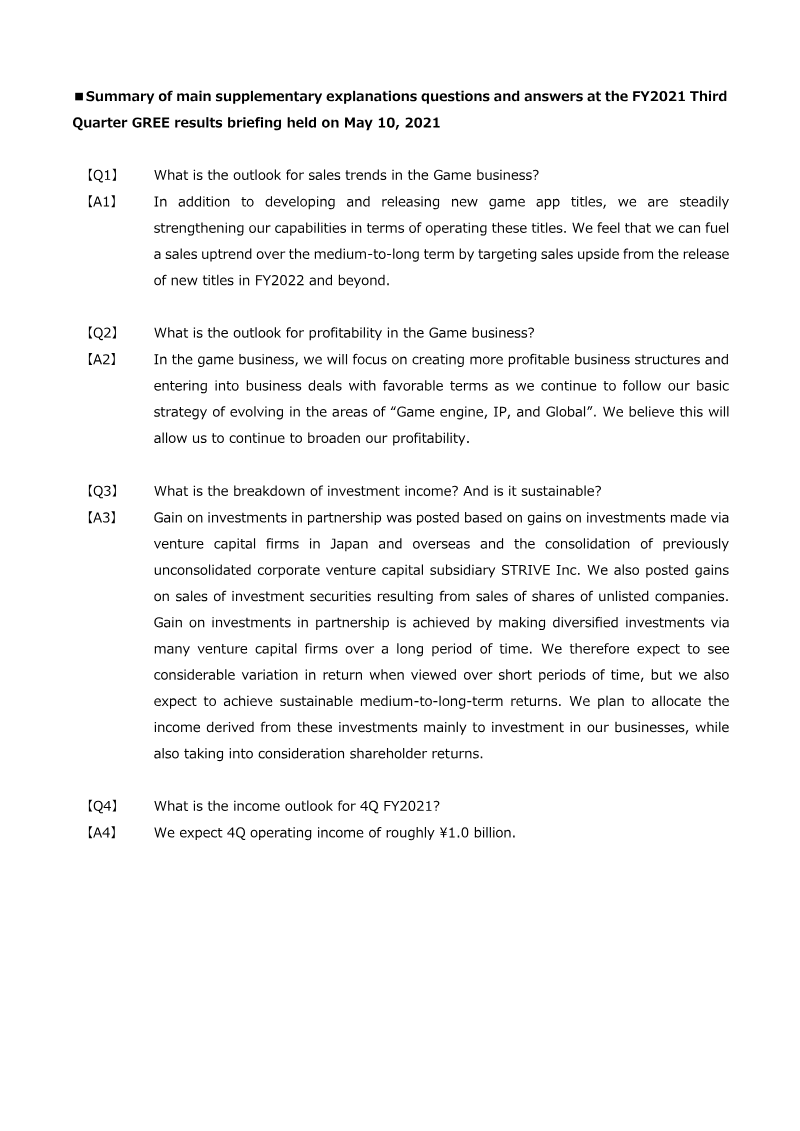
Summary of Main Supplementary Explanations Questions and Answers: FY2021 Third Quarter GREE Results Briefing
The briefing outlines GREE’s strategic outlook for the remainder of FY2021 and beyond, focusing on its core Game business, profitability trajectory, investment income sustainability, and short‑term financial expectations. GREE anticipates a medium‑to‑long‑term sales uptrend driven by the release of new game titles in FY2022 and subsequent years, while simultaneously strengthening operational capabilities for existing titles. Profitability is expected to broaden through the creation of more profitable business structures and favorable contractual terms, aligned with a strategy centered on Game engine development, intellectual property acquisition, and global expansion.
Investment income derives primarily from gains on venture‑capital partnerships in Japan and overseas, as well as the consolidation of previously unconsolidated subsidiary STRIVE Inc. The company notes that short‑term returns may fluctuate due to diversified investment portfolios, but medium‑to‑long‑term sustainability is projected. Planned allocation of these gains targets reinvestment in core businesses and shareholder returns.
Financially, GREE projects operating income for the fourth quarter of FY2021 at approximately ¥1.0 billion, reflecting confidence in its current revenue streams and cost management. The briefing covers Japan’s domestic market with implications for global expansion, covering the period up to FY2021 and projecting into FY2022. Methodological details are limited, but the focus remains on strategic investment, operational efficiency, and incremental revenue growth.
- GREE projects operating income for the fourth quarter of FY2021 to reach approximately ¥1.0 billion.
- The company anticipates a medium-to-long-term sales uptrend driven by a pipeline of new game titles scheduled for release in FY2022 and beyond.
- Strategic growth initiatives focus on game engine development, intellectual property acquisition, and global market expansion.
- Investment income is bolstered by gains from venture-capital partnerships and the consolidation of the subsidiary STRIVE Inc.
- Profitability improvements are being pursued through the restructuring of business models and the negotiation of more favorable contractual terms.
+3
GREE
Report2 pages
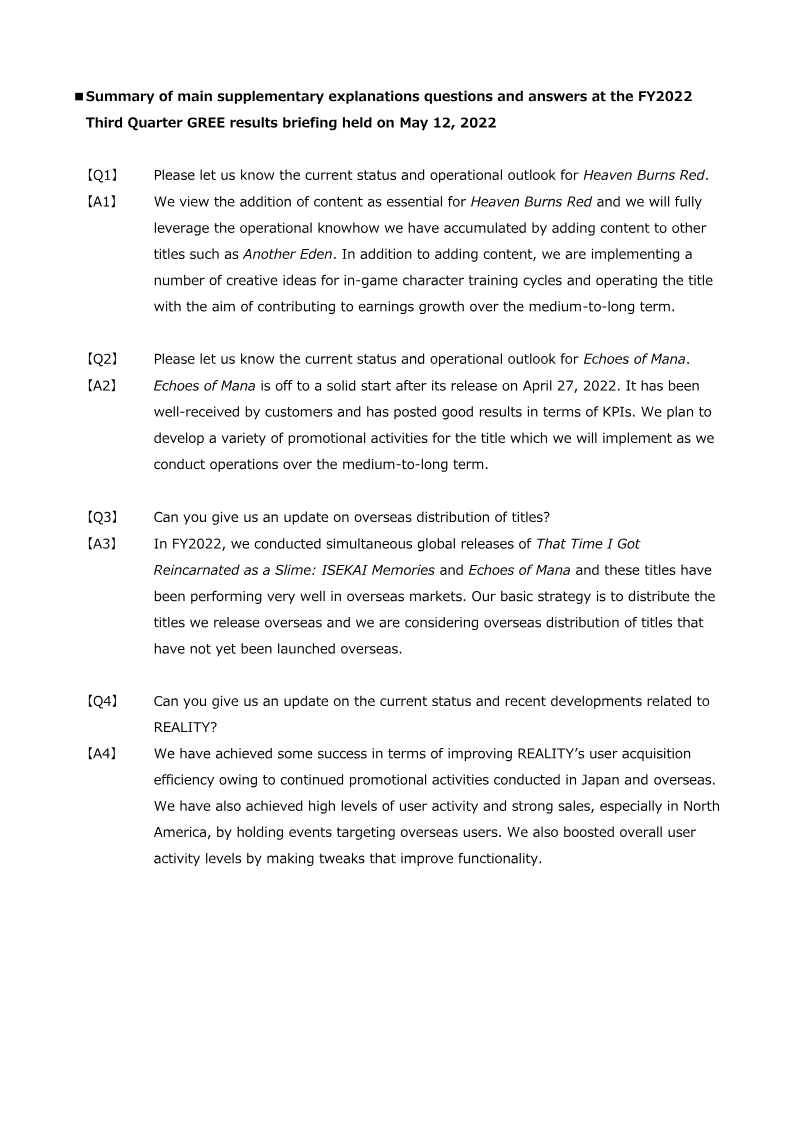
Summary of Main Supplementary Explanations Questions and Answers: FY2022 Third Quarter GREE Results Briefing
The briefing clarifies GREE’s operational status and financial outlook for FY2022 third quarter, focusing on game releases, overseas distribution, user acquisition, and investment performance. Heaven Burns Red is positioned as a long‑term growth engine; the company plans to add content and implement creative training cycles, leveraging experience from titles like Another Eden. Echoes of Mana, launched April 27, 2022, has already met key performance indicators and will receive ongoing promotional support. Simultaneous global releases of That Time I Got Reincarnated as a Slime: ISEKAI Memories and Echoes of Mana have performed strongly overseas, prompting consideration of further international launches for other titles.
User acquisition and engagement for the mobile title REALITY have improved through sustained promotional activities in Japan and abroad, with notable success in North America via targeted events and functional enhancements. Financially, the company experienced a cumulative loss for the third quarter; this is attributed to a decline in the Investment and Incubation Business relative to FY2021, despite steady growth in Internet and Entertainment operations driven by new hit titles. The Investment segment’s volatility over short periods is noted as a contributing factor.
Looking ahead to the fourth quarter, GREE projects operating income in the Internet and Entertainment Business between ¥2.5 billion and just under ¥3.0 billion, assuming continued strong sales of Heaven Burns Red and stable market trends for new releases. The outlook remains contingent on title performance dynamics.
- GREE projects Q4 operating income for its Internet and Entertainment Business to reach between ¥2.5 billion and just under ¥3.0 billion, driven by the performance of new titles.
- The company reported a cumulative loss for Q3 FY2022, primarily due to volatility and a year-over-year decline in the Investment and Incubation Business.
- Heaven Burns Red is being managed as a long-term growth engine, with the company applying operational experience from Another Eden to implement new content and training cycles.
- Simultaneous global releases of That Time I Got Reincarnated as a Slime: ISEKAI Memories and Echoes of Mana (launched April 27, 2022) have performed strongly, prompting plans for further international title launches.
- The mobile platform REALITY has seen improved user acquisition and engagement, particularly in North America, following targeted events and functional enhancements.
+2
GREE
Report3 pages
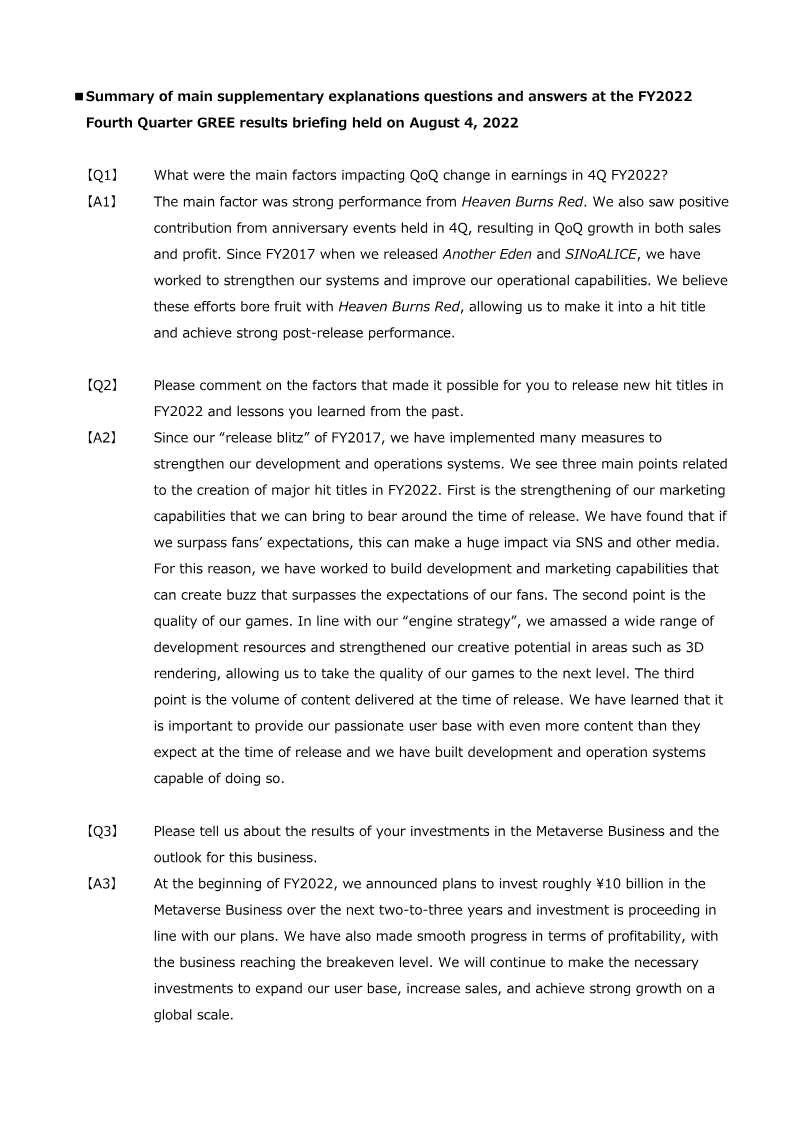
Summary of main supplementary explanations questions and answers at the FY2022 Fourth Quarter GREE results briefing held on August 4, 2022
The briefing focused on GREE’s financial performance and strategic initiatives for FY2022, highlighting the strong contribution of new titles such as Heaven Burns Red and anniversary events to quarter‑over‑quarter earnings growth. The company attributed this success to a “release blitz” strategy launched in FY2017, which has since strengthened marketing, game quality through an engine‑centric approach, and content volume at launch. These measures have enabled the company to exceed fan expectations, generate significant social media buzz, and deliver high‑quality 3D rendering.
Investment in the Metaverse Business is progressing as planned, with a ¥10 billion allocation over two to three years and the business reaching breakeven. GREE intends to continue expanding its global user base and sales through further investment. The DX Business is being restructured to integrate marketing support services, creating a data‑driven platform that offers comprehensive digital transformation solutions to corporate clients. Meanwhile, the Manga Business is introduced as part of a broader media diversification strategy aimed at leveraging first‑party IP across games, anime, and manga to broaden user engagement channels.
The Investment and Incubation Business is expected to provide stable medium‑to‑long‑term earnings, with a target return on investment of 10 % or higher. For FY2023 Q1, operating income in the Internet and Entertainment segment is projected at ¥1.0–¥1.5 billion, reflecting a decline from the strong performance of new titles and anniversary events in FY2022 while anticipating continued system‑strengthening investments.
- GREE’s FY2022 Q4 earnings growth was driven by the successful launch of Heaven Burns Red and high-performing anniversary events, validating a 'release blitz' strategy focused on high-quality 3D rendering and marketing.
- The company has allocated ¥10 billion over two to three years to its Metaverse business, which has currently reached a breakeven point as it seeks to expand its global user base.
- Operating income for the Internet and Entertainment segment is projected to decline to ¥1.0–¥1.5 billion in FY2023 Q1, reflecting a normalization after the peak performance of new titles in FY2022 and ongoing system investments.
- The Investment and Incubation business is positioned for medium-to-long-term stability with a target return on investment of 10% or higher.
- GREE is diversifying its media strategy by leveraging first-party IP across games, anime, and manga to increase user engagement channels.
+2
GREE
Report2 pages
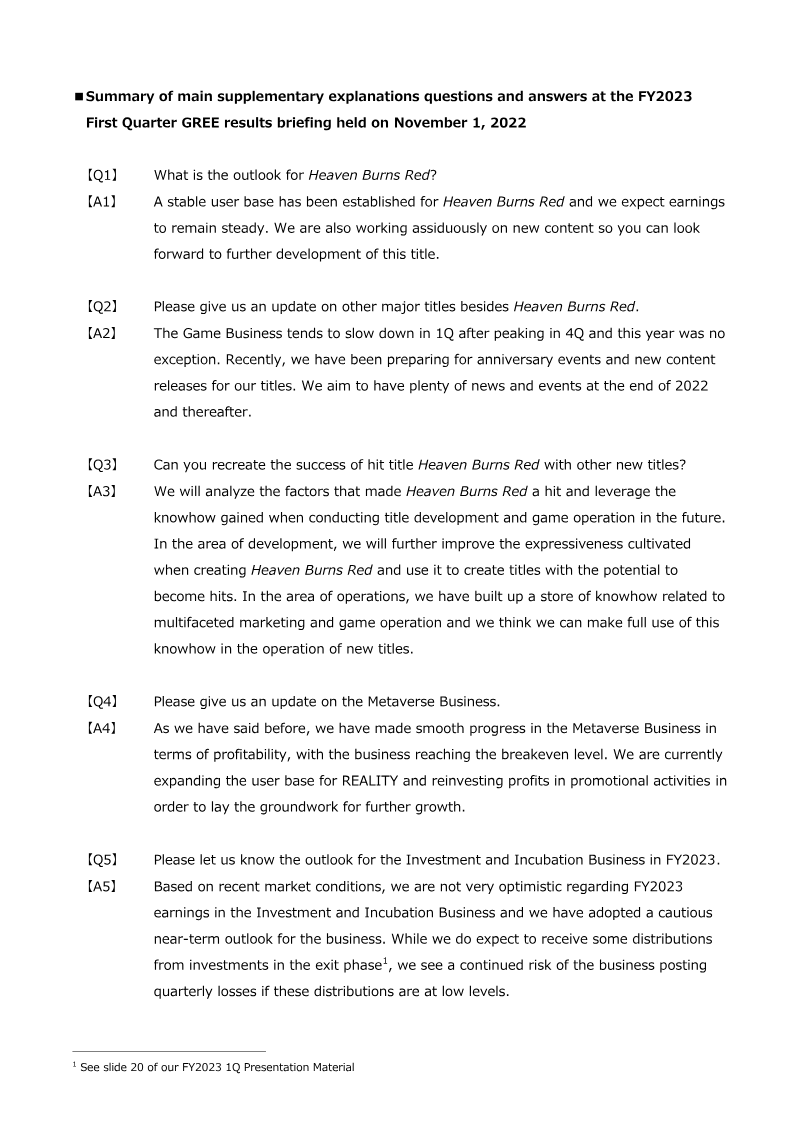
Summary of Main Supplementary Explanations Questions and Answers: FY2023 First Quarter GREE Results Briefing
The briefing outlines GREE’s strategic outlook and performance expectations for FY2023, focusing on its core gaming, metaverse, and investment activities. The company reports a stable user base for the flagship title “Heaven Burns Red,” anticipating steady earnings while continuing to develop new content. Other major titles are expected to experience a typical first‑quarter slowdown after a fourth‑quarter peak, with the company preparing anniversary events and content releases to sustain engagement through late 2022 and beyond.
GREE plans to replicate the success of “Heaven Burns Red” by applying lessons learned in development and operations to future titles, emphasizing expressive design and multifaceted marketing know‑how. In the metaverse segment, profitability has reached breakeven; the firm is expanding its user base for REALITY and reinvesting profits into promotional activities to support further growth.
The investment and incubation arm faces a cautious outlook for FY2023, with potential quarterly losses if exit distributions remain low despite some expected payouts. For the Internet and Entertainment Business, operating income for Q2 FY2023 is projected between ¥1.0 billion and ¥1.5 billion, reflecting moderate growth expectations amid market uncertainties.
Overall, GREE’s strategy centers on leveraging proven game development expertise, expanding metaverse user engagement, and managing investment risks while targeting modest income growth in its entertainment portfolio.
- GREE projects operating income for the Internet and Entertainment Business to reach between ¥1.0 billion and ¥1.5 billion in Q2 FY2023.
- The flagship title 'Heaven Burns Red' maintains a stable user base, with the company leveraging its development and marketing lessons from this game to inform future title releases.
- The metaverse segment, anchored by the platform REALITY, has reached a breakeven point and is currently reinvesting profits into promotional activities to scale its user base.
- Major game titles are expected to face a typical Q1 seasonal slowdown following a Q4 peak, with management planning anniversary events and content updates to drive engagement through late 2022.
- The investment and incubation arm faces a cautious outlook for FY2023, with the potential for quarterly losses if exit distributions remain low.
+2
GREE
Report2 pages
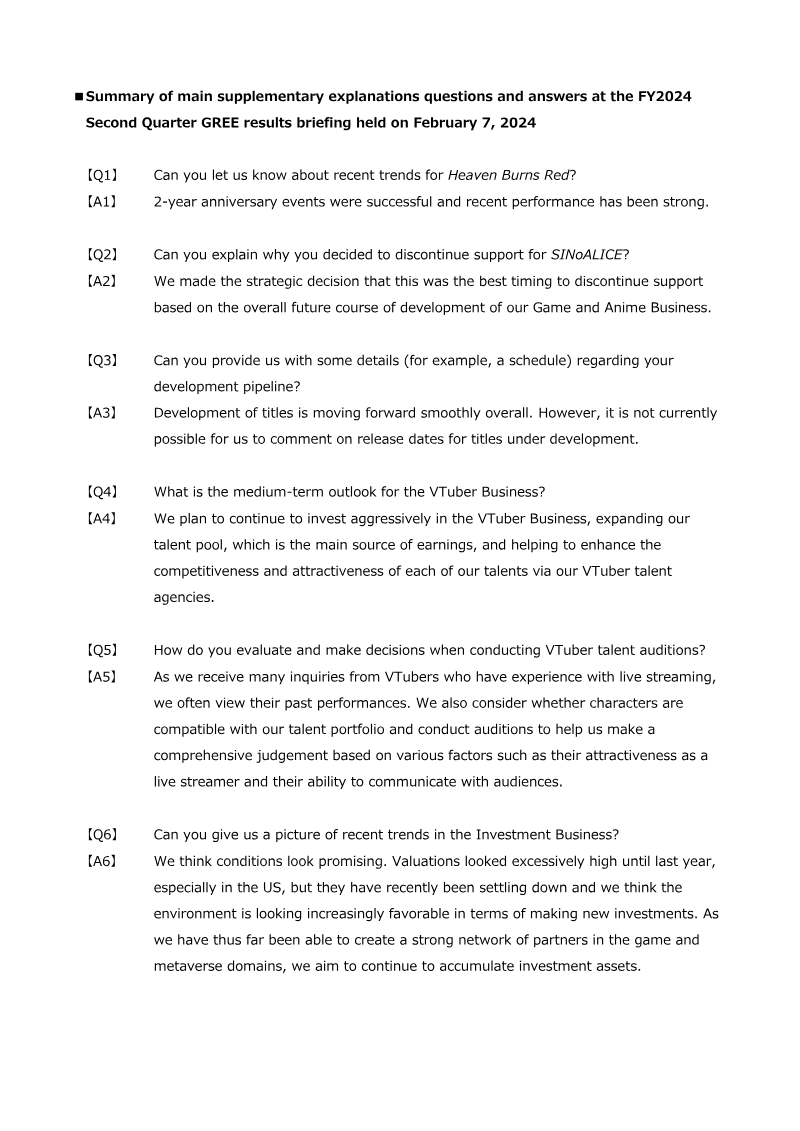
Summary of Main Supplementary Explanations Questions and Answers: FY2024 Second Quarter
The briefing clarified GREE’s strategic priorities and financial outlook for the second quarter of FY2024. Recent events for Heaven Burns Red celebrated its two‑year anniversary, generating strong performance and reinforcing the company’s focus on successful titles. The decision to discontinue support for SINoALICE was framed as a timing choice aligned with the broader development trajectory of GREE’s Game and Anime Business, indicating a shift toward more promising projects.
Development activities continue to progress smoothly, though specific release dates remain undisclosed. In the VTuber segment, GREE plans aggressive investment to expand its talent pool and enhance competitiveness through its talent agencies. Talent auditions are evaluated on past streaming performance, character fit with the existing portfolio, and audience engagement capabilities.
Investment business conditions are described as improving; after a period of inflated valuations—particularly in the United States—market values have stabilized, creating a favorable environment for new investments. GREE’s established network in gaming and metaverse sectors positions it to accumulate additional investment assets.
Financial projections for the third quarter exclude the Investment Business, estimating consolidated operating income of approximately ¥1.5 billion. For the full fiscal year FY2024, the company forecasts consolidated operating income of roughly ¥5.0 billion under the same exclusion. These figures suggest a steady growth trajectory driven by core gaming, anime, and VTuber operations while maintaining a cautious stance on investment activities.
- GREE forecasts consolidated operating income of approximately ¥1.5 billion for Q3 and ¥5.0 billion for the full fiscal year FY2024, excluding the Investment Business.
- The company is shifting its Game and Anime Business strategy by discontinuing support for SINoALICE to prioritize more promising development projects.
- Heaven Burns Red remains a core performance driver, with its two-year anniversary events contributing to strong financial results.
- GREE is aggressively increasing investment in its VTuber segment to expand its talent pool and improve competitiveness through its talent agencies.
- Market conditions for the Investment Business have stabilized following a period of inflated valuations in the United States, prompting GREE to seek new investment assets.
+3
GREE
Report3 pages
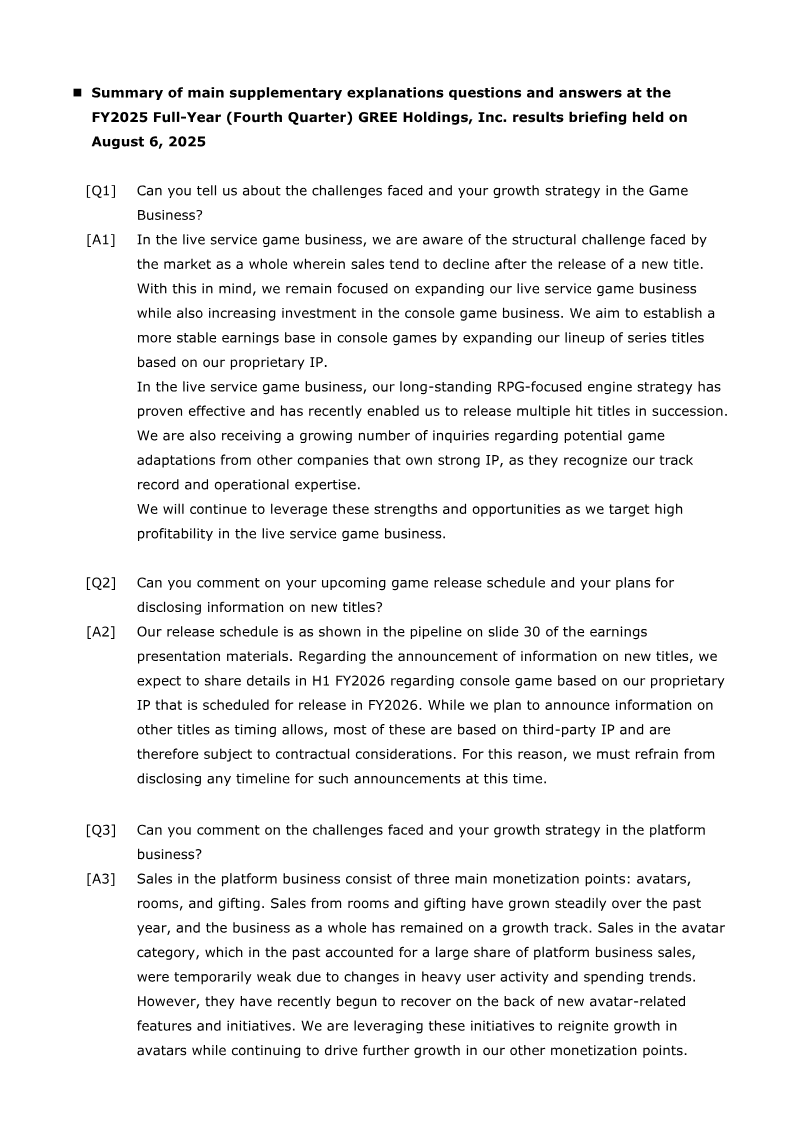
Summary of Main Supplementary Explanations Questions and Answers: FY2025 Full-Year Results
GREE Holdings outlines its FY2025 full‑year results and forward strategy across several business segments. In the game division, the company acknowledges the typical post‑launch decline in live‑service titles and counters it by expanding both its live‑service portfolio—leveraging a proven RPG engine—and investing in console games built on proprietary IP to create a steadier earnings base. The company reports multiple recent hit releases and anticipates further inquiries for third‑party IP adaptations, positioning itself to capture high profitability in the live‑service arena.
The platform business remains growth‑oriented, with steady increases in room and gifting revenue offsetting a temporary dip in avatar sales. New avatar features are expected to revive this segment, while the company continues to push other monetization channels. In the VTuber sector, GREE pursues a two‑stage growth model: first expanding its talent roster—now about 90 talents—and then boosting sales per talent through diversified merchandise channels and nascent live‑event advertising. Sales per talent have doubled since FY2024, and the company maintains a balanced portfolio to avoid over‑reliance on any single talent.
The DX business is undergoing a structural shift from one‑time project sales to recurring revenue, with modest growth projected through FY2026 as the transition completes. Investment activities in FY2026 will see increased volatility due to fund maturity and potential impairment, yet the company expects stable income streams from dividends and performance fees. Overall, GREE projects balanced returns while navigating market challenges across its diversified entertainment portfolio.
- GREE is shifting its game division strategy to balance post-launch live-service volatility by investing in console titles built on proprietary IP.
- The VTuber business has doubled sales per talent since FY2024, supported by a roster of approximately 90 talents and expanded merchandise and advertising channels.
- The DX business is transitioning from a one-time project sales model to a recurring revenue structure, with modest growth expected through FY2026.
- Platform revenue growth is currently driven by room and gifting monetization, which is offsetting a temporary decline in avatar sales.
- Investment activities in FY2026 are expected to experience increased volatility due to fund maturity and potential impairments, though stable income from dividends and performance fees is anticipated.
+4
GREE

Report15 pages
Q3 2022 Earnings Call: Stillfront Group AB
Stillfront Group AB<sub>(</sub>SF.SE ) Stillfront Group AB<sub>(</sub>SF.SE) Corrected Transcript Q3 2022 Earnings Call 26-Oct-2022 Chief Executive Officer, Stillfront Group AB ChiefFinancial Officer, Stillfront Group AB ..........................................................................................................................................................................................
- Stillfront Group AB's Q3 2022 earnings show a strong cash flow generation of almost SEK 500 million after net working capital adjustments, enabling continued investment in their portfolio and platform.
- The company's active portfolio consists of 77 games, with mobile games accounting for 77% of the share and ad bookings making up 14% of revenues. Casual & Mash-up games represent 43% of revenues, and Strategy games 35%.
- Stillfront Group AB invested SEK 257 million in new products and their platform, representing 14.4% of their revenues, and settled SEK 290 million in 2021 cash earn-outs this quarter, with no further 2021 earn-outs remaining.
- The company achieved growth with less User Acquisition (UA) spend by leveraging live operations (live ops) and expects increased synergies from live ops across its diversified studio and game teams.
- Stillfront Group AB reported a stable uplift in Daily Active Users (DAU), Monthly Active Users (MAU), and Monthly Paying Users (MPU) year-over-year, driven by acquisitions and strong performance in Strategy games.
+2
Stillfront

Report57 pages
How to Build an Effective Offer System in Your Game
A well‑designed in‑game offer system is presented as the most potent driver of lifetime value and average revenue per paying user. By integrating a limited set of synergistic offer types—login bonuses, triggered prompts, endless streams, “1 + X” bundles, battle‑passes, stamp‑cards, and curated bundles—and optimizing their frequency, timing, pricing, segmentation, and economic balance, developers can achieve conversion rates as high as ninety‑six percent on login offers and lift repeat‑purchase value by roughly twenty percent through endless offers.
Conversion is shown to be a function of repeated exposure rather than a single impression; players typically require about seven viewings before taking action. The most effective moments to surface offers are at login, during “out‑of‑currency” events, after level failures, or in high‑momentum gameplay phases. A dynamic, tiered pricing ladder that escalates after each purchase and regresses after periods of inactivity—exemplified by a seven‑tier structure ranging from under one dollar to ninety‑nine dollars—enables precise alignment with player spend propensity while avoiding both under‑monetization of high‑potential users and alienation of low‑spenders.
Segmentation must extend beyond basic recency and frequency metrics to incorporate geographic tier, acquisition source quality, and player progression. Lower‑tier regions demand adjusted price ladders and reduced offer frequency, whereas high‑quality acquisition channels justify more complex bundles. Early‑game players respond best to inexpensive, simple offers, while mid‑ and late‑game users can be presented with higher‑value packages. Anchoring the entire shop around a stable, low‑priced entry pack establishes a reference point that shapes perceived value across all offers.
Collectively, these principles apply to mobile and casual games operating globally, reflecting current industry practices and data from recent case studies. Implementing the outlined framework promises measurable improvements in monetization efficiency, player satisfaction, and overall revenue performance.
- A tiered pricing ladder ranging from under $1 to $99, which escalates after purchases and regresses during inactivity, allows for precise alignment with individual player spend propensity.
- Conversion is driven by repeated exposure, with players typically requiring seven viewings of an offer before completing a purchase.
- Strategic implementation of a limited set of offer types can drive conversion rates as high as 96% on login offers and increase repeat-purchase value by approximately 20% through endless offers.
- Effective offer surfacing relies on high-intent moments, specifically at login, during out-of-currency events, after level failures, or during high-momentum gameplay.
- Player segmentation must incorporate geographic tier, acquisition source quality, and progression stage to adjust price ladders and offer frequency for different user profiles.
+2
Sensor TowerJan 2026
Report60 pages
Global LiveOps Trends 2025
The global mobile gaming landscape in 2025 is characterized by a notable deceleration in overall market growth, with revenue increases stalling at 0.7% and download growth slowing to 4.1%. In response to this stagnation, developers are intensifying LiveOps strategies to sustain engagement and monetization. The average number of monthly events per game has risen to 89, shifting away from traditional holiday-centric scheduling toward persistent, competitive mechanics such as Win Streaks, Leaderboards, and various collection-based systems. This strategic pivot reflects a broader industry effort to maximize the lifetime value of existing player bases, particularly within the Midcore and Hybridcasual segments.
Genre performance is undergoing a significant realignment, as Puzzle and Strategy titles experience growth while RPG and Shooter categories face substantial declines. Midcore titles remain the primary drivers of revenue, relying on cooperative events and targeted monetization of high-spending players to maintain stability. Simultaneously, the Hybridcasual sector has emerged as a high-growth area, recording a 75% year-over-year revenue increase despite stagnant download figures. This success is largely attributed to the integration of Casual-style mechanics, such as Digging and Expedition events, which effectively boost session length and ad-based monetization.
The industry is currently defined by a move toward greater mechanical complexity and event density. By adopting diverse features like Stamp-based systems and Core Duplicates, developers are successfully diversifying their monetization strategies across different player archetypes. While Midcore games continue to prioritize whale-focused cooperative events, Hybridcasual titles are increasingly leveraging competitive, short-term engagement loops to drive performance. Ultimately, the 2025 market environment demonstrates that sustained success is no longer dependent on rapid user acquisition, but rather on the sophisticated, data-driven application of LiveOps to deepen engagement within established gaming ecosystems.
- The global mobile gaming market has stagnated, with revenue growth slowing to 0.7% and download growth to 4.1%, forcing a shift toward maximizing the lifetime value of existing players.
- Hybridcasual games have emerged as a high-growth sector, recording a 75% year-over-year revenue increase despite flat download numbers.
- LiveOps strategy has shifted toward high-frequency engagement, with the average number of monthly events per game rising to 89.
- Developers are moving away from holiday-centric calendars in favor of persistent, competitive mechanics like Win Streaks, Leaderboards, and collection-based systems.
- Genre performance is realigning, with Puzzle and Strategy titles showing growth while RPG and Shooter categories face substantial declines.
+3
AppMagicJan 2025

Report47 pages
How to Prepare Your Live Ops for the Holiday Season
A well‑designed Live Ops strategy is essential for capitalising on the heightened player activity that occurs during the holiday period. Analysis of hundreds of mobile games worldwide demonstrates that a coherent Live Ops framework can produce a substantial uplift in sessions, revenue and player retention throughout the season. The core argument is that developers should treat the holidays as a series of tightly integrated, short‑term experiences that reinforce the game’s everyday loop while delivering clear, time‑bound incentives.
Short‑term events that run for one to three days are most effective for generating quick spikes in engagement. These events focus on immediate objectives—such as a burst of sessions, a specific resource collection, or a limited‑time reward—while employing a “soft‑sawtooth” difficulty curve that eases players in, ramps up challenge, offers a brief respite, and then escalates again. By keeping the event mechanics a natural extension of the main gameplay loop, developers avoid disrupting player expectations and maintain momentum.
For the broader holiday window, the most successful structures combine a single, clearly defined Battle‑Pass progression path with social‑cooperation events that reward group performance through prestige items like avatars, badges and leaderboard positions. Layering weekly quests, long‑term collection albums, and brief “bonus amplifier” events creates cumulative engagement loops. Linking these components through shared currencies and diversified motivations systematically drives both retention and monetisation, particularly for mature titles that benefit from community‑driven competition.
Overall, the guidance applies to the global mobile gaming sector during the Q4 holiday season and emphasizes that incremental, interconnected events—anchored by transparent progression and social incentives—are the key levers for maximising holiday‑season performance.
- Implement a series of short-term, 1-to-3-day events to generate immediate spikes in player engagement and session frequency.
- Structure holiday content as a 'soft-sawtooth' difficulty curve that alternates between periods of challenge and respite to maintain player momentum.
- Integrate holiday events directly into the core gameplay loop to ensure they feel like natural extensions of the existing experience rather than disruptive additions.
- Combine a single, clear Battle-Pass progression path with social-cooperation events to drive both retention and monetization through group-based prestige rewards.
- Layer weekly quests, long-term collection albums, and brief 'bonus amplifier' events to create cumulative engagement loops.
+2
Sensor TowerJan 2025
Report40 pages
2024 Casual Gaming Apps Report
The global casual gaming market entered a period of recovery between April 2023 and April 2024, characterized by rebounding consumer spend despite a slowdown in total downloads. This shift is defined by a strategic migration from hyper-casual titles toward more complex hybrid-casual and 3D match models. User acquisition remains highly bifurcated by platform; iOS costs average $4.83 per install compared to just $0.65 on Android, though iOS continues to deliver a superior Day 7 return on ad spend. North America remains the most expensive and lucrative geographic region, while simulation games have emerged as the most cost-effective genre for acquisition.
Casual games function as a critical ecosystem driver, generating 91% of their own installs and significantly influencing mid-core titles. Puzzle subgenres, particularly Match3 and Mahjong Solitaire, now command 37% of casual installs, while the 3D Match category has seen explosive growth, increasing its US iOS market share fivefold in a single year. To sustain this growth, market leaders are increasingly relying on sophisticated LiveOps and social mechanics. Successful strategies include collaborative partner events, social win streaks, and "digging" minigames, all of which leverage group competition to drive engagement and baseline revenue.
Monetization strategies have evolved toward player choice and direct-to-consumer models. Progressive offers and "pick-one" bundles are now standard in 70% of top-performing US casual games, providing structured value through tiered rewards. Furthermore, developers are aggressively adopting engagement-linked offers and external web stores. By linking premium rewards to gameplay tasks and moving transactions to proprietary web platforms, developers are successfully bypassing traditional app store fees while fostering long-term player loyalty through exclusive digital storefronts and daily login incentives.
- The casual gaming market is shifting from hyper-casual titles toward hybrid-casual and 3D match models, with 3D Match category market share on US iOS increasing fivefold between April 2023 and April 2024.
- Developers are increasingly bypassing app store fees by adopting proprietary web stores and engagement-linked offers, a strategy now utilized by 70% of top-performing US casual games.
- User acquisition costs are highly bifurcated, with iOS installs averaging $4.83 compared to $0.65 on Android, though iOS maintains a superior Day 7 return on ad spend.
- Puzzle subgenres, specifically Match3 and Mahjong Solitaire, currently dominate the market by commanding 37% of all casual gaming installs.
- Simulation games have emerged as the most cost-effective genre for user acquisition, while casual games overall generate 91% of their own installs.
+3
LiftoffApr 2024
Report14 pages
The True Cost of Building a Mobile Game Backend
This analysis examines the financial and operational costs associated with developing in-house backend technology for mobile games. The primary thesis suggests that while third-party game engines have become industry standards, backend infrastructure is currently undergoing a similar shift as the technical demands of live-service games outpace the practicality of internal development.
The findings are based on a survey of 125 C-level executives and tech leads at US-based mobile game studios with at least 50 employees, conducted in April 2024. Data indicates that the average leading US studio employs 52 developers for 36 months to build and maintain an internal backend. With an average annual salary of $138,864 per developer, the direct financial investment for a custom backend is estimated at approximately $21.6 million. The research notes that strategy and shooter genres are most likely to require these complex systems, while hypercasual games are increasingly adopting them to support "hybridcasual" live-ops models.
Beyond direct costs, the analysis identifies significant "hidden" human and operational tolls. Approximately 50% of surveyed studios reported that diverting gameplay programmers to backend tasks slowed overall game development. Furthermore, one-third of respondents experienced higher employee turnover and increased "crunch" periods, while 20% reported direct revenue loss. The study concludes that the decision to build internal tech often results in negative knock-on effects across departments, suggesting that third-party solutions offer a more sustainable path for scaling live-service titles without sacrificing personnel well-being or development velocity.
- Building an in-house mobile game backend costs an average of $21.6 million, requiring 52 developers working over a 36-month period.
- Diverting gameplay programmers to backend infrastructure tasks slows overall development velocity for 50% of surveyed studios.
- Internal backend development contributes to negative organizational outcomes, including increased employee turnover, higher rates of crunch, and direct revenue loss for 20% of studios.
- The technical demands of live-service games are driving a shift toward third-party backend solutions, mirroring the industry-wide adoption of third-party game engines.
- While strategy and shooter genres have the highest requirement for complex backend systems, the rise of 'hybridcasual' models is expanding this need to the hypercasual sector.
+2
MetaplayMar 2024
Report24 pages
Mobile Gaming Benchmarks: Q1 2024
The Q1 2024 mobile gaming benchmarks provide a comprehensive analysis of player engagement metrics, specifically retention rates, session lengths, and session counts across 15 game genres. The analysis is based on data from over 10,000 games utilizing the GameAnalytics platform, representing 1.67 billion monthly active users across North America, Europe, the Middle East, and Asia. The primary objective is to offer developers a standardized framework to evaluate game performance, identify areas for optimization, and refine mechanics to improve long-term player retention and engagement.
Key findings indicate that global median retention rates for the first quarter of 2024 were 22.91% for Day 1, 4.20% for Day 7, and 0.85% for Day 28. Classic games—encompassing board, card, casino, and trivia titles—consistently outperformed other genres across most regions and metrics. While North America and Europe generally exhibit higher retention averages, the Middle East shows a distinct preference for classic games, which achieve their highest regional performance there. Puzzle games also demonstrate notable stability, maintaining consistent engagement metrics across all monitored territories.
Regarding session behavior, the global median session length is 4.45 minutes, with most genres averaging 4 to 5 sessions per day. Europe leads in session duration, while the Middle East records the highest frequency of daily sessions, particularly within the puzzle and word genres. The analysis suggests that session length and frequency are highly correlated with game pacing and social features. To optimize these metrics, the findings recommend a data-driven approach involving A/B testing, funnel analysis, and the implementation of LiveOps to adapt to player behavior in real-time.
- Global median retention rates for Q1 2024 were 22.91% for Day 1, 4.20% for Day 7, and 0.85% for Day 28.
- Classic games, including board, card, casino, and trivia titles, consistently outperformed all other genres across most regions and metrics.
- The global median session length is 4.45 minutes, with most genres averaging between 4 and 5 sessions per day.
- The Middle East records the highest frequency of daily sessions globally, particularly within the puzzle and word genres.
- Europe leads all regions in average session duration, while North America and Europe generally exhibit higher retention averages than other territories.
+2
GameAnalyticsJan 2024
Report24 pages
Mobile Gaming Benchmarks for Q1 2024
The benchmark study presents a comprehensive snapshot of mobile gaming performance during Q1 2024, focusing on key engagement metrics—retention, session length, and session count—across North America, Europe, the Middle East, and Asia. Data derive from over 10 000 games tracked by GameAnalytics, with each title typically released in at least three regions, yielding a combined monthly active user base of approximately 1.67 billion.
Retention figures reveal that the global median day‑1 retention stands at 22.91 %, day‑7 at 4.20 %, and day‑28 at 0.85 %. Classic games (board, card, casino, trivia, word) dominate retention performance, especially in the Middle East where they lead all regions. Casual and mid‑core titles lag behind, with puzzle games maintaining stable but lower retention across all markets.
Session length analysis shows a global median of 4.45 minutes, with casino and card games achieving the longest sessions in North America (≈20 min) and Europe (card games exceeding 25 min). In the Middle East, casino titles surpass 15 minutes, while Asia’s top casino games reach nearly 23 minutes. Session count averages range from 3–5 daily sessions per game, with puzzle and word games in the Middle East achieving the highest counts (≈10 sessions/day).
Methodologically, metrics are reported in quantiles—top 25 %, median, and bottom 25 %—to illustrate performance across the spectrum of developers. The report underscores that high retention, longer session lengths, and frequent session counts correlate with stronger player engagement, offering actionable insights for studios aiming to benchmark against industry leaders.
- Global median retention rates for Q1 2024 are 22.91% for day-1, 4.20% for day-7, and 0.85% for day-28.
- Classic genre titles, including board, card, casino, trivia, and word games, consistently outperform casual and mid-core titles in retention metrics across all tracked regions.
- The global median session length is 4.45 minutes, though casino and card games significantly exceed this, reaching up to 25 minutes in European markets.
- Daily session frequency typically ranges from 3 to 5 sessions, with puzzle and word games in the Middle East achieving a peak performance of approximately 10 sessions per day.
- The Middle East region shows a distinct preference for classic games, which lead retention performance in that market compared to other global regions.
+1
GameAnalyticsJan 2024