Report87 pages
Libro Blanco del Desarrollo Español de Videojuegos 2025
The Spanish video game industry stands at a critical juncture, characterized by resilience and creative output despite a global climate of economic instability. As of 2024, the sector generated €1,464 million in turnover and sustained over 10,500 direct jobs, with Catalonia and Madrid serving as the primary hubs for development. While the industry maintains a stable core—with 72% of studios operating for over five years—it faces a notable slowdown in growth. Currently, 820 active studios operate within the country, yet approximately 200 of these entities remain at risk of closure due to project cancellations and workforce reductions, reflecting a broader vulnerability to international market volatility.
Structural challenges persist, particularly regarding the industry's reliance on self-financing and self-publishing models. Most studios operate on a small scale, often managing only one project at a time, which complicates the transition toward complex "games as a service" models. While 53% of companies have begun integrating generative artificial intelligence into their workflows, adoption remains cautious and technically experimental. Furthermore, the industry continues to depend heavily on international sales, which account for 52% of revenue, highlighting a need for stronger domestic investment ecosystems and more robust collaboration with international platforms to retain intellectual property within Spain.
To ensure long-term competitiveness, the sector requires a strategic shift toward institutional support. Key priorities include the implementation of targeted tax incentives, the consolidation of public funding, and improved professional training programs to address the persistent shortage of experienced talent in programming and design. By fostering a more sustainable financial environment and bridging the gap between small-scale production and global market demands, the industry aims to transition from a fragmented landscape of small studios to a more scalable, technologically advanced, and strategically recognized pillar of the Spanish economy.
- The Spanish video game industry generated €1,464 million in turnover and supports over 10,500 direct jobs, with Catalonia and Madrid acting as the primary development hubs.
- Approximately 200 of the 820 active studios are currently at risk of closure due to project cancellations and workforce reductions, signaling significant vulnerability to international market volatility.
- While 72% of studios have been operational for over five years, the industry faces a growth slowdown and a structural reliance on self-financing and single-project development models.
- International sales account for 52% of total revenue, underscoring a critical need for stronger domestic investment and strategies to retain intellectual property within Spain.
- 53% of Spanish studios have begun integrating generative artificial intelligence into their workflows, though current adoption remains in an experimental and cautious phase.
+2
Asociación Española de Empresas Productoras y Desarrolladoras de Videojuegos
Report38 pages
Libro Blanco del Desarrollo Español de Videojuegos 2025
The Spanish video game industry serves as a critical engine for national innovation, currently comprising 820 studios that generate 1,464 million euros in annual revenue and employ over 10,500 professionals. Despite this robust footprint, the sector faces a period of significant volatility, with nearly half of all studios reporting negative impacts from the current economic climate, including project cancellations and workforce reductions. While the industry remains characterized by a highly educated, young workforce and a strong specialization in PC development via the Unity engine, the reliance on internal self-financing remains a structural vulnerability that hinders the scaling of larger, more sustainable AAA projects.
Human talent remains the primary driver of the industry, even as the integration of generative artificial intelligence becomes more prevalent. Although 53 percent of studios have adopted AI tools, widespread skepticism regarding their reliability persists, reinforcing the necessity of human expertise in programming and design. The industry is currently navigating a transition where the ease of hiring has improved, yet the demand for experienced, specialized talent remains unmet. To address these challenges, the sector is prioritizing the retention of intellectual property and economic value within Spain, aiming to shift away from a reliance on international operators toward a more self-sustaining national ecosystem.
Strategic efforts are now focused on securing legislative recognition to integrate game development into national audiovisual tax incentive programs. By fostering a coalition of developers, technology partners, and academic institutions, the industry is implementing a roadmap through 2026 that emphasizes international promotion and professional networking. These initiatives are designed to mitigate the current crisis by expanding public funding and creating a more favorable investment climate, ultimately ensuring that the Spanish gaming sector can compete effectively on the global stage while maintaining its long-term economic viability.
- The Spanish video game industry comprises 820 studios generating 1,464 million euros in annual revenue and employing over 10,500 professionals.
- Nearly 50% of studios report negative economic impacts, including project cancellations and workforce reductions, highlighting a vulnerability caused by a reliance on internal self-financing.
- The industry is lobbying for legislative changes to integrate game development into national audiovisual tax incentive programs to improve investment and long-term sustainability.
- While 53% of studios have adopted generative AI, widespread skepticism regarding tool reliability maintains a strong reliance on human expertise in programming and design.
- The sector is executing a strategic roadmap through 2026 focused on international promotion, professional networking, and retaining intellectual property within Spain.
+2
Asociación Española de Empresas Productoras y Desarrolladoras de Videojuegos
Report9 pages
Kodeks Dobrych Praktyk w Sprawie Stosowania Ratingu Gier Wideo: Polska
The Kodeks Dobrych Praktyk w Sprawie Stosowania Ratingu Gier Wideo (Code of Good Practice for Video Game Rating in Poland), established in November 2016 by the Stowarzyszenie Polskie Gry and the Indie Games Polska foundation, serves as a self-regulatory framework for the Polish video game industry. Its primary objective is to protect minors from exposure to inappropriate content by standardizing the information provided to consumers regarding age-appropriate game classifications. The code functions as an industry-wide commitment to transparency, ensuring that producers, publishers, and distributors clearly label games regardless of the platform or distribution method.
The framework establishes five distinct age-based categories—3+, 7+, 12+, 16+, and 18+—which align closely with the established Pan European Game Information (PEGI) system. These categories define acceptable levels of violence, language, sexual content, and fear-inducing elements. By adopting these standards, participating entities agree to provide clear, legible, and accessible age ratings on all digital and physical product packaging. The code emphasizes that responsibility for accurate labeling lies with the producers and publishers, who are required to assess the effectiveness of their rating practices at least every two years.
Enforcement of these standards is managed through an internal Sąd Koleżeński (Peer Court), which oversees compliance and adjudicates potential violations. While the code is a voluntary, industry-led initiative, it is designed to complement existing Polish consumer protection laws and European Union directives regarding the protection of minors in digital environments. By formalizing these ethical and professional norms, the industry aims to foster greater social trust and ensure that consumers, particularly parents, can make informed purchasing decisions. Entities that choose to adopt the code must formally register their commitment, and any false claims of adherence are subject to scrutiny under national regulations concerning unfair market practices.
- The Kodeks Dobrych Praktyk, established in November 2016 by Stowarzyszenie Polskie Gry and Indie Games Polska, serves as the self-regulatory framework for age-appropriate game labeling in Poland.
- The framework utilizes five age-based categories—3+, 7+, 12+, 16+, and 18+—which are aligned with the Pan European Game Information (PEGI) system to standardize content warnings for violence, language, sexual content, and fear.
- Producers and publishers hold the primary responsibility for accurate labeling and are required to assess the effectiveness of their rating practices at least every two years.
- Compliance and potential violations are managed through an internal Peer Court (Sąd Koleżeński), which oversees the industry-led initiative.
- While participation is voluntary, the code complements existing Polish consumer protection laws and EU directives, with false claims of adherence subject to scrutiny under national unfair market practice regulations.
Stowarzyszenie Polskie Gry
Report1 pages
Stowarzyszenie Polskie Gry: Member Overview
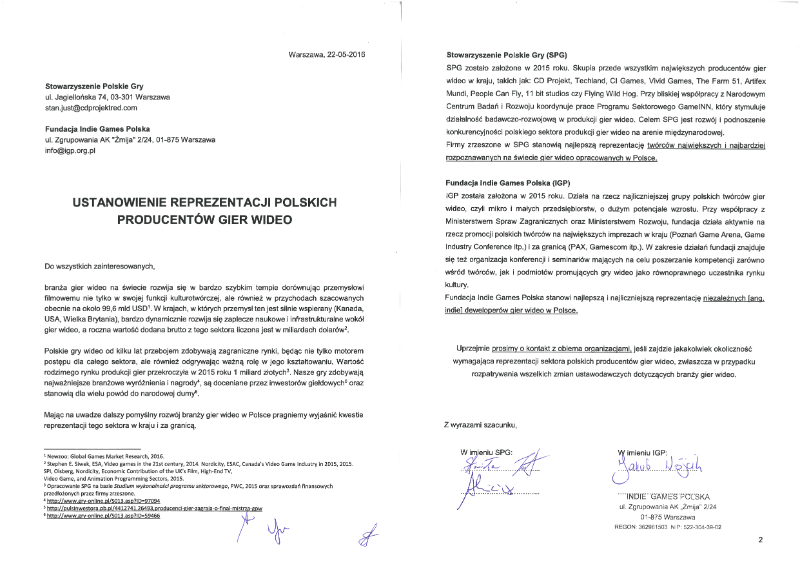
The Polish video game industry is represented by two primary organizations established in 2015: Stowarzyszenie Polskie Gry (SPG) and Fundacja Indie Games Polska (IGP). SPG focuses on the country’s largest developers, such as CD Projekt, Techland, and 11 bit studios, aiming to enhance the international competitiveness of the sector through research and development initiatives like the GameINN program. Conversely, IGP serves as the representative body for micro and small independent developers, focusing on promotional activities, industry networking, and professional development through conferences and seminars.
The sector has experienced significant growth, with the value of domestic game production exceeding 1 billion PLN in 2015. This expansion mirrors global trends, where the video game market has reached an estimated value of 99.6 billion USD, rivaling the film industry in both cultural impact and economic contribution. Countries that provide robust institutional support, such as Canada, the United States, and the United Kingdom, have successfully leveraged this industry to foster scientific and infrastructural development, resulting in billions of dollars in annual gross value added.
These organizations collectively advocate for the interests of Polish game developers, particularly regarding legislative changes and the need for a unified voice in national and international forums. By bridging the gap between large-scale commercial studios and independent creators, these entities seek to sustain the momentum of a sector that has become a source of national pride, attracting significant investor interest and earning prestigious global accolades. The collaborative efforts of SPG and IGP are intended to ensure the continued professionalization and strategic growth of the Polish gaming ecosystem.
- The Polish video game industry is supported by two primary organizations established in 2015: Stowarzyszenie Polskie Gry (SPG), representing major studios like CD Projekt, Techland, and 11 bit studios, and Fundacja Indie Games Polska (IGP), which supports micro and small independent developers.
- Domestic game production in Poland exceeded 1 billion PLN in value as of 2015.
- The global video game market has reached an estimated value of 99.6 billion USD, positioning it as a significant economic and cultural rival to the film industry.
- SPG focuses on enhancing international competitiveness through R&D initiatives such as the GameINN program, while IGP prioritizes networking, professional development, and promotional activities.
- Institutional support models from countries like Canada, the US, and the UK serve as benchmarks for Poland to leverage the gaming sector for scientific and infrastructural development.
Stowarzyszenie Polskie Gry
Report27 pages
Rovio Sustainability Report 2025
The Rovio Sustainability Report 2025 outlines the company’s voluntary environmental, social, and governance performance for the fiscal period spanning April 1, 2025, to March 31, 2026. As a subsidiary of SEGA SAMMY Holdings, Rovio utilizes this disclosure to maintain transparency and accountability regarding its sustainability strategy, which is structured around three core pillars: Positive Play, Empowered People, and Protecting our Planet. The report aligns partially with European Sustainability Reporting Standards, though it remains a voluntary exercise for the organization.
Key findings highlight a total carbon footprint of 20,980 tons of CO2e, with Scope 3 emissions accounting for 98.6% of the total. For the first time, the company included downstream emissions from initial game downloads in its accounting, which significantly improved coverage but precluded direct year-over-year comparisons. Operationally, Rovio maintains six global locations with 508 employees, reporting a gender pay gap of 1.4% when adjusted for location, level, and role. The company continues to prioritize industry collaboration, maintaining active memberships in the Playing for the Planet Alliance and the Sustainable Games Alliance to drive collective climate action.
Strategic conclusions emphasize a pragmatic approach to sustainability, acknowledging challenges in formalizing long-term emission reduction plans due to supply chain limitations and evolving market realities. While the company successfully implemented new internal "Rovio Way" principles and improved data tracking for career progression, it faced capacity constraints that delayed the rollout of certain accessibility scorecards and carbon pricing models. Looking ahead, the organization intends to focus on integrating AI sustainability frameworks, enhancing inclusive game design, and embedding its new corporate principles into daily operations to ensure long-term, sustainable growth across its transmedia and mobile gaming portfolio.
- Rovio reported a total carbon footprint of 20,980 tons of CO2e for the fiscal period ending March 31, 2026, with Scope 3 emissions representing 98.6% of that total.
- The company expanded its carbon accounting to include downstream emissions from initial game downloads, a change that improved data coverage but prevented direct year-over-year comparisons.
- Rovio maintains a workforce of 508 employees across six global locations and reports an adjusted gender pay gap of 1.4%.
- The organization is prioritizing industry collaboration through active memberships in the Playing for the Planet Alliance and the Sustainable Games Alliance to address climate action.
- Capacity constraints caused delays in the implementation of planned accessibility scorecards and internal carbon pricing models.
+3
Rovio

Report20 pages
Mobile Matters: The Impact of Mobile Games for Europe
The European mobile games sector functions as a critical pillar of the continent’s digital and creative economy, serving as a primary driver of both technological innovation and employment. By leveraging free-to-play models that democratize access to interactive entertainment, the industry has established a robust economic footprint, contributing €5.89 billion in Gross Value Added and supporting over 63,000 jobs as of 2025. This economic influence extends beyond direct financial output, as the sector fosters essential digital skills and advances developments in artificial intelligence, positioning Europe as a competitive global hub for creative talent.
The industry’s reach spans 32 jurisdictions, with key operational centers concentrated in the United Kingdom, Sweden, and Spain. Projections indicate that revenue within the European Single Market will climb to €6.13 billion by 2028, reflecting sustained growth despite intensifying international competition and rising operational expenditures. Beyond commercial performance, the sector increasingly integrates social impact initiatives, utilizing mobile platforms to facilitate advancements in health research and environmental awareness, thereby embedding the industry into the broader societal fabric.
Analytical assessments of this sector rely on a rigorous methodology that prioritizes tangible operational spending over raw revenue figures to ensure a conservative and accurate evaluation of economic contributions. By measuring direct, indirect, and induced impacts across more than 1,170 validated companies, the data underscores the necessity of a stable regulatory environment. To maintain its current trajectory and global competitiveness, the industry requires balanced digital policies that encourage long-term investment, support infrastructure development, and nurture the specialized talent pool essential for continued innovation in an evolving digital landscape.
- In 2025, the global video games industry generated €167.26 billion, with mobile games accounting for over half of that total at €91.25 billion.
- European mobile games studios contributed an estimated €5.89 billion in Gross Value Added (GVA) and supported 63,340 full-time equivalent jobs in 2025.
- Mobile games are the most common way to experience video games in Europe, with over 300 million players and 61% of monthly active users playing on smartphones or tablets.
- The European mobile games sector is forecast to grow its GVA by 4.8%, reaching €6.17 billion by 2028.
- European mobile games publishers are highly competitive, with 97% of the 320 million European mobile gamers playing free-to-play titles, a model that requires studios to spend 41% of annual expenditure on player acquisition and retention.
KingJul 2026
Report14 pages
Europe and Esports: High Engagement and Even Higher Potential (2020)
The study demonstrates that Europe’s esports audience reached 92 million viewers by the end of 2020, up 7.4 % from 2019, with 33 million classified as “Esports Enthusiasts” and the remaining 59 million as occasional viewers. Revenue projections for the global market hit €973.9 million in 2020 and are expected to rise to €1.6 billion by 2023, with European figures mirroring this upward trend. The research surveyed 10 175 participants aged 18‑45 across ten Western and Northern European countries, using invitation‑only questionnaires administered over one month (29 May–28 June 2020). Respondents were nationally representative of esports viewers in each country.
Key findings reveal that engagement is highest among 21‑25‑year‑olds, with Finland showing the strongest enthusiast proportion (52 % of 18‑20‑year‑olds) versus only 21 % in the UK. COVID‑19 lockdowns increased viewership in markets with stricter restrictions, such as France and Spain, where 62 % of respondents expected continued higher viewership post‑lockdown. Women constitute 32 % of the audience, largely as occasional viewers; however, 60 % of respondents believe female participation is growing. Female spenders are slightly lower than male counterparts (46 % vs 38 %) but show a higher propensity for physical merchandise, whereas men favor digital items like skins and premium passes.
The report also highlights cross‑sport fandom: 64 % of viewers own a favorite sports team, with football and tennis being the most common. Rocket League enjoys significant popularity, especially in the UK (34 % of enthusiasts). Overall, 58 % of enthusiasts spend on esports products, with Spain leading at 62 %. These insights underscore a rapidly expanding, monetizable European esports ecosystem that offers substantial opportunities for brands across both traditional and digital channels.
- Europe's esports audience reached 92 million viewers in 2020, a 7.4% increase from 2019, consisting of 33 million enthusiasts and 59 million occasional viewers.
- Global esports revenue is projected to grow from €973.9 million in 2020 to €1.6 billion by 2023, with European market trends mirroring this expansion.
- Engagement is highest among 21–25-year-olds, with Finland reporting the highest enthusiast proportion at 52% for the 18–20 age bracket, compared to 21% in the UK.
- COVID-19 lockdowns significantly boosted viewership in countries like France and Spain, with 62% of respondents in these regions expecting sustained higher engagement post-lockdown.
- Women represent 32% of the total audience and show a higher propensity for physical merchandise spending, while men favor digital items such as skins and premium passes.
+2
PayPal

Report10 pages
Europe’s Gaming Consolidators: The Magnificent Seven Post-M&A Rush
The analysis examines the surge of M&A activity among European gaming publishers between 2020 and 2024, highlighting a capital deployment of $19 billion across more than 140 deals. Seven leading consolidators—mienn Easybrain Group, Stillfront, Keywords, Multiplay Media, Management Studios, The Label Yippee!, and SoftWare—dominated the market, with mienn Easybrain Group alone executing 78 deals worth $14.1 billion and acquiring studios such as Ashodee, CrazyLabs, and Aspyr. The largest individual acquisitions include Asmodee Group’s $3.145 billion purchase of a target in March 2022 and Plarium MO’s $620 million deal for SoftWare in November 2024.
Revenue growth data reveal that reported year‑over‑year increases were largely driven by inorganic expansion, with average revenue growth rates ranging from 21 % to 66 %. In contrast, organic growth remained modest; only a handful of firms maintained double‑digit positive trajectories without M&A. Adjusted EBITDA minus CAPEX (AEBITDAC) trends show a decline for many PC and console publishers, reflecting high‑budget projects that failed to deliver expected returns.
Share price performance indicates a post‑pandemic correction: most acquirers’ stocks fell 30–70 % from December 2019 levels, and the aggregate market cap of the seven firms peaked at $25.5 billion in April 2021 before stabilizing around $5.4 billion after share issuances financed acquisitions. Valuation multiples peaked during the 2020 bull market (EV/NTM revenue up to 30×) and subsequently contracted as investors shifted focus toward profitable organic growth.
Overall, the report underscores that aggressive inorganic strategies during low‑interest periods did not generate sustainable shareholder value, prompting leadership changes, layoffs, and restructuring initiatives across the sector.
- Between 2020 and 2024, seven major European gaming consolidators deployed $19 billion across over 140 deals, with mienn Easybrain Group accounting for 78 deals totaling $14.1 billion.
- Aggressive inorganic growth strategies failed to deliver sustainable shareholder value, as evidenced by a market cap collapse from a $25.5 billion peak in April 2021 to approximately $5.4 billion.
- Share prices for the primary acquirers corrected significantly, falling 30–70% from December 2019 levels as valuation multiples contracted from highs of 30× EV/NTM revenue.
- Revenue growth was primarily driven by M&A activity, with inorganic expansion rates ranging from 21% to 66%, while organic growth remained modest and rarely reached double digits.
- Financial performance metrics show a decline in AEBITDAC for many PC and console publishers, largely due to high-budget projects failing to meet return expectations.
+1
InvestGame

Report9 pages
The Future of Ad Monetization: Insights from Industry Leaders
The panel “The Future of Ad Monetization” presented at Gamesforum Barcelona 2026 focuses on the evolving role of advertising within mobile game economies, arguing that ads are no longer ancillary revenue but integral to core gameplay loops. Experts from PlayPack, GameBiz Consulting, and Nekki highlight that by 2025 ad monetization has become one of the most challenging systems, requiring creative integration and data‑driven adaptivity. PlayPack’s Merge Away example illustrates how hybrid models combining rewarded ads and in‑app purchases can drive profitability, yet misaligned user cohorts can cause revenue drops of up to 30 %. The discussion stresses the necessity of real‑time visibility into ad source performance and the importance of designing ad moments as optional, rewarding side quests rather than punitive blockers.
GameBiz Consulting’s specialist notes that newer formats such as App Open, audio, and immersive ads have yet to achieve widespread adoption due to user experience friction and lower eCPMs. He recommends cautious experimentation, high price floors for intrusive formats, and pairing ads with “no‑ads” purchase offers to mitigate churn. The panel also emphasizes that the future lies in contextual, segmented ad experiences—matching the player’s motivation and session flow—to transform ads from interruptions into meaningful choices.
Nekki’s head of monetization projects that the most valuable in‑game currency will shift from virtual goods to player time, advocating for adaptive ad systems that respect individual player preferences. He foresees LiveOps integration of dynamic, data‑driven ad touchpoints tied to progression events. Overall, the panel concludes that sustainable revenue will stem from a balance of data insight, empathetic design, and adaptive monetization strategies that treat ads as living components of the game ecosystem.
- Hybrid monetization models that combine rewarded ads with in-app purchases are essential for profitability, but misaligned user cohorts can result in revenue losses of up to 30%.
- Ad monetization has evolved into a core gameplay component that requires real-time visibility into source performance and data-driven adaptivity to remain effective.
- Ad moments should be designed as optional, rewarding side quests rather than punitive blockers to maintain player retention and engagement.
- Newer ad formats like App Open, audio, and immersive ads currently face limited adoption due to high user experience friction and lower eCPMs.
- To mitigate churn, developers should pair intrusive ad formats with 'no-ads' purchase offers and implement high price floors for those formats.
+2
Gamesforum
Report12 pages
The Rise and Reset of Sweden's $19B Gaming Capital Machine
The analysis demonstrates that Sweden’s gaming sector has evolved into a $19 billion capital ecosystem, with 1,100 companies and 202 firms engaging in tracked transactions since 2014. Sweden contributes roughly 20 % of Steam’s projected 2025 gross revenue, and its developers produced five of the platform’s global top‑10 bestsellers in 2024–25. Capital flows have shifted from early‑stage seed rounds to late‑stage growth and acquisition deals, reflecting a maturation of the pipeline. Private investment rebounded in 2024 after a pullback; late‑stage rounds now dominate, with Aonic’s $157 million growth round and Arrowhead’s $80 million investment illustrating investor preference for studios with proven commercial traction. Early‑stage deal counts have normalized from 2021’s peak, indicating a steady but active pipeline.
M&A activity peaked in 2021–22, with ESL’s $1.05 billion sale to Savvy marking the cycle’s apex; subsequent deals have become more selective. Three transactions—King ($5.9 billion), Mojang ($2.5 billion), and ESL ($1.05 billion)—account for 93 % of total M&A value, underscoring the premium paid by global acquirers for Sweden’s IP and engineering talent. Public market activity has shifted from equity‑fueled growth to defensive debt financing; Embracer’s $4.4 billion raised through fixed income and PIPE in 2020–22 exemplifies this trend. Capital concentration is high, with the top ten private rounds comprising over $495 million of an $811 million total.
The data, sourced from InvestGame and market‑cap records through December 2025, cover Sweden’s entire gaming industry—mobile, PC & console, VR/AR, esports, and platforms—from 2014 to the present. Methodology includes tracking VC rounds, public offerings, PIPEs, and M&A transactions across all segments. The findings illustrate a resilient ecosystem that has transitioned from early‑stage bootstrapping to mature, high‑value capital flows driven by proven studios and strategic consolidation.
- Sweden’s gaming sector has matured into a $19 billion ecosystem comprising 1,100 companies, with Swedish developers producing five of Steam’s global top-10 bestsellers in 2024–25.
- Swedish studios contribute approximately 20% of Steam’s projected 2025 gross revenue, cementing the country's status as a dominant global gaming hub.
- M&A activity is highly concentrated, with three major deals—King ($5.9 billion), Mojang ($2.5 billion), and ESL ($1.05 billion)—accounting for 93% of the total transaction value.
- Investment trends have shifted toward late-stage growth, evidenced by significant 2024 capital injections such as Aonic’s $157 million round and Arrowhead’s $80 million investment.
- Capital concentration remains high, as the top ten private funding rounds account for $495 million of the $811 million total tracked investment.
+3
InvestGame

Report52 pages
Modern Responsibility Report 2011
MTG’s 2011 corporate responsibility strategy centers on integrating ethical business practices, environmental stewardship, and social engagement across its operations in 39 countries. By aligning its governance with the Global Reporting Initiative framework and securing a position in the FTSE4Good Index, the company demonstrates a commitment to transparency and high-level sustainability standards. The primary objective is to balance commercial success with a robust social mandate, ensuring that broadcasting and production activities contribute positively to the diverse markets in which the company operates.
Operational performance in 2011 was marked by the successful achievement of 14 out of 15 short-term sustainability goals. Environmental efforts proved particularly effective, as the company exceeded its carbon reduction target by achieving a 6% decrease in emissions per employee through enhanced energy efficiency and facility management. Simultaneously, the company prioritized internal governance by updating anti-bribery and corruption policies and ensuring 100% employee participation in regulatory training. Workforce development was further bolstered by the launch of the Modern People career platform and expanded training through the MTG Academy, which aims to address gender representation in management and foster professional growth.
Social impact remains a core pillar of the company’s mission, evidenced by significant charitable contributions and community-focused programming. In 2011, the company donated 146 million SEK in airtime and raised 37 million SEK for health and welfare initiatives. Beyond financial support, the company utilized its media reach to promote social cohesion through projects like the United for Peace football tournament. Furthermore, the organization maintained a strong focus on consumer protection, particularly regarding child safety in digital and traditional media, while increasing accessibility through expanded subtitling services. These combined efforts reflect a comprehensive approach to corporate citizenship that emphasizes both internal compliance and external community development.
- MTG achieved 14 out of 15 short-term sustainability goals in 2011 while maintaining its position in the FTSE4Good Index and aligning with Global Reporting Initiative standards.
- The company exceeded its carbon reduction target by achieving a 6% decrease in emissions per employee through improved energy efficiency and facility management.
- MTG donated 146 million SEK in airtime and raised 37 million SEK for various health and welfare initiatives during the 2011 fiscal year.
- Internal governance was strengthened by updating anti-bribery and corruption policies and achieving 100% employee participation in regulatory training.
- Workforce development efforts included the launch of the Modern People career platform and expanded training via the MTG Academy to improve gender representation in management.
+1
Modern Times Group
Report43 pages
Corporate Responsibility Report 2014
MTG’s 2014 operational strategy centered on the integration of corporate responsibility into its core business model, prioritizing digital data protection, the rights of minors, and the preservation of freedom of expression. By aligning operations with UN Global Compact and OECD guidelines, the company achieved net sales of 16,746 MSEK while maintaining a rigorous ethical framework. This governance structure included the implementation of a new supplier code of conduct, mandatory anti-bribery training, and the introduction of an external whistleblower system, resulting in zero confirmed cases of corruption during the fiscal year.
The company’s commitment to social and environmental stewardship was evidenced by a 33% reduction in energy consumption per employee since 2010 and an improved CDP score of 90B. Beyond internal efficiency, MTG leveraged its media platforms to double donated airtime for social and environmental causes. HR initiatives focused on decentralizing operations to empower local markets, fostering a diverse workforce of 4,111 employees representing 44 nationalities. While the company successfully promoted initiatives like Women in Tech, it acknowledged ongoing challenges regarding gender pay parity and high turnover rates in sales-intensive roles, leading to the restructuring of certain internal development goals.
Operating across diverse geographic regions, MTG maintained strict neutrality and regulatory adherence through robust content rating systems and parental controls. Independent assurance provided by Ethos International confirmed that the company’s performance indicators met the Core level of the Global Reporting Initiative G4 guidelines. While the organization successfully met most targets regarding data protection and environmental impact, auditors recommended the adoption of advanced digital management systems to enhance the accuracy of future human resource data collection, ensuring continued transparency and operational efficiency in subsequent reporting periods.
- MTG achieved net sales of 16,746 MSEK in 2014 while maintaining zero confirmed cases of corruption through the implementation of mandatory anti-bribery training and an external whistleblower system.
- The company reduced energy consumption per employee by 33% since 2010 and achieved a CDP score of 90B, reflecting its commitment to environmental stewardship.
- MTG employed 4,111 people across 44 nationalities, though the company identified ongoing challenges regarding gender pay parity and high turnover rates in sales-intensive roles.
- Operational governance was aligned with UN Global Compact and OECD guidelines, with independent assurance from Ethos International confirming compliance with the Global Reporting Initiative G4 Core level.
- The company prioritized digital safety by implementing robust content rating systems and parental controls to protect minors and preserve freedom of expression.
+1
Modern Times Group
Report71 pages
Annual Report 2012: 11 bit studios S.A.
I. PISMO ZARZĄDU ............................................................................................................. 3 II. WYBRANE JEDNOSTKOWE DANE FINANSOWE ZAWIERAJĄCE PODSTAWOWE POZYCJE ROCZNEGO SPRAWOZDANIA FINANSOWEGO WRAZ Z DANYMI PORÓWNYWALNYMI ................ 4 III. SPRAWOZDANIE FINANSOWE ZA ROK 2012 11 BIT STUDIOS S.A. ........................................ 4 IV. SPRAWOZDANIE ZARZĄDU Z DZIAŁALNOŚCI SPÓŁKI W ROKU 2012....................................
- 11 bit studios S.A. reported a net profit of 1,344,700.33 PLN in 2012, a slight increase from 1,292,777.32 PLN in 2011.
- The company's equity significantly increased from 2,560,977.91 PLN in 2011 to 6,913,931.74 PLN in 2012, primarily due to an increase in share capital and reserve capital.
- Share capital increased from 187,076.10 PLN to 221,719.90 PLN in 2012 through the issuance of Series D and E shares, with nominal values of 0.10 PLN per share.
- Revenue from sales in 2012 totaled 3,346,593.68 PLN, with 95.5% of this revenue coming from foreign sales.
- Operating costs amounted to 3,007,118.43 PLN in 2012, with salaries constituting 59.7% and external services 31.9% of these costs.
+2
11 bit studios
Report54 pages
Annual Report 2010: 11 bit studios
I. PISMO ZARZĄDU ............................................................................................................. 3 II. WYBRANE JEDNOSTKOWE DANE FINANSOWE ZAWIERAJĄCE PODSTAWOWE POZYCJE ROCZNEGO SPRAWOZDANIA FINANSOWEGO WRAZ Z DANYMI PORÓWNYWALNYMI ................ 4 III. SPRAWOZDANIE FINANSOWE ZA ROK 2010 11 BIT STUDIOS S.A. ........................................ 5 IV. SPRAWOZDANIE ZARZĄDU Z DZIAŁALNOŚCI SPÓŁKI W ROKU 2010....................................
- 11 bit studios S.A. reported a net loss of 231,199.53 PLN for the financial year ending December 31, 2010. This was attributed to lower than projected game production costs for "Anomaly Warzone Earth" and a delay in a planned distribution agreement from Q4 2010 to Q1 2011.
- The company's share capital on December 31, 2010, was 187,076.10 PLN, with a share capital increase from 100,000.00 PLN at the beginning of the period. Total equity stood at 1,268,200.59 PLN.
- 11 bit studios S.A. was founded on December 7, 2009, and its shares (Series A, B, and C) were first listed on the New Connect alternative trading system on January 12, 2011.
- The company signed publishing agreements for "Anomaly Warzone Earth" in early 2011: with Just a Game GmbH for PC and Mac boxed versions worldwide (excluding Poland), and with Licomp Empik Multimedia Sp. z o.o. for PC boxed distribution in Poland.
- "Anomaly Warzone Earth" was released in Poland on May 9, 2011, and in German-speaking countries on May 31, 2011.
+1
11 bit studios
Report69 pages
Raport Roczny 2011: 11 bit studios
I.! PISMO ZARZĄDU ........................................................................................................... 3! II.! WYBRANE JEDNOSTKOWE DANE FINANSOWE ZAWIERAJĄCE PODSTAWOWE POZYCJE ROCZNEGO SPRAWOZDANIA FINANSOWEGO WRAZ Z DANYMI PORÓWNYWALNYMI ............... 4! III.! SPRAWOZDANIE FINANSOWE ZA ROK 201111 BIT STUDIOS S.A. .......................................
- 11 bit studios S.A. experienced significant financial growth in 2011, achieving a net profit of 1,292,777.32 PLN, a substantial improvement from a net loss of 231,199.53 PLN in 2010.
- The company's revenue from sales increased dramatically by 544.4% from 474,038.19 PLN in 2010 to 3,054,721.58 PLN in 2011.
- Total operating costs increased by 110.4% from 757,807.86 PLN in 2010 to 1,594,533.17 PLN in 2011.
- Share capital was increased on November 10, 2011, through the issuance of up to 500,000 Series D ordinary bearer shares, each with a nominal value of 0.10 PLN, raising the capital from 187,076.10 PLN to a maximum of 237,076.10 PLN.
- 11 bit studios S.A. continued work on versions of the game "Anomaly Warzone Earth" for additional hardware platforms in 2011, with plans to complete and launch sales in 2012, alongside building new game development teams.
+1
11 bit studios
Report67 pages
Annual Report 2014: 11 bit studios S.A.
I. PISMO ZARZĄDU ........................................................................................................3 II. WYBRANE JEDNOSTKOWE DANE FINANSOWE ZAWIERAJĄCE PODSTAWOWE POZYCJE ROCZNEGO SPRAWOZDANIA FINANSOWEGO WRAZ Z DANYMI PORÓWNYWALNYMI...........4 III. SPRAWOZDANIE FINANSOWE 11 BIT STUDIOS S.A. ZA ROK 2014 ...................................5 IV. SPRAWOZDANIE ZARZĄDU Z DZIAŁALNOŚCI SPÓŁKI W ROKU 2014. ............................. 40 V.
- 11 bit studios S.A. released "This War of Mine" in 2014, a milestone game developed in-house, and also launched "Spacecom" through its 11 bit launchpad publishing division.
- The company's total assets significantly increased from 589,514.42 PLN in 2013 to 1,745,563.16 PLN in 2014, driven by growth in intangible assets (from 466,671.58 PLN to 1,444,226.03 PLN) and tangible assets (from 63,180.84 PLN to 103,579.73 PLN).
- Net profit for 2014 was 890,745.75 PLN, a substantial increase from the previous year, with operating profit at 1,248,589.34 PLN.
- 11 bit studios S.A. generates most of its revenue in foreign currencies (primarily USD), meaning a weaker Polish Zloty positively impacts its income.
- The company faces risks including strong competition from other publishers, increasing competition in the game market, the risk of ideas being copied, and the challenge of keeping up with dynamic market trends like Virtual Reality (VR).
+3
11 bit studios
Report84 pages
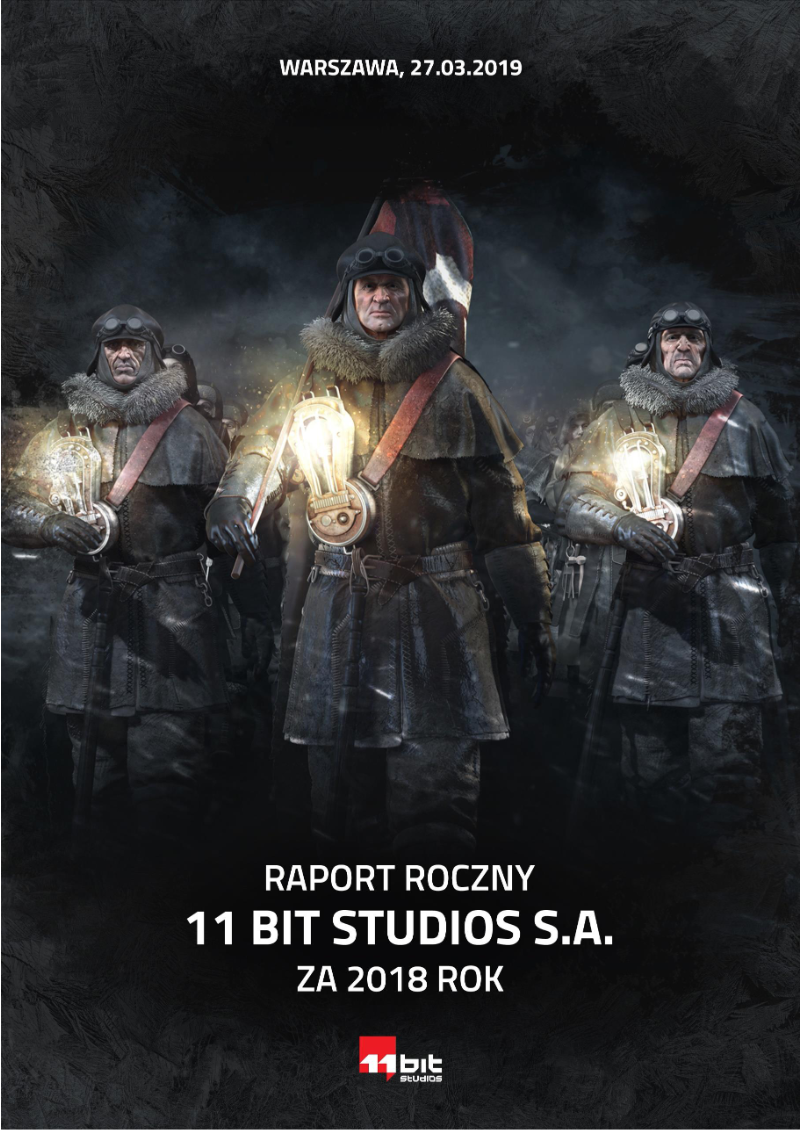
Annual Report 2018: 11 bit studios S.A.
wynagrodzenia róznicowana jest w zaleznosci od petnionej funkcji czy zajmowanego stanowiska). Wynagrodzenia uzyskiwane przez osoby zarzadzajace oraz osoby zarzadzajace wyzszego szczebla w Spótce obejmuje wynagradzanie akcjami, opcjami na akcje lub innymi prawami nabycia akcji, jak równiez wynagrodzenie nie jest ustalane w oparciu o zmiany cen akcji. PISMO ZARZĄDU WEWNETRZNEJ I ZARZADZANIA RYZYKIEM Szanowni Akcjonariusze i Inwestorzy raportów finansowych.
- 11 bit studios S.A. had an exceptional year in 2018, driven by the successful launches of "Frostpunk" (April 24) and "Moonlighter" (May 29), both of which quickly became bestsellers on platforms like Steam.
- The company actively supported its top games, "Frostpunk" and "Moonlighter," with significant free DLC releases throughout 2018, including "Survivor Mode," "The Fall of Winterhome," and "Endless Mode" for "Frostpunk," and "The Binding of Will" for "Moonlighter," which boosted sales and player engagement.
- Total capital expenditures on tangible assets (primarily real estate for a new office at Brzeska 2) and intangible assets (primarily game production) significantly increased from PLN 7,372,863 in 2017 to PLN 26,571,879 in 2018.
- NN Investment Partners TFI S.A. increased its stake in 11 bit studios S.A. to 5.21% of the share capital (119,229 shares) on June 15, 2018, up from 4.93% (112,476 shares) previously.
- 11 bit studios S.A. continued its charitable activities in 2018, donating a portion of revenue from the "War Child Charity DLC" for "This War of Mine" to War Child UK, an organization assisting child victims of war.
+1
11 bit studios
Report74 pages
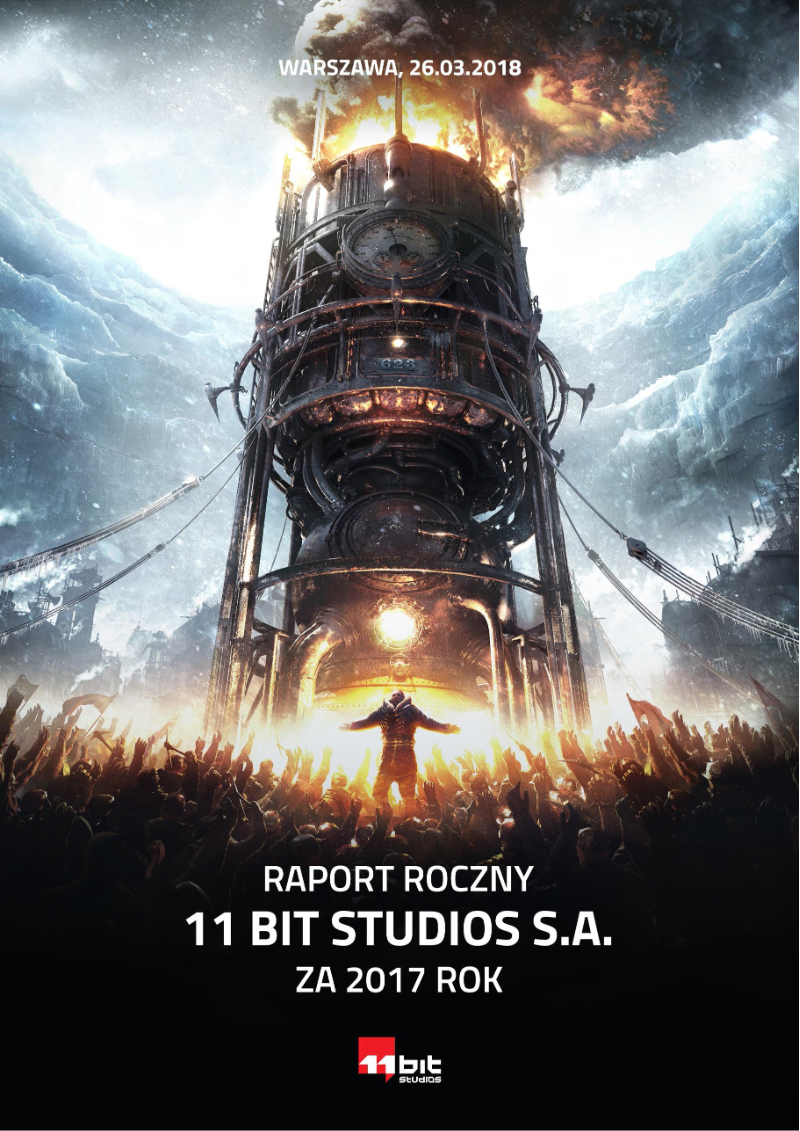
Annual Report 2017: 11 bit studios
2.2. SPRAWOZDANIE Z SYTUACJI FINANSOWEJ (PLN) AKTYWA PISMO ZARZĄDU Nota Stan na Stan na 31.12.2017 31.12.2016 Aktywa trwate Warszawa, 26 marca 2018 roku Rzeczowe aktywa trwate 3.11. 814 332 779 540 Szanowni Akcjonariusze i Inwestorzy 3.12.
- 11 bit studios S.A. focused heavily on "Frostpunk" in 2017, anticipating it will drive financial results for years, with its release scheduled for April 24, 2018.
- The company continued developing "This War of Mine" in 2017, releasing the "Fathers Promise" DLC on November 14, with two more "TWoM: Stories" DLCs planned for 2018. They also began work on a new game, "Projekt 8," involving a 20-person team, to be released after "Frostpunk."
- 11 bit publishing released two external games in 2017: "Beat Cop" (March 30) and "Tower 57" (November 16), with external game sales contributing over 10% to total revenue and recouping investment within months.
- Operating profit for 2017 was 7,619,936 PLN, a 50.69% decrease from 15,454,560 PLN in 2016, despite a 5.64% increase in operating costs to 11,845,351 PLN (from 11,212,540 PLN in 2016) and increased promotional spending.
- 11 bit studios S.A. sold its 100% stake in subsidiary Games Republic Limited to Lousva Trading Limited on April 11, 2017, dissolving the 11 bit studios S.A. Capital Group.
+3
11 bit studios

Report38 pages
Annual Report 2015: Financial Statement
RAPORT ROCZNY11 BIT STUDIOS S.A. SPRAWOZDANIE FINANSOWE 11 BIT STUDIOS S.A. ZA 2015 ROK Pozostate koszty operacyjne 226 247 0,00 226 247 Zysk / (Strata) z dziatalnosci operacyjnej 11 244 147 - 54 945 11 189 201 1.
- 11 bit studios S.A. reported an operating profit of 11,189,201 PLN for the 2015 fiscal year.
- The company's operating profit figure of 11,189,201 PLN was derived from an initial operating profit of 11,244,147 PLN adjusted by 54,945 PLN in losses.
- Other operating costs for the 2015 period totaled 226,247 PLN.
11 bit studios
Report145 pages
Raport Roczny 2020: 11 bit studios S.A.
RAPORT ROCZNY 11 BIT STUDIOS S.A. ZA 2020ROK Warszawa, 28 kwietnia 2021 roku Szanowni Akcjonariusze i Inwestorzy Serdecznie zapraszamy Was do lektury Raportu rocznego 11 bit studios S.A. za 2020 rok. Nie ukrywamy, że z uwagi na pandemię COVID-19 był to rok dużych wyzwań jeśli chodzi o zarządzanie firmą i prowadzenie biznesu.
- 11 bit studios S.A. generated total revenue of 87,101,774 PLN in 2020, an increase from 71,221,248 PLN in 2019.
- The company's net profit in 2019 was restated from 21,710,280 PLN to 23,726,914 PLN due to adjustments related to the Motivational Program and ground value presentation.
- Revenue from external development studios' games, including "Moonlighter" and "Children of Morta," accounted for 29% of the company's revenue in 2020, down from 40% in 2019.
- The game "This War of Mine," released in November 2014, continued to provide a noticeable revenue stream in 2020.
- In 2020, 11 bit studios S.A. secured revenue from an agreement with Microsoft to include "Frostpunk" (January 9, 2020) and "Children of Morta" (January 16, 2020) in the Xbox Pass subscription service.
11 bit studios