Report11 pages
Crypto on Live Streaming Mini‑Report
This analysis examines the intersection of cryptocurrency and live streaming, tracking the rapid growth of digital asset content across Twitch, YouTube, and Kick. The primary thesis identifies a significant surge in crypto-related broadcasting driven by market speculation, memecoin popularity, and political events. The scope covers global data from July 2023 through June 2025, utilizing a methodology that tracks unique channels with at least 30 hours of monthly airtime while excluding bots and suspicious accounts to ensure data integrity.
Findings reveal that the number of unique channels streaming crypto content doubled in the six months leading into late 2024. YouTube experienced the most dramatic growth, rising from 31 channels in July 2024 to over 200 by June 2025. Viewership peaked across platforms in early 2025, with Twitch reaching its height in February and YouTube seeing major spikes in January and June. While Bitcoin remains the most discussed asset with over 500,000 chat mentions in the first half of 2025, Solana has emerged as a dominant secondary interest, recording 171,000 mentions—triple that of Cardano.
The geographic reach of this content is notably diverse, with India emerging as a major hub; four of the top ten crypto creators are based there and stream primarily on YouTube. K1m6a is identified as the leading creator with 6.7 million hours watched. Beyond dedicated finance streams, crypto discourse has permeated gaming communities. Just Chatting is the top category for crypto mentions, but Escape from Tarkov and Fortnite lead among gaming titles. Furthermore, crypto integration is deepening in professional gaming, evidenced by high-viewership esports events like the 2025 Mid-Season Invitational, which secured major crypto-related sponsorships.
- The number of unique crypto-focused streaming channels doubled in the six months leading to late 2024, with YouTube channels surging from 31 in July 2024 to over 200 by June 2025.
- India has become a primary hub for crypto content, hosting four of the top ten global creators who stream primarily on YouTube.
- Bitcoin remains the most discussed asset with over 500,000 chat mentions in the first half of 2025, while Solana has emerged as the dominant secondary interest with 171,000 mentions.
- Creator K1m6a leads the sector with 6.7 million hours watched, highlighting the significant audience reach of top-tier crypto broadcasters.
- Crypto discourse has expanded beyond finance into gaming, with 'Just Chatting' as the top category and 'Escape from Tarkov' and 'Fortnite' leading among gaming titles.
+3
Stream HatchetNov 2024

Report145 pages
State of Web3 in Saudi Arabia
Saudi Arabia has emerged as the dominant hub for Web3 investment in the Middle East and North Africa, capturing 51 % of Q1 2024 venture‑capital funding with $429 million across 163 deals. This concentration reflects a supportive ecosystem that blends proactive government initiatives, a growing pool of local founders, and active participation from international investors. The market is presently skewed toward consumer‑facing applications such as DeFi, GameFi and SocialFi, while foundational protocol development remains limited, highlighting a clear opening for infrastructure builders.
Founders of Saudi‑based Web3 ventures underscore the rapid maturation of the sector, citing high‑profile partnerships—including Animoca Brands with NEOM, collaborations with Hedera, and alignment with Vision 2030—as catalysts for growth. Yet they identify three persistent barriers: inadequate user‑friendly interfaces, insufficient public and investor education, and ambiguous regulatory frameworks that impede both builder activity and funding cycles. Sector‑specific use cases—blockchain‑enabled freelance payments, Sharia‑compliant insurance, and localized NFT platforms—are viewed as primary drivers of mass adoption.
Government commitment reinforces this trajectory, with $37.7 billion earmarked for esports and $13.3 billion for gaming, complemented by sizable venture funds such as Wa’ed’s $500 million vehicle and 500 Global’s $2.4 billion under management. Notable projects illustrate tangible impact: Tharawat Green Exchange aims to plant ten million trees by 2030, while Ticket Souq has generated $3.3 million in gross merchandise value, serving 36 k users across 55 events in ten countries. Stakeholders agree that clear, supportive regulation, robust education, and targeted technology investment are essential to translate this momentum into sustainable, high‑pay‑off outcomes for the kingdom’s burgeoning gaming, fintech, e‑commerce and proptech sectors.
- Saudi Arabia captured 51% of all MENA Web3 venture capital funding in Q1 2024, totaling $429 million across 163 deals.
- The government has committed $37.7 billion to esports and $13.3 billion to gaming, supported by major investment vehicles like Wa’ed’s $500 million fund and 500 Global’s $2.4 billion under management.
- While the market is currently concentrated in consumer-facing sectors like DeFi, GameFi, and SocialFi, there is a significant supply gap for foundational infrastructure development.
- Founders identify three primary barriers to growth: a lack of user-friendly interfaces, insufficient public and investor education, and regulatory ambiguity.
- High-profile partnerships, such as Animoca Brands with NEOM and collaborations with Hedera, are serving as key catalysts for sector maturation under the Vision 2030 framework.
+2
AdaverseJul 2024
Report59 pages
The State of Web3 Gaming 2024
The Web3 gaming market entered a phase of maturation in 2024, marked by a strategic pivot from rapid expansion to ecosystem stability. While new game announcements decreased by 36%, project discontinuations plummeted by 84%, signaling a more resilient landscape. Indie developers currently drive over 90% of new launches, though technical integration remains a significant hurdle, with only 34% of titles successfully incorporating blockchain infrastructure. To combat the inflationary failures of earlier economic models, the industry is shifting toward "Play-to-Airdrop" mechanics to foster more sustainable player engagement.
Geographically, the APAC region and the United States remain the primary hubs for development, collectively hosting the majority of active teams. Genre dominance continues to favor RPG, Casual, and Action titles, which also attract the bulk of stabilized venture capital funding. A notable shift in distribution is underway as Telegram emerged as a powerhouse platform, capturing 21% of new game launches, while the Epic Games Store expanded its Web3 portfolio to nearly 100 titles. This evolution in accessibility is mirrored by a technical migration toward Layer 2 and Layer 3 solutions, which now account for 57% of new game launches.
Infrastructure is becoming increasingly specialized, with 64% of new blockchains designed specifically for gaming. Although the Ethereum Virtual Machine ecosystem maintains its dominance, high-growth frameworks like Arbitrum Orbit and Immutable are driving a record number of migrations as developers seek more efficient environments. Despite a 200% surge in token launches, investors maintain a conservative outlook, prioritizing high-quality game content over foundational infrastructure. This growth occurs against a fragmented regulatory backdrop, where developers must navigate the rigorous enforcement of the U.S. SEC alongside more structured frameworks in Asia and the European Union.
- The Web3 gaming sector is maturing, evidenced by a 36% decrease in new game announcements alongside an 84% reduction in project discontinuations.
- Indie developers now account for over 90% of new launches, though technical integration remains a challenge with only 34% of titles successfully implementing blockchain infrastructure.
- Telegram has emerged as a major distribution channel, capturing 21% of new game launches, while the Epic Games Store has expanded its Web3 portfolio to nearly 100 titles.
- Infrastructure is shifting toward efficiency, with 57% of new games utilizing Layer 2 or Layer 3 solutions and 64% of new blockchains being purpose-built for gaming.
- Despite a 200% surge in token launches, venture capital remains conservative, prioritizing high-quality content in RPG, Casual, and Action genres over foundational infrastructure.
+1
Game7 ResearchJan 2024
Report64 pages
Blockchain Game Alliance: State of the Industry 2024
The blockchain gaming sector is entering a phase of maturation characterized by a strategic pivot from speculative financial models toward high-quality, "fun-first" development. Player asset ownership remains the industry’s primary value proposition, cited by over 71% of professionals for four consecutive years. This shift is bolstered by the entry of traditional gaming giants such as Sony and Ubisoft, which provides necessary credibility to a field where 66.3% of practitioners still identify public misconceptions of scams as a major hurdle. While the industry faces a 42.7% decline in new hiring due to market uncertainty, professional sentiment remains resilient, with over 82% of workers intending to remain in the sector long-term.
Geographically, the industry is expanding its footprint into the Middle East and South America, while Asia and Latin America lead in the adoption of player-reward mechanics. Despite this global reach, the sector continues to struggle with demographic challenges, including a lack of gender diversity and a decline in younger talent entering the workforce. Operationally, the most significant barriers to mainstream adoption are onboarding complexities and poor user experience, though the severity of these concerns has decreased significantly since 2023. Companies currently identify lack of funding and high user acquisition costs as their most pressing internal obstacles.
Looking toward 2025, the industry is moving toward "invisible" Web3 infrastructure to prioritize seamless gameplay over technical complexity. Emerging trends include the rise of fully onchain games, the integration of artificial intelligence for personalized experiences, and the use of social platforms like Telegram to simplify user acquisition. As environmental concerns continue to fade, the focus has shifted toward sustainable "play-and-earn" economies and the consolidation of fragmented infrastructure. This evolution suggests a transition toward a more integrated gaming ecosystem where blockchain serves as a foundational layer for digital property rights rather than a standalone marketing feature.
- The blockchain gaming industry is shifting from speculative models to 'fun-first' development, with 71% of professionals identifying player asset ownership as the primary value proposition.
- Mainstream adoption is being driven by the entry of traditional giants like Sony and Ubisoft, though 66.3% of practitioners still cite public perceptions of scams as a significant barrier.
- Operational barriers like onboarding complexity and poor user experience remain the top hurdles to mainstream growth, despite a notable decrease in the severity of these concerns since 2023.
- Industry hiring has declined by 42.7% due to market uncertainty, yet 82% of current workers intend to remain in the sector long-term.
- Companies are currently prioritizing funding and high user acquisition costs as their most pressing internal obstacles.
+1
Blockchain Game AllianceJan 2024
Report5 pages
State of Blockchain Gaming Q1 2023 Report
Investment in Blockchain Games (Q4 2022 → Q1 2023)
| Quarter | Investment (USD) | Investment (Bn USD) | % Quarter‑over‑Quarter Change | |---------|------------------|----------------------|--------------------------------| | Q4 2022 | ≈ $654.5 million | ≈ 0.655 Bn | – | | Q1 2023 | $739 million | 0.739 Bn | +12.95 % |
How the numbers were derived
The report states that Q1 2023 saw a 12.95 % increase over the previous quarter and that the Q1 2023 total was $739 M. To back‑calculate the Q4 2022 figure:
\[ \text{Q4 2022 Investment} = \frac{\text{Q1 2023 Investment}}{1 + 0.1295} = \frac{739\text{ M}}{1.1295} \approx 654.5\text{ M} \]
Converting to billions (1 Bn = 1,000 M):
\[ 654.5\text{ M} \approx 0.655\text{ Bn} \qquad 739\text{ M} = 0.739\text{ Bn} \]
Key take‑away
Q1 2023 investment in blockchain gaming and metaverse projects reached $739 M (0.739 Bn), marking a robust 12.95 % quarter‑over‑quarter growth from the ≈ $654.5 M (0.655 Bn) invested in Q4 2022. This upward trajectory underscores the accelerating capital interest in the blockchain gaming sector.
- Blockchain gaming and metaverse projects secured $739 million in investment during Q1 2023.
- Investment in the sector grew by 12.95% quarter-over-quarter compared to the $654.5 million recorded in Q4 2022.
- The $739 million total for Q1 2023 represents a sustained upward trajectory in capital interest for blockchain-based gaming.
- Quarterly investment figures rose from approximately $0.655 billion in Q4 2022 to $0.739 billion in Q1 2023.
+1
DappRadarMar 2023
Report54 pages
2022 Blockchain Gaming Report: New Frontiers And The Path Forward
The blockchain gaming industry underwent a significant market correction in late 2022, signaling a transition from speculative "Play-to-Earn" (P2E) models toward more sustainable, gameplay-focused ecosystems. While unique active wallets stabilized at approximately one million, NFT transaction volumes fell 30% to $500 million, and major project market capitalizations plummeted by over 90%. Despite a 19% year-over-year decline in total deal value to $875 million in the third quarter, the sector saw a 2.6x increase in the number of funding deals. This shift indicates a move away from infrastructure-heavy "picks and shovels" investments toward seed-stage funding for game studios and user-friendly wallet solutions.
The collapse of unsustainable economic designs has catalyzed a pivot toward "Free-to-Own" (F2O) and "Play-and-Own" (P&O) models. These frameworks prioritize fun-first gameplay and lower entry barriers by offering free initial digital assets, moving away from the yield-focused mechanics that previously dominated the space. This evolution is supported by a significant talent migration from traditional AAA and mobile gaming companies, which is professionalizing development and introducing more sophisticated tokenomics. Furthermore, the industry is expanding its reach through casual genres and the integration of established intellectual properties from major Asian studios like Square Enix and SEGA.
Mass adoption efforts are increasingly focused on distribution and technical scalability. Notable milestones include the launch of blockchain titles on mainstream platforms like the Epic Games Store and the clarification of NFT guidelines within the Apple App Store. However, the industry faces ongoing challenges, including a crisis in the gaming guild model and intensifying regulatory scrutiny. As the SEC investigates major entities regarding the classification of digital assets as securities, developers are balancing innovation in on-chain mechanics and AI-driven content with the need for compliance in an increasingly complex global legal landscape.
- The blockchain gaming sector shifted from speculative 'Play-to-Earn' models toward 'Free-to-Own' and 'Play-and-Own' frameworks that prioritize gameplay over yield-focused mechanics.
- Market valuations for major projects dropped by over 90% in 2022, while NFT transaction volumes fell 30% to $500 million despite unique active wallets stabilizing at approximately one million.
- Investment activity transitioned toward seed-stage game studios and user-friendly wallets, resulting in a 2.6x increase in the number of funding deals even as total deal value declined 19% year-over-year to $875 million in Q3.
- The industry is professionalizing through a significant talent migration from traditional AAA and mobile gaming companies, alongside the integration of established IP from major Asian studios like Square Enix and SEGA.
- Blockchain titles are gaining mainstream distribution through the Epic Games Store and clarified NFT guidelines on the Apple App Store.
+2
CMC ResearchOct 2022
Report24 pages
Blockchain Industry Report: October 2022
The analysis evaluates the health and dynamics of the blockchain ecosystem during October 2022, revealing a sector in transition marked by divergent growth patterns across applications, platforms, and asset classes. Overall user engagement rose, with unique active wallets for decentralized applications increasing 6.8 percent to just over two million, driven primarily by explosive adoption on Arbitrum, Optimism and a dramatic surge on NEAR following its partnership with Google Cloud. By contrast, the gaming segment and Ethereum’s core wallet base contracted, falling 2 percent and 4.5 percent respectively, underscoring a shift of activity toward emerging layer‑2 solutions.
DeFi continued its rebound, with total value locked climbing 5.3 percent to $83 billion, though Ethereum retained a dominant 62 percent share of that capital. New entrants also made notable strides; the Aptos token achieved a $1 billion market capitalization within two weeks, entering the top‑50 cryptocurrencies, while Dogecoin posted the strongest price appreciation of the month at 50 percent. NFT markets displayed mixed signals: trading volume and sales declined 30 percent month‑on‑month, yet the number of unique NFT traders grew 18 percent to 1.11 million, and Polygon’s NFT volume surged 770 percent, largely propelled by Reddit‑hosted collections.
Security vulnerabilities remained a critical concern, with cross‑chain bridges accounting for 82 percent of the month’s $3.57 million in exploit losses, including high‑profile attacks on Mango Markets, TempleDAO, the QANX bridge and Rabby Swap. The combined effect of rapid user migration, uneven asset performance, and persistent bridge exploits highlights both the growth potential and the systemic risk factors shaping the blockchain industry at the close of 2022.
- Total unique active wallets for decentralized applications grew 6.8 percent to over two million in October 2022, fueled by adoption on Arbitrum, Optimism, and NEAR.
- Cross-chain bridges were the primary security risk, accounting for 82 percent of the $3.57 million in total exploit losses during the month.
- DeFi total value locked increased 5.3 percent to $83 billion, with Ethereum maintaining a 62 percent market share.
- NFT trading volume and sales fell 30 percent, yet the number of unique NFT traders rose 18 percent to 1.11 million, driven by a 770 percent volume surge on Polygon due to Reddit collections.
- The blockchain gaming segment experienced a contraction, with activity falling 2 percent as users shifted toward emerging layer-2 solutions.
+1
DappRadarOct 2022
Report19 pages
Blockchain Industry Report: August 2022
This analysis examines the state of the decentralized application (dapp) and blockchain industry during August 2022. The report highlights a period of significant volatility characterized by a 14.73% year-over-year decline in daily Unique Active Wallets (UAW), which reached a yearly low of 1.67 million. Despite the prevailing bear market and a series of high-profile security breaches—including the $190 million Nomad bridge exploit and the Solana wallet hack—the industry showed pockets of resilience, particularly within Ethereum scaling solutions and the gaming sector.
The Decentralized Finance (DeFi) sector experienced a 10.47% contraction in Total Value Locked (TVL), falling to $74.21 billion. This decline was exacerbated by U.S. sanctions against Tornado Cash, which sparked industry-wide debates regarding the true nature of Web3 decentralization. Conversely, Ethereum Layer-2 protocols like Optimism and Arbitrum saw growth in anticipation of "The Merge," with Optimism entering the top ten blockchains by TVL. While the gaming sector’s dominance of industry usage dipped slightly to 51%, it remained the primary driver of blockchain activity with over 847,000 daily UAW.
The NFT market faced downward pressure, with UAW dropping 16.7% to its lowest level since mid-2021. Trading volumes decreased by 5% month-over-month, influenced by the falling price of Ethereum and liquidation fears surrounding major collections like Bored Ape Yacht Club. However, the report notes structural evolution in the marketplace, specifically the rise of the Automated Market Maker (AMM) model via SudoSWAP and continued interest from traditional brands like Mars and Tiffany & Co. The findings suggest that while macroeconomic uncertainty and security vulnerabilities persist, the underlying infrastructure continues to mature through technical milestones and diversifying use cases.
- Daily Unique Active Wallets (UAW) across the blockchain industry fell 14.73% year-over-year to a yearly low of 1.67 million in August 2022.
- The gaming sector remains the primary driver of blockchain activity, accounting for 51% of industry usage with over 847,000 daily UAW.
- Total Value Locked (TVL) in Decentralized Finance (DeFi) contracted by 10.47% to $74.21 billion, impacted by market volatility and U.S. sanctions against Tornado Cash.
- NFT market activity declined significantly, with UAW dropping 16.7% to its lowest level since mid-2021 and trading volumes falling 5% month-over-month.
- Ethereum Layer-2 protocols, specifically Optimism and Arbitrum, experienced growth in anticipation of 'The Merge,' with Optimism securing a position in the top ten blockchains by TVL.
+1
DappRadarAug 2022

Report21 pages
Global Gaming Report H1 2022
The first half of 2022 marked the most active period in the history of the gaming industry, characterized by unprecedented consolidation and record-breaking investment levels. Total deal value exceeded $107 billion across 651 transactions, with mergers and acquisitions accounting for $95 billion of that total. This surge was primarily driven by massive strategic consolidations, most notably Microsoft’s acquisition of Activision Blizzard and Take-Two’s purchase of Zynga. While the public markets faced significant headwinds and valuation corrections, the private sector remained resilient, securing $7 billion in financing across nearly 500 deals.
Blockchain gaming and metaverse infrastructure emerged as the dominant catalysts for growth, representing over half of all financing transactions in the second quarter. This sector attracted more than $2.2 billion in funding, supported by the launch of multi-billion dollar funds from major venture capital firms. Despite the robust private activity, public gaming stocks largely underperformed, leading to a shift in investor focus toward high-quality, profitable targets. The absence of activity in the IPO and SPAC markets further underscored a transition toward private equity and strategic M&A as the primary vehicles for industry movement.
The industry landscape is currently defined by a divergence between aggressive private investment and cautious public market sentiment. As valuation multiples adjust to new economic realities, the sector is positioned for a second half of the year focused on opportunistic acquisitions and potential take-private transactions. The continued integration of Web3 technologies and the entry of massive capital reserves suggest that while the pace of "mega deals" may fluctuate, the fundamental restructuring of the gaming ecosystem toward a consolidated, blockchain-integrated future remains the central trajectory for the global market.
- The gaming industry saw record-breaking activity in H1 2022 with $107 billion in total deal value across 651 transactions, dominated by $95 billion in M&A activity.
- Strategic consolidation was driven by major acquisitions, most notably Microsoft’s purchase of Activision Blizzard and Take-Two’s acquisition of Zynga.
- Blockchain gaming and metaverse infrastructure became the primary growth catalysts, accounting for over 50% of all financing transactions in Q2 and attracting $2.2 billion in funding.
- While public markets faced valuation corrections and underperformed, the private sector remained resilient, securing $7 billion in financing across nearly 500 deals.
- The absence of IPO and SPAC activity signals a shift in industry movement toward private equity and strategic M&A as the primary vehicles for growth.
+3
Drake Star PartnersJul 2022
Report16 pages
DappRadar Blockchain Industry Report: Highlights of July 2022
The July 2022 DappRadar Blockchain Industry Report analyzes the state of the decentralized application ecosystem during a significant market downturn. The findings indicate that while the broader crypto industry remains trapped in a bear market influenced by the collapse of Terra and macroeconomic pressures like U.S. inflation, specific sectors—most notably blockchain gaming—demonstrate remarkable resilience. The report covers global trends across decentralized finance (DeFi), non-fungible tokens (NFTs), and gaming, utilizing data on Unique Active Wallets (UAW) and Total Value Locked (TVL) to measure health and engagement.
Data shows that dapp activity reached a yearly low in July with 1.68 million daily UAW, a 4% decrease from June. DeFi was the hardest-hit segment, with UAW dropping below 500,000 for the first time since early 2021. Despite this, DeFi TVL saw a 22% recovery during the month, rising to $82.3 billion, led by growth on Ethereum, BNB Chain, and Tron. The report also highlights the continued "crypto contagion" following the Celsius Network bankruptcy filing, which has increased calls for international regulatory frameworks like the EU’s MiCA.
The NFT market experienced a contraction, with monthly trading volume failing to reach $1 billion for the first time in over a year. Market dynamics are shifting as OpenSea’s dominance fell from 84% in May to 58.6% in July, facing increased competition from new entrants like the GameStop and Nickelodeon marketplaces. Conversely, the gaming sector emerged as a primary industry driver, accounting for nearly 60% of all dapp usage. With nearly 1 million daily UAW, blockchain games grew 8% month-over-month, suggesting that immersive mechanics and venture capital interest are insulating the segment from the prevailing "crypto winter."
- Blockchain gaming remains the industry's primary driver, accounting for nearly 60% of all dapp usage with 1 million daily Unique Active Wallets (UAW), an 8% month-over-month increase.
- DeFi activity hit a yearly low with UAW dropping below 500,000, though Total Value Locked (TVL) recovered 22% to reach $82.3 billion across Ethereum, BNB Chain, and Tron.
- The NFT market contracted significantly in July 2022, with monthly trading volume falling below $1 billion for the first time in over a year.
- OpenSea’s market dominance in the NFT space declined sharply from 84% in May to 58.6% in July due to competition from new entrants like GameStop and Nickelodeon.
- Overall dapp activity reached a yearly low of 1.68 million daily UAW in July, representing a 4% decrease from the previous month.
+2
DappRadarJul 2022
Report30 pages
Games, Esports, Live Streaming, Cloud and the Metaverse: 2022 Trends to Watch
The global gaming industry is currently undergoing a structural transformation characterized by the integration of emerging technologies and a pivot toward cross-platform accessibility. Central to this evolution is the expansion of cloud gaming, which serves as a critical bridge to overcome hardware constraints, allowing publishers to reach broader audiences on mobile devices and legacy consoles. Simultaneously, the metaverse is maturing into a robust commercial ecosystem, fueled by significant venture capital investment, the proliferation of virtual real estate, and the integration of digital fashion. These developments signal a broader industry shift toward enhanced creator-viewer interactivity and the adoption of Web3.0 business models.
Monetization strategies are diversifying as companies experiment with blockchain-based player trading and fan engagement tools, despite notable consumer resistance toward non-fungible tokens. This period is also defined by a surge in high-quality cross-media intellectual property adaptations and a crowded release calendar, which intensifies competition for consumer attention. Furthermore, regulatory and consumer pressures are forcing a transition toward more open app store ecosystems, challenging traditional distribution gatekeepers.
Within the esports sector, organizations are actively diversifying revenue streams by prioritizing mobile-first titles and leveraging co-streaming to maximize viewership reach. These trends, observed throughout 2022, reflect a strategic effort to sustain growth across global markets. By synthesizing market intelligence and tracking key performance metrics, the industry continues to navigate the complexities of digital transformation, balancing the pursuit of innovative monetization with the necessity of maintaining user trust in an increasingly interconnected virtual landscape.
- Cloud gaming is driving industry growth by bypassing hardware limitations, enabling publishers to deliver high-end experiences to mobile devices and legacy consoles.
- The metaverse is evolving into a commercial ecosystem supported by significant venture capital, virtual real estate markets, and digital fashion integration.
- Monetization models are shifting toward Web3.0 and blockchain-based player trading, despite ongoing consumer resistance to non-fungible tokens.
- Regulatory and consumer pressure is forcing a transition away from traditional app store gatekeepers toward more open distribution ecosystems.
- Esports organizations are prioritizing mobile-first titles and utilizing co-streaming strategies to diversify revenue and expand global viewership.
+5
NewzooJan 2022
Report30 pages
Games, Esports, Live Streaming, Cloud and the Metaverse: 2022
The global gaming industry is undergoing a fundamental transformation characterized by the convergence of traditional media, high-fidelity content, and emerging Web3 technologies. The primary thesis posits that the sector is shifting toward an interconnected, cross-platform ecosystem where revenue diversification and creator-driven engagement models are essential for growth. While consumer skepticism persists regarding blockchain-based assets and NFTs, publishers are successfully navigating this transition by prioritizing mobile esports, co-streaming strategies, and efforts to circumvent restrictive app store ecosystems to foster deeper fan loyalty.
Technological infrastructure is evolving to support this expansion, with cloud-based solutions and Platform-as-a-Service models playing a critical role in mitigating hardware limitations. By integrating gaming experiences into smart TVs and leveraging cloud technology, companies are effectively broadening their reach to new demographics. Simultaneously, the metaverse has emerged as a significant focal point for venture capital and brand investment, as corporations increasingly utilize digital fashion and virtual real estate to capture the attention of younger, digitally native audiences.
Geographically, the market remains dominated by the Asia-Pacific region, which generates $88.2 billion in annual revenue, representing over half of the global total. North America follows with $42.6 billion, maintaining a strong position in the industry landscape. However, the long-term trajectory of the market is increasingly influenced by emerging territories in Latin America, the Middle East, and Africa. These regions are currently expanding at rates exceeding the global average, signaling a gradual decentralization of revenue and a more diverse, globalized future for the interactive entertainment sector.
- The Asia-Pacific region dominates the global gaming market with $88.2 billion in annual revenue, accounting for more than 50% of the total global share.
- North America remains a primary industry pillar, generating $42.6 billion in annual revenue.
- Emerging markets in Latin America, the Middle East, and Africa are currently experiencing growth rates that exceed the global average, signaling a shift toward market decentralization.
- Publishers are prioritizing mobile esports, co-streaming, and direct-to-consumer strategies to bypass restrictive app store ecosystems and increase fan loyalty.
- Cloud-based infrastructure and Platform-as-a-Service models are being used to overcome hardware limitations and expand reach through smart TV integration.
+5
NewzooJan 2022
Report46 pages
The Metaverse, Blockchain Gaming, and NFTs: Navigating the Internet’s Uncharted Waters 2022
The analysis demonstrates that the metaverse, blockchain gaming, and NFTs have transitioned from niche curiosities to mainstream commercial forces, reshaping consumer engagement across entertainment, fashion, and gaming. Major brands—including Nike, Gucci, Samsung, and Louis Vuitton—are investing in digital real estate and virtual storefronts to capture a digitally native audience, while music artists leverage virtual concerts and NFT sales as alternative revenue streams. Virtual events such as Ariana Grande’s Rift Tour and Justin Bieber’s Wave performance illustrate the capacity of fully digital experiences to attract millions of concurrent viewers, signaling a shift toward immersive entertainment and fan‑centric monetization.
In the fashion sector, digital‑first houses like Auroboros and The Fabricant generate millions of users by selling high‑priced virtual garments, integrating NFTs to provide ownership and community benefits. The report projects that realistic XR shopping, AR try‑ons, and interoperable digital wardrobes will drive higher engagement and conversion rates, enabling luxury brands to test markets digitally before physical production. Blockchain gaming remains dominated by low‑revenue titles, yet play‑to‑earn (P2E) ecosystems—exemplified by Axie Infinity’s 3 billion gamers and Illuvium’s $72 million funding—are expanding, with guilds such as Yield Guild Games monetizing in‑game assets through lending models. Sustainability hinges on continued user engagement and broader adoption beyond speculative gains.
Non‑PFP NFTs, including virtual land, music collectibles, and utility tokens, are gaining traction through community‑building perks and cross‑game interoperability, as seen in VeeFriends, NBA Top Shot, Habbo Hotel, and Metakey. These use cases broaden the NFT value proposition and support deeper metaverse integration. However, the industry faces significant regulatory and safety challenges: governments are pushing for open standards to mitigate political, moderation, and privacy risks, while the proliferation of user‑generated content amplifies concerns over deepfakes, disinformation, and harassment. Addressing these issues will require new legal frameworks and robust community moderation before a safe, inclusive metaverse can be fully realized.
- The metaverse and blockchain gaming have evolved into mainstream commercial forces, with major brands like Nike, Gucci, Samsung, and Louis Vuitton investing in virtual storefronts and digital real estate.
- Virtual events are demonstrating massive scale, as evidenced by Ariana Grande’s Rift Tour and Justin Bieber’s Wave performance attracting millions of concurrent viewers.
- Blockchain gaming is expanding through play-to-earn models, highlighted by Axie Infinity’s 3 billion gamers and Illuvium’s $72 million in funding, though long-term viability depends on engagement beyond speculative gains.
- Digital-first fashion houses like Auroboros and The Fabricant are successfully monetizing virtual garments, utilizing NFTs to provide ownership and community benefits to users.
- Non-PFP NFTs, such as virtual land and music collectibles from projects like NBA Top Shot and VeeFriends, are gaining traction by focusing on utility and cross-game interoperability.
+2
NewzooJan 2022
Report16 pages
Blockchain Industry Report
The report examines the blockchain ecosystem during a prolonged bear market, highlighting how macroeconomic pressures—high U.S. inflation, rising interest rates, and a recessionary environment—have driven investors to withdraw capital from both equity and cryptocurrency markets. This withdrawal has intensified selling pressure, reducing medium‑term trading volume and pushing dapp activity to its lowest point of 2022, with 1.68 million daily unique active wallets (UAW) in July, a 4 % month‑over‑month decline yet still 20 % above July 2021 levels.
DeFi remains the most affected segment, with UAW falling below 500 k for the first time since April 2021—a 22 % MoM drop and a 31 % YoY decline. Total value locked (TVL) has begun to recover, rising 22 % from July 1 to July 31 to $82.3 bn, driven by gains across Ethereum, BNB Chain, and Polygon. Polygon’s network upgrades and migration of Terra projects have contributed to a 17 % TVL increase, while the launch of a web3 smartphone partnership signals continued innovation.
NFT trading volume contracted 25 % MoM, falling below $1 bn for the first time since June 2021. Market concentration intensified, with Yuga Labs’ collections accounting for over 20 % of July’s volume. OpenSea’s dominance has eroded from 84 % to 58.6 %, as new marketplaces such as GameStop and Nickelodeon capture niche segments.
Gaming defied the downturn, achieving 1 million daily UAW and $857 m in transactions, with its share of overall usage rising from 52 % to 57.4 %. The report concludes that while the crypto winter has triggered significant market recalibration, resilient projects—particularly in DeFi and gaming—are positioned to drive a future bull run.
- Blockchain gaming remains the industry's most resilient sector, accounting for 57.4% of total daily unique active wallet (UAW) activity with 1 million daily UAW and $857 million in transactions.
- Total Value Locked (TVL) in DeFi showed signs of recovery in July, increasing 22% to $82.3 billion across major networks like Ethereum, BNB Chain, and Polygon.
- NFT trading volume dropped 25% month-over-month to below $1 billion, while OpenSea’s market share eroded significantly from 84% to 58.6% due to competition from new entrants like GameStop and Nickelodeon.
- Macroeconomic pressures, including high inflation and rising interest rates, caused overall dapp activity to hit its lowest point of 2022 in July with 1.68 million daily UAW.
- The DeFi sector experienced a sharp contraction, with UAW falling 22% month-over-month to below 500,000, marking its lowest level since April 2021.
+1
DappRadarJan 2022
Report46 pages
The Metaverse, Blockchain Gaming, and NFTs: Navigating the Internet’s Uncharted Waters
The metaverse represents a fundamental shift from a two-dimensional internet toward a persistent, three-dimensional social ecosystem driven by gamified virtual spaces. This evolution is currently led by "game as a platform" models, most notably Roblox, which leverages tens of millions of daily active users to host diverse commercial and social experiences. While major global brands in fashion, luxury, and finance are increasingly investing in "direct-to-avatar" economies and digital real estate to reach younger, digital-native demographics, the sector faces significant economic and technical hurdles. High developer take rates, consistent net losses among platform leaders, and networking limitations that prevent massive simultaneous user scaling remain primary obstacles to long-term growth.
The integration of blockchain technology and non-fungible tokens (NFTs) has introduced new economic paradigms, such as the "Play-to-Earn" model. Although these games accounted for nearly half of all decentralized application wallet activity by late 2021, their growth is largely concentrated in emerging markets where users treat gaming as an income-generating activity. The sustainability of these ecosystems is currently challenged by high entry barriers and a prioritization of financial speculation over core gameplay quality. For the industry to mature, it must transition toward higher-quality experiences and more robust virtual economies that offer genuine utility beyond profile-picture status symbols.
Mass adoption of these decentralized virtual worlds is currently constrained by technical and regulatory friction. Interoperability across different platforms remains a theoretical goal rather than a functional reality, while high transaction fees on networks like Ethereum and environmental concerns create additional barriers. Furthermore, the industry must navigate complex legal landscapes regarding digital privacy, content moderation, and the protection of intellectual property. Despite a cooling of initial market hype following a crypto correction in 2022, the long-term trajectory points toward a transmedia future where digital assets and virtual identities are central to global commerce and social interaction.
- The metaverse is evolving into a 3D social ecosystem led by 'game as a platform' models like Roblox, which currently sustains tens of millions of daily active users.
- Blockchain-based 'Play-to-Earn' games represented nearly 50% of all decentralized application wallet activity by late 2021, though growth is primarily driven by emerging markets seeking income rather than gameplay.
- Long-term growth for virtual platforms is hindered by high developer take rates, persistent net losses among industry leaders, and technical limitations preventing massive simultaneous user scaling.
- The sector faces significant friction from a lack of platform interoperability, high transaction fees on networks like Ethereum, and unresolved regulatory challenges regarding digital privacy and intellectual property.
- The industry must shift from speculative financial models and profile-picture NFTs toward higher-quality gaming experiences and virtual economies that provide genuine utility.
+3
NewzooJan 2022
Report46 pages
Newzoo Trend Report 2022: The Metaverse, Blockchain, Gaming, and NFTs
The metaverse represents a persistent, three-dimensional evolution of the internet, driven by a fundamental cultural shift toward virtual socialization among digital natives. As Gen Z and Gen Alpha increasingly prioritize digital identities, major global brands are pivoting toward direct-to-avatar strategies and virtual real estate to maintain relevance. This transition is characterized by the transformation of gaming platforms into multi-layered social ecosystems, where high-fidelity simulations and blockchain technology enable new forms of digital ownership and direct fan engagement across the fashion, music, and sports industries.
While platforms like Roblox demonstrate massive scale with over 50 million daily active users, the broader ecosystem faces significant structural and technical hurdles. The current blockchain gaming landscape is heavily influenced by play-to-earn models and scholarship guilds, yet these models struggle with financial sustainability during market downturns and often fail to prioritize core gameplay enjoyment. Furthermore, the industry remains fragmented by high platform fees and a lack of interoperability between "walled garden" environments. Emerging web3 challengers aim to solve these issues through open protocols, but achieving mass concurrency and cross-platform standards remains a long-term technical challenge.
The path toward a fully realized metaverse will be gradual and contingent upon mobile accessibility and modernized intellectual property laws. Significant risks regarding user safety, decentralized content moderation, and political fragmentation must be addressed to prevent the centralized abuse of power. Ultimately, the blurring of physical and digital identities will continue to reshape global commerce, provided that the industry can move beyond speculative assets toward functional, interoperable digital identities and secure, user-centric social environments.
- The metaverse is evolving into a persistent, 3D social ecosystem driven by Gen Z and Gen Alpha's prioritization of digital identities and direct-to-avatar commerce.
- Gaming platforms like Roblox have achieved significant scale, currently maintaining over 50 million daily active users.
- Current blockchain gaming models, particularly play-to-earn and scholarship guilds, face critical challenges regarding long-term financial sustainability and core gameplay quality.
- Industry growth is currently hindered by fragmented 'walled garden' environments, high platform fees, and a lack of technical interoperability.
- The transition to a fully realized metaverse depends on mobile accessibility, modernized intellectual property laws, and the development of open protocols to support mass concurrency.
+1
NewzooJan 2022
Report51 pages
Global Esports & Live Streaming Market Report
The global esports market is projected to reach $1.38 billion in revenue and an audience of 532 million by the end of 2022, signaling a period of robust expansion and structural evolution. China remains the dominant regional player, contributing nearly one-third of total global revenue. While sponsorships continue to serve as the industry’s financial backbone, accounting for approximately 60% of income, organizations are increasingly diversifying into direct-to-fan models. These new revenue streams include lifestyle apparel, blockchain-integrated loyalty programs, and educational platforms, reflecting a strategic shift toward positioning esports as a broader lifestyle brand.
The live-streaming ecosystem is experiencing even more rapid growth, with the audience expected to reach 1.41 billion by 2025 at a compound annual growth rate of 16.3%. This surge is fueled by the rise of non-gaming content and the explosive popularity of mobile esports in emerging markets such as Southeast Asia, Latin America, and the Middle East. Demographically, the esports audience represents a high-value target for advertisers, as nearly three-quarters of enthusiasts are employed full-time and 44% belong to high-income brackets.
Platform dynamics reveal a clear geographic and technological divide. Twitch maintains its dominance in Western markets for PC and console gaming, while YouTube Gaming and Facebook Gaming have successfully captured the mobile-centric audiences of emerging regions. To challenge established leaders, platforms are leveraging massive video-on-demand audiences and exclusivity deals to convert passive viewers into live participants. Despite this growth, the industry faces potential volatility from the fluctuating cryptocurrency sector and the possible migration of audiences toward emerging metaverse events.
- The global esports market is projected to reach $1.38 billion in revenue with 532 million viewers by the end of 2022, with China accounting for nearly one-third of total global revenue.
- The live-streaming audience is forecast to grow at a 16.3% compound annual growth rate, reaching 1.41 billion users by 2025.
- Sponsorships remain the primary financial driver at 60% of total income, though organizations are diversifying into lifestyle apparel, blockchain loyalty programs, and educational platforms.
- The esports demographic is highly attractive to advertisers, with 75% of enthusiasts employed full-time and 44% falling into high-income brackets.
- Platform dominance is split geographically, with Twitch leading Western PC and console markets while YouTube Gaming and Facebook Gaming capture mobile-centric audiences in Southeast Asia, Latin America, and the Middle East.
+2
NewzooJan 2022
Report32 pages
Member Survey & Report 2021
The blockchain gaming industry experienced a transformative period of expansion in 2021, driven primarily by the emergence of play-to-earn mechanics and the implementation of true digital asset ownership. Industry professionals identify these features as the most significant catalysts for growth, with a vast majority anticipating that traditional gaming entities will integrate blockchain technology within the next two years. This momentum is further evidenced by approximately $4 billion in capital inflows from venture firms and decentralized autonomous organizations, signaling strong institutional confidence in the sector’s long-term viability.
Despite this rapid financial and technological acceleration, the industry faces substantial structural headwinds. Regulatory uncertainty remains the most pressing concern for over half of the organizations operating in the space, followed closely by a general lack of public understanding regarding core blockchain concepts. Additionally, the sector must navigate technical challenges related to user-friendliness and a shortage of specialized engineering talent. While environmental sustainability has been a point of external criticism, the industry is actively transitioning toward carbon-neutral protocols and Proof of Stake networks to mitigate its ecological footprint.
The ecosystem is characterized by a diverse and collaborative landscape that spans game studios, major traditional publishers like Ubisoft, and specialized firms in decentralized finance, legal, and infrastructure. While financial incentives have been the primary driver of initial adoption, long-term sustainability is widely believed to depend on the development of high-quality gameplay that can compete with traditional titles. This cross-sector synergy suggests that the future of the industry relies on balancing innovative monetization models with the fundamental entertainment value required for mainstream appeal.
- The blockchain gaming sector saw $4 billion in capital inflows from venture firms and DAOs in 2021, signaling strong institutional confidence in the industry's long-term viability.
- Industry professionals expect traditional gaming entities to integrate blockchain technology within the next two years, driven by the adoption of play-to-earn mechanics and true digital asset ownership.
- Regulatory uncertainty is the primary concern for over 50% of organizations in the space, followed by challenges regarding public education, user-friendliness, and a shortage of specialized engineering talent.
- Long-term industry sustainability is contingent upon shifting from financial-incentive models to the development of high-quality gameplay that competes directly with traditional titles.
- The industry is actively addressing environmental criticism by transitioning toward carbon-neutral protocols and Proof of Stake networks.
+1
Blockchain Game AllianceDec 2021
Report15 pages
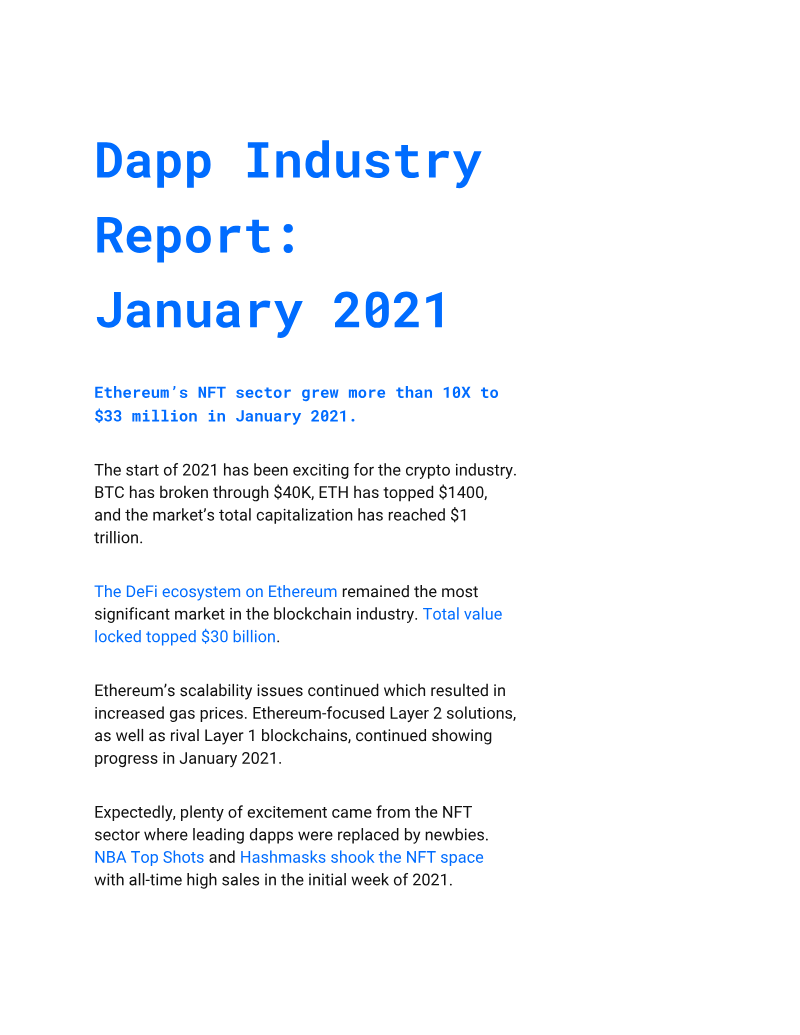
Dapp Industry Report: January 2021
The report presents a snapshot of the decentralized‑application (dapp) landscape in January 2021, emphasizing Ethereum’s continued dominance while highlighting the rapid emergence of competing blockchains and the explosive growth of the NFT sector. Across the month, Ethereum generated more than $112 billion in transaction volume—86 % of total blockchain activity—and supported roughly 72 000 daily active wallets (30 % of the market). Its DeFi ecosystem accounted for 99 % of this activity, with Uniswap and 1inch leading in unique wallet usage, while total value locked (TVL) on Ethereum surpassed $30 billion, driven by token price surges and a rise in aTVL to $14 billion.
NFT activity on Ethereum expanded tenfold, from $3 million in December to $33 million in January, propelled by CryptoPunks and the newly launched Hashmasks, which quickly became the top collectible dapp. Meanwhile, the Flow blockchain’s NBA Top Shot achieved over $40 million in sales, overtaking Ethereum‑based NFTs to become the leading NFT platform. Binance Smart Chain (BSC) recorded its strongest month, exceeding $15 billion in transaction volume and generating the highest number of unique active wallets on its network, largely through Venus and PancakeSwap. Wax’s gaming dapp Alien Worlds also posted rapid growth, reaching 8 000 daily active wallets.
Scalability constraints on Ethereum continued to inflate gas fees, prompting migration to layer‑2 solutions such as Matic and to alternative layer‑1 chains. The report’s data derive from DappRadar analytics, covering transaction volumes, wallet activity, and TVL across major protocols (Ethereum, BSC, Wax, Flow, EOS, Tron, and emerging networks like Polkadot and Solana) for the calendar month of January 2021. Overall, the findings indicate a blockchain ecosystem transitioning from DeFi‑centric growth to a new wave dominated by high‑value NFT dapps and diversified cross‑chain activity.
- Ethereum maintained market dominance in January 2021 with $112 billion in transaction volume, representing 86% of total blockchain activity and over $30 billion in total value locked.
- The NFT sector experienced explosive growth, with Ethereum-based NFT volume increasing tenfold to $33 million, while Flow’s NBA Top Shot surpassed all Ethereum platforms to lead the market with over $40 million in sales.
- Binance Smart Chain recorded its strongest performance to date, processing over $15 billion in transaction volume and achieving the highest number of unique active wallets, driven primarily by Venus and PancakeSwap.
- Ethereum's DeFi ecosystem remained the primary driver of its activity, accounting for 99% of its network usage with Uniswap and 1inch as the leading platforms.
- High gas fees caused by Ethereum's scalability constraints accelerated a migration toward alternative layer-1 blockchains and layer-2 solutions like Matic.
+1
DappRadarJan 2021