14 documents matching your filters
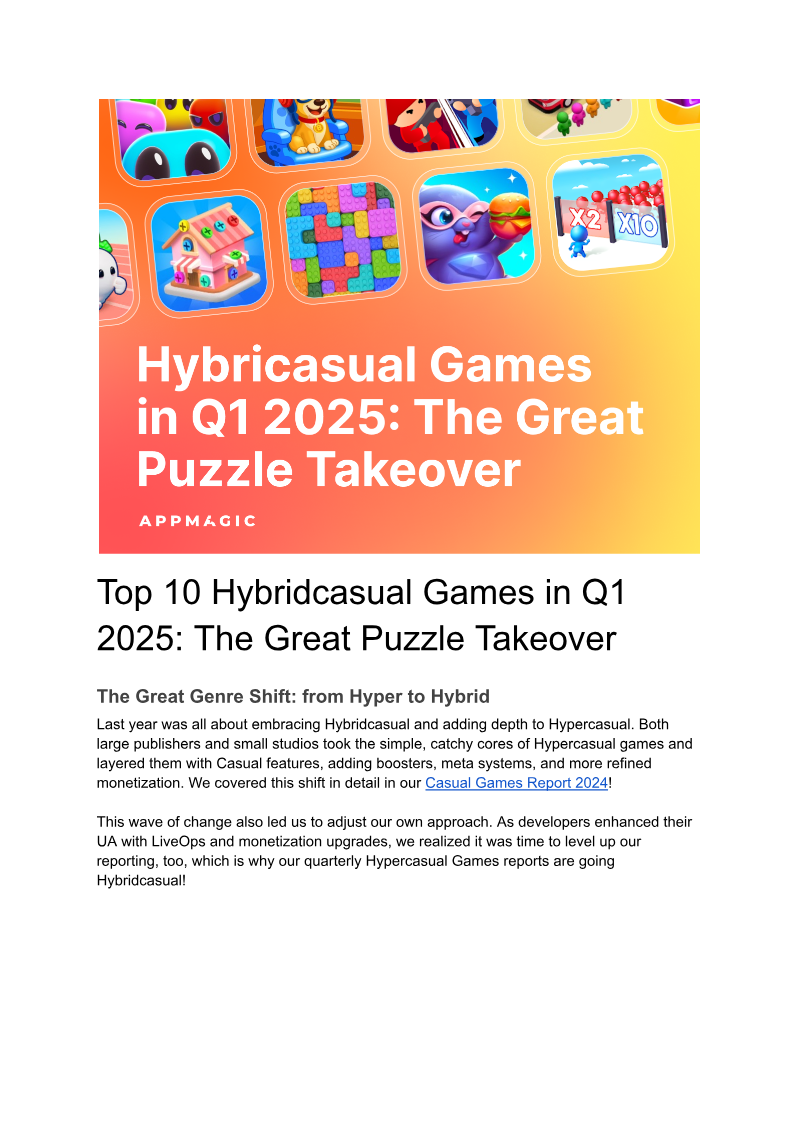
The analysis highlights a rapid maturation of the hybrid‑casual segment in the mobile gaming market, showing that the top ten titles generated $87 million in net in‑app‑purchase (IAP) revenue in the first quarter of 2025—a 67 percent year‑over‑year increase from the same period in 2024. Puzzle games dominate the revenue mix, contributing 48 percent, while arcade titles account for 45 percent; together they represent more than 90 percent of total earnings. Within puzzles, block‑puzzle titles lead with 71 percent of puzzle revenue, followed by screw‑puzzle (20 percent) and sort‑puzzle (9 percent), the latter posting a 5.6‑times YoY growth. The report covers a global scope of 60 countries, focusing on the period from Q1 2023 through Q1 2025 and concentrating on the hybrid‑casual niche that blends hyper‑casual mechanics with deeper casual‑style monetisation and live‑ops. Methodologically, the study isolates hybrid‑casual games by filtering the hyper‑casual tag for top‑grossing apps, then examines revenue, download, and release data for each title. Key case studies include Color Block Jam, which achieved $25 million in Q1 2025 after a modest Q4 2024 start, All in Hole, whose eat‑and‑grow model drove a nine‑fold YoY revenue surge and now accounts for 84 percent of its sub‑genre’s earnings, Mob Control, which posted 27 percent revenue growth and introduced “skip tickets” to balance ad and IAP streams, and Screwdom, whose shift to 3D puzzle design generated $3.6 million and set a new benchmark for screw‑puzzle games. The findings suggest that successful hybrid‑casual titles combine a highly clickable core loop with layered progression, strategic live‑ops, and nuanced monetisation—often leveraging high‑budget user‑acquisition campaigns and viral social media exposure. This convergence of design and marketing is reshaping sub‑genres, lowering acquisition costs, and establishing hybrid‑casual as a dominant, profit‑rich trend in the mobile gaming ecosystem.
The 2025 Mobile Casual Benchmarks Report provides a comprehensive analysis of the Android gaming market, focusing on performance metrics across various casual genres and subgenres. Based on data collected from over 10,000 mobile games and billions of installs between June 2024 and January 2025, the findings offer a strategic overview of the United States market. The analysis evaluates key performance indicators including download volume, user retention, session length, and ad monetization efficiency to identify growth opportunities for developers. Findings indicate a significant shift in the mobile landscape, with a strong recommendation for developers to transition from pure hypercasual models to hybrid casual designs. While hypercasual and simulation games lead in total downloads, they suffer from low 30-day retention rates of approximately 3% and a modest ARPU of $0.79. In contrast, hybrid casual games—which integrate deeper progression systems and meta-elements—demonstrate superior sustainability. Subgenres such as Merge 3, Luck Battle, and Life Simulator emerge as highly profitable outliers, achieving ARPU figures between $11.08 and $14.83. Engagement data reveals that Strategy and Tabletop genres command the highest user attention, while subgenres like Ludo and Merge 3 lead in session duration, with the latter averaging 656 seconds. Retention is strongest in Sports, Racing, and Tabletop categories, while specific subgenres like Coin Pusher and Management Sim maintain over 50% Day 1 retention. Regarding monetization, Puzzle and Match games are identified as the most effective vehicles for high-frequency ad impressions, whereas Strategy and Tabletop games are better suited for rewarded video formats. Ultimately, the data suggests that long-term profitability in 2025 depends on balancing accessible gameplay with the deeper engagement mechanics characteristic of the hybrid casual segment.
The global casual gaming market entered a period of recovery between April 2023 and April 2024, characterized by rebounding consumer spend despite a slowdown in total downloads. This shift is defined by a strategic migration from hyper-casual titles toward more complex hybrid-casual and 3D match models. User acquisition remains highly bifurcated by platform; iOS costs average $4.83 per install compared to just $0.65 on Android, though iOS continues to deliver a superior Day 7 return on ad spend. North America remains the most expensive and lucrative geographic region, while simulation games have emerged as the most cost-effective genre for acquisition. Casual games function as a critical ecosystem driver, generating 91% of their own installs and significantly influencing mid-core titles. Puzzle subgenres, particularly Match3 and Mahjong Solitaire, now command 37% of casual installs, while the 3D Match category has seen explosive growth, increasing its US iOS market share fivefold in a single year. To sustain this growth, market leaders are increasingly relying on sophisticated LiveOps and social mechanics. Successful strategies include collaborative partner events, social win streaks, and "digging" minigames, all of which leverage group competition to drive engagement and baseline revenue. Monetization strategies have evolved toward player choice and direct-to-consumer models. Progressive offers and "pick-one" bundles are now standard in 70% of top-performing US casual games, providing structured value through tiered rewards. Furthermore, developers are aggressively adopting engagement-linked offers and external web stores. By linking premium rewards to gameplay tasks and moving transactions to proprietary web platforms, developers are successfully bypassing traditional app store fees while fostering long-term player loyalty through exclusive digital storefronts and daily login incentives.
The casual gaming landscape in 2023 is defined by a strategic pivot from rapid user acquisition toward long-term profitability and sophisticated engagement models. While iOS acquisition costs significantly exceed those of Android at $2.23 compared to $0.63, both platforms achieve a comparable Day-7 return on ad spend of approximately 7.7%. North America remains the most expensive yet lucrative market, yielding an 8.1% return on ad spend despite a high $3.59 cost per install. Simulation games have emerged as a particularly efficient entry point for developers, maintaining the lowest acquisition costs at $0.59. Casual titles serve as the primary engine for the broader mobile ecosystem, driving 74% of installs across all gaming categories and nearly 75% of mid-core installs. Hyper-casual and puzzle games remain the dominant traffic sources, but the industry is increasingly embracing hybridization. This trend involves layering complex meta-elements, such as narrative progression and competitive social features, over simple core mechanics. By blending ad-based and in-app purchase monetization models, developers are successfully targeting crossover audiences and extending the lifecycle of traditionally short-lived genres. Engagement strategies now heavily rely on competitive mechanics and gameplay diversification. Approximately 90% of leading level-based titles utilize solo leaderboards, while over half incorporate team-based races, debunking the myth that casual players avoid competitive environments. Furthermore, nearly a quarter of top-grossing casual games integrate minigames, such as hidden object or board game mechanics, to refresh the user experience and lower acquisition barriers. These features collectively deepen player retention and monetization, signaling a shift toward more robust, feature-rich casual experiences that prioritize player depth over simple volume.
India’s mobile‑gaming ecosystem is experiencing rapid expansion, with a projected market value of $8.6 billion by 2027 and more than 600 million active users. Growth is fueled by affordable smartphones, low data costs, and a pandemic‑accelerated surge in casual, hyper‑casual, and real‑money titles. Install rates spiked up to 90 % during lockdowns, while in‑app purchase revenue is expected to reach $284 billion by 2026. To sustain this momentum, brands must deploy comprehensive customer‑engagement platforms that provide real‑time analytics, segmentation, and personalized push campaigns to enhance retention and monetization. Push notifications and in‑app messaging prove critical for user engagement. Data shows a 3.34 % click‑through rate and up to 91 % delivery success for push alerts, while in‑app campaigns achieve 15–44 % conversion rates and a 38 % average on one million impressions. Segmentation techniques such as RFM, affinity profiling, and predictive AI models (e.g., Sherpa) enable targeted, omnichannel flows that reduce churn and lower acquisition costs—new customers cost five times more than retaining existing ones. App Store Optimization tools like AppTweak further amplify visibility; for instance, RummyCircle’s keyword strategy increased visibility by 14.2 % and drove a 200,000‑download spike after A/B testing. Despite the market’s growth, brands face declining installs, stickiness, and revenue. The solution lies in data‑driven engagement: hyper‑personalized messaging powered by AI unlocks deeper customer insights, improves retention, and provides a competitive advantage. Platforms such as MoEngage, already trusted by Fortune 500 and internet‑first brands worldwide, offer the scalability required for publishers to thrive in India’s dynamic mobile‑gaming landscape.
This analysis examines the highest-grossing mobile games across iOS and Android platforms during the second quarter of 2022. Utilizing data from the Apptica platform across 37 countries, the study focuses on three primary industry segments: casual, casino, and mid-core games. The central thesis highlights the continued dominance of established franchises and the significant revenue-generating power of mid-core titles, which emerged as the highest-grossing genre during this period. Key findings indicate that Rise of Kingdoms by Lilith Games was the top-earning individual title, generating over $179.5 million on iOS alone. On the Android platform, Candy Crush Saga led with revenues exceeding $122 million. When aggregating performance across multiple top-charting titles, King emerged as the highest-grossing publisher with over $264 million in revenue, followed closely by Lilith Games at $254.6 million and Playrix at $182.8 million. The data also reveals a high reliance on organic traffic for top-tier games; mid-core titles on iOS averaged 91% organic traffic, while casual games on Android maintained a lower average of 70%. Geographically, the United States remains the primary hub for mobile game development, hosting 28.8% of the top-performing publishers' headquarters. Ireland and Israel follow as significant secondary hubs. In terms of market presence, Playrix and Playtika were the most frequent leaders in the charts, each accounting for 16.2% of the games appearing in the top-10 rankings. The analysis concludes that while the market is competitive, a small group of global publishers and established mid-core titles continue to capture the majority of mobile gaming revenue.
This analysis examines the evolving landscape of the casual mobile gaming market as of March 2022, focusing primarily on the United States iOS market. The central thesis posits that the casual sector has become increasingly competitive, forcing developers to move beyond simple core gameplay by integrating sophisticated meta-elements, hybrid mechanics, and social features to maintain chart positions and drive player retention. Key findings indicate a massive shift in the Match3 genre, where the presence of meta-elements in top-100 grossing games rose from under 10% six years ago to 70% by early 2022. Renovation and construction mechanics have emerged as the dominant trend; notably, every top-100 grossing casual game released in the two years preceding the report utilizes renovation elements. Construction features specifically appeared in 49% of top Match3 games, a significant increase from 7% in 2016. These elements are prized for providing visual progression and satisfying psychological "completionist" motivations without disrupting core game balance. The scope of the research covers the casual genre hierarchy—including subgenres like Match3, Solitaire, and Time Management—with a specific focus on top-grossing titles on the US iOS platform. Data points highlight the stability of the top three casual games between Q4 2020 and Q4 2021, while noting that newer titles like Royal Match and Project Makeover successfully captured market share by leveraging episodic design and deep customization. Methodologically, the insights are derived from the GameRefinery SaaS platform, utilizing a proprietary three-layered taxonomy (Category, Genre, Subgenre) developed with industry experts. The analysis concludes that successful casual games are increasingly adopting midcore-inspired features, such as social hangouts, competitive tournaments, and diverse minigames, to broaden their motivational appeal and create new monetization sinks in a post-IDFA marketing environment.
The casual gaming landscape is undergoing a significant transformation driven by the rise of hybrid designs that blend core puzzle mechanics with complex meta-layers. This shift is most evident in the Match3 genre, where 70% of the top-grossing titles now incorporate elements such as renovation, collectibles, or RPG mechanics to enhance long-term engagement and monetization. Data indicates a dramatic pivot in player preferences over the last six years, with construction mechanics in top Match3 games surging from 7% to 49%. Currently, every top-100 casual game released within the past two years utilizes renovation elements, highlighting their role in providing visual progression and psychological satisfaction. Beyond permanent gameplay features, developers are increasingly leveraging renovation and construction layers within limited-time events across diverse genres, including card games and puzzle RPGs. This strategy allows studios to introduce new monetization sinks and broaden motivational appeal without disrupting core gameplay balance. Furthermore, the industry is moving toward a model of digital togetherness by integrating social and competitive features into traditionally solitary experiences. Features such as guilds, chat functions, and communal hangout areas are becoming standard tools for improving player retention and fostering cooperative environments. Competitive elements have emerged as a primary differentiator between market leaders and lower-performing titles. Top-tier games like Candy Crush Saga are successfully attracting players motivated by rivalry through the integration of leaderboards and head-to-head challenges. While the highest-grossing titles in the casual segment have aggressively adopted these social and competitive frameworks to distinguish themselves in a saturated market, underperforming titles have been slower to adapt. This evolution reflects a broader industry trend toward multifaceted gaming experiences that prioritize social connectivity and diverse motivational drivers to maintain a dominant market position.
The mobile gaming landscape entered a period of transition in early 2022, marked by the first year-over-year decline in global spending during the first quarter. Despite this contraction, mobile gaming remains the dominant force in the industry, commanding over 60% of the total market share. Analysis of performance metrics from May 2021 to May 2022 reveals an average cost per install (CPI) of $1.10 and a Day 30 return on ad spend (ROAS) of 17.81%. Lifestyle games emerged as a particularly lucrative segment, generating the highest returns for developers despite carrying higher-than-average acquisition costs. Platform and regional disparities significantly influence user acquisition strategies. Android remains the more cost-effective platform with an average CPI of $0.75, which is less than half of the $2.27 required on iOS. Notably, both platforms maintain comparable ROAS at the Day 7 and Day 30 marks, suggesting that Android offers superior efficiency for many casual titles. Geographically, North America represents the most expensive market with a CPI of $3.32, while the LATAM and APAC regions provide the most affordable entry points. However, lower acquisition costs in LATAM are often offset by lower overall returns compared to more established markets. To maintain long-term player investment and monetization, top-grossing casual games increasingly utilize hybrid mechanics. By blending core puzzle or rhythm gameplay with secondary layers like interior design or social competition, developers are successfully extending player lifecycles. These findings, derived from an extensive dataset of 76.1 billion impressions and 58.5 million installs, underscore a shift toward sophisticated, multi-layered game design as a primary driver for growth in an increasingly competitive and price-sensitive mobile environment.
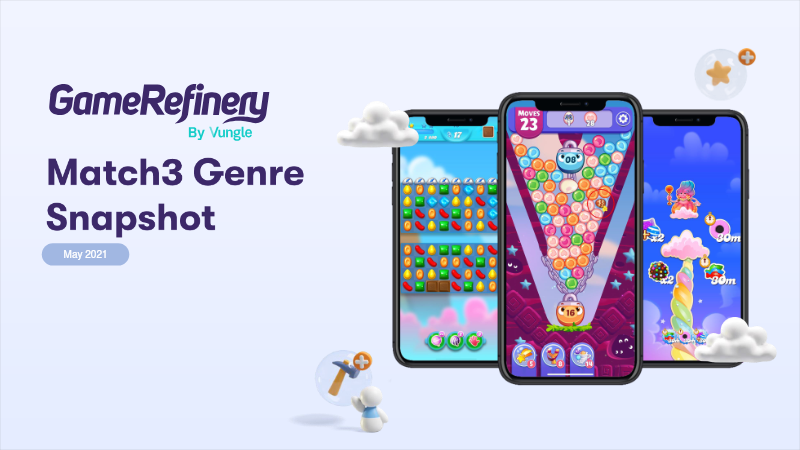
The Match3 subgenre represents the largest individual segment of the US iOS mobile gaming market, accounting for approximately 16% of total market revenue as of May 2021. While the category has long been dominated by established titles that have maintained chart positions for years, recent market shifts indicate a move away from traditional swapping mechanics. Notably, none of the new Match3 titles entering the top 500 grossing rankings over the last 18 months utilize standard swapping gameplay, signaling a diversification in core mechanics and the rising importance of meta-layers. Meta-elements, particularly those focused on decoration and customization, have become essential components for modern success in the genre. Successful megahits like Royal Match and Project Makeover demonstrate the effectiveness of combining core puzzle gameplay with deep progression systems and sophisticated monetization strategies. Data indicates that recurring live events, special event rewards, and limited-time in-app purchase offers have the highest impact on revenue. Furthermore, social features such as guild mechanics and "send/ask help" systems are increasingly vital for driving engagement and retention. Player motivation analysis, based on a survey of over 7,000 mobile gamers across English-speaking Western markets, reveals distinct psychological drivers within the genre. While "Thinking and Solving" remains the primary driver for traditional titles like Candy Crush Saga, newer successful entries increasingly lean into "Customization and Decoration" and "Role-playing and Emotions." This shift reflects a broader industry trend where loss aversion mechanics and social competition are leveraged to enhance the player experience and maximize lifetime value in a highly competitive landscape.
The Match3 subgenre represents the largest segment of the US iOS mobile gaming market, accounting for approximately 16% of total revenue as of mid-2021. While established titles have dominated the charts for years, the landscape is evolving through the integration of complex meta-layers and sophisticated monetization strategies. Notably, every new Match3 title that entered the top 500 grossing rankings between late 2019 and early 2021 utilized traditional swapping mechanics, signaling a preference for familiar core gameplay enhanced by modern secondary features. Meta-elements, particularly customization and decoration, have become essential components of modern Match3 success. Recent megahits like Royal Match and Project Makeover demonstrate this trend by blending core puzzle mechanics with narrative progression and aesthetic choices. Beyond gameplay, monetization has shifted toward loss aversion mechanics and diverse live operations. Data indicates that recurring live events, special event rewards, and limited-time in-app purchase offers have the highest impact on revenue. Social features, including guild mechanics and "send/ask help" systems, further bolster engagement and retention within the subgenre. Player motivation analysis, based on a survey of over 7,000 mobile gamers across major English-speaking markets, reveals distinct psychological drivers. While traditional titles like Candy Crush Saga rely heavily on the "Thinking & Solving" and "Completing Milestones" drivers, the broader Match3 market is increasingly leaning into "Customization & Decoration." This shift highlights a move away from pure puzzle-solving toward a more expressive and multi-layered player experience. The findings suggest that future growth in the category depends on balancing core puzzle mastery with social competition and deep meta-progression.
The casual gaming sector experienced significant growth and volatility between March 2020 and February 2021, driven largely by shifting consumer habits during the COVID-19 pandemic. While mobile gaming spend surged to nearly triple that of PC and console platforms, the market became increasingly competitive. Analysis of 246 million installs across 416 apps reveals that while the audience for casual titles is massive, the cost to acquire these users has risen sharply. The average cost-per-install (CPI) for casual games increased by 45.2% year-over-year to $1.96, while return-on-ad-spend (ROAS) saw a corresponding decline, dropping 7.5 percentage points to 29.6% by Day 30. Market dynamics vary significantly by sub-genre and platform. Lifestyle games emerged as the most expensive to acquire at $2.57 per install but offered the highest engagement, yielding a Day 7 ROAS of 22.5%, which far outperforms Puzzle and Simulation categories. Platform trends indicate a strategic shift toward Android, where CPIs surged by 120% as marketers prepared for privacy changes on iOS. Despite this, iOS remains the more expensive platform, with an average CPI of $4.30 compared to $1.15 on Android. Geographically, North America remains the most expensive region for user acquisition, while APAC and EMEA offer more cost-effective opportunities. Countries such as France, Germany, and South Korea are highlighted as high-performance markets with relatively low CPIs and strong ROAS. To combat rising costs and diminishing returns, the findings suggest a heavy reliance on creative experimentation, particularly through playable ads, which saw a 113% increase in usage. The data indicates that success in the current landscape requires balancing localized strategies with high-engagement ad formats to convert increasingly distracted global audiences.
The evolution of gaming from localized, offline experiences to global, interconnected online environments necessitates a modern approach to parental guidance and family communication. The primary purpose of this guide is to bridge the generational gap between parents and children by providing a framework for establishing mutually agreed-upon rules for safe and responsible gaming. It emphasizes that while the technology and accessibility of games have shifted from television-bound consoles to ubiquitous mobile and cross-platform devices, the fundamental need for trust and clear boundaries remains constant. The analysis highlights significant shifts in the gaming landscape, noting that modern play is no longer restricted by age, geography, or hardware limitations. Because online environments allow for real-time interaction with diverse global participants, the risks and social dynamics have become more complex. To address this, the guide advocates for a collaborative rule-setting process that prioritizes the child’s developmental stage and specific gaming context. Effective agreements should be flexible, evolving alongside the child’s maturity, and should be rooted in open dialogue rather than rigid, top-down restrictions that may fail to account for the realities of online events or social gaming commitments. Furthermore, the guide underscores the importance of digital literacy for parents, encouraging them to familiarize themselves with common gaming terminology and technical concepts such as in-app purchases, server stability, and online etiquette. By understanding these elements, parents can provide more informed advice regarding security, privacy, and behavior. Ultimately, the document concludes that gaming rules should function as a shared commitment to safety and mutual respect, ensuring that the gaming experience remains a positive and secure activity for children as they navigate increasingly sophisticated digital worlds.
The Q4 2025 investor presentation details a period of record financial performance for the company, characterized by significant revenue growth and successful strategic integration. The primary thesis centers on the company’s transformative year, highlighted by the successful consolidation of Plarium and a shift toward a midcore gaming focus. For the fourth quarter of 2025, the company achieved net sales of SEK 3,123 million, representing an 8% organic growth rate and a 108% increase in constant currency year-over-year. Adjusted EBITDA reached SEK 717 million, maintaining a 23% margin, while unlevered free cash flow totaled SEK 878 million with a 66% conversion rate. The scope of the report covers the global gaming operations of the company throughout the 2025 fiscal year, with specific emphasis on the fourth quarter. Key operational findings indicate that user acquisition (UA) spending rose to 38% of revenue in Q4, a 98% year-over-year increase in constant currency, largely driven by the integration of Plarium and the scaling of casual and racing franchises. Revenue streams showed a notable shift, with direct-to-consumer contributions rising 600 basis points to 32% of the total. Franchise performance was bolstered by strong results in the racing and word game segments, which saw year-over-year growth of 43% and 28%, respectively. Methodologically, the financial data is presented on a reported basis, with constant currency adjustments applied to isolate organic growth trends. The report incorporates full-year 2025 figures and highlights the impact of the Plarium acquisition, which was integrated into the group starting in February 2025. Looking ahead, the company concludes the period with a stable leverage ratio and a new organizational structure, positioning itself for continued midcore expansion and the potential public offering of its PlaySimple division.