Game Development reports and market data
Documents
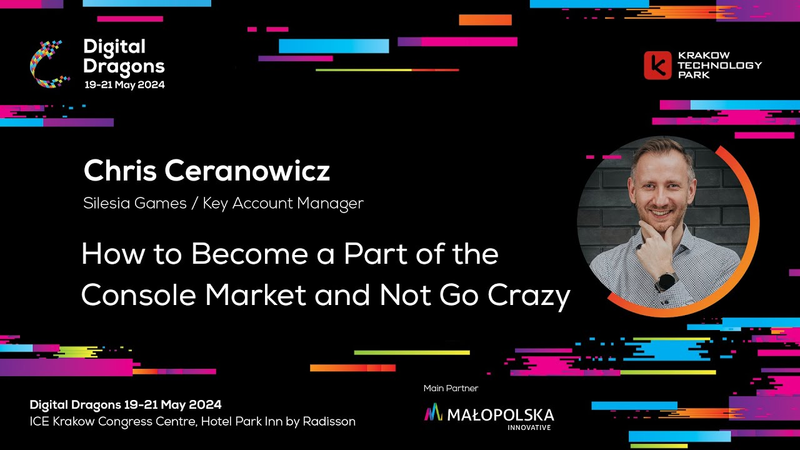
Silesia Games - How to Become a Part of the Console Market and Not Go Crazy
Expanding a game’s reach from PC to console environments requires a strategic approach to technical development, rigorous quality control, and navigation of complex platform-specific certification standards.
- Console platform holders like Nintendo and Microsoft enforce strict, non-negotiable rules for marketing materials, such as prohibiting the depiction of non-console digital devices or specific controller brands in trailers.
- Porting projects require significant technical overhead due to evolving SDKs; for example, the Nintendo Switch SDK versioning has advanced from version 6 to 18 over a five-year period.
- Developers should prioritize signing an NDA before sharing source code with a publisher, as this document is essential for protecting intellectual property and ensuring the developer retains ownership of their code.

Panel: Show Me the (private capital) Money! Let’s Discuss Unlocking GameDev Dollars
The contemporary investment landscape for game development has transitioned from the speculative, post-pandemic environment toward a more disciplined, data-driven model.
- Investors prioritize studio identity and long-term viability over individual projects, specifically evaluating the founders' track records and the studio's ability to address unmet consumer needs in a novel way.
- Polish game development studios are gaining international attention due to a deep talent pool, high product quality, and a culture of community-driven iteration, as seen in the success of studios like Vinci Games.
- Early adoption of emerging technologies, such as Houdini or generative AI, provides smaller, agile teams a competitive edge over large-scale AAA studios that struggle with rigid, slow-moving production processes.
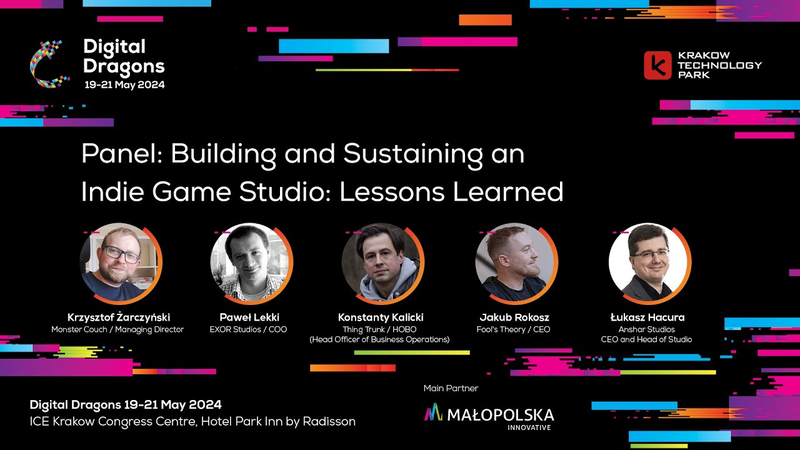
Panel: Building and Sustaining an Indie Game Studio: Lessons Learned
Achieving long-term viability in the independent game industry requires a strategic blend of financial discipline and operational agility.
- Studio sustainability is best achieved through a 'brick-by-brick' approach, where profitable external engineering projects or contract work fund the development of original IP to avoid reliance on publishers.
- Scaling a studio beyond 8 to 15 employees creates significant communication friction, requiring a shift from informal, open-space collaboration to structured, remote-first communication protocols even for on-site teams.
- To maintain lean operations, studios should prioritize automation and internal technology development, such as building proprietary engines and scripting tools to reduce repetitive manual tasks during production.
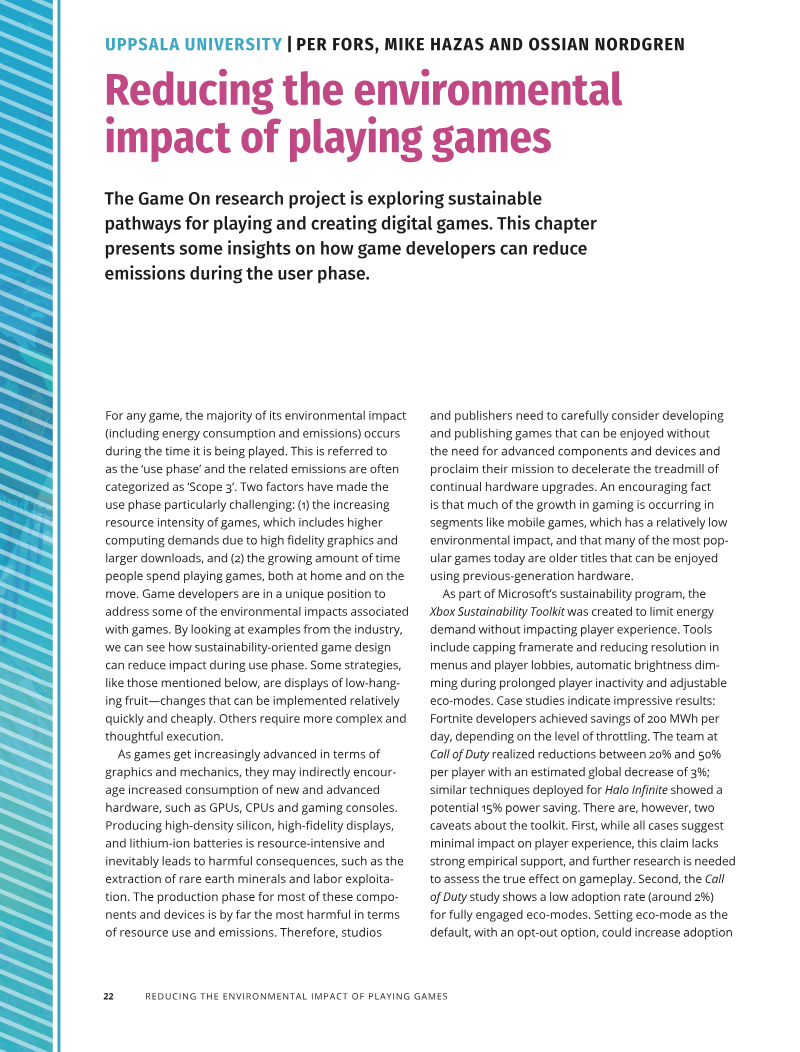


Game Development and the Green Transition: Code, Climate, Creativity
Swedish game development combines a small direct carbon footprint with large potential to support the green transition.
- The Swedish games industry grew nearly 900% in turnover between 2012 and 2023, reaching €3.1 billion while maintaining a relatively low carbon footprint compared to other industrial sectors.
- Scope 3 emissions—primarily generated by energy consumption during player use—account for 90–99% of the Swedish games sector's total carbon footprint.
- Global gaming emissions are estimated at 14 Mt CO₂e annually, roughly equivalent to the total industrial emissions of Sweden.
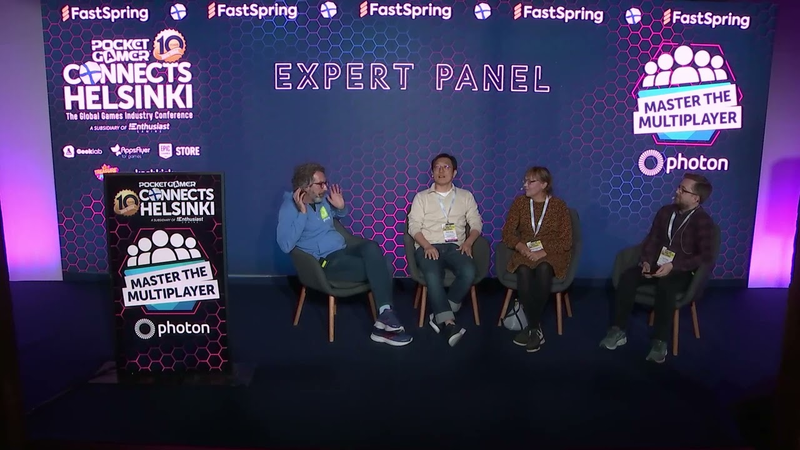
Panel: PvE or PvP: Multiplayer Game Design Considerations
The fundamental choice between player-versus-environment and player-versus-player design should be dictated by the intended player experience rather than prevailing industry trends.
- Multiplayer game design should be driven by the intended player experience—such as teamwork, social interaction, or competition—rather than following industry trends or choosing between PvE and PvP based on technical difficulty alone.
- Competitive multiplayer games are generally more technically challenging to develop than cooperative PvE games due to the unpredictability of human opponents and the complexity of synchronizing physics-based interactions.
- Developers should prioritize core game design over adding excessive social features, as features like leaderboards and chat are only valuable if they meaningfully enhance the gameplay experience rather than acting as irrelevant additions.
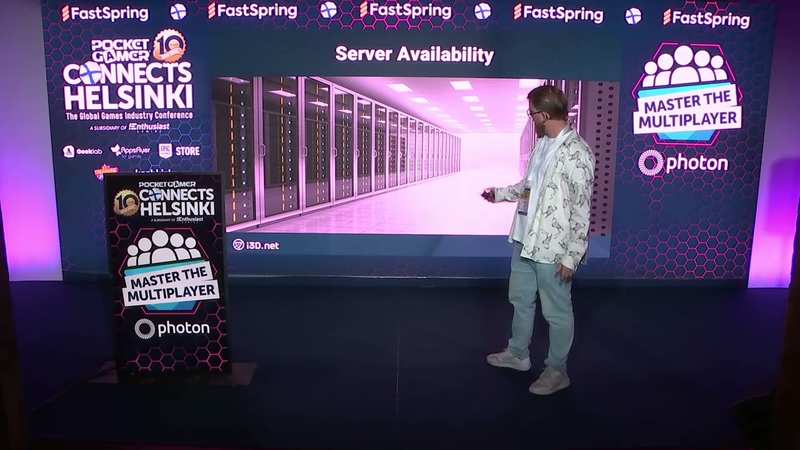
Session: No More BS: Demystifying Game Hosting Beyond Marketing Speak - Lucas Tak, i3D.net
Effective multiplayer game hosting requires balancing high-quality player experiences with strict cost management.
- To minimize latency, game servers must be physically located near the player base to overcome the speed-of-light limitations inherent in data transmission.
- A hybrid hosting strategy is the most effective approach, combining the rapid scalability of cloud computing for fluctuating player counts with the cost-efficient, high-performance nature of bare metal servers for steady-state traffic.
- Direct peering agreements with local internet service providers are essential to bypass inefficient public routing, which reduces both latency and unnecessary bandwidth costs.

Traditional Quizzing with a Twist: Involving University Students in the Development Process
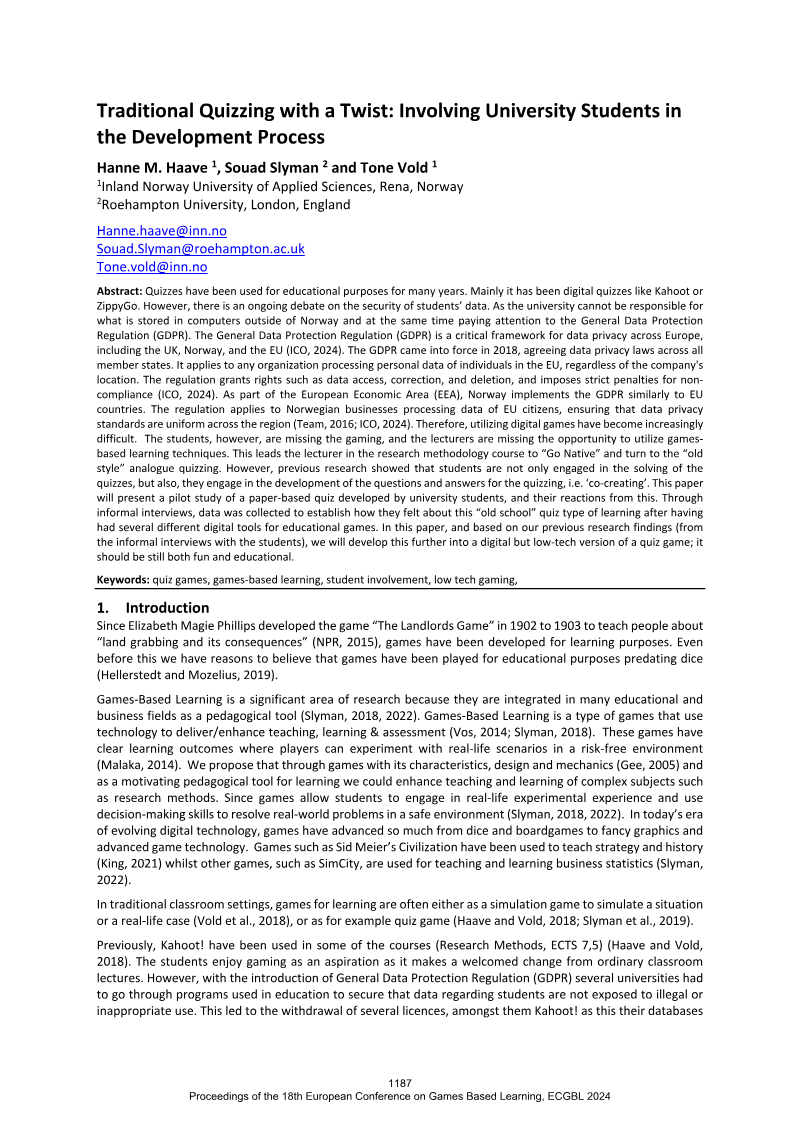
This pilot study by Haave, Slyman, and Vold, based at Inland Norway University of Applied Sciences and Roehampton University, examines how a low-tech, paper-based quiz developed by university students can support games-based learning in a research methods course.
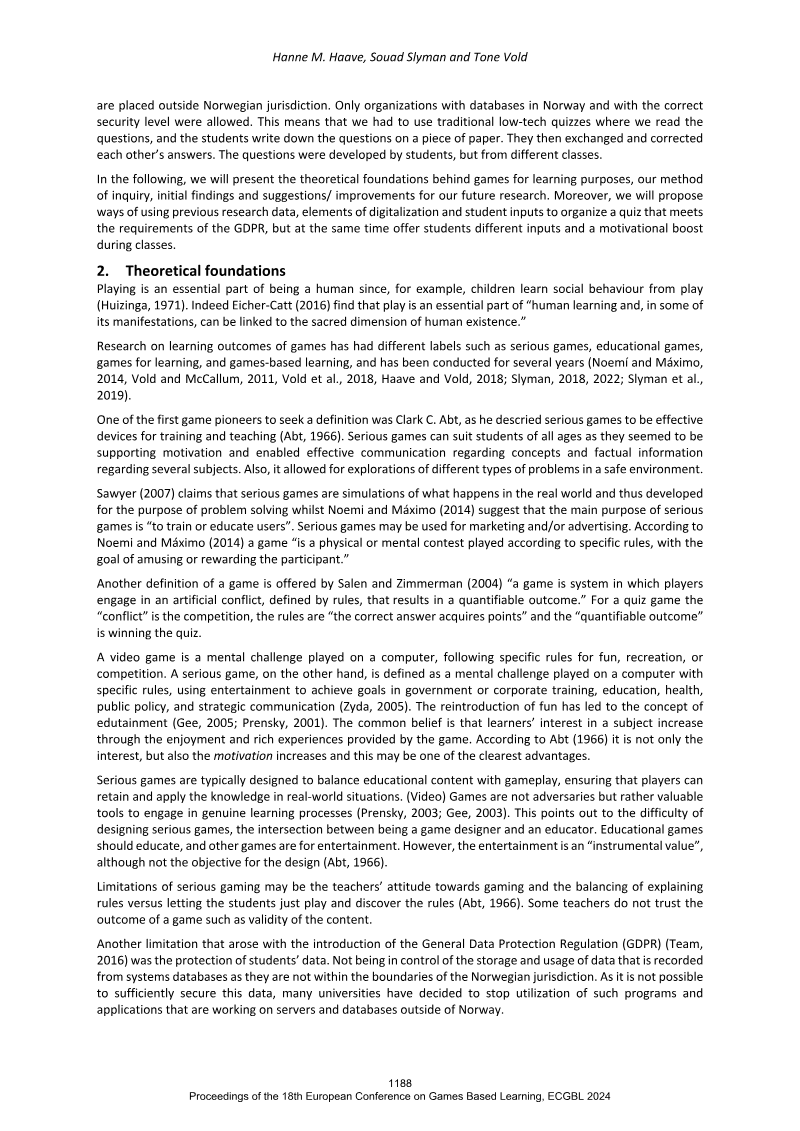
- Analogue, paper-based quizzes written by students offer a way to keep games-based learning engaging while complying with GDPR, after several Norwegian universities withdrew licences for platforms like Kahoot! because their servers sat outside Norwegian jurisdiction.
- The authors frame the approach as linking student co-creation, low-technology design, and data-protection compliance within a single pedagogical model for games-based learning.
- The evidence is a small, exploratory qualitative pilot based on informal group interviews with students in a single research methods course at one institution, so the authors describe its conclusions as preliminary.

How Studio Culture Fuels an Exit (with Seth Sivak)
Organizational culture serves as a fundamental driver of success in the game industry, acting as the primary mechanism for attracting top-tier talent and building the resilience necessary to navigate market volatility.
- Studio culture must be treated as a core operational foundation rather than a peripheral concern to effectively compete against larger industry incumbents.
- To avoid cultural debt during rapid scaling, studios must transition from informal, ad-hoc communication to structured, intentional operational processes.
- Effective organizational culture is built on actionable norms like rapid iteration and accountability, which should be integrated into daily operations and performance reviews rather than static slogans.
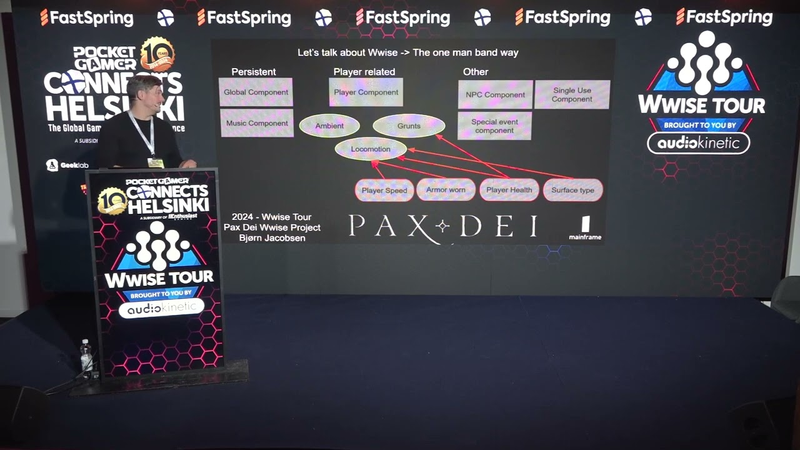
Session: One Man Band AAAudio Department - Bjørn Jacobsen, Mainframe Industries.
Managing the audio landscape for a massive, systemic open-world title like Pax Dei requires a shift from manual asset triggering to a highly automated, data-driven architecture.
- A solo audio lead can achieve AAA-level fidelity in a systemic open-world game by prioritizing a data-driven Wwise architecture over manual asset triggering.
- The system utilizes global RTPCs, states, and switches that update every half-second to dynamically adjust audio based on variables like altitude, weather, time of day, and terrain slope.
- Performance in dense environments is maintained through component pooling, persistent audio components, and strict voice management that limits active virtual voices to the player's immediate biome.

Session: Navigating 50 Years of Evolution in Interactive Audio - Simon Ashby, Audiokinetic.
The evolution of interactive audio over the past half-century reflects a continuous tension between hardware limitations and creative ambition.
- Future interactive audio production faces a massive scaling challenge, with some upcoming titles projected to require up to 50 million individual audio elements.
- To manage exponential asset growth without unsustainable headcount increases, the industry must transition to AI-driven workflows for tasks like mixing, text-to-speech, and procedural sound propagation.
- The evolution of interactive audio has been defined by a shift from hardware-dependent sound design to flexible, sample-based workflows that decouple creative goals from technical constraints.
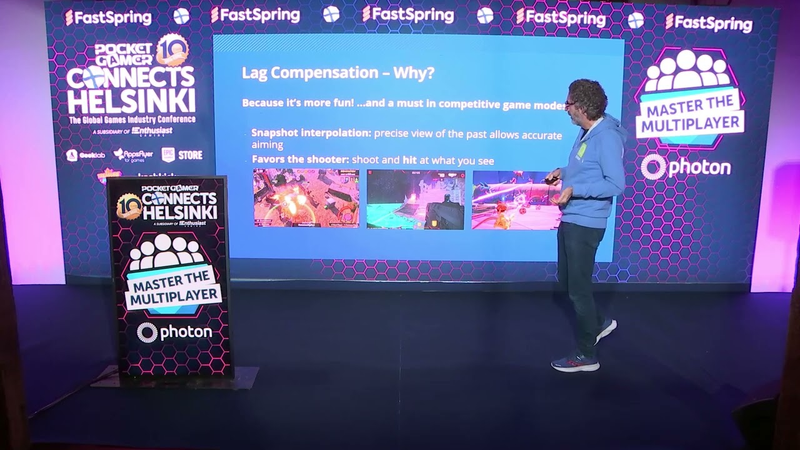
Session: Multiplayer Mastery: Key Considerations for a Successful Start - Robert Boehm, Photon.
Effective multiplayer game development requires strategic planning and a deep understanding of network architecture before production begins.
- According to the 2024 Unity Gaming Report, only 62% of game studios perform formal planning before beginning multiplayer production, a critical oversight given the technical complexity involved.
- Multiplayer game architecture requires managing latency and jitter through fundamental netcode techniques, including snapshot interpolation, client-side prediction, and lag compensation, to ensure a playable experience.
- Choosing the correct network topology is essential for project success; options include state synchronization (for general objects) or deterministic engines (for specific genres like fighting games or racing sims).
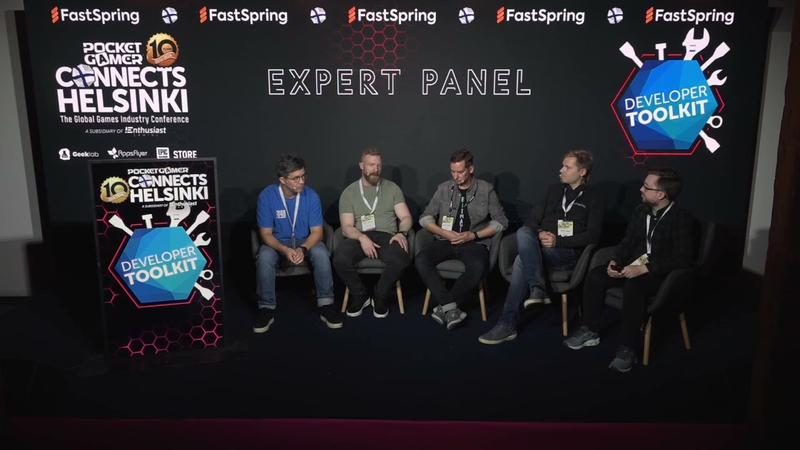
Curated Panel: Behind the Game: Strategies for Building the Tech That Powers Today’s Top Titles.
Modern game development necessitates a strategic shift toward early-stage commitment to live-service models, where technical infrastructure and monetization strategies are integrated into the initial prototyping phase.
- Building internal tools carries significant long-term maintenance overhead and documentation requirements, making third-party middleware the preferred choice for most studios unless the technology is a core strategic differentiator.
- Live operations require distinct skill sets and team structures compared to the incubation phase, with successful scaling often necessitating a transition from small, multi-functional teams to specialized groups focused on content, scheduling, and live service management.
- Modern game development requires integrating live-ops and service-experience infrastructure into the project from the very beginning, rather than treating them as post-launch additions.
Writers
Games and companies
Games