Updated Mar 17, 2026 by Dataspelsbranschen
Report · October 24, 2024
Published by Dataspelsbranschen
**Executive Summary – “Code, Climate, Creativity: Game Development and the Green Transition”** --- ### 1. Rapid Industry Growth, Low Relative Carbon Footprint - **Turnover:** €427 M (2012) → **€3.1 B (2023)** – a **≈ 900 %** increase. - **Employment:** > 9 000 people across **1 000+ firms**; **87 %** are micro‑enterprises (≤10 staff). - **Carbon Profile:** Despite the boom, the Swedish games sector’s emissions remain modest compared with other Swedish industries. - **Electricity & travel:** only a slight rise. - **Scope 3 (down‑stream) emissions** dominate, mainly from the energy used while players are gaming. **Key Insight:** The sector’s carbon intensity is low, but the sheer scale of downstream use means total emissions can still be significant. --- ### 2. A Dense, Emerging Climate‑Action Network - **Handbooks & Alliances:** Nordic *PlayCreateGreen* guide, UN‑backed *Playing for the Planet* Alliance, European *Sustainable Games Alliance*. - **Industry Footprint:** Global gaming ≈ **14 Mt CO₂e** (≈ Sweden’s total industrial emissions). - **Swedish Share:** **2.3 kt CO₂e (2022)** – **0.015 %** of national industry output. - **Emission Distribution:** **90‑99 %** of Swedish games‑sector emissions are Scope 3. **Take‑away:** A well‑connected ecosystem of NGOs, academia, and industry is already mobilising around measurement, best‑practice sharing, and player engagement. --- ### 3. Scope 3 Dominance & Regulatory Pressure - **Average Intensity:** **≈ 99 t CO₂e per MEUR of turnover** → **≈ 302 kt CO₂e total** for Swedish firms. - **Potential Reduction:** Up to **90 %** cut if all players switch to fossil‑free electricity. - **Policy Landscape:** - **Science‑Based Targets initiative (SBTi):** Requires Scope 3 reduction targets for developers. - **EU Corporate Sustainability Reporting Directive (CSRD):** Will soon mandate detailed Scope 1‑3 disclosures. **Implication:** Companies must embed Scope 3 accounting into strategy now, not later. --- ### 4. Where Scope 3 Emissions Come From - **Primary Sources:** Production & use of **consoles** and **PCs**. - **Emerging Mitigation:** **Cloud‑gaming** and **thin‑client streaming** can lower the energy needed for high‑performance gaming, but the net impact depends on data‑center efficiency and network load. --- ### 5. Sweden’s R&D Strength – A Launchpad for Green Tech - **Opportunities:** - Strong **certification schemes** and a culture of **open innovation**. - Existing **digital‑tool stack** (game engines, GPUs, XR platforms,
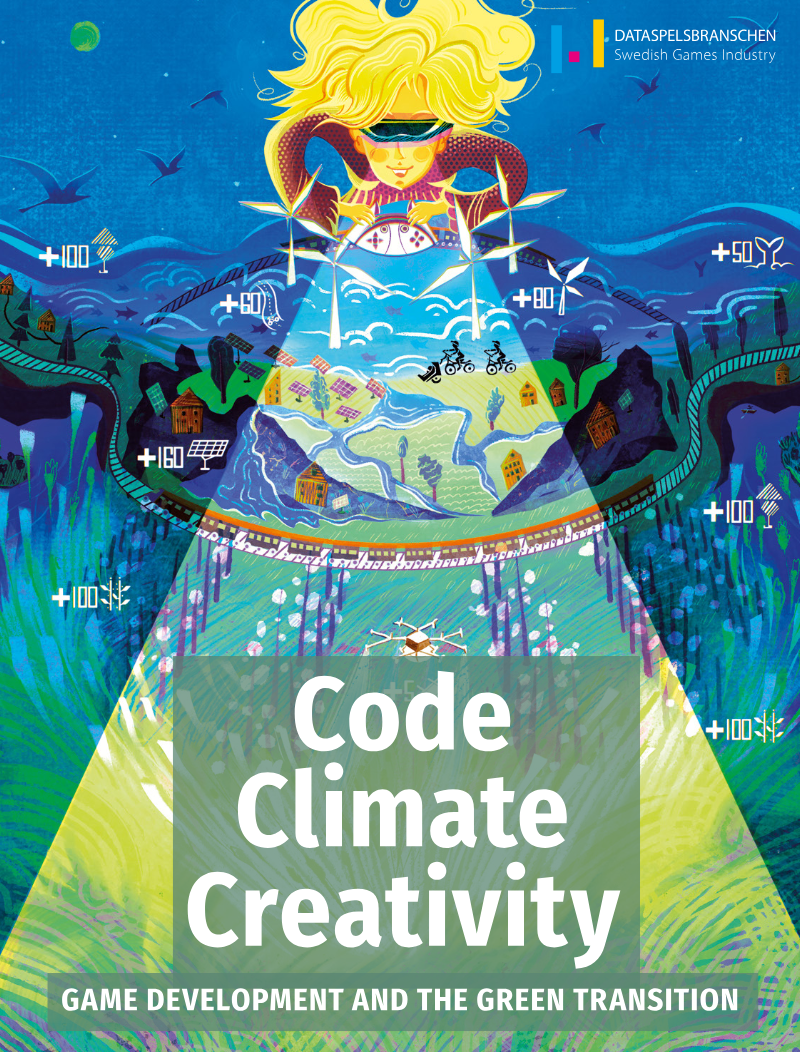
Swedish Games Industry +100 +50 +80 HR +160 ARPR +100 Code +100 Climate Creativity GAME DEVELOPMENT AND THE GREEN TRANSITION CODE, CLIMATE, CREATIVITY 1
Kapitelnamn Net quaecul parcia nos dis seres estio verciis Occum et eaquam evenim id mo tempore hentem illuptatiis videm nosam repta veliquas dolluptaerum qui aut mo volupta iusam dolestrum quiatet labore mo dolorat. Third edition December 2024 This is the final report for project SUSINDI – a collaboration between the Swedish Games Industry, RISE, Game Habitat and U&We, with funding from Vinnova. Project group: Marléne Tamlin, Johanna Nylander, Per Strömbäck, Elin Carlsson, Björn Flintberg, Gabriella Kalteneckar, Linnéa Svenman Wiker, Peter Lübeck, Elin Arvidsson, Erik Sundberg, Anna Larsson Corcoran and Amanda Möttönen Operational project manager: Marléne Tamlin Published by The Swedish Games Industry Editors: Marléne Tamlin, Elin Carlsson, Johanna Nylander Layout: Emilie Ihre Illustration, cover: Yelyzaveta Anysymova, lisasobacca.art Translation: Sarah Fagerström Contact: [email protected] The report is printed on FSC-labelled paper. Dataspelsbranschen | Swedish Games Industry Magnus Ladulåsgatan 65, SE-118 27 Stockholm swedishgamesindustry.com 2 KAPITELNAMN
Content in brief Foreword 4 The carbon footprint of Swedish game companies is Sustainable development 6 low, both compared with other industries in Sweden and The games industry in sweden 9 the games industry internationally, and several compa- Overview – green engagement in 11 nies are at the forefront. The greatest consumption of the games industry resources occurs when games are played, which is more Footprint – reducing 15 difficult to measure. Global investments in fossil-free negative impacts energy and circular economy are important for the indus- Emission data and regulatory 16 try to reach zero emissions throughout the value chain. frameworks The new Play, Create, Calculate toolbox helps game Play, Create, Calculate – a toolbox 20 for calculating emissions (U&We) studios calculate their emissions. The most essential actions to reduce emissions from game development are Reducing the environmental 22 choosing fossil-free energy and reviewing purchases of impact of playing games (Uppsala University) electronics, server services and travel. Efficiency improvements and eco-modes in games can reduce the resource Handprint – spreading 25 needs of the player. the positive effects Direct benefits of games 26 Technologies, methods and lessons learnt from Climate, digitalisation 28 games are needed in the green transition. These tools and intangible value are important for people, society and industry. The role Technical, commercial 30 of games as innovation catalysts can be strengthened and financial resources through research, room for cross-sectoral creative meet- Spreading game innovation (RISE) 32 ings and dissemination of good practices.
value are important for people, society and industry. The role Technical, commercial 30 of games as innovation catalysts can be strengthened and financial resources through research, room for cross-sectoral creative meet- Spreading game innovation (RISE) 32 ings and dissemination of good practices. Games also build relationships and practise skills that are important Voice – contributing to 41 for sustainability and resilience. dialogue and engagement Game creators and the art 42 Games are digital, creative and intangible rather of changing the world than physical, contributing to the dematerialisation of Unique creative works 47 the economy. Playing games is a relatively low-emission Inspiration 51 activity compared to many alternative interests. There is a need for deeper analysis on how intangible value in Information 54 general can contribute to a more sustainable economy. Interaction 59 The transformative power of (game) culture and art Analysis and conclusions 64 requires artistic freedom and infrastructure to create About the report 66 more opportunities for creators and new ideas. Art’s ability to evoke emotions and dialogue has always played an important role in major societal changes and games are one of the most important cultural expressions today.
4 requires artistic freedom and infrastructure to create About the report 66 more opportunities for creators and new ideas. Art’s ability to evoke emotions and dialogue has always played an important role in major societal changes and games are one of the most important cultural expressions today. The reach of games can be an opportunity to raise money, knowledge and engagement – provided it suits the game’s creators, narrative, mechanics and audience. Sharing experiences and contacts can expand these opportunities. The challenge, uniqueness and strength of games is the interactive and changing nature of games where players are co-creators.
Foreword No Games on a Cooked Planet In June 2019, around 50 leaders from games companies across the Nordic region met on the idyllic Danish island of Bornholm to discuss the future of the industry. The number one issue was to be selected. There was no shortage of suggestions: access to capital, international competition, new markets, consolidation, skills shortage, budget inflation and much more. But it was the climate that ‘won’. If we can’t solve the climate crisis, there is no point in thinking about the other problems. There are no games on a cooked planet. This report is about how digital innovative industries can help reduce human climate impact. We choose to use digital games made in Sweden as an example, but we hope that the analysis and suggestions can be applied to other industries and countries. Should we have to sacrifice our standard of living for the climate? There are many suggestions on how to get out of this conundrum. Digitalisation, servitization and electrification are often mentioned as pathways to green growth. Games encompass all of these: they are of course digital, they have long since moved from being products to being services, and electricity is the energy that powers computers, servers and game devices. Games are intangible. They have no physical form, they are ephemeral, changeable. But they have great value. The intangible value creation is a suggestion of how economic development can be sustainable. In 2012, the Swedish games industry had a modest turnover of EUR 427 Million. Ten years later, the industry in Sweden had a turnover of EUR 3.1 Billion. An increase of almost 900% in a decade.
Sweden’s gaming sector is positioned as a low‑impact yet high‑potential catalyst for the nation’s green transition. Compared with other Swedish industries and the global gaming market, the sector’s carbon emissions are modest, with the majority of resource use occurring during gameplay—a phase that remains difficult to quantify. By leveraging built‑in eco‑modes, energy consumption can fall by 20‑50 % per player, yet adoption is currently around two percent; making such modes the default could raise the estimated global saving to three percent. The report highlights how core gaming technologies—game engines, GPUs, extended reality and artificial intelligence—are already being transferred to sectors such as infrastructure, mining and climate modelling, delivering measurable efficiency gains and emission reductions. Immersive tools like AR/VR, digital twins and AI are deployed in public‑sector pilots, including Sweco’s metaverse dialogue platform, Nacka’s “Greenovation Twin” and Vasakronan’s Twinfinity, to visualise climate impacts, streamline urban planning and cut travel‑related emissions. Hackathons and serious‑game prototypes further accelerate climate‑focused solutions, while gamified training and board‑game initiatives foster behavioural change and generate transport‑usage data. Design guidance stresses that games must promote collective action and embed climate objectives into social norms, rather than focusing solely on individual behaviour. Educational programmes and events such as the 2023 Green Game Jam, which linked gameplay to snow‑leopard conservation and generated donation‑linked purchases, demonstrate the sector’s capacity to mobilise large audiences—evidenced by the UN‑backed “Peoples’ Climate Vote” reaching thirty million mobile users. Collaboration across more than fifty studios
The 2024 overview of Sweden’s games industry presents a comprehensive assessment of the sector’s performance, challenges, and forward‑looking dynamics within the Swedish market. It argues that, despite a noticeable wave of studio closures, the industry remains resilient and is entering a phase of regeneration driven by regional clusters, targeted investment schemes, and internationally successful titles. Analysis of the year shows that development activity is increasingly concentrated in hubs such as Skövde, where new studios have emerged and produced world‑hit games like *Satisfactory*, a title that secured both D.I.C.E. and Golden Joystick awards. This creative output underscores Sweden’s capacity to generate globally competitive products even as legacy firms exit the market. Growth is attributed largely to coordinated programmes—including Redeye Gaming Day, Invest in Games, and the EU‑funded CDG‑Booster mentoring cohort—that channel capital, mentorship, and market access to emerging developers. The findings highlight a sector that, while contending with consolidation pressures, is expanding its export footprint and sustaining employment through the formation of new companies and the scaling of award‑winning projects. Investment in talent development and cluster formation emerges as a decisive factor in maintaining Sweden’s reputation as a leading European game‑development hub. Overall, the 2024 snapshot confirms that Sweden’s games industry, spanning development, publishing, and ancillary services, continues to generate significant economic value and cultural impact, positioning itself for sustained growth in the coming years.
The analysis evaluates the health and trajectory of Sweden’s video‑game sector during 2023‑24, mapping its economic performance, creative output, ecosystem structure and emerging challenges. By quantifying sales, employment, investment and cultural impact, it argues that the industry remains a growth engine for the Swedish economy while confronting structural constraints that could limit future expansion. Domestic net sales rose 6 % to SEK 34.6 billion (≈ EUR 3 billion, USD 3.2 billion) and total global revenue reached SEK 90.4 billion, a 4.5 % increase. The number of registered firms grew by 108 to 1,010, and Swedish‑owned companies expanded overseas to 218 subsidiaries in 54 countries, employing 15,792 staff abroad, of whom 29.5 % are women. Major titles such as Helldivers 2 (12 million copies in three months) and Satisfactory (6 million copies and a console launch) reinforced Sweden’s market presence, while Steam and Twitch data showed Swedish games accounting for over 700 million streamed hours in 2023 and nearly 500 million from January‑October 2024. The ecosystem is heavily concentrated in Stockholm, home to 439 studios and 5,816 employees, with secondary hubs in Skåne‑Blekinge, Västra Götaland, Västerbotten‑Norrbotten and Östergötland. Educational provision spans bachelor, master and vocational programmes, serving roughly 700 students across multiple institutions. Inclusion initiatives have broadened participation, exemplified by a game‑developer camp for about 100 gender‑diverse teens and a network of scholarships and mentorships. Nevertheless, early‑stage capital has weakened, talent pipelines remain thin—with only 644 new hires in 2023 and rising work‑permit refusals—and public‑health screen‑time guidance remains ambiguous. Capital flows revived in 2023‑24, highlighted by Embracer’s SEK 4.9 billion sale of Gearbox to Take‑Two and EQT’s SEK 28.7 billion acquisition of
The Swedish games industry reached a significant financial milestone in 2022, with domestic revenues rising 13% to €3.1 billion and total global revenue, including foreign subsidiaries, surging 40% to €8.1 billion. This growth is characterized by a massive international footprint, as Swedish-owned companies now operate nearly 400 studios across 59 countries. Large-scale acquisitions, such as Embracer Group’s multi-billion euro purchase of Asmodee, have shifted the employment landscape, resulting in Swedish firms employing nearly twice as many people abroad as they do domestically. Within Sweden, the number of active companies grew by 20% to 939, supported by a maturing ecosystem of regional hubs and specialized educational programs. Despite this commercial success, the industry faces a critical production capacity bottleneck driven by a chronic shortage of skilled labor. While domestic employment grew to over 8,400 positions and diversity improved—with women accounting for over 44% of new entrants—the sector remains heavily dependent on foreign recruitment to sustain its trajectory. Furthermore, Swedish startups face a competitive disadvantage due to a lack of formal financial support structures compared to other European nations, forcing many to rely on organic growth or early acquisition rather than domestic venture capital. The sector is also navigating complex structural and environmental challenges. Sustainability efforts are increasingly focused on Scope 3 emissions, which represent over 99% of the industry’s carbon footprint, while legal and ethical concerns regarding generative AI and online radicalization have emerged as new operational risks. Geopolitical instability, particularly the war in Ukraine, continues to impact global workforces. Nevertheless, the integration of the Swedish E-sports Association into the Swedish Sports Confederation and the continued dominance of major entities like King, Mojang, and Stillfront Group underscore Sweden’s position as a premier global hub for game development and digital entertainment.