Nintendo
Game Co.9 documents
Documents
Financial27 pages
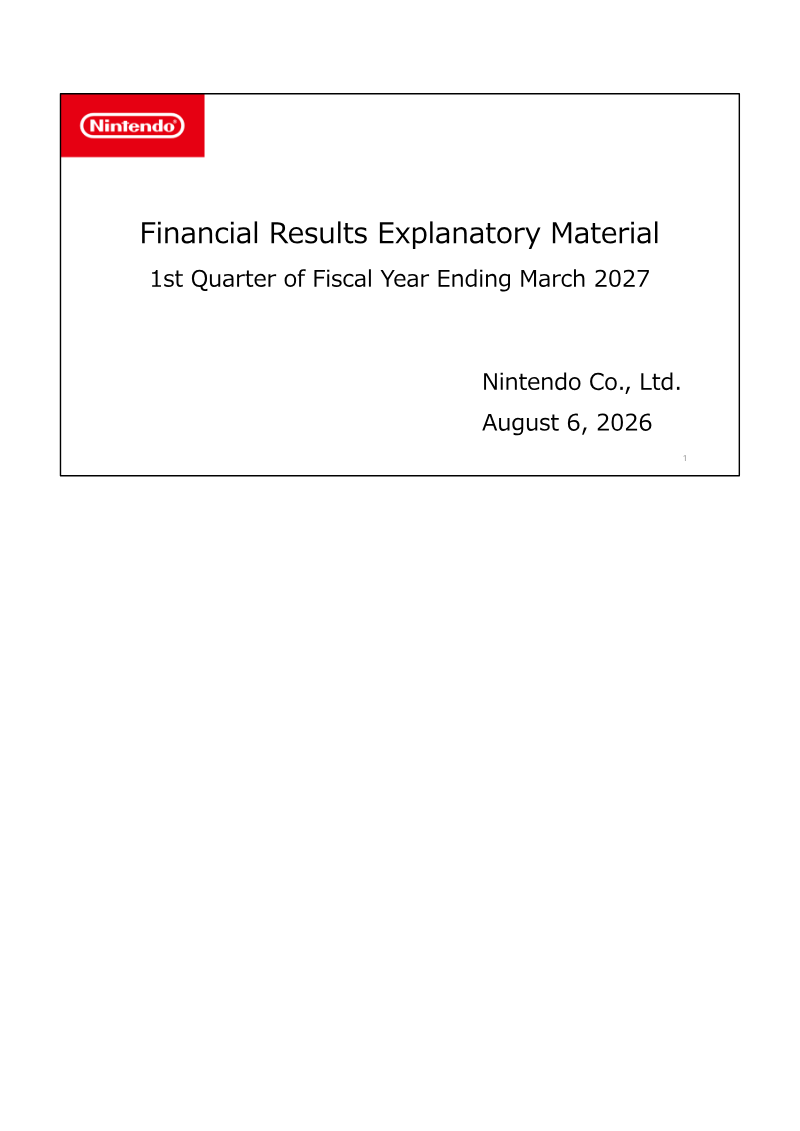
Financial Results Explanatory Material: 1st Quarter of Fiscal Year Ending March 2027
Nintendo’s financial performance for the first quarter of the fiscal year ending March 2027 reflects a strategic transition between hardware generations. While net sales experienced a 9.5 percent year-on-year decline due to the anticipated cooling of legacy hardware demand, the company achieved a 150.5 percent surge in operating profit, reaching 142.5 billion yen. This profitability was driven by a combination of IEEPA tariff refunds, high-margin digital software sales, and substantial revenue contributions from intellectual property licensing. Annual active users remain resilient, consistently exceeding 100 million, which provides a stable foundation for the ongoing transition to the Nintendo Switch 2 ecosystem.
The current hardware strategy centers on the rapid adoption of the Nintendo Switch 2, which recorded 382,000 units sold during the quarter. Management maintains a confident full-year outlook, projecting 16.5 million hardware units and 60 million software units, supported by a pipeline of new releases and enhanced software upgrades. First-party titles continue to demonstrate strong commercial viability, exemplified by the success of Tomodachi Life: Living the Dream, which has surpassed 8 million units in global sell-through. Furthermore, the company is successfully diversifying its revenue streams through non-gaming media, as evidenced by The Super Mario Galaxy Movie crossing the 1 billion dollar threshold in global box-office receipts.
To ensure long-term competitiveness, the company is prioritizing infrastructure and research. A significant investment of 121 billion yen is currently allocated toward the construction of a new Technology Development Center, slated for completion in March 2029. By balancing immediate hardware transition costs with sustained investment in intellectual property and internal development capabilities, the company aims to maintain its market position throughout the remainder of the fiscal year and beyond.
- Nintendo achieved a 150.5% surge in operating profit to 142.5 billion yen in Q1 FY2027, despite a 9.5% year-on-year decline in net sales.
- The company is successfully transitioning to the Nintendo Switch 2, which recorded 382,000 units sold during the quarter toward a full-year target of 16.5 million hardware units.
- Profitability was bolstered by IEEPA tariff refunds, high-margin digital software sales, and significant revenue from intellectual property licensing.
- Non-gaming media revenue is a major growth driver, highlighted by 'The Super Mario Galaxy Movie' surpassing $1 billion in global box-office receipts.
- Annual active users remain stable at over 100 million, providing a consistent base for the ongoing hardware transition.
+1
Nintendo
Financial7 pages
Consolidated Financial Highlights: Three Months Ended June 30, 2026
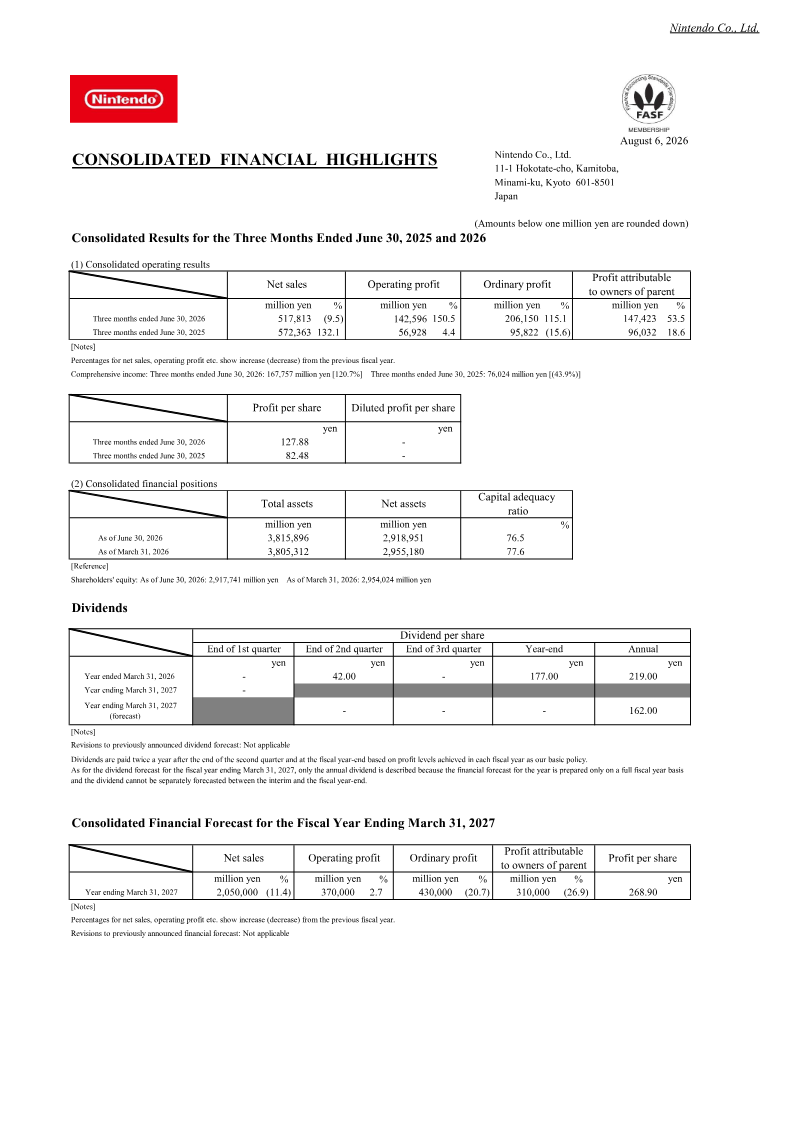
The consolidated financial results for the three months ended June 30, 2026, reflect a period of strategic transition and strong profitability for Nintendo. Despite a 9.5% year-on-year decline in net sales to 517.8 billion yen, the company achieved a significant 150.5% increase in operating profit, reaching 142.6 billion yen. This performance was driven by a favorable shift in the sales mix toward higher-margin software and the impact of non-recurring factors, including the refund of U.S. IEEPA tariffs. Ordinary profit rose by 115.1% to 206.2 billion yen, bolstered by foreign exchange gains and equity method earnings.
The company’s primary business focus remains its dedicated video game platform segment. The Nintendo Switch 2, now in its second year, recorded 3.82 million hardware units sold, supported by a steady software lineup including titles like Yoshi and the Mysterious Book and Star Fox. Simultaneously, the legacy Nintendo Switch platform maintained relevance with 0.66 million hardware units sold and strong software performance, notably from Tomodachi Life: Living the Dream. Digital sales grew by 90.0% to 132.7 billion yen, while the IP-related business saw a 107.4% increase to 34.8 billion yen, largely attributed to the success of The Super Mario Galaxy Movie.
Geographically, the company maintains a global footprint, with 77.9% of sales generated outside of Japan. As of June 30, 2026, total assets stood at 3,815.9 billion yen, with a capital adequacy ratio of 76.5%. Looking ahead, management has maintained its full-year financial forecast for the fiscal year ending March 31, 2027, projecting net sales of 2,050 billion yen and an operating profit of 370 billion yen. The strategy for the remainder of the year centers on expanding the installed base of the Nintendo Switch 2 through a robust release schedule and sustaining engagement across the existing Nintendo Switch ecosystem.
- Nintendo reported a 150.5% increase in operating profit to 142.6 billion yen for the quarter ending June 30, 2026, despite a 9.5% year-on-year decline in net sales to 517.8 billion yen.
- Ordinary profit surged 115.1% to 206.2 billion yen, supported by foreign exchange gains, equity method earnings, and a one-time refund of U.S. IEEPA tariffs.
- Digital sales grew by 90.0% to 132.7 billion yen, while IP-related business revenue more than doubled, rising 107.4% to 34.8 billion yen due to the success of The Super Mario Galaxy Movie.
- The Nintendo Switch 2 sold 3.82 million hardware units during the quarter, while the legacy Nintendo Switch platform contributed an additional 0.66 million units.
- International markets remain critical to the company's financial health, accounting for 77.9% of total sales for the quarter.
+1
Nintendo
Financial30 pages
Financial Results Explanatory Material Fiscal Year Ended March 2025
The financial results for the fiscal year ending March 2025 reflect a period of significant contraction for the company, characterized by a year-over-year decline across all primary performance metrics. Net sales fell by 30.3% to 1,164.9 billion yen, while operating profit decreased by 46.6% to 282.5 billion yen. This downturn was largely driven by a 30.9% decline in revenue from the dedicated video game platform segment, which remains the company’s core business, accounting for the vast majority of total sales.
The decline in performance is attributed to a cooling demand for the aging Nintendo Switch hardware, which saw unit sales drop from 15.70 million in the previous fiscal year to 10.80 million. Software sales also experienced a contraction, falling 22.2% to 155.41 million units. Despite these headwinds, the company maintained a robust digital sales strategy, with the proportion of digital revenue increasing by 3.3 percentage points to 53.5% of total platform software sales. Geographic distribution of revenue remained heavily weighted toward international markets, with 76.4% of sales generated outside of Japan.
Looking ahead to the fiscal year ending March 2026, the company projects a recovery, forecasting net sales of 1,900.0 billion yen and an operating profit of 320.0 billion yen. This optimistic outlook is anchored by the planned launch of the Nintendo Switch 2 hardware on June 5, 2025, supported by a robust pipeline of new software titles and upgrade packs. The company continues to leverage its intellectual property through diverse channels, including visual content and theme park expansions, while maintaining a focus on long-term engagement through its established user base of over 100 million annual playing users.
- Nintendo projects a fiscal recovery for the year ending March 2026, forecasting 1,900.0 billion yen in net sales and 320.0 billion yen in operating profit.
- The company will launch the Nintendo Switch 2 hardware on June 5, 2025, to revitalize its core dedicated video game platform segment.
- Fiscal year 2025 performance saw significant contraction, with net sales falling 30.3% to 1,164.9 billion yen and operating profit dropping 46.6% to 282.5 billion yen.
- Hardware demand for the aging Nintendo Switch declined sharply, with unit sales falling to 10.80 million from 15.70 million in the previous year.
- Software sales contracted by 22.2% to 155.41 million units, though digital revenue increased to 53.5% of total platform software sales.
+1
NintendoMay 2025
Financial25 pages
Financial Results Explanatory Material: 3rd Quarter of Fiscal Year Ending March 2025
Nintendo Co., Ltd. – FY 2025 Q1‑Q3 Financial Results (Explanatory Material) Prepared 4 Feb 2025 – covering the period 1 Apr 2024 – 31 Dec 2024 (FY 25 Q1‑Q3)
1. Core Financial Highlights (FY 24 Q1‑Q3 vs. FY 25 Q1‑Q3)
| Metric | FY 24 Q1‑Q3 | FY 25 Q1‑Q3 | YoY Δ | |--------|------------|------------|-------| | Net sales | ¥1,394.7 bn | ¥956.2 bn | ‑31.4 % | | Operating profit | ¥464.4 bn | ¥247.5 bn | ‑46.7 % | | Operating profit margin | 33.3 % | 25.9 % | ‑7.4 pts | | Ordinary profit | ¥567.3 bn | ¥327.1 bn | ‑42.3 % | | Net profit (profit attributable to owners) | ¥408.0 bn | ¥237.1 bn | ‑41.9 % | | Net profit margin | 29.3 % | 24.8 % | ‑4.5 pts |
The decline is driven primarily by weaker hardware and software sales, a shift toward a higher share of “Other” (merchandise) revenue, and a less favorable foreign‑exchange environment.
2. Revenue Mix
| Category (FY 24 Q1‑Q3) | FY 25 Q1‑Q3 | YoY Δ | |------------------------|------------|-------| | Dedicated video‑game platform (hardware + software + accessories) | ¥895.5 bn | ‑31.7 % | | – Hardware | ¥895.5 bn × 46.1 % ≈ ¥413 bn | ‑30.6 % (units) | | – Software (first‑party) | ¥895.5 bn × 73.4 % ≈ ¥658 bn | ‑9.1 pts in share | | Mobile / IP‑related income | ¥49.7 bn | ‑33.9 % | | Other (merchandise, official stores, playing cards) | ¥10.9 bn | +27.6 % | | Proportion of sales outside Japan | 76.5 % (FY 25) | up from 71.5 % (FY 24) |
Digital sales grew as a share of software revenue (48.1 % → 51.0 %). The average USD/JPY exchange rate rose from ¥143.22 to ¥152.45, adding ¥9.23 per dollar to the yen‑denominated results.
3. Cost Structure
| Item | FY 24 Q1‑Q3 | FY 25 Q1‑Q3 | YoY Δ | |------|------------|------------|-------| | SG&A expenses | ¥
- Nintendo experienced a significant financial contraction in the first nine months of FY2025, with net sales falling 31.4% to ¥956.2 billion and operating profit dropping 46.7% to ¥247.5 billion compared to the same period last year.
- The core video game segment, which accounts for the vast majority of revenue, saw a 31.7% decline, driven by a 30.6% drop in hardware unit sales.
- Despite the overall hardware and software downturn, digital sales increased their share of total software revenue from 48.1% to 51.0%.
- The 'Other' revenue category, encompassing merchandise, official stores, and playing cards, was the only major segment to show growth, rising 27.6% year-over-year.
- International markets became increasingly critical to Nintendo's revenue mix, with the proportion of sales generated outside Japan rising to 76.5%, up from 71.5% in the previous year.
+1
NintendoFeb 2025

Report37 pages
The Industry Quest for Growth
Global games spending reached a record $199.4 bn in 2024, rising 3.5 % year‑over‑year and projected to stabilize near $200 bn in 2025 with modest growth thereafter. The sector remains smaller than the broader video‑related entertainment market but is nine times larger than recorded music, underscoring its expanding economic footprint. Key growth levers include a $7‑8 bn upside from Nintendo’s Switch 2, which is expected to sell 103 million units by 2030, and an additional $1‑2 bn from enhanced in‑game monetisation. Emerging markets—particularly the Middle East, Africa, and Southeast Asia—offer significant upside driven by youthful, mobile‑savvy populations.
The launch delay of GTA VI is anticipated to shave $2.7 bn from 2025 console spend, creating a sales window for other publishers and Nintendo to capture holiday‑season revenue. Untapped consumer cohorts, such as 16‑24 year‑old females and players aged 55+, represent further opportunities for market expansion.
Publishers are responding to slower growth by shifting toward higher‑margin, low‑cost strategies. Remasters and remakes—examples include Resident Evil 4 and the Final Fantasy VII remake—are becoming primary revenue engines. Simultaneously, platform diversification across PC, console, and direct‑to‑consumer web stores, coupled with hybrid monetisation models that blend advertising, in‑app purchases, and subscriptions, are being tested to optimise returns. Expanding intellectual property into music, merchandising, and cloud‑gaming subscriptions further unlocks value from dormant franchises.
- Global games spending reached a record $199.4 billion in 2024, a 3.5% year-over-year increase, with projections stabilizing near $200 billion in 2025.
- The upcoming Nintendo Switch 2 is projected to generate $7–8 billion in upside and reach 103 million units sold by 2030.
- The delay of GTA VI is expected to reduce 2025 console spending by $2.7 billion, creating a strategic window for other publishers to capture holiday market share.
- Publishers are mitigating slower growth by prioritizing high-margin, low-cost strategies such as remasters and remakes, alongside diversifying platforms and hybrid monetization models.
- Emerging markets in the Middle East, Africa, and Southeast Asia, combined with untapped demographic cohorts like 16–24-year-old females and players aged 55+, represent the primary opportunities for future expansion.
+1
NintendoJan 2025

Report74 pages
Japan’s World of Gaming & Influencer Marketing 2025
Japan represents the world’s third-largest gaming market, valued at $26.3 billion in 2024 with projections to exceed $60 billion by 2033. This growth is underpinned by a mature player base of 55.5 million, characterized by the highest average revenue per user globally at approximately $580. While mobile gaming currently commands 75% of consumer spending, the market is undergoing a structural transition. Digital distribution and subscription models are increasingly replacing physical media, while the PC sector exhibits a robust 8.8% annual growth rate. Domestic giants Sony and Nintendo maintain market leadership by leveraging iconic intellectual properties and a cultural preference for narrative-heavy genres such as RPGs and adventure titles.
The ecosystem is increasingly defined by the convergence of gaming, live streaming, and broader entertainment. Esports revenue is expected to reach ¥21.8 billion by 2025, supported by a shift in viewership toward platforms like YouTube and Twitch. A unique cultural phenomenon in this space is the dominance of VTubers and virtual influencers, who drive significant engagement among Gen Z and Millennial demographics. Marketing strategies have pivoted toward these creators and nano-influencers to achieve authenticity, particularly as major publishers aim to quadruple the international market for Japanese content by integrating anime aesthetics into global entertainment ecosystems.
Technological advancements in 5G, cloud streaming, and augmented reality are further diversifying the landscape, though traditional social dynamics remain influential. While YouTube and X serve as the primary digital hubs for the gaming community, professional networking continues to favor established platforms like Facebook over LinkedIn due to local cultural barriers. As the mobile sector prepares for a projected rebound to $21 billion by 2025, the industry focus remains on cross-platform accessibility and the expansion of "evergreen" franchises within an increasingly digital and interconnected global market.
- Japan’s gaming market is valued at $26.3 billion in 2024 and is projected to exceed $60 billion by 2033, supported by 55.5 million players and the world's highest average revenue per user at approximately $580.
- Mobile gaming currently accounts for 75% of consumer spending, with a projected rebound to $21 billion by 2025, while the PC sector maintains a robust 8.8% annual growth rate.
- Domestic leaders Sony and Nintendo maintain market dominance by leveraging iconic intellectual properties and a strong cultural preference for narrative-heavy RPGs and adventure titles.
- Esports revenue in Japan is expected to reach ¥21.8 billion by 2025, driven by a shift in viewership toward YouTube and Twitch.
- VTubers and virtual influencers are the primary drivers of engagement for Gen Z and Millennial demographics, leading publishers to prioritize these creators for authentic marketing.
+1
NintendoJan 2025
Financial7 pages
Consolidated Financial Highlights: Six Months Ended September 30, 2024
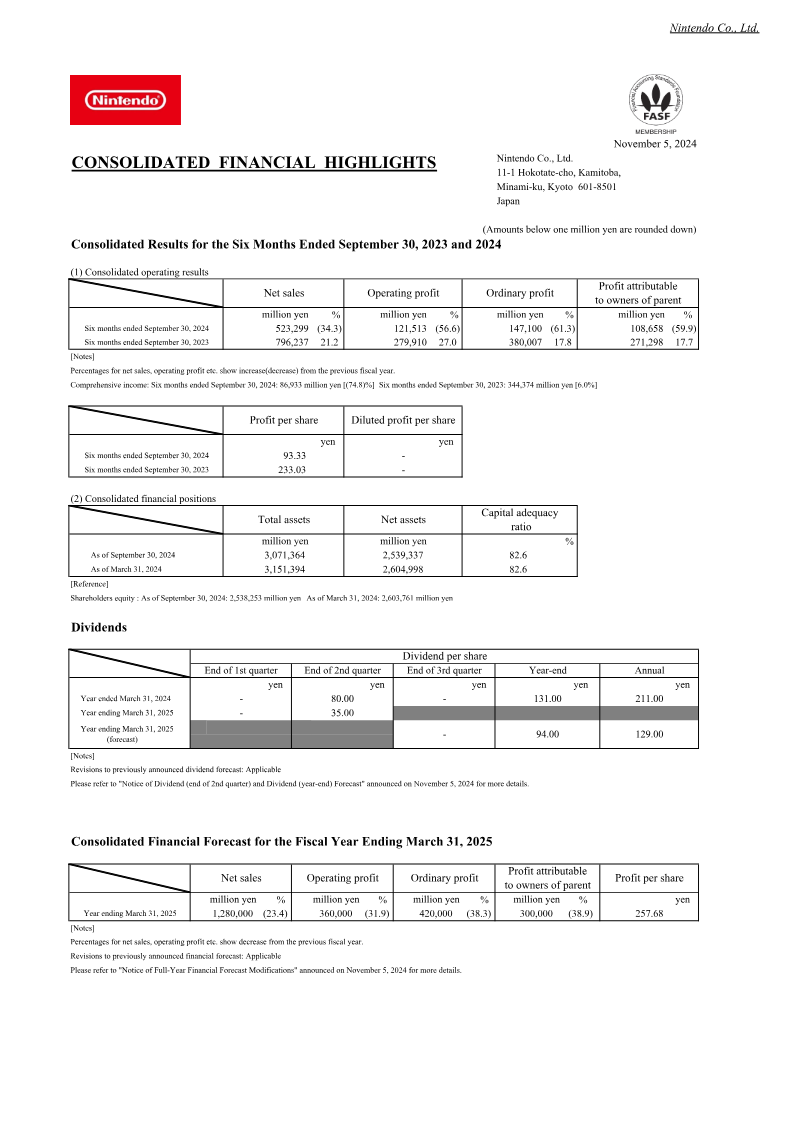
Nintendo’s consolidated financial results for the first half of the fiscal year ending March 31, 2025, reveal a significant year-on-year contraction in performance across all major financial metrics. Net sales fell by 34.3% to 523.2 billion yen, while operating profit declined by 56.6% to 121.5 billion yen. Profit attributable to owners of the parent saw a 59.9% decrease, totaling 108.6 billion yen. These results reflect a challenging comparison to the previous year, which benefited from the high-profile release of The Legend of Zelda: Tears of the Kingdom and the global success of The Super Mario Bros. Movie.
The downturn is primarily driven by declining hardware and software volumes as the Nintendo Switch enters its eighth year. Hardware sales reached 4.72 million units, a 31% decrease, while software sales fell 27.6% to 70.28 million units. Despite the overall decline, the platform maintained engagement with nine million-seller titles during the period, led by The Legend of Zelda: Echoes of Wisdom and Paper Mario: The Thousand-Year Door. Digital sales also saw a 26.5% reduction, and mobile/IP-related revenue dropped 43.3% due to the absence of movie-related income that bolstered the prior year’s figures.
Geographically, the business remains heavily export-oriented, with international sales accounting for 74.7% of total revenue. The financial position remains stable with a capital adequacy ratio of 82.6%, though total assets decreased slightly to 3.07 trillion yen. In response to first-half performance falling below initial expectations, full-year forecasts have been revised downward. The updated outlook projects annual net sales of 1.28 trillion yen and an operating profit of 360 billion yen, representing year-on-year decreases of 23.4% and 31.9%, respectively. Management intends to mitigate these trends by focusing on upcoming software releases and maintaining the "multiple systems per household" strategy.
- Nintendo reported a significant downturn for the first half of the fiscal year ending September 30, 2024, with net sales falling 34.3% to 523.2 billion yen and operating profit dropping 56.6% to 121.5 billion yen.
- Management has revised its full-year outlook downward, now projecting annual net sales of 1.28 trillion yen and an operating profit of 360 billion yen, representing year-on-year declines of 23.4% and 31.9% respectively.
- The Nintendo Switch hardware sales declined 31% to 4.72 million units, while software sales fell 27.6% to 70.28 million units as the platform enters its eighth year.
- The sharp financial contraction is largely attributed to a difficult year-on-year comparison against the prior period, which was bolstered by the release of 'The Legend of Zelda: Tears of the Kingdom' and revenue from 'The Super Mario Bros. Movie'.
- Mobile and IP-related revenue experienced a 43.3% decrease due to the absence of the movie-related income that significantly contributed to the previous year's performance.
NintendoNov 2024

Financial25 pages
Nintendo Q1 FY2024 Financial Results (English)
Thunderful Group’s interim report for the first quarter of 2024 details a period of significant financial decline and aggressive corporate restructuring. Net revenue fell 27.7 percent to 391.7 MSEK, while the group recorded an operating loss (EBIT) of 184.4 MSEK, a sharp reversal from the 19.2 MSEK profit reported in the same period the previous year. This downturn was driven by a 35.5 percent revenue drop in the Games segment and a 25.7 percent decrease in Distribution, largely due to weaker market demand for Nintendo Switch products and the underperformance of the internal title SteamWorld Build.
To address these challenges, the group initiated a restructuring program aimed at annual cost savings of 90–110 MSEK. This process involved a 72.4 MSEK write-down of capitalized development costs following the cancellation or divestment of twelve game projects. Strategic shifts include the divestment of the German publishing subsidiary Headup GmbH and the sale of Nordic Game Supply’s assets to reduce net debt. Despite these pressures, the group successfully extended its Nintendo distribution agreement for the Nordics and Baltics through March 2026 and reported 13.9 percent growth in its Amo Toys division.
The report covers the group’s global operations with a focus on European and Nordic markets for the period of January to March 2024. Financial data indicates a strained liquidity position, with cash and credit facilities dropping to 130.9 MSEK from 329.3 MSEK year-over-year. Management secured a bank waiver conditional on asset divestments and maintains that current funds are sufficient for continued operations. The overarching strategy moving forward emphasizes a simplified games portfolio, more rigorous project validation, and a balanced risk profile across internal and external development.
- Thunderful Group reported a net revenue decline of 27.7% to 391.7 MSEK and an operating loss of 184.4 MSEK for Q1 2024, compared to a 19.2 MSEK profit in the same period last year.
- The company initiated a restructuring program targeting 90–110 MSEK in annual cost savings, which included a 72.4 MSEK write-down following the cancellation or divestment of twelve game projects.
- Revenue in the Games segment dropped 35.5% and the Distribution segment fell 25.7%, driven by weaker demand for Nintendo Switch products and the underperformance of SteamWorld Build.
- Liquidity significantly tightened, with cash and credit facilities decreasing to 130.9 MSEK from 329.3 MSEK year-over-year, necessitating a bank waiver conditional on asset divestments.
- Strategic divestments include the sale of the German publishing subsidiary Headup GmbH and the assets of Nordic Game Supply to reduce net debt.
+3
NintendoJan 2024
Financial29 pages
Gaming Industry Report Q2 2023
The analysis presents a comprehensive snapshot of the global gaming industry in the second quarter of 2023, emphasizing the sector’s continued expansion and shifting investment dynamics. The market is projected to reach $201 billion in 2023, reflecting a 9 % year‑over‑year increase, while public gaming ETFs have risen between 10 % and 30 % since the start of the year, underscoring strong investor confidence. Cash reserves across leading public gaming firms total roughly $45 billion, supporting a robust merger‑and‑acquisition environment.
Venture capital activity shows a pronounced contraction, with total gaming VC funding falling to $1.23 billion in Q2 2023—a 38 % decline quarter‑on‑quarter—driven primarily by a 60 % drop in growth‑stage investments. The number of deals fell 22 % to 194, with early‑stage financing in North America down about 60 % and Europe remaining essentially flat. Asia remains the most active region, accounting for the majority of growth‑stage capital, while South America’s activity is concentrated in Brazil and Africa recorded no deals during the period. Data are drawn from CB Insights, Newzoo, public market filings and company disclosures, covering all VC rounds from pre‑seed through late‑stage across 2019‑2023.
Strategic developments highlighted include Apple’s launch of the Vision Pro spatial computer, Embracer Group’s restructuring toward first‑party IP, and the near‑completion of Microsoft’s acquisition of Activision Blizzard pending regulatory clearance in the UK, EU and US. Emerging trends point to a new era for user‑generated content, where popular IP will drive platform growth, and the expanding role of generative AI in asset creation, map design and NPC behavior. The report also outlines the 2023 conference calendar and provides a brief profile of Konvoy’s investment focus, assets under management and recent activity in frontier gaming technologies.
- The global gaming market is projected to reach $201 billion in 2023, representing a 9% year-over-year increase.
- Venture capital funding for gaming contracted by 38% quarter-over-quarter to $1.23 billion in Q2 2023, with growth-stage investments falling by 60%.
- Public gaming firms hold approximately $45 billion in cash reserves, facilitating a strong environment for mergers and acquisitions.
- Public gaming ETFs have demonstrated strong investor confidence, rising between 10% and 30% since the start of 2023.
- Deal volume decreased by 22% to 194 total transactions, with early-stage financing in North America experiencing a 60% decline.
+1
KonvoyMar 2023