AI reports and market data
648 game industry reports, presentations and talks about ai from writers such as PocketGamer.biz, Game Developers Conference and Deconstructor of Fun, newest from 2026. Every document has a summary and key insights with the page they come from, and 1,925 charts and tables are extracted as data.
Key figures
MIXI is prioritizing global expansion as a top management goal, noting that overseas sales accounted for only approximately 12% of total net sales in fiscal year 2026.
mixi, 2026 · MIXI Integrated Report 2026, p. 18
32% of industry professionals report dissatisfaction with their remuneration, highlighting a critical need for standardized salary frameworks and transparent industry-wide benchmarks.
New Zealand Game Developers Association, 2026 · Game Development Workforce Report: New Zealand 2026, p. 5
The micro-drama sector saw a 21.93 percent year-over-year increase in monthly advertisers by Q1 2026, with AI-generated ad creatives surging by nearly 200 percent in March 2026 alone.
SocialPeta, 2026 · Insights into the Global AI Animation Market in 2026, p. 13
Global in-app purchase (IAP) revenue reached $43.5 billion in Q1 2026, marking 9% year-over-year growth and the 13th consecutive quarter of positive performance.
Sensor Tower, 2026 · Digital Market Index: Q1 2026, p. 9
Between 69% and 84% of industry professionals are actively considering new employment due to widespread job insecurity and inadequate compensation.
InvestGame, 2026 · Games and Immersive: Salary & Satisfaction 2026 Report, p. 20
Documents

S08, E03: Amazon and Agentic Commerce (with Adam Epstein)
Agentic commerce currently functions more as a theoretical aspiration than a mass-market reality, as the prevailing retail infrastructure remains fundamentally incompatible with the open integration of third-party AI agents.
- Amazon is leveraging its $80 billion advertising business to pivot from transaction-based take rates toward an ad-driven monetization model for AI-integrated retail.
- To prevent losing traffic to external AI tools, Amazon is integrating its proprietary advertising stack—including the Amazon DSP and responsive e-commerce creative units—directly into third-party platforms like ChatGPT.
- Amazon’s strategy of embedding its ad stack into external interfaces allows the company to maintain closed-loop purchase tracking and monetize consumer intent outside of its own ecosystem.

Should devs change their release plans due to AI clones?
The rapid advancement of AI-assisted decompilation has introduced new security concerns regarding the cloning of unreleased game titles.
- AI-assisted decompilation threats are primarily limited to simple, memetic projects, meaning developers should prioritize market visibility and early prototyping over delaying releases to protect complex, original intellectual property.
- Major studios must balance the pressure of rigorous annual release schedules with the need to maintain cultural relevance through direct consumer communication and the pursuit of industry accolades.
- The Meta Quest ecosystem is experiencing a demographic shift, with younger users increasingly driving demand for free-to-play, sandbox-style gaming experiences.

Why Supercell couldn’t save Squad Busters and Google's AI game maker | Week in Mobile Games podcast
The mobile gaming landscape is currently defined by a tension between established intellectual property expansion and the integration of generative artificial intelligence.
- Supercell is discontinuing Squad Busters on December 14th, marking its first global launch failure despite the title reaching 58 million downloads and $67 million in lifetime revenue.
- Squad Busters failed to sustain long-term engagement due to a combination of convoluted gameplay mechanics and ineffective monetization strategies.
- Google’s Playground is attempting to democratize game development through text-to-game generation, though current iterations lack the mechanical depth and visual variety to compete with professional ecosystems like Roblox.
Why Use Tenjin’s MCP Server?
Tenjin’s Model Context Protocol (MCP) server serves as a bridge between AI assistants like Claude and live mobile measurement partner (MMP) tools.
- Tenjin’s Model Context Protocol (MCP) server enables AI assistants like Claude to perform both read and write operations, moving beyond passive reporting to active execution of mobile measurement tasks.
- The platform allows users to manage technical infrastructure, including creating applications, configuring callbacks, and setting up tracking links, directly through natural language commands.
- By automating routine account management and API chains across ad networks and analytics tools, the system eliminates the need for manual dashboard navigation and reduces data fragmentation.

The One Thing AI Can't Put In Your Game
In an increasingly saturated gaming market, the primary challenge for independent developers is distinguishing their work from the rising tide of AI-generated or gimmick-driven titles.
- A deeply personal, human-driven narrative is the primary tool for market differentiation and long-term relevance in an increasingly saturated gaming landscape.
- AI-generated or gimmick-driven titles are highly susceptible to being copied or 'vibecoded' by automated tools, making them poor foundations for a sustainable brand.
- Developers should prioritize a unique, authentic creative voice over broad, safe appeal to foster audience loyalty and ensure their product remains unclonable.
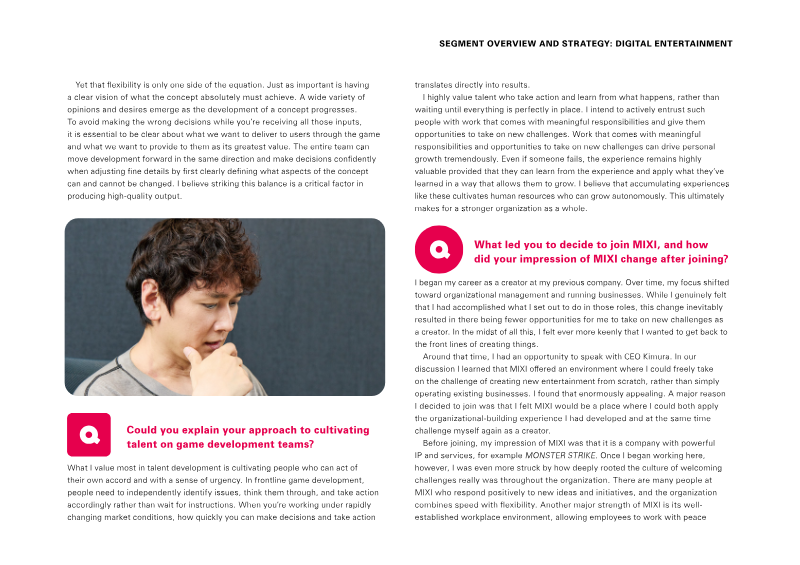


MIXI Integrated Report 2026
The MIXI Integrated Report 2026 details the company’s strategic transition into its "Third Founding" phase, a period defined by a pivot toward the "We-Time Economy."
- MIXI is prioritizing global expansion as a top management goal, noting that overseas sales accounted for only approximately 12% of total net sales in fiscal year 2026.
- The company is shifting its financial policy to return profits generated across all business segments to shareholders, moving away from a reliance on MONSTER STRIKE as the primary source of financial leverage.
- MIXI has introduced a medium-term 'Growth Strategy in the We-Time Economy,' focusing on creating economic value through shared experiences among families, friends, and fans.

Block Blast Hit 300M Players — And Kills 95% of Ideas
Hungry Studio, the developer behind the mobile puzzle game Block Blast, has achieved significant growth, scaling from 40 million daily active users in 2024 to 300 million monthly active users by late 2025.
- Hungry Studio's Block Blast grew from 40 million daily active users in 2024 to 300 million monthly active users by late 2025, driven by a focus on long-term brand building and user experience.
- The studio uses an internal simulation tool, "Block AI," to test new features, validating ideas in days and rejecting 95-97% of proposed concepts to prevent resource waste.
- Hungry Studio prioritizes accessibility and high product design standards to create a consistent, high-quality experience for a global audience.

Podcast: Will consumers adopt agentic commerce? (with Michael Morton)
The promise of agentic commerce—autonomous AI systems that handle shopping decisions on behalf of consumers—is largely a Silicon Valley narrative that fails to align with established retail behavior.
- The narrative of autonomous agentic commerce is currently unsupported by data, as the average consumer makes only ten non-automated purchases per month, suggesting that shopping friction is not a significant enough pain point to drive mass adoption.
- Amazon’s deep consumer identity data and physical fulfillment infrastructure create a structural moat that makes it nearly impossible for independent shopping agents to unbundle established marketplaces.
- The high operational costs of being a merchant of record—including logistics, fraud protection, and customer support—render the business model of independent, third-party shopping agents financially unviable.

Design Club: Industry Shenanigans! GTA6, AI in development, and the 1400$ PS5!
The gaming industry is currently defined by a tension between massive cultural phenomena and aggressive monetization strategies that prioritize publisher control over consumer accessibility.
- Grand Theft Auto VI is currently confirmed for release only on PlayStation and Xbox consoles, with no immediate plans for a PC or Nintendo Switch launch.
- The gaming industry frequently experiences cyclical narratives regarding the death of specific platforms or business models, such as the supposed demise of PC, mobile, or premium gaming, which often simply evolve rather than disappear.
- Modern game development requires massive teams, with some lead artists managing up to 60 people to handle the complex modeling, rigging, and animation required for thousands of character assets.

Epic Games Goes All In On AI For Disney Shooter
Epic Games has initiated a significant strategic pivot, transitioning its upcoming collaborative project with Disney—an extraction shooter featuring Marvel and Star Wars intellectual property—into an AI-first production.
- Epic Games has delayed its upcoming Disney-licensed extraction shooter and mandated an 'AI-first' production strategy, requiring staff to replace handwritten code and traditional art workflows with generative AI tools.
- CEO Tim Sweeney is aggressively positioning Epic Games as a leader in the AI transition, viewing the technology as essential for the company's survival and future competitiveness in game development.
- The project, which features Marvel and Star Wars intellectual property, has faced multiple delays and internal development challenges, including shifting priorities and inconsistent decision-making.

AI Game Dev: Is It Over For Indies?
The current state of the indie game industry is defined by a tension between the rapid democratization of development tools through artificial intelligence and the traditional, labor-intensive craft of game creation.
- The primary differentiator between a commercially viable game and low-effort AI-generated content is the rigorous process of prototyping and iterative player testing.
- Developers should focus on building an audience through a high-quality, polished demo rather than relying on AI to generate game assets, as audiences are built through human connection and engagement.
- The development workflow should prioritize testing a core, stripped-down prototype with players—ideally around 20 people—to validate the game loop before investing in art, music, or full production.

The Truth About AI Transformation (It's Not What You Think)
The fundamental challenge of modern organizational transformation lies in the distinction between retrofitting legacy operations and building AI-native enterprises.
- Successful AI transformation requires shifting from retrofitting legacy workflows to building AI-native enterprises that utilize decentralized, high-velocity decision-making.
- Organizations must establish a centralized business context—an 'internal AI brain'—to ensure data consistency and cross-departmental coordination as operational velocity increases.
- Democratizing data access is essential, enabling non-technical staff to automate processes and generate insights without relying on centralized analytics bottlenecks.