Report49 pages
Essential Facts about Video Games in Italy: 2025
In 2025, roughly 14.2 million Italians—about a third of the population aged six to seventy‑five—engage in video gaming, with a pronounced male bias and a concentration of players under 35. The industry’s total revenue remains steady at €2.4 billion, of which game sales account for 77 percent (€1.8 bn). Gaming time has risen to nearly eight hours per week, driven primarily by smart‑device play (22 percent reach, €929 m revenue) and console gaming (13 percent reach, €643 m). App‑based games now represent more than half of the market, dominated by freemium monetisation; only one percent of app revenue comes from upfront purchases.
Revenue distribution varies by platform. Smart‑device earnings are almost entirely from in‑app purchases (ARPU €84), while console sales lean heavily on digital downloads—65 percent of new game revenue comes from full‑game downloads (€502 m) and 21 percent from DLC (ARPU €99). PC revenue is largely driven by DLC (43 percent) and full‑game downloads (98 percent of console sales). Subscription services are pivotal: console ecosystem subscriptions contribute 59 percent of total gaming‑subscription revenue (€153 m), with mobile and single‑game franchises accounting for 6 percent and 35 percent respectively.
Player demographics reveal that smart devices attract a younger, male‑skewed audience (31 percent of 6–17‑year-olds), whereas console and PC gaming remain niche but heavily male‑skewed, concentrated among teens. Casual and sports titles dominate sales across all platforms, with subscription services such as PlayStation Plus and Xbox Game Pass driving a significant share of paid play. Engagement patterns show males spending the most hours on consoles (average seven hours per week), while PC gaming remains steady across age groups. Approximately one‑quarter of players follow gaming news on YouTube or vlogs, and 20 percent rely on social media or family discussions for information. The data derive from a nationally representative online survey of 3,000 respondents, weighted against an offline omnibus sample and calibrated to industry sales figures.
- The Italian video game market generated €2.4 billion in 2025, with game sales accounting for 77 percent (€1.8 billion) of total revenue.
- App-based gaming dominates the market, representing over half of total revenue with a freemium model where only one percent of earnings come from upfront purchases.
- Smart devices are the primary revenue driver at €929 million, while console gaming accounts for €643 million, supported by an average of eight hours of gameplay per week across the population.
- Console revenue is heavily reliant on digital distribution, with 65 percent of new game sales coming from full-game downloads and 21 percent from DLC.
- Console ecosystem subscriptions are the primary driver of the subscription market, contributing 59 percent (€153 million) of total subscription revenue.
+4
IIDEA – Italian Interactive Digital Entertainment Association
Presentation41 pages
Game & Network Services Segment Presentation
Sony Interactive Entertainment’s Game & Network Services segment demonstrates a clear trajectory of growth and increasing operating leverage. Console sales have risen from $24 B in 2000 to $136 B in 2024, while operating income has shifted from a –$4 B loss to $13 B. The PlayStation ecosystem now supports 124 million monthly active users, a 14% year‑over‑year increase, and generates $846 in life‑to‑date spend per console. A diversified content mix of over 12 000 titles and high‑engagement live‑service games underpins this momentum, with revenue increasingly driven by services such as PlayStation Plus, the Store, and peripherals—accounting for roughly 52–54 % of total revenue.
Strategically, Sony is building a multi‑device ecosystem that expands single‑player franchises to PC, television, film, and location‑based entertainment while reinforcing live‑service titles like HellDivers and Astro. The company leverages artificial intelligence, cloud computing, and cross‑Sony Group partnerships to broaden audience reach and enhance operational efficiency. Portfolio diversification, rigorous development processes, and strategic collaborations are central to capitalizing on the current console generation’s momentum.
The company’s roadmap balances sustainability initiatives—“Road to Zero & Safety & Community”—with profitable growth. Projected platform revenue of $26.8 B and operating income rising from $1.8 B to $2.7 B reflect disciplined investment in intellectual property, content, and services within an agile cost structure. Sony aims to maintain its leading market position while extending franchise reach across PC, television, and media, ensuring long‑term profitability in a rapidly evolving industry.
- Sony’s Game & Network Services segment has achieved a significant financial turnaround, growing from a $4 billion operating loss in 2000 to $13 billion in operating income by 2024.
- Revenue is increasingly driven by services, the PlayStation Store, and peripherals, which now account for 52–54% of the segment's total revenue.
- The PlayStation ecosystem has reached 124 million monthly active users, representing a 14% year-over-year increase, with a life-to-date spend of $846 per console.
- Sony is projecting platform revenue of $26.8 billion and an increase in operating income from $1.8 billion to $2.7 billion through disciplined investment in IP and content.
- The company is executing a multi-device strategy that expands single-player franchises to PC, film, television, and location-based entertainment to broaden audience reach.
+3
Sony Interactive Entertainment
Report41 pages
PC/Console Gaming Index: 2025
The 2025 PC/Console Gaming Index demonstrates that action titles dominate the market, with approximately 262 million downloads year‑to‑date. Indie and AA developers such as R.E.P.O., Split Fiction, and Peak contribute the majority of these downloads, while Steam remains the leading platform for both volume (≈450 million downloads) and premium revenue. Console ecosystems differ: PlayStation and Xbox each secure around 376 million and 283 million downloads respectively, with a pronounced preference for AAA releases (≈50 % each).
Electronic Arts leads global download counts at roughly 82.8 million, followed by Microsoft (≈71 million) and Sony (≈55 million). Steam’s marketplace favors indie publishers, who account for 60 % of downloads, whereas PlayStation and Xbox are dominated by large studios. Monetization patterns diverge across platforms: Xbox users largely adopt free‑to‑play models (≈39 % of downloads), driven by Game Pass and cross‑platform titles, whereas Steam users prefer premium content (≈79 % paid). PlayStation exhibits the highest premium skew among consoles, with 83 % of downloads from paid titles.
Microsoft’s year‑to‑date download total reaches 452 million, with mobile accounting for 83 % of that figure and PC/console contributing 75 million. Sony’s strategy focuses on internal studios, generating 55 million PC/console downloads and 15 million mobile downloads centered on anime‑IP titles. Key publishers such as Kepler Interactive and Deep Silver excel in AA performance, while American and Japanese studios dominate global PC/console downloads—particularly on Xbox (over 50 % US share) and PlayStation (22 % Japanese share).
Monster Hunter Wilds illustrates a shift from pre‑launch pet and cooking themes to post‑launch epic gameplay, with US creatives featuring PlayStation branding and Japanese creatives using Capcom branding. Steam remains the dominant download platform, delivering nearly four times more downloads than PlayStation. The campaign’s channel shift saw TikTok fall from #2 to #7 post‑launch, while OTT rose to #2 in US spend, indicating a transition from trend‑driven hype to sustained engagement.
- Steam remains the dominant platform for PC/console gaming, generating approximately 450 million downloads year-to-date, which is nearly four times the volume of PlayStation.
- Monetization strategies are platform-specific: 79% of Steam downloads and 83% of PlayStation downloads are premium, while 39% of Xbox downloads are free-to-play, largely driven by Game Pass.
- Indie and AA developers drive the majority of the 262 million action-genre downloads, with indie titles accounting for 60% of total downloads on Steam.
- Electronic Arts leads global download counts at 82.8 million, followed by Microsoft at 71 million and Sony at 55 million for PC/console segments.
- Console ecosystems show a strong preference for AAA releases, which constitute approximately 50% of downloads on both PlayStation and Xbox.
+3
Sensor Tower

Presentation89 pages
Capital Markets Event 2025: Coffee Stain Group
Capital Markets Event 2025 showcases the Coffee Stain Group’s strategy of building a portfolio around small, autonomous teams that prioritize gameplay quality and community engagement. Ninety percent of net sales derive from a handful of flagship titles—most notably Goat Simulator, Deep Rock Galactic and Satisfactory—which consistently achieve high review scores (above 96 %) and generate lifetime sales up to SEK 2 bn. The company’s partnership model, publishing and investing in niche‑focused games, sustains long‑term value through continuous content updates and a symbiotic developer‑player relationship.
The global gaming market is projected to grow at 3 % CAGR across all platforms, driven by rising consumer spend and the expansion of Steam, mobile, Game Pass and PlayStation Plus. Despite saturation and increased competition for player attention, Coffee Stain maintains a strong presence; its titles enjoy high review counts (over 500 k for Goat Simulator) and retain players through regular updates, platform expansions and community‑driven development. Innovation, creative gameplay and long‑term support are core to the firm’s approach.
Strategic collaborations reinforce this model. The partnership with Tuxedo Labs leverages the proprietary Teardown physics engine, producing a highly engaged community (10 000+ mods, 20 major updates) and peak concurrent users of 60 k for Deep Rock Galactic seasons. The studio’s headcount grew from six to 47 FTEs over five years, illustrating the scalability of open development and a “make happy decisions” culture that drives both critical acclaim (e.g., 9.5/10 reviews) and commercial success.
Coffee Stain’s Roblox title, Welcome to Bloxburg, exemplifies a successful free‑to‑play transition. With 791 k daily active users and SEK 1.35 bn in lifetime net sales, the monetization mix of currency purchases, optional unlocks and a premium subscription maintains a non‑pay‑to‑win stance while rebuilding player trust. The company’s lean cost base and strong cash generation are amplified by launch‑driven sales spikes from new content releases and strategic stakes such as its 30 % share in Iron Gate’s Valheim publishing.
Financially, the group reports a net‑sales CAGR of 34 % to SEK 1.2 bn and a cash EBIT margin of 44 %. Cash reserves reach SEK 472 m in 2025, with no external debt, providing flexibility for capital allocation and potential M&A. The lean, autonomous team model underpins low overheads, high cash conversion (≈120 %) and a focus on developing existing IPs while selectively pursuing new opportunities across platforms and partnerships.
- Coffee Stain Group maintains strong financial health with a 34% net-sales CAGR to SEK 1.2 bn, a 44% cash EBIT margin, and 120% cash conversion.
- The company holds SEK 472 m in cash reserves with zero external debt, providing significant flexibility for future M&A and capital allocation.
- Ninety percent of net sales are generated by a core portfolio of flagship titles—Goat Simulator, Deep Rock Galactic, and Satisfactory—which consistently maintain review scores above 96%.
- The Roblox title Welcome to Bloxburg has achieved 791,000 daily active users and SEK 1.35 bn in lifetime net sales following its transition to a free-to-play model.
- Strategic partnerships and investments, such as a 30% stake in Valheim publisher Iron Gate and the collaboration with Tuxedo Labs, serve as key drivers for long-term value and IP expansion.
+3
Coffee Stain Group AB
Report39 pages
Bilan du Marché Français: 2025
The French video game market demonstrated significant resilience in 2025, generating €5.856 billion in total revenue, a 2.9% increase over the previous year. This performance marks the second-highest in the industry’s history, solidifying its position as a cornerstone of the national cultural economy. Growth was primarily fueled by a rebound in console hardware sales and a record-breaking 11% surge in the mobile sector, which reached €1.792 billion. The market maintains a balanced ecosystem, with consoles commanding a 44% share, followed by mobile at 31% and PC gaming at 26%.
Software remains the primary revenue driver, accounting for over two-thirds of the total market. While physical game sales faced a double-digit decline, this was effectively mitigated by the expansion of digital content, including microtransactions and downloadable content. Electronic Arts emerged as the leading publisher across console and PC platforms, while the mobile landscape remains almost entirely dominated by free-to-play models, which now represent 94% of mobile revenue.
The industry’s reach expanded to 40.2 million players, characterized by a maturing demographic where adults comprise 88% of the base. High engagement levels persist, with 76% of players gaming on a weekly basis and a growing trend toward cross-platform usage. Alongside this growth, there is a heightened emphasis on responsible gaming. Parental involvement has reached new heights, with 67% of parents actively monitoring gaming habits through PEGI classifications and standardized parental control tools. This commitment to safety, supported by organizations like the SELL and events such as Paris Games Week, ensures that the industry continues to thrive as a mature, socially responsible, and culturally significant sector within France.
- The French video game market reached €5.856 billion in 2025, a 2.9% year-over-year increase and the second-highest revenue in the industry's history.
- Mobile gaming experienced an 11% surge to reach €1.792 billion, with free-to-play models accounting for 94% of that sector's total revenue.
- Market share is distributed across consoles (44%), mobile (31%), and PC (26%), with software sales—driven by digital content and microtransactions—comprising over two-thirds of total revenue.
- The player base has expanded to 40.2 million people, 88% of whom are adults, with 76% of all players engaging with games on a weekly basis.
- Physical game sales suffered a double-digit decline in 2025, necessitating a shift toward digital distribution and downloadable content strategies.
+3
SELL – Syndicat des Éditeurs de Logiciels de Loisirs
Report9 pages
ESG Fact Sheet: FY 2023/24
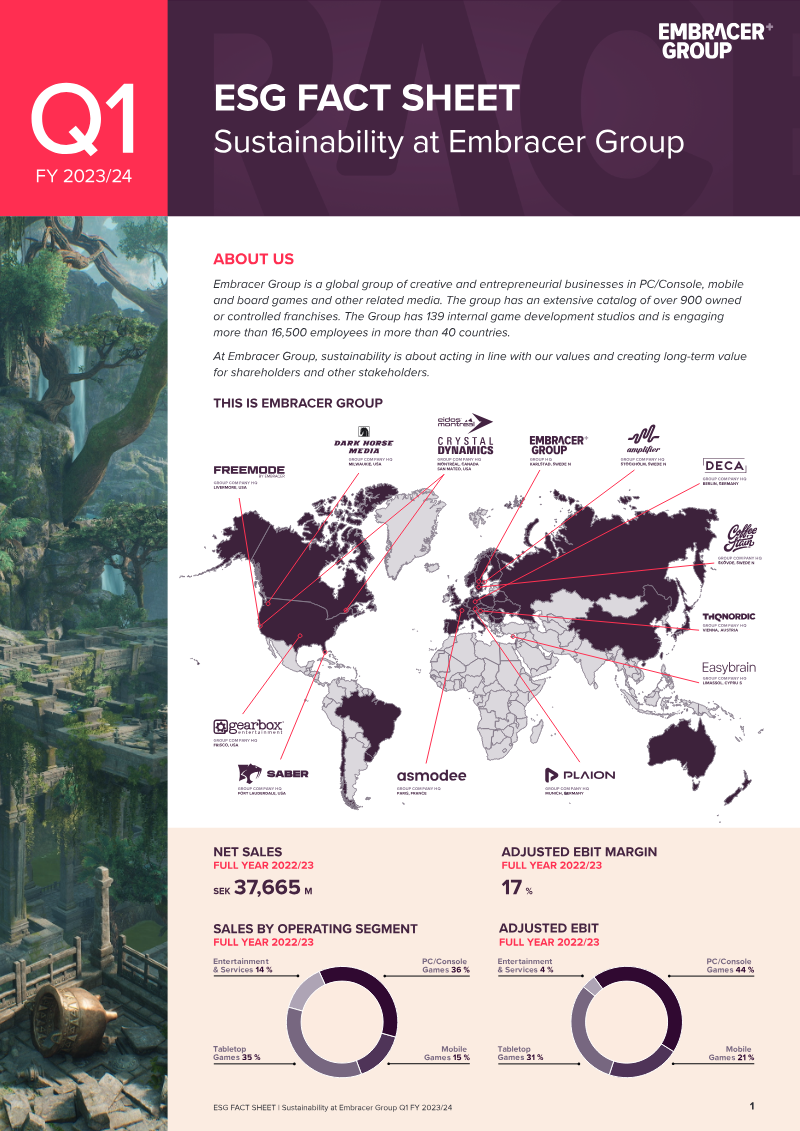
Embracer Group’s FY 2023/24 ESG Fact Sheet outlines the company’s sustainability framework, titled Smarter Business, which focuses on three core pillars: Great People, Solid Work, and Our Planet. Operating across more than 40 countries with 139 internal studios, the organization aims to integrate ethical governance and long-term value creation into its global operations. The company’s sustainability strategy is supported by 16 group policies and 12 guidelines, with oversight provided by the Audit and Sustainability Committee and an internal Ambassador Group.
Key performance indicators for the 2022/23 financial year highlight both progress and areas for development. Within the Great People pillar, the company reported a 26% female representation rate and an employee satisfaction score (eNPS) of +29. To foster leadership diversity, the board has committed to doubling the number of female managing directors and studio heads by 2025. Regarding environmental impact, the company has conducted a comprehensive greenhouse gas inventory, reporting total emissions of 687,102 tCO2e. The firm has aligned its climate strategy with the Paris Agreement, targeting a 45% reduction in carbon emissions by 2030 compared to a 2021/22 baseline.
The company utilizes a structured methodology for tracking progress, including annual global employee surveys and standardized sustainability due diligence during acquisitions. Furthermore, the organization actively participates in industry-wide initiatives such as the UN Global Compact, Women in Games, and PlayCreateGreen. By integrating these partnerships with internal training programs on privacy and ethics, the company seeks to manage operational risks while promoting digital well-being and accessibility across its portfolio of over 900 franchises.
- Embracer Group has committed to a 45% reduction in total carbon emissions by 2030, using the 2021/22 financial year as its baseline.
- The company reported total greenhouse gas emissions of 687,102 tCO2e for the 2022/23 financial year.
- Female representation across the organization stands at 26%, with a board-level mandate to double the number of female managing directors and studio heads by 2025.
- The organization maintains an employee satisfaction score (eNPS) of +29 across its 139 internal studios.
- Sustainability oversight is managed through 16 group policies and 12 guidelines, with governance provided by an Audit and Sustainability Committee and an internal Ambassador Group.
+3
Embracer Group
Report80 pages
PC & Console Gaming Report 2026
1. Market trajectory What direction is the PC and console market heading in 2026? 8 What direction is the PC and console market heading in 2026? 2. Attention & value allocation Where do players spend time and money on PC and console? 17 3. Market concentration What happens if you are not a top-20 game? 45 4.
- PC player base is projected to exceed one billion by 2028, with a CAGR of 2.9% from 2025-2028, while console player growth moderates with a 2.2% CAGR in the same period.
- Almost two-thirds of console revenues (PlayStation and Xbox) go to the top 20 games, whereas on PC, over half of revenue comes from games ranked 21+.
- PC is the only platform effectively monetizing Free-to-Play (F2P) games, with revenue holding stable despite falling playtime in the west; on console, F2P revenue is dropping faster than engagement.
- Games ranked 21+ are capturing a growing share of playtime across platforms, with PC showing the strongest shift since 2022, indicating market disaggregation and growth from outside the top 20 titles.
- Premium game revenue is growing on PC and PlayStation, but Xbox's more modest growth cannot offset declines in F2P and Call of Duty.
+3
NewzooApr 2026

Report6 pages
GungHo Business Report Vol. 42
GungHo Online Entertainment’s Vol. 42 report outlines the company’s strategic focus on expanding its two flagship intellectual properties—Puzzle & Dragons and Ragnarok—into global markets while sustaining robust financial performance. The report highlights that Puzzle & Dragons, launched in 2012, has achieved over 63 million downloads worldwide and continues to drive user engagement through frequent events, cross‑media collaborations, and a 13th‑anniversary release in May 2025. The Ragnarok franchise, managed by subsidiary Gravity Co., Ltd., has expanded from its original PC MMORPG roots to mobile and console titles, with recent releases such as Ragnarok X (PC/Android/iOS) and LUNAR Remastered Collection targeting Latin America, Southeast Asia, and other regions.
Financially, consolidated net sales rose from ¥125.3 billion in 2022 to ¥103.6 billion in 2024, with operating profit increasing from ¥27.9 billion to ¥17.5 billion over the same period. Overseas sales ratio climbed from 39.3 % in 2022 to 47.7 % in 2024, reflecting successful international penetration. The company maintained a dividend payout ratio above 30 % and executed treasury‑share repurchases totaling ¥9.86 billion in 2024, underscoring a commitment to shareholder value.
Methodologically, the report aggregates data from internal analytics on downloads, MAU, and revenue across more than 150 countries in 11 languages. It also references quarterly performance metrics and event‑based user activity to gauge engagement. Overall, the document presents a cohesive narrative of sustained growth through IP expansion, diversified platform presence, and disciplined financial management.
- GungHo’s overseas sales ratio grew from 39.3% in 2022 to 47.7% in 2024, signaling a successful shift toward international market penetration.
- Consolidated net sales decreased from ¥125.3 billion in 2022 to ¥103.6 billion in 2024, with operating profit declining from ¥27.9 billion to ¥17.5 billion over the same period.
- The flagship title Puzzle & Dragons has surpassed 63 million global downloads since its 2012 launch and is preparing for a 13th-anniversary release in May 2025.
- Subsidiary Gravity Co., Ltd. is actively diversifying the Ragnarok franchise across PC, mobile, and console platforms, specifically targeting growth in Latin America and Southeast Asia.
- The company maintains a commitment to shareholder returns, evidenced by a dividend payout ratio exceeding 30% and ¥9.86 billion in treasury-share repurchases during 2024.
+4
GungHo Online Entertainment
Report6 pages
FY2025 Third Quarter Financial Highlights: Japan
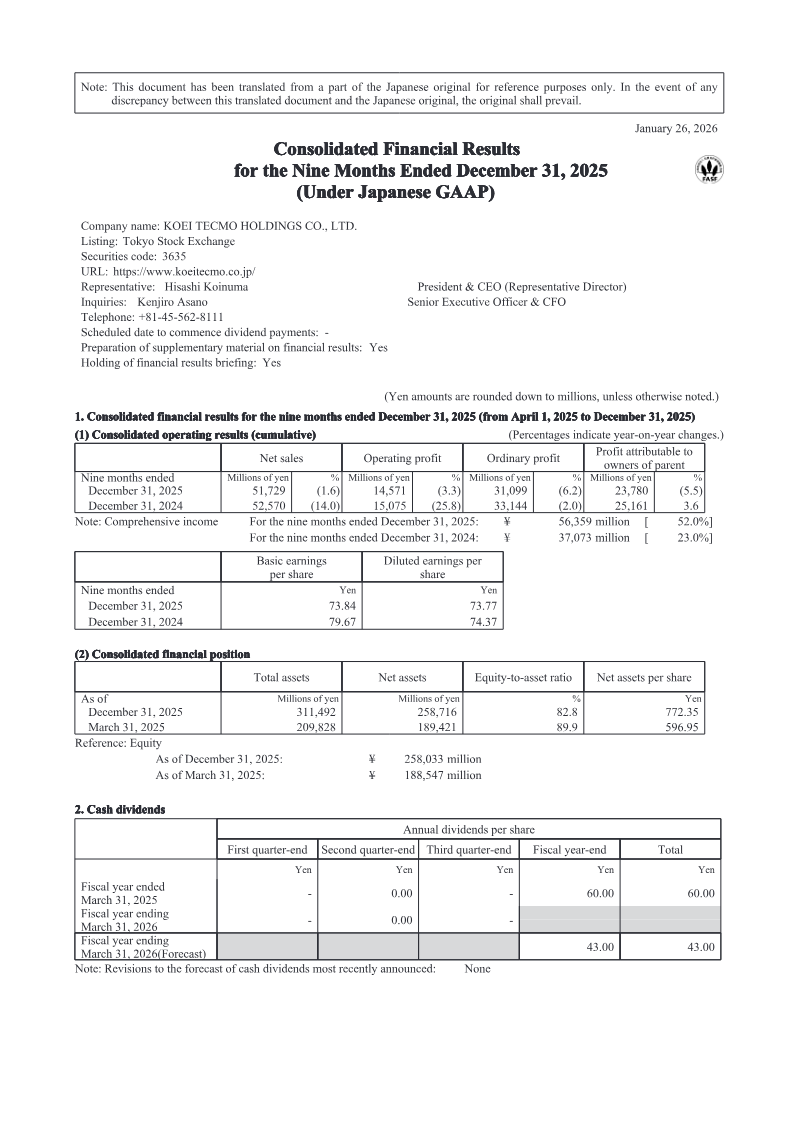
The FY2025 third‑quarter financial highlights for Koei Tecmo Holdings detail a modest decline in core operating metrics while comprehensive income rises sharply. Net sales for the nine months ended December 31, 2025 fell 1.6% to ¥51,729 million from ¥52,570 million in the prior year. Operating profit slipped 3.3% to ¥14,571 million, and ordinary profit decreased 6.2% to ¥31,099 million. Despite these contractions, comprehensive income surged 52.0% year‑on‑year to ¥56,359 million, driven by significant gains in non‑operating items such as interest income and foreign exchange gains. Basic earnings per share declined slightly to ¥73.84 from ¥79.67, reflecting a higher weighted‑average share count due to treasury share disposals and secondary offerings.
Total assets expanded from ¥209,828 million at March 31, 2025 to ¥311,492 million by December 31, 2025, largely through increases in investment securities and property, plant, and equipment. Net assets rose to ¥258,716 million, with the equity‑to‑asset ratio improving to 82.8% from 89.9%. Treasury shares reduced dramatically, lowering the average number of outstanding shares to 322 million from 315 million.
Dividend policy remains unchanged, with a forecast of ¥43.00 per share for the fiscal year ending March 31, 2026, and no revisions to cash dividend forecasts. The report covers Japan‑based operations for FY 2025, presenting consolidated quarterly financial statements without significant changes in consolidation scope or accounting policies.
- Koei Tecmo Holdings reported a 1.6% decline in net sales to ¥51,729 million and a 3.3% drop in operating profit to ¥14,571 million for the nine months ended December 31, 2025.
- Comprehensive income surged 52.0% year-on-year to ¥56,359 million, primarily fueled by non-operating gains from interest income and foreign exchange fluctuations.
- Total assets grew significantly to ¥311,492 million by December 31, 2025, up from ¥209,828 million at the start of the fiscal year, driven by increases in investment securities and property, plant, and equipment.
- Basic earnings per share fell to ¥73.84 from ¥79.67, impacted by an increase in the weighted-average share count following treasury share disposals and secondary offerings.
- The company maintains its dividend forecast at ¥43.00 per share for the fiscal year ending March 31, 2026, with no changes to its current dividend policy.
+2
Koei Tecmo
Report5 pages
FY2018 2Q Result Presentation
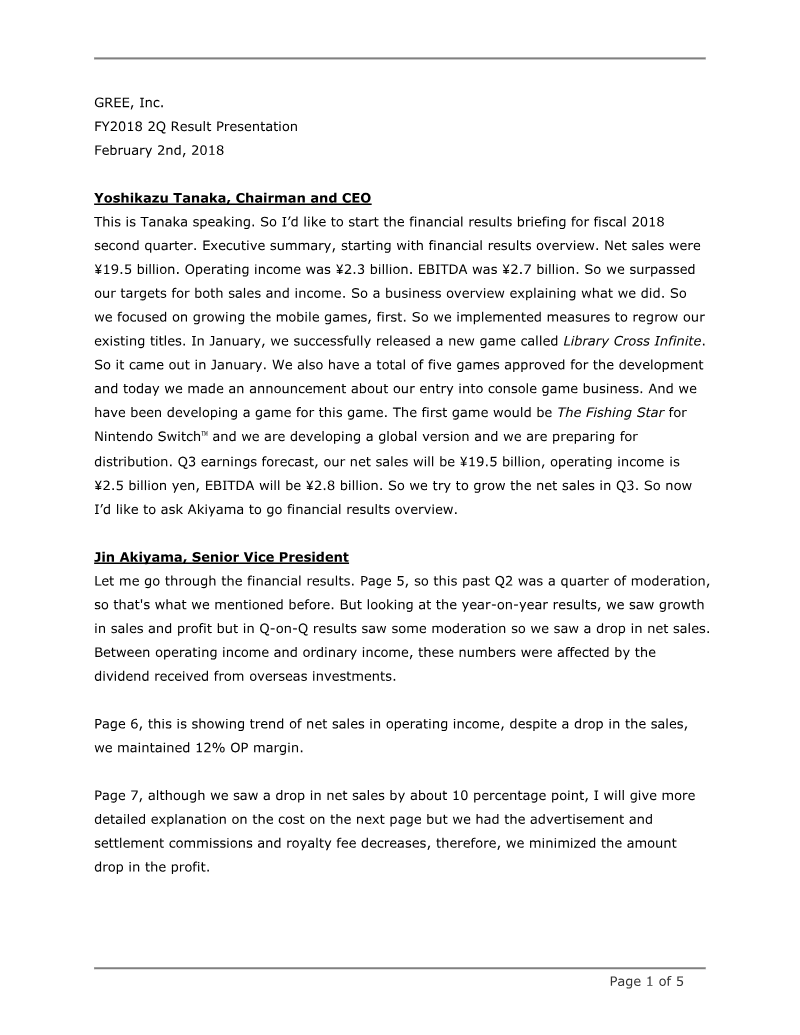
GREE, Inc. reported FY2018 second‑quarter results on February 2, 2018, with net sales of ¥19.5 billion and operating income of ¥2.3 billion, exceeding targets for both metrics. EBITDA reached ¥2.7 billion. Year‑on‑year growth was achieved, though quarter‑over‑quarter sales moderated by roughly 10 percentage points; operating margin remained at 12 %. The company attributed the sales dip to reduced advertising spend and lower commission fees, while cost controls on labor and outsourcing mitigated profit erosion. A strategic shift toward console gaming was announced, with the first title “The Fishing Star” slated for Nintendo Switch and a global release in development. Mobile game performance was bolstered by the launch of “Library Cross Infinite” and ongoing content updates for titles such as Another Eden, Danmachi, SINoALICE, SYMPHOGEAR, and Puchiguru Love Live. Five new mobile titles are approved for development, with three slated for release this fiscal year.
The FY2018 Q3 forecast projects flat net sales at ¥19.5 billion and operating income of ¥2.5 billion, aiming for a year‑to‑date total of ¥60.6 billion. GREE plans to sustain growth through aggressive title reinforcement, overseas expansion, and cost discipline across mobile, console, VR, advertising, and media segments. The presentation covered financial performance, cost structure adjustments following overseas operation closures, and a pipeline of upcoming releases across multiple platforms.
- GREE reported FY2018 Q2 net sales of ¥19.5 billion and operating income of ¥2.3 billion, both exceeding internal targets.
- The company is pivoting toward console gaming, with 'The Fishing Star' confirmed for Nintendo Switch and a global release currently in development.
- While year-on-year growth was positive, quarterly sales moderated by approximately 10 percentage points due to reduced advertising spend and lower commission fees.
- Operating margin held steady at 12%, supported by strict cost controls on labor and outsourcing that offset the impact of lower sales.
- Mobile performance was driven by the launch of 'Library Cross Infinite' and ongoing updates to key titles including 'Another Eden,' 'Danmachi,' 'SINoALICE,' 'SYMPHOGEAR,' and 'Puchiguru Love Live.'
+2
GREE
Report1 pages
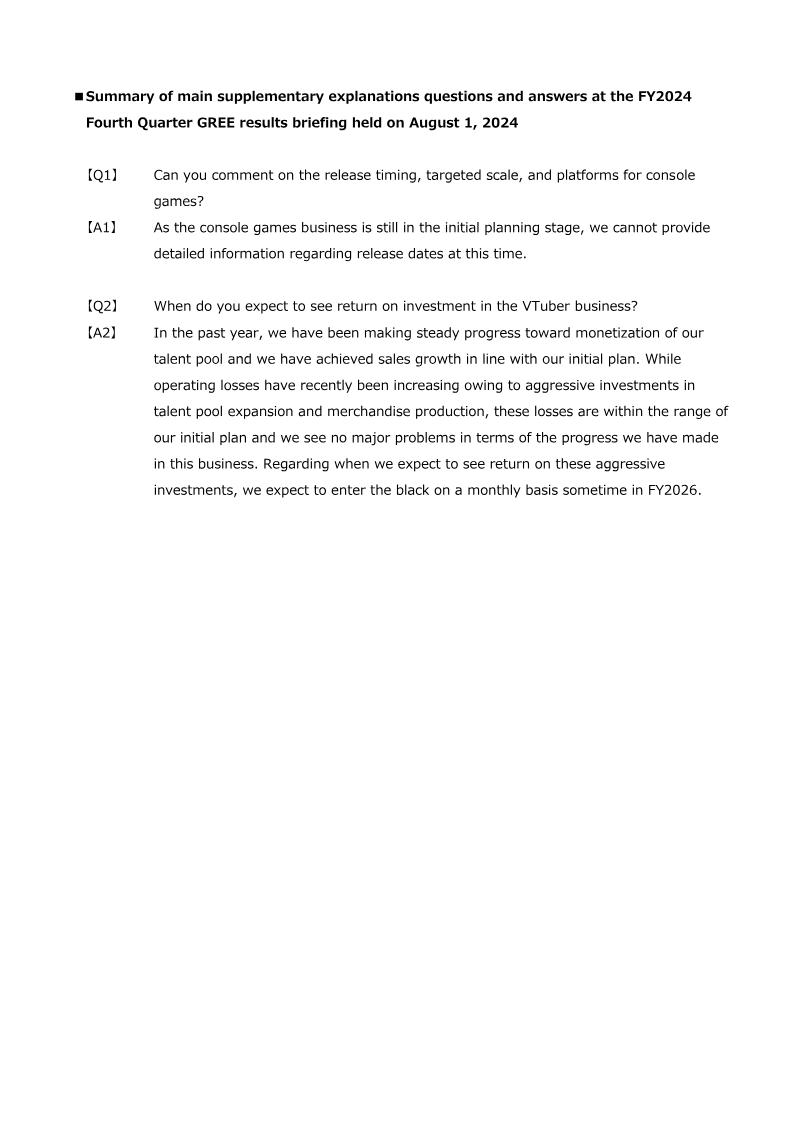
Summary of Main Supplementary Explanations Questions and Answers: FY2024 Fourth Quarter GREE Results Briefing
The briefing clarified GREE’s strategic outlook for FY2024, focusing on console game development and the VTuber business. The company confirmed that its console gaming venture remains in early planning, with no concrete release dates or platform commitments disclosed. This indicates a cautious approach as GREE evaluates market entry points and potential partnerships before committing resources.
In contrast, the VTuber segment is progressing toward profitability. GREE reported steady sales growth aligned with its initial projections, despite operating losses that have risen due to aggressive talent acquisition and merchandise production. These losses fall within the company’s planned range, suggesting disciplined financial management amid expansion efforts. GREE projects that monthly operating losses will be eliminated in FY2026, marking the anticipated break‑even point for its VTuber investments.
The briefing covered a domestic Japanese market focus, with no mention of international expansion for either segment. The time frame discussed spans FY2024 through FY2026, highlighting short‑term challenges and medium‑term profitability goals. Methodological details were limited; the company referenced internal financial metrics rather than external surveys or third‑party data. Overall, GREE’s communication signals a phased growth strategy: cautious console game development coupled with aggressive scaling of its VTuber platform, aiming for profitability by the middle of FY2026.
- GREE targets a break-even point for its VTuber business by the middle of FY2026, with monthly operating losses expected to be eliminated by that time.
- The VTuber segment is currently experiencing rising operating losses due to aggressive investments in talent acquisition and merchandise production, though these costs remain within the company's planned budget.
- GREE’s console game development remains in the early planning stages, with no confirmed release dates, platforms, or resource commitments disclosed.
- The company is pursuing a phased growth strategy that prioritizes cautious evaluation for console gaming while aggressively scaling its VTuber platform.
- GREE’s current strategic outlook is focused exclusively on the domestic Japanese market, with no stated plans for international expansion in the console or VTuber segments.
+2
GREE
Report3 pages
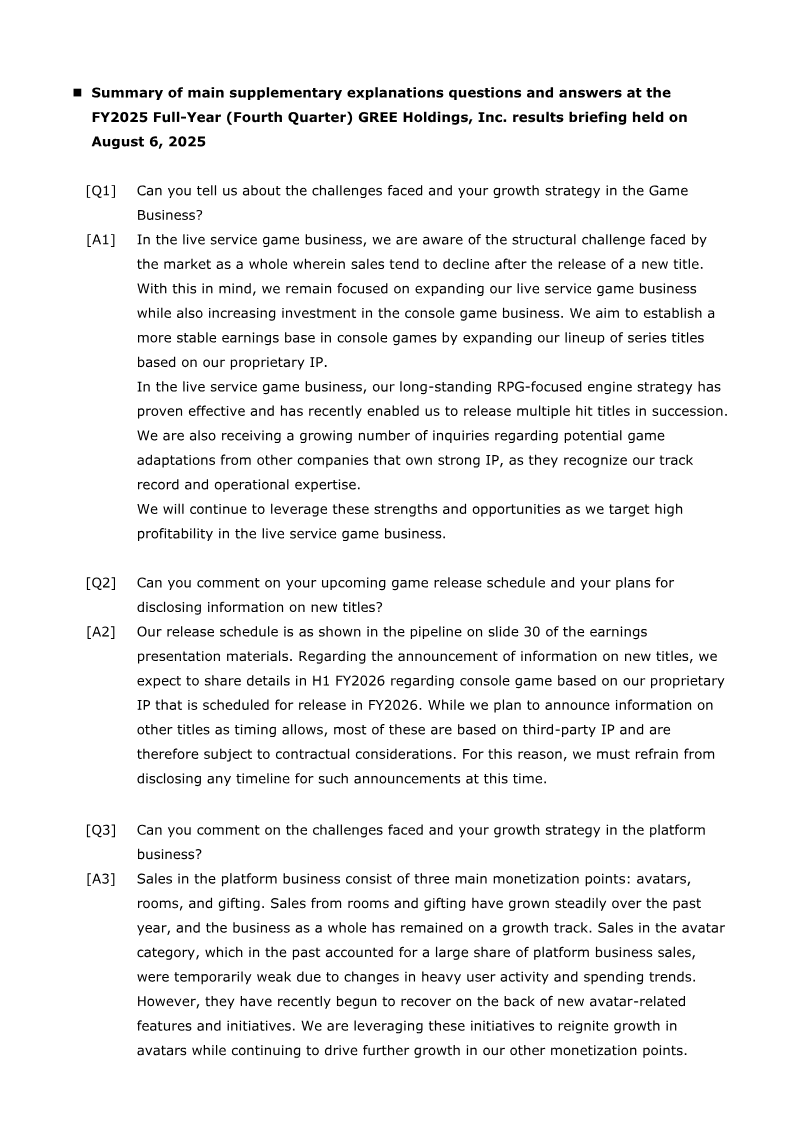
Summary of Main Supplementary Explanations Questions and Answers: FY2025 Full-Year Results
GREE Holdings outlines its FY2025 full‑year results and forward strategy across several business segments. In the game division, the company acknowledges the typical post‑launch decline in live‑service titles and counters it by expanding both its live‑service portfolio—leveraging a proven RPG engine—and investing in console games built on proprietary IP to create a steadier earnings base. The company reports multiple recent hit releases and anticipates further inquiries for third‑party IP adaptations, positioning itself to capture high profitability in the live‑service arena.
The platform business remains growth‑oriented, with steady increases in room and gifting revenue offsetting a temporary dip in avatar sales. New avatar features are expected to revive this segment, while the company continues to push other monetization channels. In the VTuber sector, GREE pursues a two‑stage growth model: first expanding its talent roster—now about 90 talents—and then boosting sales per talent through diversified merchandise channels and nascent live‑event advertising. Sales per talent have doubled since FY2024, and the company maintains a balanced portfolio to avoid over‑reliance on any single talent.
The DX business is undergoing a structural shift from one‑time project sales to recurring revenue, with modest growth projected through FY2026 as the transition completes. Investment activities in FY2026 will see increased volatility due to fund maturity and potential impairment, yet the company expects stable income streams from dividends and performance fees. Overall, GREE projects balanced returns while navigating market challenges across its diversified entertainment portfolio.
- GREE is shifting its game division strategy to balance post-launch live-service volatility by investing in console titles built on proprietary IP.
- The VTuber business has doubled sales per talent since FY2024, supported by a roster of approximately 90 talents and expanded merchandise and advertising channels.
- The DX business is transitioning from a one-time project sales model to a recurring revenue structure, with modest growth expected through FY2026.
- Platform revenue growth is currently driven by room and gifting monetization, which is offsetting a temporary decline in avatar sales.
- Investment activities in FY2026 are expected to experience increased volatility due to fund maturity and potential impairments, though stable income from dividends and performance fees is anticipated.
+4
GREE
Report3 pages
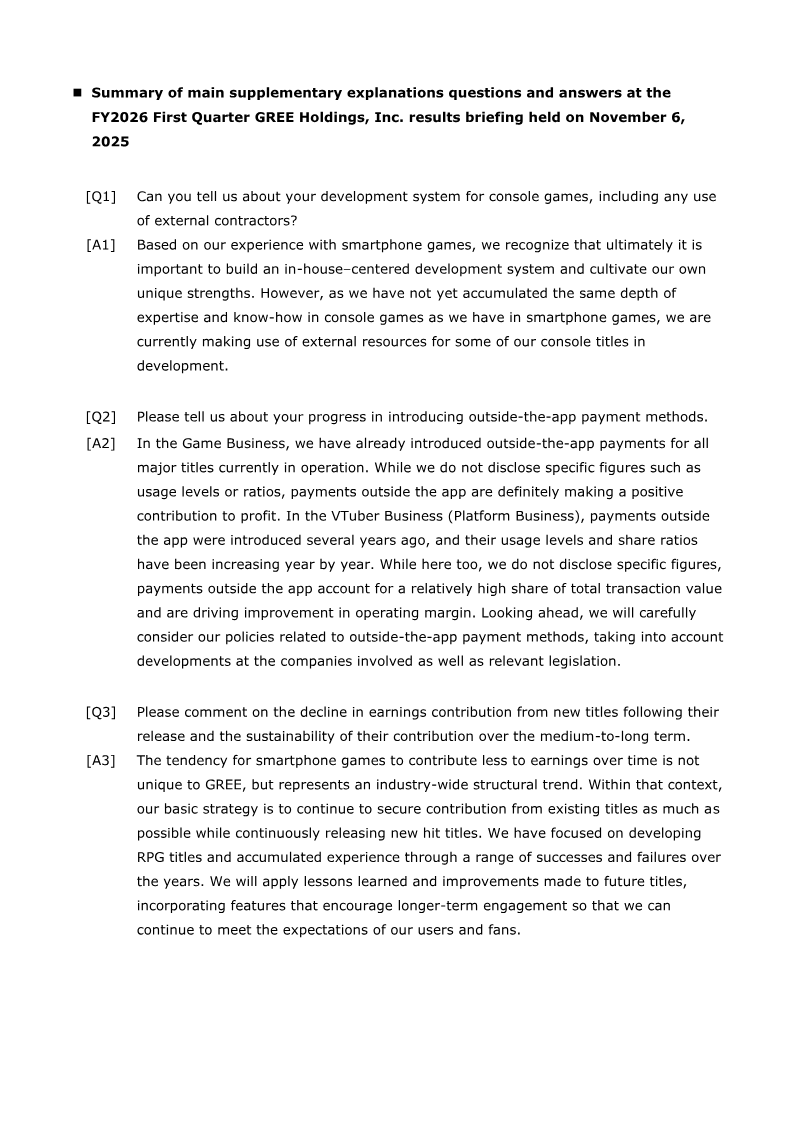
Summary of main supplementary explanations questions and answers at the FY2026 First Quarter GREE Holdings, Inc. results briefing held on November 6, 2025
GREE Holdings’ FY2026 first‑quarter briefing clarified strategic priorities across its game, VTuber, and investment divisions. The company emphasized a shift toward an in‑house development model for console titles while still leveraging external contractors to bridge current expertise gaps. In the mobile game segment, outside‑app payment methods have been fully deployed across all major titles and are contributing positively to profitability; the VTuber platform has similarly expanded its outside‑app transactions, boosting operating margins. The firm acknowledges a structural decline in earnings from new smartphone releases but plans to sustain revenue by focusing on long‑term engagement features and continuous hit title launches, particularly within the RPG genre.
Market outlooks reveal a plateau in smartphone installs but growing potential through high‑value IP and outside‑app monetization. Console gaming is viewed as a long‑term investment, with an emphasis on cultivating enduring IP series. The VTuber market is still expanding globally, especially overseas, and the company projects full‑year profitability for its VTuber production arm by FY2027 as higher‑margin merchandise and live events offset earlier talent acquisition costs.
Exit strategies for the investment business have shifted from IPOs to M&A, reflecting broader market conditions. Generative AI is being integrated across game development, VTuber content creation, and digital transformation services to enhance efficiency and service quality, though its direct earnings impact remains difficult to quantify. Overall, GREE aims to strengthen core competencies, diversify revenue streams, and adapt to evolving market dynamics while pursuing sustainable growth.
- GREE is transitioning to an in-house development model for console titles, utilizing external contractors to address current expertise gaps while focusing on long-term IP cultivation.
- Outside-app payment methods have been fully implemented across all major mobile titles and the VTuber platform, directly contributing to improved operating margins.
- The VTuber production arm is projected to reach full-year profitability by FY2027 as high-margin merchandise and live events offset initial talent acquisition costs.
- The company is shifting its investment business exit strategy from IPOs to M&A to better align with current market conditions.
- Generative AI is being integrated into game development, VTuber content creation, and digital transformation services to improve operational efficiency and service quality.
+3
GREE

Report65 pages
Annual Report and Consolidated Financial Statements: 2020
ANNUAL REPORT AND CONSOLIDATED FINANCIAL STATEMENTS FOR THE YEAR ENDED 31 DECEMBER 2020 Strategic report 3 Highlights of the year 4 Chairman’s statement 6 History and background 7 Strategy 9 Business model 10 tinyBuild portfolio 14 Chief Executive’s ...
- tinyBuild aims for growth through both organic strategies, leveraging existing partnerships and in-house developers, and inorganic strategies, utilizing a low-risk M&A approach focused on 'acquihiring' development teams and acquiring relevant IP.
- The 'Hello Neighbor' franchise serves as a template for tinyBuild's multimedia strategy, having grown organically and through M&A, expanding into merchandise, books, and potential animated TV series, and generating over 60 million downloads for its first game.
- tinyBuild's organic growth strategy focuses on increasing the quality of its game pipeline with 23 games planned for 2021 and 2022, and accumulating IP through standard partnership agreements to extend franchise lifespans.
- The company mitigates risks associated with early-stage developer partnerships by typically providing funding at specific milestones, ensuring investments are tied to key development stages over a limited time horizon.
- tinyBuild's cash generated from operations increased from $11,732,000 in 2019 to $16,470,000 in 2020, with a net increase in cash and cash equivalents of $9,304,000 in 2020, bringing the total to $26,313,000 by year-end.
+3
tinyBuild

Report66 pages
Annual Report and Consolidated Financial Statements: 2021
ANNUAL REPORT AND CONSOLIDATED FINANCIAL STATEMENTS FOR THE YEAR ENDED 31 DECEMBER 2021 Strategic Report 3 Highlights of the year 5 Chairman’s statement 6 History and background 7 Strategy 9 Business model 11 Chief Executive’s review 16 Chief ...
- tinyBuild achieved record growth in 2021 through mergers and acquisitions and organically, and listed on the London Stock Exchange on March 9, 2021.
- The company's back catalog revenue has consistently grown, representing 51% of gaming revenue in FY17, increasing to 83% in FY19, and settling at 79% in FY21.
- tinyBuild has a strong focus on influencer marketing, having achieved over 5 billion content-related views on YouTube by December 31, 2021, and maintaining relationships with over 10,000 verified influencers.
- tinyBuild is actively relocating staff from Ukraine due to the war, setting up a temporary location in the Balkans and planning a third studio in Western Europe to assist with relocation and visa processes.
- The company has a policy against 'crunching' and provided an extra week of holiday to all direct employees in 2021 as appreciation for their work during the pandemic.
+3
tinyBuild

Report70 pages
Annual Report and Consolidated Financial Statements 2024
ANNUAL REPORT AND CONSOLIDATED FINANCIAL STATEMENTS FOR THE YEAR ENDED Chairman’s statement 4 History and background 5 Strategy 7 Business model 9 Chief Executive’s review 14 Chief Financial Officer’s review 16 Environmental, social and governance (ESG) 18 Principal risks and uncertainties ...
- tinyBuild experienced a significant decline in revenue and continued operating losses in 2024, with revenue dropping by 22% year-over-year to $34.7 million (from $44.7 million in 2023) and an operating loss of $20.4 million (compared to $63.8 million in 2023).
- The revenue decline was primarily due to limited flow-through from new games released in 2023 and a 50% drop in development revenues, largely from platform deals.
- Adjusted EBITDA remained negative at -$3.681 million in 2024, an improvement from -$7.113 million in 2023, impacted by revenue decline and a $13.7 million impairment of software development costs.
- tinyBuild raised over $11 million in new capital in January 2024 and welcomed Atari as a new core investor, helping to fund promising projects.
- The company maintains an organic growth strategy focusing on diversification, internal development teams (e.g., DUCKSIDE), established partnerships (e.g., Potion Craft), and leveraging influencer relationships for marketing, achieving over 5 billion content-related views on YouTube by December 31, 2024.
+2
tinyBuild
Report67 pages
Annual Report 2014: 11 bit studios S.A.
I. PISMO ZARZĄDU ........................................................................................................3 II. WYBRANE JEDNOSTKOWE DANE FINANSOWE ZAWIERAJĄCE PODSTAWOWE POZYCJE ROCZNEGO SPRAWOZDANIA FINANSOWEGO WRAZ Z DANYMI PORÓWNYWALNYMI...........4 III. SPRAWOZDANIE FINANSOWE 11 BIT STUDIOS S.A. ZA ROK 2014 ...................................5 IV. SPRAWOZDANIE ZARZĄDU Z DZIAŁALNOŚCI SPÓŁKI W ROKU 2014. ............................. 40 V.
- 11 bit studios S.A. released "This War of Mine" in 2014, a milestone game developed in-house, and also launched "Spacecom" through its 11 bit launchpad publishing division.
- The company's total assets significantly increased from 589,514.42 PLN in 2013 to 1,745,563.16 PLN in 2014, driven by growth in intangible assets (from 466,671.58 PLN to 1,444,226.03 PLN) and tangible assets (from 63,180.84 PLN to 103,579.73 PLN).
- Net profit for 2014 was 890,745.75 PLN, a substantial increase from the previous year, with operating profit at 1,248,589.34 PLN.
- 11 bit studios S.A. generates most of its revenue in foreign currencies (primarily USD), meaning a weaker Polish Zloty positively impacts its income.
- The company faces risks including strong competition from other publishers, increasing competition in the game market, the risk of ideas being copied, and the challenge of keeping up with dynamic market trends like Virtual Reality (VR).
+3
11 bit studios
Report74 pages
Annual Report 2017: 11 bit studios
2.2. SPRAWOZDANIE Z SYTUACJI FINANSOWEJ (PLN) AKTYWA PISMO ZARZĄDU Nota Stan na Stan na 31.12.2017 31.12.2016 Aktywa trwate Warszawa, 26 marca 2018 roku Rzeczowe aktywa trwate 3.11. 814 332 779 540 Szanowni Akcjonariusze i Inwestorzy 3.12.
- 11 bit studios S.A. focused heavily on "Frostpunk" in 2017, anticipating it will drive financial results for years, with its release scheduled for April 24, 2018.
- The company continued developing "This War of Mine" in 2017, releasing the "Fathers Promise" DLC on November 14, with two more "TWoM: Stories" DLCs planned for 2018. They also began work on a new game, "Projekt 8," involving a 20-person team, to be released after "Frostpunk."
- 11 bit publishing released two external games in 2017: "Beat Cop" (March 30) and "Tower 57" (November 16), with external game sales contributing over 10% to total revenue and recouping investment within months.
- Operating profit for 2017 was 7,619,936 PLN, a 50.69% decrease from 15,454,560 PLN in 2016, despite a 5.64% increase in operating costs to 11,845,351 PLN (from 11,212,540 PLN in 2016) and increased promotional spending.
- 11 bit studios S.A. sold its 100% stake in subsidiary Games Republic Limited to Lousva Trading Limited on April 11, 2017, dissolving the 11 bit studios S.A. Capital Group.
+3
11 bit studios
Report127 pages
Annual Report: 11 Bit Studios S.A. 2024
ANNUAL REPORT OF 11 BIT STUDIOS S.A. FOR 2024 (all amounts in PLN unless stated otherwise) DEAR SHAREHOLDERS AND INVESTORS, It is with great pleasure that we present to you our Annual Report for 2024. During this period, 11 bit studios S.A. generated revenue of PLN 140.54 million, marking a 168.9% increase year on year and representing an all-time record for the Company.
- 11 Bit Studios S.A. is a computer game developer and publisher, with Frostpunk 2 (PC version) being a major recent success, selling 350,000 copies within three days of its September 20, 2024 launch and reaching 592,000 total unit sales by the end of 2024.
- The company's equity has grown significantly, from PLN 42.13 million in 2017 to PLN 229.92 million in 2024, reflecting a higher net profit in 2024 compared to 2023.
- Cash resources increased by 29.56% to PLN 70,463,596 at the end of 2024, up from PLN 54,386,466 in 2023, and total financial assets reached PLN 91,543,938.
- Total liabilities increased by 3.59% to PLN 32,384,084 in 2024, with current liabilities rising 12.66% to PLN 27,830,893, including PLN 11,002,109 in contract liabilities for future game sales and DLCs.
- The company has a multi-purpose credit facility of PLN 20,000,000 with PKO BP S.A. until June 25, 2025, which had no drawdowns as of the reporting date, and an investment credit facility with PKO BP S.A. of PLN 5,040,000 outstanding as of December 31, 2024.
+4
11 bit studios

Report48 pages
Semi-Annual Report of 11 bit studios S.A.
Signed by: LETTER FROM THE MANAGEMENT BOARD Dear Shareholders and Investors Przemystaw Marszat Michat Drozdowski President of the Management Board Member of the Management Board Member of the Management Board Please be invited to read the Half-Year Report of 11 bit studios S.A. for the first half of 2019. During the period, we recorded over PLN 30.7m in revenue. Operating profit came in close to PLN 8.7m, with net profit above PLN 6.4m.
- 11 bit studios S.A. reported H1 2019 revenue of over PLN 30.7m, operating profit near PLN 8.7m, and net profit above PLN 6.4m, despite PLN 4.1m in non-cash provisions for their incentive scheme.
- The company's financial assets (cash, bank deposits, financial instruments, trade receivables) grew by PLN 13m from the end of 2018 to nearly PLN 84m by June 30, 2019, supported by almost PLN 20m in net cash flows from operating activities.
- Strong sales of Frostpunk and Moonlighter, both over a year old, along with continued contributions from This War of Mine, were the primary drivers of H1 2019 financial performance.
- Moonlighter, developed by Digital Sun, had over one million players by early Q3 2019, with Nintendo Switch becoming its leading sales platform since Q1 2019, especially after a successful Japanese launch.
- Children of Morta, a new publishing title, is set to launch for PCs on September 3, 2019, and consoles on October 15, 2019, with strong pre-release interest on Steam suggesting significant commercial potential.
+2
11 bit studios