Report37 pages
Report of the German Games Industry: 2026
The German video games market solidified its status as Europe’s largest in 2025, achieving a total revenue of 9.4 billion euros. This four percent growth was primarily fueled by a 12 percent surge in hardware sales and the milestone achievement of online gaming services exceeding one billion euros in revenue. Despite these gains, the sector faces a complex transition, marked by a 13 percent decline in one-off game purchases and a slight three percent contraction in the workforce, even as the total number of industry companies grew to 956.
Domestic production remains a critical area for development, as local companies currently capture only 5.50 euros of every 100 euros spent within the German market. To address this, the industry is leveraging increased federal funding, which is set to reach 125 million euros annually by 2026, alongside new tax-based incentive proposals and infrastructure projects like the House of Games Berlin. These initiatives aim to provide the long-term planning certainty required to improve international competitiveness and foster a more robust ecosystem for developers, publishers, and academic institutions.
Beyond economic metrics, the industry is undergoing significant professionalization and cultural integration. Regulatory frameworks, such as the USK’s expanded youth protection measures, and the formal recognition of esports clubs as charitable organizations reflect a maturing sector. With the average gamer age now at 38.2 years and major events like gamescom maintaining record attendance, Germany continues to serve as a central global hub for innovation. Industry associations are further driving progress through standardized diversity initiatives and environmental sustainability programs, ensuring that the sector remains aligned with modern social and economic expectations.
- The German video games market reached 9.4 billion euros in 2025, a four percent increase driven by a 12 percent surge in hardware sales and over one billion euros in online gaming service revenue.
- Domestic production remains low, with local companies capturing only 5.50 euros of every 100 euros spent in the German market.
- Federal funding for the industry is set to reach 125 million euros annually by 2026, supplemented by proposed tax incentives and infrastructure projects like the House of Games Berlin to boost competitiveness.
- The industry faces a structural shift characterized by a 13 percent decline in one-off game purchases and a three percent contraction in the workforce, despite the total number of companies rising to 956.
- The German gaming demographic is maturing, with the average gamer age now at 38.2 years.
+1
game – Verband der deutschen Games-Branche e. V.
Whitepaper38 pages
White Paper on Spanish Videogame Development 2025
The Spanish video game industry stands at a pivotal juncture, characterized by steady growth alongside significant structural vulnerabilities. Comprising 820 studios and employing over 10,500 professionals, the sector generated €1.464 billion in 2024. Despite this output, the industry remains highly consolidated, with 78 percent of total revenue concentrated among a small group of large-scale studios. A pervasive reliance on external financing, affecting 80 percent of companies, underscores the fragility of the current ecosystem, particularly as nearly half of all studios report negative impacts from recent economic instability, including project cancellations and workforce reductions.
To secure long-term viability and global competitiveness, the industry must transition toward a model that prioritizes the retention of intellectual property and the scaling of mid-sized enterprises. Strategic objectives include quadrupling annual turnover and doubling high-quality employment through a framework of five core pillars. These initiatives emphasize the necessity of robust tax incentives, expanded public funding, and the cultivation of a national investment ecosystem. Furthermore, while generative artificial intelligence has been adopted by 53 percent of studios, the lack of consensus regarding its utility suggests that future growth depends on balanced, responsible technological integration rather than uncritical adoption.
Ultimately, the sector’s evolution requires deeper collaboration between local creators and international platforms to bridge the gap between creative potential and financial sustainability. By fostering stronger ties between academic institutions, professional organizations, and independent developers, the industry aims to solidify its position within the global market. The path forward necessitates a coordinated policy approach that mitigates economic risks while providing the capital and infrastructure required to transform Spain into a premier hub for high-value digital entertainment production.
- The Spanish video game industry generated €1.464 billion in 2024 across 820 studios, but 78 percent of this revenue is concentrated within a small group of large-scale companies.
- Eighty percent of studios rely on external financing, leaving the sector vulnerable to economic instability, which has already caused project cancellations and workforce reductions for nearly half of all firms.
- The industry employs over 10,500 professionals and has set strategic goals to quadruple annual turnover and double high-quality employment through improved tax incentives and public funding.
- While 53 percent of Spanish studios have adopted generative artificial intelligence, there is no industry consensus on its utility, signaling a need for cautious and balanced technological integration.
- Long-term viability depends on transitioning toward a model that prioritizes the retention of intellectual property and the scaling of mid-sized enterprises.
+1
Asociación Española de Empresas Productoras y Desarrolladoras de Videojuegos

Report87 pages
Libro Blanco del Desarrollo Español de Videojuegos 2025
The Spanish video game industry stands at a critical juncture, characterized by resilience and creative output despite a global climate of economic instability. As of 2024, the sector generated €1,464 million in turnover and sustained over 10,500 direct jobs, with Catalonia and Madrid serving as the primary hubs for development. While the industry maintains a stable core—with 72% of studios operating for over five years—it faces a notable slowdown in growth. Currently, 820 active studios operate within the country, yet approximately 200 of these entities remain at risk of closure due to project cancellations and workforce reductions, reflecting a broader vulnerability to international market volatility.
Structural challenges persist, particularly regarding the industry's reliance on self-financing and self-publishing models. Most studios operate on a small scale, often managing only one project at a time, which complicates the transition toward complex "games as a service" models. While 53% of companies have begun integrating generative artificial intelligence into their workflows, adoption remains cautious and technically experimental. Furthermore, the industry continues to depend heavily on international sales, which account for 52% of revenue, highlighting a need for stronger domestic investment ecosystems and more robust collaboration with international platforms to retain intellectual property within Spain.
To ensure long-term competitiveness, the sector requires a strategic shift toward institutional support. Key priorities include the implementation of targeted tax incentives, the consolidation of public funding, and improved professional training programs to address the persistent shortage of experienced talent in programming and design. By fostering a more sustainable financial environment and bridging the gap between small-scale production and global market demands, the industry aims to transition from a fragmented landscape of small studios to a more scalable, technologically advanced, and strategically recognized pillar of the Spanish economy.
- The Spanish video game industry generated €1,464 million in turnover and supports over 10,500 direct jobs, with Catalonia and Madrid acting as the primary development hubs.
- Approximately 200 of the 820 active studios are currently at risk of closure due to project cancellations and workforce reductions, signaling significant vulnerability to international market volatility.
- While 72% of studios have been operational for over five years, the industry faces a growth slowdown and a structural reliance on self-financing and single-project development models.
- International sales account for 52% of total revenue, underscoring a critical need for stronger domestic investment and strategies to retain intellectual property within Spain.
- 53% of Spanish studios have begun integrating generative artificial intelligence into their workflows, though current adoption remains in an experimental and cautious phase.
+2
Asociación Española de Empresas Productoras y Desarrolladoras de Videojuegos

Report38 pages
Libro Blanco del Desarrollo Español de Videojuegos 2025
The Spanish video game industry serves as a critical engine for national innovation, currently comprising 820 studios that generate 1,464 million euros in annual revenue and employ over 10,500 professionals. Despite this robust footprint, the sector faces a period of significant volatility, with nearly half of all studios reporting negative impacts from the current economic climate, including project cancellations and workforce reductions. While the industry remains characterized by a highly educated, young workforce and a strong specialization in PC development via the Unity engine, the reliance on internal self-financing remains a structural vulnerability that hinders the scaling of larger, more sustainable AAA projects.
Human talent remains the primary driver of the industry, even as the integration of generative artificial intelligence becomes more prevalent. Although 53 percent of studios have adopted AI tools, widespread skepticism regarding their reliability persists, reinforcing the necessity of human expertise in programming and design. The industry is currently navigating a transition where the ease of hiring has improved, yet the demand for experienced, specialized talent remains unmet. To address these challenges, the sector is prioritizing the retention of intellectual property and economic value within Spain, aiming to shift away from a reliance on international operators toward a more self-sustaining national ecosystem.
Strategic efforts are now focused on securing legislative recognition to integrate game development into national audiovisual tax incentive programs. By fostering a coalition of developers, technology partners, and academic institutions, the industry is implementing a roadmap through 2026 that emphasizes international promotion and professional networking. These initiatives are designed to mitigate the current crisis by expanding public funding and creating a more favorable investment climate, ultimately ensuring that the Spanish gaming sector can compete effectively on the global stage while maintaining its long-term economic viability.
- The Spanish video game industry comprises 820 studios generating 1,464 million euros in annual revenue and employing over 10,500 professionals.
- Nearly 50% of studios report negative economic impacts, including project cancellations and workforce reductions, highlighting a vulnerability caused by a reliance on internal self-financing.
- The industry is lobbying for legislative changes to integrate game development into national audiovisual tax incentive programs to improve investment and long-term sustainability.
- While 53% of studios have adopted generative AI, widespread skepticism regarding tool reliability maintains a strong reliance on human expertise in programming and design.
- The sector is executing a strategic roadmap through 2026 focused on international promotion, professional networking, and retaining intellectual property within Spain.
+2
Asociación Española de Empresas Productoras y Desarrolladoras de Videojuegos
Report72 pages
Cyprus Video Game Industry Report 2025
Cyprus has emerged as the world’s most efficient video game development ecosystem, functioning as a critical hub within the $263.7 billion global gaming market. By 2025, the island’s industry comprised over 400 companies and a workforce exceeding 4,300 employees, contributing approximately €1.15 billion directly to the national GDP. This rapid expansion, which saw the number of firms more than double between 2019 and 2024, is underpinned by a mobile-first strategy, a favorable IP Box tax regime, and a high concentration of mobile game installs per capita. Despite its small population, Cyprus ranks third globally in mobile downloads and eleventh in mobile in-app revenue, reflecting a mature, export-oriented sector.
The ecosystem’s financial health is characterized by significant capital activity, including €2.76 billion in M&A and €137 million in equity funding between 2020 and 2025. A unique feature of this landscape is the prevalence of user-acquisition financing, which provided €128.3 million in non-dilutive capital in 2025, allowing studios to maintain agility. Furthermore, Cyprus-based developers are at the forefront of the industry-wide shift toward direct-to-consumer (D2C) sales models. By bypassing traditional platform fees and securing direct access to player data, these studios have gained a distinct competitive advantage in an increasingly saturated global market that now prioritizes profitability and player relationship management over rapid, unchecked expansion.
Despite these successes, the industry faces structural challenges regarding long-term sustainability. While the tax framework is highly competitive for established studios, there is a notable deficit in dedicated early-stage grants and seed funding for startups. Additionally, the talent pipeline remains a bottleneck; although the nation hosts a large student population, the annual output of graduates specifically trained for game development is insufficient to meet current demand. Future growth will depend on closing these funding and educational gaps, as exemplified by upcoming initiatives like the 2026 Plug&Play accelerator, which aim to solidify Cyprus’s position as a premier global gaming destination.
- By 2025, Cyprus's video game industry became a critical global hub, comprising over 400 companies and 4,300 employees, contributing approximately €1.15 billion directly to the national GDP.
- The industry's rapid expansion, with firms more than doubling between 2019 and 2024, is driven by a mobile-first strategy, a favorable IP Box tax regime, and high mobile game installs per capita.
- Cyprus ranks third globally in mobile downloads and eleventh in mobile in-app revenue, reflecting a mature, export-oriented sector.
- The ecosystem's financial health is strong, with €2.76 billion in M&A and €137 million in equity funding between 2020 and 2025, alongside €128.3 million in user-acquisition financing in 2025.
- Cyprus-based developers are leading the shift to direct-to-consumer (D2C) sales models, gaining competitive advantage by bypassing platform fees and accessing player data.
+1
Cyprus Game Makers Association
Report41 pages
Annual Report of the German Games Industry 2024
The German games industry reached a total revenue of 9.97 billion euros in 2023, marking a 6 percent increase driven largely by hardware sales, mobile gaming, and in-game purchases. Despite this financial expansion and a 52 percent growth in the number of development and publishing companies since 2020, the sector faces a period of cooling optimism. A challenging international economic climate, coupled with the unpredictability of federal funding, has slowed the pace of new company formations and employment growth. While Germany maintains its position as the largest games market in Europe, domestic developers are increasingly disadvantaged by a reliance on fixed-budget funding models that lack the stability of the tax credit systems utilized by international competitors.
To secure long-term competitiveness, the industry is advocating for a transition to a hybrid, tax-based funding model. Strategic priorities for 2024 include the cultivation of a specialized workforce, the integration of gaming into educational frameworks, and the expansion of digital infrastructure. These efforts are complemented by a strong commitment to social and environmental responsibility. A significant majority of companies have adopted sustainability measures, such as transitioning to green energy, while industry-led initiatives continue to promote diversity, combat toxicity, and provide professional support for esports athletes through structured talent development programs.
The industry’s cultural and economic influence remains anchored by the global success of gamescom, which continues to expand its international footprint through satellite events in Singapore and Brazil. Furthermore, the sector is prioritizing rigorous youth protection standards and the promotion of games as essential cultural and educational tools. By balancing these community-focused initiatives with a push for more consistent federal policy, the German games industry aims to solidify its status as a premier global hub for development, innovation, and esports, ensuring both economic resilience and social sustainability in an evolving digital landscape.
- The German games industry generated 9.97 billion euros in revenue in 2023, representing a 6 percent year-over-year increase driven by hardware, mobile gaming, and in-game purchases.
- While the number of development and publishing companies has grown by 52 percent since 2020, the sector is experiencing a slowdown in new company formations and employment growth due to economic instability and unpredictable federal funding.
- Industry stakeholders are advocating for a shift from fixed-budget funding to a hybrid, tax-based model to remain competitive against international rivals who benefit from more stable tax credit systems.
- Germany remains the largest games market in Europe, with its global influence bolstered by the international expansion of the gamescom event into markets like Singapore and Brazil.
- Strategic priorities for 2024 include workforce development, the integration of gaming into educational frameworks, and the improvement of digital infrastructure.
+1
game – Verband der deutschen Games-Branche e. V.
Report51 pages
Modern Responsibility Report 2012
Modern Times Group (MTG) integrates sustainability and ethical governance into its core business strategy to drive long-term growth across its global entertainment operations. During the 2012 fiscal year, the company maintained a workforce of 3,012 employees and generated net sales of 13,336 MSEK. Operating across more than 30 broadcast markets, the organization utilizes a four-pillar framework—business, colleague, broadcast/marketing, and community responsibility—to ensure regulatory compliance, promote diversity, and uphold editorial integrity.
The company’s commitment to corporate responsibility is evidenced by measurable progress in environmental and social performance. In 2012, MTG achieved a 6% reduction in CO2 emissions per employee and secured a "B" rating from the Carbon Disclosure Project. Social impact initiatives were equally prominent, with the company raising 49 million SEK for charitable causes and supporting programs such as "Reach for Change" and the "School of Tolerance." Furthermore, the organization prioritized consumer safety through enhanced parental controls and expanded accessibility services, including subtitling and audio descriptions, to better serve its diverse audience.
Adhering to the Global Reporting Initiative (GRI) G3.1 guidelines at a C+ application level, the company maintains a transparent approach to its operations, supported by independent assurance from Ethos International. While the 2012 performance reflects significant advancements in anti-corruption training, internal communication, and community engagement, the organization acknowledges the necessity for future improvements in supply chain management and human resources data collection systems. By aligning its broadcasting reach with strategic sustainability goals, MTG continues to leverage its media platforms to promote social awareness and mitigate climate-related business risks.
- In 2012, Modern Times Group (MTG) generated 13,336 MSEK in net sales while employing 3,012 staff across more than 30 broadcast markets.
- The company achieved a 6% reduction in CO2 emissions per employee and earned a 'B' rating from the Carbon Disclosure Project.
- MTG raised 49 million SEK for charitable causes in 2012, supporting initiatives such as 'Reach for Change' and the 'School of Tolerance'.
- The organization reported its sustainability performance using the Global Reporting Initiative (GRI) G3.1 guidelines at a C+ application level, with independent assurance provided by Ethos International.
- MTG implemented enhanced parental controls and expanded accessibility services, including subtitling and audio descriptions, to improve consumer safety and service inclusivity.
Modern Times Group
Report43 pages
Corporate Responsibility Report 2014
MTG’s 2014 operational strategy centered on the integration of corporate responsibility into its core business model, prioritizing digital data protection, the rights of minors, and the preservation of freedom of expression. By aligning operations with UN Global Compact and OECD guidelines, the company achieved net sales of 16,746 MSEK while maintaining a rigorous ethical framework. This governance structure included the implementation of a new supplier code of conduct, mandatory anti-bribery training, and the introduction of an external whistleblower system, resulting in zero confirmed cases of corruption during the fiscal year.
The company’s commitment to social and environmental stewardship was evidenced by a 33% reduction in energy consumption per employee since 2010 and an improved CDP score of 90B. Beyond internal efficiency, MTG leveraged its media platforms to double donated airtime for social and environmental causes. HR initiatives focused on decentralizing operations to empower local markets, fostering a diverse workforce of 4,111 employees representing 44 nationalities. While the company successfully promoted initiatives like Women in Tech, it acknowledged ongoing challenges regarding gender pay parity and high turnover rates in sales-intensive roles, leading to the restructuring of certain internal development goals.
Operating across diverse geographic regions, MTG maintained strict neutrality and regulatory adherence through robust content rating systems and parental controls. Independent assurance provided by Ethos International confirmed that the company’s performance indicators met the Core level of the Global Reporting Initiative G4 guidelines. While the organization successfully met most targets regarding data protection and environmental impact, auditors recommended the adoption of advanced digital management systems to enhance the accuracy of future human resource data collection, ensuring continued transparency and operational efficiency in subsequent reporting periods.
- MTG achieved net sales of 16,746 MSEK in 2014 while maintaining zero confirmed cases of corruption through the implementation of mandatory anti-bribery training and an external whistleblower system.
- The company reduced energy consumption per employee by 33% since 2010 and achieved a CDP score of 90B, reflecting its commitment to environmental stewardship.
- MTG employed 4,111 people across 44 nationalities, though the company identified ongoing challenges regarding gender pay parity and high turnover rates in sales-intensive roles.
- Operational governance was aligned with UN Global Compact and OECD guidelines, with independent assurance from Ethos International confirming compliance with the Global Reporting Initiative G4 Core level.
- The company prioritized digital safety by implementing robust content rating systems and parental controls to protect minors and preserve freedom of expression.
+1
Modern Times Group
Report62 pages
Corporate Responsibility Report 2015
MTG’s 2015 corporate responsibility strategy centers on navigating a strategic transition into a global digital entertainment powerhouse while upholding rigorous ethical standards and sustainability commitments. The company prioritizes transparency, governance, and social impact, aligning its reporting with GRI G4 standards to ensure accountability across its diverse operations. By integrating a zero-tolerance policy toward corruption and enforcing a mandatory supplier code of conduct, the organization seeks to mitigate risks associated with its evolving digital and live-event portfolio, including cyber-resilience and intellectual property protection.
Environmental and social performance metrics reveal a complex landscape of progress and ongoing challenges. While total energy consumption and carbon emissions saw a slight uptick, the company successfully reduced emissions per employee by over 2% and improved long-term energy efficiency by 13% since 2010. Air travel remains the primary driver of the company’s carbon footprint, prompting a shift toward virtual collaboration and renewable energy reliance. Socially, the company leverages its media influence to support global causes, donating over €9 million in airtime and fostering social entrepreneurship through initiatives like Reach for Change.
Workforce development remains a critical focus, characterized by a diverse staff of nearly 4,000 employees representing 38 nationalities. Despite a 24% turnover rate and a persistent gender gap in leadership, the company has formalized a commitment to achieve gender parity in management by 2020 through targeted mentorship and internal policy adjustments. As the company expands its digital footprint, it continues to refine its risk management and compliance frameworks, ensuring that its growth is balanced by a commitment to ethical content production, child protection, and robust data privacy standards across its European and global markets.
- MTG has committed to achieving gender parity in management by 2020 through formalized mentorship programs and policy adjustments to address a persistent leadership gender gap.
- The company maintains a workforce of nearly 4,000 employees across 38 nationalities, though it currently faces a 24% annual staff turnover rate.
- MTG donated over €9 million in airtime to support global causes and social entrepreneurship initiatives such as Reach for Change.
- While total carbon emissions increased, the company achieved a 13% improvement in energy efficiency since 2010 and a 2% reduction in emissions per employee.
- Air travel is the primary contributor to MTG’s carbon footprint, leading the organization to prioritize virtual collaboration and increased reliance on renewable energy.
Modern Times Group
Report3 pages
Modern Slavery Statement
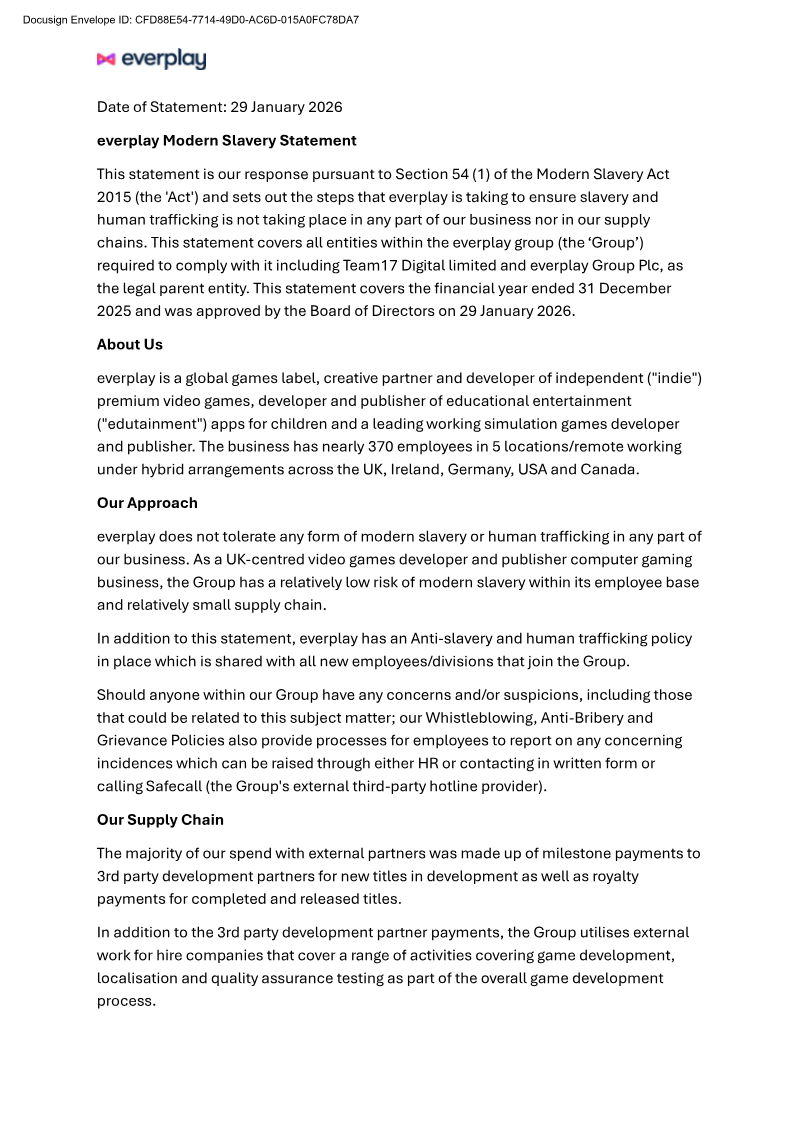
Everplay, a global video game developer and publisher, maintains a firm commitment to preventing modern slavery and human trafficking across its operations and supply chains. Covering the financial year ending December 31, 2025, this statement fulfills the requirements of the Modern Slavery Act 2015. The organization operates with approximately 370 employees across the UK, Ireland, Germany, the USA, and Canada, maintaining a business model that relies primarily on intellectual property and digital services rather than physical manufacturing, which inherently limits its exposure to modern slavery risks.
The company’s supply chain is primarily composed of third-party development partners, royalty recipients, and external service providers for localization and quality assurance. While the overall risk profile is considered low, the organization identifies quality assurance and localization as areas requiring heightened vigilance. To mitigate these risks, Everplay mandates that all new and renewing contracts include specific clauses requiring supplier compliance with the Act, granting the company the right to terminate agreements in the event of a breach.
Governance of these efforts is overseen by the Audit Committee, which reports to the Board of Directors at least twice annually. The company utilizes a multi-layered approach to risk management, incorporating internal policies, annual risk register reviews, and an external third-party whistleblowing hotline to ensure transparency and accountability. To date, these measures have proven effective, with no reported incidents of modern slavery. Everplay continues to prioritize employee and stakeholder awareness through ongoing training and the integration of anti-slavery protocols into its broader corporate governance framework.
- Everplay employs approximately 370 staff across the UK, Ireland, Germany, the USA, and Canada, operating a business model focused on intellectual property and digital services.
- The company mandates that all new and renewing contracts include specific anti-slavery compliance clauses, granting Everplay the right to terminate agreements for breaches.
- While the overall risk profile is considered low, the company identifies third-party localization and quality assurance providers as the primary areas requiring heightened vigilance.
- Governance of anti-slavery efforts is managed by the Audit Committee, which reports to the Board of Directors at least twice annually.
- Risk management is supported by annual risk register reviews and an external third-party whistleblowing hotline to ensure transparency.
+1
Everplay
Report3 pages
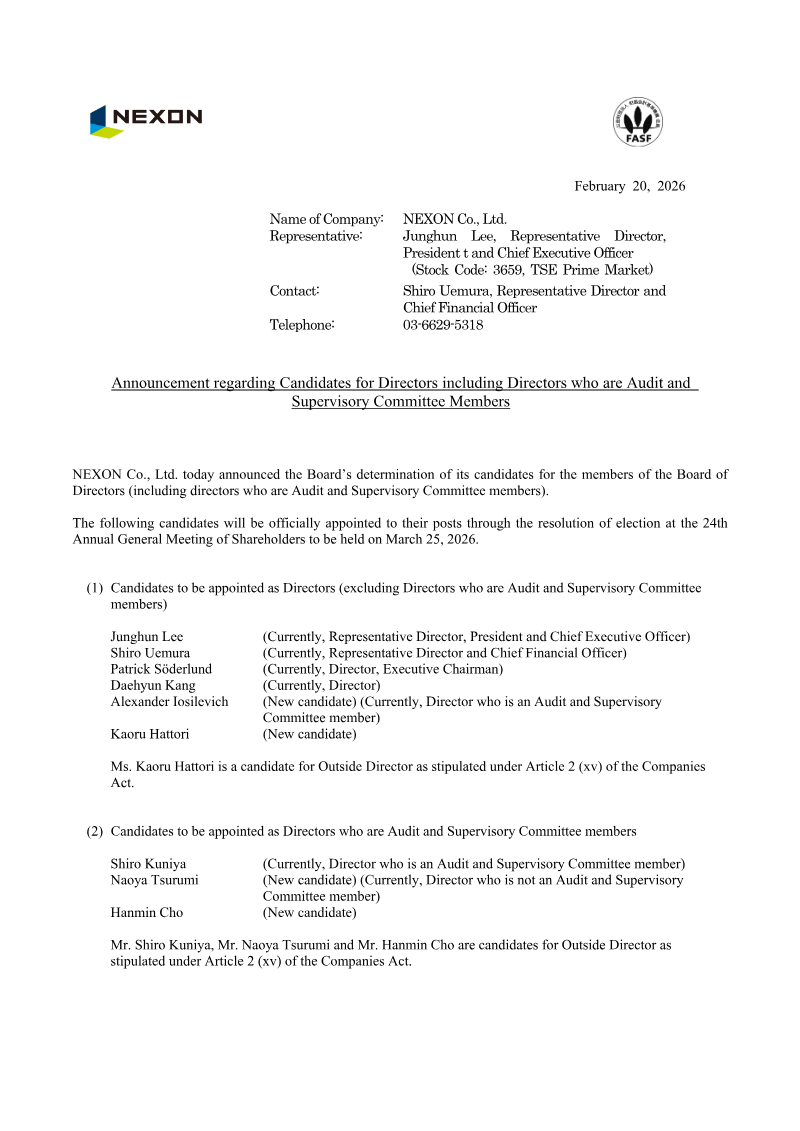
2026.02.20 Announcement regarding Candidates for Directors including Directors who are Audit and Supervisory Committee Members
NEXON Co., Ltd. announced the Board’s selection of candidates for its 24th Annual General Meeting on March 25, 2026. The slate includes six directors, among them two new outside directors and three individuals who will serve concurrently on the Audit and Supervisory Committee. Current executives Junghun Lee, Shiro Uemura, Patrick Söderlund and Daehyun Kang are retained. New appointments comprise Alexander Iosilevich, a seasoned investment‑banking executive with no shareholding in NEXON, and Kaoru Hattori, a Japanese lawyer and partner at Nagashima Ohno & Tsunematsu who also holds trustee and board roles in Toyo Seikan Group Holdings. The Audit and Supervisory Committee will be strengthened by Shiro Kuniya, Naoya Tsurumi—an experienced Sega executive with extensive leadership roles across SEGA subsidiaries—and Hanmin Cho, a private‑equity professional who has led investment divisions at NXC Corporation and holds directorships in NXMH B.V. and Bitstamp Limited.
The announcement details each candidate’s career trajectory, concurrent positions, and share ownership (all new candidates hold zero shares). The selection aligns with Korean Companies Act provisions for outside directors and reflects NEXON’s strategy to blend internal leadership continuity with external expertise in finance, gaming operations, and regulatory oversight. The candidates’ diverse backgrounds—spanning global investment banking, legal practice, gaming industry leadership, and private‑equity management—are intended to enhance governance, strategic direction, and risk oversight for the company’s operations in South Korea and its international markets.
- NEXON Co., Ltd. will present a slate of six director candidates for approval at its 24th Annual General Meeting on March 25, 2026.
- The board is retaining current executives Junghun Lee, Shiro Uemura, Patrick Söderlund, and Daehyun Kang to ensure leadership continuity.
- New outside director appointments include Alexander Iosilevich, an investment-banking executive, and Kaoru Hattori, a partner at the law firm Nagashima Ohno & Tsunematsu.
- The Audit and Supervisory Committee will be strengthened by the addition of Shiro Kuniya, former Sega executive Naoya Tsurumi, and private-equity professional Hanmin Cho.
- The new director candidates hold zero shares in NEXON, and their appointments are intended to bolster governance and regulatory oversight in South Korea and international markets.
+1
NEXON Co.
Report84 pages
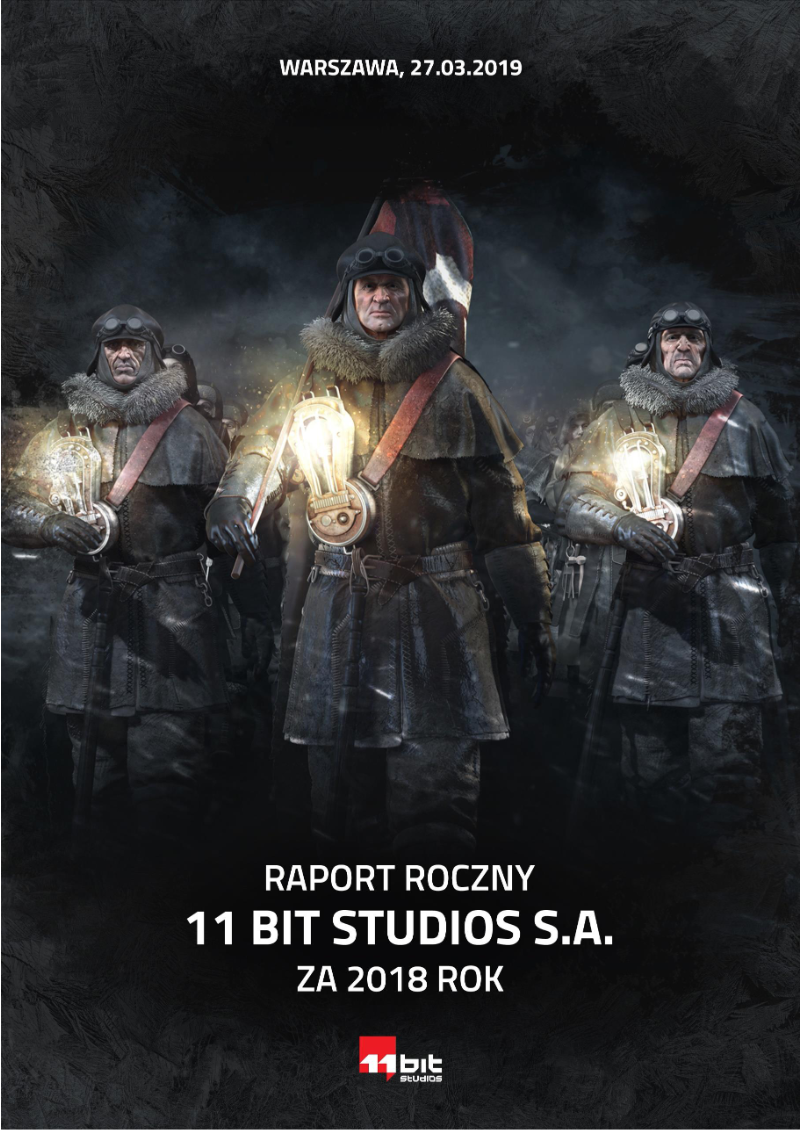
Annual Report 2018: 11 bit studios S.A.
wynagrodzenia róznicowana jest w zaleznosci od petnionej funkcji czy zajmowanego stanowiska). Wynagrodzenia uzyskiwane przez osoby zarzadzajace oraz osoby zarzadzajace wyzszego szczebla w Spótce obejmuje wynagradzanie akcjami, opcjami na akcje lub innymi prawami nabycia akcji, jak równiez wynagrodzenie nie jest ustalane w oparciu o zmiany cen akcji. PISMO ZARZĄDU WEWNETRZNEJ I ZARZADZANIA RYZYKIEM Szanowni Akcjonariusze i Inwestorzy raportów finansowych.
- 11 bit studios S.A. had an exceptional year in 2018, driven by the successful launches of "Frostpunk" (April 24) and "Moonlighter" (May 29), both of which quickly became bestsellers on platforms like Steam.
- The company actively supported its top games, "Frostpunk" and "Moonlighter," with significant free DLC releases throughout 2018, including "Survivor Mode," "The Fall of Winterhome," and "Endless Mode" for "Frostpunk," and "The Binding of Will" for "Moonlighter," which boosted sales and player engagement.
- Total capital expenditures on tangible assets (primarily real estate for a new office at Brzeska 2) and intangible assets (primarily game production) significantly increased from PLN 7,372,863 in 2017 to PLN 26,571,879 in 2018.
- NN Investment Partners TFI S.A. increased its stake in 11 bit studios S.A. to 5.21% of the share capital (119,229 shares) on June 15, 2018, up from 4.93% (112,476 shares) previously.
- 11 bit studios S.A. continued its charitable activities in 2018, donating a portion of revenue from the "War Child Charity DLC" for "This War of Mine" to War Child UK, an organization assisting child victims of war.
+1
11 bit studios
Report2 pages
Professional Curriculum Vitae: Piotr Sulima
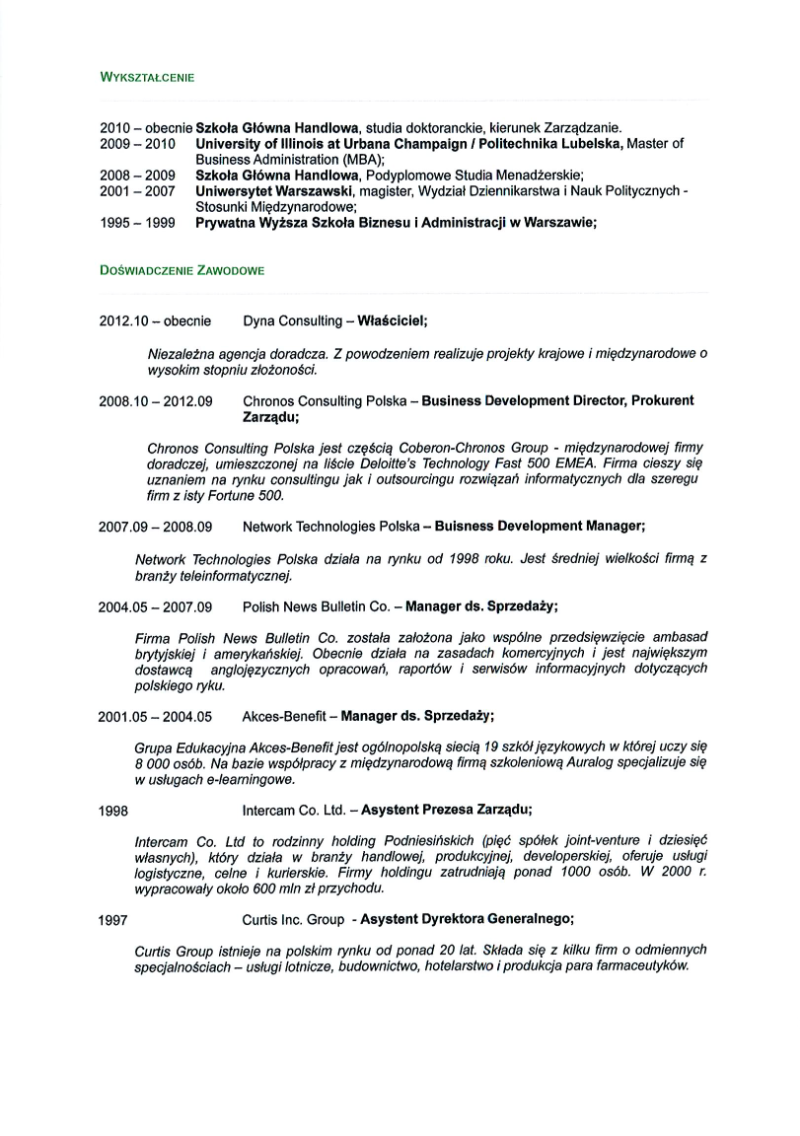
Piotr Sulima’s professional trajectory spans academia, consulting, and business development across Poland and internationally. He holds a PhD in Management from the Warsaw School of Economics (2010‑present) and an MBA, complemented by a master’s degree from the University of Illinois at Urbana‑Champaign (2009‑2010). Earlier academic credentials include a master’s in International Relations from the University of Warsaw (1995‑1999) and postgraduate managerial studies at the Warsaw School of Economics (2001‑2007).
Professionally, Sulima has led growth initiatives for several firms. From 2012 onward he owns Dyna Consulting, a boutique advisory agency executing national and mid‑regional projects. Between 2008 and 2012 he served as Business Development Director at Chronos Consulting Polska, part of the Deloitte Technology Fast 500 EMEA‑listed Coberon‑Chronos Group, where he managed Fortune 500 client engagements. Earlier roles include Business Development Manager at Network Technologies Polska (2007‑2008), Sales Manager positions at Polish News Bulletin Co. and Akces‑Benefit (2004‑2008), and assistant roles at Intercam Co. Ltd. and Curtis Inc. Group (1997‑2001).
His language proficiency is fluent English with FCE, CAE, CPE certifications; basic German and Russian. Technical skills cover Windows, Office, Lotus Notes/Domino, Linux Ubuntu, and macOS.
Sulima’s extracurricular involvement includes volunteering with a Maltese medical service (2013‑present), vice‑chairmanship of SMT SA’s supervisory board (since 2011), and long‑standing participation in youth, student, and sports organizations. His interests feature motorcycling (Harley Owners Group) and skydiving (Polish Association of Air Sports).
- Piotr Sulima has operated his own boutique advisory firm, Dyna Consulting, since 2012, focusing on national and mid-regional business projects.
- From 2008 to 2012, he served as Business Development Director at Chronos Consulting Polska, a subsidiary of the Deloitte Technology Fast 500-listed Coberon-Chronos Group, managing Fortune 500 client accounts.
- Sulima holds a PhD in Management from the Warsaw School of Economics (in progress since 2010) and an MBA from the University of Illinois at Urbana-Champaign (2009–2010).
- His early career includes business development and sales management roles at Network Technologies Polska, Polish News Bulletin Co., and Akces-Benefit between 2004 and 2008.
- He has served as the vice-chair of the supervisory board for SMT SA since 2011 and has been a volunteer with a Maltese medical service since 2013.
11 Bit Studios
Report1 pages
Oświadczenie o nieubieganiu się o wybór na kolejną kadencję: 11 bit studios
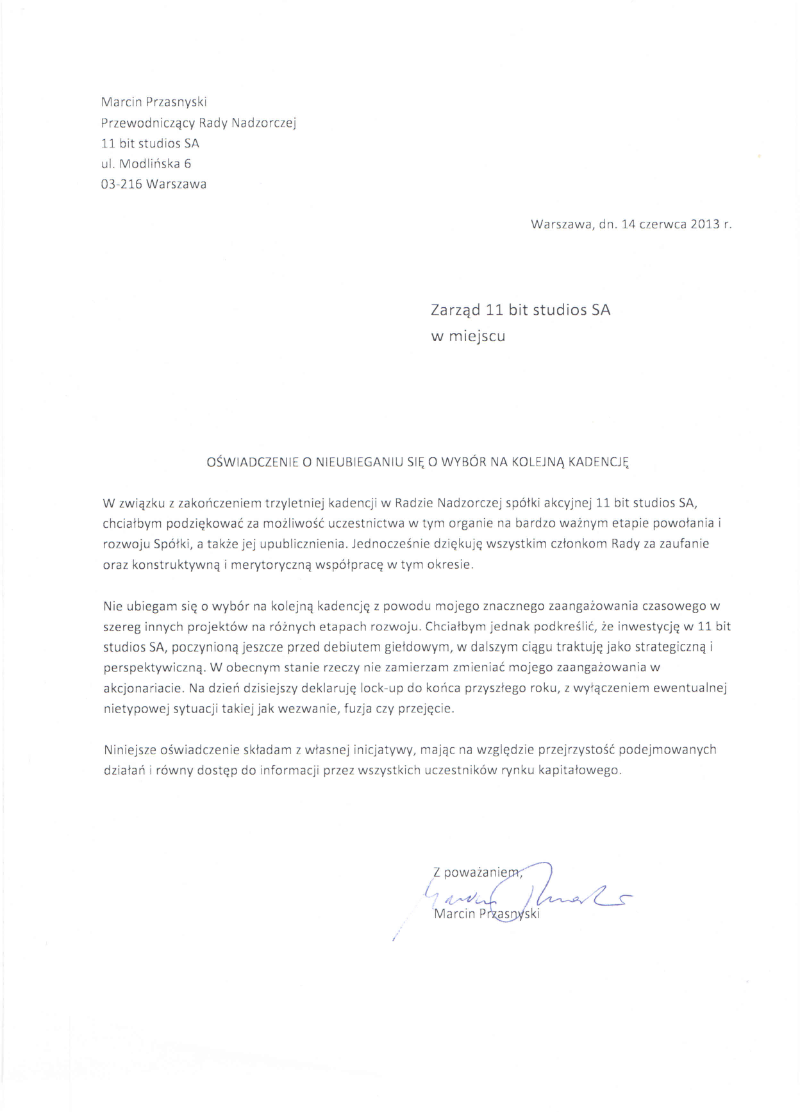
The statement, issued by Marcin Przasnyski, Chairman of the Supervisory Board of 11 bit Studios SA on 14 June 2013, announces his decision not to seek re‑election for the next three‑year term. Przasnyski expresses gratitude to shareholders and board members for their trust and collaborative work during a critical phase of the company’s development and public listing. He cites extensive time commitments to other projects at various stages as the primary reason for stepping down, while affirming continued strategic investment in 11 bit Studios. The declaration includes a lock‑up commitment until the end of the following year, except in extraordinary circumstances such as a call, merger or acquisition. The statement underscores transparency and equal access to information for all market participants, reflecting the company’s commitment to governance standards. The document is a formal communication from the board chair to shareholders, covering the period up to mid‑2013 and focusing on corporate governance within the Polish capital market. No additional data, statistics or methodological details are provided beyond the personal commitment and governance context.
- Marcin Przasnyski, Chairman of the Supervisory Board of 11 bit studios, announced on 14 June 2013 that he will not seek re-election for the upcoming three-year term.
- Przasnyski cited excessive time commitments to other professional projects as the primary reason for his departure from the board.
- Despite stepping down, Przasnyski committed to maintaining his strategic investment in 11 bit studios.
- The outgoing chairman entered into a lock-up agreement for his shares effective until the end of 2014, with exceptions only for extraordinary events such as mergers, acquisitions, or calls.
- The announcement was framed as a commitment to corporate governance standards, emphasizing transparency and equal information access for all market participants.
11 bit studios
Report3 pages
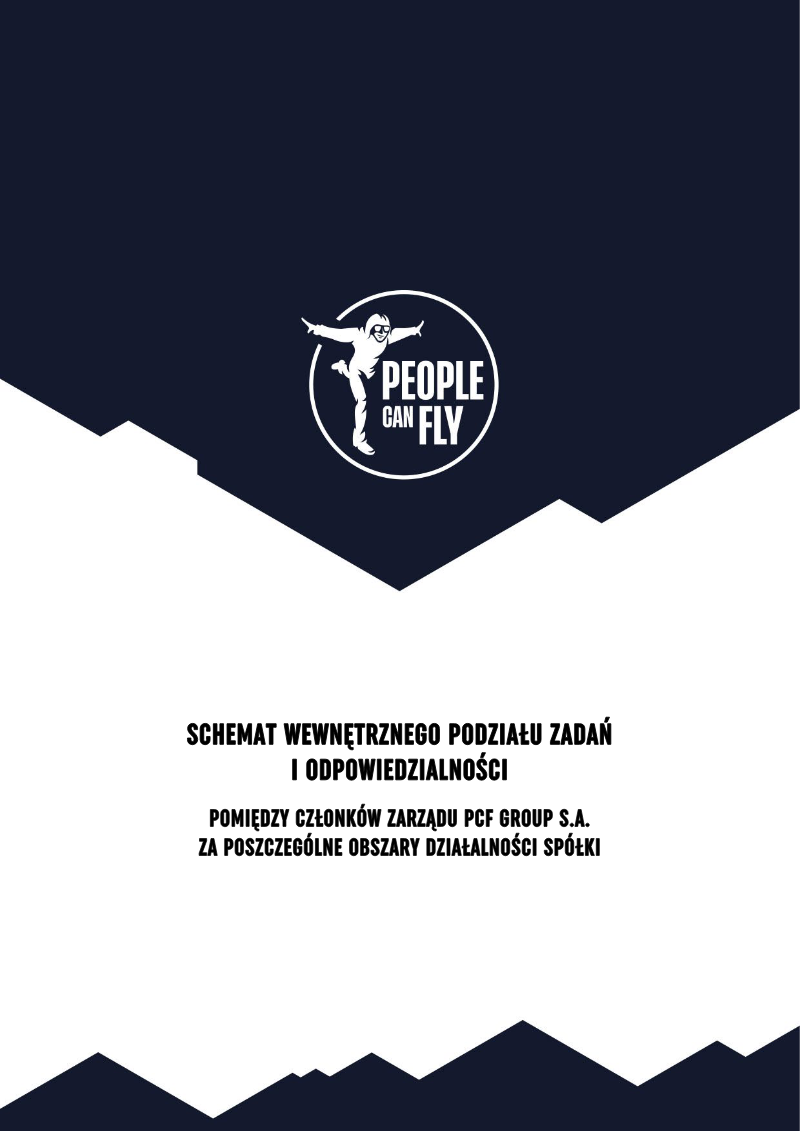
Internal Division of Tasks and Responsibilities
The internal task and responsibility diagram for PCF Group S.A. outlines the governance structure under a single‑person board headed by the President of the Board. The purpose is to clarify how executive duties are distributed within the company’s management framework, in compliance with Polish corporate governance guidelines and the 2016 Good Practices for Companies listed on the Warsaw Stock Exchange. The document specifies that the board, represented by the President, manages all non‑reserved corporate activities, including legal, financial, and operational matters. It further details the President’s core responsibilities: overseeing day‑to‑day operations, financial management and compliance, legal and accounting oversight, strategic planning including M&A transactions, production supervision across the Group, development team management, contract acquisition and negotiation—particularly for video game publishing agreements—and liaison with licensors. The President also holds authority to establish an internal audit function, appoint auditors, and report audit findings. Governance is governed by the Board’s regulations adopted by the supervisory board, with additional constraints from statutory law, the company’s articles of association, and resolutions by the supervisory board and general meeting. The scope covers all business areas of PCF Group, with a focus on production, development, and licensing within the video‑game sector. The methodology is purely structural, presenting a hierarchical responsibility map rather than empirical data or statistical analysis.
- PCF Group S.A. operates under a single-person board structure led by the President of the Board, who holds comprehensive authority over all non-reserved corporate activities.
- The President is responsible for core executive functions including financial management, legal and accounting oversight, strategic planning, and M&A transactions.
- Operational duties include direct supervision of the Group’s video game production, development team management, and the negotiation of publishing agreements and licensor relationships.
- The President maintains the authority to establish internal audit functions, appoint auditors, and oversee the reporting of audit findings.
- The company’s governance framework is designed to comply with Polish corporate governance guidelines and the 2016 Good Practices for Companies listed on the Warsaw Stock Exchange.
PCF Group
Report2 pages
Information on Processing of Personal Data: Shareholders of PCF Group S.A.
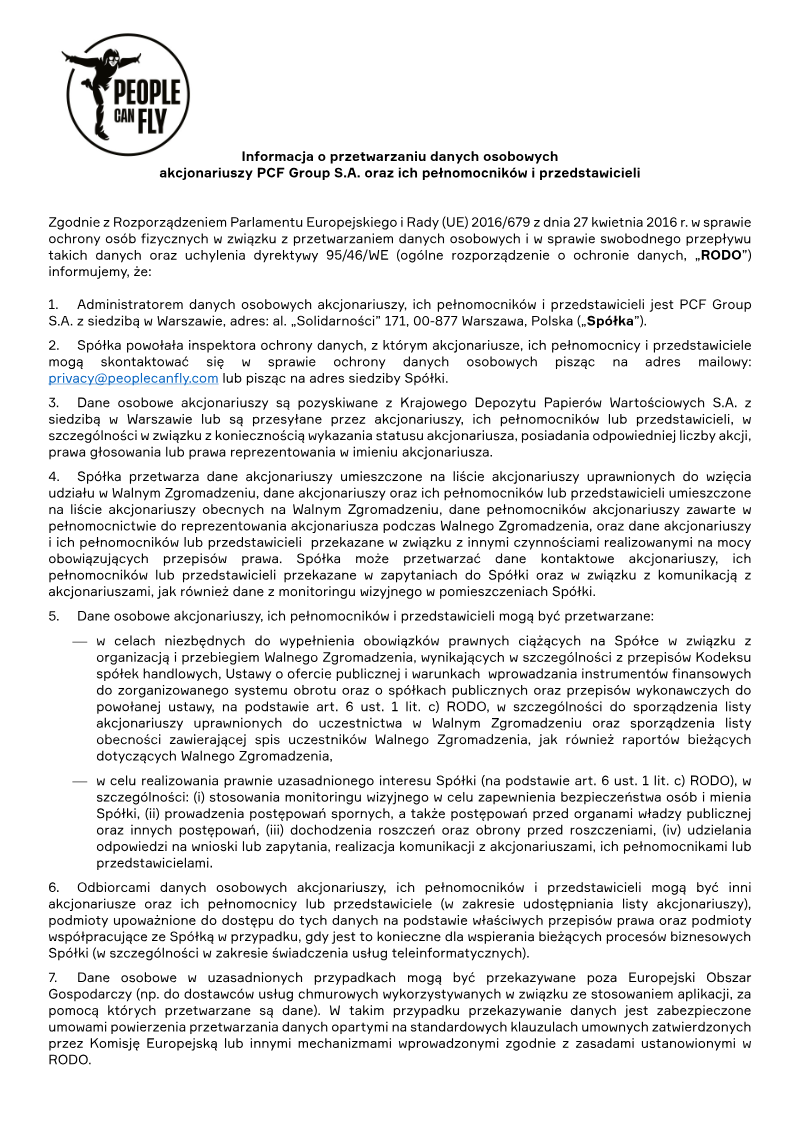
The notice explains that PCF Group S.A., headquartered in Warsaw, is the data controller for personal information of its shareholders, their agents and representatives. Data are sourced from the National Securities Depository or directly supplied by shareholders to verify ownership, share quantity, voting rights and representation. Processing activities cover the preparation of shareholder lists for general meetings, attendance records, agent authorisations, and other legal obligations under Polish corporate law, public offering statutes, and EU GDPR. The company may also use contact details for communication and employ video surveillance within its premises, with recorded footage retained no longer than three months.
Recipients of the data include other shareholders and authorised parties under legal provisions, as well as service providers assisting business processes such as cloud or telecommunication services. Transfers outside the European Economic Area are permitted only under contractual safeguards, such as standardised data‑processing agreements approved by the European Commission.
Personal data are retained for the duration of shareholder status, extended if necessary to pursue or defend legal claims, and thereafter only as required by accounting regulations. Shareholders and their agents retain rights to access, rectify, erase or restrict processing, object to lawful interest‑based processing, and lodge complaints with the Polish Data Protection Authority. Providing personal data is voluntary but essential for participation in general meetings or to receive corporate communications; failure to provide required information will preclude such engagement. No automated decision‑making or profiling is applied to the data set.
- PCF Group S.A. acts as the data controller for the personal information of its shareholders, agents, and representatives, primarily sourced from the National Securities Depository.
- Data processing is strictly limited to fulfilling legal obligations under Polish corporate law, public offering statutes, and EU GDPR, including the management of general meetings and shareholder records.
- Personal data is retained for the duration of the shareholder's status, with potential extensions for legal claims or mandatory accounting requirements.
- Video surveillance footage recorded at company premises is subject to a strict retention limit of no more than three months.
- Data may be shared with authorized third-party service providers, such as cloud or telecommunication firms, with transfers outside the EEA restricted to those covered by European Commission-approved contractual safeguards.
PCF Group
Report1 pages
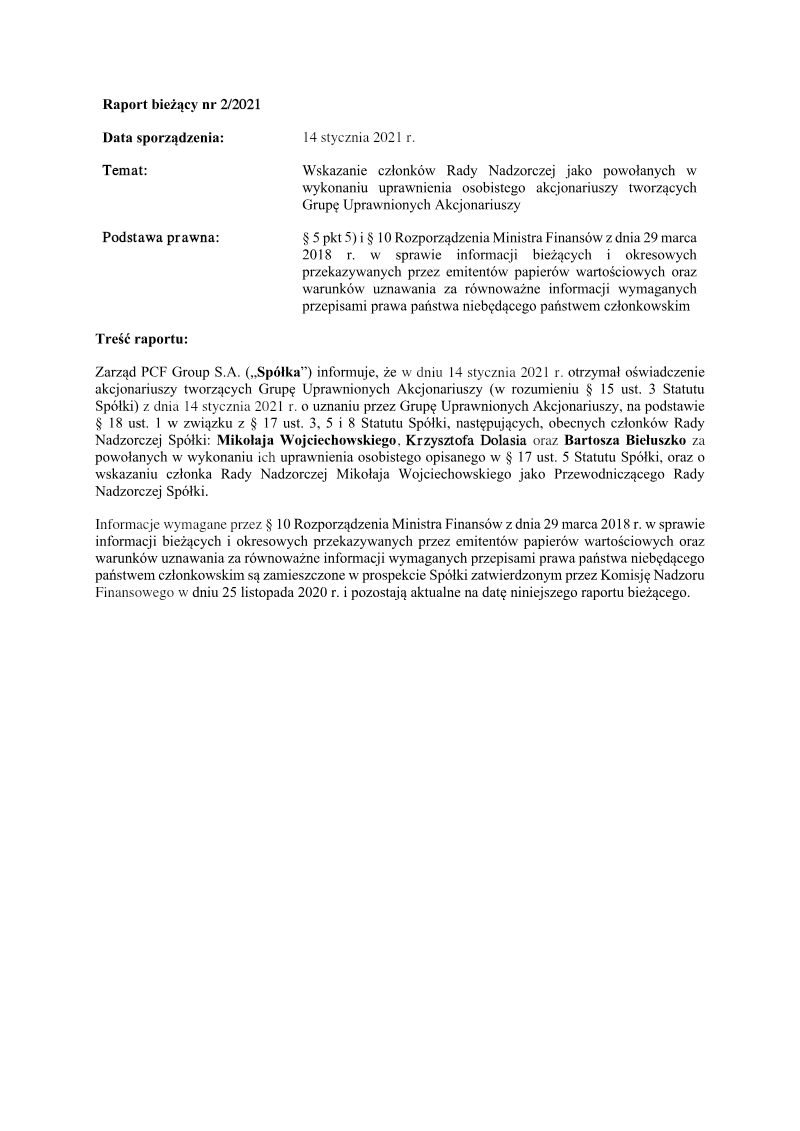
Current Report No. 2/2021: Appointment of Supervisory Board Members
The report announces the appointment of supervisory board members for PCF Group S.A. on 14 January 2021, following a declaration by the group of entitled shareholders. Under Polish corporate statutes and the 2018 Ministry of Finance regulation on current information, the board now includes Mikołaj Wojciechowski, Krzysztof Dolias, and Bartosz Biełuszko, all elected pursuant to the shareholders’ personal rights. Wojciechowski is designated as chairman of the supervisory board.
The document confirms that all required information under § 10 of the Ministry regulation is incorporated in the company’s prospectus, approved by the Polish Financial Supervision Authority on 25 November 2020, and remains current as of the report date. No additional data or statistics are presented; the scope is limited to the corporate governance update for PCF Group S.A. in Poland, covering a single event within the 2021 reporting period. The methodology is straightforward: the board composition was determined by shareholder vote in accordance with statutory provisions, and the report serves to inform stakeholders of this change.
- On 14 January 2021, PCF Group S.A. appointed Mikołaj Wojciechowski, Krzysztof Dolias, and Bartosz Biełuszko to its supervisory board.
- Mikołaj Wojciechowski has been designated as the chairman of the newly appointed supervisory board.
- The board members were elected based on the personal rights of entitled shareholders in accordance with Polish corporate statutes.
- The appointment process and board composition comply with the requirements detailed in the company’s prospectus, which was approved by the Polish Financial Supervision Authority on 25 November 2020.
- This corporate governance update fulfills the disclosure obligations mandated by the 2018 Ministry of Finance regulation regarding current information.
PCF Group
Report1 pages
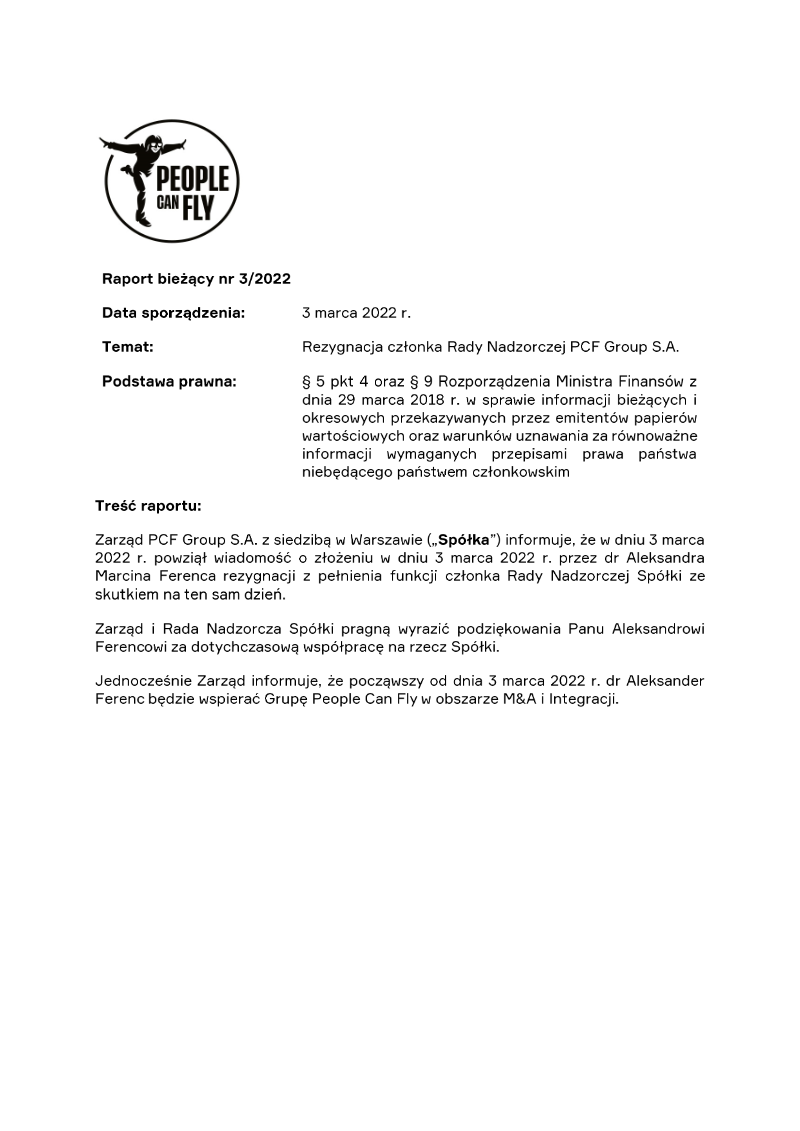
Current Report No. 3/2022: Resignation of a Supervisory Board Member of PCF Group S.A.
The report announces the resignation of Dr. Aleksander Ferenc from the Supervisory Board of PCF Group S.A., effective March 3, 2022. The board’s decision is communicated in compliance with Polish financial regulatory requirements, specifically the 2018 Minister of Finance regulation on ongoing information obligations for issuers. The announcement confirms that Dr. Ferenc’s resignation was submitted and accepted on the same day, and expresses gratitude for his contributions to the company.
Simultaneously, the report states that Dr. Ferenc will continue to support PCF Group S.A.’s parent company, People Can Fly, in mergers and acquisitions (M&A) and integration activities from March 3, 2022 onward. No additional data on financial performance or strategic initiatives are provided; the focus remains strictly on governance changes and the continuity of Dr. Ferenc’s advisory role within the broader corporate group.
The scope is limited to PCF Group S.A., a Warsaw‑based entity, and its parent company People Can Fly. The time frame is the specific date of resignation, March 3, 2022, with implications for ongoing M&A support. Methodology is not applicable beyond the regulatory reporting framework mandated by Polish financial law.
- Dr. Aleksander Ferenc resigned from the Supervisory Board of PCF Group S.A., effective March 3, 2022.
- Following his resignation from the board, Dr. Ferenc transitioned to an advisory role supporting the parent company, People Can Fly, specifically focusing on mergers, acquisitions, and integration activities.
- The resignation was formally processed and accepted on March 3, 2022, in accordance with Polish financial regulatory requirements.
- The governance change is limited to the Supervisory Board of the Warsaw-based PCF Group S.A. and does not impact the company's broader operational or financial reporting.
- No changes to the company's strategic initiatives or financial performance were announced in conjunction with this board-level personnel shift.
PCF Group
Report1 pages
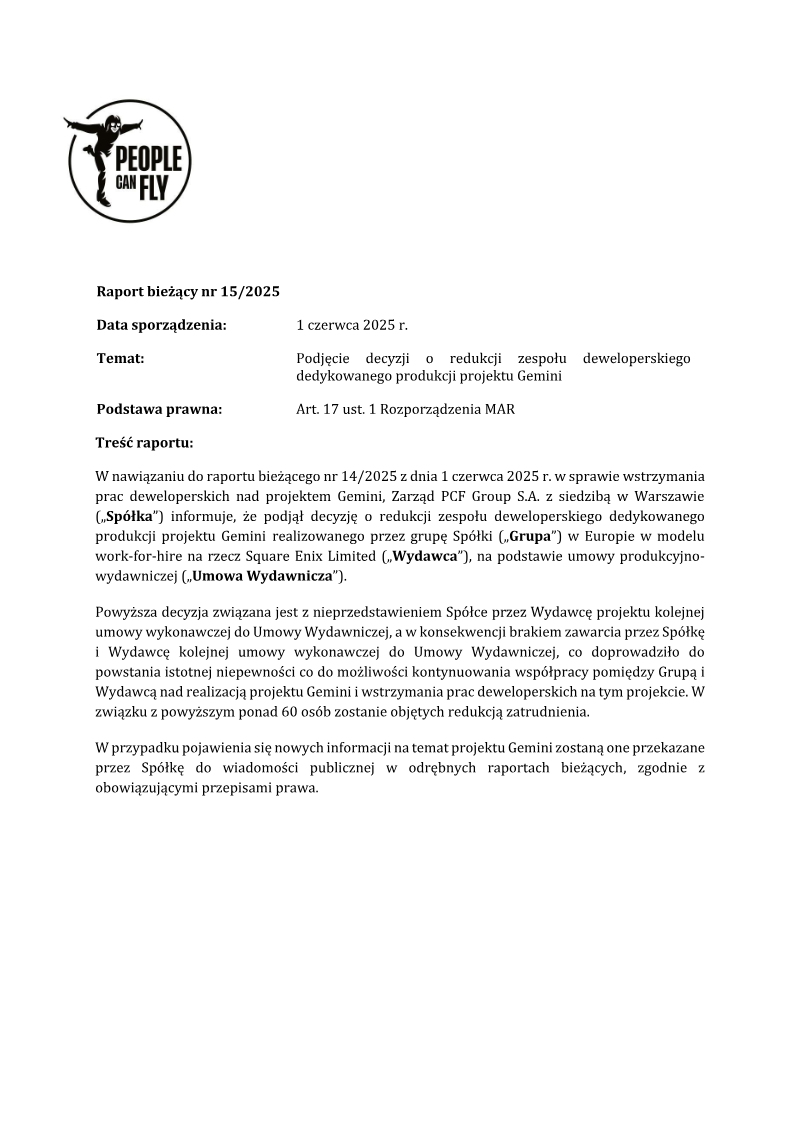
Raport Bieżący Nr 15/2025: Podjęcie Decyzji o Redukcji Zespołu Deweloperskiego Projektu Gemini
PCF Group S.A. has initiated a workforce reduction affecting over 60 employees previously assigned to the development of Project Gemini. This decision follows the formal suspension of all development activities related to the title, which was being produced in Europe under a work-for-hire agreement with Square Enix Limited. The restructuring is a direct consequence of the publisher’s failure to provide a subsequent executive agreement, rendering the future of the collaboration and the project’s continuation untenable.
The termination of the development team marks a significant shift in the company’s operational strategy regarding this specific partnership. By failing to secure a follow-up contract, the company faced critical uncertainty regarding the project's viability, necessitating the immediate downsizing of the dedicated staff. This action reflects the inherent risks associated with the work-for-hire business model, where project continuity is heavily dependent on the publisher’s commitment to ongoing executive agreements.
Management maintains that the current status of Project Gemini remains uncertain, and no further development work is scheduled at this time. Future updates regarding the project’s status or potential changes to the company’s relationship with the publisher will be disclosed as they arise. This reduction represents a definitive step in mitigating the financial and operational impact caused by the cessation of work on the project.
- PCF Group S.A. has suspended all development activities for Project Gemini, a title previously produced under a work-for-hire agreement with Square Enix Limited.
- The company has initiated a workforce reduction affecting over 60 employees who were assigned to the Project Gemini development team.
- The project's cancellation stems from Square Enix Limited's failure to provide a necessary subsequent executive agreement, rendering the collaboration untenable.
- Management has confirmed that no further development work on Project Gemini is currently scheduled, leaving the project's future status uncertain.
- This downsizing serves as a strategic move to mitigate the financial and operational impact caused by the sudden cessation of the project.
+1
PCF Group
Report1 pages
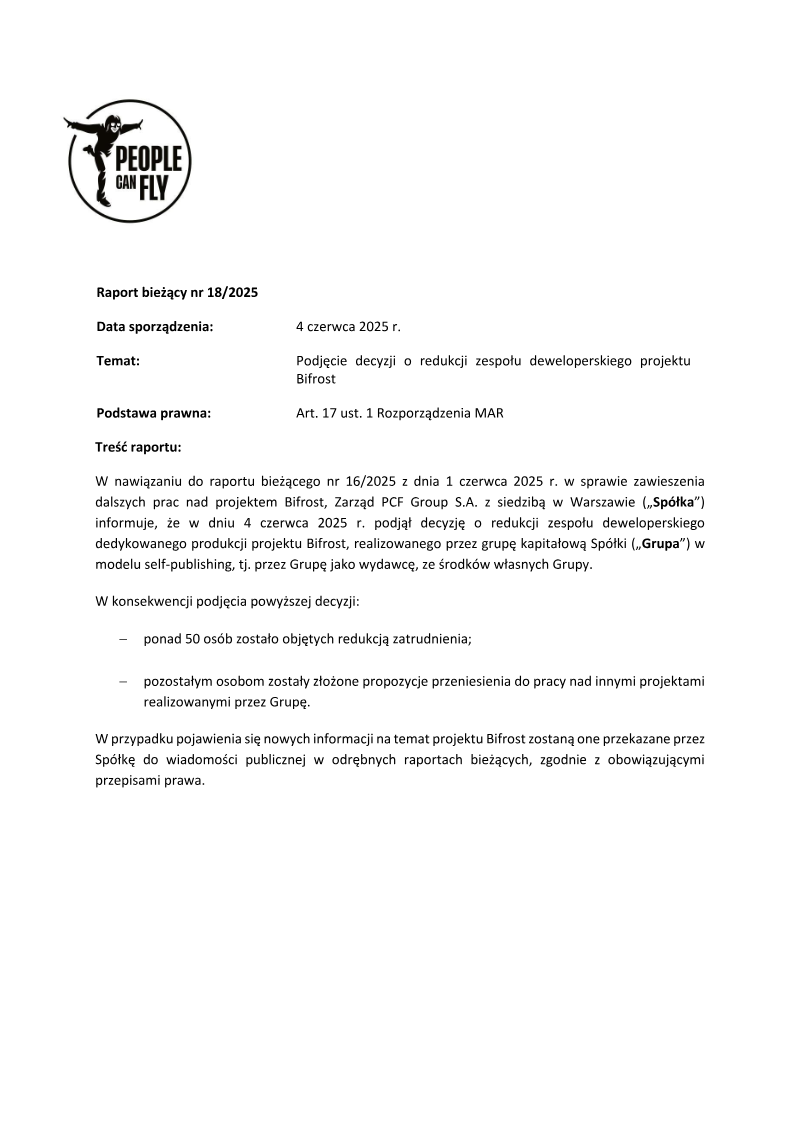
Raport Bieżący Nr 18/2025: Podjęcie Decyzji o Redukcji Zespołu Deweloperskiego Projektu Bifrost
PCF Group S.A. has initiated a significant workforce reduction following the recent suspension of development on Project Bifrost. This strategic decision marks a shift in the company’s internal resource allocation, as the project was previously being developed under a self-publishing model funded entirely by the company’s own capital. The move reflects a broader effort to streamline operations and mitigate financial exposure associated with the project’s cessation.
The restructuring impacts over 50 employees who were directly involved in the development of Project Bifrost. To retain institutional knowledge and maintain operational continuity, the company has extended offers to the remaining staff members to transition into roles within other active projects currently under development by the group. This approach aims to preserve human capital while pivoting resources toward more viable production pipelines.
These actions represent a definitive step in the company’s management of its current portfolio. By reassigning personnel and reducing the headcount associated with the halted project, the organization is adjusting its cost structure to align with its updated strategic priorities. Future updates regarding the status of Project Bifrost will be disclosed as they arise, ensuring transparency regarding the company’s ongoing development activities and organizational adjustments.
- PCF Group S.A. has officially suspended development of Project Bifrost, a title previously managed under a self-publishing model funded by the company's own capital.
- The project cancellation has resulted in a workforce reduction impacting over 50 employees.
- To preserve institutional knowledge, PCF Group S.A. is offering remaining staff from the Bifrost team roles within other active projects.
- The restructuring is a strategic move to streamline operations, mitigate financial exposure, and realign the company's cost structure.
- Management is pivoting internal resources toward more viable production pipelines following the cessation of the Bifrost project.
+1
PCF Group