Infinity
Company
Documents about Infinity



No Room in the Infinite for the Masculine and Queer: How Do Dress-Up Pleasures in Infinity Nikki Collide with Player Desire and Queer/Masculine Fashion?
This analysis investigates the aesthetic limitations of dress-up options in the Chinese gacha game Infinity Nikki, focusing on the underrepresentation of masculine and queer fashion styles despite the game's emphasis on "infinite" variety.
- The paper's central finding is that Infinity Nikki's fashion pleasures are aesthetically limited, skewing overwhelmingly toward cute, comfort-focused, and ballgown-style feminine outfits, while masculine and queer styles are largely absent.
- The authors describe the absence of butch, tomboy, androgynous, ouji, drag king, Takarazuka, and British pantomime styles as a "misappearance" of masculine and queer expression, with the developer providing little explicit support for them.
- Players improvise masculine and boyish looks with available tools and read queer themes into the narrative, but the game itself offers limited structural support for these identities.

2026 Global Mobile Gaming Marketing Trends White Paper
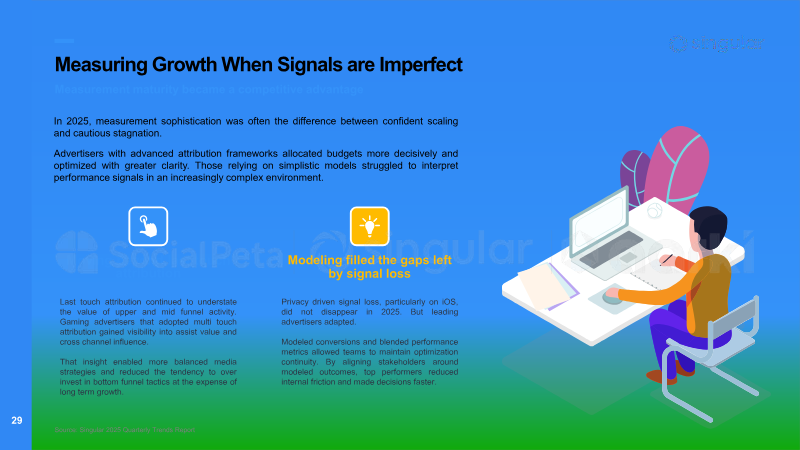
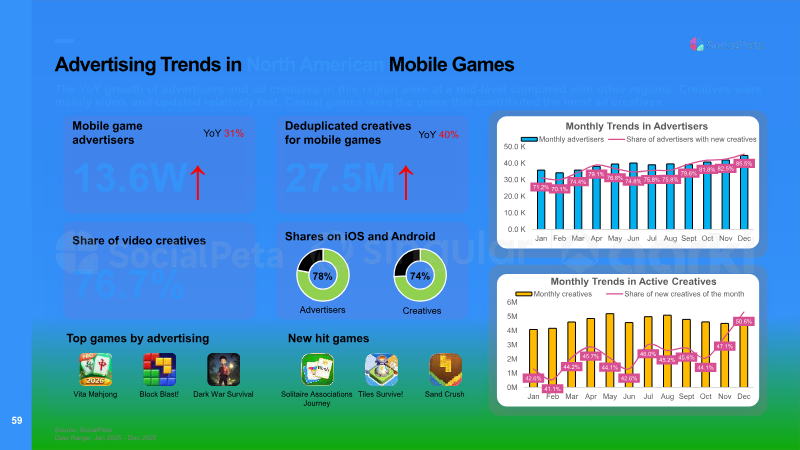
The "2026 Global Mobile Gaming Marketing Trends White Paper" analyzes the evolving landscape of mobile game advertising and user acquisition, highlighting a shift towards more sophisticated, data-driven, and AI-powered strategies for sustainable growth.
- The mobile gaming advertising ecosystem grew by 22% year-over-year in 2025, with over 90,000 active advertisers and 8,000 new entrants joining monthly.
- Video content now accounts for 74% of all mobile game ads, representing a 14% year-over-year increase in usage.
- A shift toward an 'Infinity Loop' marketing model, supported by supervised AI, can increase player lifetime value (LTV) by up to 30% by integrating acquisition, retargeting, and lifecycle management.
Digital Bros Investor Presentation: STAR Conference 2026
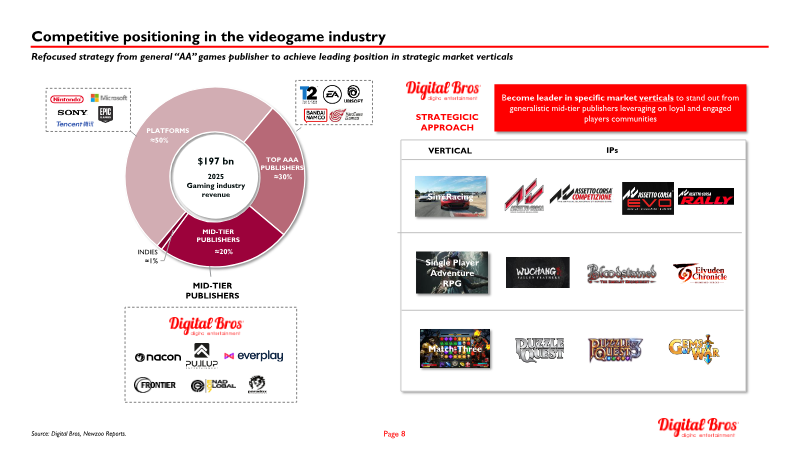
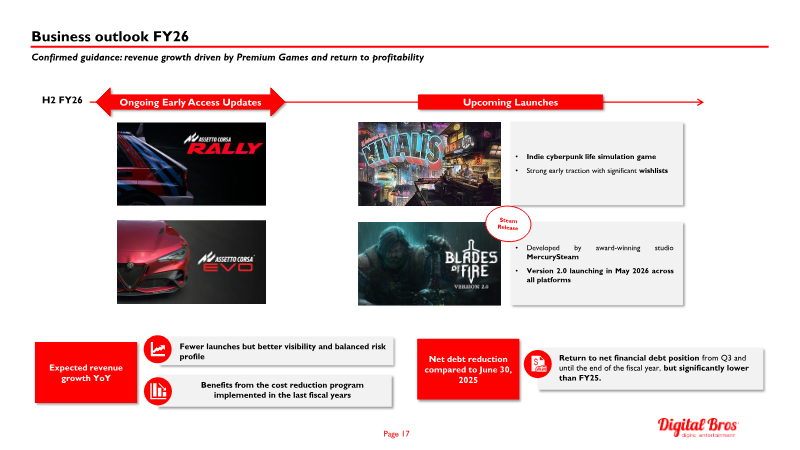
Digital Bros, a Milan-based publisher of video games for consoles, PC, mobile and streaming platforms, presents its STAR Conference 2026 investor deck.
- Digital Bros reported H1 FY26 revenue of €69m and EBITDA of €33.6m, against €43m and €13.1m in H1 FY25.
- The company's refocused strategy followed a FY24 reorganization that reduced about 30% of the Group's workforce.
- Assetto Corsa brand revenue reached €18.3m in H1 FY26, up 40% year on year, after the launch of Assetto Corsa Rally.


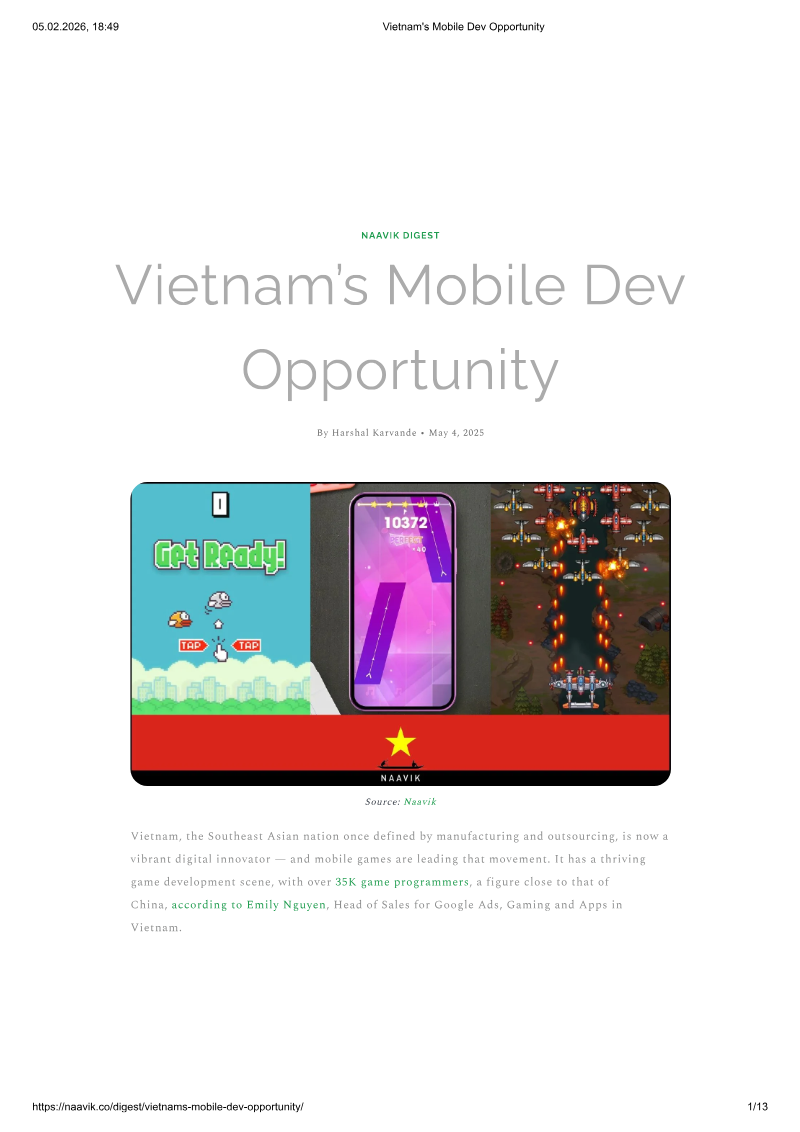
Vietnam's Mobile Dev Opportunity
Vietnam has emerged as a significant player in the global mobile game development landscape, transitioning from a consumer-driven market to a vibrant producer of original intellectual property.
- Vietnam has emerged as a major global mobile development hub with over 35,000 game programmers and more than 300 active local publishers.
- In 2024, five Vietnamese studios ranked among the world’s top 25 publishers, generating 2.4 billion downloads and $133 million in revenue.
- Since 2020, the sector has experienced significant growth, marked by a 67% increase in downloads and an 82% rise in earnings.
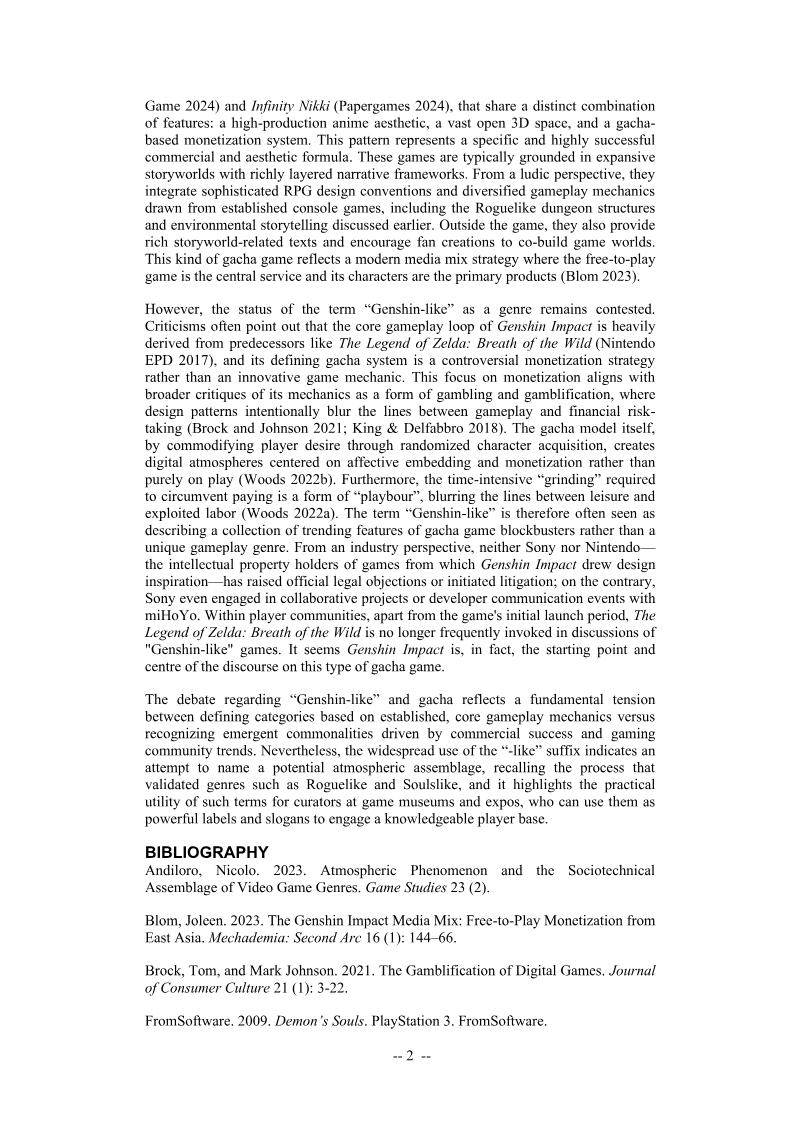

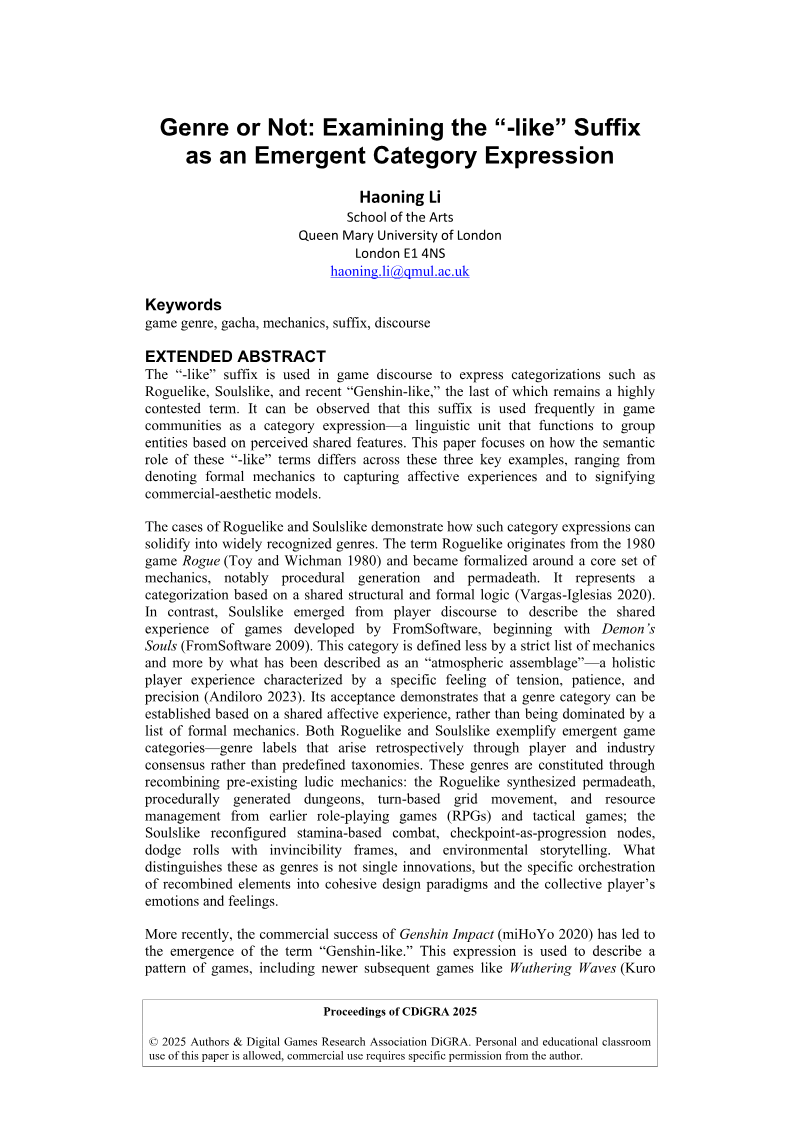
Genre or Not: Examining the "-like" Suffix as an Emergent Category Expression
The document examines the "-like" suffix in game discourse as an emergent category expression, analyzing how terms like Roguelike, Soulslike, and Genshin-like function to group games based on shared features.
- The "-like" suffix functions as a retrospective labeling device: genre status is conferred through player and industry consensus rather than a single innovation, and validation depends on how recombined mechanics are orchestrated into a cohesive design paradigm and felt experience.
- The "-like" suffix carries different meanings across cases: Roguelike denotes formal mechanics (procedural generation and permadeath, traced to the 1980 game Rogue), Soulslike denotes a shared affective experience (an "atmospheric assemblage" of tension, patience, and precision, beginning with FromSoftware's Demon's Souls), and Genshin-like denotes a commercial-aesthetic formula.
- Genshin-like is defined by a high-production anime aesthetic, open 3D worlds, expansive storyworlds, and gacha monetization, with examples including Genshin Impact, Wuthering Waves, and Infinity Nikki.
Playgrounds as Workgrounds: How Real-Money Trading Transforms the Gaming Experience
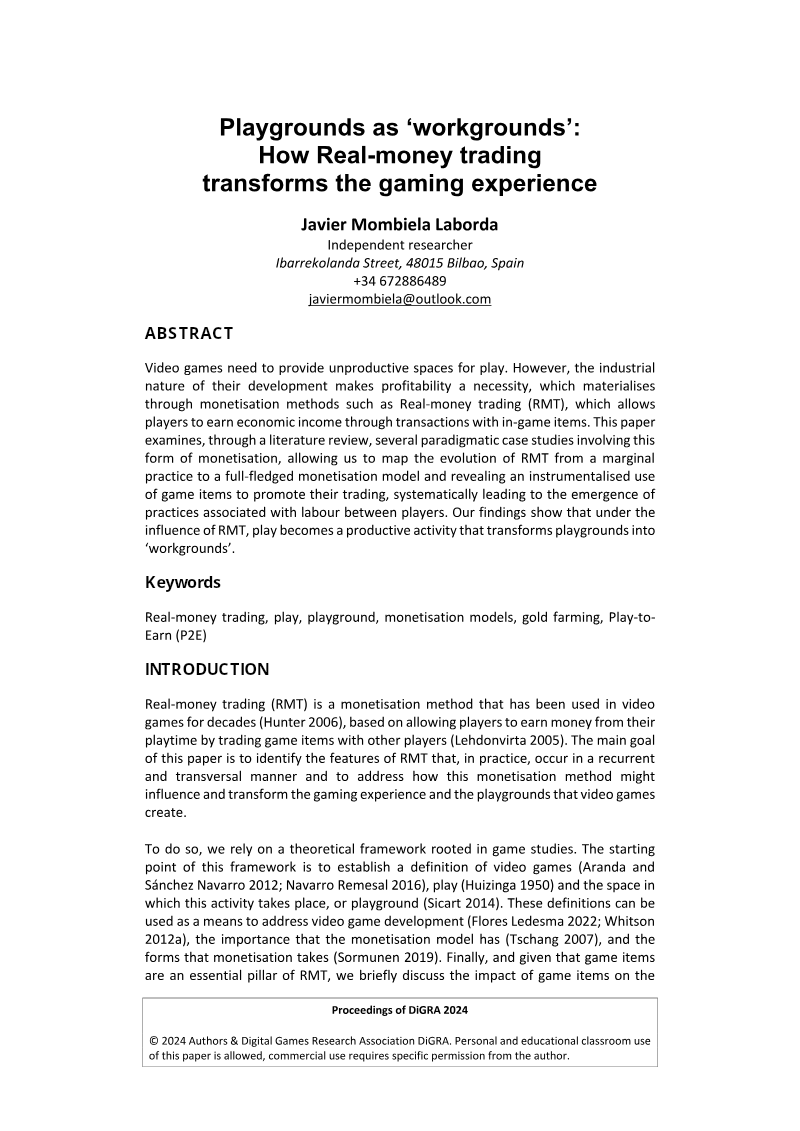
Javier Mombiela Laborda, an independent researcher, presents a literature review of paradigmatic case studies of real-money trading (RMT) in video games, a monetisation method in which players earn money by trading in-game items with other players.
- RMT has shifted from a practice developed outside the game to a company-driven, central part of the game experience, according to the author's findings.
- Diablo III was released with its Auction House as a feature that allows players to trade virtual items for real money, with Blizzard receiving a per-transaction fee.
- Diablo III's Auction House was permanently shut down two years after release, with Blizzard claiming it undermines Diablo's core gameplay.
Localization in the MENA Region
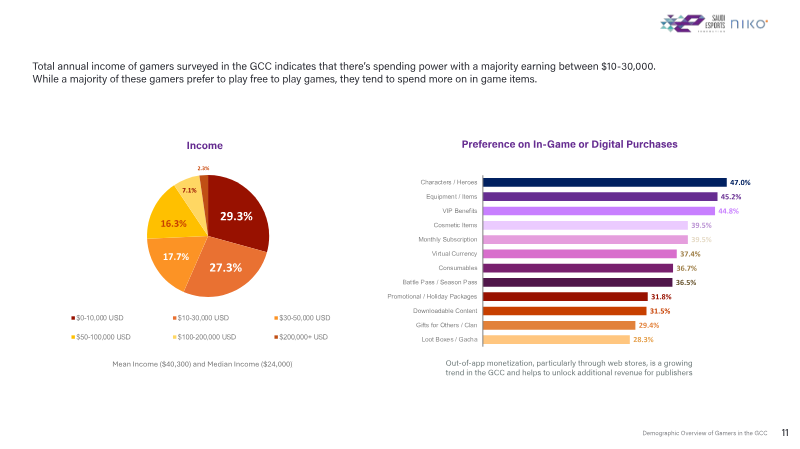
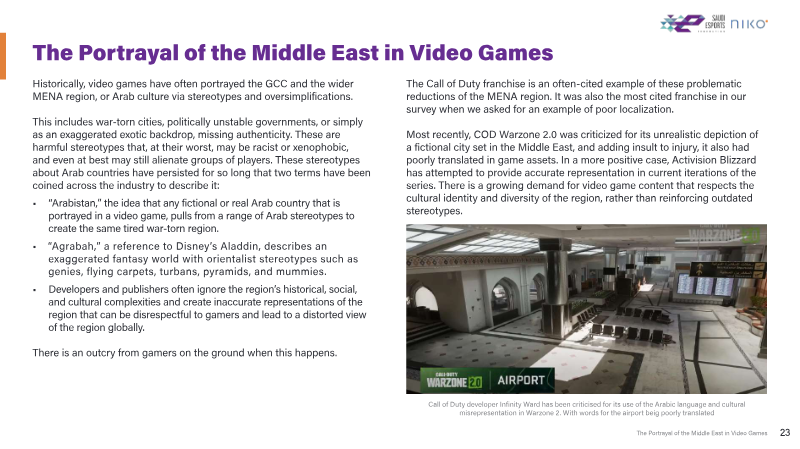
Arabic localization is a strategic growth lever in the Gulf Cooperation Council gaming market, and success depends on culturally informed, dialect-aware adaptation rather than literal translation.
- The MENA gaming market is a high-growth frontier projected to reach $3.24 billion in player spending and 38.9 million gamers by 2028.
- There is a significant supply gap in the region, as only 3.5% of Steam titles are currently localized despite 41% of regional gamers prioritizing localized content.
- Deep culturalization can drive exponential growth, with some titles increasing their MENA-based revenue and daily active users from 3% to 80% of their global total.

Genre Awareness and Nostalgia: Textual Aspects of Role-Playing in Black Geyser: Couriers of Darkness
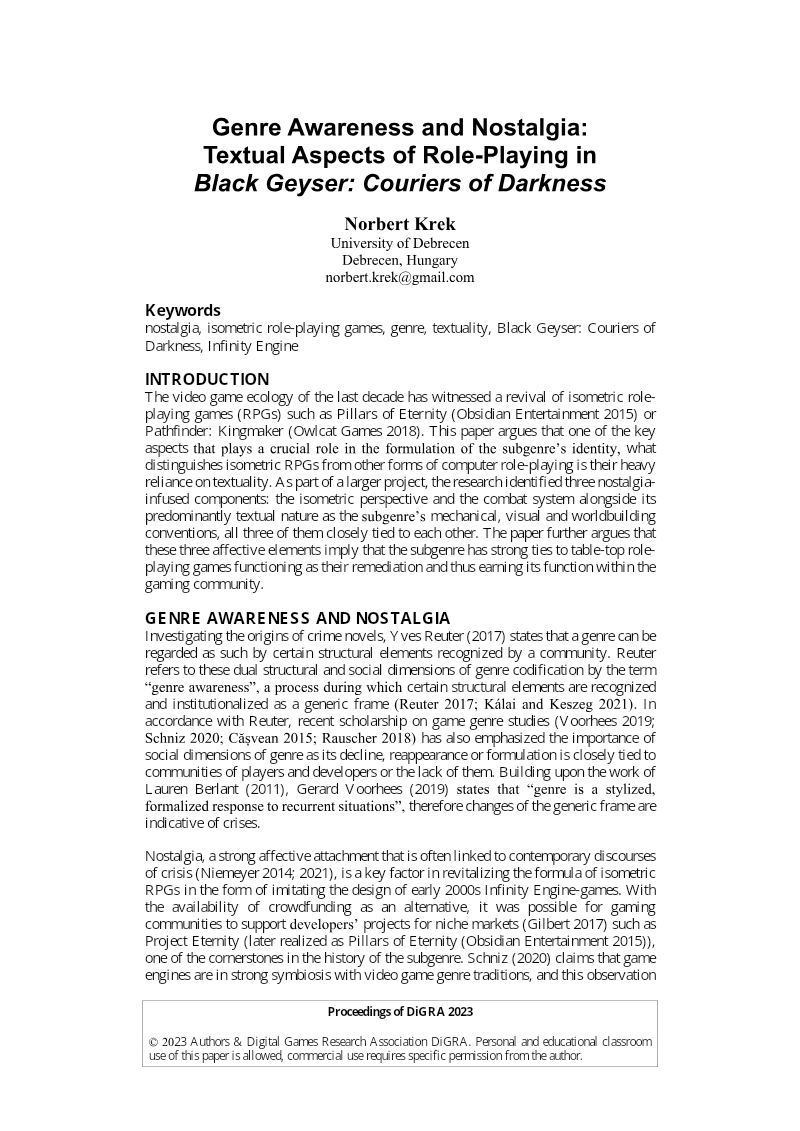
The document examines the textual aspects of role-playing in isometric RPGs, specifically focusing on Black Geyser: Couriers of Darkness, to understand the subgenre's identity, which is heavily influenced by nostalgia for early 2000s Infinity Engine games.
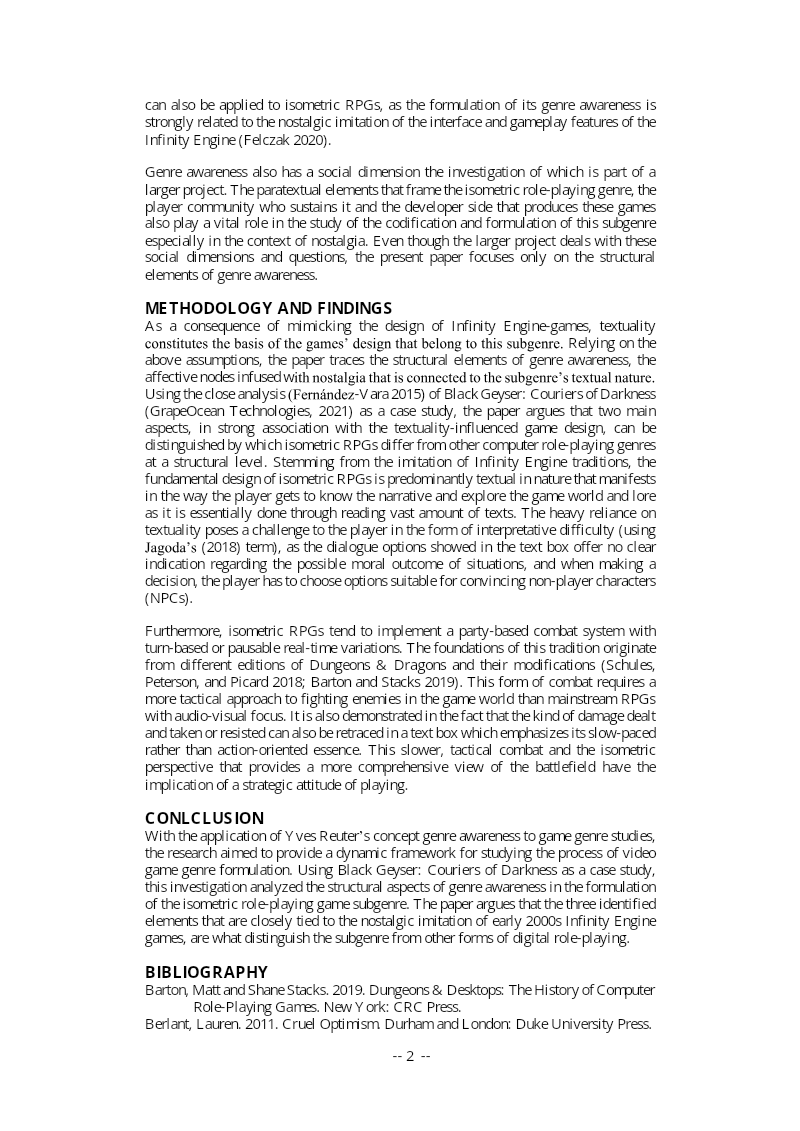
- The paper argues that isometric RPGs (e.g., Pillars of Eternity, Pathfinder: Kingmaker) are defined by three nostalgia-infused components: the isometric perspective, a largely textual tactical combat system, and reading-dependent worldbuilding.
- The subgenre's revival over the past decade is framed as nostalgic imitation of early 2000s Infinity Engine titles, with crowdfunding enabling niche projects such as Project Eternity.
- Using Yves Reuter's concept of 'genre awareness' and treating genre as a formalized response to recurring situations, the author links isometric RPGs closely to tabletop RPGs, which they remediate.

Charting the Forgotten Realms of Digital Vernacularity: 25 Years of D&D Infinity Engine Games
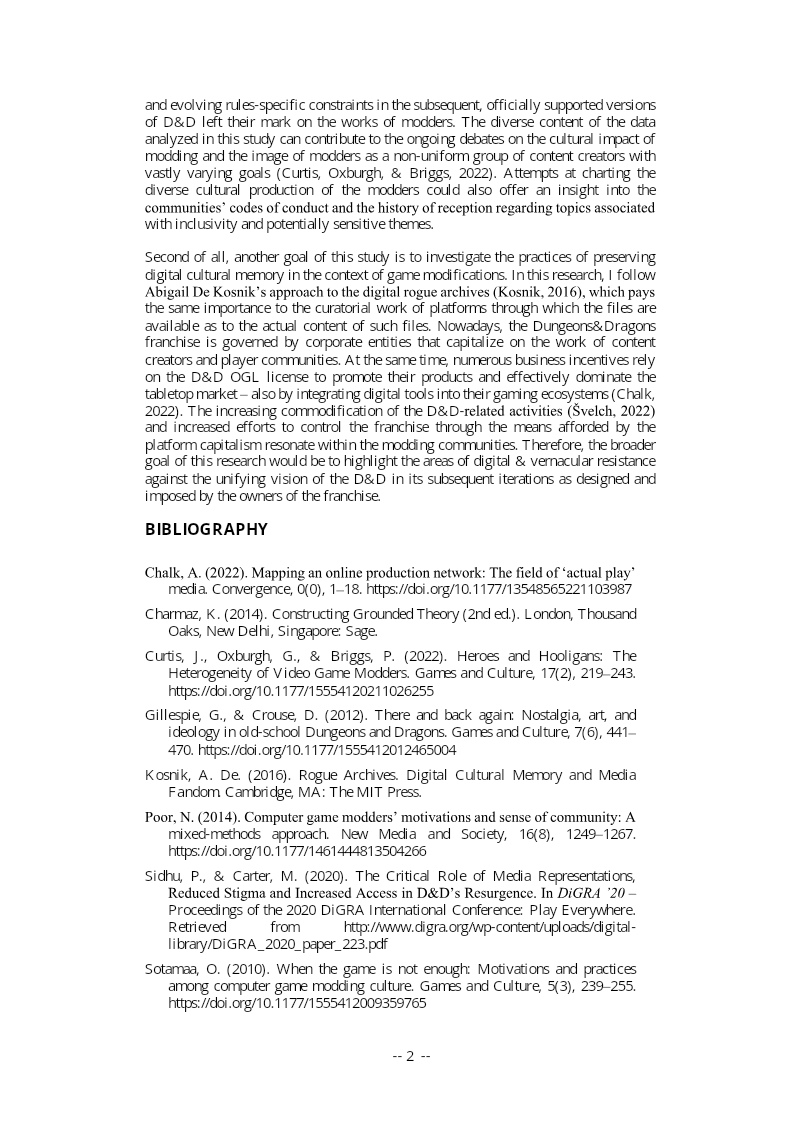
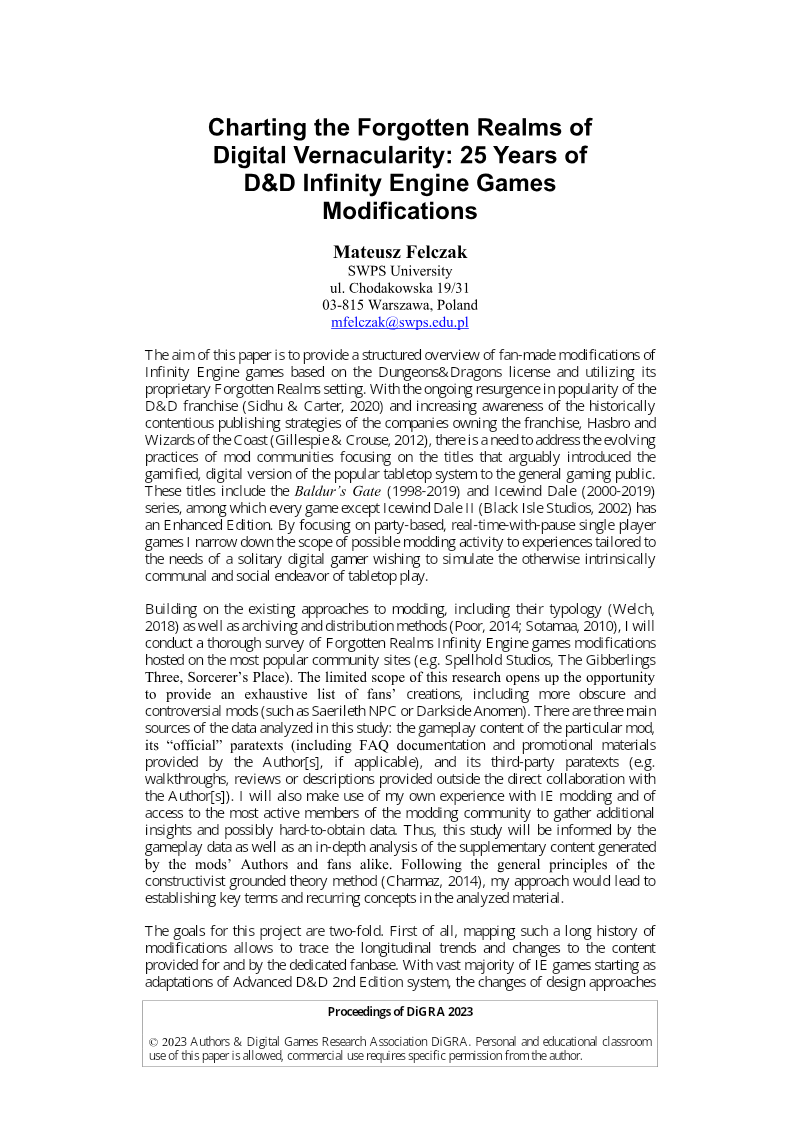
This paper maps fan-made modifications of the Infinity Engine games set in the Dungeons & Dragons Forgotten Realms, focusing on the Baldur's Gate and Icewind Dale series, which together span roughly 25 years of modding activity.
- The paper maps fan modifications of the Infinity Engine Forgotten Realms games, chiefly Baldur's Gate and Icewind Dale, spanning roughly 25 years of modding activity on community hosts such as Spellhold Studios, The Gibberlings Three, and Sorcerer's Place.
- The study restricts its scope to party-based, real-time-with-pause single-player titles, framing them as digital stand-ins for the communal experience of tabletop D&D play.
- Methodology is constructivist grounded theory, triangulating mod gameplay content, official paratexts (FAQs, promotional materials), and third-party paratexts (walkthroughs, reviews), supplemented by the author's own Infinity Engine modding experience and access to active community members.
RDNA 3: Beyond the Current Gen
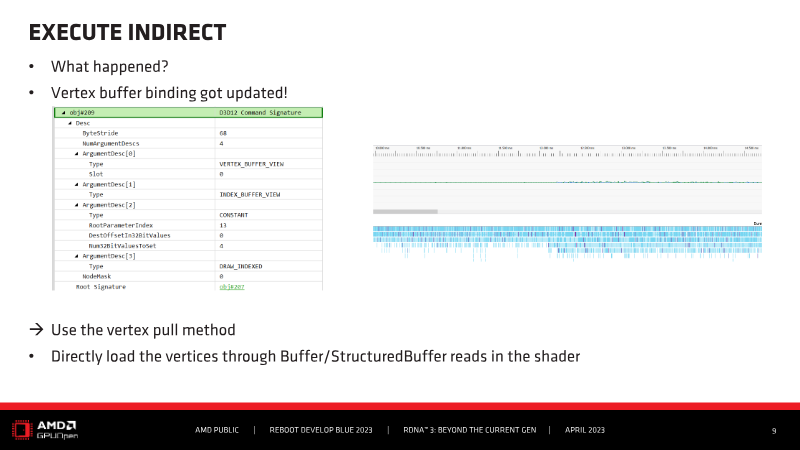
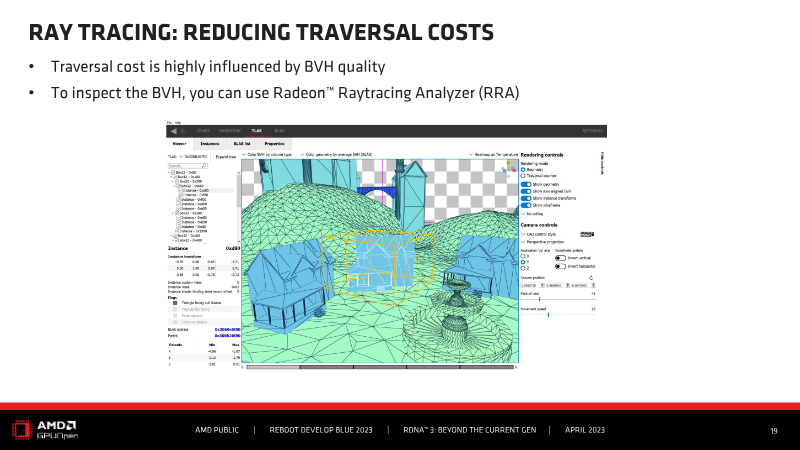
This is an AMD presentation by Lou Kramer titled "RDNA 3: Beyond the Current Gen," offering performance guidance for developers on AMD's RDNA 3 GPU architecture.
- The RX 7900 XTX has 96 compute units and 960 GB/s of memory bandwidth, compared with 80 units and 512 GB/s on the RX 6900 XT.
- On RDNA 3, the Infinity Cache is smaller than on RDNA 2 (96 MB versus 128 MB), but the document says the bandwidth gain is higher.
- Splitting a workload into three blocks increased L0 cache hit rates by 37% on an AMD Radeon RX 6800XT, per the FSR 2 example.


2022 Blockchain Gaming Report: New Frontiers And The Path Forward
Blockchain gaming in Q3 2022 remains far from mass adoption, and the central thesis of this Naavik and CoinMarketCap analysis is that the sector is leaving a failed first era of play-to-earn for a fun-first, Free-to-Own model.
- The blockchain gaming sector shifted from speculative 'Play-to-Earn' models toward 'Free-to-Own' and 'Play-and-Own' frameworks that prioritize gameplay over yield-focused mechanics.
- Market valuations for major projects dropped by over 90% in 2022, while NFT transaction volumes fell 30% to $500 million despite unique active wallets stabilizing at approximately one million.
- Investment activity transitioned toward seed-stage game studios and user-friendly wallets, resulting in a 2.6x increase in the number of funding deals even as total deal value declined 19% year-over-year to $875 million in Q3.

State of Play-to-Earn: Finland
This EGDF discussion paper, compiled by Neogames Finland with the European Games Developer Federation in early 2022, gives an overview of play-to-earn (P2E) games built on non-fungible tokens (NFTs).
- The paper argues that the hype places the focus on monetisation, while the key challenges in the games industry are more linked with discoverability and player retention.
- Citing NonFungible.com, the paper reports that sales of all NFTs jumped to more than $17 billion in 2021.
- NFTs as game collectibles represent about 22% of total NFT trading volume, according to DappRadar.