1 free read left. Create a free account for unlimited reading + AI research.
Create free accountWhitepaper DiGRA
1 free read left. Create a free account for unlimited reading + AI research.
Create free accountWhitepaperDiGRA
The authors attribute this gap partly to the stigma long attached to "pink games" aimed at primarily female audiences.
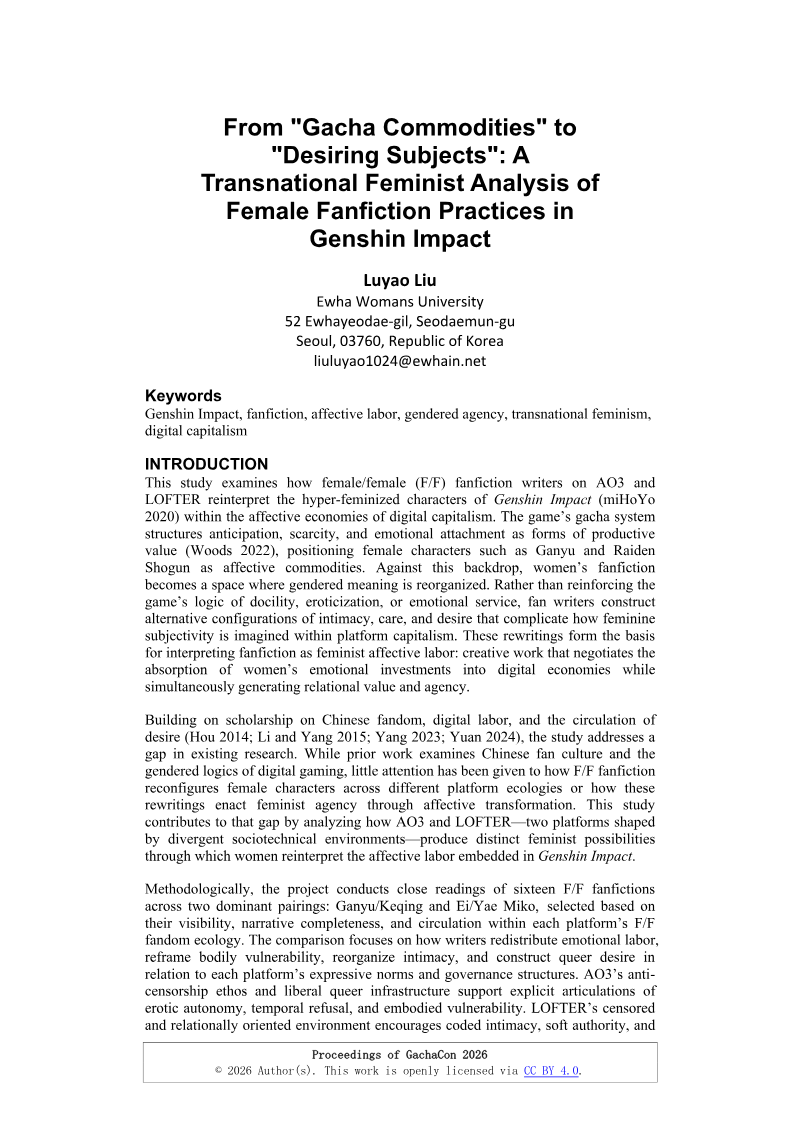
Infinity Nikki, a Chinese-developed open-world action game with extensive dress-up customisation and gacha monetisation, is examined here as a case study in how its fashion systems shape player pleasure and gender representation. The paper situates the game within the broader success of Asian-developed titles outside Japan, noting that Infinity Nikki has received comparatively little scholarly attention, a gap the authors attribute to the stigma that "pink games" aimed at primarily female audiences have traditionally faced. Its wardrobe is praised for aesthetic strength and a flexible mix-and-match design that supports player-driven fashion, in contrast to criticism of fashion options in other games.
The central finding is that the game's fashion pleasures are aesthetically limited, skewing overwhelmingly toward cute, comfort-focused, and ballgown-style feminine outfits. Styles associated with butch, tomboy, androgynous, ouji, drag king, Takarazuka, and British pantomime traditions are largely absent, a condition the authors describe as a "misappearance" of masculine and queer expression. The developer provides little explicit support for such styles, though the community improvises masculine and boyish looks with available tools and reads queer themes into the broader narrative. The game's outfit classification system, which sorts clothing into elegant, cool, sweet, fresh, and sexy categories, is examined for what its "sexy" label implies about gendered and sexual framing.
The analysis contrasts Infinity Nikki's notable restraint in avoiding explicit sexualisation of its protagonist with the heavier titillation common in other gacha titles, while observing that Nikki herself conforms to an idealised feminine standard in her appearance, with one slim body type and limited skin tone options. Her narrative agency, including deposing governments, brokering peace, and solving mysteries, is presented as substantial, which the authors argue makes a masculine or queer presentation of the character a radical possibility.
Methodologically, the study is a multifaceted case study combining textual analysis of the wardrobe, monetisation system, and frame narrative, informed by cultural understandings of fashion's relationship to gender and by Chinese content restrictions on gender and sexuality. The authors frame the work as an investigation of which pleasures remain absent from the game's apparently infinite variety, with particular attention to players whose motivations for dressing up fall outside the assumed female-majority audience.
 Genshin ImpactGame · HoYoverse · 2020 · 265 documents
 Nikke: Goddess of VictoryGame · SHIFT UP · 2022 · 15 documents
 Honkai: Star RailGame · HoYoverse · 2023 · 76 documents
 Black Myth: WukongGame · Game Science · 2024 · 73 documents
 Stellar BladeGame · SHIFT UP · 2024 · 46 documents
 Zenless Zone ZeroGame · miHoYo · 2024 · 36 documents
 Blue ArchiveGame · Nexon Games · 2021 · 17 documents
 Azur LaneGame · Xiamen Yongshi · 2017 · 3 documents
Each row is a game or company this document names, each column a document, oldest first. A mark means that document names it. Select a row to see those documents.
DiGRA · 2026
DiGRA · 2026