Updated Jun 1, 2026 by Naavik
Article · February 4, 2026
Published by Naavik
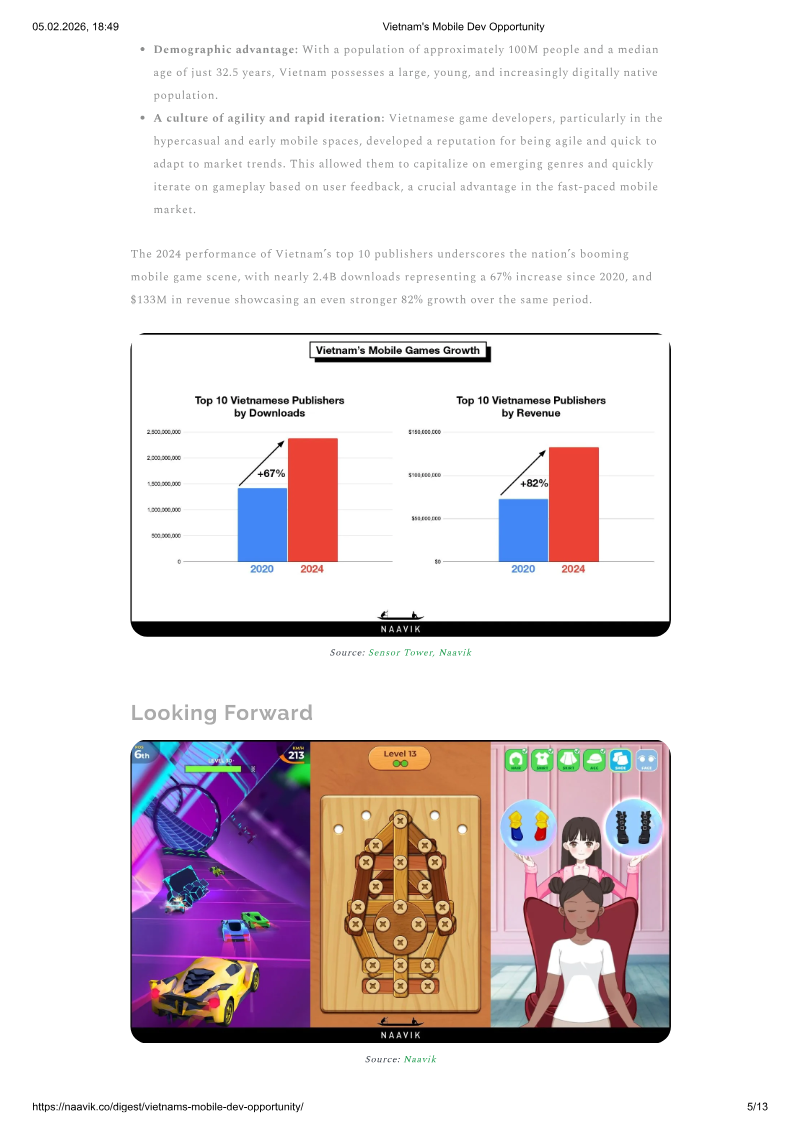
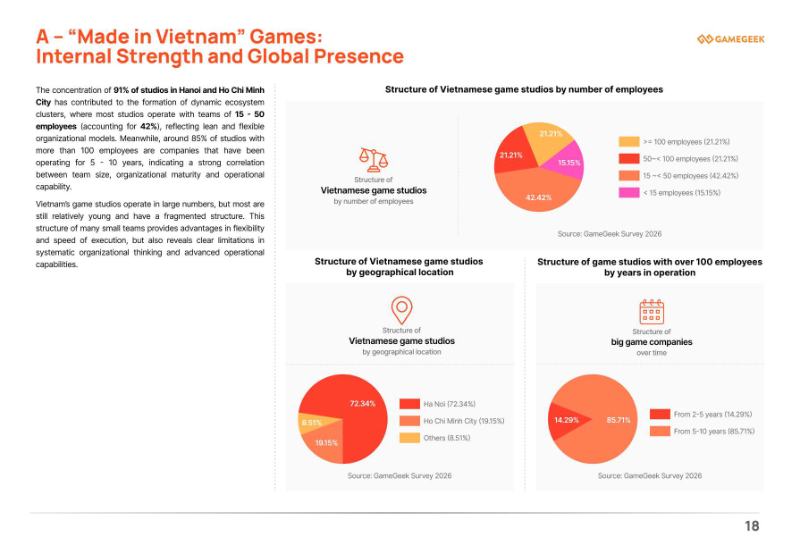
By Harshal Karvande • May 4, 2025 By Harshal Karvande • May 4, 2025 Vietnam, the Southeast Asian nation once defined by manufacturing and outsourcing, is now a vibrant digital innovator — and mobile games are leading that movement. It has a thriving game development scene, with over 35K game programmers, a figure close to that of China, according to Emily Nguyen, Head of Sales for Google Ads, Gaming and Apps in nina, accoldnng to Eny Tguyen, T Top 25 Game Publishers by Downloads 0 R 77 ...
NAAVIK DIGEST NAAVIK DIGEST Vietna ’ bil m s Mo e Dev Opportunity By Harshal Karvande • May 4, 2025 By Harshal Karvande • May 4, 2025 I 10372 Get Ready! PERFECT ×40 TAP TAP ah S o u r c e :N a a v i k Vietnam, the Southeast Asian nation once defined by manufacturing and outsourcing, is now a vibrant digital innovator — and mobile games are leading that movement. It has a thriving game development scene, with over 35K game programmers, a figure close to that of China, according to Emily Nguyen, Head of Sales for Google Ads, Gaming and Apps in Vietnam. nina, accoldnng to Eny Tguyen, T Vietnam.
Top 25 Game Publishers by Downloads 2024, Unified, Worldwide 1,500M SensorTower 1.250M 21,000M 750M 500M 250M 0 R 77 KO 63 1 3 . E IS R O '99 C 7O 8 0 B3 G O * * * * 1 in Top 5, 2 in Top 10, 4 in Top 25 are Vietnamese Game Publishers NAAVIK S o u r c e :S e n s o rT o w e r ,N a a v i k In 2024, there were five Vietnamese companies in the top 25 publishers by downloads: VNGGames, iKame Games, ABI Games Studio, Bravestars Games, and Xgame Global. Their presence was driven by games like Car Race (iKame), Wood Nuts & Bolts Puzzle (ABI), and Hair Salon: Beauty Salon Game (Bravestars). Here, we uncover the forces behind Vietnam’s mobile game development scene and its potential impact on the wider industry. From Internet Cafes to Mobile Phones Vietnam's Historical Evolution INTERNET Early 2000s Early 2010s 2013 Gaming Transition towards Flappy Bird from a Vietnamese in Internet Cafes Mobile Gaming Solo Developer topped Download Charts Worldwide S o u r c e :N a a v i k Vietnam’s engagement with digital entertainment began in the early 2000s, with PC gaming establishing itself as a pastime in bustling internet cafés. Vietnam’s role was predominantly that of a consumer, rather than a producer, of games, with most titles imported from China, South Korea, and Western countries. Notable games at the time were League of Legends, Counter Strike, and Võ Lâm Truyền Kỳ (The Swordman).
gamers, but high-profile crimes linked to gaming led to strict government regulations, with Deputy Minister for Culture and Information Do Huy Doan saying, “Playing games online for too long will affect gamers’ health, even cause death.” Given this backdrop, how did Vietnam manage to evolve from a consumer to a successful producer of games? The transformation flowed from three converging forces: a long history of outsourcing, government regulation, and the explosive rise of mobile gaming. Outsourcing Outsourcing has a long history in Vietnam, with outfits like Glass Egg (established in 1999, acquired by Virtuos in 2022), Sparx (founded in 1995, acquired by Virtuos in 2011), and Gear Games (formed in 2006) representing some of the oldest external development shops. Foreign companies like Ubisoft and Gameloft have also set up shop in Vietnam. Through these outfits, thousands of game developers have cut their teeth across the entire development pipeline, from art and engineering to QA and live ops. (Virtuos alone has more than 1,000 employees in Vietnam.) Decades of work on everything from AAA blockbusters to mobile hits have produced a large, highly skilled talent pool, ripe for powering Vietnam’s shift from a reliable outsourcing hub to a new force in original IP creation.n. Rules Make The Market Before the 2000s, there was no gaming regulation in Vietnam, but the public outcry during the “online gaming crisis” began a trend of government regulation that would change the landscape of the Vietnamese game industry.
ourcing hub to a new force in original IP creation.n. Rules Make The Market Before the 2000s, there was no gaming regulation in Vietnam, but the public outcry during the “online gaming crisis” began a trend of government regulation that would change the landscape of the Vietnamese game industry. In short, local game makers had to seek government approval and licenses to sell and run games in the country, and were banned from advertising their work. Fines and other punishments were introduced for noncompliance, and new restrictions were being added up to and including last year. Foreign game publishers had three choices if they wanted to release games in Vietnam: work with a local publisher to distribute games, establish a local entity, or give up entirely — Supercell famously pulled out from Vietnam due to regulations in 2019. The rules requiring a local entity resulted in a proliferation of Vietnamese firms that would publish foreign games in the market, an easier choice compared to setting up a local entity. A chief player in that space is VNG Corporation, founded in 2004. Recognised as Vietnam’s first tech unicorn, it holds the top spot for mobile game publishing, messaging applications, music streaming, and online news platforms in Vietnam. VNGGames is the number one mobile game publisher in Vietnam by market share, publishing the likes of Roblox, PUBG Mobile VN, Call of Duty: Mobile VN, and Teamfight Tactics.
with knowledge on how to launch and operate successful games. This, combined with the development know-how from outsourcing, made the soil fertile for homegrown success. It only needed a seed. The Mobile Explosion That seed was the emerging mobile gaming space. The watershed moment came in 2013 with the unexpected success of Flappy Bird, created by Vietnamese solo developer Nguyen Ha Dong. It topped charts worldwide, achieving a peak in advertising revenue estimated at up to $50K per day. Its creator eventually removed it from app stores, but Flappy Bird demonstrated that Vietnamese developers could create globally successful mobile games with limited resources, inspiring a generation of local developers. In Flappy Bird’s wake, Vietnam saw an explosion of small mobile studios and startups, and teams that cut their teeth on outsourcing or publishing began creating their own IP. Vietnamese games like Sky Garden: Farming Paradise, Magic Tiles 3, and Axie Infinity gained millions of players and global recognition. According to Sensor Tower, there are currently more than 300 active mobile game publishers with their HQ in Vietnam. Notable Games Made in Vietnam 326 10372 Support Giftreode Sky Garden: Farm in Paradise Magic Tiles 3TM - Piano Game by VNG Games by Amanotes Farming Simulator Game Hypercasual Music Game 2012 2018 -0 XPLAY Teams Inventory Coliection Axie Infinity by Sky Mavis Play-to-Earn Blockchain Game 2018 S o u r c e :N a a v i k
ietnam 326 10372 Support Giftreode Sky Garden: Farm in Paradise Magic Tiles 3TM - Piano Game by VNG Games by Amanotes Farming Simulator Game Hypercasual Music Game 2012 2018 -0 XPLAY Teams Inventory Coliection Axie Infinity by Sky Mavis Play-to-Earn Blockchain Game 2018 S o u r c e :N a a v i k Another example of a local publisher/outsourcer turned standout developer is Bill Truong, CEO of Suga Group. He started as a developer at VNG before founding Suga which, under its subsidiary Farm Studios, has published games like Prison Break: Stick Story, which now has over 100M downloads on Android alone. Additional Factors To Success Vietnam also has other advantages: Technological readiness: Vietnam has achieved over 84% smartphone penetration, with
Marvelous Inc., listed on Tokyo’s Prime Market, released its third‑quarter financial results for the fiscal year ending March 31 2026. The company’s core business spans digital content, amusement, audio‑visual production and live entertainment, with a focus on original IPs and collaborations. Revenue rose to ¥29.1 billion in Q3, up 4.5% from the prior quarter and 10.6% year‑on‑year, driven primarily by digital content sales of ¥7.2 billion and amusement revenue of ¥3.0 billion. Gross operating profit reached ¥10.4 billion, a 12% increase over Q2 and a 9% rise versus the same period last year, reflecting improved cost control in production and marketing. Operating profit fell to ¥1.8 billion, a 12% decline from Q2, largely due to higher selling‑general‑administrative expenses of ¥8.6 billion compared with ¥7.9 billion in Q2. Net income attributable to shareholders was ¥1.5 billion, down 18% from Q2, with a net profit margin of 5.3%. The company’s cash‑flow position remained solid, with operating cash flow of ¥2.8 billion and a cash‑equivalent balance of ¥16.4 billion at quarter end. Geographically, the report covers Japan and overseas markets where Marvelous operates. The data derive from consolidated financial statements prepared under Japanese GAAP, covering all subsidiaries and affiliates. Key metrics such as return on equity (13.7%) and asset turnover (0.82) indicate healthy profitability, while dividend payout remained at 52% of net income. Overall, the quarter shows revenue growth but margin pressure from higher operating costs, prompting management to focus on cost efficiency and portfolio diversification.
The briefing clarified GREE’s strategic outlook for FY2019, emphasizing a steady domestic game portfolio while pursuing growth overseas. In Japan, the company expects no major shift in performance for existing titles but plans to broaden multiplatform distribution and launch new releases in the second half of FY2019, projecting an earnings uptrend. Internationally, GREE is developing and self‑distributing overseas versions of current titles, targeting markets with high profitability potential. Human resource allocation reflects this focus: sufficient staff are dedicated to overseas distribution and new title development, while existing titles receive concentrated support for top performers and operational stability for less successful ones. China is identified as a priority market, with preparations underway to initiate operations and marketing. The company also highlights the Facebook Messenger platform as a high‑potential channel for new titles, indicating an expansion into social media gaming. Advertising strategy will be selective; overseas launches of self‑distributed titles will receive targeted, efficient campaigns rather than broad mass media spend. Regulatory compliance and consumer protection are addressed through company‑wide measures to prevent gacha system issues, including strengthened evaluation protocols and employee training. The REALITY livestreaming platform for VTubers is in an exploratory phase, with ongoing data collection on technology, planning, and marketing to build know‑how for future content expansion. Overall, GREE’s FY2019 strategy balances domestic stability with aggressive international diversification and platform innovation.
GungHo Online Entertainment’s FY 2025 financial briefing outlines a strategic pivot from Japan‑centric mobile development toward global expansion, emphasizing action titles on consoles and PCs. The company reports a 64.1 % overseas net‑sales ratio in FY 2025, up from 47.7 % in 2019 and 56.2 % in 2020, reflecting intensified sales in North America and Europe through new releases such as “Let It Die: Inferno” on PlayStation 5, Steam, and Nintendo Switch. The launch of nine global titles in 2025, including the “Ragnarok” series and “Puzzle & Dragons,” is highlighted as a key growth driver, with the latter celebrating its 5 000‑day anniversary and hosting cross‑platform events to boost user activity. Financially, consolidated net sales fell by 1.3 % YoY to ¥125.3 billion, driven mainly by declines in mobile titles and “Ragnarok”‑related revenue under subsidiary Gravity. Operating profit contracted by 9.3 % YoY to ¥276 million, as SG&A expenses rose due to increased advertising spend and personnel costs following the full acquisition of Alim in December 2024. Non‑consolidated results remained flat, but mobile sales slipped and Gravity’s “Ragnarok” titles underperformed, contributing to the consolidated loss. The briefing covers a global geographic scope—North America, Europe, Latin America, and Asia—with a 2025 focus on launching titles in over 150 countries. Methodologically, data derive from consolidated financial statements and quarterly performance metrics, with a clear emphasis on aligning product development with international market demand.
The presentation reports fiscal year 2020 first‑quarter results for a Japanese entertainment company. Net sales reached 15.8 billion yen, operating income was 1.2 billion yen and EBITDA 1.3 billion yen, surpassing the mid‑to‑high hundred‑million yen forecast and maintaining a stable operating margin despite a quarter‑on‑quarter sales decline driven by post‑anniversary event effects and the transfer of some game titles to improve profitability. Cost controls, particularly a 1.5 billion yen reduction in advertising and outsourcing expenses, offset the sales drop and kept operating income flat. An extraordinary income from equity issuance related to a listing event contributed positively to net income. Geographically, the company expanded its flagship title “DanMachi” into 27 European markets and continued global distribution in Japan, Asia, North America, and Europe. The live‑entertainment segment launched a reality virtual platform, hosting festivals and new program formats to broaden content offerings. The advertising and media arm focused on strengthening community engagement through targeted campaigns and anime tie‑ins, while the game development pipeline aimed to release two new titles in FY 2020 and plan four to six additional releases for FY 2021. Methodologically, the figures derive from consolidated financial statements and internal cost‑tracking systems. The outlook for Q2 projects operating income around 0.5 billion yen, with increased advertising spend to activate promising titles and a continued decline in browser game revenue. The company’s investment securities, notably the Bushiroad listing, are expected to continue appreciating in value.