Skip to main content
Game Industry
Library
Library
Search
Ask AI
News
Connect your AI
Browse
The Catch Up
Topics
Collections
Writers
Help
Subscribe
Game Industry
Library
Library
Search
Ask AI
Saved
Library
14 reports matching your filters
All Types
Reports
Articles
Presentations
Whitepapers
Financial
Legal
Other
Search
RPG
Market Analysis
Mobile
Global
Japan
Investment
Console
Live Ops
Monetization
Game Publishing
PC
Player Behavior
Advertising
Game Development
Marketing
JRPG
User Acquisition
Asia
Clear
Filters
1
RPG
Recently added
Newest first
Oldest first
Title A–Z
Title Z–A
Report
12 pages
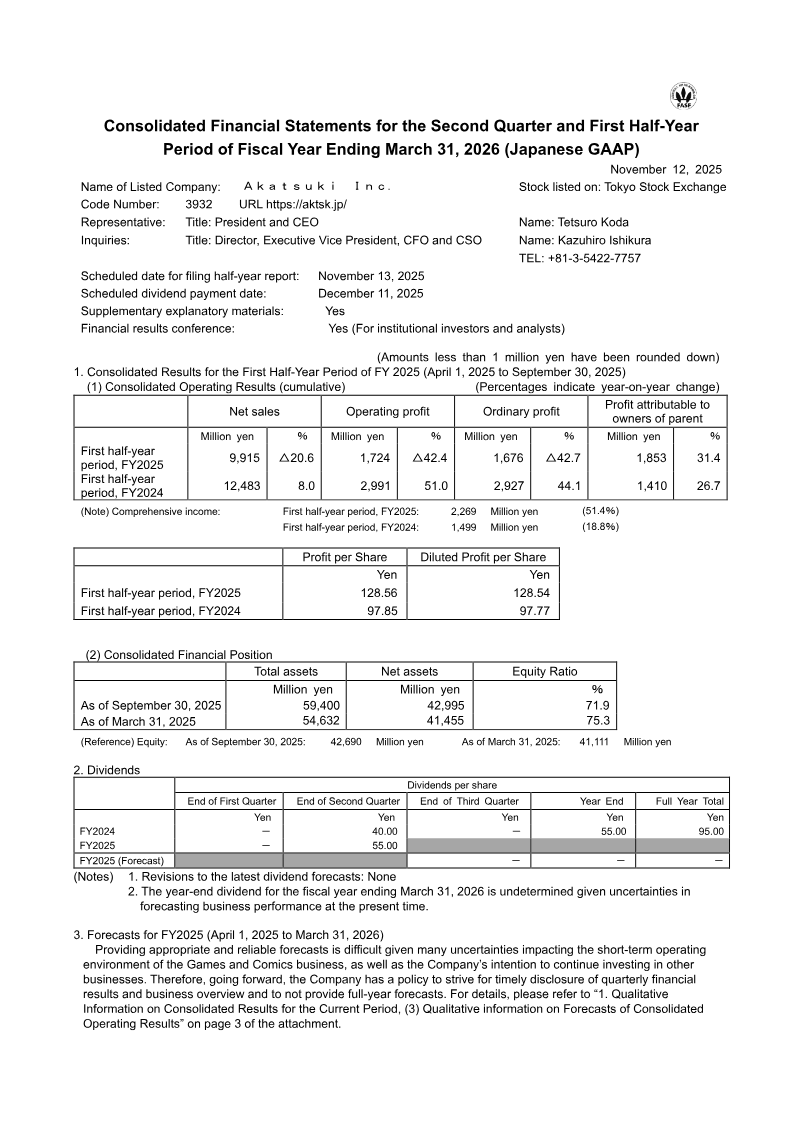
Consolidated Financial Statements: Second Quarter and First Half-Year Period of Fiscal Year Ending March 31, 2026
Akatsuki Inc. reported a 20.6% YoY decline in net sales to ¥9,915 million and a 42.4% drop in operating profit to ¥1,724 million for the first half of the fiscal year ending March 31, 2026.
Net income attributable to the parent rose 31.4% to ¥1,853 million, with diluted earnings per share increasing from ¥97.85 to ¥128.56.
The core Games and Comics segment, which accounts for the majority of revenue, saw a 23.2% sales decline and a 41.2% drop in profit.
Investment
Japan
Mobile
+1
Akatsuki
Report
2 pages
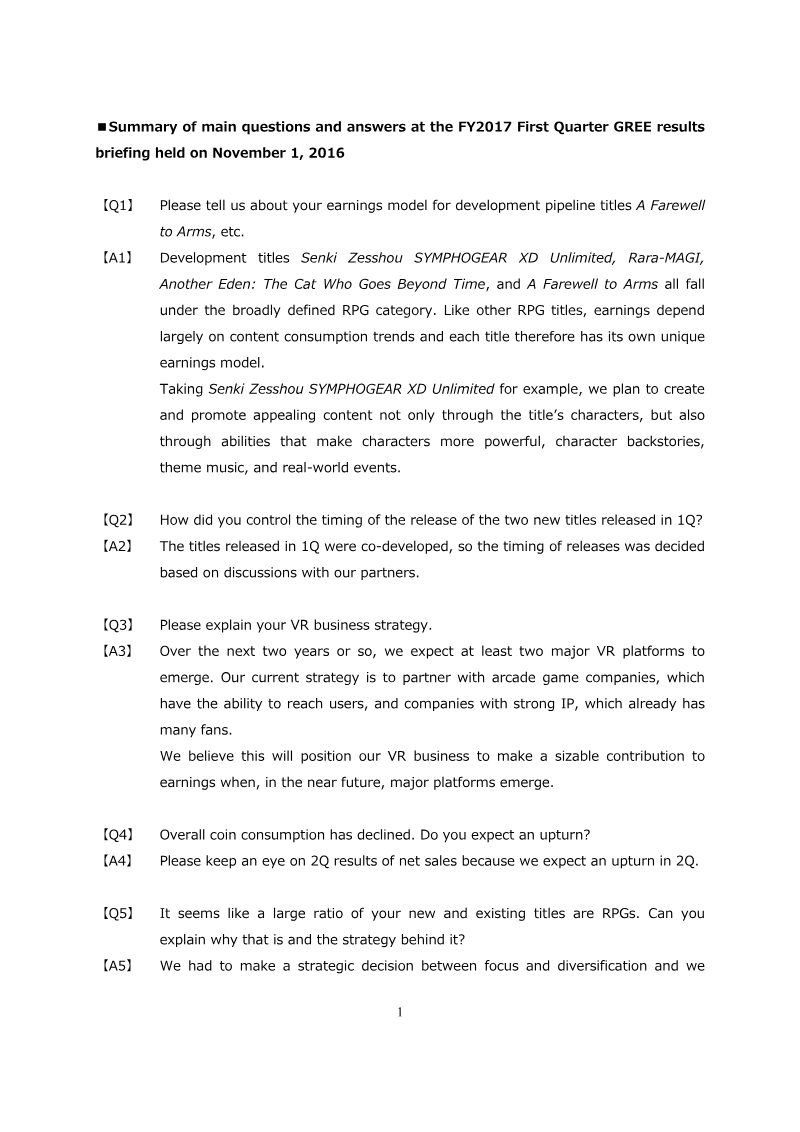
Summary of Main Questions and Answers: FY2017 1Q GREE Results Briefing
GREE is prioritizing the RPG genre to drive FY2017 growth, citing its market dominance in Japan, resilience to trends, and internal development efficiencies.
The company expects a ¥1.0 billion decline in operating income for Q2 due to strategic investments in advertising, rental costs, and goodwill amortization.
Key RPG titles in the development pipeline include Senki Zesshou SYMPHOGEAR XD Unlimited, Rara-MAGI, Another Eden, and A Farewell to Arms.
Market Analysis
Monetization
Mobile
+2
GREE
Report
1 pages
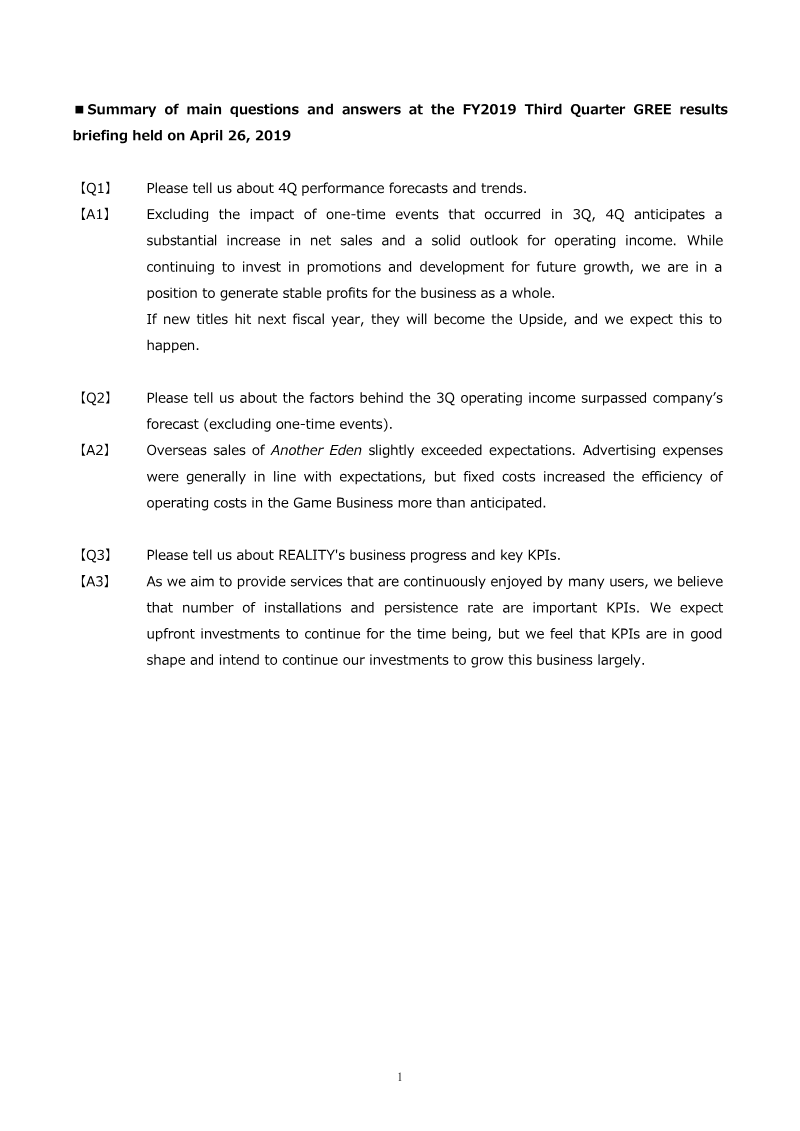
Summary of Main Questions and Answers at the FY2019 Third Quarter GREE Results Briefing
GREE projects a significant increase in net sales for the fourth quarter of fiscal 2019, with operating income expected to remain robust when excluding one-time events.
Third-quarter operating income exceeded forecasts, driven primarily by strong overseas sales performance of the title 'Another Eden'.
Profitability in the game business was bolstered by fixed-cost efficiencies that surpassed internal expectations during the third quarter.
Market Analysis
Market Forecast
Investment
+4
GREE
Report
2 pages
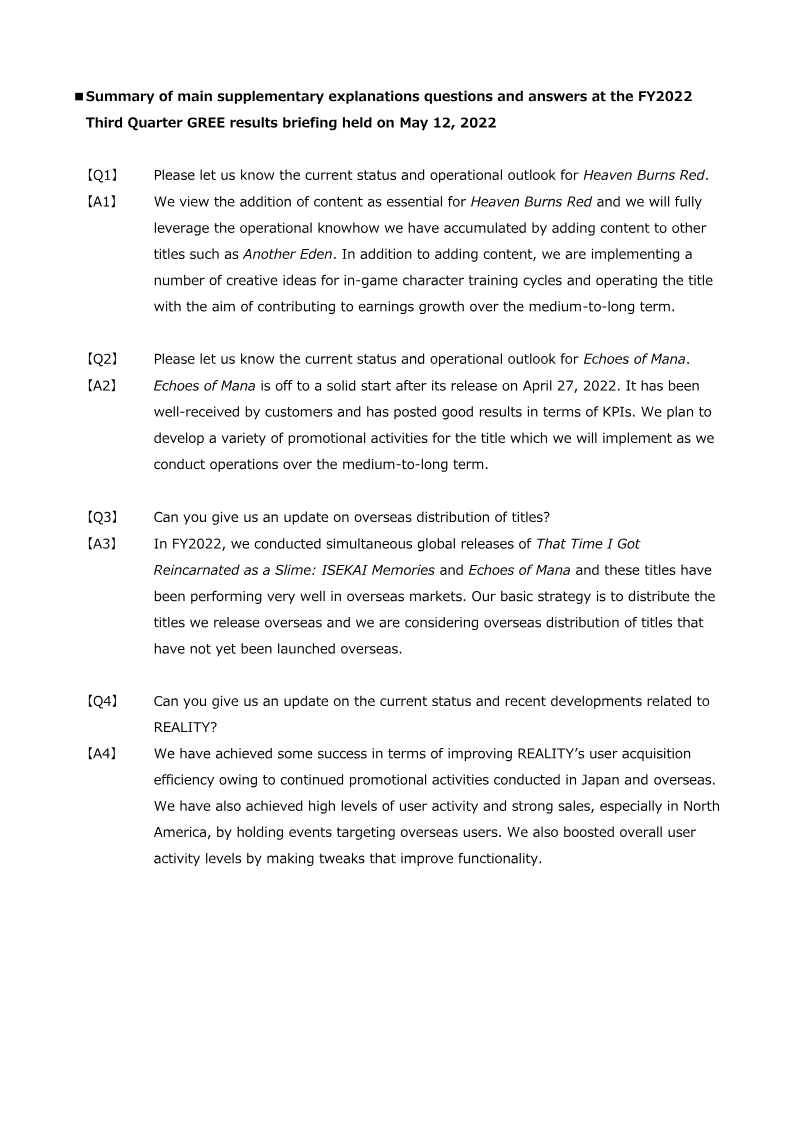
Summary of Main Supplementary Explanations Questions and Answers: FY2022 Third Quarter GREE Results Briefing
GREE projects Q4 operating income for its Internet and Entertainment Business to reach between ¥2.5 billion and just under ¥3.0 billion, driven by the performance of new titles.
The company reported a cumulative loss for Q3 FY2022, primarily due to volatility and a year-over-year decline in the Investment and Incubation Business.
Heaven Burns Red is being managed as a long-term growth engine, with the company applying operational experience from Another Eden to implement new content and training cycles.
Market Analysis
Live Ops
Mobile
+2
GREE
Report
2 pages
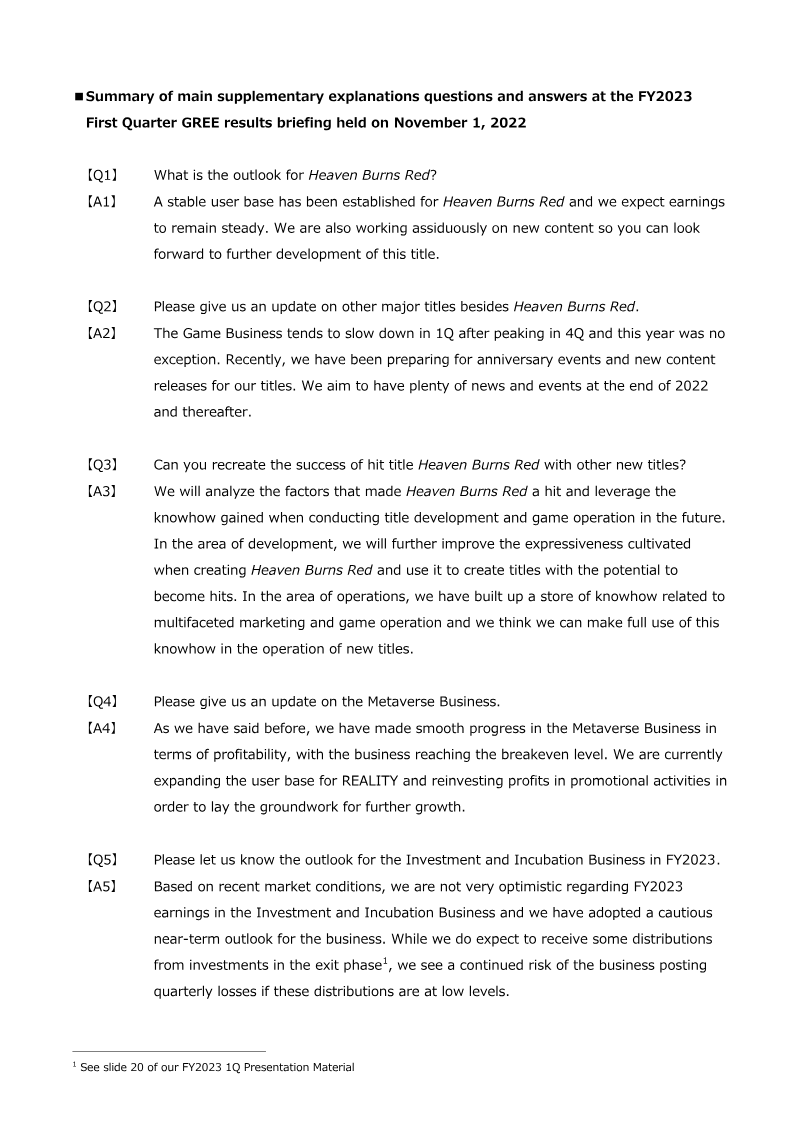
Summary of Main Supplementary Explanations Questions and Answers: FY2023 First Quarter GREE Results Briefing
GREE projects operating income for the Internet and Entertainment Business to reach between ¥1.0 billion and ¥1.5 billion in Q2 FY2023.
The flagship title 'Heaven Burns Red' maintains a stable user base, with the company leveraging its development and marketing lessons from this game to inform future title releases.
The metaverse segment, anchored by the platform REALITY, has reached a breakeven point and is currently reinvesting profits into promotional activities to scale its user base.
Market Analysis
Live Ops
Mobile
+2
GREE
Report
2 pages
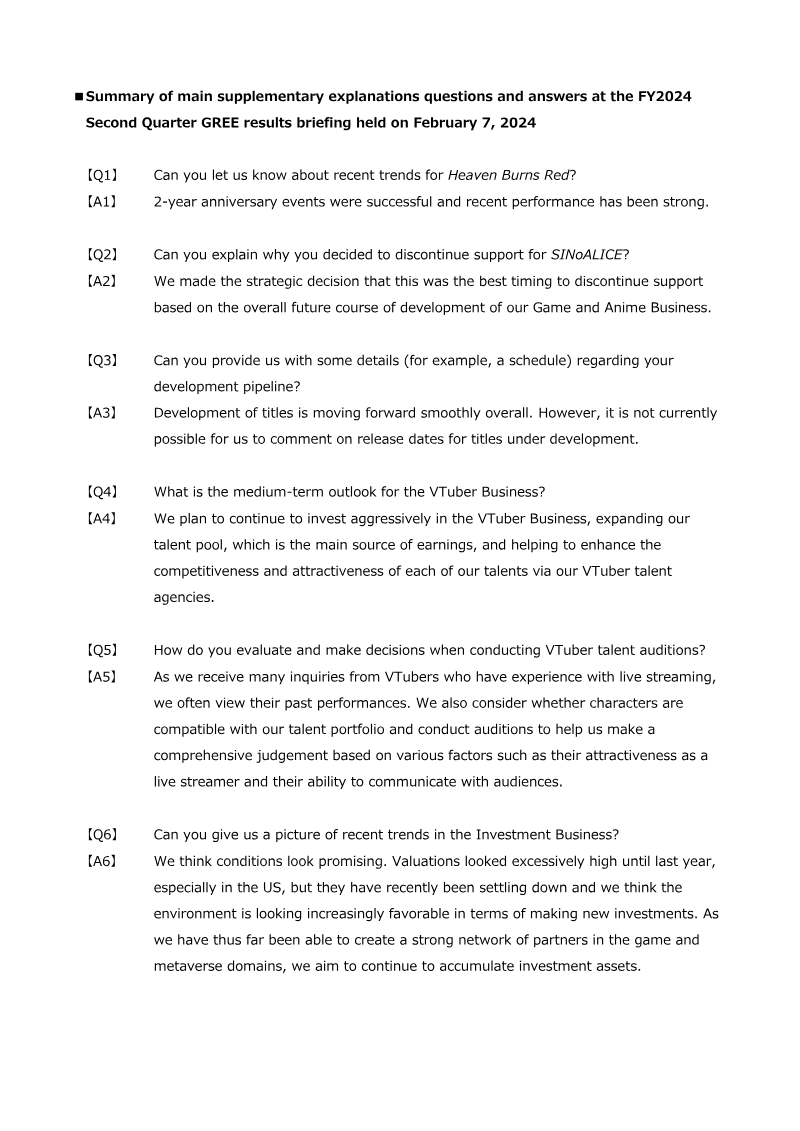
Summary of Main Supplementary Explanations Questions and Answers: FY2024 Second Quarter
GREE forecasts consolidated operating income of approximately ¥1.5 billion for Q3 and ¥5.0 billion for the full fiscal year FY2024, excluding the Investment Business.
The company is shifting its Game and Anime Business strategy by discontinuing support for SINoALICE to prioritize more promising development projects.
Heaven Burns Red remains a core performance driver, with its two-year anniversary events contributing to strong financial results.
Market Analysis
Game Development
Mobile
+3
GREE
Report
3 pages
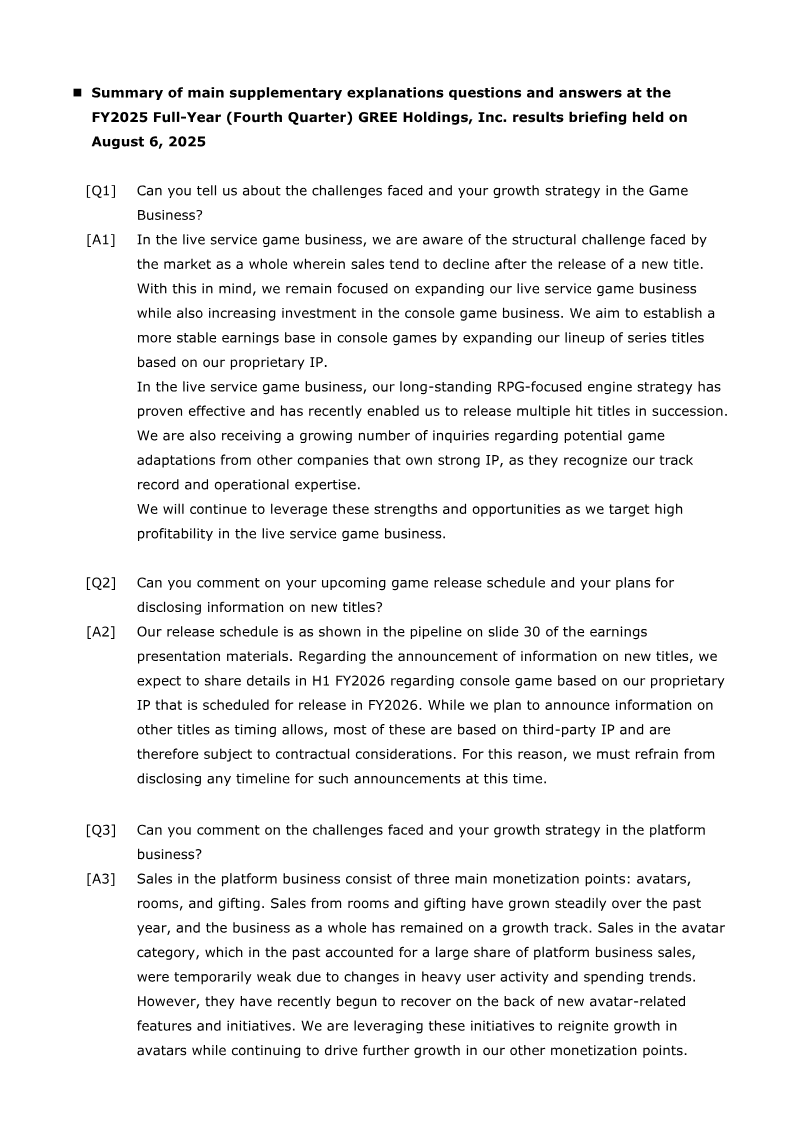
Summary of Main Supplementary Explanations Questions and Answers: FY2025 Full-Year Results
GREE is shifting its game division strategy to balance post-launch live-service volatility by investing in console titles built on proprietary IP.
The VTuber business has doubled sales per talent since FY2024, supported by a roster of approximately 90 talents and expanded merchandise and advertising channels.
The DX business is transitioning from a one-time project sales model to a recurring revenue structure, with modest growth expected through FY2026.
Market Analysis
Live Ops
Investment
+4
GREE
Report
64 pages
Annual Report 2005
The 2005 annual report categorizes business performance across five primary segments: offline games, online games, mobile phone content, publications, and other miscellaneous activities.
Financial data for the 2004 and 2005 fiscal years is structured to allow for direct year-over-year performance comparisons across all operational divisions.
The organization maintains a focus on environmental sustainability by utilizing recycled paper for the production of its 2005 annual report.
Market Analysis
Mobile
Console
+3
Square Enix
Report
2 pages
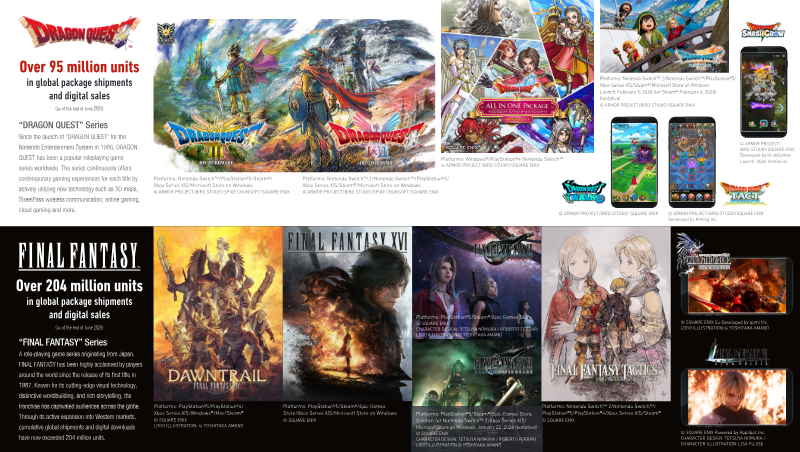
Square Enix Special Feature: Erdrick Trilogy Reimagined
The Dragon Quest I & II HD-2D Remake is scheduled for release on February 5, 2026, across Nintendo Switch 2, PlayStation 5, Xbox Series X|S, and PC.
The Dragon Quest franchise has reached 95 million units in total shipments and digital sales as of June 2025.
The Final Fantasy franchise has surpassed 204 million units globally as of mid-2025, driven by Final Fantasy XIV: Dawntrail and Final Fantasy VII Rebirth.
Market Analysis
Global
Console
+3
Square Enix
Sept 2025
Report
26 pages
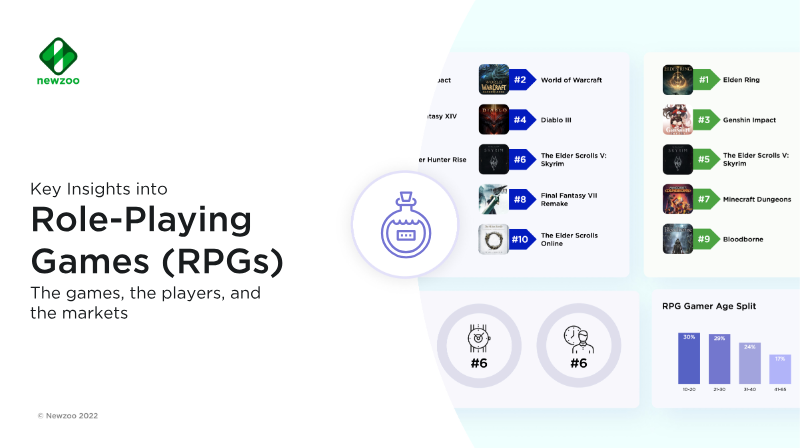
Key Insights into Role-Playing Games (RPGs)
As of 2022, Role-Playing Games (RPGs) rank as the highest-revenue genre in the global gaming market.
The player base is predominantly male (58%) and young, with 59% of users falling between the ages of 10 and 30.
Monetization is heavily driven by pay-to-play models used by 97% of the player base, supplemented by in-app purchases at 90%.
Market Analysis
Player Demographics
Player Behavior
+2
Newzoo
Jan 2025
Report
19 pages
RPG Genre Snapshot Report June 2021
As of mid-2021, RPGs account for approximately 14% of total revenue on the US iOS mobile gaming platform.
The RPG market is shifting from traditional turn-based titles toward high-fidelity, open-world Action RPGs that offer console-quality experiences.
Genshin Impact is the primary driver of the genre's evolution, currently commanding over 10% of the total RPG market share.
Market Analysis
Global
RPG
+1
GameRefinery
Jun 2021
Report
19 pages
RPG Genre Snapshot
RPG titles account for 14% of the total revenue share on the US iOS mobile gaming market.
Genshin Impact alone captures 10% of the total RPG market share, signaling a shift from turn-based titles toward high-production action RPGs.
Market leaders are increasingly defined by console-quality production values, open-world environments, and narrative-heavy gameplay.
Market Analysis
RPG
Mobile
+1
GameRefinery
Jun 2021
Report
30 pages
Mobile Game Genre Report: Role-Playing Games 2021
Mobile RPGs generated $18.5 billion in 2020, representing nearly 25% of total mobile gaming revenue.
The market is heavily concentrated in East Asia, with China, Japan, and South Korea accounting for over 70% of global RPG earnings.
Approximately 50% of top-performing RPG titles rely on established intellectual properties, such as the Marvel franchise, to drive player acquisition and revenue.
Market Analysis
RPG
Mobile
+5
Pangle
Jan 2021
Report
30 pages
Mobile Game Genre Report: Comparing & Contrasting Eastern and Western Markets
Role-playing games (RPGs) dominated the 2020 mobile market with $18.5 billion in revenue, representing over 21% of the global market share.
East Asian markets (China, Japan, and South Korea) drive RPG financial performance, accounting for 72% of the genre's total global earnings.
Successful RPG monetization is shifting toward hybrid models, as 83% of players are receptive to opt-in rewarded video ads alongside traditional gacha mechanics and battle passes.
Market Analysis
Mobile
RPG
+1
Newzoo
Jan 2021