GameRefinery
Research36 documents
Documents

Article
Analyst Bulletin: Mobile Game Market Review July & August 2026
The mobile gaming landscape during July and August 2026 demonstrated a marked departure from traditional seasonal lulls, characterized by aggressive LiveOps strategies and structural innovation. Developers increasingly prioritized the integration of complex gacha systems and hybrid monetization models within casual titles, effectively gating player progress behind real-money transactions. This period underscored a broader industry shift toward enhancing engagement through sophisticated reward structures, such as Battle Pass-hybrid wheels and seasonal collectible album events, which successfully revitalized long-standing franchises like Clash of Clans and CSR 2.
Market trends during these two months highlighted a convergence of genres, most notably the emergence of casualized 4X strategy games that utilize simplified combat mechanics and stylized aesthetics to broaden their appeal. Despite this trend toward accessibility, established, IP-driven titles maintained significant market dominance, proving that traditional, high-complexity mechanics remain a cornerstone of competitive performance. Furthermore, midcore titles increasingly adopted roguelike-inspired player-versus-player modes, reflecting a strategic effort to deepen gameplay loops and sustain long-term retention.
These developments illustrate a maturing mobile ecosystem where the boundaries between casual and midcore experiences are becoming increasingly porous. By blending exploration-based minigames with advanced progression systems, developers are successfully navigating a competitive environment that demands constant content updates and refined monetization. The data from this period confirms that while the industry is experimenting with new structural formats, the core drivers of success remain rooted in the effective deployment of live services and the strategic evolution of established gameplay loops.
- The New York Times Games reached ninth place in the revenue charts on August 28, 2026, driven by a 75% discount on first-year subscriptions.
- Marvel SNAP experienced a doubling of iOS downloads compared to its pre-launch baseline following the introduction of a new Draft Mode, which features roguelike mechanics and deck upgrades.
- Mobile games like Coin Master, Dice Dreams, and Disney Solitaire are increasingly utilizing 'chain-offer' mechanics that lock milestone reward progress behind real-money purchases.
- Exploration minigames, which allow players to clear map obstacles using energy, have seen a resurgence in popularity across titles like Bingo Voyage and Truck Star.
- Major publishers, including Playrix, have continued to utilize exploration events as a standard feature to boost engagement since their introduction to the genre in 2020.
+2
GameRefinery
Article
Analyst Bulletin: Mobile Game Market Review June 2026
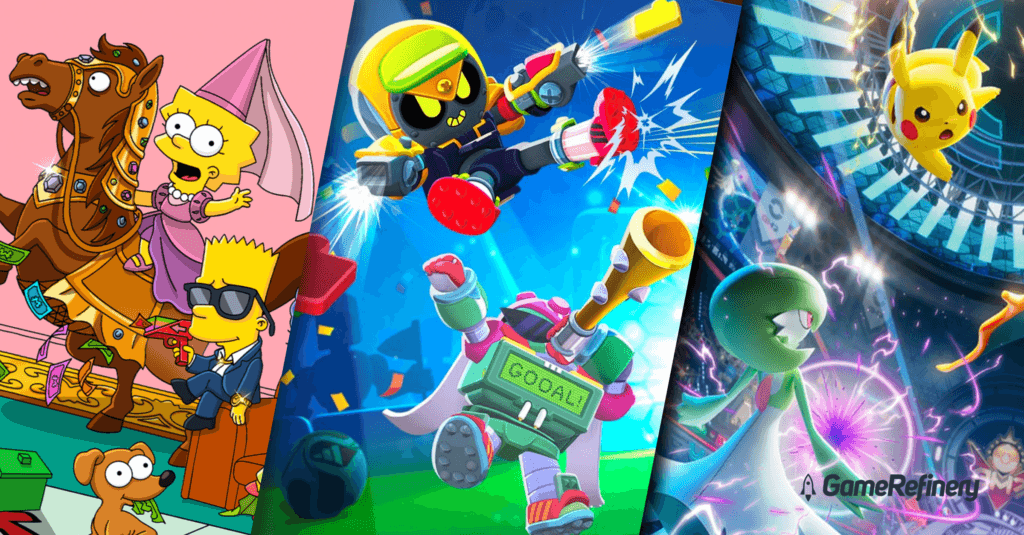
The mobile gaming landscape in June 2026 was defined by a strategic reliance on major sporting events and high-profile intellectual property collaborations to drive user engagement. The FIFA World Cup served as the primary catalyst for live-ops innovation, with developers across diverse genres—ranging from battle royales like PUBG Mobile to strategy titles such as Rise of Kingdoms—implementing prediction-based mechanics and themed reward tracks. While these sports-centric events successfully increased active participation, the industry faced questions regarding the long-term sustainability of such saturation, as the sheer volume of similar mechanics across the market began to yield diminishing returns.
Intellectual property partnerships emerged as a secondary pillar of market activity, though results remained inconsistent. The collaboration between Monopoly GO! and The Simpsons succeeded in driving a significant surge in new downloads, yet it failed to translate into a proportional increase in in-app purchase revenue. Conversely, new releases such as Game of Thrones: Dragonfire and Inazuma Eleven: Cross demonstrated that the fusion of established franchises with skill-based, interactive gameplay remains a potent formula for securing market performance. These trends highlight a broader industry shift toward genre-blending and experimental live-ops, as seen in titles like Project Makeover, XP Hero, and Bubble Word Jam.
Ultimately, the mobile market in mid-2026 reflected a period of intense experimentation. Developers are increasingly prioritizing engagement-focused events and cross-media partnerships to maintain relevance in a crowded ecosystem. While these strategies effectively capture user attention, the disparity between download volume and monetization performance suggests that the industry is still refining how to effectively convert temporary event-based interest into sustained financial growth.
- The June 2026 mobile market shows a significant disconnect between high user engagement from live-ops events and actual monetization, as developers struggle to convert temporary interest into sustained revenue.
- Major sporting events like the FIFA World Cup drove widespread adoption of prediction-based mechanics and themed reward tracks across diverse genres, including PUBG Mobile and Rise of Kingdoms.
- Market saturation of sports-centric live-ops is leading to diminishing returns, raising concerns about the long-term sustainability of these engagement strategies.
- Intellectual property collaborations yielded inconsistent financial results; while the Monopoly GO! and The Simpsons partnership drove new downloads, it failed to generate a proportional increase in in-app purchase revenue.
- Franchise-based titles that integrate skill-based, interactive gameplay, such as Game of Thrones: Dragonfire and Inazuma Eleven: Cross, proved more effective at securing market performance than standard IP crossovers.
+2
GameRefineryJul 2026

Article
Analyst Bulletin: Mobile Game Market Review May 2026
The bulletin examines the mobile‑game landscape in May 2026, focusing on how top titles and emerging casual releases adapt their monetization and engagement strategies. It reveals a persistent reliance on third‑party tracking, with 40 marketing, 17 statistical, 7 preference and 21 essential cookies sourced from major providers such as Google, Meta, HubSpot and Cloudflare. This ecosystem underpins both market analysis and targeted advertising for the industry.
In May, overall revenue growth slowed, yet leading franchises continued to innovate. Coin Master extended its System‑Driven event framework beyond gacha, launching Merge Haven while maintaining its reward loop. Whiteout Survival doubled down on casual puzzle events to keep mid‑core players engaged, and Free Fire refined its ultra‑whale auction with serialized skins and refund options. Clash of Clans introduced a community‑vs‑environment event, signalling a shift toward socially driven competition models.
The bulletin highlights a broader trend of low‑risk, high‑engagement live‑ops in casual titles. Phase 10 and Family Island refreshed their calendars using proven hyper‑casual blueprints, while Dual Hunt added a risk‑vs‑reward mechanic that heightened player agency. Lilith’s Clash of Critters proved the viability of niche hybrids, topping downloads and sustaining May revenue by blending autobattler lane defense with pinball‑style progression. Sunday City demonstrated how slot‑based revenue can be anchored to a persistent world, generating idle currency that fuels further spending. These examples illustrate that borrowing established casual mechanics and integrating them with unique progression loops can sustain player interest and monetize effectively without the cost of building new systems from scratch.
The bulletin’s footer lists publisher logos and standard legal links, providing contact information but no additional analysis.
- Mobile game publishers remain heavily reliant on third-party tracking, utilizing a total of 85 cookies—including 40 marketing and 17 statistical—sourced from providers like Google, Meta, HubSpot, and Cloudflare.
- Leading titles are successfully sustaining engagement by integrating low-risk, proven casual mechanics into their existing loops, such as Whiteout Survival’s use of casual puzzle events for mid-core players.
- Hybrid genre titles are gaining traction, evidenced by Lilith’s Clash of Critters topping download charts by blending autobattler lane defense with pinball-style progression.
- Monetization strategies are evolving through refined high-end mechanics, such as Free Fire’s implementation of serialized skins and refund options for its ultra-whale auction model.
- Socially driven competition is emerging as a key engagement trend, exemplified by Clash of Clans shifting focus toward community-vs-environment event frameworks.
+2
GameRefineryJun 2026
Article
Mobile Game Market Review: April 2026
The April 2026 mobile game market review highlights a blend of innovative retention mechanics, event design, and monetization shifts across casual and midcore titles. Casual games such as Monopoly GO! introduced narrative‑driven seasons that add new core mechanics, while Gossip Harbor launched a hybrid PvE format combining match‑3 and merge progression. Hay Day’s April Fools’ event tied rewards to milestone achievements, contributing to record monthly revenue and illustrating a trend toward cohesive, progression‑centric events.
Midcore titles pivoted monetization toward webstore currencies, with games like Last Z and MLB Perfect Inning replacing direct real‑money purchases with in‑app store options. Invincible: Guarding the Globe experienced a significant spike in downloads and revenue during its Season 4 release, driven by new characters and cross‑platform promotional activities linked to the TV show’s fourth season. The review notes uncertainty about the longevity of this momentum.
New launches such as Neverness to Everness, Dragon Quest Smash, and Honor of Kings: World are discussed. NtE offers a GTA‑style open world with gacha mechanics that guarantee limited‑time characters after a set number of pulls, while Dragon Quest Smash blends roguelite gameplay with party and co‑op elements, maintaining strong performance in Japan. Honor of Kings: World expands the franchise into an open‑world ARPG/MMO with cross‑platform progression.
Overall, the market shows a shift toward hybrid gameplay models and webstore monetization, with event‑driven retention strategies proving effective across both casual and midcore segments.
- Casual and midcore titles are increasingly adopting hybrid gameplay models, such as Gossip Harbor’s integration of match-3 and merge progression and Dragon Quest Smash’s blend of roguelite and co-op elements.
- Midcore games like Last Z and MLB Perfect Inning are shifting monetization strategies by replacing direct real-money purchases with webstore-based currency systems.
- Event-driven retention strategies are yielding measurable success, exemplified by Hay Day’s April 2026 milestone-based event, which resulted in record monthly revenue.
- High-profile midcore releases are leveraging cross-platform integration and IP synergy, such as Invincible: Guarding the Globe’s Season 4 launch and Honor of Kings: World’s cross-platform ARPG/MMO expansion.
- New gacha-based titles like Neverness to Everness are implementing player-friendly mechanics, such as guaranteed limited-time character drops after a fixed number of pulls.
+3
GameRefineryMay 2026
Article
Analyst Bulletin: Mobile Game Market Review March 2026
The mobile gaming landscape in March 2026 is defined by a strategic shift toward complex, multi-layered engagement loops and the aggressive integration of cross-genre mechanics. Publishers are increasingly prioritizing retention through sophisticated progression systems, such as seasonal collectible albums and event-within-an-event structures, which incentivize sustained player spending. This trend is evident across diverse segments, ranging from casual titles like Royal Match and Coin Master to midcore powerhouses such as Clash Royale and PUBG Mobile, all of which are adopting these layered reward paths to maintain competitive relevance.
Market dynamics during this period reflect a significant push toward hybrid gameplay models. Established titles are diversifying their core loops by incorporating elements from disparate genres, such as the addition of 4X strategy mechanics in Hero Wars or merge-style features in casual puzzle games. Simultaneously, the industry is witnessing the continued influence of Chinese publishers in Western markets, particularly within the Merge genre, where titles like Gossip Harbor have successfully captured significant market share. The launch of high-profile intellectual properties, including The Division: Resurgence and Roco Kingdom: The World, further underscores the industry's reliance on nostalgia-driven branding and deep RPG-style progression to attract and retain users.
These developments highlight a broader evolution in mobile monetization and design, where the boundaries between casual and midcore experiences are becoming increasingly porous. By leveraging complex UI updates and tiered competitive events, developers are successfully extending the lifecycle of their products. This strategic focus on long-term engagement through multifaceted progression systems serves as the primary driver for growth in the current mobile ecosystem, signaling a departure from simpler, singular gameplay loops toward more intricate, service-oriented experiences.
- Mobile games are shifting from simple loops to complex, multi-layered engagement models that utilize seasonal collectible albums and nested event structures to drive sustained spending.
- The industry is increasingly adopting hybrid gameplay models, such as integrating 4X strategy mechanics into titles like Hero Wars or merge features into casual puzzle games.
- Chinese publishers are successfully capturing significant Western market share, particularly within the merge genre, as evidenced by the performance of titles like Gossip Harbor.
- Publishers are leveraging nostalgia-driven branding and deep RPG-style progression through high-profile IP launches like The Division: Resurgence and Roco Kingdom: The World to secure user retention.
- The distinction between casual and midcore mobile experiences is eroding as developers across the spectrum, including Royal Match, Coin Master, Clash Royale, and PUBG Mobile, adopt identical tiered competitive systems.
+3
GameRefineryApr 2026
Article
Analyst Bulletin: Mobile Game Market Review February 2026
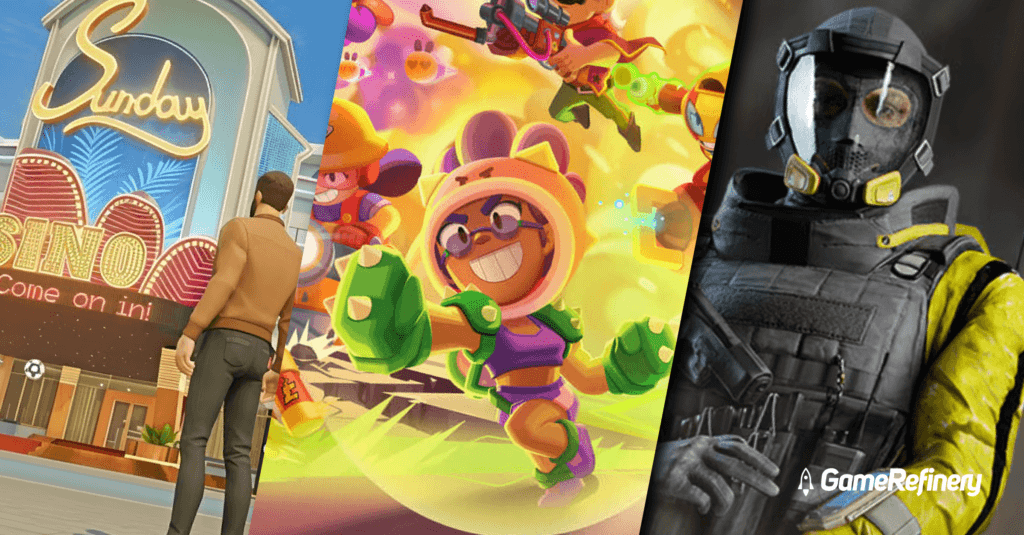
The mobile gaming landscape in February 2026 reflects a period of significant innovation, characterized by the convergence of disparate genres and the refinement of live-service engagement strategies. The primary thesis of current market activity centers on the successful integration of hybrid mechanics, where developers are increasingly blending casual, tycoon, and social elements into midcore and strategy titles to drive both retention and monetization. This trend is particularly evident in the rise of titles like Sunday City: Life Simulator, which effectively combines casino-style mechanics with tycoon gameplay to secure a top 200 grossing position.
Industry performance during this period highlights a clear divide between acquisition success and long-term monetization. While high-profile releases such as Rainbow Six Mobile achieved immediate dominance in download volume on the US iOS charts, these titles face substantial hurdles in converting initial interest into sustained revenue, likely due to the complexities of their user interfaces and tactical depth. Conversely, established titles like Brawl Stars, Clash of Clans, and Summoners War continue to leverage sophisticated LiveOps updates—ranging from dating-sim mechanics to high-profile intellectual property collaborations—to maintain market relevance and deepen player engagement.
The scope of this market activity encompasses global mobile gaming trends with a specific emphasis on the North American iOS ecosystem. The data indicates a broader industry shift toward hybrid-casual and 4X strategy titles, such as Yarn Loop: Knit Puzzle and Last Asylum: Plague, which are successfully capturing market share through innovative monetization models. Ultimately, the current market environment rewards developers who can balance accessible social mechanics with the depth required to sustain long-term player investment, even as complex tactical games struggle to bridge the gap between initial popularity and commercial profitability.
- The mobile market is shifting toward hybrid-genre titles that blend casual, tycoon, and social mechanics into midcore and strategy games to improve retention and monetization.
- Titles like Sunday City: Life Simulator have successfully utilized hybrid mechanics, specifically combining casino-style gameplay with tycoon elements, to reach the top 200 grossing charts.
- High-profile releases like Rainbow Six Mobile are achieving high download volumes on US iOS but struggling to convert initial interest into sustained revenue due to UI complexity and tactical depth.
- Established games including Brawl Stars, Clash of Clans, and Summoners War are maintaining market relevance through sophisticated LiveOps updates, such as IP collaborations and non-traditional mechanics like dating-sim elements.
- Hybrid-casual and 4X strategy titles, exemplified by Yarn Loop: Knit Puzzle and Last Asylum: Plague, are capturing significant market share in the North American iOS ecosystem.
+3
GameRefineryMar 2026

Report20 pages
Match-3 Genre Snapshot Report: May 2021
The document presents a comprehensive analysis of the mobile match‑3 puzzle segment for Q1 2021, focusing on revenue performance, genre characteristics, and player motivations. It identifies the top five match‑3 titles—Candy Crush Saga, Homescapes, Project Makeover, Gardenscapes, and Toon Blast—detailing their market share changes, revenue per download (Rev/DL), and year‑over‑year growth. Candy Crush Saga leads with a 16.74% share and a Rev/DL of $11.27, while Project Makeover shows the strongest growth at 10.57% share and a Rev/DL of $45.51, reflecting its premium monetization strategy.
The analysis breaks down genre features, noting that Royal Match and Project Makeover exemplify modern match‑3 design: fast‑paced gameplay, quick animations, and a progression system tied to home or makeover themes. Monetization models emphasize consumable boosters, lives, and continue options, with special events such as guilds, recurring tournaments, and exclusive levels driving engagement. The document also highlights unique mechanics—bonus “no‑fail” levels, mystery boxes, and avatar customization—that differentiate titles within the subgenre.
Player motivation data from a US sample classify drivers into escapism, mastery, social interaction, and management. Match‑3 games score high on mastery (completing milestones) and escapism, while social competition scores lower. The report’s methodology relies on GameRefinery’s SaaS dashboard, aggregating download and revenue metrics across the US market for Q1 2021. Overall, the document underscores that successful match‑3 titles combine rapid core loops with layered progression and event systems to sustain high monetization rates.
- Candy Crush Saga remains the market leader with a 16.74% share and a revenue per download (Rev/DL) of $11.27 as of Q1 2021.
- Project Makeover demonstrates the most aggressive growth in the sector, capturing a 10.57% market share with a high-premium monetization strategy yielding a $45.51 Rev/DL.
- Modern match-3 success is driven by fast-paced core loops, quick animations, and progression systems integrated with home or makeover themes, as seen in titles like Royal Match and Project Makeover.
- Monetization in the genre relies heavily on consumable boosters, lives, continue options, and recurring engagement events like guilds and tournaments.
- Player motivation data indicates that match-3 users are primarily driven by mastery of milestones and escapism, while social competition remains a lower priority.
+1
GameRefineryJan 2025
Report40 pages
Casual Gaming Apps Report 2024
The mobile gaming landscape is currently defined by a strategic shift toward casual and hybrid-casual experiences, which serve as the primary engine for industry growth and user acquisition. While the market faces significant headwinds in the form of rising acquisition costs—particularly on iOS, where the $4.83 cost-per-install is nearly eight times higher than on Android—high-performing regions like North America continue to deliver a sustainable Day 7 return on ad spend of 5.9%. This economic environment has triggered a transition away from hyper-casual titles toward puzzle games, which now command 37% of installs, and hybrid-casual models that integrate complex meta-layers and sophisticated LiveOps into accessible core mechanics.
Monetization strategies are becoming increasingly diversified as developers move beyond traditional advertising. The rise of "progressive offers" and "engagement offers" has transformed in-app purchases by tying discounts and rewards directly to active gameplay milestones. Furthermore, the industry is seeing a surge in collaborative "partner events" and social mechanics, such as win streaks and digging minigames, to stabilize and boost baseline revenues. These engagement-driven tactics are often paired with the emergence of external web stores, allowing developers to bypass platform fees and foster direct-to-consumer relationships through exclusive loyalty rewards and daily gifts.
The casualization of the market extends even to mid-core titles, which now rely on casual mechanics for 74% of their installs. Emerging subgenres like 3D match and Mahjong Solitaire are gaining significant traction, reflecting a broader trend of deepening gameplay depth within the casual category. By combining simple core loops with complex monetization structures and social event formats, developers are successfully navigating the high-cost acquisition environment to maintain long-term player retention and revenue growth across global markets.
- Puzzle games now account for 37% of all mobile gaming installs as the industry shifts away from hyper-casual titles.
- Casual mechanics are increasingly vital for mid-core titles, currently driving 74% of their total installs.
- User acquisition costs on iOS remain significantly higher than Android, with a cost-per-install of $4.83 that is nearly eight times the rate on Android.
- North American markets remain a key growth driver, delivering a sustainable Day 7 return on ad spend of 5.9%.
- Developers are increasingly utilizing external web stores to bypass platform fees and establish direct-to-consumer relationships through loyalty rewards.
GameRefineryJan 2024
Report32 pages
Midcore Gaming Apps Report 2023
The midcore mobile gaming market is undergoing a significant expansion as players increasingly migrate from hyper-casual titles toward games offering greater depth and complexity. Currently accounting for 35% of total US iOS gaming revenue, the midcore segment is defined by its high player retention and diverse monetization strategies. While these games face higher user acquisition costs than casual titles—averaging a $2 cost-per-install (CPI)—they leverage sophisticated LiveOps and multi-layered Battle Pass systems to drive long-term profitability. Strategy and RPG genres lead the market, while emerging trends like extraction shooters and season-based gameplay loops further solidify the segment's dominance.
Data from 2022 to 2023 highlights stark contrasts in performance across platforms and regions. Android remains the more cost-effective platform for developers, offering a $0.73 CPI compared to $3.86 on iOS, while also delivering nearly double the Day-7 return on ad spend (ROAS) at 6.1%. Geographically, North America represents the most expensive market with a $5.45 CPI, yet it maintains a strong 4.5% ROAS. Conversely, the EMEA region provides the best overall value, balancing a low $0.80 CPI with a competitive 4.4% ROAS. Genre-specific analysis shows that Shooters require the highest acquisition investment at $7.47 but yield the highest early returns, whereas RPGs offer the lowest entry cost at $0.60.
To maximize revenue and bypass traditional platform fees, midcore developers are increasingly adopting external web stores and aggressive LiveOps schedules, often running an average of 15 simultaneous active events. This shift toward complex, service-based ecosystems is supported by specialized growth acceleration platforms that provide the infrastructure for large-scale app marketing and monetization. By utilizing programmatic exchanges and targeted advertising solutions, developers can navigate the high-cost landscape of midcore gaming to secure a dedicated and high-value audience.
- Midcore games now account for 35% of total US iOS gaming revenue, driven by a player migration from hyper-casual titles toward deeper, more complex gameplay.
- Android is significantly more cost-effective for developers than iOS, with a $0.73 CPI compared to $3.86 and nearly double the Day-7 ROAS at 6.1%.
- The EMEA region offers the best market value, balancing a low $0.80 CPI with a competitive 4.4% ROAS, while North America remains the most expensive market at a $5.45 CPI.
- Genre-specific acquisition costs vary widely, with Shooters requiring the highest investment at $7.47 per install, while RPGs offer the lowest entry cost at $0.60.
- To drive long-term profitability and bypass platform fees, developers are increasingly utilizing external web stores and aggressive LiveOps strategies, often maintaining 15 simultaneous active events.
+1
LiftoffJan 2024
Report14 pages
Mobile Game Market Review December 2023
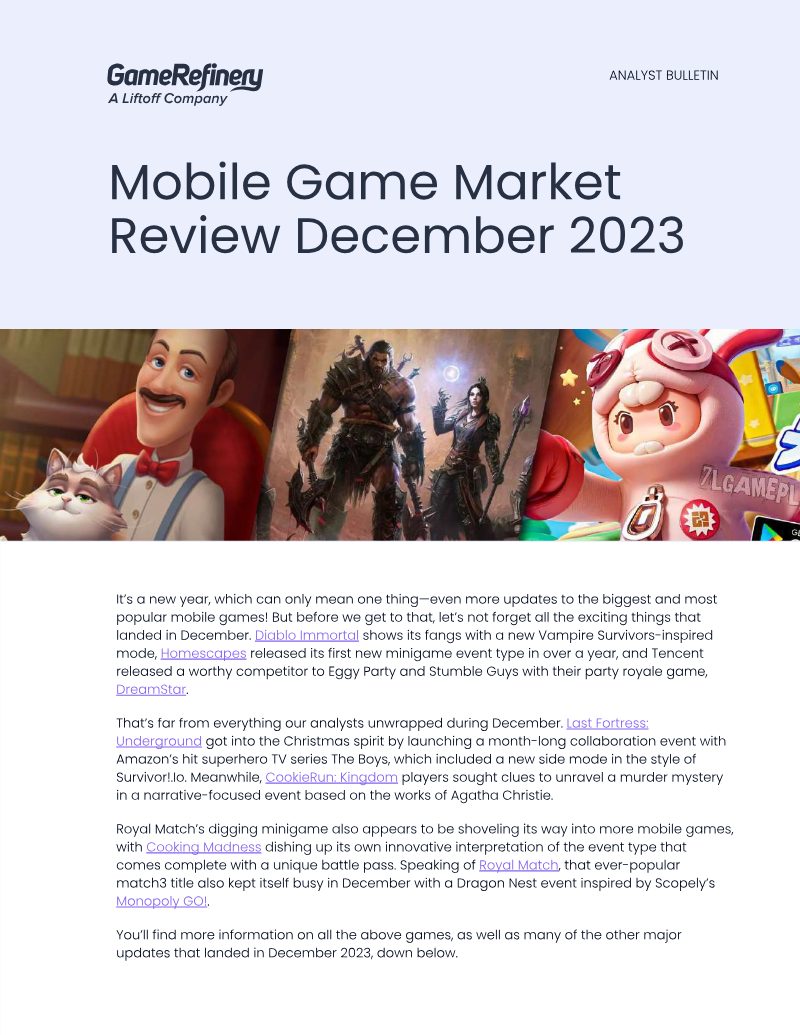
The mobile gaming market in December 2023 was characterized by aggressive experimentation with cross-genre mechanics and high-profile intellectual property collaborations. Analysts observed a significant trend of "genre-blending," where successful mechanics from market leaders were integrated into established titles. Notable examples include Royal Match adopting the cooperative partner event structure popularized by Monopoly GO!, and Diablo Immortal and Last Fortress: Underground introducing roguelite survival modes inspired by Vampire Survivors and Survivor.io.
In the casual segment, developers focused on deepening engagement through complex minigames. Homescapes introduced tycoon-style restoration events to its match-3 core, while Cooking Madness innovated by linking a digging minigame directly to battle pass progression. The midcore sector saw diverse narrative and social strategies, such as CookieRun: Kingdom’s Agatha Christie-inspired murder mystery and the launch of Tencent’s party royale title DreamStar in China. DreamStar quickly became a top-grossing competitor to Eggy Party by emphasizing social hubs and user-generated content.
Major updates to legacy titles yielded substantial financial results, particularly for Clash of Clans. The introduction of Town Hall 16, building-merging mechanics, and a new hero equipment system drove a 350% daily revenue spike in the United States. Geographically, the review highlights strong performance in the Chinese market for both domestic releases like DreamStar and localized versions of Western hits. Overall, the period demonstrated that mobile developers are increasingly looking beyond their own sub-genres to borrow proven engagement and monetization loops from the broader gaming ecosystem.
- Clash of Clans experienced a 350% daily revenue spike in the U.S. following the December 2023 release of Town Hall 16, new building-merging mechanics, and a hero equipment system.
- Mobile developers are increasingly adopting cross-genre mechanics, such as Royal Match integrating cooperative partner events and midcore titles like Diablo Immortal adding roguelite survival modes.
- Tencent’s new party royale title, DreamStar, emerged as a top-grossing competitor to Eggy Party in China by focusing on social hubs and user-generated content.
- Casual games are deepening engagement through complex minigames, exemplified by Homescapes adding tycoon-style restoration events and Cooking Madness linking digging minigames to battle pass progression.
- The mobile market in December 2023 was defined by a shift toward borrowing proven engagement and monetization loops from across the broader gaming ecosystem rather than remaining within traditional sub-genre silos.
+1
GameRefineryDec 2023
Report13 pages
Analyst Bulletin: Mobile Game Market Review November 2023
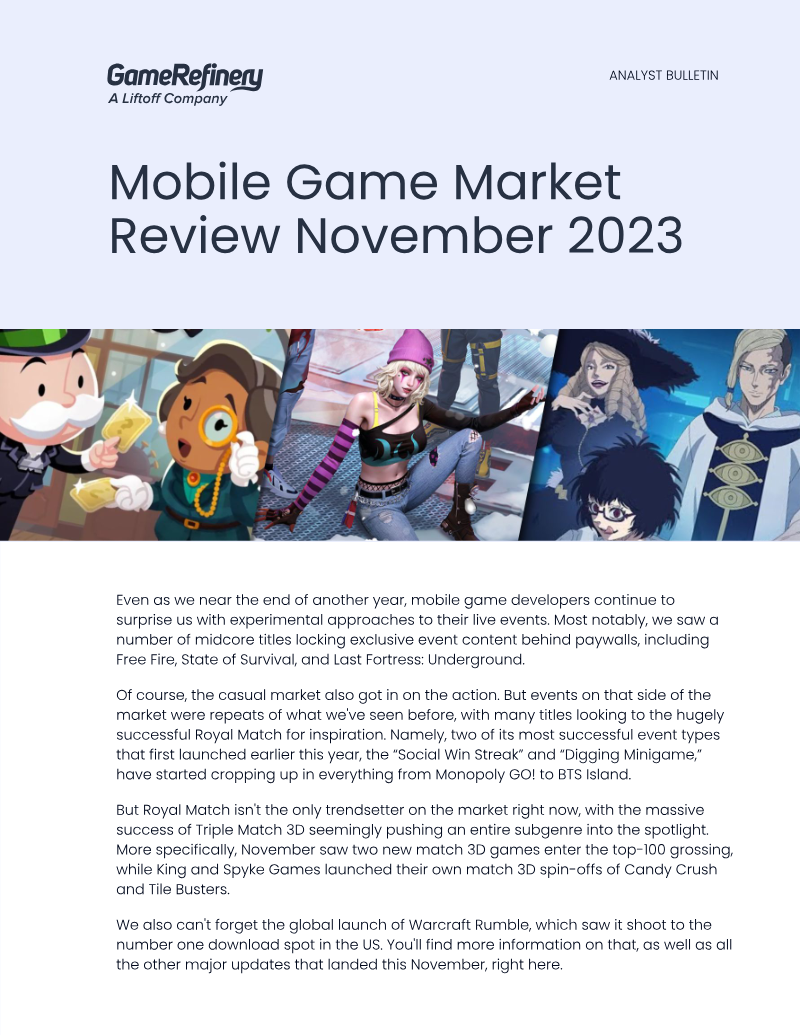
The mobile gaming market in November 2023 was characterized by the proliferation of specific event mechanics and the rise of the 3D match subgenre. Analysis of market leaders reveals that Royal Match has become a primary trendsetter for casual titles. Its "Social Win Streak" and "Digging Minigame" mechanics were widely adopted by competitors such as Monopoly GO!, Matchington Mansion, and BTS Island. Simultaneously, the success of Triple Match 3D spurred a wave of new entries in the 3D match category, including Match Factory and spin-offs from established franchises like Candy Crush.
A significant shift occurred in the midcore segment, where developers increasingly experimented with pay-gated event content. Titles such as Free Fire, State of Survival, and Last Fortress: Underground implemented exclusive rewards and gameplay modes accessible only through direct purchases or premium currency top-ups. This trend suggests a strategic move toward more aggressive monetization of live events, moving away from purely engagement-based models to those requiring financial entry points for participation.
Geographically, the US market saw major activity with the global launch of Warcraft Rumble, which achieved the top download spot and maintained a top-50 grossing position. In China, Soul Knight Prequel demonstrated the continued strength of the roguelite genre, reaching the top of the download charts. Other notable developments included the expansion of user-generated content via the Stumble Workshop in Stumble Guys and the rapid emergence of mobile clones inspired by the viral Nintendo Switch title, Suika Game. These findings indicate a highly reactive market where developers quickly iterate on successful mechanics and viral trends across both casual and midcore segments.
- Royal Match has emerged as the primary industry trendsetter, with competitors like Monopoly GO!, Matchington Mansion, and BTS Island adopting its 'Social Win Streak' and 'Digging Minigame' mechanics.
- Midcore titles including Free Fire, State of Survival, and Last Fortress: Underground are shifting toward aggressive monetization by pay-gating exclusive event content and gameplay modes.
- The 3D match subgenre is expanding rapidly following the success of Triple Match 3D, leading to new entries like Match Factory and 3D spin-offs of established franchises such as Candy Crush.
- Warcraft Rumble's global launch in November 2023 secured the top download spot in the US market while maintaining a top-50 grossing position.
- The roguelite genre remains highly competitive in China, evidenced by Soul Knight Prequel reaching the top of the download charts.
+1
GameRefineryNov 2023
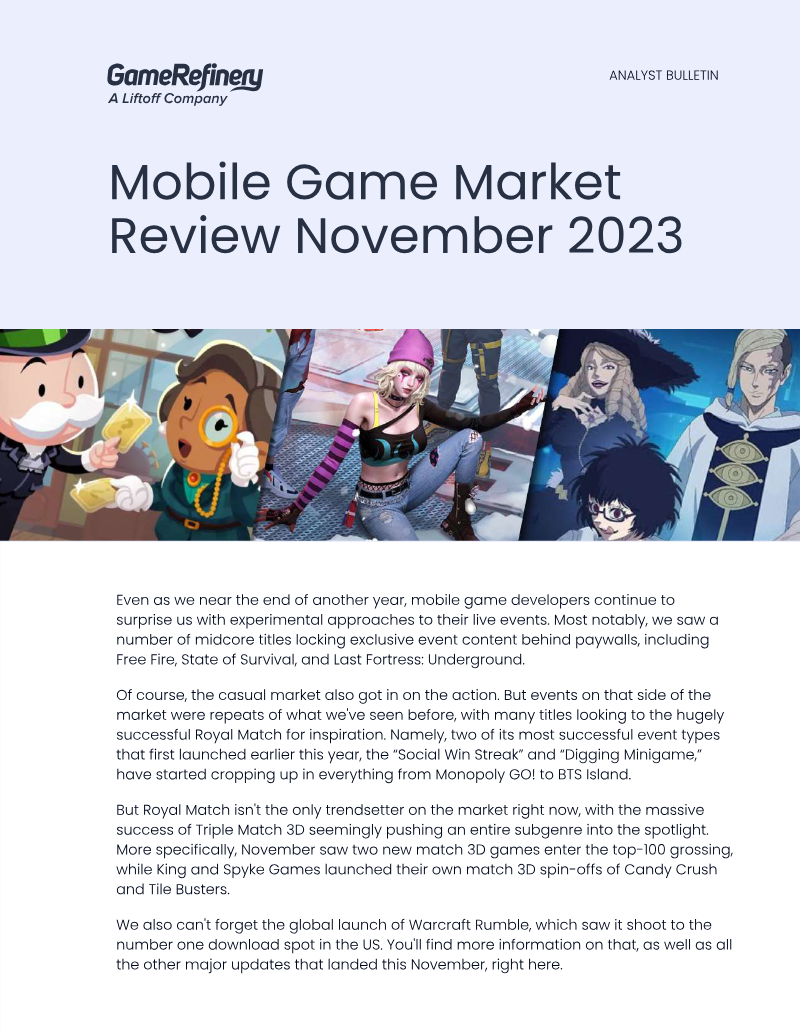
Report13 pages
Mobile Game Market Review: November 2023
This market review analyzes mobile gaming trends and performance for November 2023, focusing on the United States and Chinese markets. The analysis identifies a significant shift in monetization strategies within midcore titles, where developers are increasingly locking exclusive event content and story missions behind paywalls. Notable examples include Free Fire’s Luminous Pass and State of Survival’s Resident Evil collaboration, which required specific purchases or gacha mechanics to access core event gameplay.
In the casual segment, the industry is seeing a period of heavy mechanical imitation led by the success of Royal Match. Two specific event archetypes—the "Social Win Streak" (a battle royale-style level progression) and the "Digging Minigame" (a grid-based reward hunt)—have been widely adopted by major titles like Monopoly GO! and Matchington Mansion. Furthermore, the 3D match subgenre is expanding rapidly following the success of Triple Match 3D, with industry giants like King and Peak launching new competitors such as Candy Crush 3D and Match Factory.
The review also highlights the impact of viral trends and major intellectual properties. The "watermelon game" craze, sparked by the Nintendo Switch title Suika Game, led to a surge of mobile clones climbing the download charts. Meanwhile, high-profile launches like Warcraft Rumble and Black Clover M demonstrated the continued strength of established IPs, with both titles securing top-tier positions in US download and grossing ranks. Methodology for these findings includes data from live event trackers, download rankings, and revenue performance across major mobile app stores.
- Midcore mobile titles are increasingly gating core event gameplay and story missions behind paywalls, as seen in Free Fire’s Luminous Pass and State of Survival’s Resident Evil collaboration.
- The casual gaming sector is experiencing widespread mechanical imitation, specifically the adoption of 'Social Win Streak' and 'Digging Minigame' features by major titles like Monopoly GO! and Matchington Mansion.
- The 3D match subgenre is seeing rapid expansion and increased competition from industry leaders, with King and Peak launching Candy Crush 3D and Match Factory to challenge the success of Triple Match 3D.
- Established intellectual properties remain a primary driver of market performance, evidenced by the top-tier download and grossing rankings achieved by Warcraft Rumble and Black Clover M in the US.
- Viral trends continue to influence mobile download charts, most notably the surge of clones following the popularity of the Nintendo Switch title Suika Game.
+1
GameRefineryNov 2023