Digital Games
Company
Documents about Digital Games
Intentional and Accidental Tropes of Polish Heritage in Sienkiewicz-Themed Digital Games
This paper investigates the intentional and accidental incorporation of Polish national heritage tropes in digital games based on the works of Henryk Sienkiewicz, particularly his "Trilogy."
- The paper analyses how Polish national heritage is embedded in digital games adapted from Henryk Sienkiewicz's historical novels, combining Umberto Eco's tripartite model of intentionality with Stuart Hall's encoding-decoding framework.
- Its central questions are which national-heritage elements developers deliberately implement, which elements Polish-affiliated players feel must be explained to international audiences, and which tropes are treated as transparent or too obvious to mention.
- The corpus comprises four games tied to Sienkiewicz's Trilogy, set in the seventeenth-century Polish-Lithuanian Commonwealth: The Witcher 3: Hearts of Stone, Hellish Quart, Mount & Blade: With Fire & Sword, and the ironic 8-bit mini-game With Fire and Sword: Spiders within Observer.
The Inadvertent Construction of Leaders in Digital Games
This qualitative research project investigates how individuals, particularly women, non-gender individuals, and people of color, develop leadership skills and opportunities through their experiences in digital game organizations.
- Leadership in digital games is often inadvertent: many participants did not seek the role but were pushed into it through in-game performance or a predecessor's sudden departure, sometimes while concealing their gender from guild members.
- Most participants had already left their leadership roles by the time of interview, frequently citing burnout, after experiencing stress and being undercut by other members.
- The study is a qualitative project based on semi-structured interviews with 20 leaders (combining 2015–2023 interviews with 2024 follow-ups) across World of Warcraft, EVE Online, and Clash of Clans, analyzed through categorization analysis and grounded theory.
Differential Impact of the Positive and Negative Image of Digital Games on University Students' Computational Thinking
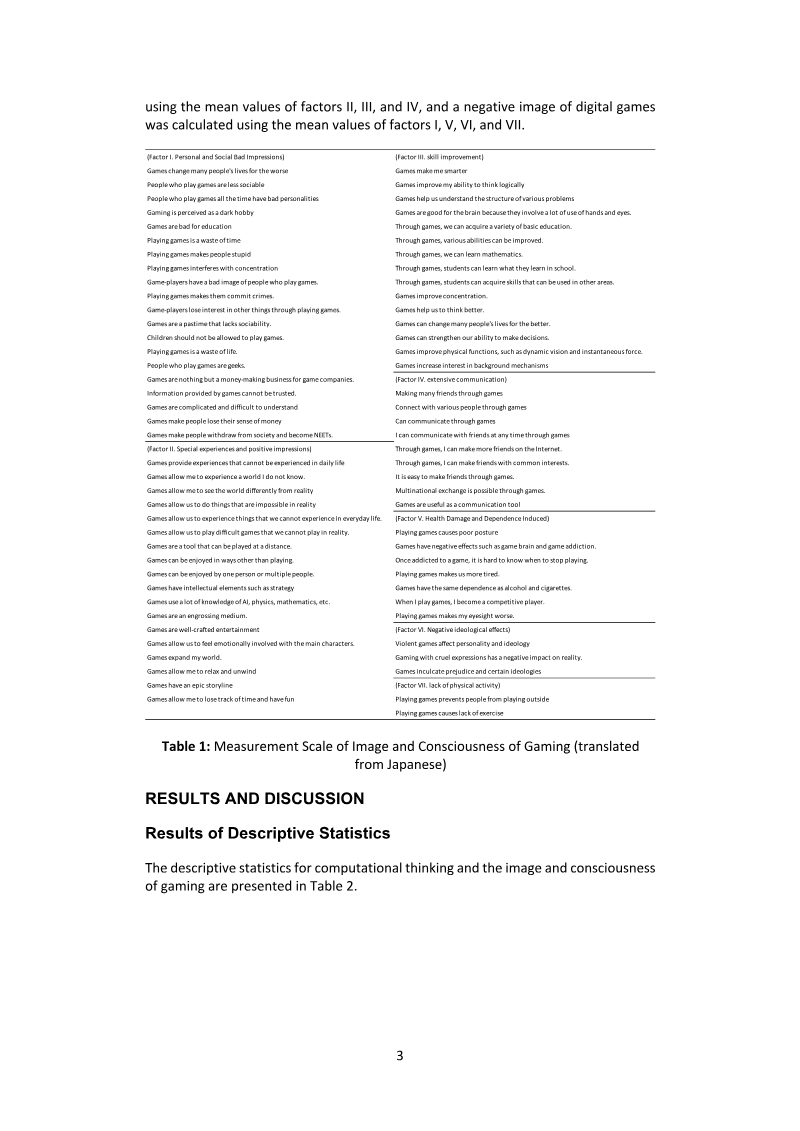
This study investigates the relationship between university students' perceptions of digital games and their computational thinking skills.
- Students in this Japanese university survey (158 valid responses, 146 men and 12 women) held relatively favorable views of digital games, scoring highest on special experiences and positive impressions (4.52) and lowest on personal and social bad impressions (2.42).
- Students who were split into four groups by positive and negative image scores differed significantly in creativity (F = 8.61, p < .01), with those holding both strong positive and negative images scoring higher than others.
- Those with stronger positive game images scored higher on creativity than those with weaker positive images, showing a link between favorable perceptions and creative computational thinking.
Salmon Grief in Sámi Digital Games
This analysis examines how Indigenous digital game creation in Northern Fennoscandia addresses the profound environmental and cultural impacts of declining salmon stocks on the Sámi people.
- Two small Sámi games, The Story of the Rainbow Salmon and The Rainbow Salmon Talks With Fish, were created in 2023 during Skins workshops in Ohcejohka/Utsjoki and are presented as spaces for expressing salmon grief (luossamoraš).
- The grief stems from the collapse of Atlantic salmon stocks on the Deatnu River, leading to a fishing ban from 2020 after the 2017 New Deatnu Agreement, which the authors characterize as settler colonialism following Kuokkanen's analysis.
- Sámi communities anticipated losses of up to 80% of their fishing rights under the New Deatnu Agreement, and the authors frame the resulting grief as cultural and identity-related rather than merely ecological.

New Law Will Change How Digital Games Are Sold: California
A new California law, AB 2426, will significantly alter how digital games and other digital goods are sold in the state, effective January 1.
- Starting January 1, 2025, California law AB 2426 prohibits digital retailers from using terms like 'buy' or 'purchase' for digital goods unless they provide a clear, conspicuous warning that the consumer is acquiring a potentially revocable license rather than permanent ownership.
- The legislation applies to any digital game sold with digital rights management (DRM), effectively covering nearly all titles sold through major digital marketplaces like Valve, Xbox, and PlayStation.
- Retailers failing to comply with the new disclosure requirements face potential fines of $2,500 per non-compliant listing and sale, in addition to potential violations of California’s Unfair Competition Law.
The Many Facets of Culture in Digital Games Policy: The EU Dimension
The document examines the European Union's evolving approach to digital games within its cultural policy framework, specifically through the lens of State aid rules.
- The European Commission now treats culture and economics as intertwined in State aid decisions under Article 107(3)(d) TFEU, framing State aid for games as a form of cultural policy rather than competition policy alone.
- The Commission's stance on digital games has shifted from excluding them in the 2013 Cinema Communication and requiring proof of market failure, to demanding demonstrable cultural value, and later to a more industrial, creative-cluster view.
- A 2006 French tax relief case questioned whether games qualified as cultural products at all, while national schemes in the UK, Denmark, Germany, Italy, Belgium, and Ireland were initially scrutinised for cultural value, often favouring artistic or educational titles.
The Ink Splotch Effect: A Case Study on ChatGPT as a Co-Creative Game Designer
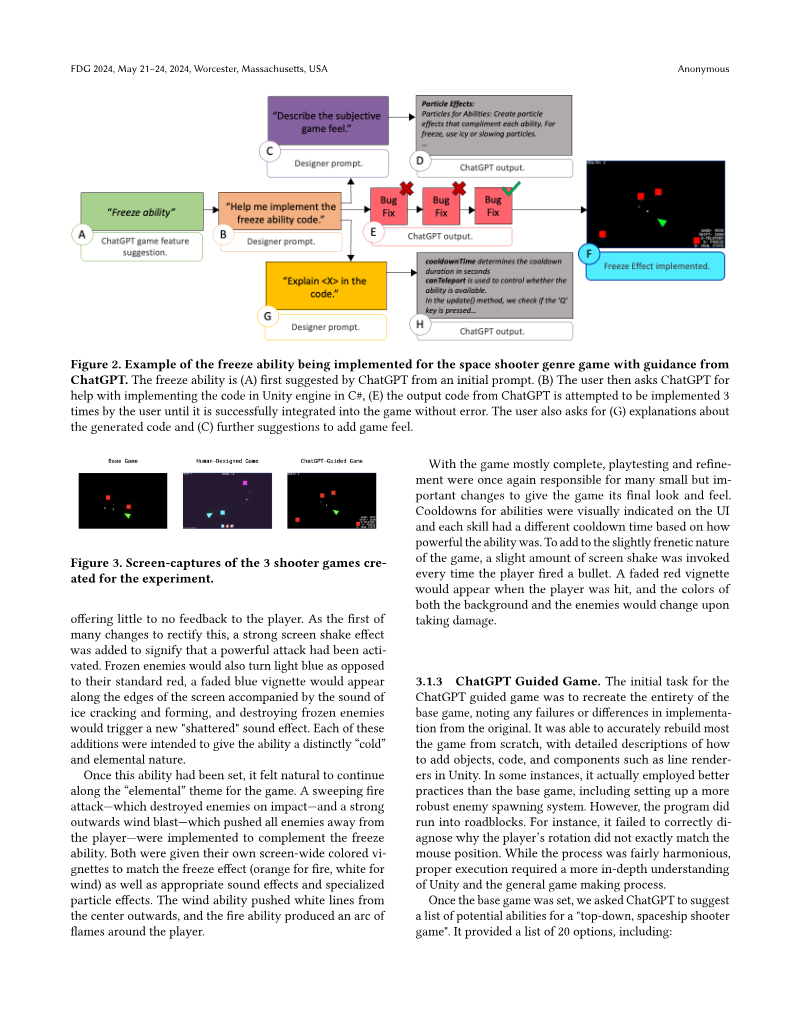
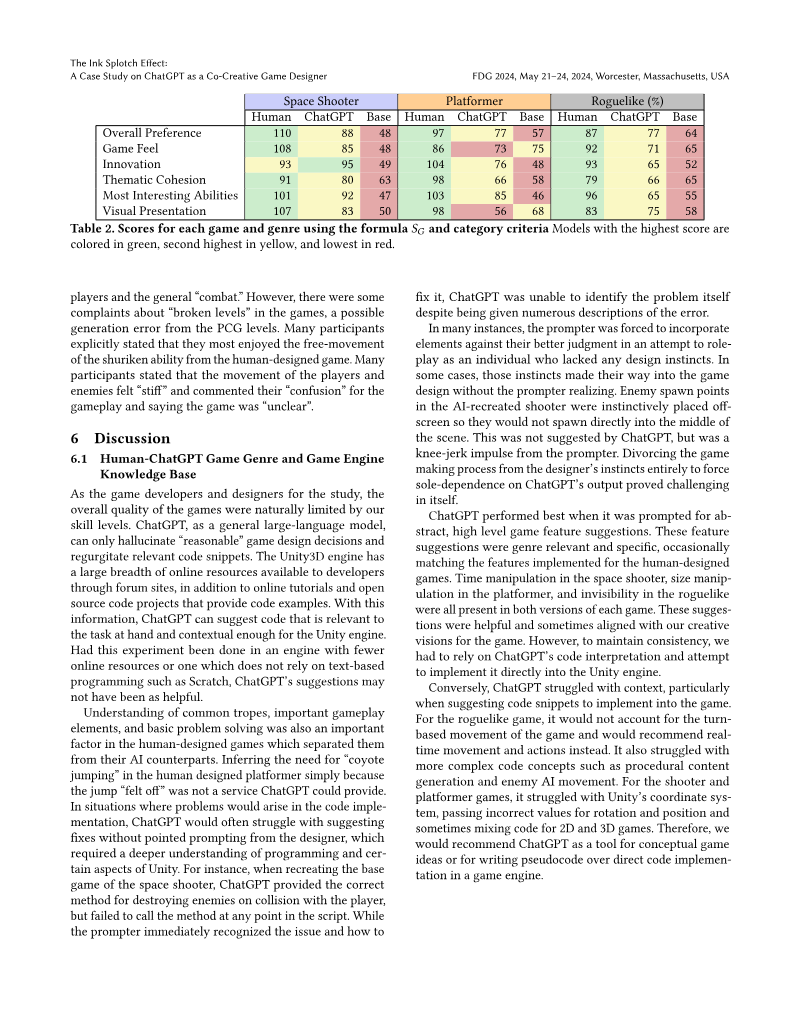
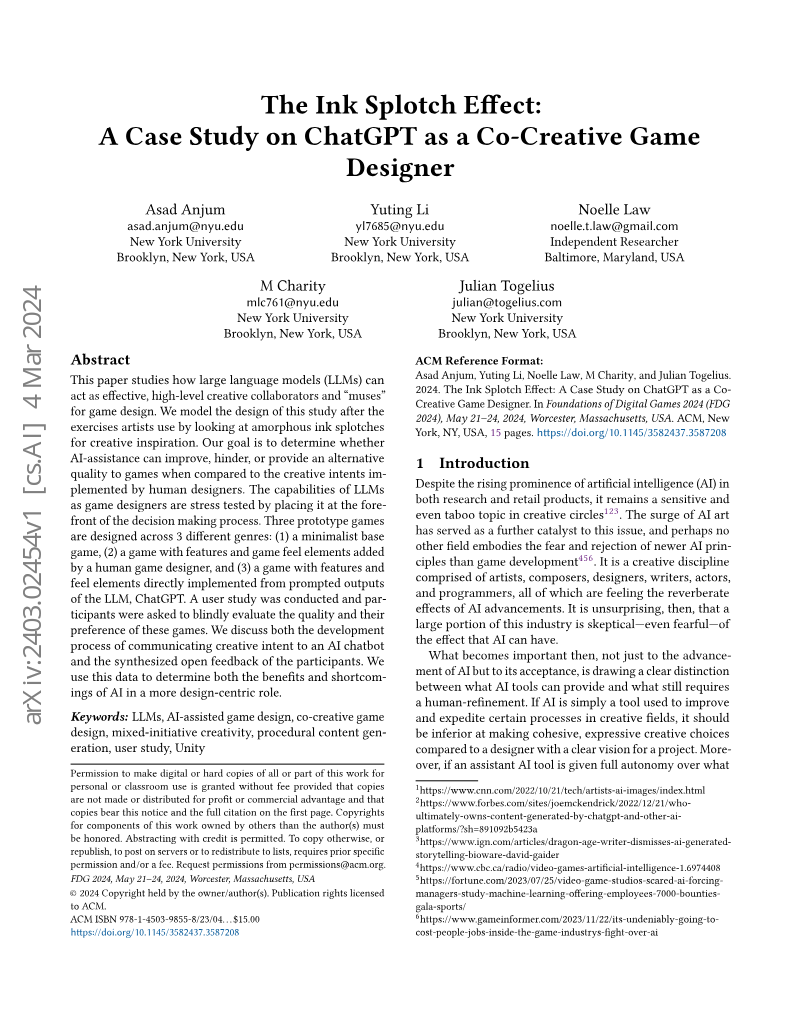
The Ink Splotch Effect is a 2024 Foundations of Digital Games paper by Asad Anjum, Yuting Li, Noelle Law, M Charity and Julian Togelius, studying whether ChatGPT (GPT-3.5) can act as a co-creative game designer.
- The authors state that ChatGPT performed best when prompted for abstract, high-level feature suggestions rather than direct code implementation.
- The authors report that participants almost consistently rated human-designed games higher than ChatGPT-suggested games, with both above the baseline in most categories.
- The authors report that ChatGPT could not recreate the turn-based roguelike base game and struggled with its procedural generation and enemy AI.

The Eyes, the Hands and the Brain: What can Text-to-Image Models Offer for Game Design and Visual Creativity?
The authors, Hongwei Zhou, Jichen Zhu, Michael Mateas and Noah Wardrip-Fruin of UC Santa Cruz and IT University of Copenhagen, present a theoretical analysis for the 2024 Foundations of Digital Games conference, aimed at informing games that foster critical literacy around text-to-image models such as DALL-E, Stable Diffusion…
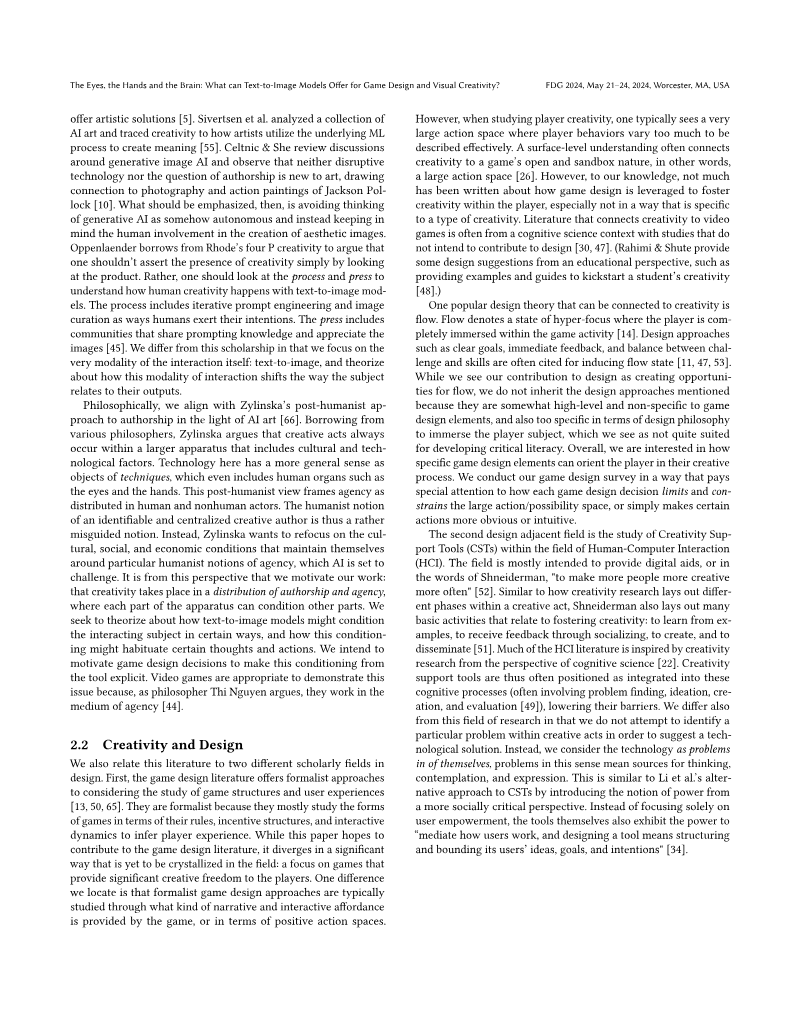
- The authors distinguish two ways of orienting players to visual creativity: seeing for visual communication, which works directly with color, shape and lines, and seeing for recognition, which text-to-image interfaces emphasize.
- The authors argue that text-to-image models habituate users toward seeing as recognition, partly because the author's intention must be explicitly inscribed through text.
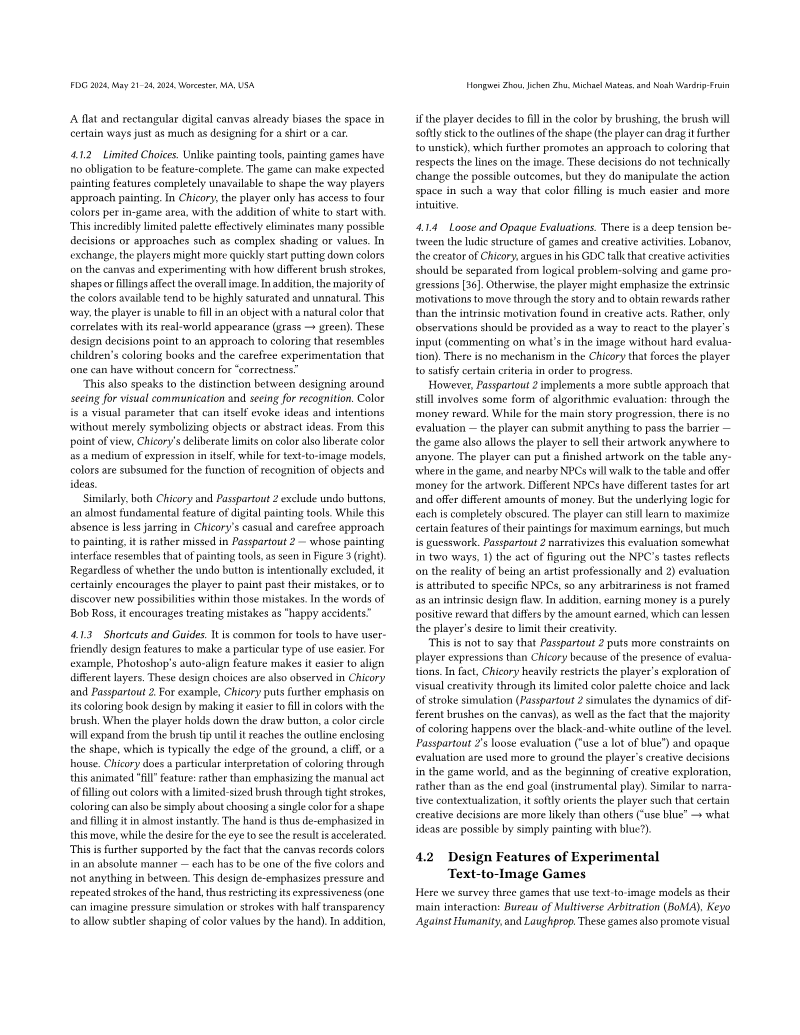
- Chicory limits players to four colors per in-game area, plus white, and its canvas records colors in an absolute manner, with each having to be one of five colors.
Permalife of the Archive: Archaeogaming as Queergaming
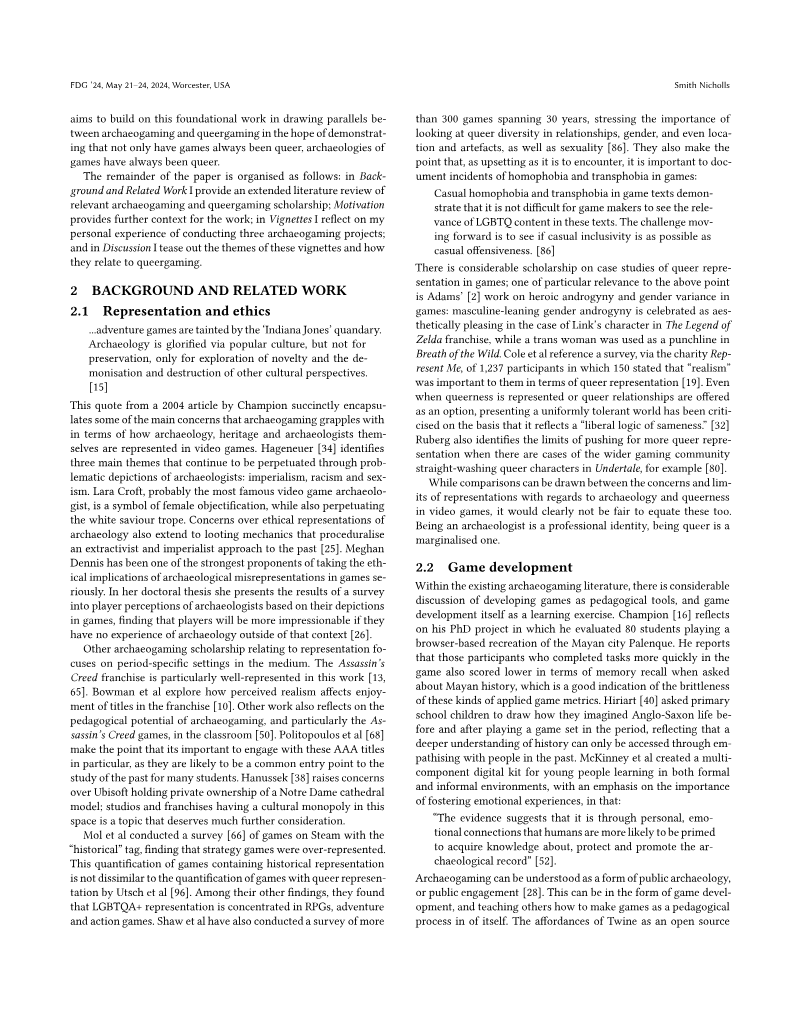
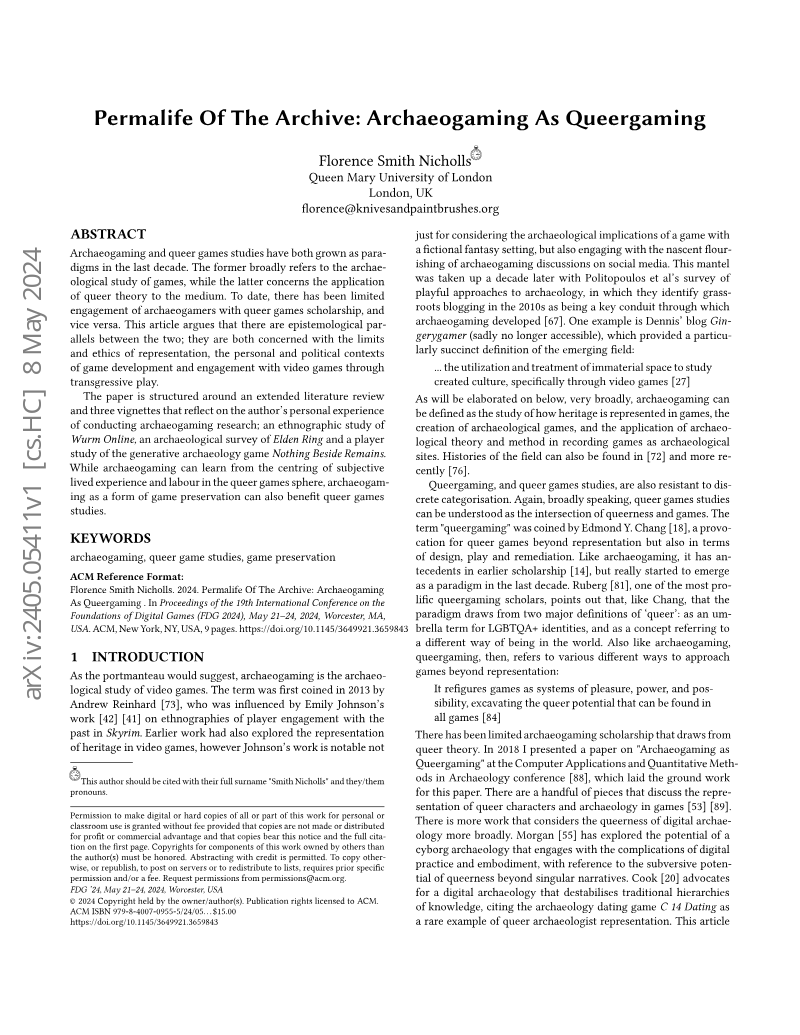
Florence Smith Nicholls, of Queen Mary University of London, presents a paper published for the 19th International Conference on the Foundations of Digital Games (FDG 2024) arguing that archaeogaming, the archaeological study of games, and queergaming, the application of queer theory to games, share epistemological parallels.
- The author argues that archaeogaming and queergaming both concern the limits and ethics of representation, and the personal and political contexts of game development.
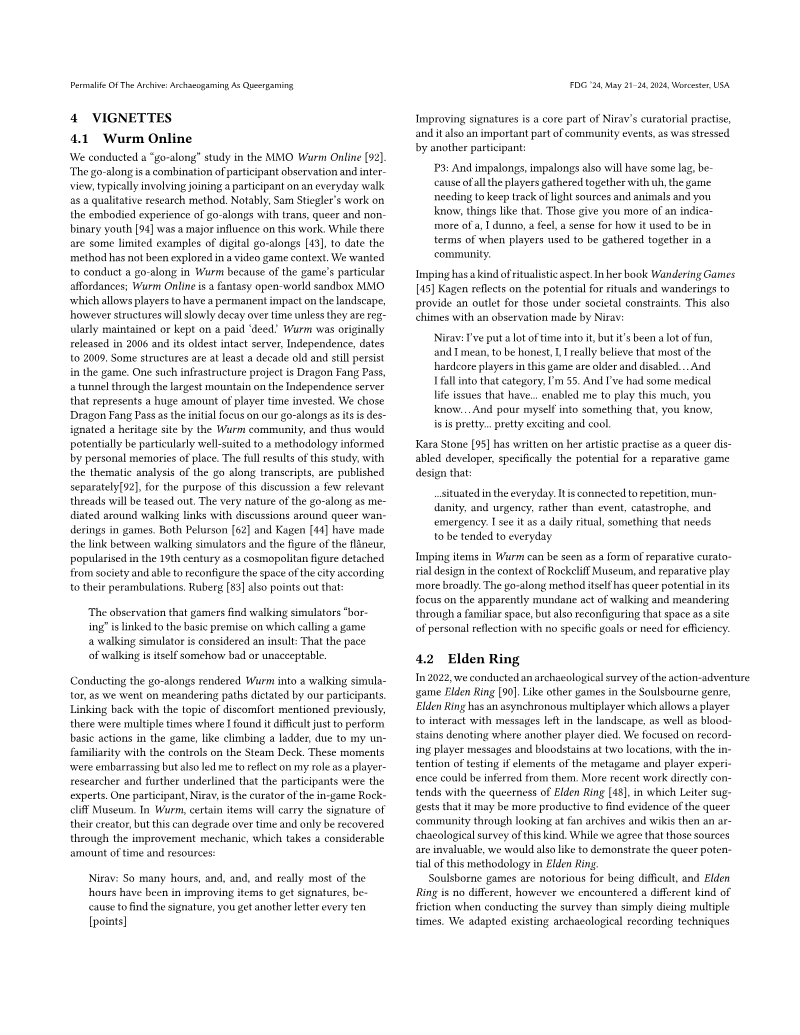
- The Wurm Online go-along study chose Dragon Fang Pass, a tunnel through the largest mountain on the Independence server that the Wurm community designates a heritage site, as its initial focus.
- In the Elden Ring survey, the author adapted analogue techniques, using the player character's foot as a unit of measurement to create scale base plans.
Motivation in Digital Games: The 28 Dimensions of Play
The study of digital game engagement has long suffered from fragmented research and overly simplistic player typologies that fail to capture the complexity of modern gaming experiences.
- A new meta-ethnographic analysis has synthesized 332 concepts into a standardized framework of 28 distinct dimensions of play to replace fragmented and simplistic player typologies.
- Existing industry models for player motivation are insufficient, currently accounting for less than 25% of the identified dimensions of engagement.
- The research identifies critical gaps in understanding player motivations within serious games, e-sports, and social media-integrated platforms.
Game On: Ireland's Digital Games Sector Gets Ready for Growth 2024
The document, "Game On: Ireland's Digital Games Sector Gets Ready for Growth 2024," asserts that Ireland's digital gaming sector is poised for significant expansion, driven by a new tax incentive and the presence of established industry players.
- Ireland's digital games sector is poised for growth, significantly bolstered by a new Digital Games Tax Credit, which many in the industry believe could replicate the success of the Section 481 relief for film and TV.
- Major international gaming companies like Black Shamrock, Riot Games (League of Legends), EA Games, and Demonware already have a significant presence in Ireland, with Black Shamrock planning to expand its Dublin studio to 200 people by 2022.
- The Digital Games Tax Credit offers a 32% tax credit on eligible expenditure, capped at €25 million per project, with StoryToys being the first company to successfully apply for and reinvest the credit.
FY2024 Report: Australian Game Development Survey
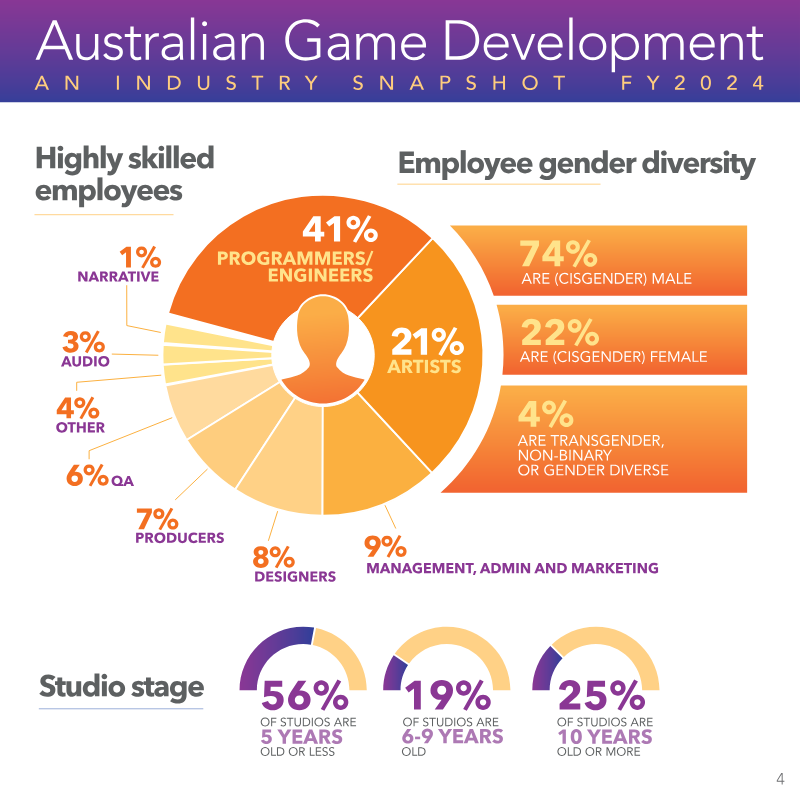
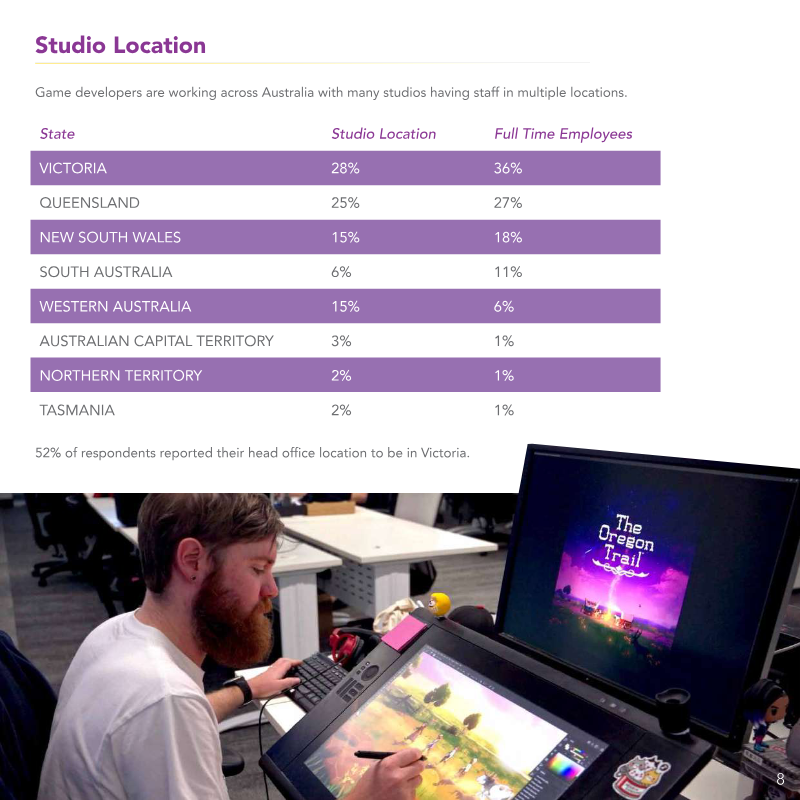
The FY2024 Australian Game Development Survey, the ninth annual edition from IGEA, offers a snapshot of the local industry's size, health and outlook for the financial year from 1 July 2023 to 30 June 2024.
- The Australian game development industry generated $339.1 million in revenue during FY2024, reflecting a minor 1.9% year-over-year decline despite global economic headwinds.
- The sector is highly export-focused, with 93% of total revenue derived from international markets and 85% of studios prioritizing the development of original intellectual property.
- Employment remains stable at 2,465 full-time equivalent workers, with 61% of studios planning to increase their headcount in the coming year.