Digital Games
Company
200 documents in the library are about Digital Games, from writers such as DiGRA, European Conference on Games Based Learning (ECGBL) and gamevironments. Each has a summary and key insights with the page they come from.
Connections
Each row is a game or company named alongside Digital Games, each column a document, oldest first. A mark means that document names it. Select a row to see those documents.
Key figures from the reports
Hasbro’s Wizards of the Coast and Digital Games segment generated $1.1 billion in revenue with a high operating margin of 41.8%.
SuperJoost, 2025 · Toys Transcending
Government support, including tax rebates and direct funding, is crucial, with 25% of studios accessing the Digital Games Tax Offset in FY2024 and nearly 40% intending to do so in the current financial year.
Interactive Games and Entertainment Association, 2024 · Australian Video Game Development Industry Stays Steady, Generating $339.1 Million for the Economy
Documents about Digital Games
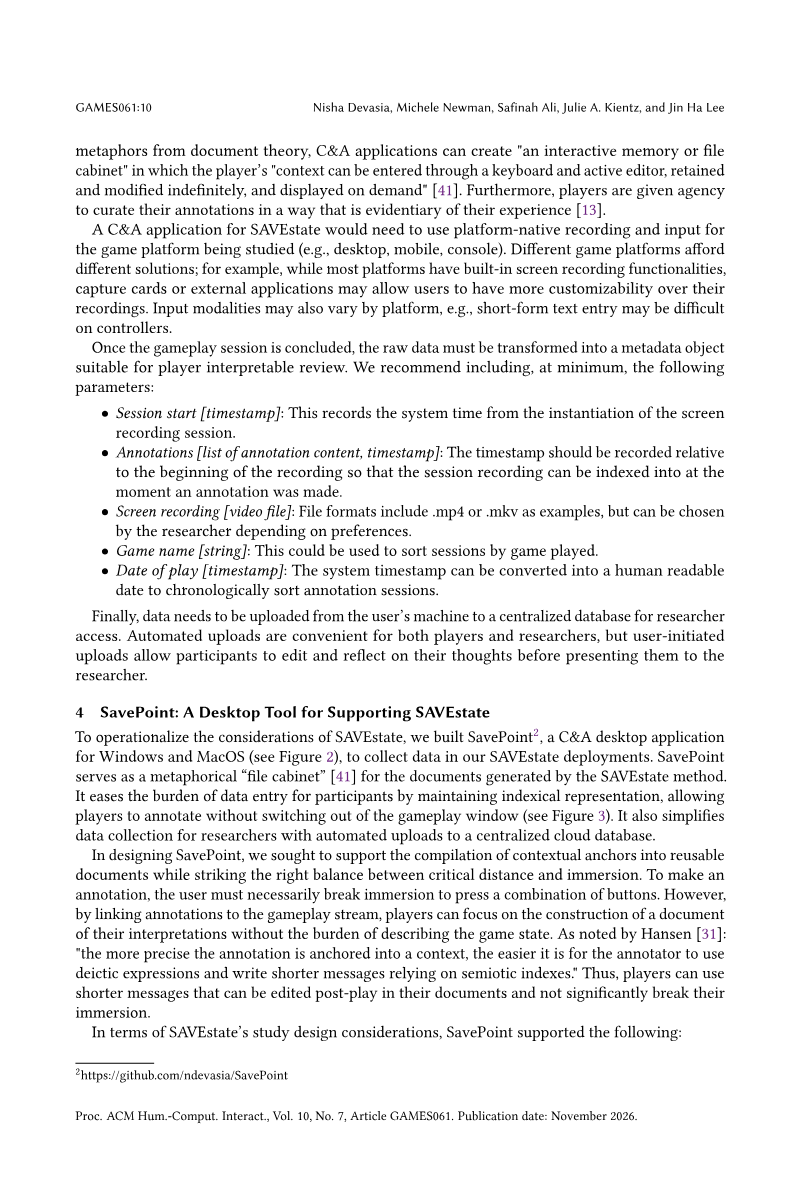
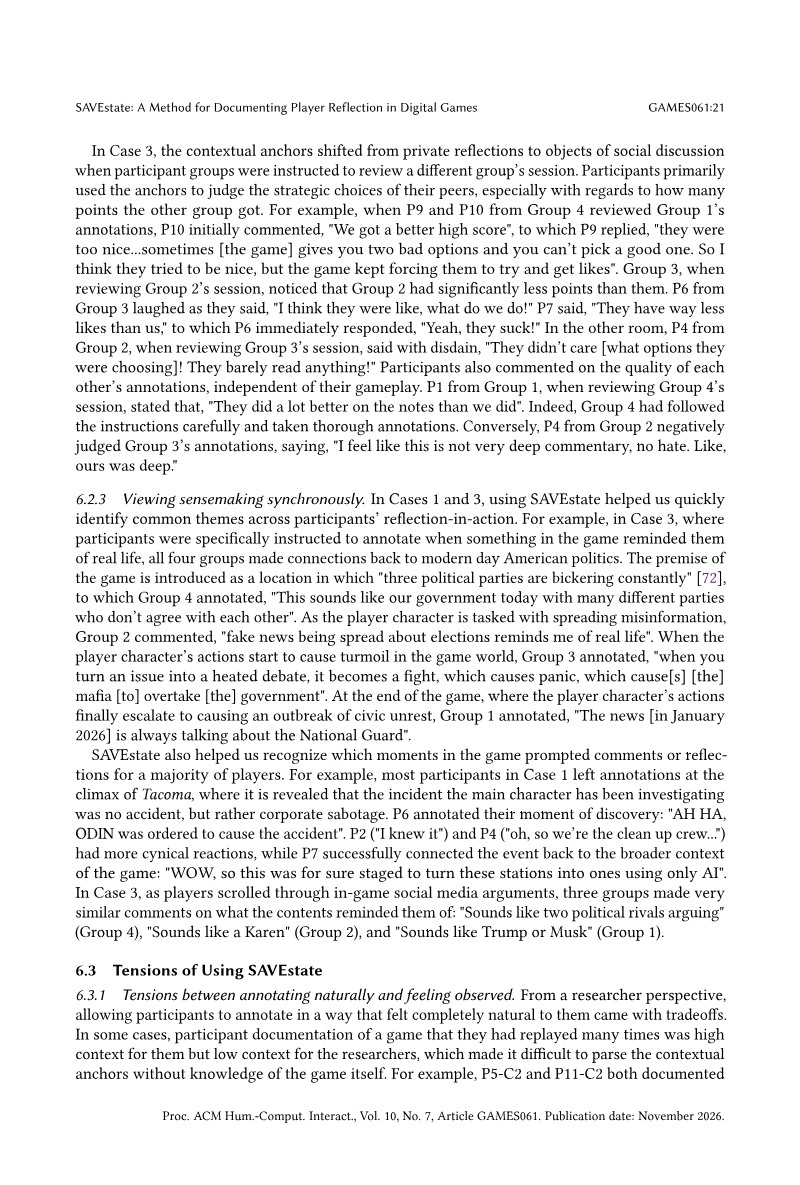
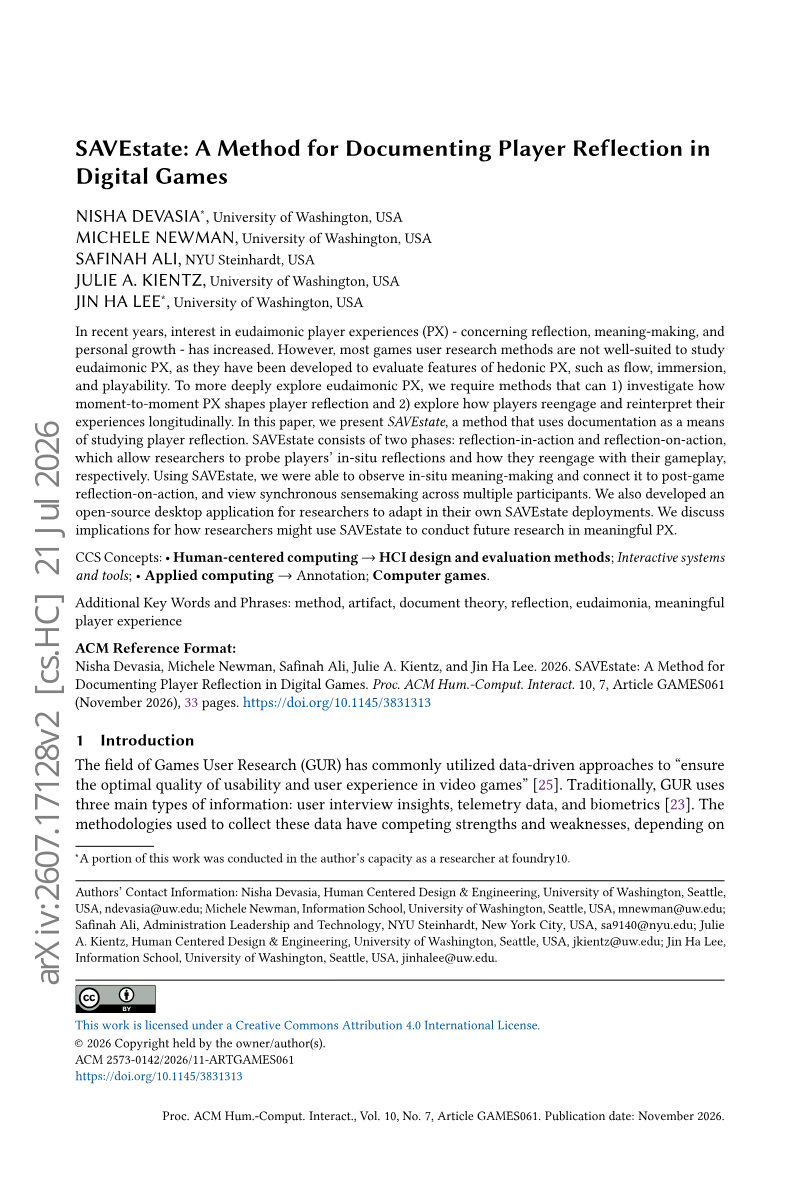
SAVEstate: A Method for Documenting Player Reflection in Digital Games
The SAVEstate method establishes a robust framework for capturing eudaimonic player experiences, shifting the focus of game user research from purely hedonic metrics toward the nuanced processes of reflection and meaning-making.
- The SAVEstate method utilizes the SavePoint desktop application to synchronize in-situ player annotations with gameplay recordings, allowing for the documentation of reflection-in-action and reflection-on-action.
- This framework shifts game user research from purely hedonic metrics toward eudaimonic experiences, focusing on how players construct meaning and significance within digital environments.
- By using contextual anchors linked to specific gameplay timestamps, the method categorizes player insights into functional types such as procedural signaling, memory aids, and traces of affect.
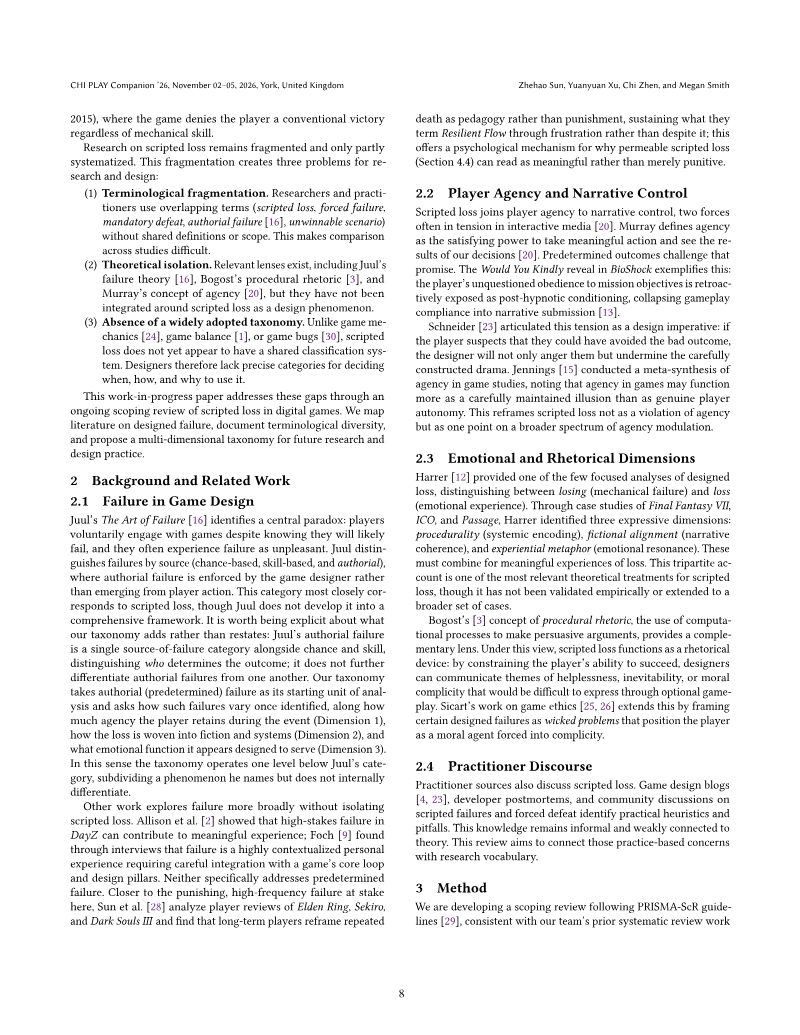
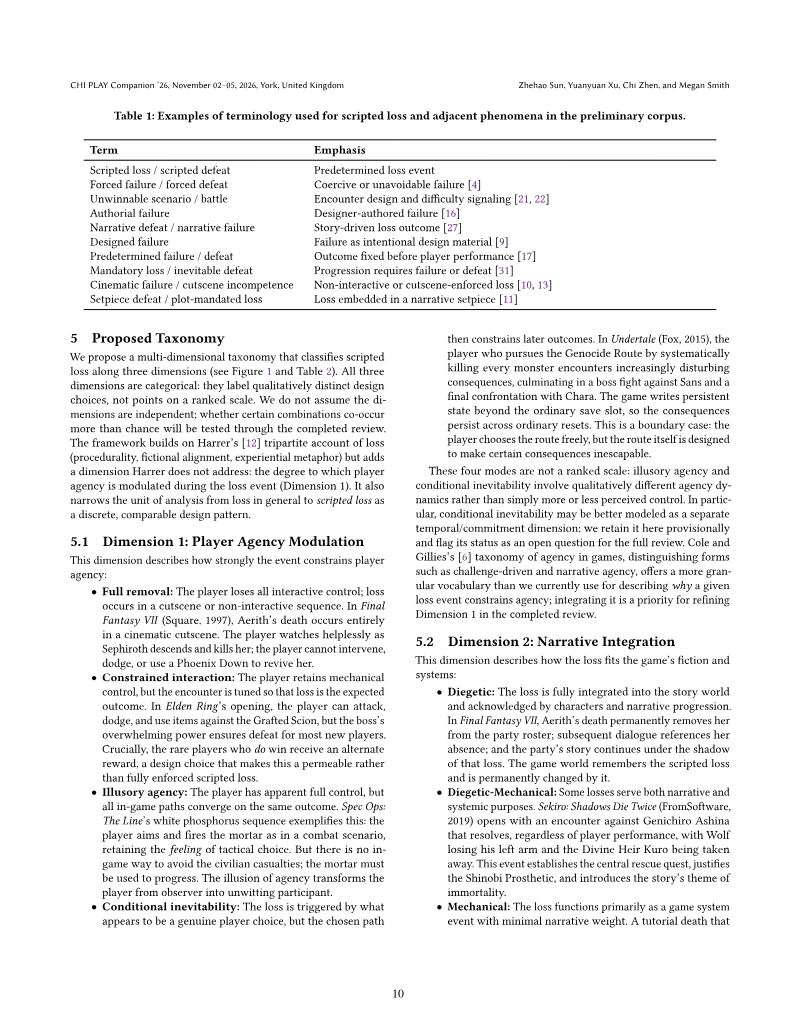
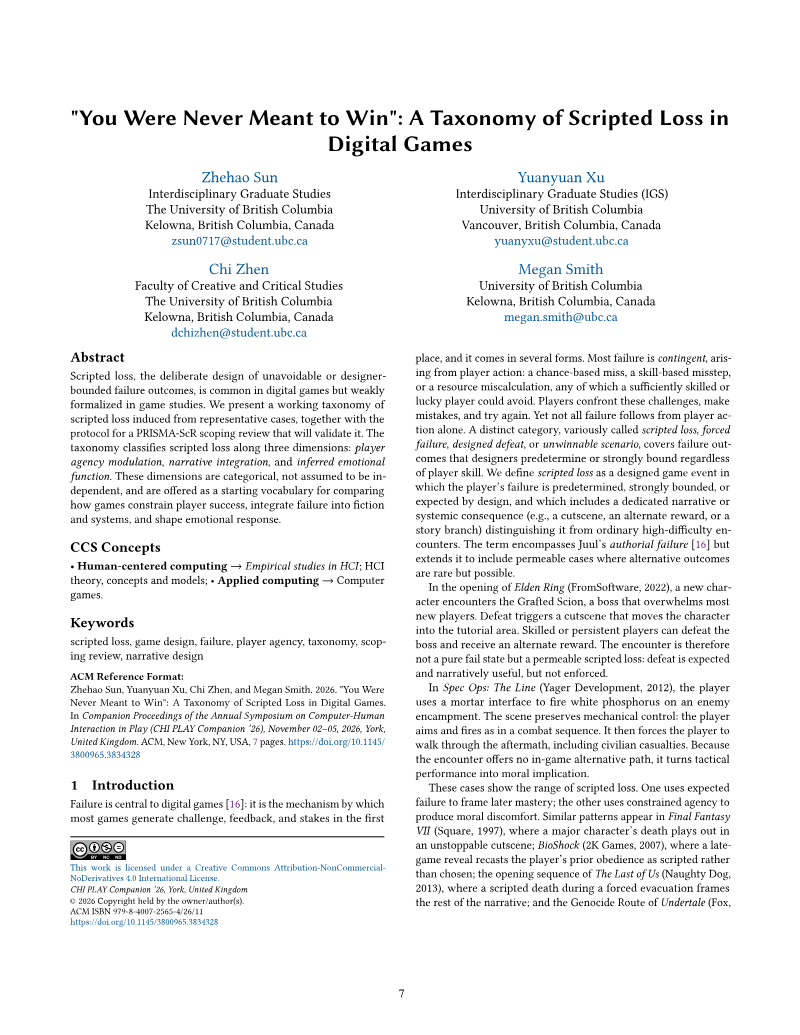
"You Were Never Meant to Win": A Taxonomy of Scripted Loss in Digital Games
"You Were Never Meant to Win": A Taxonomy of Scripted Loss in Zhehao Sun Yuanyuan Xu Interdisciplinary Graduate Studies Interdisciplinary Graduate Studies (IGS) The University of British Columbia University of British Columbia Kelowna, British Columbia, Canada Vancouver, British Columbia, Canada [email protected]…
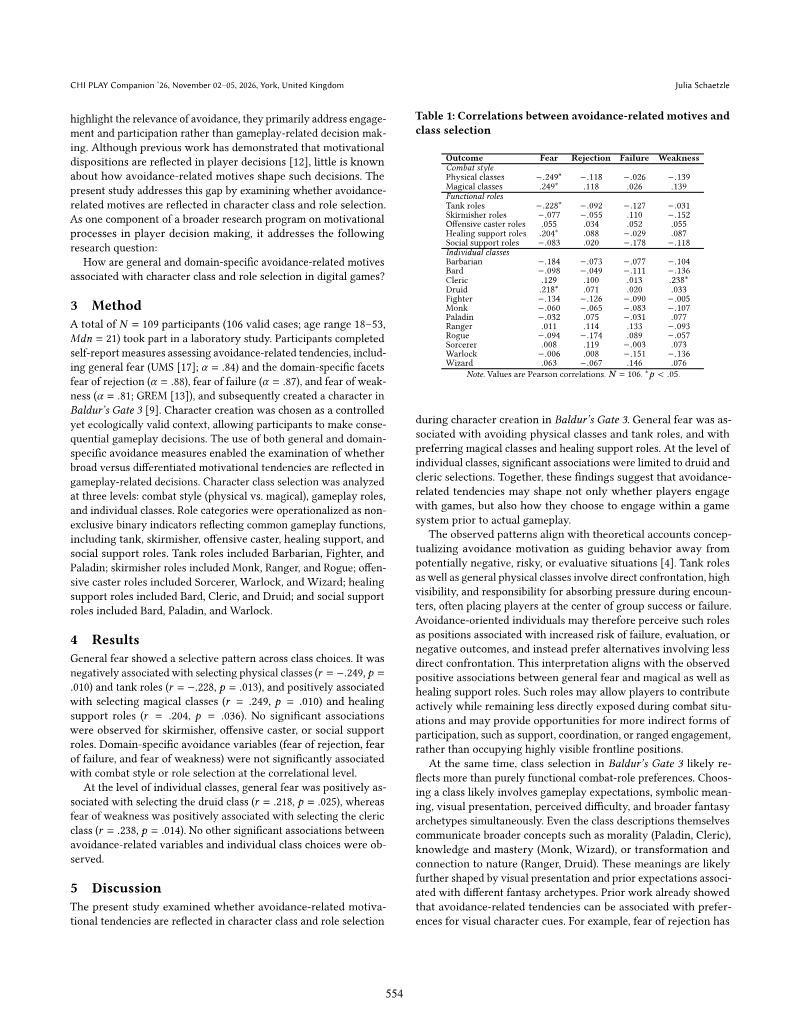
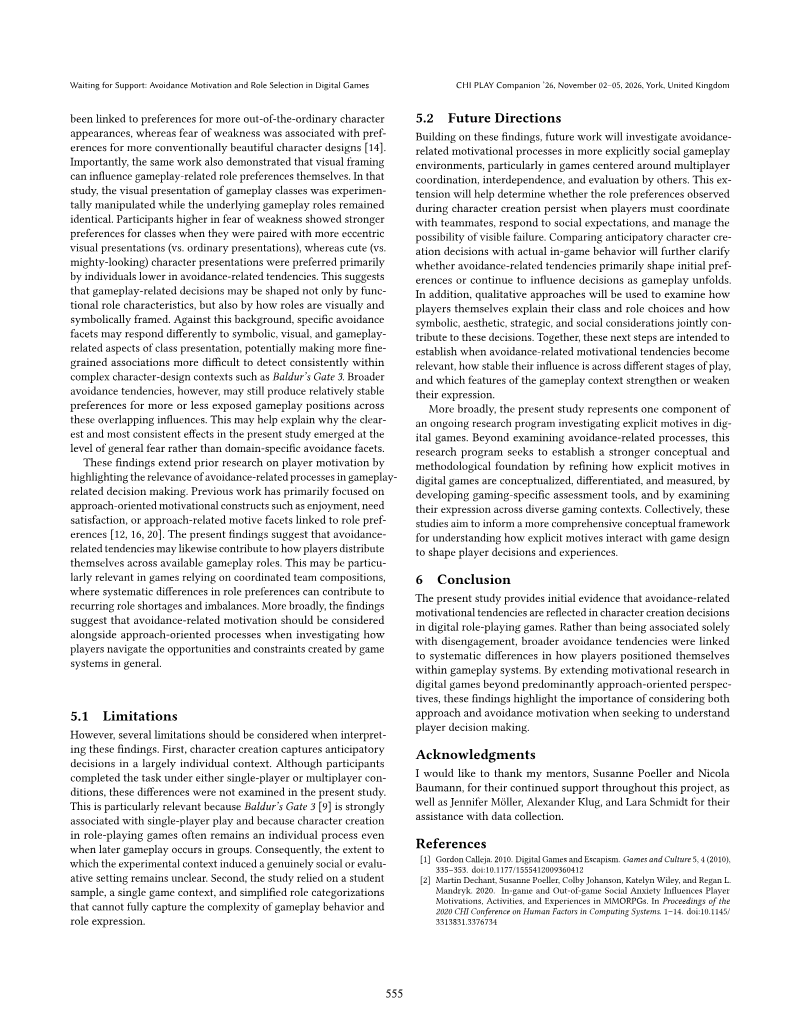
Waiting for Support: Avoidance Motivation and Role Selection in Digital Games
Waiting for Support: Avoidance Motivation and Role Selection in Digital Games Abstract success, as reflected in developer reports on role imbalances and Role selection in digital role-playing games requires players to posi- support shortages [7, 19].
- General fear is a significant predictor of role selection in RPGs, with higher levels of fear correlating with a reduced preference for physical classes and tank roles.
- Players with higher general fear scores are more likely to select magical classes and healing support roles, suggesting a preference for less direct combat exposure.
- In a study of 106 participants creating characters in Baldur's Gate 3, general fear showed a statistically significant negative correlation with tank roles (r = -.228) and a positive correlation with healing support roles (r = .204).

Irish Games Fund 2026
The Irish Games Fund 2026 announcement, published by IMIRT in September 2026, sets out the rules and timetable for the Development Fund, the first of three funding strands under the Irish Games Fund, which is delivered through the Screen Ireland Digital Games Portfolio.
- The Irish Games Fund 2026, managed by Screen Ireland's Digital Games Portfolio, offers three funding strands for game creators: a Development Fund, a Prototype Fund, and a new Release Fund.
- The Development Fund, the first to launch, provides up to €50,000 to a maximum of four teams for established projects moving towards production and commercial release.
- Eligible applicants for the Development Fund must be registered Irish game studios operating for at least one year, have filed accounts, and the studio or core team must have previously released a commercial project, focusing on original IP.
Integrating Digital Games and Digital Tourism: Exploring Consumers’ Awareness of Chinese Heritage
The integration of high-fidelity digital gaming and cultural heritage represents a transformative frontier for international tourism marketing and cross-cultural communication.
- High-fidelity digital twin technology in action role-playing games like Black Myth: Wukong effectively bridges the gap between virtual entertainment and physical heritage tourism.
- Immersive virtual environments significantly increase international player awareness, recognition, and recall of Chinese mythology, historical architecture, and traditional landmarks.
- Interactive engagement with meticulously rendered historical sites fosters a measurable increase in player curiosity and a subsequent desire to visit these locations in the physical world.

Facing Lawsuit, Sony Argues Digital Games Ownership
Sony is defending itself against a proposed class action lawsuit in California's Northern District Court by arguing that its current PlayStation Store disclosures are already clear enough that "reasonable consumers would not be misled" into believing they own the digital games they buy.
- Sony is defending a class-action lawsuit in California’s Northern District Court over whether its digital storefront adequately informs consumers that purchases are limited licenses rather than permanent ownership.
- The litigation centers on a 2025 California law that mandates clear and conspicuous warnings for digital transactions, which plaintiffs claim Sony failed to provide.
- In an August 2026 court filing, Sony argued that its existing checkout process, which links to its Terms of Service and Software Product Licensing Agreement, provides sufficient notice to a reasonable consumer.

Germany’s Gaming for Democracy Push: VGIM Daily, 28/08/2026
Germany's Foundation for Digital Games Culture, created by the country's games industry and the Bundestag, has launched Gaming for Democracy, an initiative to strengthen democratic values in gaming communities.
- The Foundation for Digital Games Culture has launched the 'Gaming for Democracy' initiative to counter extremist influence in gaming spaces ahead of the 2029 German general election.
- A core component of the project is a Community Support Network that provides resources and best practices for over 100 community moderators to foster inclusive environments.
- Research from the Bertelsmann Foundation indicates that frequent gamers exhibit higher levels of political engagement than the general population, justifying the focus on gaming as a 'third place' for civic discourse.
Reaganoludography: The 1980s Japanese Digital Games in the Service of the United States
Reaganoludography defines the strategic alignment of 1980s Japanese video games with the neoconservative cultural agenda of the United States.
- During the 1980s, Japanese game developers adapted their content to align with American neoconservative values to successfully export products to the U.S. market following the 1982 industry crash.
- The term 'Reaganoludography' describes how Japanese games were modified or selected to mirror the themes of 1980s American action cinema, such as the hyper-masculine, one-man-army tropes found in films like Rambo.
- Nintendo of America enforced strict censorship policies on imported titles, including a 'No Religion' mandate that prohibited symbols related to religious, nationalistic, or ethnic groups.



Modernities of Authenticity in Recreated Online Digital Games: A Comparative Case Study
This paper examines how nostalgic game recreations construct authenticity, using a comparative case study of two projects that attempt to restore earlier versions of online games: World of Warcraft Classic, a recreation of the 2006 "Vanilla" version of World of Warcraft, and Team Fortress 2 Classified, a community-developed mod…
- The paper compares two nostalgic game recreations: World of Warcraft Classic, a recreation of the 2006 'Vanilla' version of World of Warcraft, and Team Fortress 2 Classified, a community-developed mod re-imagining Team Fortress 2's 2008–2009 era.
- It reframes the question from whether restorations are accurate to how different philosophies of authenticity, drawn from postmodern and post-postmodern perspectives, shape nostalgic design and play.
- World of Warcraft Classic is described as a 'genuine fake' operating through postmodern hyperreality, built on players' subjective memories and sentimental myth rather than strict fidelity, including quality-of-life updates and reimplemented historical bugs.



Playable Folklore: Digital Games and the Representation of Folklore and Cultural Heritage
This paper examines how digital games represent folklore and cultural heritage, arguing that the translation of living, variable cultural processes into codified, rule-based systems introduces structural and ethical tensions.
- Translating living, variable folklore into codified, rule-based game systems creates structural and ethical tensions, chiefly that tradition becomes stabilised as 'heritage' when it is managed or staged for external consumption.
- The paper proposes 'playable folklore' as a lens that treats games not as display cases for heritage but as cultural systems in which traditions are selected, stabilised, transformed, and contested.
- Its theoretical framework rests on four concepts: cultural presence, folk mechanics, digital folklore, and mnemonic hegemony.
The Relationship Between Signs and Context: Semiotic Meaning-Making in Digital Games
This paper examines how players interpret signs in digital games, arguing that meaning arises from the relationship between a sign, the thing it seems to refer to, and the player's interpretive activity rather than from the symbol alone.
- Meaning in digital games arises from the relationship between a sign, what it seems to refer to, and the player's interpretive activity, not from the symbol alone.
- The paper proposes a two-variable model crossing symbol familiarity (conventional or unconventional) with context familiarity (conventional or unconventional), yielding four distinct interpretive situations.
- Conventional symbols in conventional contexts give immediately legible meaning because denotation and genre convention align, while conventional symbols in surreal contexts shift attention toward connotation, atmosphere, and reflection.
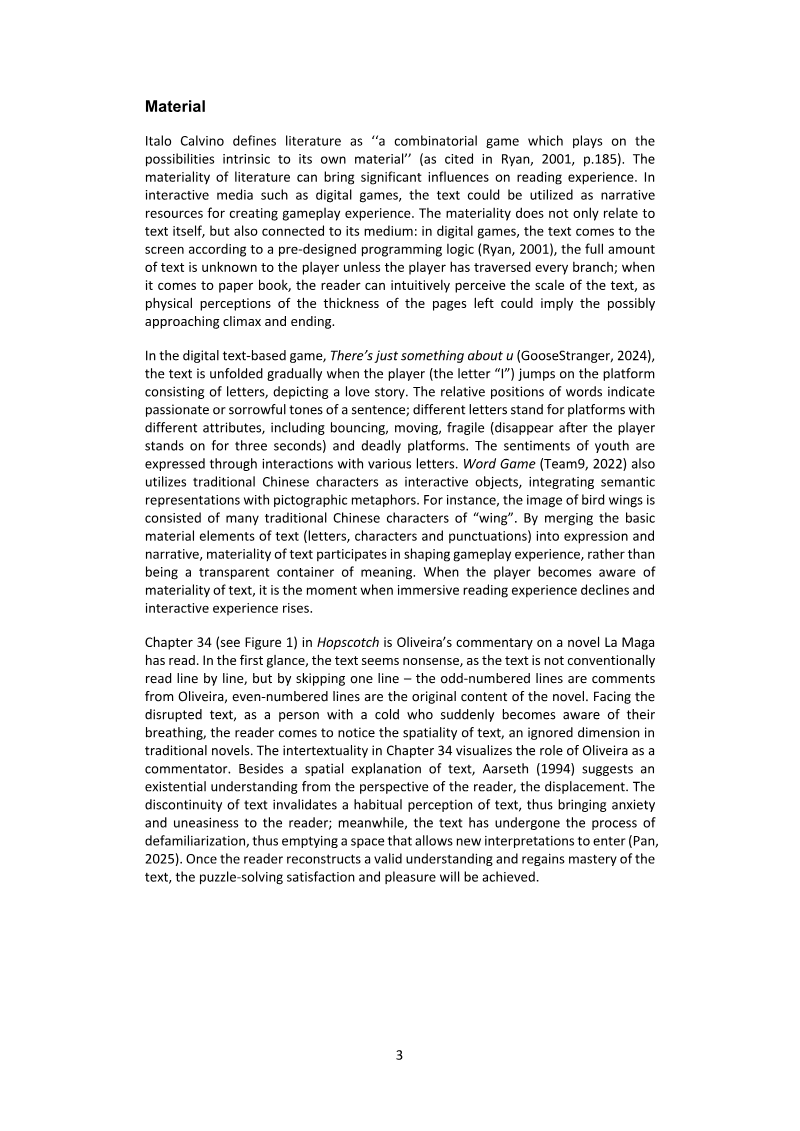
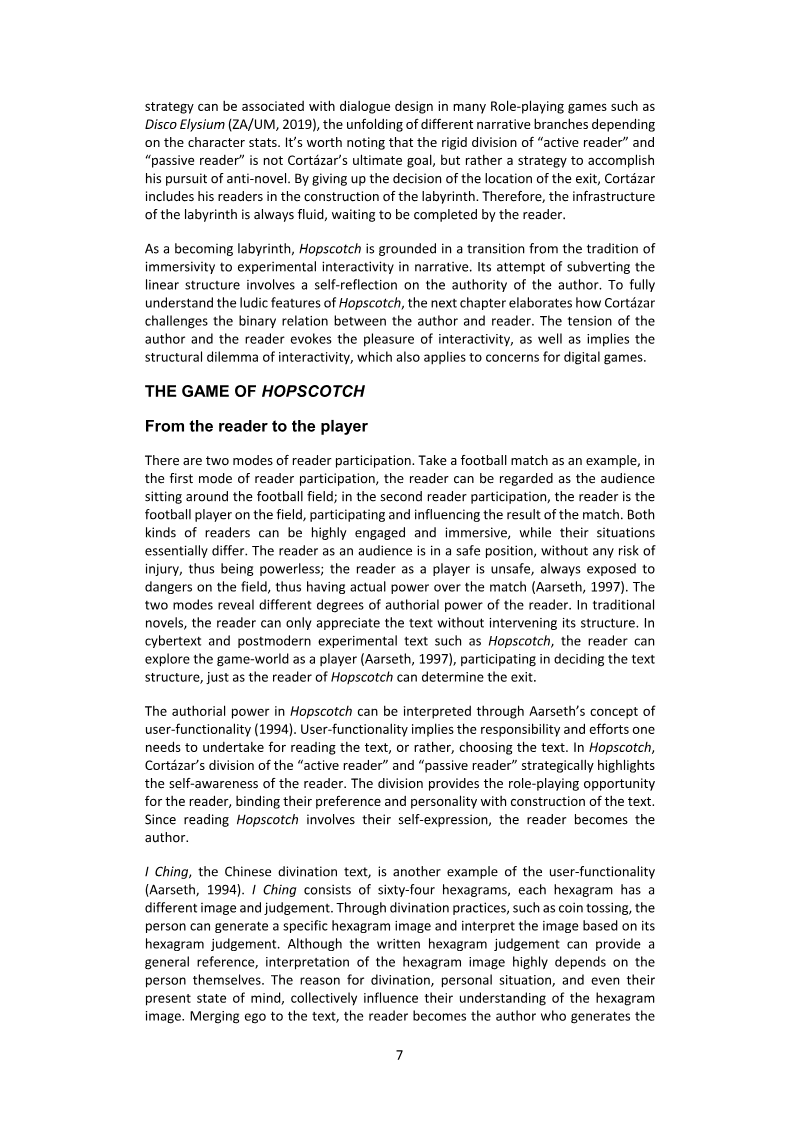
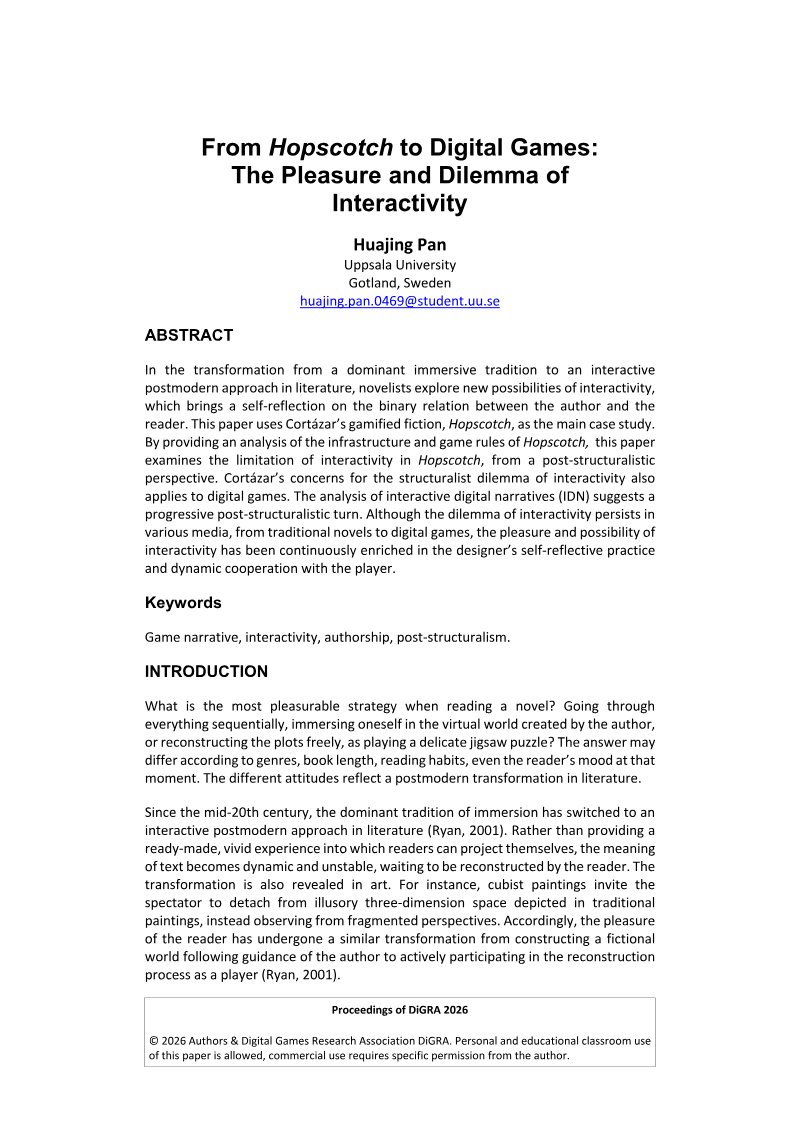
From Hopscotch to Digital Games: The Pleasure and Dilemma of Interactivity
The document, "From Hopscotch to Digital Games: The Pleasure and Dilemma of Interactivity," examines the evolution and inherent challenges of interactive experiences, using Julio Cortázar's novel Hopscotch as a foundational case study and extending its analysis to digital games.
- The paper's central thesis is that interactivity creates both pleasure and a structural dilemma: authorial power is genuinely redistributed to readers and players, but only within bounds, generating lasting anxiety for novelists and designers about how authorship should be shared.
- Pan treats this author-reader tension not as a failure to be resolved but as a productive condition that refines interactive design over time.
- Using Julio Cortázar's Hopscotch as its primary case, the paper examines its three-part structure of 155 chapters offering multiple reading paths, and frames the shift from reader-as-audience to reader-as-player as the novel's defining innovation.