
Report14 pages
Medium-Term Vision: Our Growth Strategy in the We-Time Economy
The We-Time Economy serves as the central strategic framework for future growth, predicated on the belief that artificial intelligence will increase leisure time and heighten the value of shared, trust-based human experiences. By facilitating social interaction through digital platforms and services, the organization aims to capture a significant portion of a global market estimated at US$10–15 trillion. The core thesis posits that shared emotional experiences—ranging from social betting and sports entertainment to family-oriented digital products—create high-retention, high-profitability ecosystems that rely on word-of-mouth growth and community engagement.
Financial targets for the medium term include doubling net sales to 300 billion yen, with a specific focus on scaling the sports and lifestyle segments. To achieve these objectives, the company is implementing a rigorous business portfolio management strategy. This involves classifying business units based on growth potential and profitability relative to a 6.18% weighted average cost of capital. Resources are dynamically allocated to high-growth areas, while underperforming units are subject to restructuring or divestment. Key growth drivers include the global expansion of social betting through PointsBet, the scaling of the FamilyAlbum economic sphere, and the continued monetization of domestic intellectual property like MONSTER STRIKE.
Operational efficiency and shareholder value are prioritized through a commitment to raising the EBITDA margin to 20% and the return on equity (ROE) to 15%. Governance reforms, including the appointment of independent directors to lead compensation committees and the alignment of executive incentives with long-term performance, support these financial goals. The company has also committed to a more robust shareholder return policy, targeting a 40% dividend payout ratio to reflect its transition into a sustained profit growth phase.
- The company aims to double net sales to 300 billion yen by focusing on the 'We-Time Economy,' a strategy targeting a global market estimated at US$10–15 trillion.
- Financial performance targets include achieving a 20% EBITDA margin and a 15% return on equity (ROE).
- Capital allocation is governed by a strict portfolio management strategy that evaluates business units against a 6.18% weighted average cost of capital, leading to the restructuring or divestment of underperforming assets.
- Key growth drivers include the global expansion of social betting via PointsBet, the scaling of the FamilyAlbum ecosystem, and the continued monetization of the MONSTER STRIKE intellectual property.
- The company has established a new shareholder return policy targeting a 40% dividend payout ratio to reflect its transition into a phase of sustained profit growth.
mixi

Report41 pages
Mobile App Trends 2026: Japan Edition
The Japanese mobile application market maintains a robust, iOS-dominant trajectory, characterized by a 4% year-over-year increase in total installs during the first half of 2026. This growth is underpinned by a maturing digital ecosystem where mobile integration has become deeply embedded in daily life. Legislative shifts, specifically the Mobile Software Competition Act, are actively reshaping the landscape by incentivizing developers to diversify their distribution and payment strategies, thereby fostering a more competitive and sustainable environment for long-term growth.
Financial and gaming sectors serve as the primary catalysts for this expansion. Stock trading applications have experienced a 90% surge in installs, bolstered by the participation of younger investors and the influence of tax-advantaged programs like NISA. Simultaneously, gaming engagement has intensified, highlighted by a 113% increase in card game sessions. These sectors are not only attracting new users but are also achieving higher retention rates and longer session durations, indicating that users are increasingly comfortable managing complex financial and recreational activities through mobile interfaces.
The entertainment sector continues to evolve through cross-media synergy, particularly between anime, manga, and short-form content. While OTT streaming services recorded a 15% revenue increase in 2025 and maintain high engagement levels with average session lengths exceeding 36 minutes, the digital manga industry is pivoting toward low-friction content models to better capture younger demographics. Based on aggregated data from January 2024 through May 2026, these trends suggest that success in the Japanese market now requires a strategic focus on high-frequency engagement and the ability to adapt to shifting regulatory and consumer preferences.
- The Japanese mobile market saw a 4% year-over-year increase in total installs during the first half of 2026, maintaining a robust, iOS-dominant trajectory.
- Stock trading applications surged by 90% in installs, driven by younger investors and the influence of tax-advantaged programs like NISA.
- Gaming engagement has intensified significantly, evidenced by a 113% increase in card game sessions and improved user retention rates.
- The Mobile Software Competition Act is actively forcing developers to diversify their distribution and payment strategies to comply with a more competitive regulatory landscape.
- OTT streaming services achieved a 15% revenue increase in 2025, with average user session lengths now exceeding 36 minutes.
+2
Adjust

Report5 pages
East vs. West: Monetization Trends
The study examines how mobile gaming spending patterns differ between Eastern and Western markets, focusing on frequency of purchases, average spend per transaction, and motivational drivers. Findings reveal that Eastern gamers purchase in‑app items more often than Western players; 35 % of East spend frequently versus 36 % in the West, with a higher proportion of occasional and rare spenders in the West. When it comes to transaction size, Eastern users tend to pay more per purchase: 76 % spend over $10 compared with only 42 % of Western users, while a smaller share of East spend under $5 (30 %) versus 8 % in the West. Motivational analysis shows that Western gamers prioritize value and bundles, whereas Eastern players are more attracted to exclusivity, limited‑time items, new offers, and character acquisition. The research covers key markets in Asia—Korea and Japan—and Western regions including the United States, United Kingdom, and broader Europe. Data were collected through a survey of mobile gamers across these regions, with sample sizes sufficient to compare spending behaviors and motivations. The report concludes that monetization strategies should be tailored regionally: value‑based bundles may resonate better in the West, while exclusive content and limited editions could drive higher spend in Eastern markets.
- Eastern mobile gamers demonstrate a significantly higher propensity for large transactions, with 76% of purchases exceeding $10 compared to only 42% in Western markets.
- Western mobile gamers are more likely to make small-scale purchases, with 8% of spenders in the West opting for transactions under $5, contrasted with 30% in the East.
- Monetization strategies in the West should prioritize value-based bundles, as these resonate more effectively with the purchasing preferences of Western players.
- Eastern markets, specifically Korea and Japan, show a stronger consumer preference for exclusivity, limited-time offers, and character acquisition.
- Purchase frequency remains relatively balanced across regions, with 35% of Eastern gamers and 36% of Western gamers identified as frequent spenders.
+5
Mistplay
Report6 pages
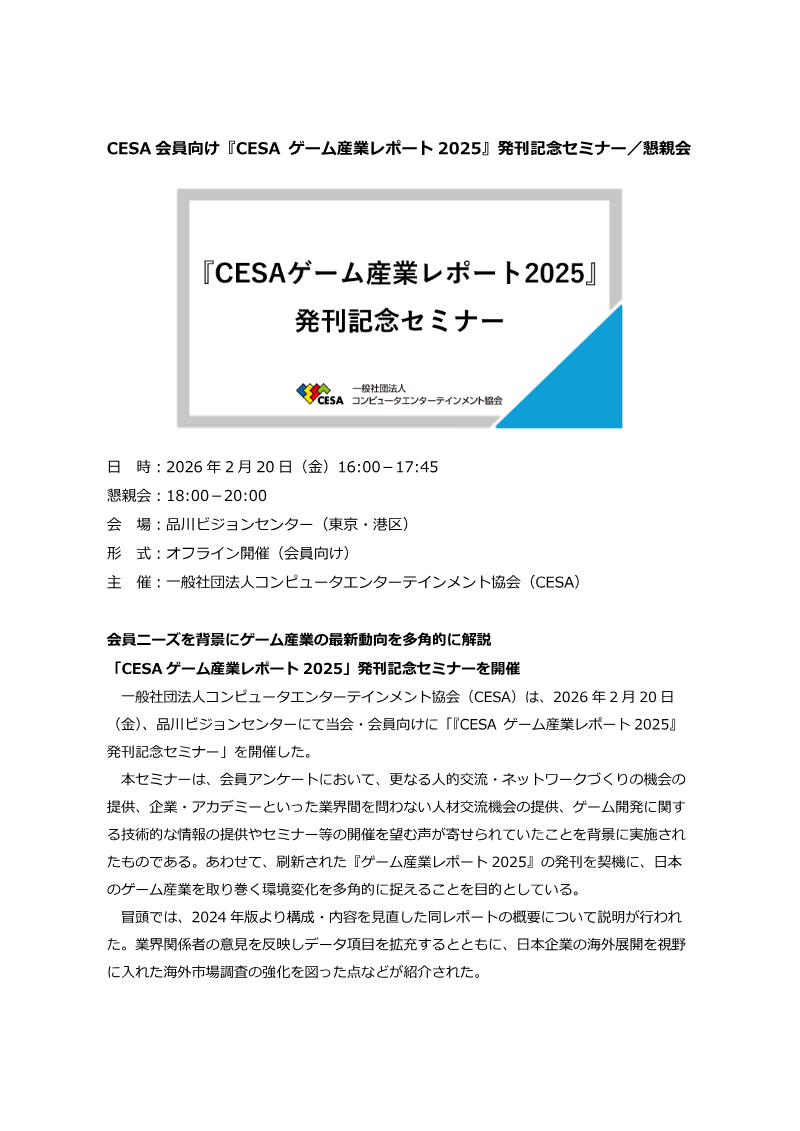
CESA Game Industry Report 2025: Launch Seminar Report
The CESA Game Industry Report 2025 Launch Seminar, held in Tokyo on February 20, 2026, served as a platform to analyze the evolving landscape of the Japanese gaming sector. The event introduced the updated 2025 industry report, which features expanded data sets and enhanced international market research to better support the global expansion of Japanese firms. The seminar aimed to address industry needs for technical knowledge sharing, talent development, and cross-sector networking among corporate and academic stakeholders.
Key findings highlight a significant shift toward the integration of generative AI, with approximately half of domestic game companies now utilizing these tools within their development pipelines. While internal production workflows show high adoption rates, industry experts noted a more cautious approach regarding AI-generated content visible to end-users. Legal discussions emphasized the importance of navigating copyright frameworks, specifically distinguishing between AI learning and generation phases, while balancing innovation with intellectual property risks.
Government representatives from the Ministry of Economy, Trade and Industry and the Agency for Cultural Affairs outlined strategic support for the content industry, targeting 20 trillion yen in overseas sales by 2033. Policy initiatives focus on multi-year funding, tax incentives, and robust talent development programs to ensure long-term competitiveness. Furthermore, legal experts underscored the increasing complexity of global regulatory environments, noting that Japanese companies must proactively manage diverse international requirements regarding data privacy, monetization, and rating systems. By synthesizing perspectives from government, legal, and development sectors, the seminar emphasized that strategic investment and regulatory compliance are essential for the sustainable growth of Japan’s gaming industry in a globalized market.
- The Japanese government has set a strategic target to reach 20 trillion yen in overseas content industry sales by 2033.
- Approximately 50% of domestic game companies have integrated generative AI into their internal development pipelines.
- Industry adoption of generative AI remains bifurcated, with high usage in production workflows but a cautious, risk-averse approach toward AI-generated content delivered to end-users.
- Legal frameworks are currently prioritizing the distinction between AI learning and generation phases to mitigate intellectual property risks while fostering innovation.
- Government policy initiatives to support industry competitiveness include multi-year funding, tax incentives, and dedicated talent development programs.
CESA – Computer Entertainment Supplier's Association

Report2 pages
Game no Yakusoku Communication Book
The evolution of gaming from localized, offline experiences to global, interconnected online environments necessitates a modern approach to parental guidance and family communication. The primary purpose of this guide is to bridge the generational gap between parents and children by providing a framework for establishing mutually agreed-upon rules for safe and responsible gaming. It emphasizes that while the technology and accessibility of games have shifted from television-bound consoles to ubiquitous mobile and cross-platform devices, the fundamental need for trust and clear boundaries remains constant.
The analysis highlights significant shifts in the gaming landscape, noting that modern play is no longer restricted by age, geography, or hardware limitations. Because online environments allow for real-time interaction with diverse global participants, the risks and social dynamics have become more complex. To address this, the guide advocates for a collaborative rule-setting process that prioritizes the child’s developmental stage and specific gaming context. Effective agreements should be flexible, evolving alongside the child’s maturity, and should be rooted in open dialogue rather than rigid, top-down restrictions that may fail to account for the realities of online events or social gaming commitments.
Furthermore, the guide underscores the importance of digital literacy for parents, encouraging them to familiarize themselves with common gaming terminology and technical concepts such as in-app purchases, server stability, and online etiquette. By understanding these elements, parents can provide more informed advice regarding security, privacy, and behavior. Ultimately, the document concludes that gaming rules should function as a shared commitment to safety and mutual respect, ensuring that the gaming experience remains a positive and secure activity for children as they navigate increasingly sophisticated digital worlds.
- Modern gaming requires a shift from rigid, top-down restrictions to a collaborative rule-setting process that evolves alongside a child’s developmental maturity.
- The transition from localized, offline play to global, interconnected online environments has increased the complexity of social dynamics and safety risks for children.
- Effective family gaming agreements must be flexible enough to account for the realities of real-time online events and social gaming commitments.
- Parents should prioritize digital literacy by familiarizing themselves with technical concepts such as in-app purchases, server stability, and online etiquette to provide informed guidance.
- Establishing trust and clear boundaries remains the fundamental requirement for safe gaming, regardless of whether the platform is a console or a mobile device.
+1
CESA – Computer Entertainment Supplier's Association
Report3 pages
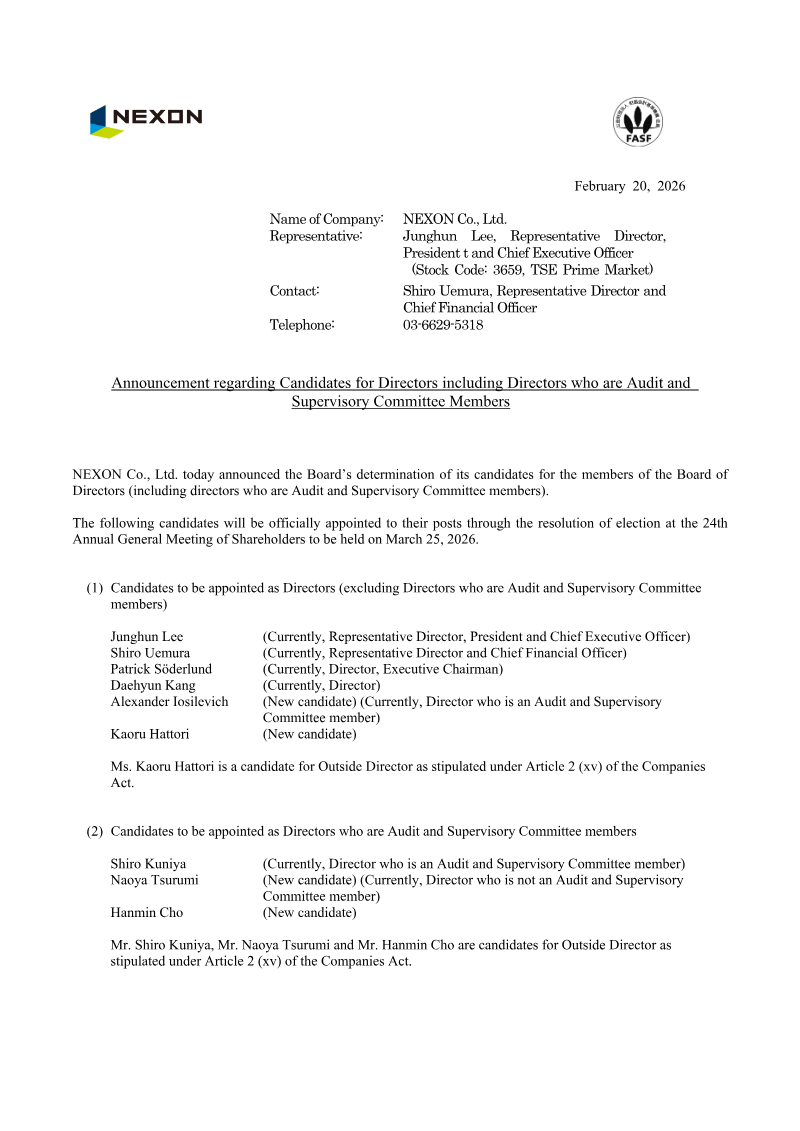
2026.02.20 Announcement regarding Candidates for Directors including Directors who are Audit and Supervisory Committee Members
NEXON Co., Ltd. announced the Board’s selection of candidates for its 24th Annual General Meeting on March 25, 2026. The slate includes six directors, among them two new outside directors and three individuals who will serve concurrently on the Audit and Supervisory Committee. Current executives Junghun Lee, Shiro Uemura, Patrick Söderlund and Daehyun Kang are retained. New appointments comprise Alexander Iosilevich, a seasoned investment‑banking executive with no shareholding in NEXON, and Kaoru Hattori, a Japanese lawyer and partner at Nagashima Ohno & Tsunematsu who also holds trustee and board roles in Toyo Seikan Group Holdings. The Audit and Supervisory Committee will be strengthened by Shiro Kuniya, Naoya Tsurumi—an experienced Sega executive with extensive leadership roles across SEGA subsidiaries—and Hanmin Cho, a private‑equity professional who has led investment divisions at NXC Corporation and holds directorships in NXMH B.V. and Bitstamp Limited.
The announcement details each candidate’s career trajectory, concurrent positions, and share ownership (all new candidates hold zero shares). The selection aligns with Korean Companies Act provisions for outside directors and reflects NEXON’s strategy to blend internal leadership continuity with external expertise in finance, gaming operations, and regulatory oversight. The candidates’ diverse backgrounds—spanning global investment banking, legal practice, gaming industry leadership, and private‑equity management—are intended to enhance governance, strategic direction, and risk oversight for the company’s operations in South Korea and its international markets.
- NEXON Co., Ltd. will present a slate of six director candidates for approval at its 24th Annual General Meeting on March 25, 2026.
- The board is retaining current executives Junghun Lee, Shiro Uemura, Patrick Söderlund, and Daehyun Kang to ensure leadership continuity.
- New outside director appointments include Alexander Iosilevich, an investment-banking executive, and Kaoru Hattori, a partner at the law firm Nagashima Ohno & Tsunematsu.
- The Audit and Supervisory Committee will be strengthened by the addition of Shiro Kuniya, former Sega executive Naoya Tsurumi, and private-equity professional Hanmin Cho.
- The new director candidates hold zero shares in NEXON, and their appointments are intended to bolster governance and regulatory oversight in South Korea and international markets.
+1
NEXON Co.

Report15 pages
Notice of the 15th Annual General Meeting of Shareholders: Akatsuki Inc.
Note: This document has been translated from a part of the Japanese original for reference purposes only. In the event of any discrepancy between this translated document and the Japanese original, the original shall prevail. (Start of electronic provision) June 3, 2025 Tetsuro Koda, President and CEO 2-13-30 Kamiosaki, Shinagawa-ku, Tokyo NOTICE OF THE 15TH ANNUAL GENERAL MEETING OF SHAREHOLDERS You are hereby notified that the 15th Annual General Meeting of Shareholders of Akatsuki Inc.
- Akatsuki Inc. will hold its 15th Annual General Meeting of Shareholders virtually, with electronic provision of information starting June 3, 2025, and the meeting scheduled for June 25, 2025, at 10:00 a.m. JST.
- Shareholders are encouraged to exercise voting rights in advance either in writing or via the Internet by 6:00 p.m. on Tuesday, June 24, 2025.
- The company proposes the election of four Directors, as the terms of all five current Directors expire at the conclusion of this meeting. The Nomination Committee, comprising a majority of independent Outside Directors, provided a report on candidate selection.
- Tetsuro Koda, President and CEO, and Kazuhiro Ishikura, CFO, are nominated for re-election as Directors, recognized for their leadership, business development, and expertise in corporate finance and investment, respectively.
- Hisashi Katsuya and Tetsuya Mizuguchi are nominated as Outside Directors, with Mizuguchi expected to contribute to the game business and provide objective oversight on officer selection and remuneration.
Akatsuki
Report2 pages
Announcement of Consolidated Results for Fiscal Year Ended March 31, 2025, a Comparison with Prior Year Results, Extraordinary Loss, and Non-operating Expense
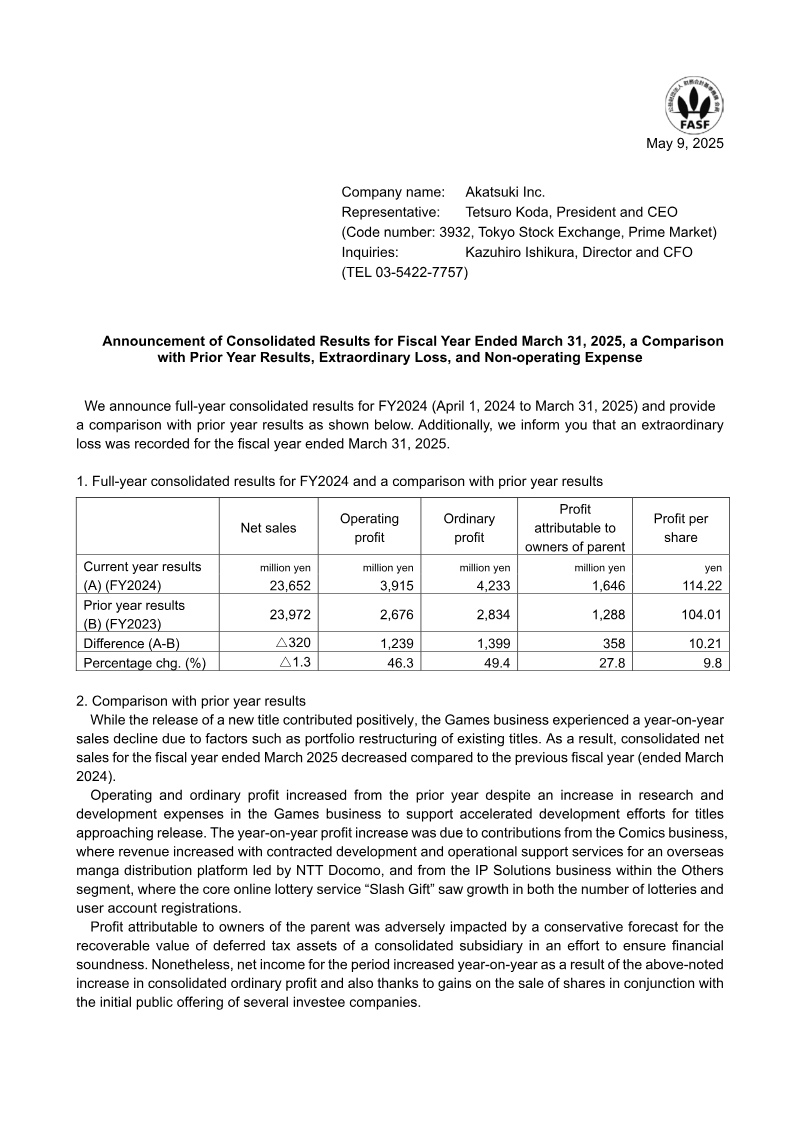
Akatsuki Inc. reported consolidated financial results for the fiscal year ending March 31, 2025 (April 1 2024–March 31 2025). Net sales fell by 1.3 % to ¥23,652 million from ¥23,972 million in FY2023, reflecting a decline in the Games segment despite a new title launch. Operating ordinary profit rose by ¥1,239 million (46.3 %) to ¥3,915 million, driven largely by gains in the Comics and IP Solutions businesses; the former benefited from contracted services for an overseas manga platform, while the latter saw growth in its online lottery service “Slash Gift.” Ordinary profit attributable to parent shareholders increased by ¥1,399 million (49.4 %) to ¥4,233 million, and net income attributable to owners of the parent grew by ¥358 million (27.8 %) to ¥1,646 million, aided by gains on share sales from IPOs of investee companies. A conservative write‑down of deferred tax assets reduced the profit attributable to owners, yet overall net income still improved.
An extraordinary loss of ¥593 million was recorded on the valuation of investment securities held by the group, reflecting a conservative assessment of recoverable value amid market uncertainty. On a non‑consolidated basis, the company recorded a ¥5,776 million provision for doubtful accounts and a ¥2,454 million loss on valuation of shares in affiliated companies; these items are largely confined to consolidated subsidiaries and have a minor impact on the consolidated results. The report covers Japan‑based operations for FY2025, with data derived from internal financial statements and market assessments.
- Akatsuki Inc. reported a 49.4% increase in ordinary profit to ¥4,233 million for the fiscal year ending March 31, 2025, despite a 1.3% decline in net sales to ¥23,652 million.
- Operating ordinary profit grew by 46.3% to ¥3,915 million, driven by strong performance in the Comics segment and the 'Slash Gift' online lottery service within the IP Solutions business.
- Net income attributable to owners of the parent rose 27.8% to ¥1,646 million, bolstered by gains from share sales related to the IPOs of investee companies.
- The Games segment experienced a decline in revenue during FY2025, failing to offset the overall sales decrease despite the launch of a new title.
- The company recorded an extraordinary loss of ¥593 million due to a conservative valuation of investment securities held by the group.
+1
Akatsuki
Report11 pages
Consolidated Financial Statements: Q1 Fiscal Year 2026 (Japan)
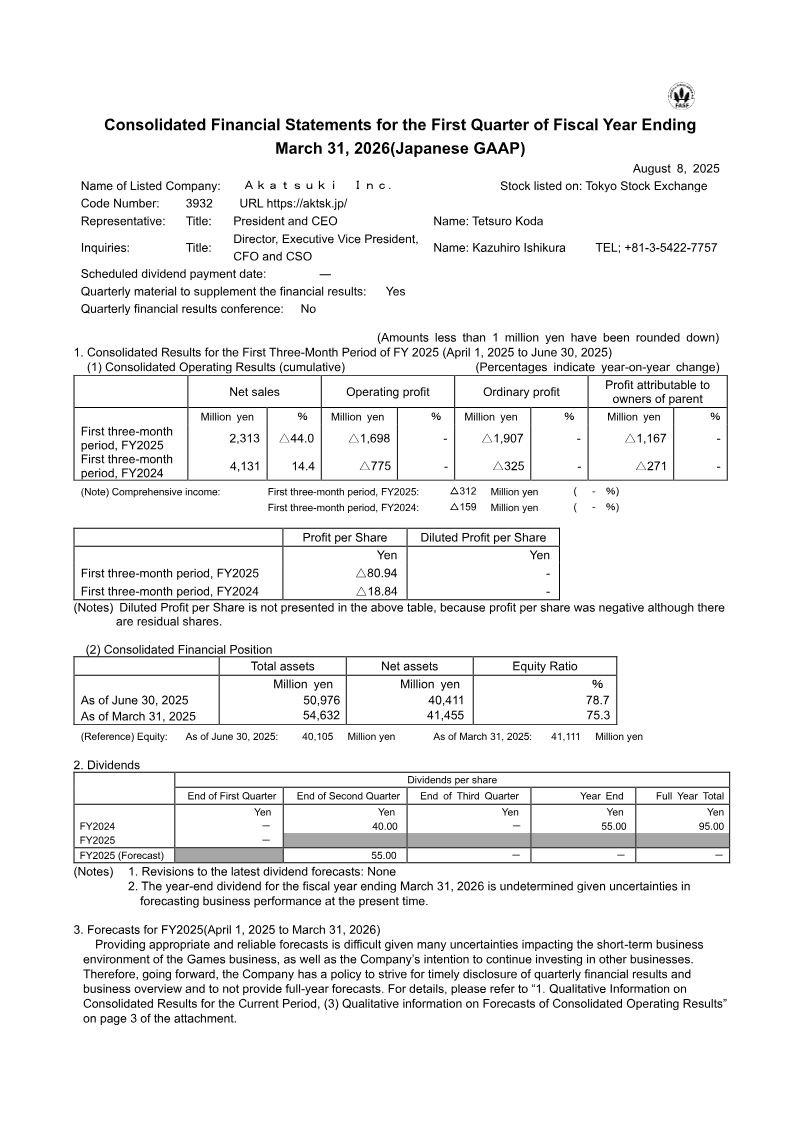
Akatsuki Inc. reports a first‑quarter fiscal 2025 performance that reflects a sharp contraction in its core gaming and comics businesses amid a challenging macro‑environment. Net sales fell 44 % YoY to ¥2,313 million, while operating loss widened to ¥1,698 million from a prior‑year loss of ¥775 million. The company’s consolidated equity ratio improved to 78.7 % from 75.3 %, but total assets declined by ¥3,656 million to ¥50,976 million. Net loss attributable to parent shareholders reached ¥1,167 million, a significant increase from the prior‑year loss of ¥271 million. Comprehensive income deteriorated to ¥312 million in losses versus ¥159 million previously.
Segment analysis shows the Games unit suffered a 52.3 % sales decline and an operating loss of ¥1,643 million; the Comics unit posted a modest profit of ¥20 million after an 18.3 % sales drop; the newly standalone IP Solutions unit grew sales by 167 % and generated a ¥122 million profit, largely driven by the inclusion of subsidiary CRAYON, Inc. The Others segment recorded a small profit after an 80.9 % sales increase.
Geographically, the report focuses on Japan with no disclosed overseas revenue breakdown. Methodologically, figures are based on Japanese GAAP quarterly consolidation; no full‑year forecasts are provided due to market uncertainty. The company maintains a policy of timely quarterly disclosure while withholding FY2026 forecasts, citing volatile gaming and investment conditions.
- Akatsuki Inc. experienced a sharp financial downturn in Q1 FY2025, with net sales falling 44% year-over-year to ¥2,313 million and operating losses widening to ¥1,698 million.
- The core Games unit was the primary driver of the deficit, suffering a 52.3% decline in sales and recording an operating loss of ¥1,643 million.
- Net loss attributable to parent shareholders increased significantly to ¥1,167 million, compared to a ¥271 million loss in the same period last year.
- The IP Solutions unit emerged as a growth driver, increasing sales by 167% and generating a ¥122 million profit, largely due to the inclusion of subsidiary CRAYON, Inc.
- The Comics unit remained marginally profitable at ¥20 million, despite an 18.3% decline in segment sales.
+1
Akatsuki
Report3 pages
Consolidated Results Supplementary Information: Fiscal Year Ended March 2025
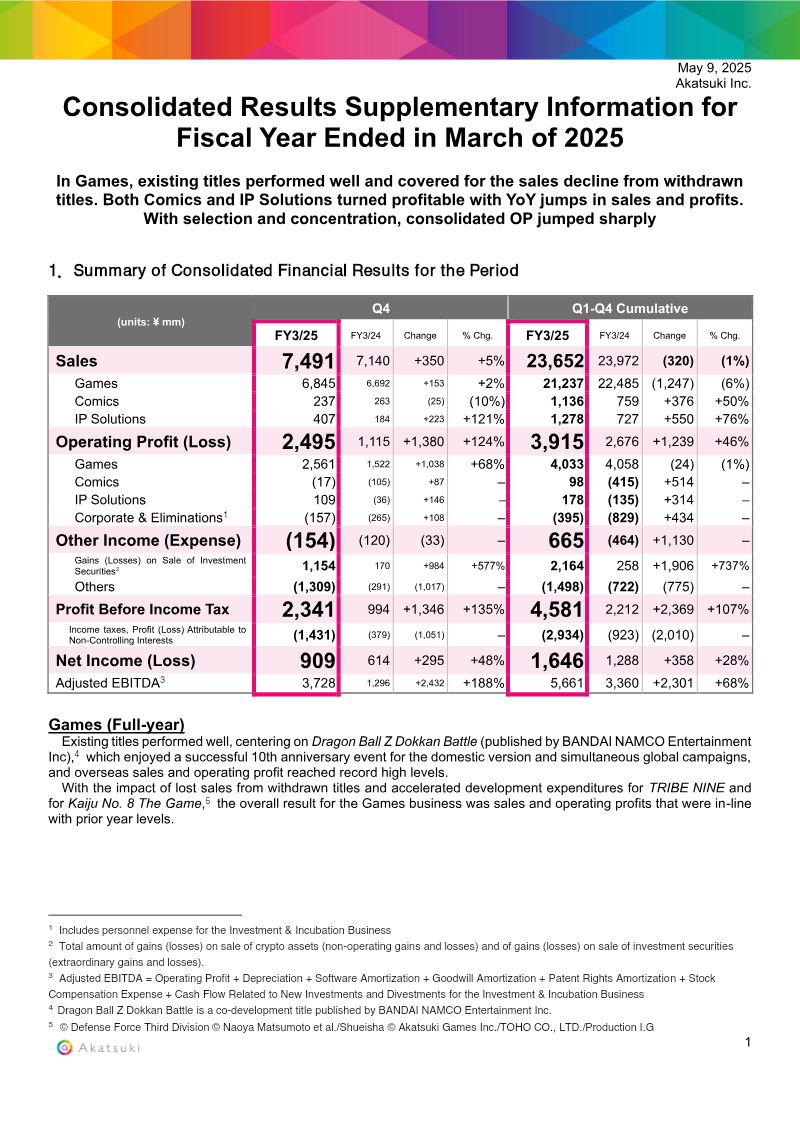
Akatsuki Inc. reported consolidated financial results for fiscal year ended March 2025, showing a modest 5 % increase in sales to ¥23.652 billion compared with the prior year, driven primarily by strong performance of existing games such as Dragon Ball Z Dokkan Battle. Games sales rose 2 % to ¥21.237 billion, while comics and IP Solutions segments returned to profitability with 10 % and 121 % year‑over‑year sales gains, respectively. Operating profit surged 124 % to ¥3.915 billion, largely due to a sharp rise in operating profit from games (68 % increase) and significant gains on the sale of investment securities, which contributed ¥1.154 billion to profit before tax.
Net income increased 48 % to ¥1.646 billion, supported by a 28 % rise in adjusted EBITDA (¥5.661 billion). The company’s balance sheet remained solid, with total assets of ¥54.632 billion and net assets of ¥41.455 billion, while total liabilities decreased to ¥13.177 billion. Cash balances were maintained at ¥33.300 billion, reflecting disciplined working‑capital management.
The results cover the Japanese market and global operations for games, comics, and IP solutions. Methodology includes consolidated financial statements with adjustments for investment and incubation business personnel expenses, and gains on crypto asset sales are classified as non‑operating. Overall, Akatsuki’s selective focus on high‑performing titles and profitable IP solutions has driven a sharp improvement in operating profitability despite the withdrawal of some titles.
- Akatsuki Inc. reported a 124% surge in operating profit to ¥3.915 billion for the fiscal year ended March 2025, driven by a 68% increase in gaming segment profit and ¥1.154 billion in gains from the sale of investment securities.
- Total sales grew 5% year-over-year to ¥23.652 billion, supported by the continued strong performance of existing titles like Dragon Ball Z Dokkan Battle.
- Net income rose 48% to ¥1.646 billion, while adjusted EBITDA increased 28% to ¥5.661 billion.
- The comics and IP Solutions segments returned to profitability, recording year-over-year sales gains of 10% and 121%, respectively.
- The company maintained a strong financial position with ¥33.300 billion in cash and a reduction in total liabilities to ¥13.177 billion.
+1
Akatsuki
Report12 pages
Consolidated Financial Statements: Second Quarter and First Half-Year Period of Fiscal Year Ending March 31, 2026
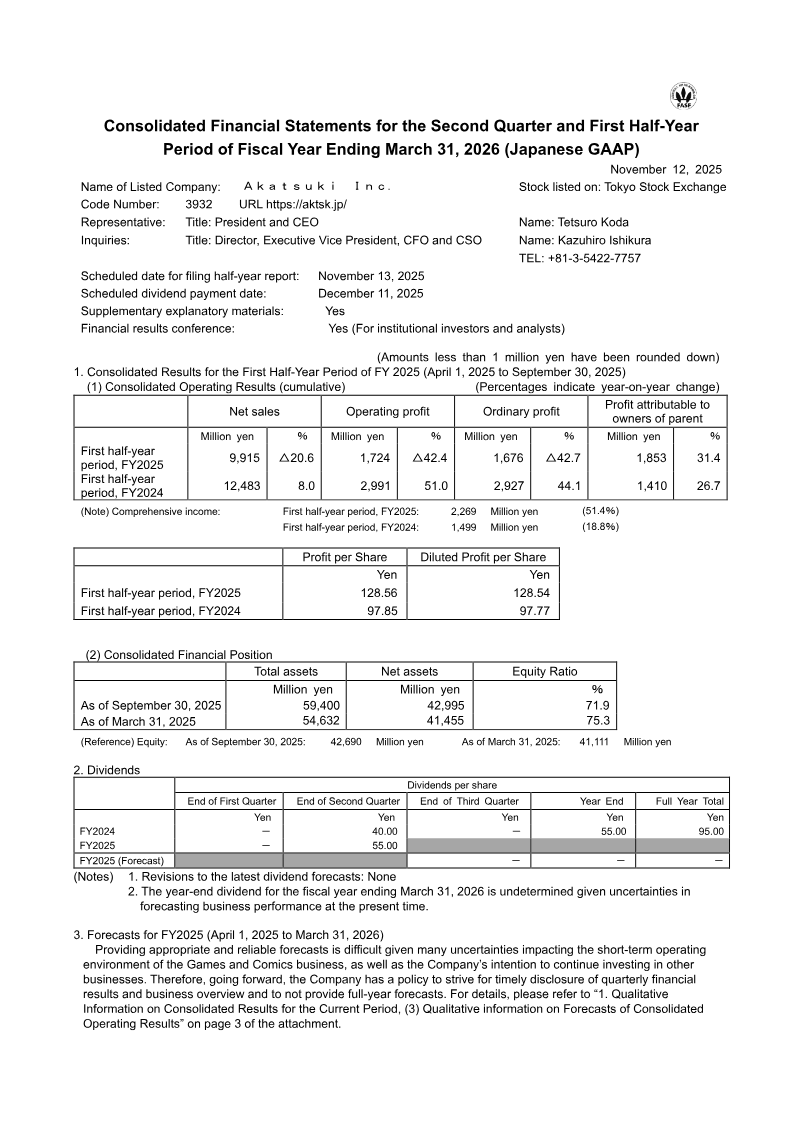
Akatsuki Inc. reports consolidated financial results for the first half of fiscal year ending March 31, 2026 (April 1–September 30, 2025). Net sales fell 20.6 % YoY to ¥9,915 million, while operating profit declined 42.4 % to ¥1,724 million; ordinary profit dropped 42.7 % to ¥1,676 million, yet net income attributable to parent rose 31.4 % to ¥1,853 million, driven by a higher comprehensive income of ¥2,269 million versus ¥1,499 million the prior year. Profit per share diluted increased from ¥97.85 to ¥128.56. Total assets grew to ¥59,400 million, with net assets rising to ¥42,995 million and equity ratio improving to 71.9 %. Cash flows from operating activities were modest at ¥369 million, while investing cash outflows of ¥5,433 million reflected significant purchases of investment securities and intangible assets. Financing activities generated net inflows of ¥1,775 million, offset by dividends paid of ¥795 million.
Segment analysis shows the Games and Comics business experienced a 23.2 % sales decline to ¥9,257 million and a 41.2 % profit drop, whereas the Entertainment and Lifestyle segment grew sales by 76.1 % to ¥649 million, achieving a 90.7 % profit increase. The Others segment recorded a sharp sales decline and continued losses.
The report notes significant consolidation changes: six new subsidiaries, including CRAYON Inc., were added; Akatsuki Fukuoka was liquidated. Goodwill increased by ¥4,316 million due to acquisitions of Natee and PAPABUBBLE JAPAN. No full‑year forecasts are provided, reflecting uncertainty in the Games and Comics market and ongoing investment plans.
- Akatsuki Inc. reported a 20.6% YoY decline in net sales to ¥9,915 million and a 42.4% drop in operating profit to ¥1,724 million for the first half of the fiscal year ending March 31, 2026.
- Net income attributable to the parent rose 31.4% to ¥1,853 million, with diluted earnings per share increasing from ¥97.85 to ¥128.56.
- The core Games and Comics segment, which accounts for the majority of revenue, saw a 23.2% sales decline and a 41.2% drop in profit.
- The Entertainment and Lifestyle segment showed strong growth, with sales increasing 76.1% to ¥649 million and profit rising 90.7%.
- The company increased goodwill by ¥4,316 million following the acquisitions of Natee and PAPABUBBLE JAPAN, while investing cash outflows reached ¥5,433 million.
+1
Akatsuki
Report4 pages
Consolidated Results Supplementary Information: Q1 FYE March 2026
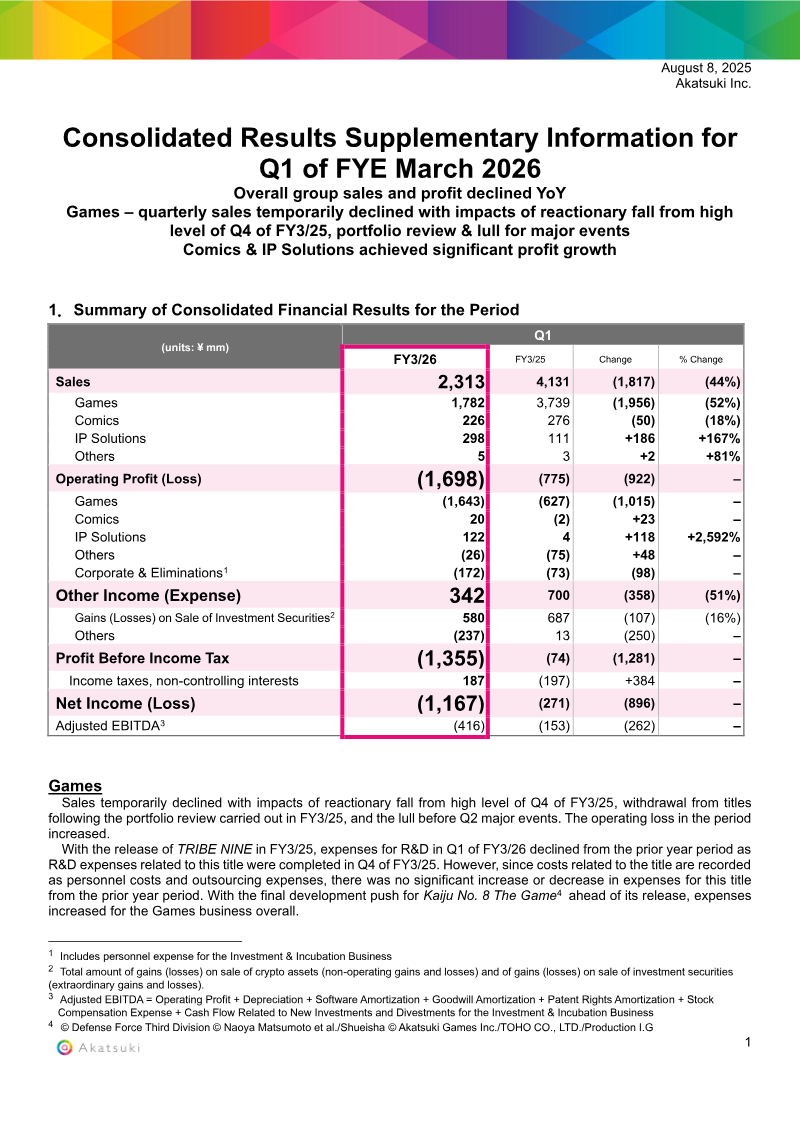
Akatsuki Inc. reported a sharp decline in consolidated sales and operating results for Q1 of the fiscal year ending March 2026, with total group sales falling 44% YoY to ¥2,313 million. The Games segment suffered the largest hit, dropping 52% to ¥1,782 million and recording an operating loss of ¥1,643 million, largely due to a post‑Q4 portfolio review withdrawal and the absence of high‑profile releases. R&D spending for the Games business fell from the previous year as development on “TRIBE NINE” concluded, but costs for the upcoming title “Kaiju No. 8 The Game” increased personnel and outsourcing expenses.
In contrast, the Comics division saw a modest 18% sales decline to ¥226 million but improved profitability, with operating profit rising from a loss of ¥2 million to ¥20 million. The division’s focus on original works and continued service provision to the overseas platform MANGA MIRAI contributed to this turnaround. The IP Solutions unit experienced explosive growth, with sales up 167% to ¥298 million and operating profit soaring 2,592% to ¥122 million, driven by the successful online lottery “Slash Gift” and the inclusion of CRAYON, Inc. in consolidation.
Other income sources shifted, with gains on investment securities decreasing by ¥107 million to ¥580 million. Net income swung from a loss of ¥271 million in FY3/25 to a larger loss of ¥1,167 million in FY3/26, reflecting the combined impact of segment downturns and higher operating losses. Adjusted EBITDA also deteriorated from ¥153 million to a loss of ¥416 million.
The financial data cover the Japanese market, covering all core segments—Games, Comics, IP Solutions, and ancillary services—from Q1 FY3/24 through Q1 FY3/26. The analysis relies on consolidated financial statements, trend tables, and explanatory notes detailing segment performance, expense composition, and investment activity.
- Akatsuki Inc. reported a 44% year-over-year decline in total consolidated sales to ¥2,313 million for Q1 FYE March 2026, resulting in a net loss of ¥1,167 million.
- The Games segment experienced a 52% sales drop to ¥1,782 million and an operating loss of ¥1,643 million, driven by a portfolio review withdrawal and a lack of major new releases.
- The IP Solutions unit achieved significant growth, with sales increasing 167% to ¥298 million and operating profit rising 2,592% to ¥122 million, bolstered by the 'Slash Gift' online lottery and the consolidation of CRAYON, Inc.
- The Comics division improved profitability, turning a ¥2 million loss into a ¥20 million operating profit despite an 18% decline in sales to ¥226 million.
- Adjusted EBITDA for the group deteriorated from a profit of ¥153 million in the previous year to a loss of ¥416 million in Q1 FY3/26.
+1
Akatsuki
Report3 pages
Consolidated Results Supplementary Information: Q2 of FYE March 2026
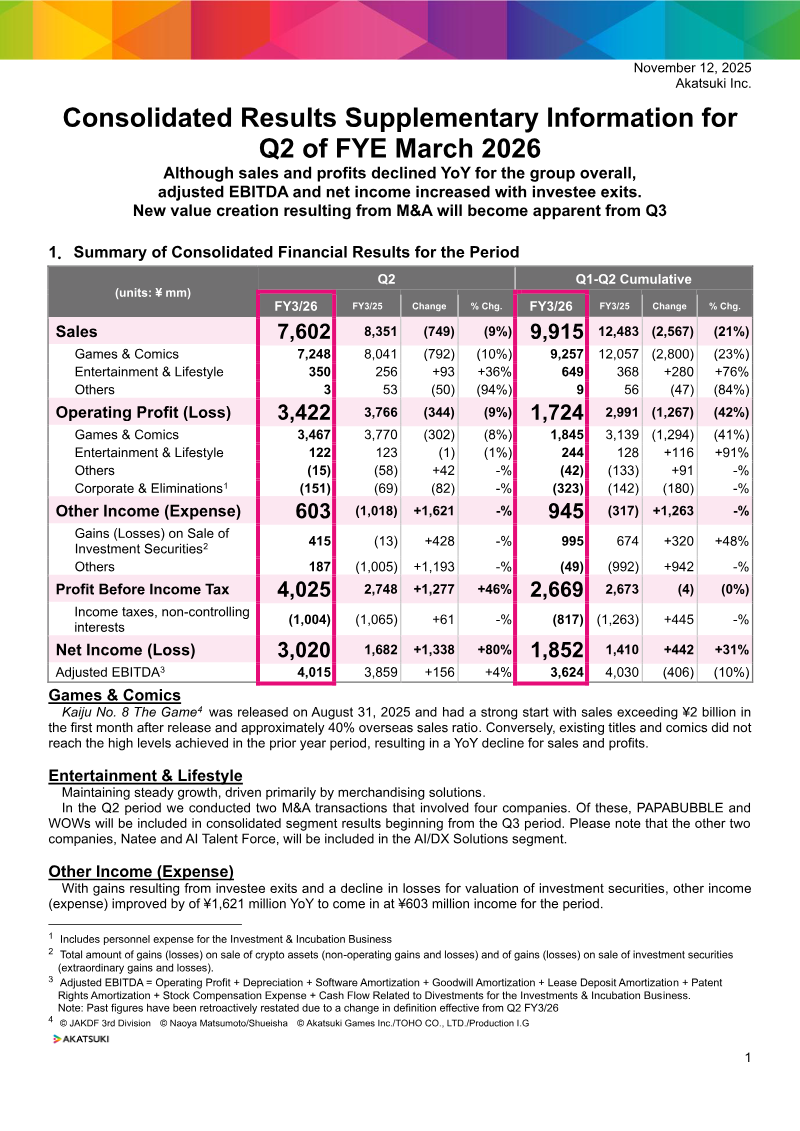
Akatsuki Inc. reported consolidated financial results for the second quarter of fiscal year ending March 2026, noting a 9 % decline in sales to ¥7,602 million and a 21 % drop in cumulative year‑to‑date sales of ¥9,915 million versus the prior year. The Games & Comics segment led the decline with a 10 % YoY fall to ¥7,248 million, while Entertainment & Lifestyle grew 36 % to ¥350 million, and the Others segment contracted sharply by 94 %. Operating profit fell 9 % to ¥3,422 million, largely due to weaker performance in the core Games & Comics unit; however, net income rose 80 % to ¥3,020 million, driven by gains from investee exits and reduced valuation losses on investment securities. Adjusted EBITDA increased modestly by 4 % to ¥4,015 million, reflecting a recovery in operating profitability after the release of new titles.
Key drivers include the launch of “Kaiju No. 8 The Game” on 31 August 2025, which generated over ¥2 billion in first‑month sales with a 40 % overseas share, partially offsetting declines from legacy titles. Two M&A transactions in Q2 added PAPABUBBLE and WOWs to the consolidated segment from Q3, while Natee and AI Talent Force will join the AI/DX Solutions segment. The company’s balance sheet shows a net asset base of ¥42,995 million and cash equivalents of ¥33,272 million, with current liabilities at ¥6,954 million.
Methodologically, the report aggregates data from all operating subsidiaries, restating prior figures to align with revised definitions effective Q2 FY3/26. The analysis covers Japan and international markets, focusing on the Games & Comics, Entertainment & Lifestyle, and AI/DX Solutions segments over a two‑quarter period.
- Akatsuki Inc. reported a 9% decline in quarterly sales to ¥7,602 million, primarily driven by a 10% YoY contraction in the core Games & Comics segment.
- Net income surged 80% to ¥3,020 million, bolstered by gains from investee exits and a reduction in valuation losses on investment securities despite lower operating profit.
- The launch of 'Kaiju No. 8 The Game' on 31 August 2025 generated over ¥2 billion in first-month sales, with 40% of revenue originating from overseas markets.
- Adjusted EBITDA increased by 4% to ¥4,015 million, signaling a recovery in operating profitability following the release of new titles.
- The company expanded its portfolio through Q2 M&A activity, acquiring PAPABUBBLE and WOWs for the Entertainment & Lifestyle segment, and Natee and AI Talent Force for the AI/DX Solutions segment.
+2
Akatsuki
Report11 pages
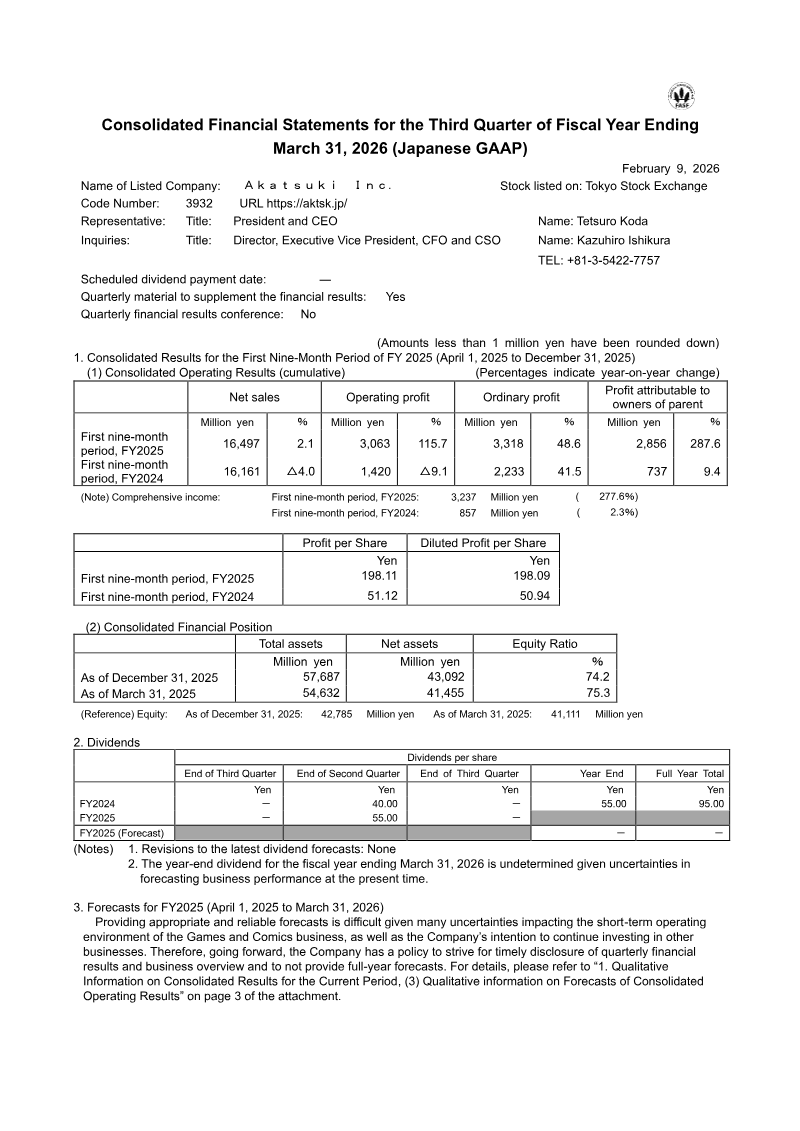
Consolidated Financial Statements for the Third Quarter of Fiscal Year Ending March 31, 2026
Akatsuki Inc. reports consolidated financial results for the first nine months of fiscal year 2025, ending December 31 2025. Net sales rose modestly by 2.1 % to ¥16,497 million, while operating profit surged 115.7 % to ¥3,063 million and ordinary profit increased 48.6 % to ¥3,318 million. Net profit attributable to parent shareholders climbed 287.6 % to ¥2,856 million, yielding diluted earnings per share of ¥198.11 versus ¥51.12 in the prior year. Total assets reached ¥57,687 million, up ¥3,054 million from March 31 2025, with net assets at ¥43,092 million and an equity ratio of 74.2 %. The company’s liquidity remained solid, with cash and deposits at ¥28,377 million and current liabilities down to ¥4,462 million.
Segment performance varied: the Games and Comics business posted a 5.3 % decline in sales but doubled operating profit through cost reductions; Entertainment and Lifestyle achieved a 76.1 % sales increase to ¥1,400 million but saw a modest profit decline; the newly reported AI/DX Solutions segment generated ¥600 million in sales and incurred a ¥112 million loss. The Others segment recorded a sharp 83.1 % sales drop and a ¥51 million loss.
The company added five subsidiaries to its consolidation scope, including CRAYON Inc. and PAPABUBBLE, while excluding Akatsuki Fukuoka after liquidation. No changes to accounting policies were noted. Forecasts for FY 2026 are withheld due to market uncertainties, and the company maintains a policy of not providing full‑year guidance.
- Akatsuki Inc. reported a significant surge in profitability for the first nine months of FY2025, with operating profit rising 115.7% to ¥3,063 million and net profit attributable to parent shareholders climbing 287.6% to ¥2,856 million.
- Net sales grew modestly by 2.1% to ¥16,497 million, while diluted earnings per share increased substantially to ¥198.11 compared to ¥51.12 in the prior year.
- The core Games and Comics business experienced a 5.3% decline in sales but successfully doubled its operating profit through effective cost-reduction measures.
- The Entertainment and Lifestyle segment achieved strong growth with a 76.1% sales increase to ¥1,400 million, though this was accompanied by a modest decline in profit.
- The company launched a new AI/DX Solutions segment, which generated ¥600 million in sales but incurred an operating loss of ¥112 million.
+1
Akatsuki
Report4 pages
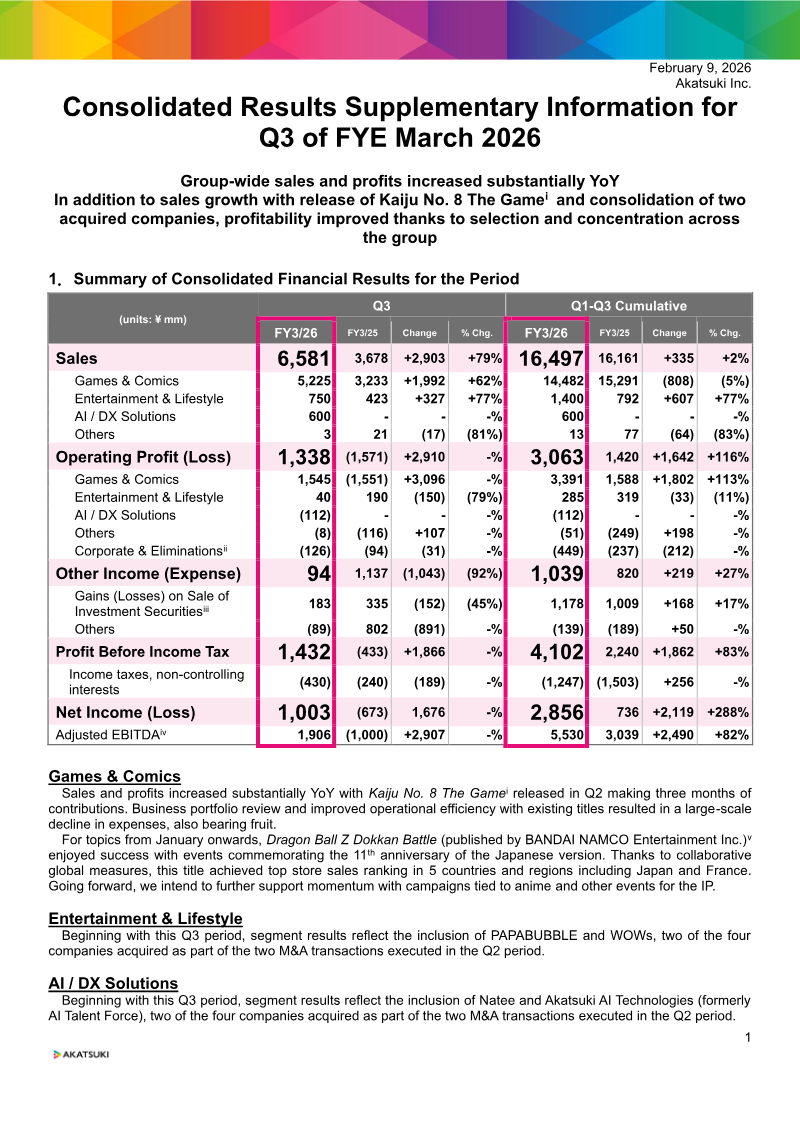
Consolidated Results Supplementary Information: Q3 FY3/26
Akatsuki Inc. reported a dramatic turnaround in Q3 FY3/26, with group‑wide sales surging 79 % YoY to ¥6,581 million and operating profit turning from a loss of ¥1,571 million to a gain of ¥1,338 million. The rebound is largely attributed to the Q2 release of “Kaiju No. 8 The Game,” which contributed three months’ worth of revenue, and the consolidation of two acquired entities that broadened the Games & Comics portfolio. Within this segment, sales climbed 62 % to ¥5,225 million and operating profit rose 113 % to ¥1,545 million. The Entertainment & Lifestyle segment also grew 77 % in sales to ¥750 million, driven by the inclusion of PAPABUBBLE and WOWs following Q2 acquisitions. AI/DX Solutions, newly integrated through Natee and Akatsuki AI Technologies, generated ¥600 million in sales but recorded a loss of ¥112 million.
Net income for the quarter reached ¥1,003 million, a 288 % increase from the prior year’s loss of ¥673 million. Adjusted EBITDA expanded 82 % to ¥1,906 million, reflecting strong operating performance and effective cost management. Cash balances rose to ¥33,266 million, while total assets stood at ¥57,687 million. The company’s balance sheet remained solid with net assets of ¥43,092 million and total liabilities of ¥14,595 million.
Methodologically, figures are presented in Japanese yen (millions) and include retroactive restatements from Q2 FY3/26 due to prior period errors. The report covers the entire Japanese market and global operations, focusing on Q3 FY3/26 with cumulative data for FY3/26 versus FY3/25.
- Akatsuki Inc. achieved a significant financial turnaround in Q3 FY3/26, reporting ¥6,581 million in group-wide sales (up 79% YoY) and an operating profit of ¥1,338 million, reversing a prior-year loss of ¥1,571 million.
- The primary growth driver was the Q2 release of 'Kaiju No. 8 The Game,' which contributed three months of revenue and helped boost Games & Comics segment sales by 62% to ¥5,225 million.
- Net income reached ¥1,003 million, a 288% increase compared to the ¥673 million loss recorded in the same period last year.
- The Entertainment & Lifestyle segment grew 77% to ¥750 million in sales, bolstered by the integration of newly acquired entities PAPABUBBLE and WOWs.
- The newly integrated AI/DX Solutions segment, comprising Natee and Akatsuki AI Technologies, generated ¥600 million in sales but incurred an operating loss of ¥112 million.
+1
Akatsuki
Report1 pages
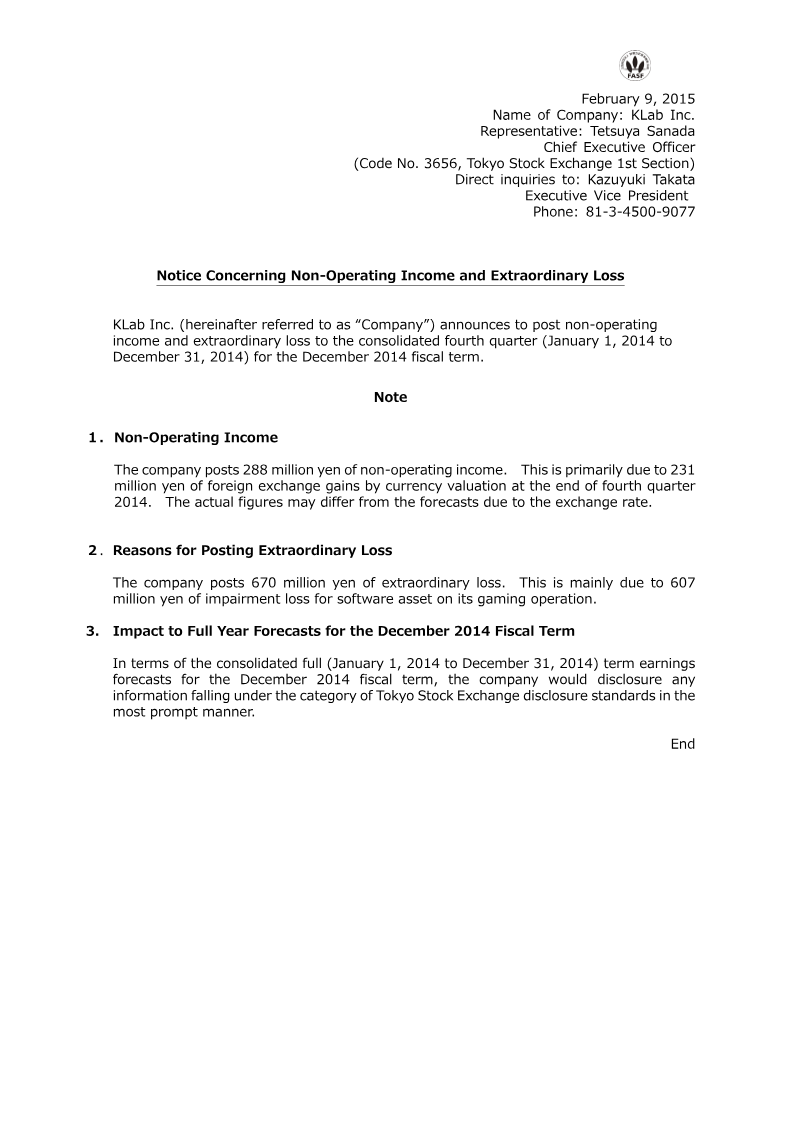
Notice Concerning Non-Operating Income and Extraordinary Loss: Japan
KLab Inc. disclosed a net non‑operating income of 288 million yen for the consolidated fourth quarter of its December 2014 fiscal year, driven largely by a 231 million yen foreign‑exchange gain from currency valuation at quarter‑end. The company also reported an extraordinary loss of 670 million yen, primarily attributable to a 607 million yen impairment charge on software assets related to its gaming operations. These figures represent the company’s first quarterly disclosure of such items for the year, indicating a significant impact on its overall profitability.
The announcement clarifies that the non‑operating income and extraordinary loss will affect the company’s full‑year earnings forecasts for the 2014 fiscal period. KLab commits to providing any additional information required under Tokyo Stock Exchange disclosure standards promptly, ensuring transparency for investors and regulators. The notice is limited to the Japanese market, covering a single fiscal year (January 1–December 31, 2014) and focusing on the gaming segment of KLab’s operations. No survey or external data sources are cited; the figures derive from internal financial statements and accounting adjustments made during the reporting period.
- KLab Inc. recorded an extraordinary loss of 670 million yen for the fourth quarter of the 2014 fiscal year, primarily driven by a 607 million yen impairment charge on gaming software assets.
- The company reported a net non-operating income of 288 million yen for the same period, bolstered by a 231 million yen foreign-exchange gain.
- These financial adjustments represent the first quarterly disclosure of such items for KLab in 2014 and will impact the company's full-year earnings forecast.
- The reported figures are derived from internal financial statements covering the fiscal period of January 1, 2014, to December 31, 2014.
- KLab has committed to ongoing transparency regarding these financial impacts in accordance with Tokyo Stock Exchange disclosure standards.
KLab
Report8 pages
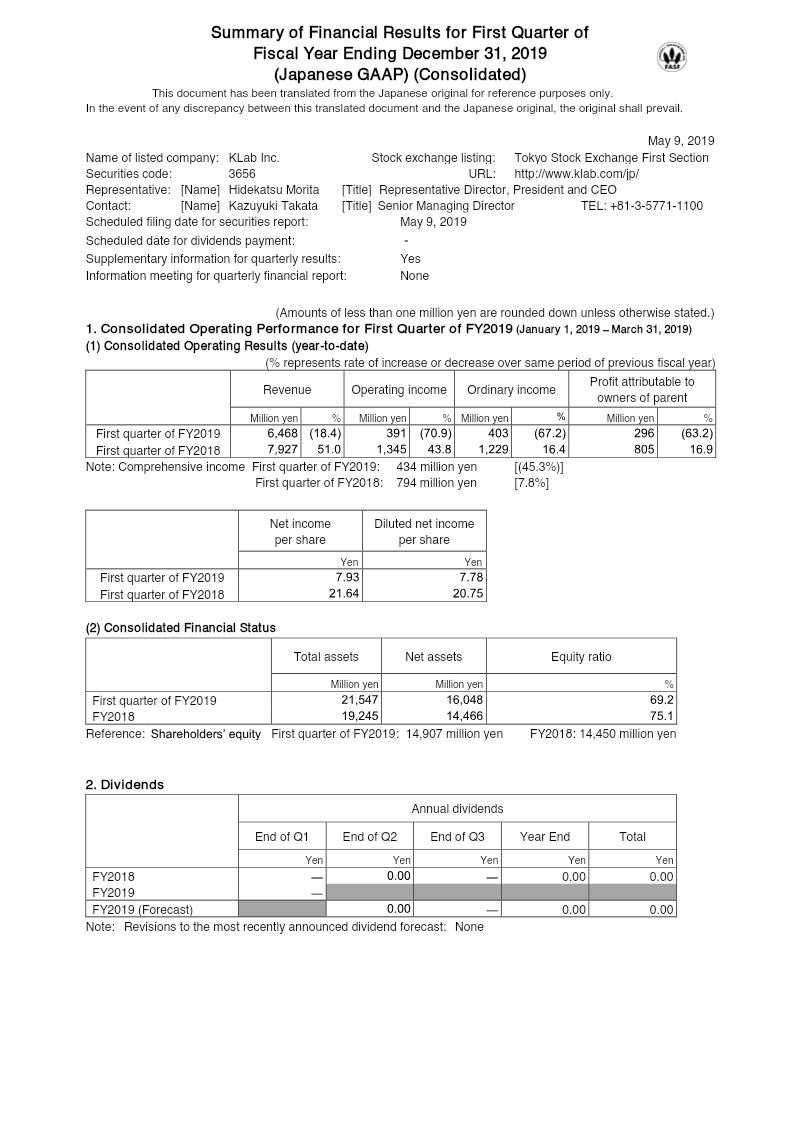
Consolidated Financial Statement: Q1 2019
KLab Inc. reported consolidated financial results for the first quarter of fiscal year 2019 (January 1–March 31, 2019). Revenue declined 18.4 % to ¥6,468 million compared with the same period in FY2018, largely due to a drop in sales of the Love Live! School Idol Festival title. Operating income fell 70.9 % to ¥391 million, ordinary income decreased 67.2 % to ¥403 million, and profit attributable to owners of parent contracted 63.2 % to ¥296 million. Net income for the quarter was ¥303 million, a 65 % reduction from ¥805 million in FY2018. Comprehensive income also fell sharply, from ¥794 million to ¥435 million, reflecting a 45.3 % increase in other comprehensive income components.
Total assets rose to ¥21,547 million, up ¥2.3 billion from the prior year’s end, driven by increases in operating investment securities and software in progress. Net assets increased to ¥16,048 million, an addition of ¥1.58 billion, largely due to equity in a newly consolidated subsidiary. The equity ratio declined from 75.1 % to 69.2 %. Current liabilities decreased, while long‑term debt increased, contributing to the shift in leverage.
KLab forecasted FY2019 revenue between ¥32 billion and ¥40 billion, operating income between ¥1 billion and ¥4.5 billion, ordinary income in the same range, and profit attributable to owners between ¥700 million and ¥3.1 billion. The company noted that future results will depend heavily on the success of new game releases and market conditions, and it applied a range‑based presentation for forecasts. No dividends were declared for FY2019, and no significant changes in shareholders’ equity or accounting policies occurred during the quarter.
- KLab Inc. experienced a significant Q1 2019 downturn, with revenue falling 18.4% to ¥6,468 million and operating income dropping 70.9% to ¥391 million compared to the same period in 2018.
- The primary driver for the revenue decline was a decrease in sales for the 'Love Live! School Idol Festival' title.
- Profit attributable to owners of the parent contracted by 63.2% to ¥296 million, while net income fell 65% to ¥303 million.
- Total assets increased by ¥2.3 billion to ¥21,547 million, primarily due to growth in software in progress and operating investment securities.
- The company’s equity ratio declined from 75.1% to 69.2% as a result of shifting leverage, characterized by a decrease in current liabilities and an increase in long-term debt.
+1
KLab
Report8 pages
Consolidated Financial Report: Q2 2020
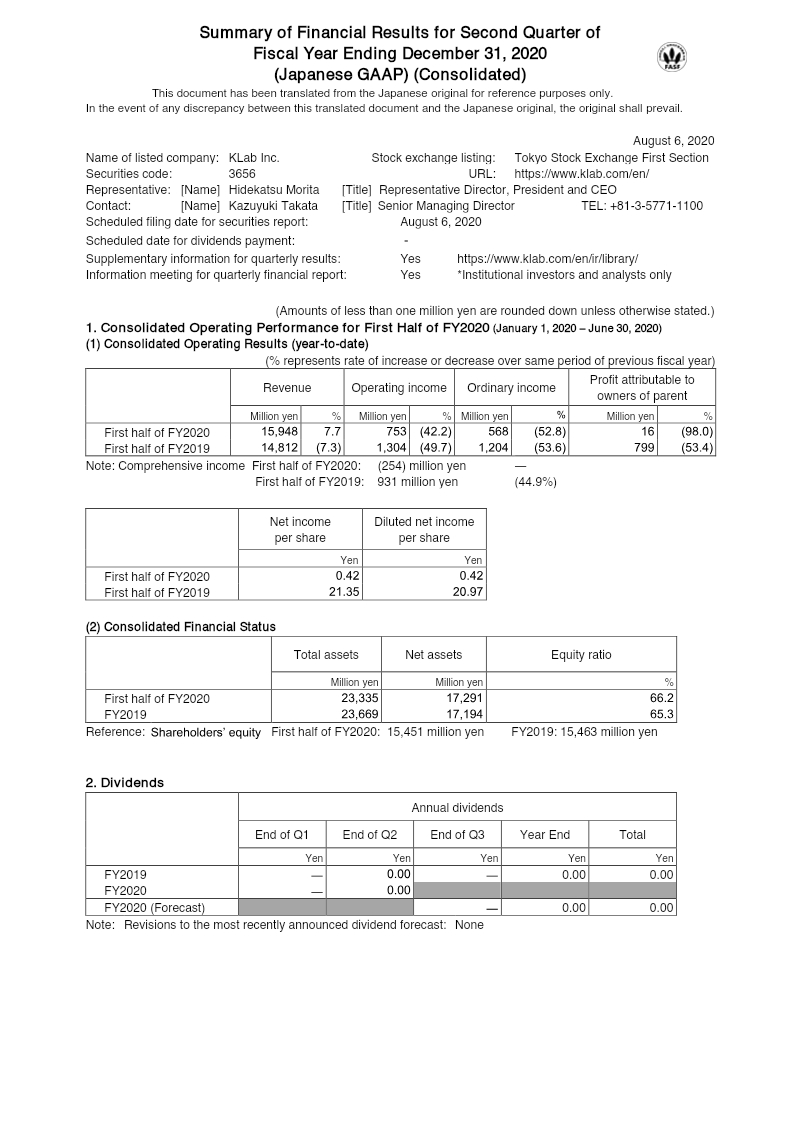
KLab Inc. reports consolidated financial results for the first half of fiscal year 2020 (January 1–June 30, 2020). Revenue rose to ¥15.95 billion from ¥14.81 billion in the same period of FY2019, a 7.7 % increase, driven by growth in the game business and other businesses such as research & consulting. Operating income fell sharply to ¥753 million from ¥1,305 million, a 42.2 % decline, largely due to higher cost of sales and lower gross profit margin. Ordinary income dropped 52.8 % to ¥568 million, and profit attributable to owners of parent fell 98 % to ¥16 million. Net income turned negative, with a loss of ¥44 million versus a profit of ¥21 million in FY2019, reflecting significant foreign exchange losses and impairment charges. Comprehensive income also turned negative at ¥254 million compared with a positive ¥932 million in FY2019, driven by valuation losses on available‑for‑sale securities and foreign currency translation adjustments.
Total assets decreased modestly to ¥23.34 billion from ¥23.67 billion, while shareholders’ equity remained stable at ¥17.29 billion, giving an equity ratio of 66.2 %. Net assets grew slightly to ¥17.29 billion, and the company maintained a strong liquidity position with cash and deposits of ¥6.38 billion. No dividends were declared for FY2019 or FY2020, and the forecasted dividend remained unchanged. The report covers Japan only, covering KLab’s core game development and ancillary businesses, with data derived from consolidated financial statements under Japanese GAAP. The methodology follows standard accounting principles without restatements or significant policy changes during the period.
- KLab Inc. reported a 98% decline in profit attributable to owners of the parent to ¥16 million for the first half of 2020, compared to the same period in 2019.
- Operating income fell 42.2% to ¥753 million, driven by an increased cost of sales and a lower gross profit margin.
- Revenue grew by 7.7% to ¥15.95 billion, supported by performance in the company's core game business and research and consulting services.
- The company recorded a net loss of ¥44 million for the first half of 2020, primarily due to significant foreign exchange losses and impairment charges.
- Comprehensive income turned negative at ¥254 million, impacted by valuation losses on available-for-sale securities and foreign currency translation adjustments.
+1
KLab
Report8 pages
Quarterly Financial Report: Q3 2020
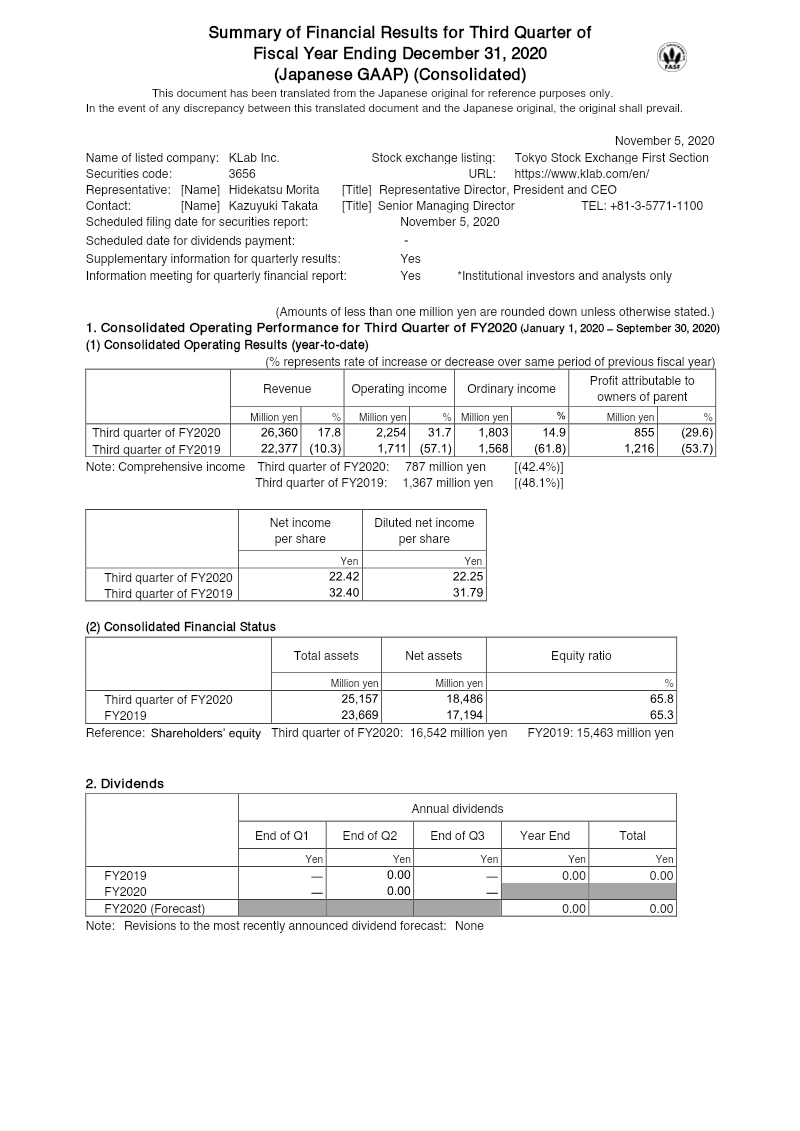
KLab Inc. reports a robust third‑quarter performance for fiscal year 2020, with revenue rising to ¥26.36 billion from ¥22.38 billion in the same period of FY2019, a 17.8 % increase driven by its game business segment. Operating income grew to ¥2.25 billion, up 31.7 % year‑over‑year, while ordinary income reached ¥1.80 billion, a 14.9 % rise. Net profit attributable to the parent fell to ¥855 million, a 29.6 % decline, largely due to higher foreign‑exchange losses and an impairment charge of ¥498.9 million on investments. Comprehensive income for the quarter was ¥787 million, down 42.4 % from ¥1.37 billion in FY2019, reflecting a reversal of the valuation gain on available‑for‑sale securities and foreign‑currency translation adjustments.
Total assets increased to ¥25.16 billion, with current assets up 13.8 % and non‑current assets slightly down due to a reduction in intangible software assets. Net assets rose to ¥18.49 billion, and the equity ratio improved to 65.8 %. Outstanding shares averaged 38.17 million, with no treasury shares held at quarter‑end.
The company maintained a dividend policy of zero for FY2020, with no forecasted dividends. No changes to accounting principles were reported, and the effective tax rate was applied consistently across periods. The report covers Japan‑based operations for FY2020 (January 1–September 30) and compares results to the same period in FY2019.
- KLab Inc. reported a 17.8% year-over-year revenue increase to ¥26.36 billion for the first nine months of FY2020, driven by strong performance in its game business segment.
- Operating income rose 31.7% to ¥2.25 billion, while ordinary income grew 14.9% to ¥1.80 billion compared to the same period in FY2019.
- Net profit attributable to the parent fell 29.6% to ¥855 million, primarily due to foreign-exchange losses and a ¥498.9 million impairment charge on investments.
- Comprehensive income declined 42.4% to ¥787 million, impacted by a reversal of valuation gains on available-for-sale securities and foreign-currency translation adjustments.
- The company’s financial position strengthened with net assets rising to ¥18.49 billion and an improved equity ratio of 65.8%.
+1
KLab
Report9 pages
Q1 2021 Financial Statement
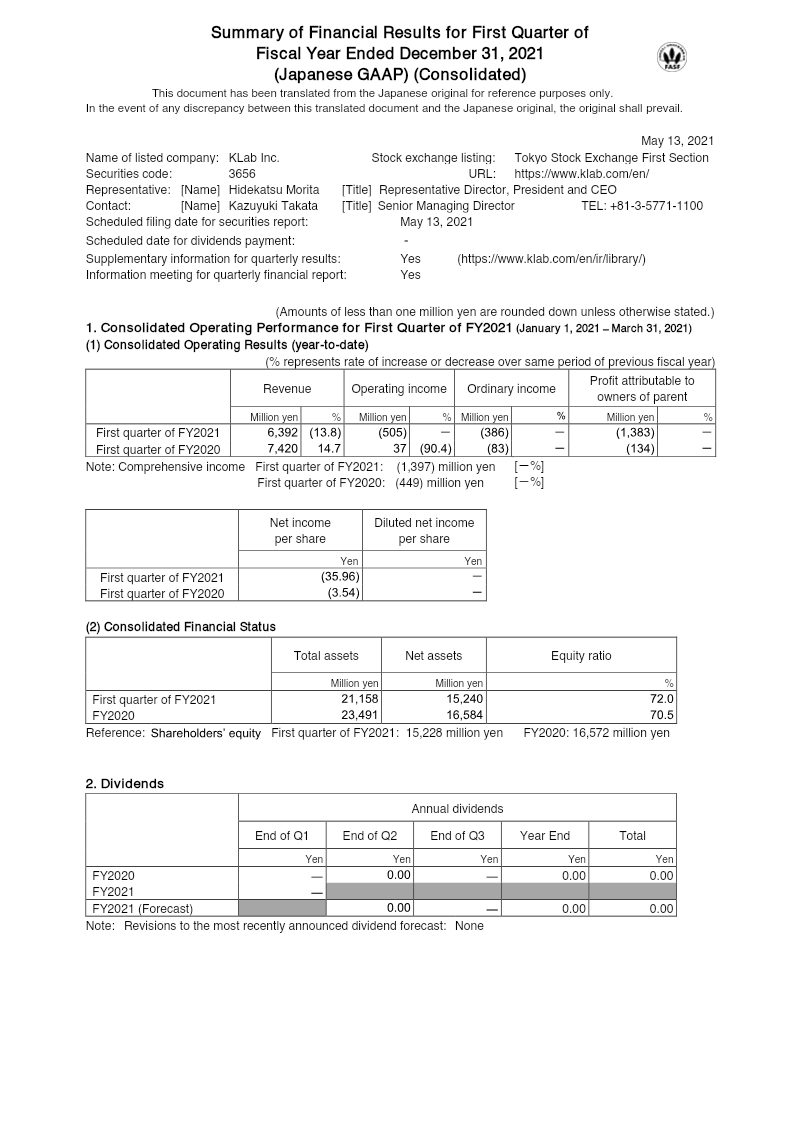
KLab Inc. reported a sharp decline in first‑quarter FY2021 operating performance compared with the same period of FY2020. Revenue fell to ¥6,392 million from ¥7,420 million, a 13.8% drop, while operating income turned negative at ¥(505) million versus a profit of ¥37 million in FY2020. Ordinary income and profit attributable to the parent also swung from a ¥(83) million loss to a ¥386 million loss, reflecting significant impairment charges of ¥1.54 billion on software assets that dominated the extraordinary loss line item. Comprehensive income deteriorated to a ¥1,397 million loss from a ¥449 million loss in FY2020, largely driven by the same impairment and foreign‑exchange losses.
Total assets decreased to ¥21.16 billion from ¥23.49 billion, with net assets falling to ¥15.24 billion and the equity ratio contracting from 70.5% to 72.0%. Cash and deposits were ¥6.38 billion, while current liabilities stood at ¥5.10 billion, leaving a modest working‑capital cushion. No dividends were declared for FY2021, and the company maintained its share‑repurchase program capped at ¥500 million.
The quarter’s financials were prepared under Japanese GAAP, with no changes to accounting principles or estimates. The company’s segment analysis shows the game business as the sole revenue generator, with a reported impairment loss of ¥1.54 billion recorded in this segment. A subsequent acquisition of GlobalGear Co., Ltd. was announced, aimed at expanding KLab’s casual‑game portfolio and global reach.
- KLab Inc. reported a 13.8% year-over-year revenue decline in Q1 2021, falling to ¥6,392 million from ¥7,420 million.
- Operating income swung to a ¥505 million loss compared to a ¥37 million profit in the same period of 2020.
- The company recorded a significant ¥1.54 billion impairment charge on software assets, which was the primary driver of a ¥386 million loss attributable to the parent company.
- Comprehensive income deteriorated significantly to a ¥1,397 million loss, exacerbated by the software impairment and foreign-exchange losses.
- Total assets decreased to ¥21.16 billion from ¥23.49 billion, though the company maintains a working-capital cushion with ¥6.38 billion in cash against ¥5.10 billion in current liabilities.
+1
KLab