Report1 pages
Wojciech Ozimek: Profile and Expertise
Wojciech Ozimek has led one2tribe Sp. z o.o. for eleven years as CEO, overseeing organizational growth, product launches, sales and key client relationships. Under his direction the company has co‑created more than a dozen mobile and internet services, as well as several online games that collectively attract four million subscribers worldwide. Ozimek’s expertise lies in designing business‑oriented games, gamification solutions and educational titles, positioning him as a proponent of integrating gaming into everyday life. He has spoken at TEDx Kraków (2011) and Hewlett Packard/Warsaw (2012), frequently presenting at business‑gaming conferences in Poland and abroad, and co‑authored articles on gamification.
Ozimek is a senior consultant with the international Cutter Consortium, contributing to “Business‑IT Strategies” and “Enterprise Architecture” teams. He authored the report “Storming the Cathedral: Collaborating for Innovation in Mobile Markets.” Within one2tribe he has led concept development for strategic projects, including a business model for interactive TV (iTVP) and advisory work on mobile content distribution for P4/Play, Heyah/PTC Era, and Polkomtel S.A. Prior to one2tribe, he managed the e‑business competency group and later served as Director of Development at Infovide (now Infovide‑Matrix), delivering architecture concepts for major clients such as Nordea Bank Polska, Telekomunikacja Polska S.A., PTC Era, Onet.pl, PTK Centertel and Kredyt Bank S.A. His notable project Nordea Solo earned the 2001 System Informatyczny Roku award.
Ozimek’s earlier career included a role in the IT team at Telekomunikacja Polska S.A., where he implemented intranet solutions for the MikroBOK system, one of Poland’s first distributed data collection platforms. He holds a bachelor’s degree in Mathematics, Computer Science and Mechanics from the University of Warsaw.
In recent years he has served on the boards of Flow Combine Sp. z o.o., SIP Consulting Sp. z o.o., and temporarily on the board of Flow Combine, a studio that published its sole title through 11 Bit Studios S.A. No records of insolvency, fraud convictions or court‑ordered prohibitions exist for Ozimek, and he has not held executive roles in companies undergoing bankruptcy or competing with 11 Bit Studios.
- Wojciech Ozimek has served as CEO of one2tribe for 11 years, overseeing the development of online games and services that have reached four million subscribers globally.
- His professional focus centers on gamification and business-oriented game design, supported by his role as a senior consultant for the Cutter Consortium’s Business-IT Strategies and Enterprise Architecture teams.
- Prior to one2tribe, Ozimek held leadership roles at Infovide, where he directed development and architecture for major clients including Nordea Bank Polska, Telekomunikacja Polska S.A., and Onet.pl.
- He led strategic advisory projects for telecommunications firms such as P4/Play, Heyah/PTC Era, and Polkomtel S.A., and developed business models for interactive TV (iTVP).
- His technical background includes a bachelor’s degree in Mathematics, Computer Science, and Mechanics from the University of Warsaw and early experience implementing distributed data collection platforms like MikroBOK.
+1
11 bit studios
Report43 pages
Videojuegos en el Aula: ¿Qué se está haciendo en España? Manual para docentes 2025
Video games have become a central cultural and educational tool in Spain, where more than 22 million people—over half of them women—play an average of 8.2 hours each week. This widespread engagement is leveraged to motivate learning, prompting the development of a coordinated ecosystem that supplies teachers with curated resources, professional training, and ready‑to‑use platforms such as Dok Student, Cokitos, Mundo Primaria, Eutopía and Escapeweb. Publicly funded titles like ABC Dinos, BookyPets and Quijote: Quest for Glory employ RPG, tower‑defense and card mechanics to reinforce early literacy, while historically grounded games such as Dîrok, Plus Ultra Legado and El Enigma de Toledo integrate rigorous research into curricula, supporting both STEM competencies and language development.
A parallel surge in health‑oriented games addresses the mental‑health concerns of Spanish adolescents, with 41 % reporting problems and one‑third never having discussed them. These applications aim to provide preventive support and therapeutic engagement within school settings. Meanwhile, esports and gamified learning are gaining institutional traction; a national competition rewards winning schools with €20 000 in technology, and industry partnerships like GGTech’s site visits illustrate viable career pathways. Complementary initiatives, such as Cruz Roja’s 150‑hour Unity programming course for unemployed youth and the Andalusian “Desafía & Aprende” program, further embed game design skills into broader employment strategies.
Overall, the Spanish educational landscape demonstrates a rapid, multi‑sectoral integration of video games that spans literacy, history, health, and vocational training, reflecting a strategic response to the medium’s pervasive cultural presence and its potential to enhance learning outcomes across the country.
- Spain’s gaming ecosystem is supported by over 22 million players, with women accounting for more than half of the user base and an average weekly playtime of 8.2 hours.
- Educational integration is facilitated by a standardized infrastructure of platforms including Dok Student, Cokitos, Mundo Primaria, Eutopía, and Escapeweb.
- Publicly funded titles like ABC Dinos, BookyPets, and Quijote: Quest for Glory utilize RPG and tower-defense mechanics to improve early literacy, while games like Dîrok and El Enigma de Toledo support STEM and history curricula.
- To address the 41% of Spanish adolescents reporting mental health concerns, schools are increasingly adopting therapeutic and preventive video game applications.
- Institutional support for esports and gamification includes a national competition offering €20,000 in technology prizes and industry-led career exposure through partners like GGTech.
+3
AEVIJan 2025
Report119 pages
Video Games in European Schools: Results from the Games in Schools 2023-2024 Research Project
Executive Summary – “Video Games in European Schools” (Based on the 2023‑2024 “Games in Schools” research project and the 25‑section document you provided)
| What we know | Key figures | Implications | |------------------|----------------|------------------| | Teacher attitudes & usage | • 1 474 teachers surveyed in 26 EU countries <br>• 63 % want more training <br>• Only 36 % currently use games; of those, 54 % use them regularly | There is strong demand for professional development, but adoption is still limited. | | Perceived benefits | • Boosts motivation, engagement, and inclusive learning <br>• Improves visuospatial cognition, attention, problem‑solving, creativity, collaborative skills, psychological capital (self‑efficacy, hope, resilience) <br>• Particularly helpful for low‑performing, special‑needs, and female students who play heavily | Games can be a lever for equity and 21st‑century competencies, but the impact varies by design and context. | | Barriers | • Difficulty finding age‑appropriate, curriculum‑aligned titles <br>• Limited teacher expertise & time <br>• Insufficient hardware, licences, and broadband <br>• Parental concerns (screen‑time, data‑privacy, violence) <br>• Lack of clear pedagogical frameworks & assessment tools | Overcoming these obstacles requires coordinated policy, funding, and teacher‑support structures. | | Enablers & best‑practice examples | • Belgium (Flemish) – “Education meets Games” events, strong focus‑group outcomes <br>• Italy – IVIPRO EDU, Maker Camp (Minecraft), Lega Scolastica esports league <br>• Poland – Free national rollout of This War of Mine with teacher guide <br>• Luxembourg – Dedicated “Digital Science” subject, Play Seriously handbook <br>• Sweden – Gamecamp programme (97 % transition to higher‑education pathways) | Nationally coordinated programmes that combine funding, teacher training, and curated game libraries are the most successful. | | Market context | • European video‑game market > €25 bn annually, 115 000 employees <br>• 53 % of Europeans play; ~50 % are women <br>• Industry bodies (Video Games Europe) and EU programmes (Horizon Europe, Creative Europe) are already positioning games as tools for education, inclusion, and wellbeing | A large, growing industry is ready to partner with schools, but alignment on educational goals is still needed. | | Research gaps
- While 53% of Europeans play video games and the industry exceeds €25 billion in annual revenue, only 36% of surveyed teachers currently use games in the classroom, with 63% explicitly requesting more professional training.
- Teachers who do integrate games report significant improvements in student motivation, problem-solving, and psychological capital, noting particular efficacy for special-needs, low-performing, and female students.
- The primary barriers to adoption include a lack of curriculum-aligned titles, insufficient hardware and broadband infrastructure, and parental concerns regarding screen time and data privacy.
- Successful national initiatives, such as Poland's rollout of 'This War of Mine' and Sweden's 'Gamecamp' program, demonstrate that coordinated government funding and curated game libraries are essential for effective classroom integration.
- Only 54% of the teachers who currently use games do so on a regular basis, highlighting a significant gap between initial adoption and sustained pedagogical implementation.
+1
European SchoolnetNov 2024
Report134 pages
Videojuegos en Aulas Europeas: Resultados del Proyecto de Investigación 'Juegos en las Escuelas 2023-2024'
The study evaluates how video‑games are being integrated into European primary and secondary classrooms and argues that, while games hold clear potential to enhance motivation, cognition and 21st‑century competencies, systematic support is still required to translate research into widespread practice. A 2023‑2024 survey of 1,474 teachers across 26 European nations reveals that 36 % already employ games in lessons, with more than half of those using them regularly and favouring puzzle‑ or narrative‑driven titles. The principal barriers reported are the difficulty of locating age‑appropriate, curriculum‑aligned and GDPR‑compliant games (45 %) and technical constraints such as insufficient hardware or internet access (42 %). Compared with a 2009 baseline, teachers now rate their digital competence higher (7.7 / 10), display more positive attitudes, and receive stronger backing from school leadership, yet further investment in training, infrastructure and coordinated policy is deemed essential.
A comprehensive taxonomy distinguishes action, adventure, RPG, simulation, sport and hybrid genres, and separates commercial‑off‑the‑shelf titles, serious games, gamified tools and game‑based learning approaches. Empirical work from 2009‑2024 consistently shows modest gains in intrinsic motivation, STEM and language achievement, spatial and attentional skills, and collaborative behaviours when games are thoughtfully aligned with learning objectives. Nonetheless, effects on higher‑order cognition remain uneven, and the literature suffers from heterogeneous definitions, limited longitudinal data and a scarcity of rigorous experimental designs.
Country‑level case studies illustrate both promise and obstacles. Inclusive esports programmes in Italy, digital‑science curricula in Luxembourg, and language‑focused game pilots in Poland and Romania demonstrate measurable improvements in communication, critical thinking and resilience, while chronic under‑funding, outdated hardware, parental scepticism, gender gaps and rigid curricula impede broader adoption. Across the region, teachers cite insufficient professional development, lack of time and compensation, and uncertainty about content safety as persistent challenges.
The overarching recommendation is a coordinated European framework that provides an ethically vetted, GDPR‑compliant repository of educational games, systematic teacher training, robust infrastructure funding, and longitudinal research to validate cognitive and health outcomes. By aligning industry partnerships, policy incentives and evidence‑based pedagogy, the initiative seeks to close the gap between game research and classroom practice, fostering inclusive, engaging learning environments throughout Europe.
- 36% of the 1,474 European teachers surveyed currently integrate video games into their lessons, with over half of those users employing them regularly.
- The primary barriers to adoption are the difficulty of finding age-appropriate, curriculum-aligned, and GDPR-compliant games (45%) and technical limitations such as inadequate hardware or internet access (42%).
- Teacher digital competence has risen to a self-reported 7.7/10 since the 2009 baseline, supported by more positive attitudes and increased backing from school leadership.
- Empirical evidence from 2009–2024 confirms that games, when aligned with learning objectives, produce modest gains in intrinsic motivation, STEM and language achievement, and collaborative behaviors.
- Despite positive trends, the field lacks rigorous longitudinal data and suffers from inconsistent definitions, making the effects of gaming on higher-order cognition remain uneven.
+2
European SchoolnetNov 2024
Report64 pages
Videojuegos en el Aula: Guía para un Aprendizaje Adecuado
The guide argues that video games, when deliberately selected and scaffolded, can become powerful learning tools across primary, secondary and vocational settings. By positioning games along a continuum from free play to structured, teacher‑guided activities, educators can align specific game mechanics—joy, meaning, immersion, challenge and agency—with curricular objectives, thereby fostering both cognitive and affective outcomes.
Empirical evidence shows that the $180 billion global games market, with more than three billion active players (over half of Europeans aged 6‑64 and 70 % of those 6‑24), can support cooperative, discovery‑based and project‑based learning. Systematic reviews and studies such as Parker & Thomsen 2019 link core game characteristics to measurable gains in attention, memory, problem‑solving, literacy and even clinical assessment for ADHD. Narrative‑driven titles (e.g., Florence, Mutazione) are already classified as literary texts in Scotland and Poland, while language‑learning apps and exergames extend benefits to vocabulary, pronunciation and physical health. Multiplayer and emotionally charged games are shown to develop empathy, self‑regulation and ethical reasoning, with data from a Flemish suicide‑prevention project confirming social‑emotional growth.
Practical integration strategies emphasize alignment with national curricula, use of in‑game metrics for assessment, and gamification elements such as digital badges and leaderboards. Open‑world and historically themed games (Minecraft, Assassin’s Creed Discovery Tour, Age of Empires) serve as contextual nodes for interdisciplinary projects, while creation platforms—from Scratch Jr to RPG Maker—enable progressive skill development in coding, storytelling and design. The guide also highlights industry disparities (71 % male developers, low representation of women and Black creators) and urges inclusive curricula to broaden participation.
Health considerations note the WHO’s classification of gaming disorder in ICD‑11, but research indicates problematic use remains a minority, often driven by micro‑transaction models. Recommendations include reliance on PEGI age ratings and parental
- Video games are effective pedagogical tools that improve cognitive functions like memory and problem-solving, with studies such as Parker & Thomsen (2019) linking game mechanics to measurable gains in literacy and clinical ADHD assessment.
- The global games market now encompasses over three billion active players, including 70% of Europeans aged 6–24, providing a massive, accessible platform for cooperative and project-based learning.
- Educational integration is most successful when educators use a continuum from free play to structured activities, utilizing titles like Minecraft and Assassin’s Creed Discovery Tour to support interdisciplinary curricula.
- Games are increasingly recognized as legitimate academic texts and social-emotional tools, with narrative titles like Florence and Mutazione used as literature in Scotland and Poland, and multiplayer games shown to foster empathy and ethical reasoning.
- Creation platforms such as Scratch Jr and RPG Maker allow students to develop technical skills in coding and design, while gamification elements like digital badges provide new methods for tracking student progress.
+1
European SchoolnetAug 2023
Report36 pages
Vägar in i spelbranschen: Kompetens, utbildning och konsten att skapa spel (2023)
The Swedish game industry is currently experiencing a critical talent shortage that threatens its long-term competitiveness and growth. With the sector recording 1,348 new hires in 2021 alone, domestic educational institutions are failing to meet demand, producing fewer than half of the required professionals. This imbalance is exacerbated by the rapid expansion of the industry and the lack of official recognition for game development as a formal academic discipline, which complicates data tracking and strategic planning. To sustain its global standing, the industry must bridge the gap between educational output and the evolving needs of studios, particularly in core disciplines such as programming, design, and graphics.
The Swedish educational landscape is characterized by a robust ecosystem of vocational programs and academic institutions that prioritize project-based, team-oriented learning. While these programs are highly effective at producing job-ready graduates, the reliance on international recruitment remains essential, with roughly one-third to half of the workforce originating from abroad. However, this dependency is hampered by significant bureaucratic obstacles, including restrictive work permit policies for non-EU vocational students and complex regulations regarding international remote work. Furthermore, the industry faces persistent challenges related to housing shortages and the need to improve gender diversity within the workforce.
To ensure future stability, the industry must foster closer alignment between academic research funding and practical studio requirements. Strengthening the pipeline for domestic talent while simultaneously streamlining pathways for international professionals is vital. By formalizing game development within the academic framework and addressing the administrative barriers that currently impede the retention of global talent, Sweden can maintain its position as a leading hub for game development. These systemic adjustments are necessary to transform the current recruitment bottleneck into a sustainable model for continued innovation and economic success.
- The Swedish game industry faces a critical talent shortage, with domestic educational institutions producing fewer than half of the professionals required to meet the demand of 1,348 new hires recorded in 2021.
- Between one-third and one-half of the current Swedish game industry workforce consists of international talent, highlighting a heavy reliance on global recruitment to sustain growth.
- Restrictive work permit policies for non-EU vocational students and complex regulations regarding international remote work act as significant bureaucratic barriers to maintaining the necessary talent pipeline.
- The lack of official recognition for game development as a formal academic discipline hinders effective data tracking and strategic planning for the sector.
- Industry growth is further constrained by domestic infrastructure challenges, specifically persistent housing shortages and a need to improve gender diversity within the workforce.
+1
DataspelsbranschenJan 2023
Report14 pages
Videojuegos en el aula
Spanish educators are progressively integrating video games into classroom practice, positioning interactive media as legitimate learning tools rather than mere entertainment. The manual demonstrates that, when combined with teacher training, games can stimulate creativity, empathy and digital competence, providing an engaging complement or alternative to traditional textbooks. Initiatives such as AEVI’s “The Good Gamer,” the nationwide rollout of Minecraft Education Edition, and locally developed titles—including EduZland, BetterWorld, Planet Rescuers, Koral and Endling—are now employed in more than a thousand schools to address subjects ranging from mathematics and language to civic values, environmental stewardship and mental‑health awareness.
A thriving ecosystem of Spanish‑origin serious games supports this pedagogical shift. Projects like Teacher+, Diana frente al espejo, Academons, Villi Adventures, 200 y +, Bailando un Tesoro, Poky Drivers, JUNIOR Esports, Futuros Talentos, Nintendo ESNE, EVAD Kids and Minecraft Education target a broad spectrum of curricular content—science, language, history, health and safety—and promote transversal values such as equality, anti‑bullying, teamwork and sustainability. The breadth of offerings illustrates a coordinated effort to embed game‑based learning across primary and secondary education.
The landscape is reinforced by a wide coalition of Spanish game developers, publishers and academic programs, including major studios such as Riot Games, Ubisoft and Take‑Two Interactive, alongside numerous university‑based game schools. This cross‑sector network is linked to the broader European context through the Interactive Software Federation of Europe, which represents trade associations from eighteen European nations and leading global companies. Together, these actors create a robust, responsible and economically vibrant environment for video‑game education and production throughout Spain and the wider European market.
- Video games are being integrated into over 1,000 Spanish schools as legitimate pedagogical tools to teach subjects ranging from mathematics and language to civic values and mental health.
- The Spanish educational ecosystem utilizes a diverse portfolio of serious games, including Minecraft Education Edition, EduZland, BetterWorld, Planet Rescuers, Koral, Endling, and Teacher+.
- Game-based learning in Spain is supported by a broad coalition of major global publishers, including Riot Games, Ubisoft, and Take-Two Interactive, alongside specialized university-based game schools.
- Educational initiatives such as AEVI’s 'The Good Gamer' and various locally developed titles are being used to foster transversal skills like empathy, creativity, digital competence, and teamwork.
- The Spanish sector is aligned with the broader European market through the Interactive Software Federation of Europe, which coordinates trade associations across eighteen nations to support responsible game production.
AEVIJan 2023
Report38 pages
Videojuegos en el Aula: Qué se está haciendo en España
¡Hola! 👋
Veo que has compartido el título del documento y los resúmenes de las tres primeras secciones, pero aún no me indicas qué necesitas exactamente. Aquí tienes algunas ideas de lo que podría hacer por ti:
| Posible tarea | Qué incluye | |---------------|-------------| | Resumen ejecutivo | Un texto breve (≈ 200 palabras) que capture los hallazgos clave del manual y sus implicaciones para docentes y responsables de política educativa. | | Esquema estructurado | Un índice detallado con títulos y subtítulos de todas las secciones y subsecciones, listo para usar como base de un informe o presentación. | | Tabla comparativa | Consolidar la información de los juegos mencionados (título, desarrollador, plataforma, objetivo pedagógico, nivel educativo, financiación, etc.) en una tabla única y fácil de consultar. | | Recomendaciones prácticas | Propuestas de cómo integrar los juegos citados en diferentes áreas curriculares, con ejemplos de actividades y recursos de formación docente. | | Análisis de tendencias | Identificar los patrones más relevantes (p.ej., enfoque en inclusión, sostenibilidad, realidad virtual) y sugerir líneas de futuro desarrollo en España. | | Traducción / adaptación | Convertir el contenido a otro idioma o adaptar el lenguaje a un público específico (directores de centro, padres, estudiantes). | | Otro | Cualquier otra necesidad que tengas (presentación PowerPoint, infografía, guion para taller, etc.). |
¿Qué te gustaría que hiciera?
1. Selecciona una de las opciones de la tabla anterior (o combina varias). 2. Indica el nivel de detalle que prefieres (p.ej., resumen muy breve vs. informe completo). 3. Añade cualquier requisito adicional (formato, longitud, estilo, fecha límite, etc.).
Con esa información podré entregarte exactamente lo que necesitas. ¡Quedo a la espera!
- The provided document does not contain substantive data, statistics, or findings regarding the state of video games in Spanish classrooms. The content is limited to a meta-discussion about potential ways to summarize a report rather than the report itself. Consequently, no factual insights regarding the integration of video games in education can be extracted from the provided text.
+1
AEVIJan 2023
Report98 pages
Uso de Videojuegos Didácticos en el Aula: Pautas para el Éxito del Aprendizaje
The central aim is to furnish educators with an evidence‑based framework for selecting, deploying and assessing video‑games that serve pedagogical goals, arguing that, when moderated and integrated with clear learning objectives, digital games can substantially enrich cognition, spatial‑motor development, ICT competence and student motivation. The thesis contends that well‑designed, age‑appropriate games are not merely supplementary tools but can function alongside—or in some cases replace—traditional textbooks, provided that implementation follows structured guidelines and post‑play debriefing.
Empirical studies cited across the material demonstrate that personalization of difficulty and immediate feedback sustain engagement and translate into measurable gains in mathematics, geography, health, ethics and language outcomes. Serious‑game applications range from mobile‑AR health simulators to environmental awareness titles, while game‑jam events are shown to boost technical confidence, collaborative skills and coding proficiency. A detailed taxonomy links specific genres—action, puzzle, RPG, simulation—to targeted competencies, and a practical checklist emphasizes low‑spec technical requirements, PEGI age ratings, intuitive interfaces and progress monitoring. Accessibility adaptations for visual, auditory, cognitive and physical impairments are outlined, though further development is needed for visually‑impaired learners.
The scope encompasses Spanish‑language initiatives and broader international examples, covering primary to secondary education and spanning the period up to the early 2020s. It addresses multiple industry segments, including educational software, serious‑game developers, AR/VR health applications, learning‑management systems and community‑driven game‑jam platforms. Data from national campaigns such as “The Good Gamer” indicate adoption in over a thousand schools, with documented improvements in engagement metrics, competency tracking and interdisciplinary learning.
Conclusions stress that balanced, safe play—limited by time, monitored for health concerns, and anchored by teacher‑led debriefs—maximizes the cognitive, affective and behavioral benefits of game‑based learning. The provision of curated lesson plans, MOOCs, and extensive resource lists equips teachers to integrate games effectively, fostering creativity, empathy and social interaction while supporting academic achievement and well‑being.
- Structured integration of video games into curricula—supported by teacher-led debriefing and clear learning objectives—significantly improves student performance in mathematics, geography, health, ethics, and language.
- National initiatives like 'The Good Gamer' have successfully scaled game-based learning to over 1,000 schools, demonstrating measurable gains in student engagement, competency tracking, and interdisciplinary learning.
- Effective pedagogical deployment relies on selecting age-appropriate titles based on PEGI ratings and utilizing a taxonomy that matches specific genres, such as RPGs or simulations, to targeted cognitive and technical competencies.
- Game-jam events serve as a proven method for increasing student technical confidence, coding proficiency, and collaborative skills.
- Maximizing cognitive and behavioral benefits requires a balanced approach that includes time-limited play, health monitoring, and the use of curated lesson plans to anchor digital experiences in academic goals.
+1
EUN Partnership AISBLJan 2022
Report14 pages
Videojuegos en el aula: ¿Qué se está haciendo en España? Manual para docentes
Spanish educators are increasingly embracing video games as legitimate pedagogical tools, recognizing their capacity to foster creativity, decision‑making, empathy and social interaction. Initiatives such as the “The Good Gamer” guide produced by the Association of Video Game Educators (AEVI) and the incorporation of titles like Minecraft Education Edition illustrate a shift toward using interactive media for subjects ranging from biodiversity and water‑management to digital competence. A diverse portfolio of serious‑games and gamified projects now supports classroom instruction, including bullying‑prevention applications such as Diana frente al espejo and Teacher+, curriculum‑reinforcement platforms like Academons and Villi Adventures, and culturally oriented experiences from museum tours to ballet simulations. These resources are employed not only to convey academic content but also to develop social‑emotional skills and preserve cultural heritage.
Collaboration across the ecosystem is extensive. Major industry players—including EA, Microsoft, Nintendo, Ubisoft and Take‑Two—alongside numerous independent studios, are partnering with Spanish universities and specialized schools such as Universidad Complutense, Universidad de La Coruña and Voxel School. This coalition is coordinated through bodies like the Interactive Software Federation of Europe, facilitating the design, testing and deployment of classroom‑based video‑game projects. The convergence of commercial expertise, academic research and educational policy signals a systemic endorsement of games as a core component of modern curricula throughout Spain, reflecting a broader European trend toward integrating interactive technology into formal learning environments.
- Spanish education is integrating video games as formal pedagogical tools to teach subjects ranging from biodiversity and water management to digital competence.
- Major industry players including EA, Microsoft, Nintendo, Ubisoft, and Take-Two are actively partnering with Spanish universities like Universidad Complutense and Voxel School to develop and deploy classroom projects.
- Gamified resources are being utilized for social-emotional development, specifically through bullying-prevention applications such as 'Diana frente al espejo' and 'Teacher+'.
- Curriculum-reinforcement platforms like 'Academons' and 'Villi Adventures' are being deployed alongside 'Minecraft Education Edition' to support standard academic instruction.
- The adoption of these tools is coordinated by organizations such as the Association of Video Game Educators (AEVI) and the Interactive Software Federation of Europe to align commercial expertise with educational policy.
AEVIJan 2020
Report46 pages
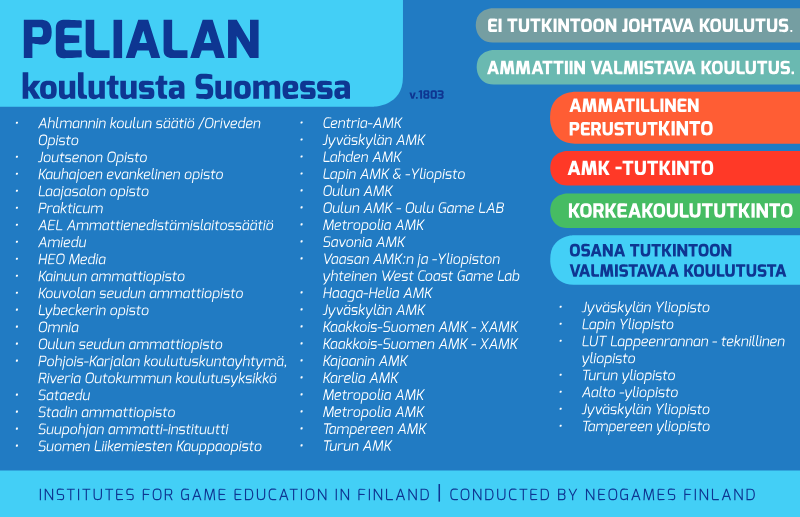
Koulutusta Suomessa
• Ahlmannin koulun säätiö /Oriveden • Opisto • • Joutsenon Opisto • • Kauhajoen evankelinen opisto • • Laajasalon opisto • • Prakticum • • AEL Ammattienedistämislaitossäätiö • • Amiedu • • HEO Media • • Kouvolan seudun ammattiopisto • • Lybeckerin opisto ...
- Finland offers a wide range of game industry education, from vocational training to university degrees, including programs focused on game programming, design, art, and business.
- Vocational education (AMMATILLINEN PERUSTUTKINTO) includes programs like Datonomi, Media-alan perustutkinto (Animation and Game Industry), and Peliohjelmoija, with durations typically ranging from 2 to 3 years.
- Universities of Applied Sciences (AMK) offer Bachelor's degrees (AMK-TUTKINTO) in fields such as Information Processing (Tietojenkäsittely) and Culture and Arts (Game Design), generally lasting 3.5 to 4 years.
- Several institutions offer non-degree game-related training, such as 'Kohti Pelialaa' at Joutsenon Opisto (9 months, 31 ECTS), 'Spelproduktion' at Prakticum (1 year, 60 ECTS), and 'Pelisuunnittelu' at HEO Media (9 months, 60 ECTS).
- Specialized programs exist, like Oulu Game LAB (Oulun AMK), West Coast Game Lab (Vaasan AMK & Yliopisto), and Metropolia AMK's 3D-animation and visualization with a focus on game graphics.
+1
Neogames FinlandJan 2018