Digital Games
Company
Documents about Digital Games
The Hong Kong Past Made in the Digital Present: Playing with the (Un)familiar and (In)authentic
This article by Jamie W.T. Tse, published in the Transactions of the Digital Games Research Association (Vol. 7 No 3, pp.
- The author argues that the two games are inauthentic in their depictions of Hong Kong yet still thrive as symbols of nostalgia, and that their meaning is continually renegotiated through play.
- Kowloon's Gate requires players to explore four other reimagined places in Hong Kong besides the main Kowloon Walled City stage, including Chungking Garden and Bailey Street.
- The Chinese subtitles in the 2014 Definitive Version of Sleeping Dogs are described as often imprecise compared with idiomatic written Chinese and spoken Cantonese, and a hostile NPC's vulgar line is flattened into a neutral translation.
SAVEstate: A Method for Documenting Player Reflection in Digital Games
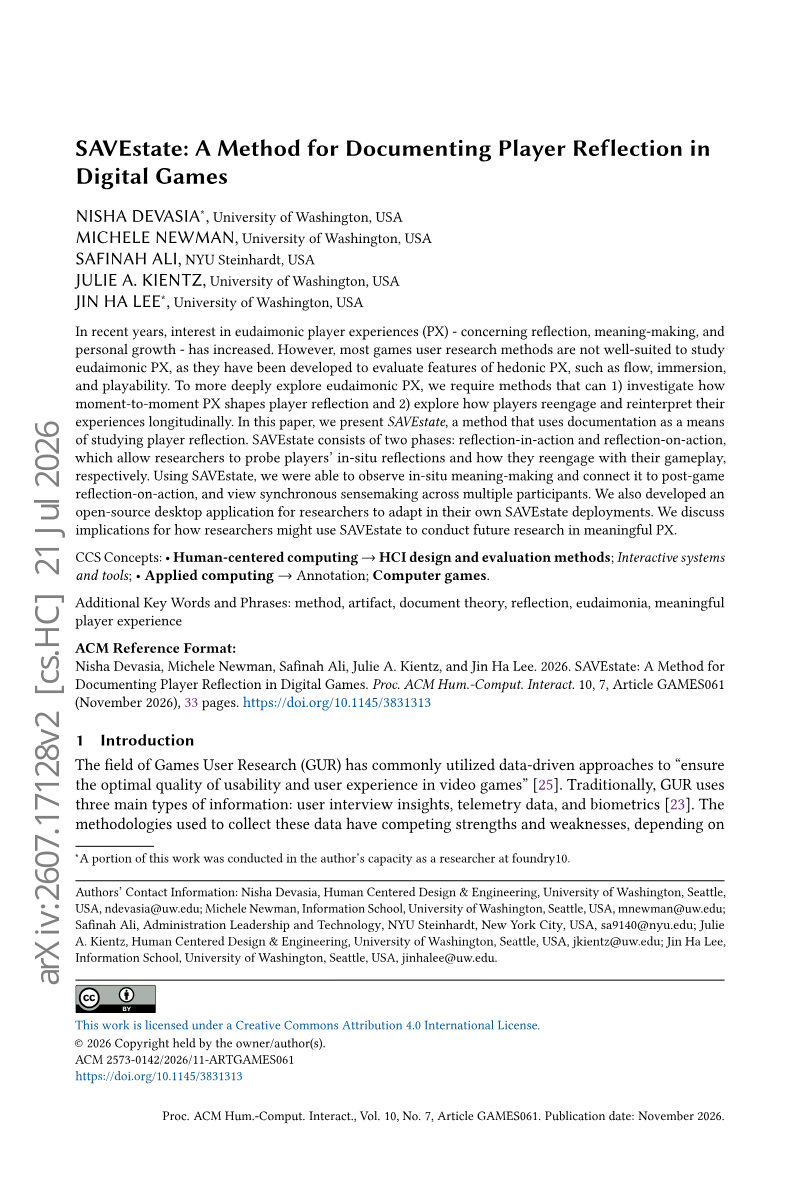
The authors present SAVEstate, a method for studying player reflection in digital games, built around documentary annotation.
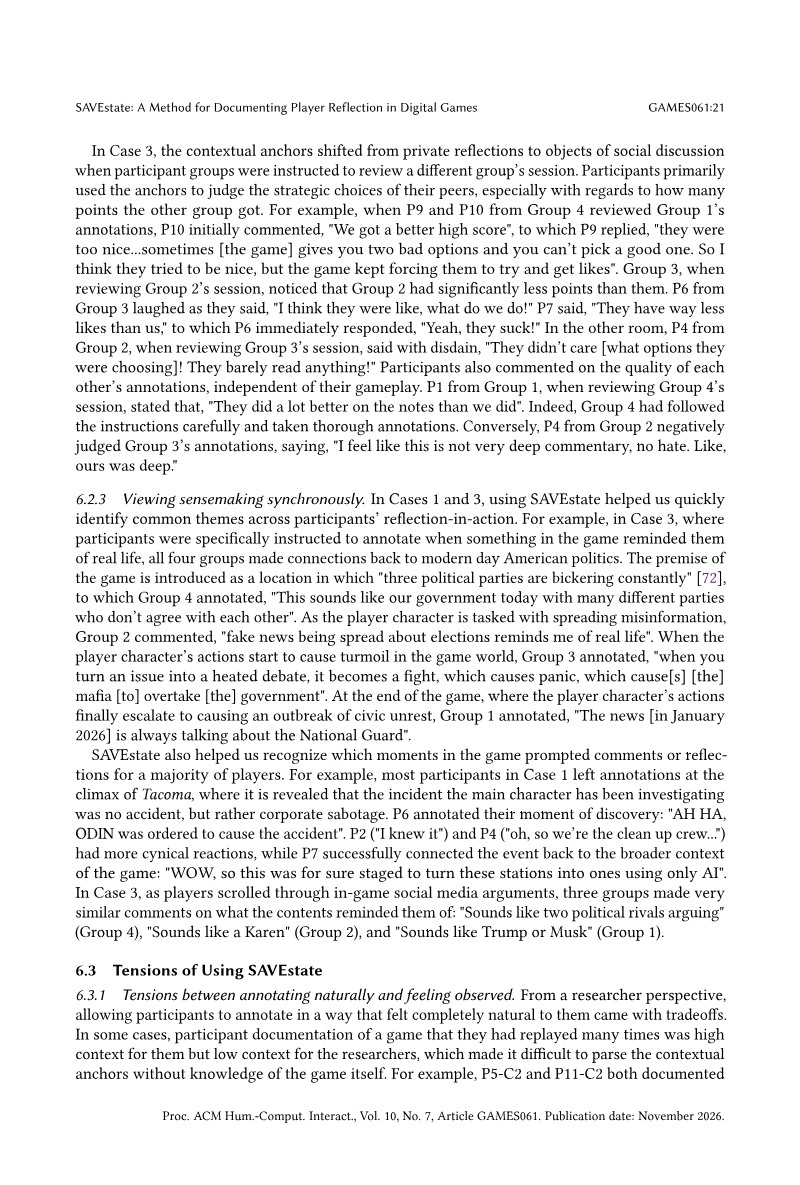
- In the adult naturalistic study, participants rated SavePoint's usability at a mean SUS score of 70.6, and the authors attribute immersion breaks to the act of reflecting rather than to the system.
- Some participants felt the documenting process reduced their emotional engagement with the game, as they focused more on events than on their feelings.
- The authors observed that some adult participants changed their behavior because they knew researchers would review their documents.
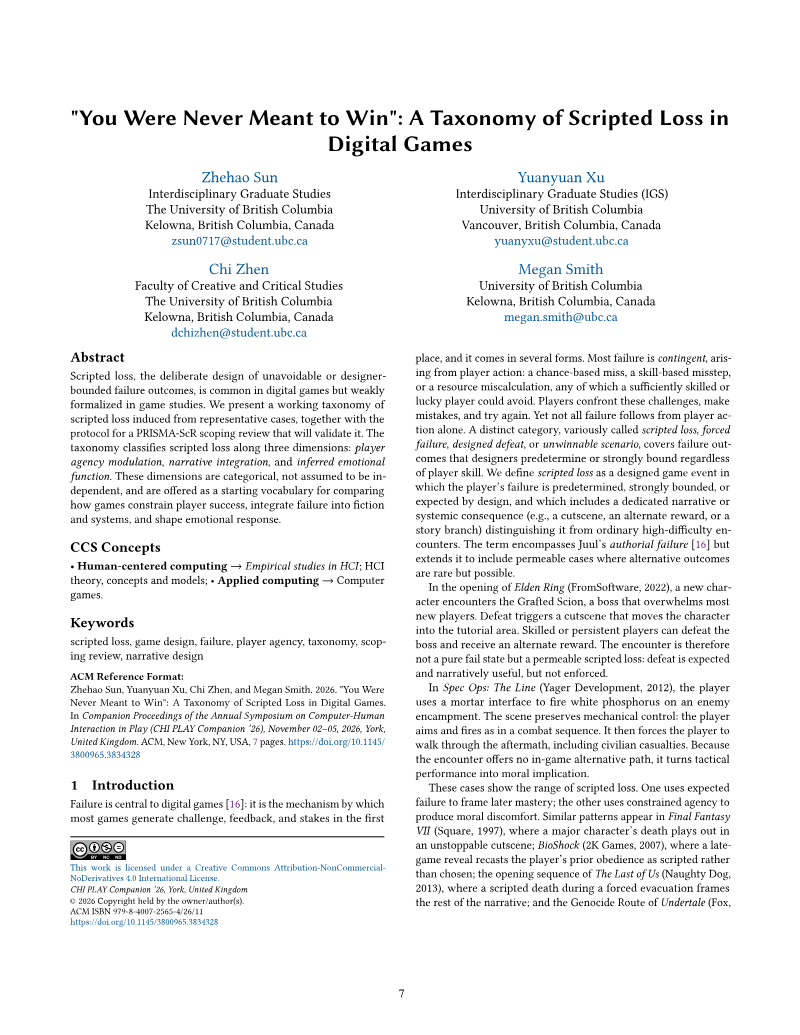
"You Were Never Meant to Win": A Taxonomy of Scripted Loss in Digital Games
The paper, by Sun, Xu, Zhen and Smith of the University of British Columbia, is a work-in-progress report on scripted loss in digital games, meaning designer-predetermined or strongly bounded failure.
- The authors define scripted loss as a designed event whose failure is predetermined or strongly bounded and that includes a dedicated narrative or systemic consequence, distinguishing it from ordinary high-difficulty encounters.
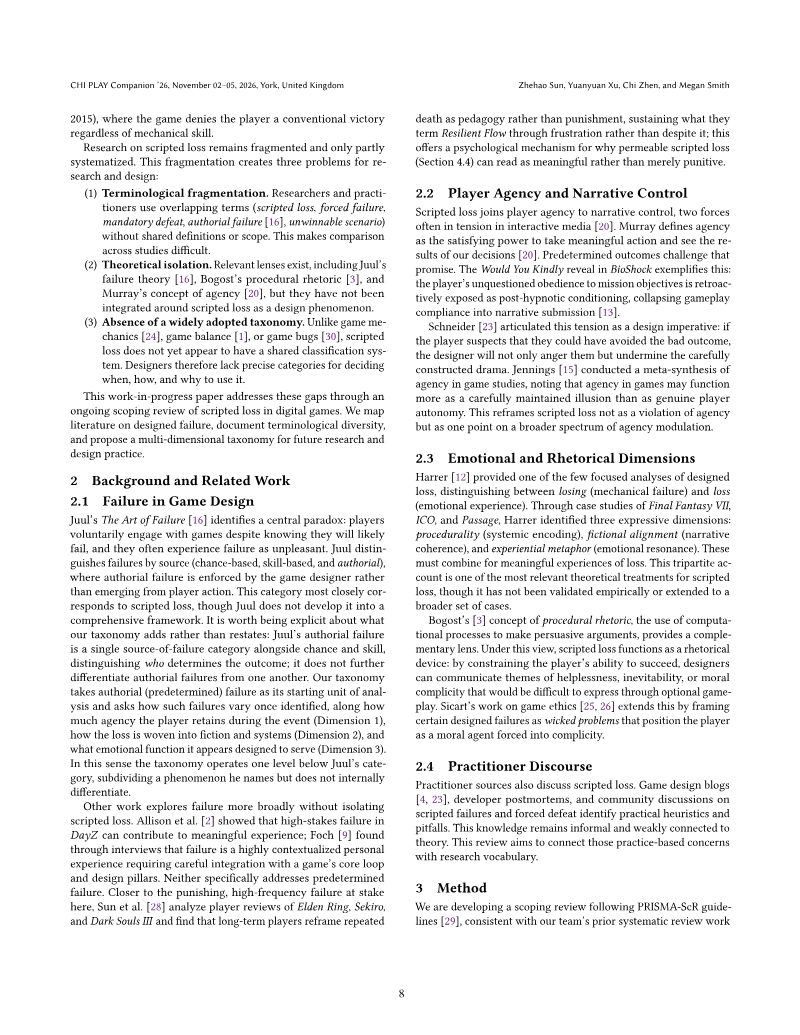
- The authors identify terminological fragmentation as a problem, noting that researchers and practitioners use overlapping terms without shared definitions, which makes comparison across studies difficult.
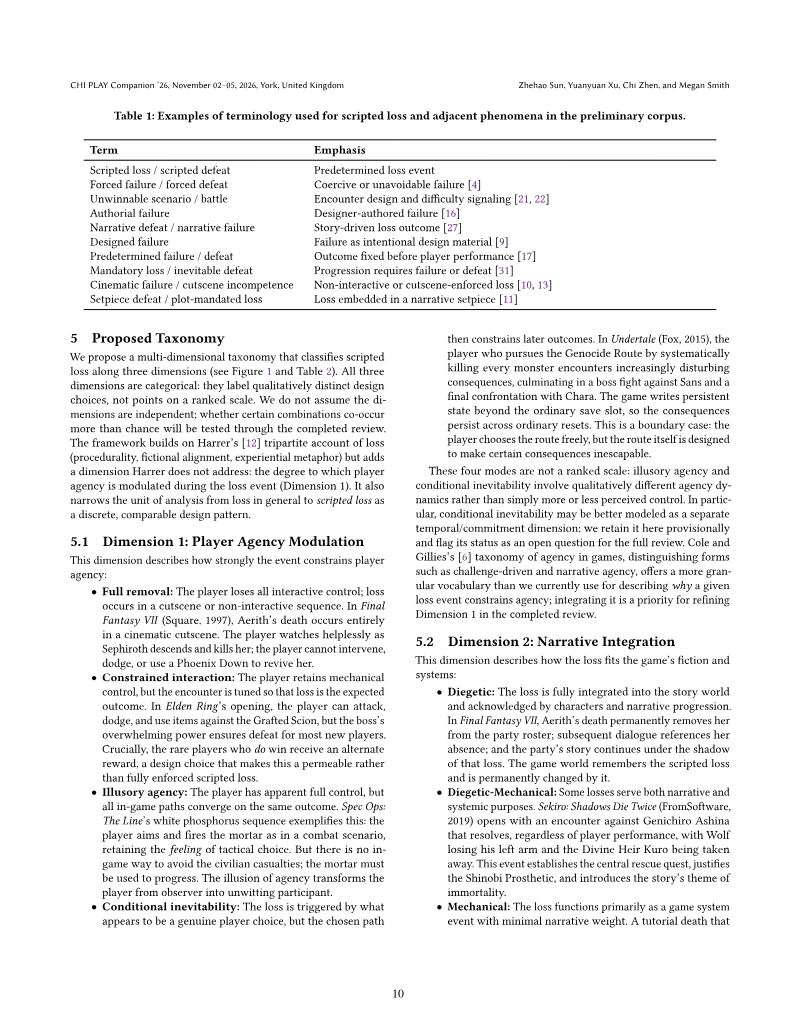
- The proposed taxonomy's first dimension, player agency modulation, has four categories: full removal, constrained interaction, illusory agency, and conditional inevitability.
Waiting for Support: Avoidance Motivation and Role Selection in Digital Games
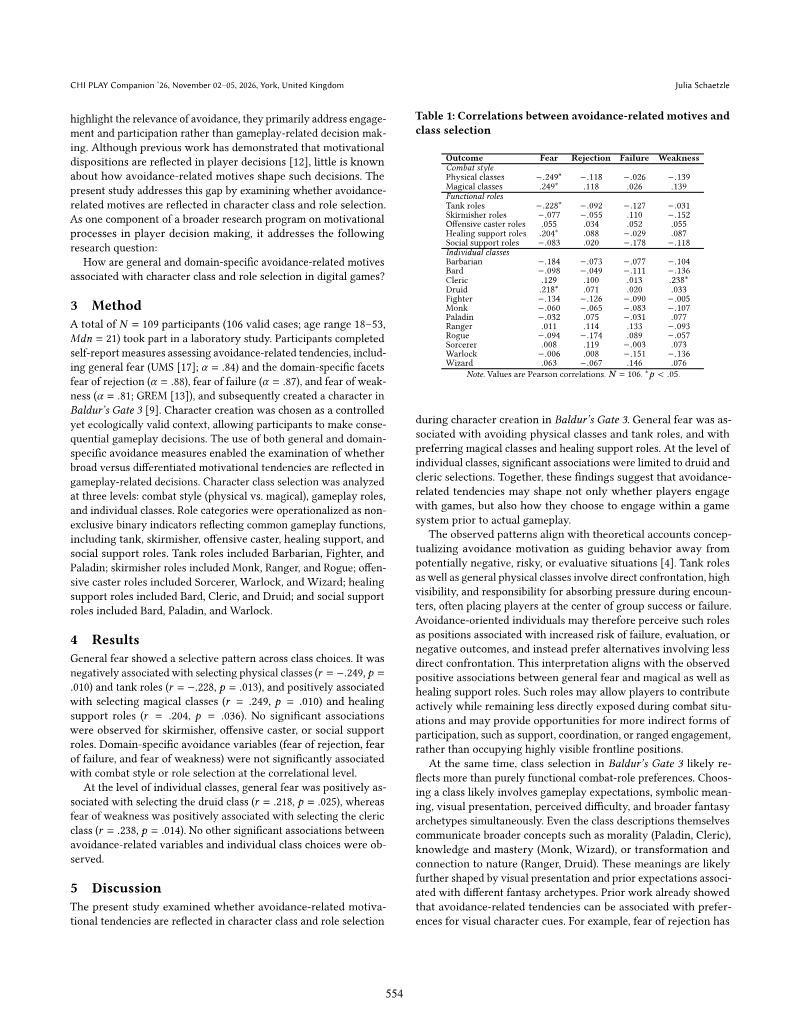
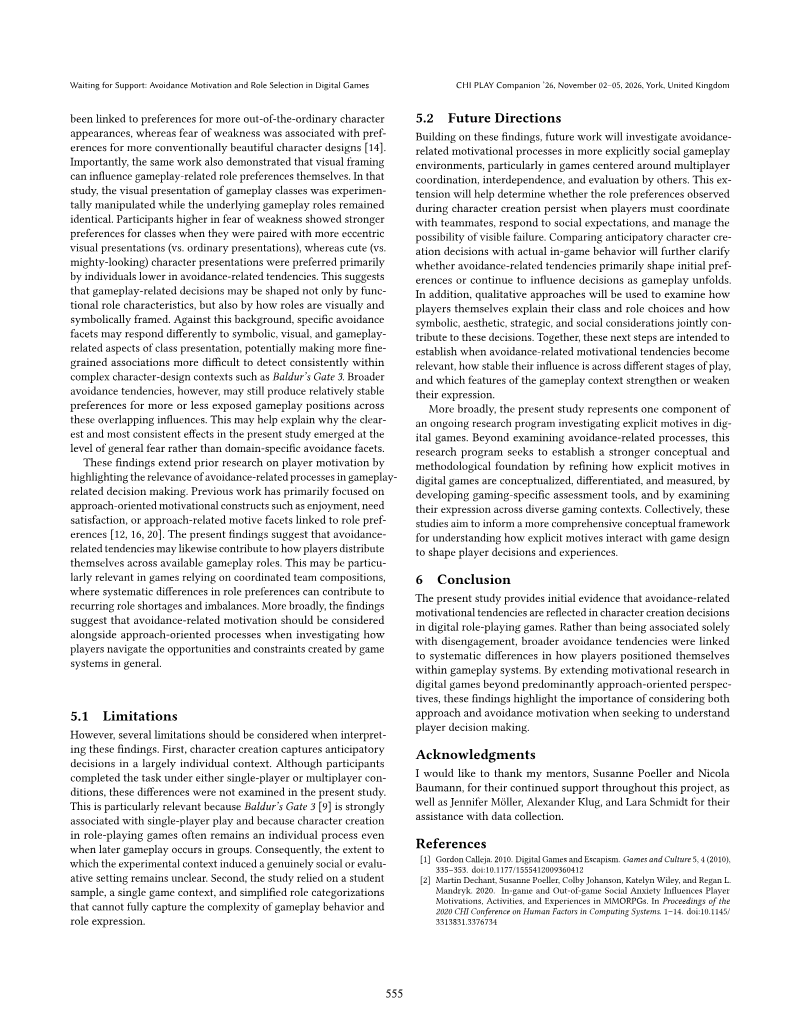
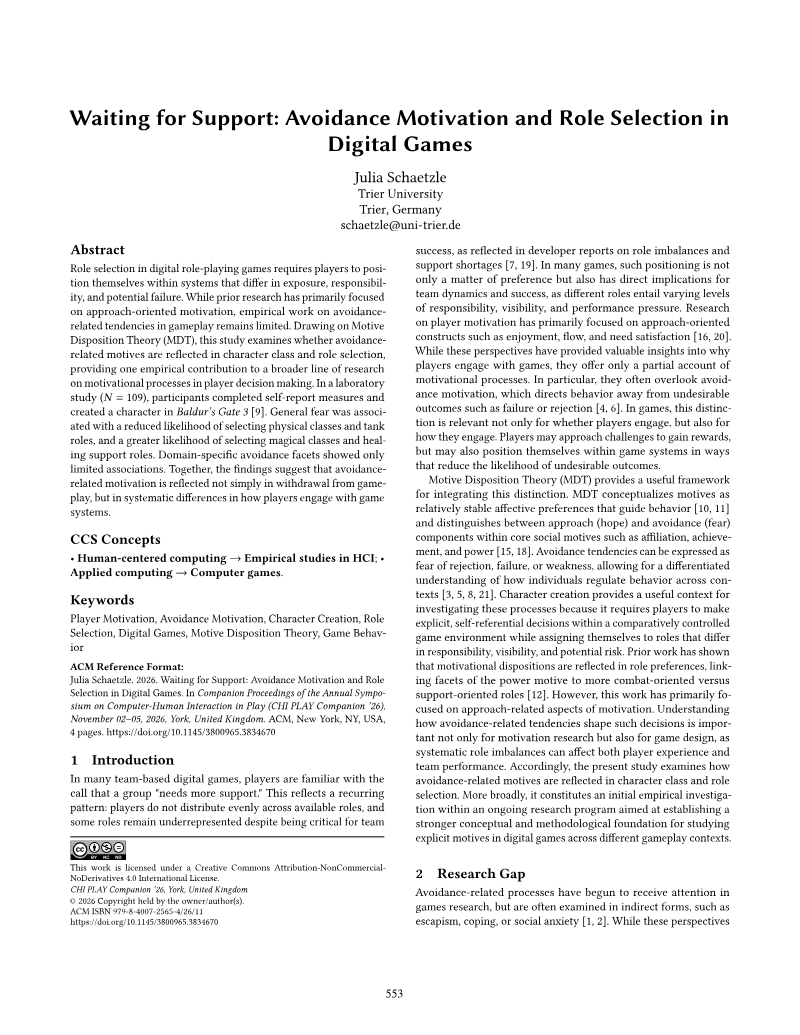
Julia Schaetzle of Trier University reports a laboratory study (N = 109; 106 valid cases; ages 18 to 53) examining whether avoidance-related motives are reflected in character class and role selection in digital games.
- General fear was negatively associated with selecting physical classes and tank roles, and positively associated with magical classes and healing support roles.
- Domain-specific avoidance facets showed only limited associations with class and role choices.
- At the individual class level, general fear was positively associated with selecting the druid, whereas fear of weakness was positively associated with selecting the cleric.
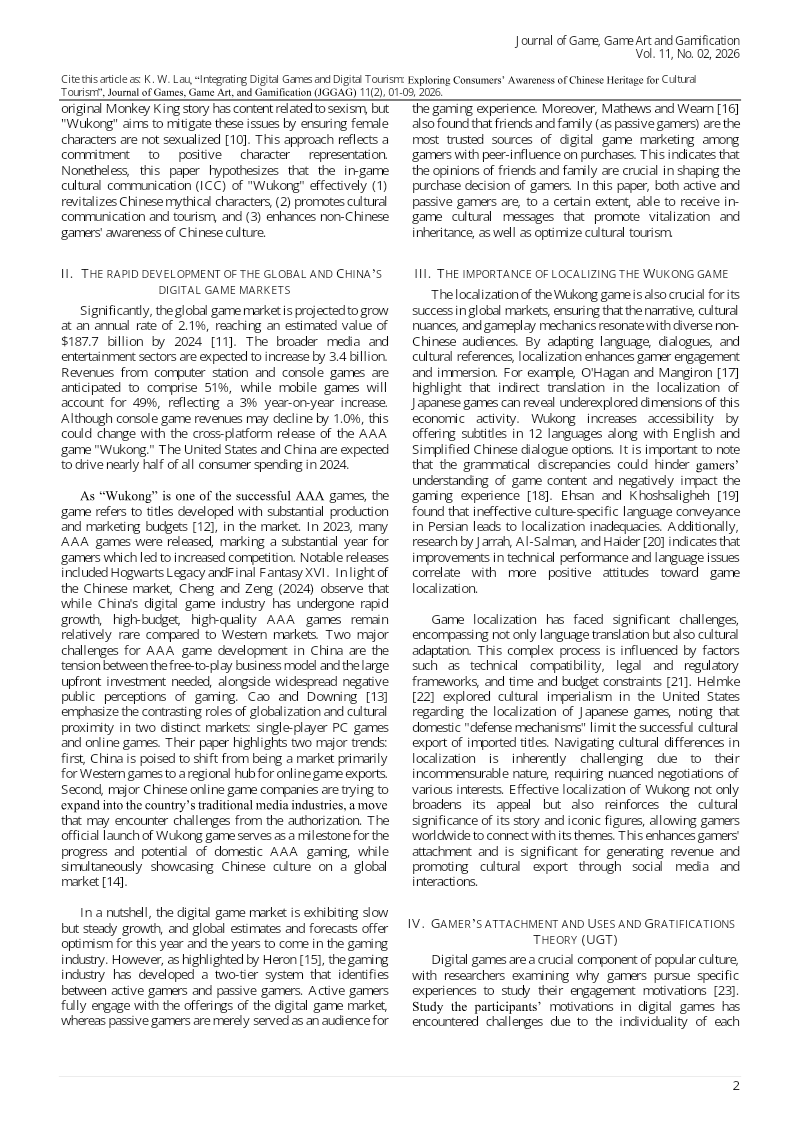
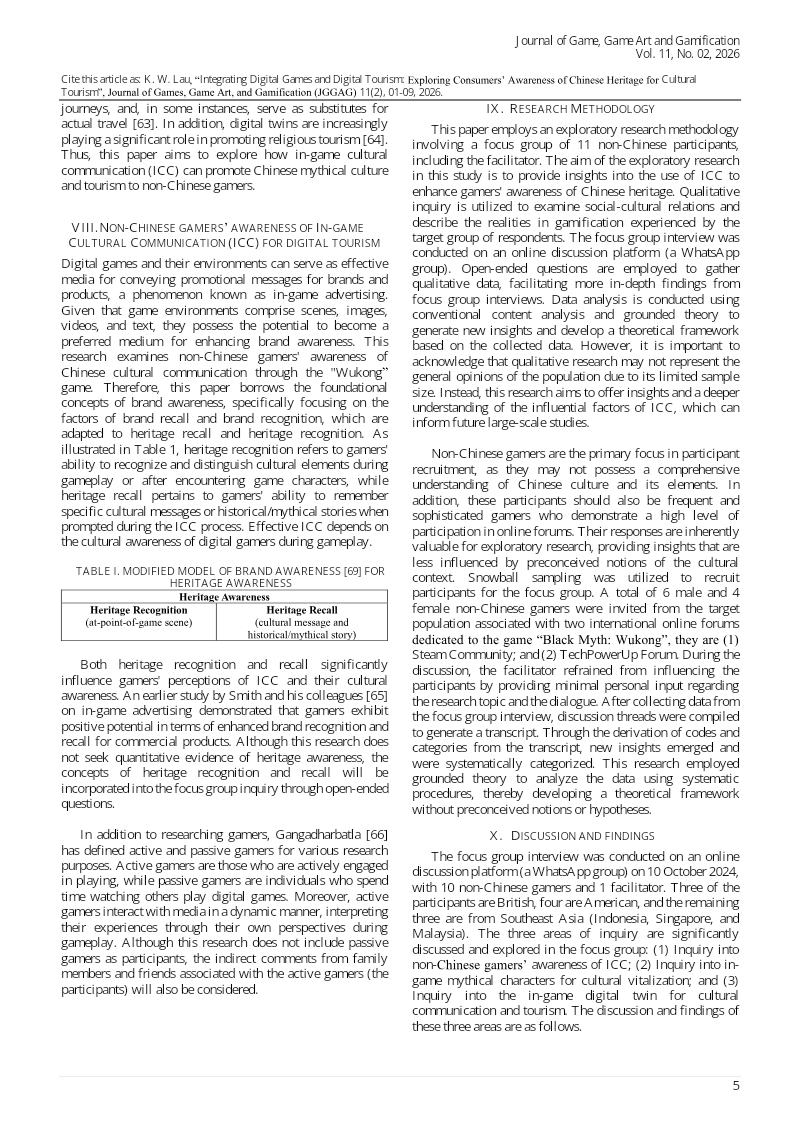
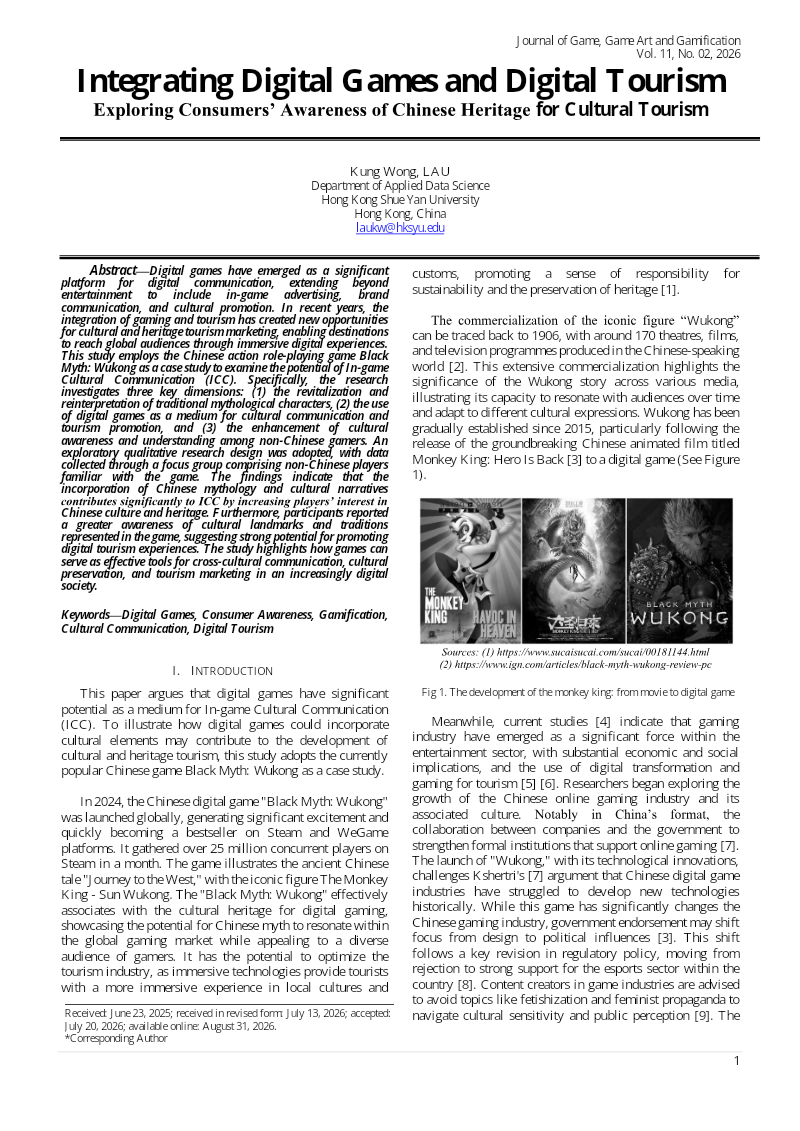
Integrating Digital Games and Digital Tourism: Exploring Consumers’ Awareness of Chinese Heritage
Lau, of Hong Kong Shue Yan University's Department of Applied Data Science, uses an exploratory qualitative design to examine how the Chinese action role-playing game Black Myth: Wukong communicates Chinese heritage to non-Chinese gamers and supports cultural tourism.
- Eight of the 10 participants, particularly all Western gamers, agreed that in-game cultural communication effectively increased their interest in visiting the actual locations represented as digital twins in the game.
- All participants reported reaching both heritage recognition and heritage recall, and non-Chinese gamers remembered specific cultural messages and the mythical meanings linked to them.
- Participants said their understanding of Chinese cultural concepts improved significantly, particularly through the personalities of the yaoguai, their environments and their distinct weapons.



Modernities of Authenticity in Recreated Online Digital Games: A Comparative Case Study
This paper examines how nostalgic game recreations construct authenticity, using a comparative case study of two projects that attempt to restore earlier versions of online games: World of Warcraft Classic, a recreation of the 2006 "Vanilla" version of World of Warcraft, and Team Fortress 2 Classified, a community-developed mod…
- The paper compares two nostalgic game recreations: World of Warcraft Classic, a recreation of the 2006 'Vanilla' version of World of Warcraft, and Team Fortress 2 Classified, a community-developed mod re-imagining Team Fortress 2's 2008–2009 era.
- It reframes the question from whether restorations are accurate to how different philosophies of authenticity, drawn from postmodern and post-postmodern perspectives, shape nostalgic design and play.
- World of Warcraft Classic is described as a 'genuine fake' operating through postmodern hyperreality, built on players' subjective memories and sentimental myth rather than strict fidelity, including quality-of-life updates and reimplemented historical bugs.
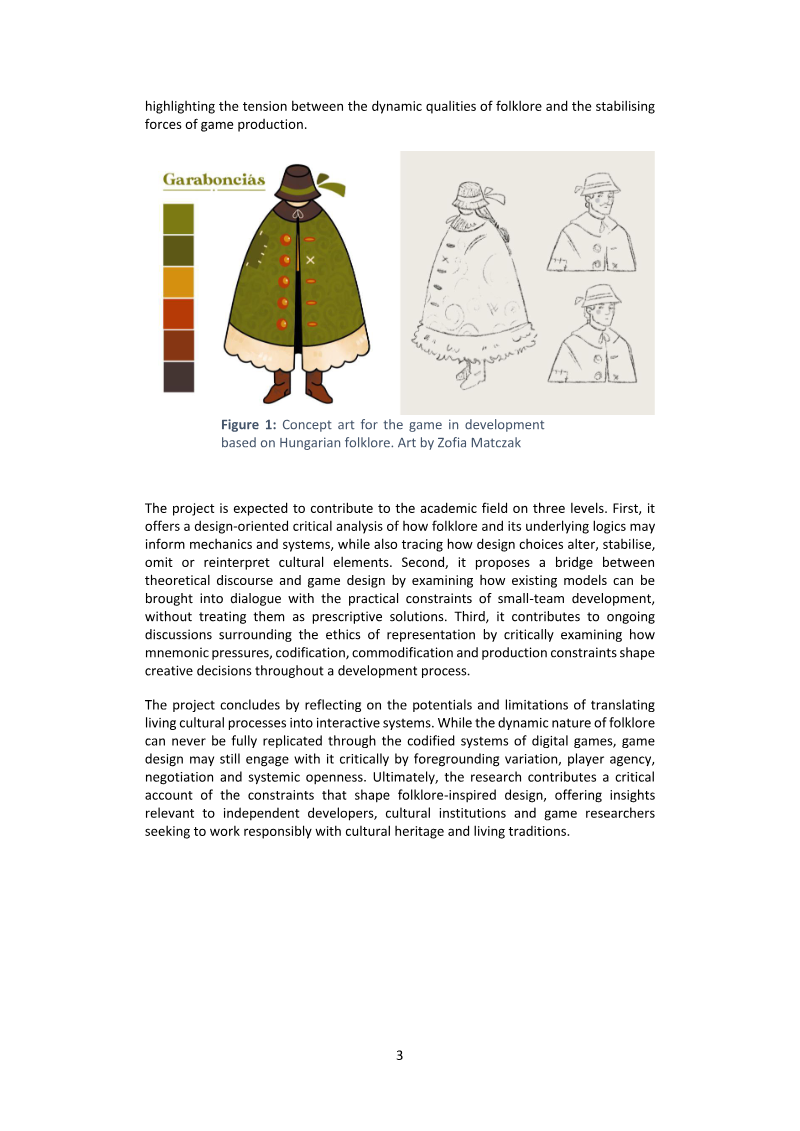
Playable Folklore: Digital Games and the Representation of Folklore and Cultural Heritage
This paper examines how digital games represent folklore and cultural heritage, arguing that the translation of living, variable cultural processes into codified, rule-based systems introduces structural and ethical tensions.
- Translating living, variable folklore into codified, rule-based game systems creates structural and ethical tensions, chiefly that tradition becomes stabilised as 'heritage' when it is managed or staged for external consumption.
- The paper proposes 'playable folklore' as a lens that treats games not as display cases for heritage but as cultural systems in which traditions are selected, stabilised, transformed, and contested.
- Its theoretical framework rests on four concepts: cultural presence, folk mechanics, digital folklore, and mnemonic hegemony.
The Relationship Between Signs and Context: Semiotic Meaning-Making in Digital Games
This paper examines how players interpret signs in digital games, arguing that meaning arises from the relationship between a sign, the thing it seems to refer to, and the player's interpretive activity rather than from the symbol alone.
- Meaning in digital games arises from the relationship between a sign, what it seems to refer to, and the player's interpretive activity, not from the symbol alone.
- The paper proposes a two-variable model crossing symbol familiarity (conventional or unconventional) with context familiarity (conventional or unconventional), yielding four distinct interpretive situations.
- Conventional symbols in conventional contexts give immediately legible meaning because denotation and genre convention align, while conventional symbols in surreal contexts shift attention toward connotation, atmosphere, and reflection.
From Hopscotch to Digital Games: The Pleasure and Dilemma of Interactivity
Huajing Pan of Uppsala University, published in the DiGRA 2026 proceedings, uses Julio Cortázar's 1960s novel Hopscotch as a case study to examine interactivity from a post-structuralist perspective.
- The paper describes Hopscotch's three reading paths: reading sequentially from Chapter 1 to 56, a hopscotching path that skips Chapter 55, and deciding on the reading path oneself.
- The author argues that Hopscotch's infiniteness is a matter of reading freedom rather than quantity, since all chapters and traversing ways will eventually be exhausted.
- Citing Mawhorter et al. (2014), the paper notes that looping branches create an illusion of quantitative infiniteness, because the enrichment of the path is created by repeated text resources.
Identity Play as Identity Work: Representation, Identity Integration, and Possible Selves in Digital Games
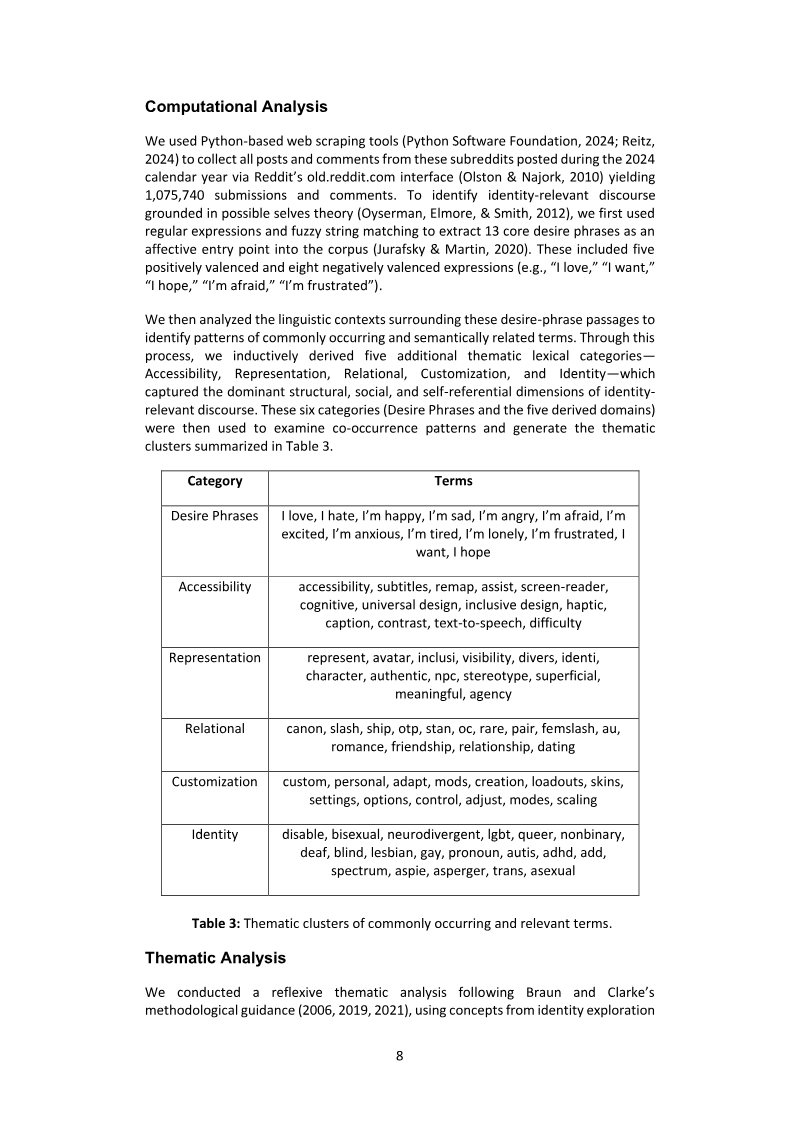
The authors Paige Safyer and Zach Pino, of the Institute of Design at Illinois Institute of Technology, examine how marginalized players conceptualize representation and identity in digital games.
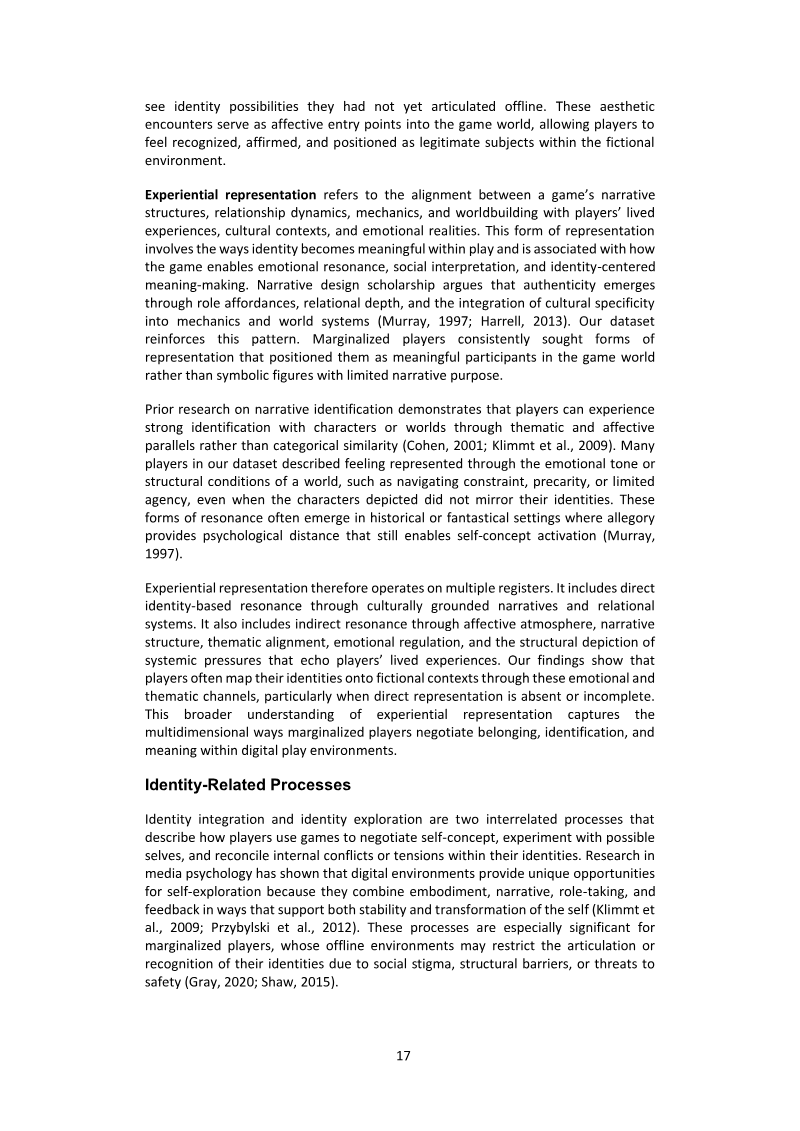
- The authors argue that representation is experienced as a multilayered process rather than demographic visibility alone, and they propose the Representation Triad with structural, aesthetic, and experiential layers.
- Structural accessibility is described as the baseline for identity work, since without inclusive systems, aesthetic or experiential representation cannot be perceived or enacted.
- Players described customization as a tool for identity affirmation and accessibility, with one r/transgamers user reporting they had modded every game to feel more like them.
Time in Digital Games: A Comparative Map of Temporal Constructs
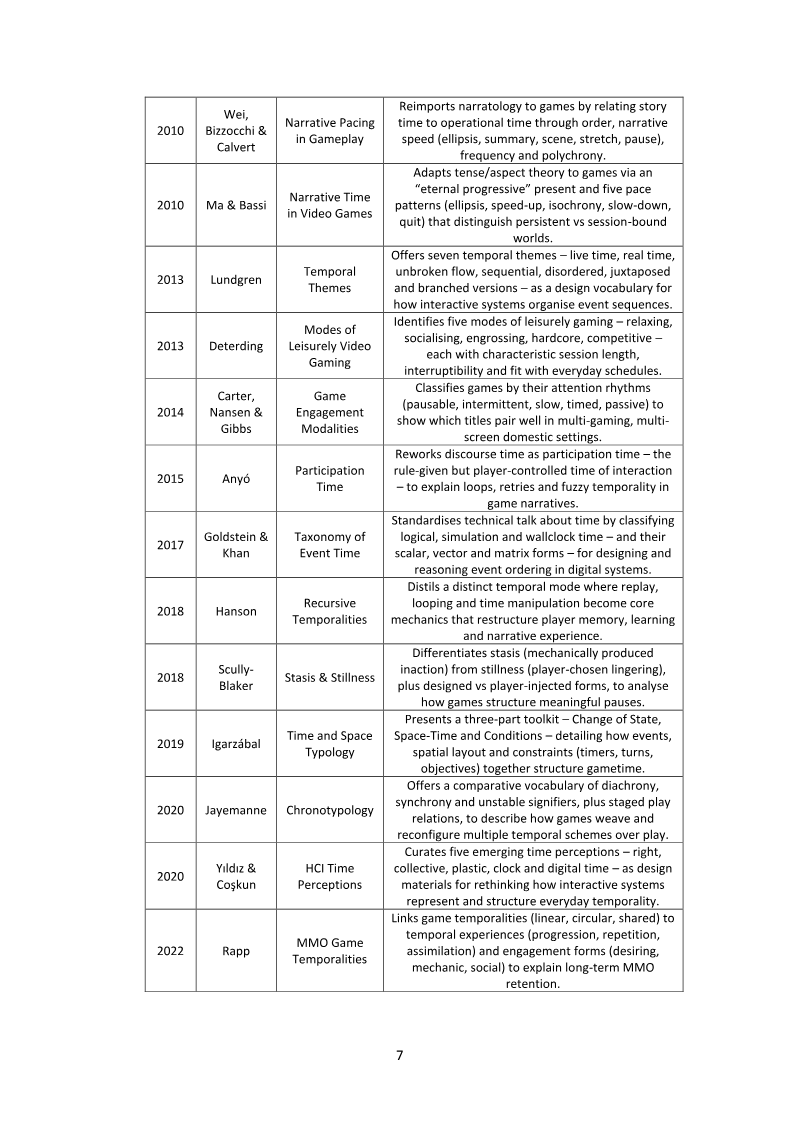
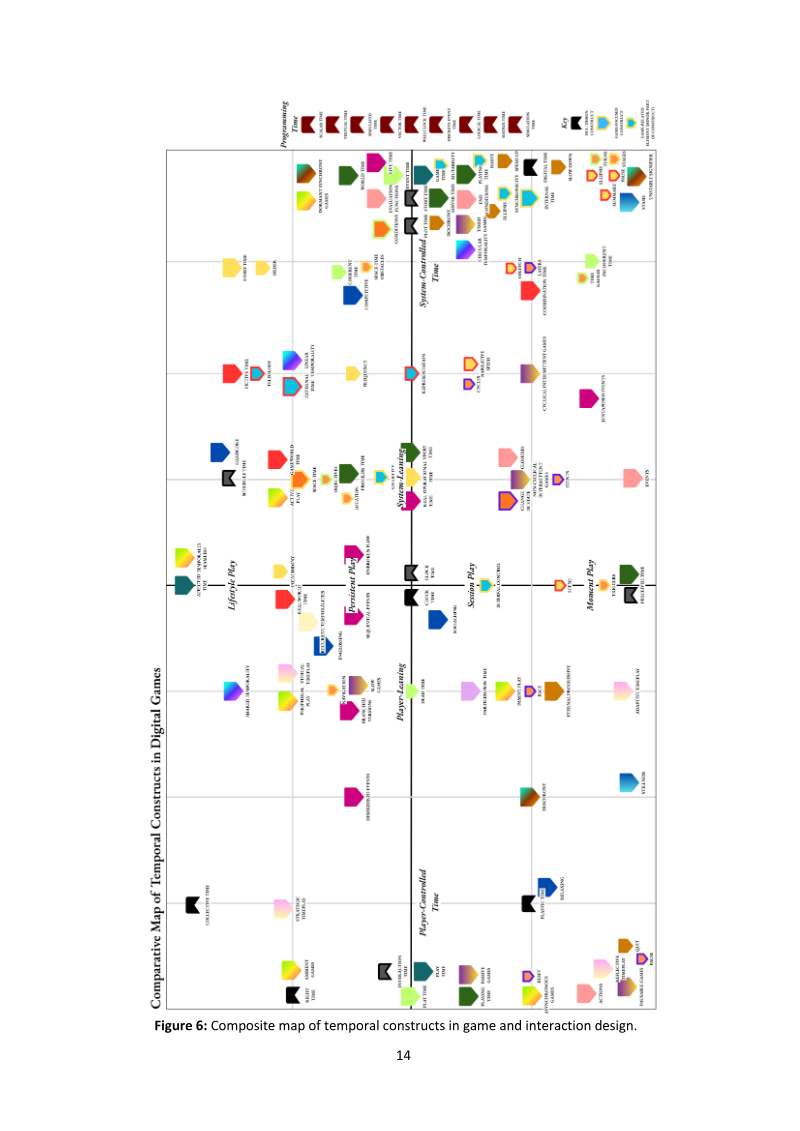
The paper, by Thomas Byers, Martin Gibbs and Bjørn Nansen of the University of Melbourne and published in the DiGRA 2026 proceedings, presents a comparative map of twenty-two named temporal constructs in digital games, published between 2003 and 2025.
- The authors' map plots twenty-two temporal constructs published between 2003 and 2025 along temporal control and temporal scale, and they describe it as a cartographic contribution rather than a new formal framework.
- The authors observe the density of system-controlled constructs on the right-hand side, which they suggest is likely because these layers are the easiest to formalise and measure.
- The authors report that the player-controlled area extending into lifestyle play remains sparse, and they note a lack of formal vocabulary for long-term, player-led rhythms.
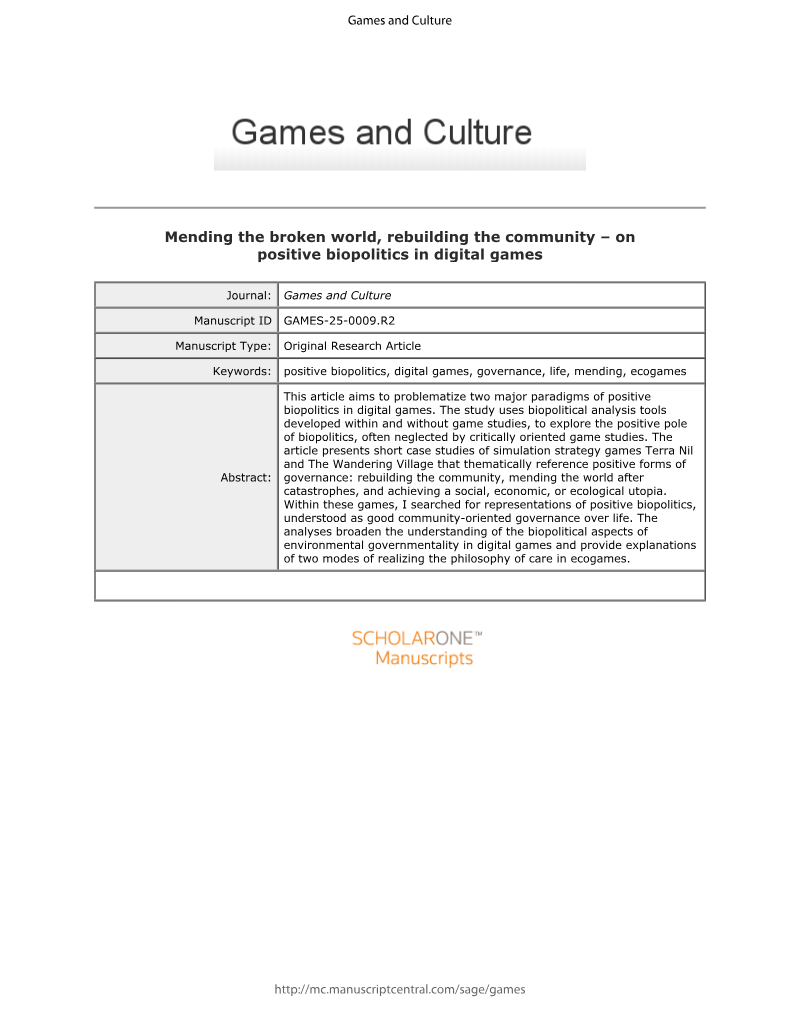
Mending the Broken World, Rebuilding the Community: On Positive Biopolitics in Digital Games
The article manuscript for Games and Culture (manuscript GAMES-25-0009.R2, an original research article for peer review) examines positive biopolitics in digital games, a pole the author says critically oriented game studies has often neglected.
- The author states that no biopolitical game studies seem to focus on positive biopolitics, which the article seeks to address.
- In Terra Nil, the author identifies a post-communal perspective in which players follow conduct designed somewhere else, realizing dispositives that already define the ideal state of things.
- The Wandering Village is described as presenting care as a constant struggle between positive biopolitics and invigilation and biopower, with thanatopolitics always lurking as an option.