Digital Games
Company
Documents about Digital Games
The Long Decade of Game Studies: Case of Finland
This study examines 34 games-related doctoral dissertations completed in Finland between 1998 and 2012, offering a metareview of how game studies took shape as an academic field within a single national context.
- The study analyses 34 games-related doctoral dissertations completed in Finland between 1998 and 2012, and finds no unified "Finnish school" of game research: the works mainly engage with international debates in game studies.
- Citation networks reveal a loose core of scholars, largely tied to DiGRA and the University of Tampere Game Research Lab, with Frans Mäyrä prominent among them, who most heavily reference the field's canon.
- Dissertation output rose steadily over the period, with a shift toward English-language publication and greater gender balance among authors.
The Role of Micronarrative in the Design and Experience of Digital Games
Micronarrative, defined as a small, self-contained unit of narrative progression and coherence, offers game designers a flexible means of reconciling authorial control with player interactivity.
- Micronarrative is proposed as a design tool: game narrative nests hierarchically in layers, from small arcs (a single hockey possession or stealth encounter) to medium units (periods or missions) to meta-arcs (a hockey season or franchise).
- The authors ground their analysis in close readings of two commercial titles released around 2011 to 2012, NHL 12 and Deus Ex: Human Revolution, spanning the sports and action-RPG segments of the console and PC market.
- NHL 12 relies largely on emergent, player-generated micronarratives with limited connection to the ongoing season, so its smaller units emphasize winning, losing, and moment-to-moment competitive drama.
Elements of Social Action: A Micro-Analytic Approach to the Study of Collaborative Behavior in Digital Games
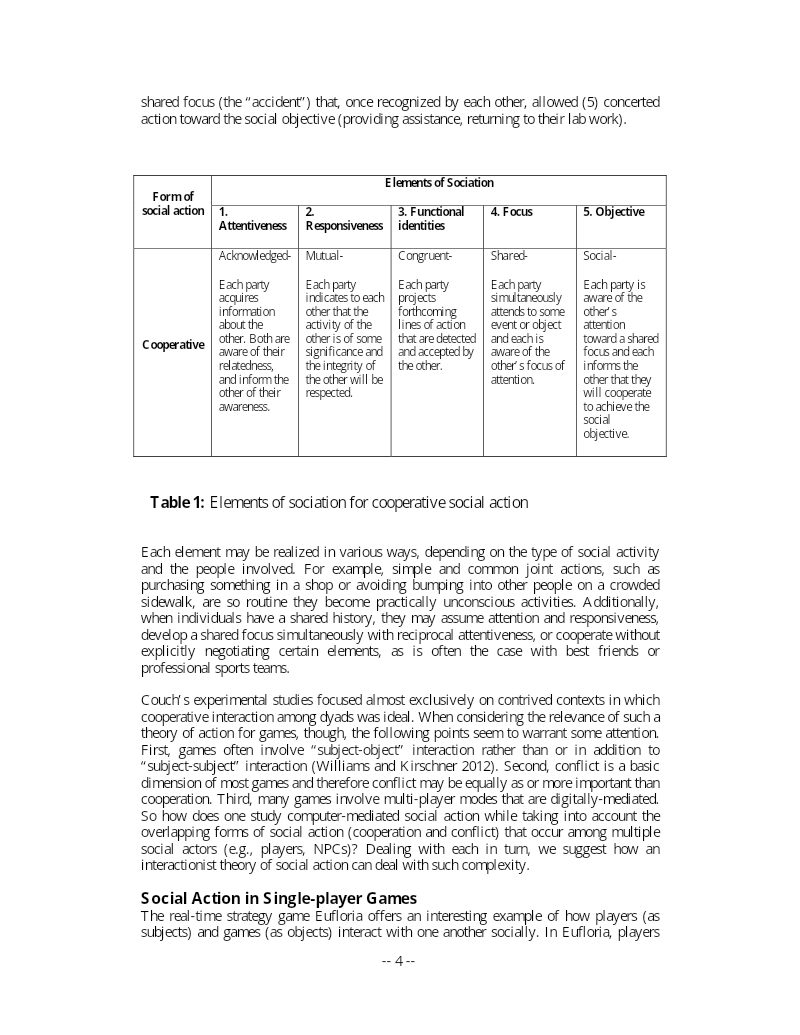
This document presents a micro-analytic, empirical framework for understanding social action within digital games, building upon Carl Couch's theory of cooperative action.
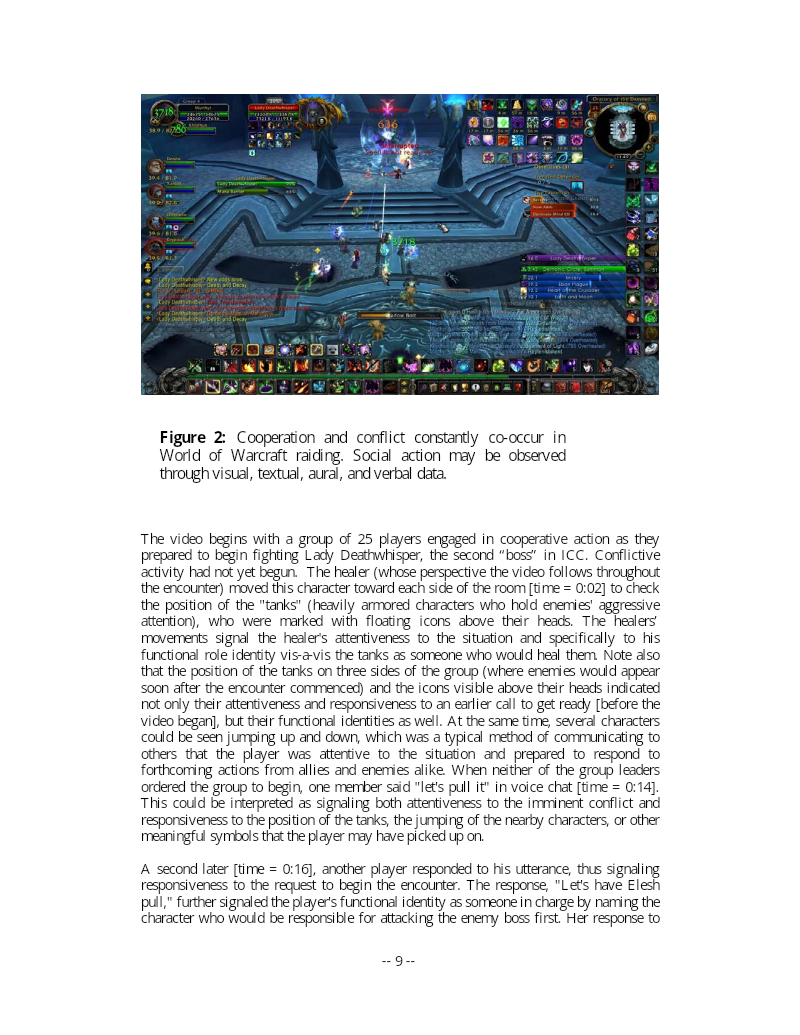
- The paper proposes a micro-analytic framework extending Carl Couch's five elements of sociation to cover both cooperative and conflictual interaction in digital games, arguing that conflict and cooperation draw on the same generic elements but serve different functions.
- The authors contend that understanding collaborative play requires moment-by-moment analysis of observable interaction from audio-visual recordings, rather than relying on players' retrospective accounts of what they did.
- In the single-player real-time strategy game Eufloria, game AI and narrative structure largely fix coordinated action in advance, leaving players limited room to redirect objectives.
Digital Seriality: On the Serial Aesthetics and Practice of Digital Games
Denson and Jahn-Sudmann argue that seriality is a central yet understudied dimension of digital games, and that understanding it requires bridging game studies with media-based seriality research.
- Seriality (repetition, variation, and continuation) is argued to be a central but neglected dimension of digital games, spanning franchises, level structures, transmedia narratives, and hardware generations.
- The authors propose a three-level framework of intra-ludic, inter-ludic, and para-ludic seriality, plus analytical approaches of 'serial interfacing' and 'collective serialization.'
- Digital seriality is framed as both a continuation of modern media history and a partial rupture from it, with digitization and convergence enabling non-linear consumption such as binge play and on-demand access.
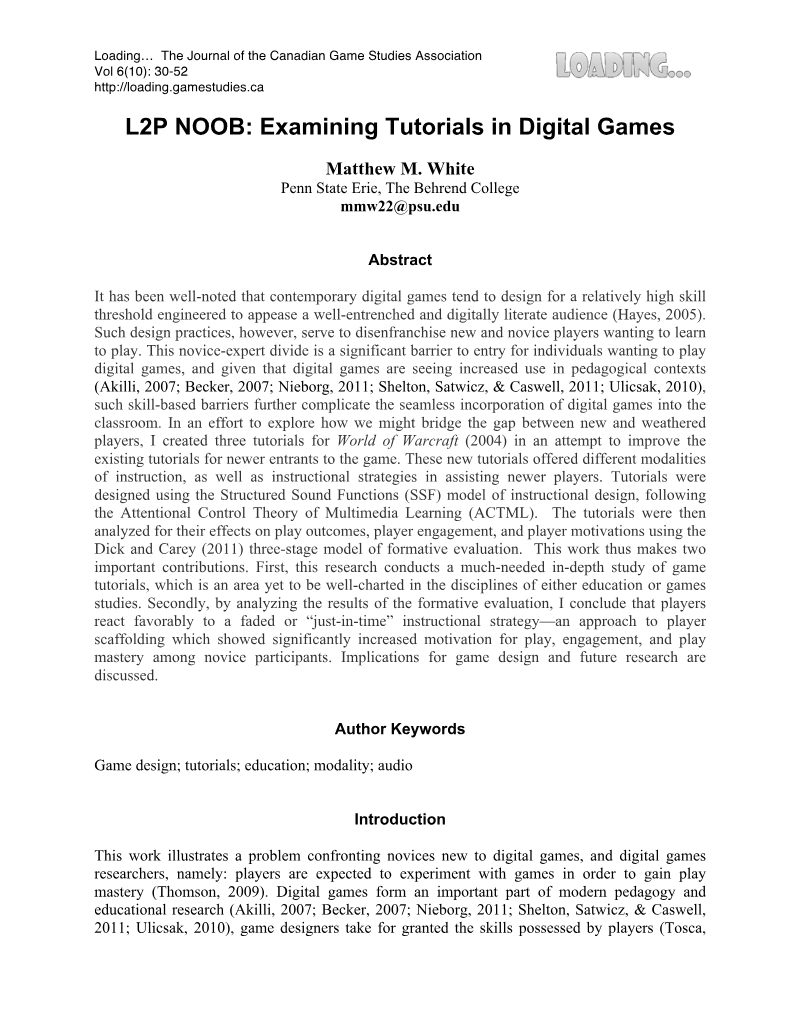
L2P Noob: Examining Tutorials in Digital Games
The novice-expert divide remains a critical barrier in digital gaming, as traditional tutorial designs frequently rely on intrusive visual pop-ups that disrupt immersion and alienate new players.
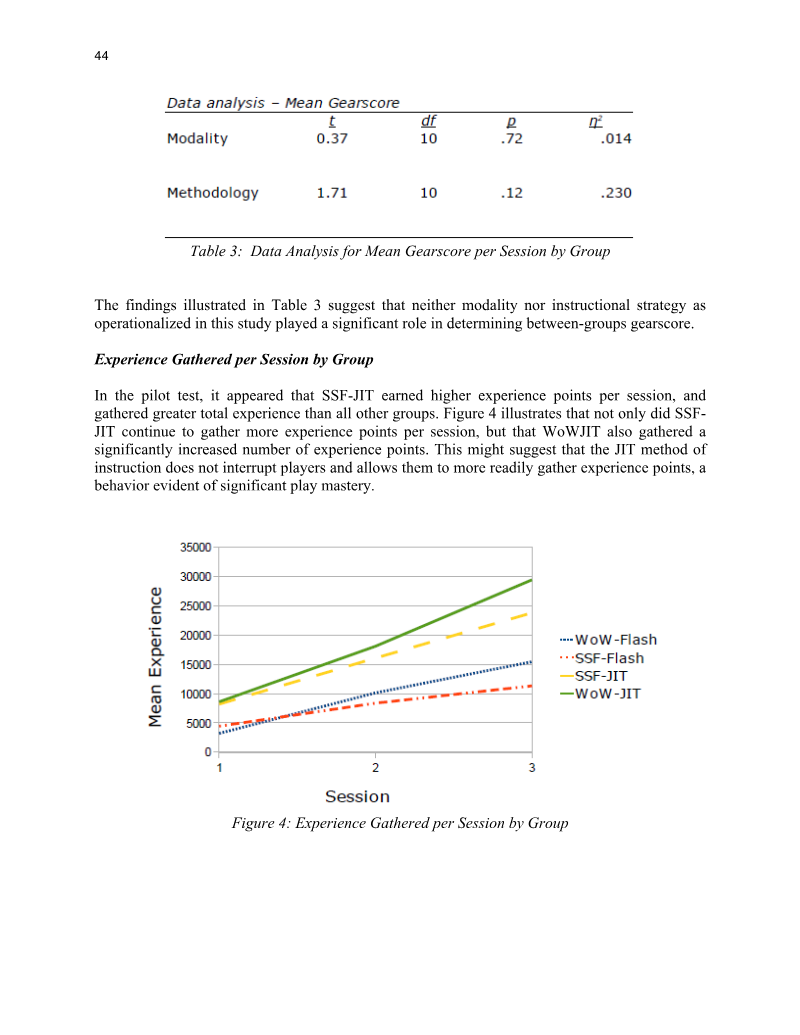
- Auditory-based, just-in-time instructional strategies significantly outperform traditional visual pop-up and flashcard methods in player skill acquisition.
- Non-intrusive, auditory-led tutorials reduce player idle time and increase experience point accumulation compared to didactic, one-size-fits-all designs.
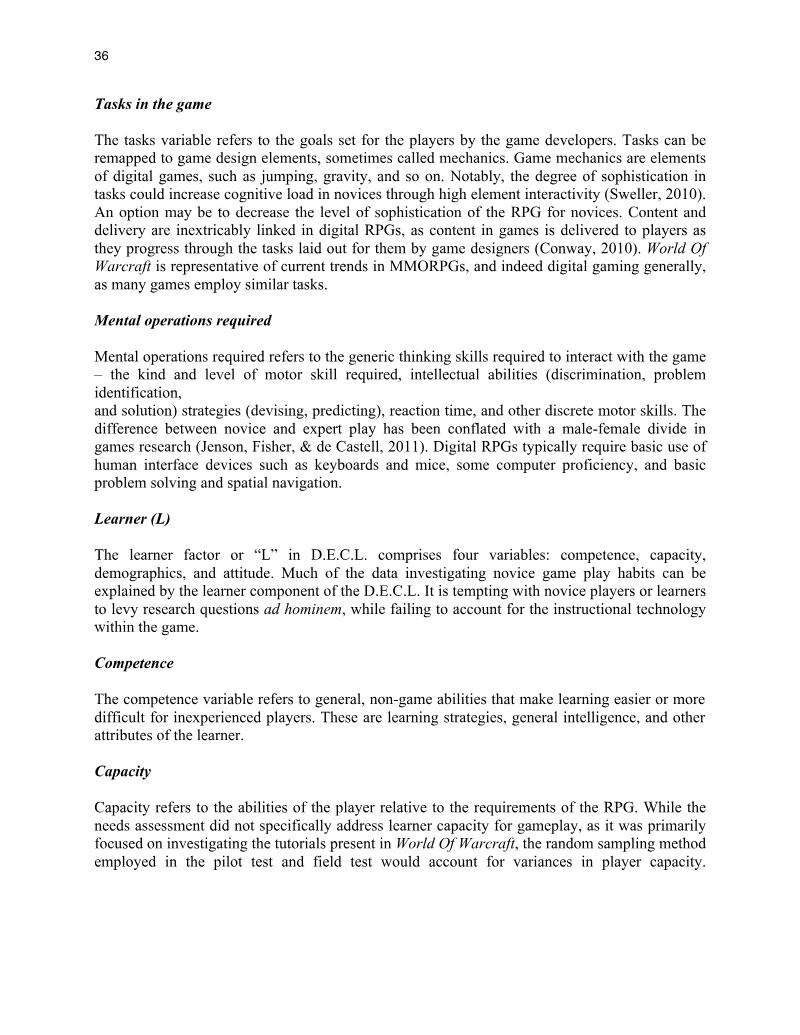
- The D.E.C.L. model (Domain, Experience, Content, and Learner) provides a framework for evaluating tutorial effectiveness by tracking metrics such as death frequency and gear scores.

Neither Playing nor Gaming: Pottering in Games
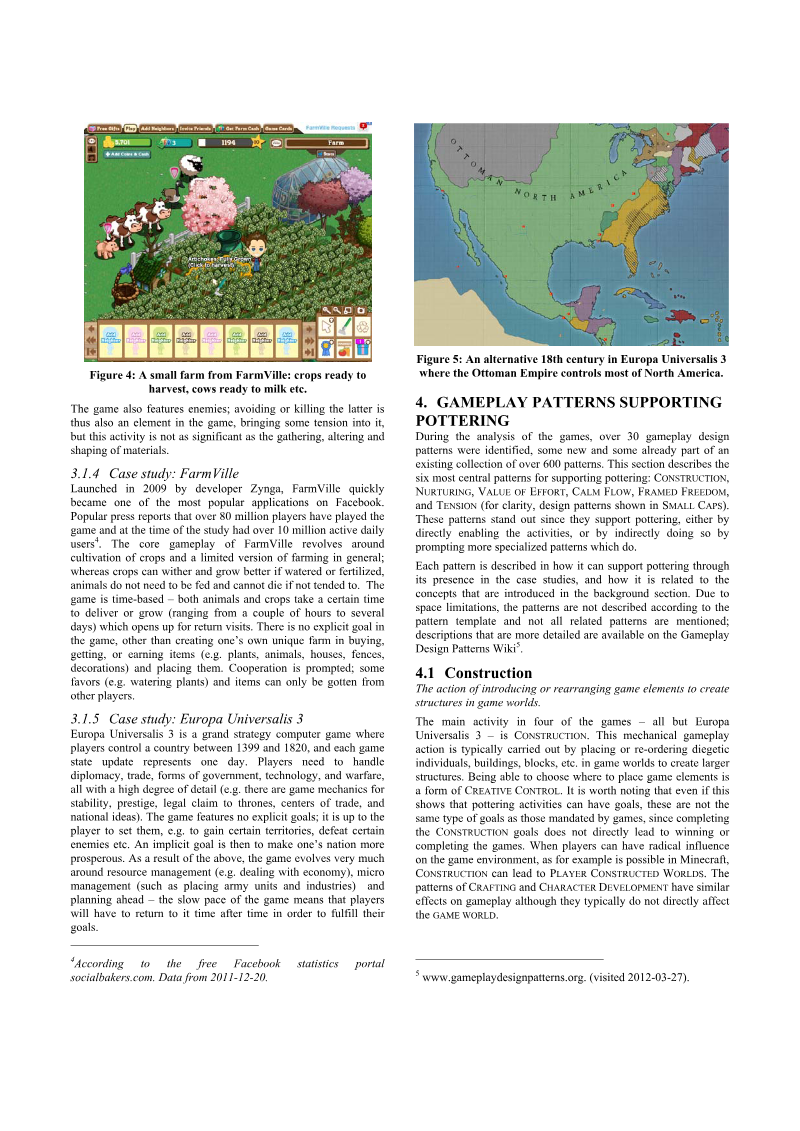
Lundgren and Björk, of Chalmers University of Technology and Göteborg University, examine pottering, a placid but focused activity of arranging, rearranging and taking care of things, as it occurs in five games: Zoo Tycoon, The Sims 3, Minecraft, Europa Universalis 3 and FarmVille.
- The authors identified six gameplay design patterns central to supporting pottering across the five games studied.
- Pottering is characterised as lacking a focus on winning or completing the game, distinguishing it from playing most games.
- The five games were analysed with between 25 and over 200 hours of gameplay time per game by the researchers.
Digital Games and the Communication of Health Problems: A Review of Games Against the Concept of Procedural Rhetoric
Serious digital games can help a regional Italian Public Health Body communicate health issues such as alcohol, smoking, and sexually transmitted diseases to teenagers, but only when their mechanics meaningfully embody the behavior or process being addressed.
- The review uses Ian Bogost's procedural rhetoric theory to argue that games persuade through their rules and processes rather than through narrative or content alone.
- Effective health-communication games must align winning conditions and mechanics directly with the understanding or behavior they target, since mismatched mechanics fail to persuade.
- Faithful simulations of off-game processes and oversimplified models can both undermine persuasion, so designers should build rhetorically persuasive models of unhealthy behaviors instead.
Skin Games: Fragrant Play, Scented Media and the Stench of Digital Games
Niedenthal argues that smell is an underexplored but promising element of game design, and that designers should treat scent as a distinct sensory mode rather than a gimmick for sensory realism.
- Christopher Niedenthal's 2012 study argues that smell is an underexplored dimension of play design, with strong associative and emotional power but significant technical, cultural, and perceptual obstacles.
- Scent is hard to digitize and standardize because olfaction lacks the universal notation systems and mature simulation technologies that exist for sight and sound.
- Historical attempts to bring scent into media, including Smell-O-Vision, AromaRama, iSmell, Kojima's scented floppy disk, and scratch-and-sniff cards in Leather Goddesses of Phobos and Leisure Suit Larry 7, are largely characterized as failures due to distribution, synchronization, residue, and cultural dismissal of smell.
Designing Digital Games to Teach Road Safety: A Study of Graduate Students’ Experiences
Digital games serve as a potent medium for road safety education when pedagogical objectives are effectively integrated with engaging game mechanics.
- Effective road safety games require a four-phase iterative development process: brainstorming, design, prototyping, and implementation.
- Educational game design is most successful when it prioritizes intrinsic learner motivation and problem-solving over direct instructional content.
- Collaborative practices, specifically distributed cognition and consistent peer feedback, are essential for improving the quality of educational game outputs.

Digital Games as Experiment Stimulus
Digital games offer researchers a rich but demanding experimental stimulus, and this work argues that their careful use can advance experimental psychology and human-computer interaction.
- Digital games are a valuable experimental stimulus because they are familiar and engaging to most participants, can safely evoke emotions, and can simulate ethically sensitive scenarios that are hard to recreate in a lab.
- Survey evidence cited in the report shows broad population reach, with 72 percent of U.S. households and 54 percent of Finnish respondents being active gamers.
- Interactive games vary from player to player due to differences in skill, AI behavior, randomness, and prior familiarity, making stimulus control much harder than with conventional experimental materials.
Playing Digital Games Will Make You a Better Human Being
Digital gaming serves as a catalyst for personal development, directly challenging pervasive cultural narratives that frame the medium as inherently detrimental to human health and social functioning.
- Digital gaming functions as a constructive tool for personal development that improves cognitive performance, physical well-being, and the quality of interpersonal relationships when integrated into a balanced lifestyle.
- Strategic and interactive game mechanics actively promote intellectual acuity and focus, refuting the stereotype that gaming leads to cognitive decline or intellectual stagnation.
- Evidence indicates that digital gaming fosters emotional intelligence and social connectivity, countering the narrative that the medium causes social isolation or emotional detachment.
Replacing Preconceived Accounts of Digital Games with Experience of Play: When Parents Went Native in GTA IV
Public and regulatory perceptions of digital games, the authors argue, rest on cautionary frameworks and non-interactive viewing rather than on actual play.
- Schott and van Vught argue that public and policy debates about digital games rely too heavily on preconceived assumptions, and that understanding should instead come from direct experience of play.
- The study observed 20 parents (7 men and 13 women) playing roughly an hour of Grand Theft Auto IV in a structured session that included the "Ivan the Not So Terrible" moral-dilemma mission and support from an expert gamer.
- Participants often found GTA IV easier and more enjoyable than expected, frequently rejected its violence, and recognized its satire, irony, and moral complexity, though not all deliberately avoided violent encounters.