Digital Games
Company
Documents about Digital Games

Gamemasters of the Playground: Exploring Children's Leadership Roles when Programming Hybrid Digital-Physical Outdoor Playground Equipment
The paper by Andreas Bergqvist and Jon Back, published in Transactions of the Digital Games Research Association (July 29, 2024, Vol.
- An implicit social role, termed the 'gamemaster', emerged in a participant in each of the five groups, centred on use of the programming device.
- The gamemaster role was about helping and coordinating as well as directing, and the role extended beyond the group in follow-up interviews.
- In four of the five groups, the first participant to pick up and successfully use the prototype went on to act as gamemaster.
Endure, Join Them, or Leave? Suffering Women in Mobile Game Advertising
Kati Alha's study, published in the Transactions of the Digital Games Research Association (2024), examines advertisements for two free-to-play mobile games aimed at women, Project Makeover and Matchington Mansion, both developed by Magic Tavern.
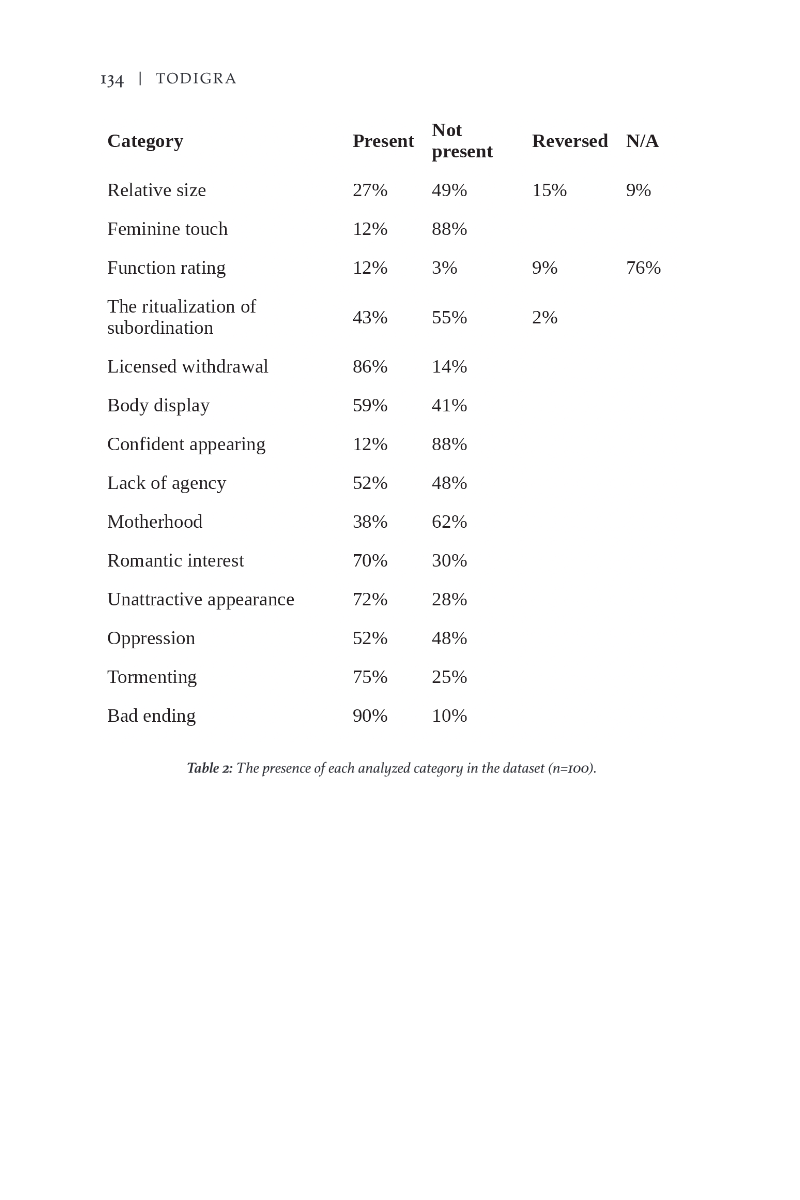
- All analysed advertisements showed the main character lacking agency, with the advertisements depicting her as passively waiting for others to decide or rescue her.
- In half of the advertisements, someone in the game was actively harming the main character, through cheating, abandonment, bullying, or physical harm.
- The confident appearing display was found in only 12 percent of advertisements, and even then it was almost always only for a moment when something went right before taking a turn for the worse again.
1001 Followers in 20 Days: Framing the Playful Use of Fame-Enhancing Bots on Instagram
Nathalie Schäfer's paper, published in the Transactions of the Digital Games Research Association (2024), examines fame-enhancing bots on Instagram, a practice called botting.
- The author's dog-themed botting experiment reached 1001 followers on the twentieth day and 1368 generated followers after 32 days of use.
- Over the 32-day project, the bot followed 12,761 accounts, unfollowed 9,790, commented 2,396 times and liked 1,858 posts.
- The author argues that botting breaks Instagram's rules and gives botters an unfair advantage over other participants.
Character-Driven Narratives in D&D5E and Fate: Core System
Joy Kumral and Luis F.T. Meza's article, published in Transactions of the Digital Games Research Association (July 29, 2024, Vol. 6 No 3, pp.
- The authors argue that D&D5E's Inspiration mechanic is a weaker incentive for character-driven play, because Advantage is available from other in-game situations such as assisting another character.
- The authors argue that in Fate: Core System, Aspects work as both Reactive and Active traits, since they can create new conflict through Compelling.
- The authors state that Fate's Compel mechanic lets a player or GM introduce complications, and that a Compelled player must take action that generates conflict for their character.
On Interdisciplinary Embraces in Game Studies
This editorial, by Lina Eklund, Björn Sjöblom and Jon Back, was published in the Transactions of the Digital Games Research Association (July 29, 2024, Vol. 6 No 3, pp. vii-xxv).
- The authors argue that game studies both is and is not interdisciplinary, describing a disciplinary gravitational core surrounded by an interdisciplinary cloud.
- The 2023 Nordic DiGRA conference was the largest so far, with 37 presentations plus panels and workshops, and almost a hundred participants.
- The special issue contains thirteen original studies, and submitted manuscripts went through an additional standard review process with two reviewers.
The Many Facets of Culture in Digital Games Policy: The EU Dimension
The document examines the European Union's evolving approach to digital games within its cultural policy framework, specifically through the lens of State aid rules.
- The European Commission now treats culture and economics as intertwined in State aid decisions under Article 107(3)(d) TFEU, framing State aid for games as a form of cultural policy rather than competition policy alone.
- The Commission's stance on digital games has shifted from excluding them in the 2013 Cinema Communication and requiring proof of market failure, to demanding demonstrable cultural value, and later to a more industrial, creative-cluster view.
- A 2006 French tax relief case questioned whether games qualified as cultural products at all, while national schemes in the UK, Denmark, Germany, Italy, Belgium, and Ireland were initially scrutinised for cultural value, often favouring artistic or educational titles.
The Ink Splotch Effect: A Case Study on ChatGPT as a Co-Creative Game Designer
The Ink Splotch Effect is a 2024 Foundations of Digital Games paper by Asad Anjum, Yuting Li, Noelle Law, M Charity and Julian Togelius, studying whether ChatGPT (GPT-3.5) can act as a co-creative game designer.
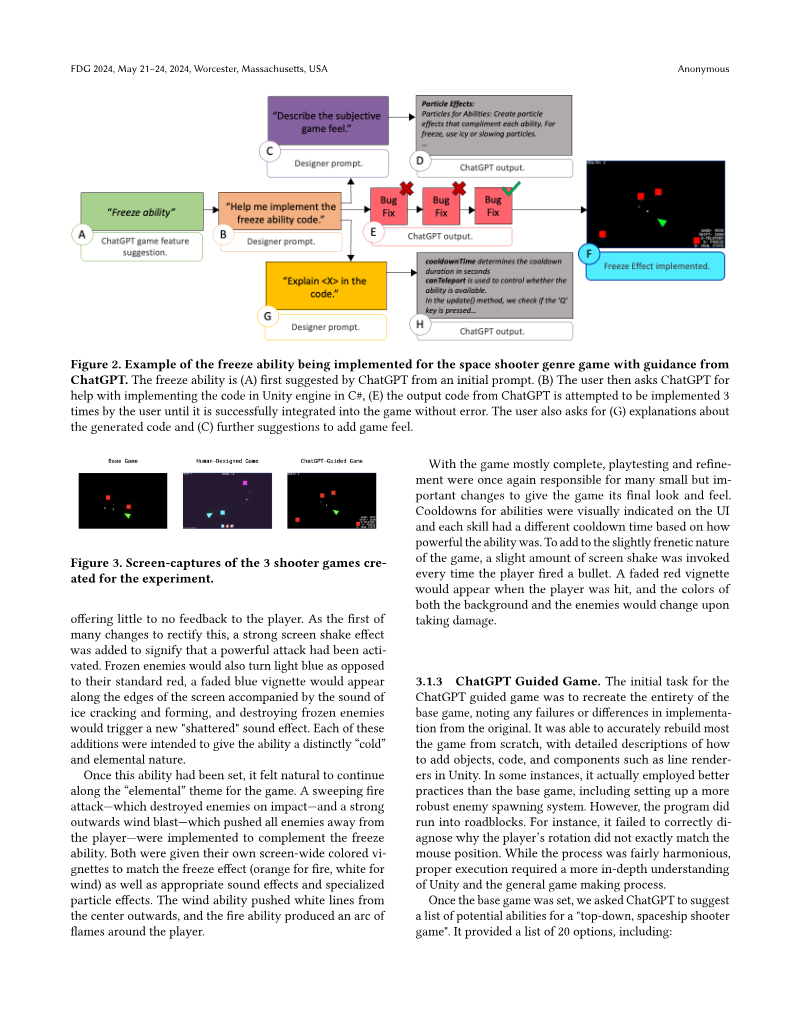
- The authors state that ChatGPT performed best when prompted for abstract, high-level feature suggestions rather than direct code implementation.
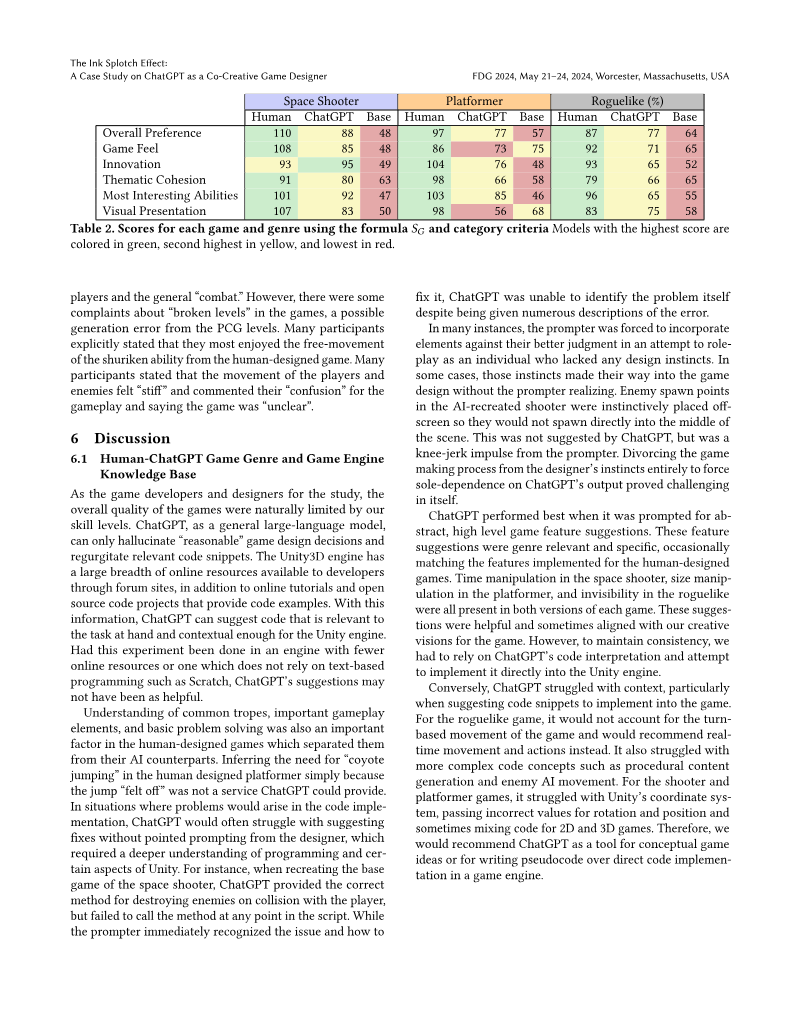
- The authors report that participants almost consistently rated human-designed games higher than ChatGPT-suggested games, with both above the baseline in most categories.
- The authors report that ChatGPT could not recreate the turn-based roguelike base game and struggled with its procedural generation and enemy AI.

The Eyes, the Hands and the Brain: What can Text-to-Image Models Offer for Game Design and Visual Creativity?
The authors, Hongwei Zhou, Jichen Zhu, Michael Mateas and Noah Wardrip-Fruin of UC Santa Cruz and IT University of Copenhagen, present a theoretical analysis for the 2024 Foundations of Digital Games conference, aimed at informing games that foster critical literacy around text-to-image models such as DALL-E, Stable Diffusion…
- The authors distinguish two ways of orienting players to visual creativity: seeing for visual communication, which works directly with color, shape and lines, and seeing for recognition, which text-to-image interfaces emphasize.
- The authors argue that text-to-image models habituate users toward seeing as recognition, partly because the author's intention must be explicitly inscribed through text.
- Chicory limits players to four colors per in-game area, plus white, and its canvas records colors in an absolute manner, with each having to be one of five colors.
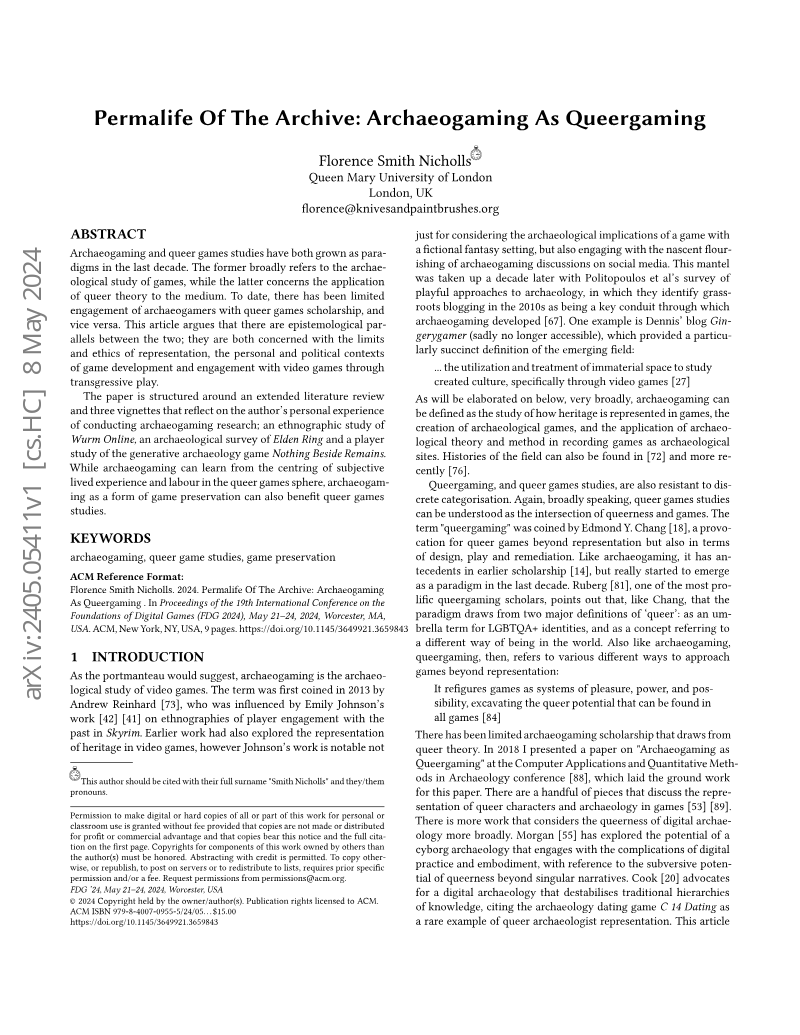
Permalife of the Archive: Archaeogaming as Queergaming
Florence Smith Nicholls, of Queen Mary University of London, presents a paper published for the 19th International Conference on the Foundations of Digital Games (FDG 2024) arguing that archaeogaming, the archaeological study of games, and queergaming, the application of queer theory to games, share epistemological parallels.
- The author argues that archaeogaming and queergaming both concern the limits and ethics of representation, and the personal and political contexts of game development.
- The Wurm Online go-along study chose Dragon Fang Pass, a tunnel through the largest mountain on the Independence server that the Wurm community designates a heritage site, as its initial focus.
- In the Elden Ring survey, the author adapted analogue techniques, using the player character's foot as a unit of measurement to create scale base plans.
Motivation in Digital Games: The 28 Dimensions of Play
This article by McKechnie-Martin, Cunningham, Baumeister and Von Itzstein, from the University of South Australia, reports a meta-ethnography of player motivation research in digital games, published in Games and Culture (2026).
- The synthesis extracted 332 concepts from 36 included studies and grouped them into 28 Dimensions of Play.
- Competence was the most discussed Dimension, appearing in 23 sources through 37 translated concepts.
- Health and Expectation were the least discussed Dimensions, each appearing in only two sources.
Game On: Ireland's Digital Games Sector Gets Ready for Growth 2024
The document, "Game On: Ireland's Digital Games Sector Gets Ready for Growth 2024," asserts that Ireland's digital gaming sector is poised for significant expansion, driven by a new tax incentive and the presence of established industry players.
- Ireland's digital games sector is poised for growth, significantly bolstered by a new Digital Games Tax Credit, which many in the industry believe could replicate the success of the Section 481 relief for film and TV.
- Major international gaming companies like Black Shamrock, Riot Games (League of Legends), EA Games, and Demonware already have a significant presence in Ireland, with Black Shamrock planning to expand its Dublin studio to 200 people by 2022.
- The Digital Games Tax Credit offers a 32% tax credit on eligible expenditure, capped at €25 million per project, with StoryToys being the first company to successfully apply for and reinvest the credit.
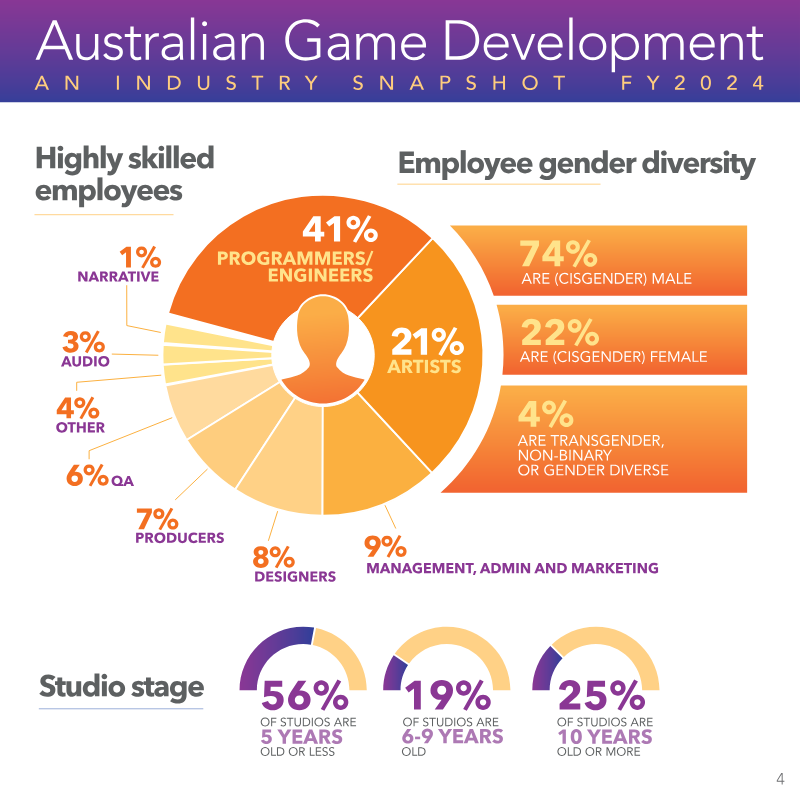
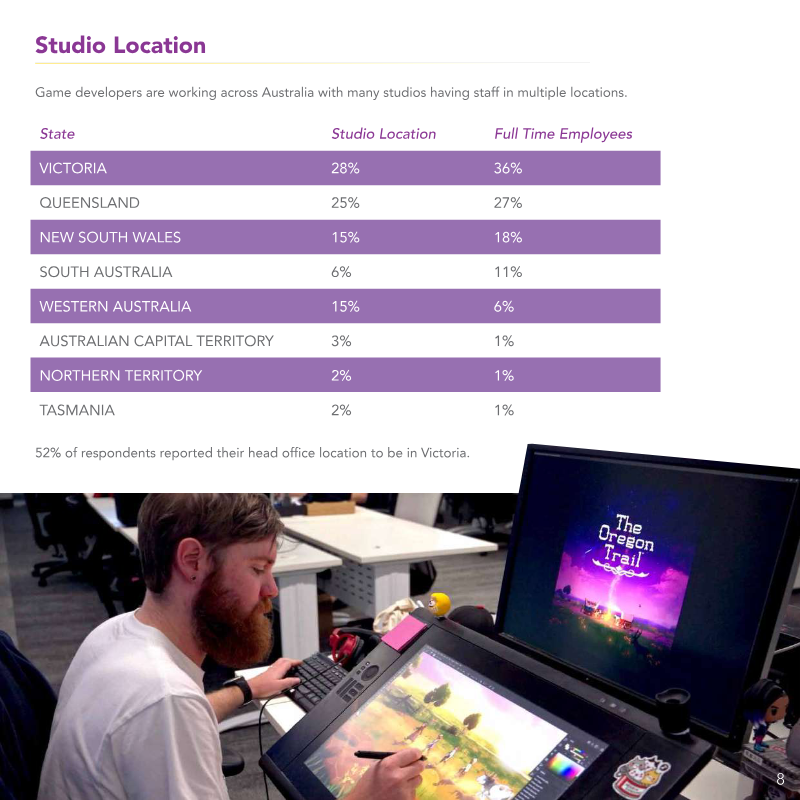
FY2024 Report: Australian Game Development Survey
The FY2024 Australian Game Development Survey, the ninth annual edition from IGEA, offers a snapshot of the local industry's size, health and outlook for the financial year from 1 July 2023 to 30 June 2024.
- The Australian game development industry generated $339.1 million in revenue during FY2024, reflecting a minor 1.9% year-over-year decline despite global economic headwinds.
- The sector is highly export-focused, with 93% of total revenue derived from international markets and 85% of studios prioritizing the development of original intellectual property.
- Employment remains stable at 2,465 full-time equivalent workers, with 61% of studios planning to increase their headcount in the coming year.