Game Culture reports and market data
286 game industry reports, presentations and talks about game culture from writers such as DiGRA, International Journal of Role-Playing and gamevironments, newest from 2026. Every document has a summary and key insights with the page they come from.
Documents



Who Owns Gaming?: Analyzing Gambling's Semantic Displacement in Philippine Cultural Policy
This paper argues that in Philippine statutory and policy discourse, the word "gaming" has been legally appropriated by gambling, so that digital game developers are structurally excluded from policy recognition.
- The paper argues that in Philippine policy, the word "gaming" has been legally appropriated by gambling, structurally excluding digital game developers from policy recognition, a phenomenon the author calls "semantic displacement" and attributes to institutional defaults rather than deliberate targeting.
- The foundational assumption that gaming and gambling are independent categories requiring separate frameworks was never established in the Philippines, so the core challenge is building conceptual infrastructure rather than policing a border between two industries.
- Analysis of 28 Philippine government legal instruments from 1907 to 2025 identifies four definitional tracks for "game" (gambling, professional sports, school sports, and a proposed folk-heritage framework), and none accommodates digital games.



Digital Resilience, Health, and Harms: The Digital Convergence
This paper, a conference abstract from the Gam(bl)ing Conference 2026, argues that the growing convergence of digital technologies, gaming, gambling, social media, dating, and shopping applications, has created harms that existing research, typically divided by device or activity, does not adequately capture.
- The paper argues that growing convergence of gaming, gambling, social media, dating, and shopping apps creates harms that research divided by device or activity fails to capture.
- Its central proposal is 'digital resilience', a framework extending beyond digital literacy to cover user behaviour, health, harms, and the support networks around users such as family and health professionals.
- Drawing on prior work with lived-experience participants, the author notes that in-game purchases and round-the-clock gambling access can complicate recovery, and that difficulties with one technology can transfer to others.



Beyond Play: Towards a Non-Gaming-Centric Gaming Research
This article proposes a multi-level framework for understanding game streamers as intermediaries who connect three domains: the self (micro level), where streamers' identities, motivations, and affective labour are shaped by biography and platform dependency; the community (meso level), where audience co-construction…
- The article proposes a three-level framework for game streamers as intermediaries: the self (micro: identity, motivation, affective labour), the community (meso: audience co-construction, third-place dynamics, shared norms), and the platformised industry (macro: gatekeeping, platform infrastructural power, regulatory fragmentation).
- The authors argue that prior research studied streaming through separate lenses such as identity, audience, or platformisation, and that intermediation should instead be understood as a continuous process arising from interactions across all three levels.
- Precarity and monetisation pressures recur across all three levels, with on-stream promotion of loot boxes cited as an example of audience engagement and platform economics becoming entangled.
Disco Elysium: Existential Reflection within Crisis
This paper examines Disco Elysium, the Estonian role-playing game developed by ZA/UM and released in 2019, as a case study in how digital games can facilitate existential reflection on crisis, agency, failure, and identity.
- The paper uses Disco Elysium (ZA/UM, Estonia, 2019) as a case study of how games can prompt existential reflection on crisis, agency, failure, and identity, and argues this design intent is substantively realized in player engagement.
- The methodology combines a critical playthrough, textual analysis, thematic analysis of six developer interview transcripts, and 100 posts and 904 comments from the r/DiscoElysium subreddit.
- Developer interviews yielded four core design priorities: social and political context, emotions, freedom, and mistakes and ownership.



Bleed as Intrapersonal Conflict: Understanding Bleed Management and Resilience
The phenomenon of bleed—the spillover of emotions, physical states, and cognitive constructs between players and their characters—is best understood as a form of intrapersonal conflict that disrupts a player’s psychological homeostasis.
- Bleed functions as a form of intrapersonal conflict that disrupts a player’s psychological homeostasis, forcing the psyche to either reject the experience or integrate it to transform the self.
- Players manage bleed through negative feedback loops, which reject character experiences to restore a pre-existing self-concept, or positive feedback loops, which incorporate those experiences to evolve the identity.
- Integration practices such as creative expression, intellectual analysis, and community-based processing are essential tools for players to navigate identity shifts and achieve a new state of homeostasis.
Aesthetic Conflict in the Musical Role-Playing Game: Runic Soundscapes
Aesthetic conflict serves as a vital tool for game design, offering a mechanism to prevent the formation of rigid, exclusionary idiocultures.
- Intentional aesthetic conflict in game design prevents the formation of exclusionary idiocultures and fosters more resilient, adaptable collaborative environments.
- The musical RPG Runic Soundscapes identified seven distinct categories of aesthetic conflict: identity, interaction, materiality of sound, interpretation, ineptitude versus virtuosity, complexity versus simplicity, and form.
- By decoupling aesthetic values from semantic narrative content, Runic Soundscapes allows for the isolation and study of pure aesthetic interaction between human and non-human agents.
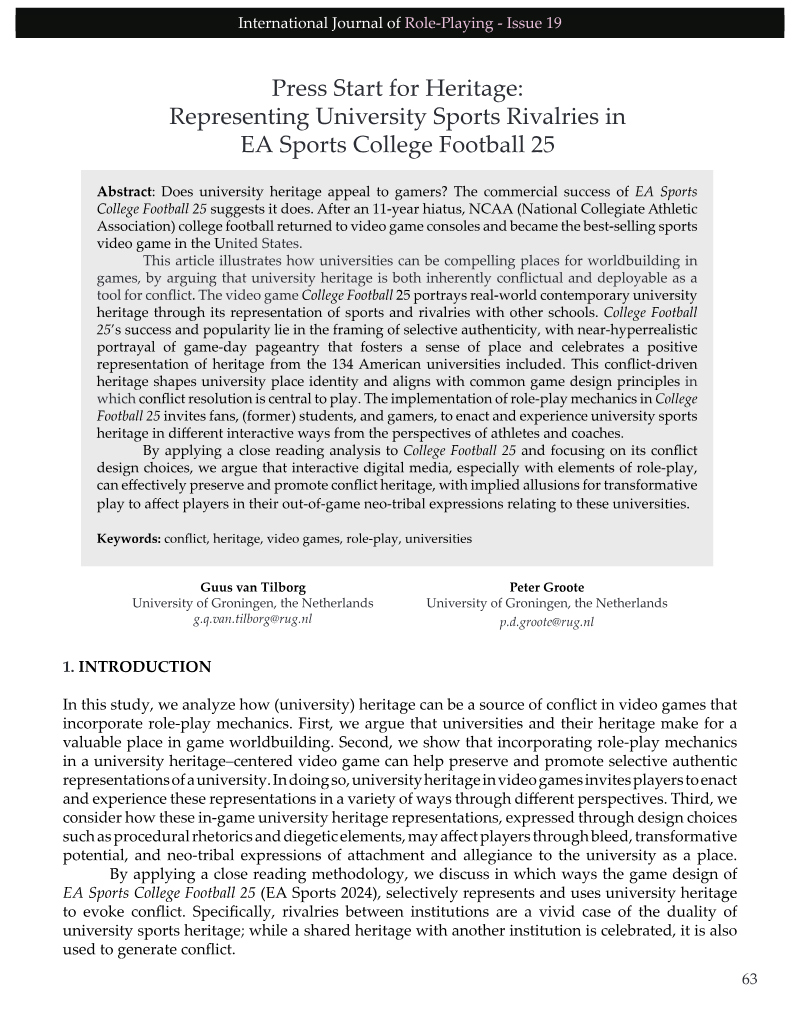
Press Start for Heritage: Representing University Sports Rivalries in EA Sports College Football 25
EA Sports College Football 25 functions as a digital vessel for university sports heritage, transforming institutional traditions into a conflict-driven gaming experience.
- EA Sports College Football 25 functions as a digital platform that transforms institutional university history into a conflict-driven, immersive gaming experience.
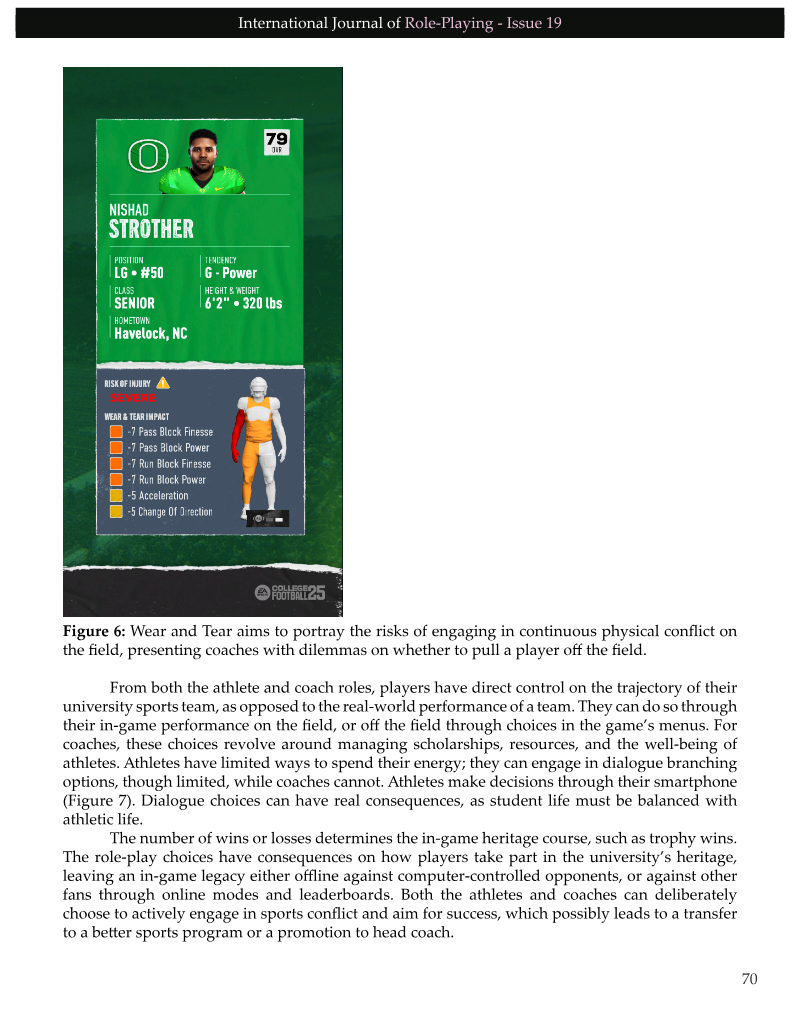
- The game utilizes specific mechanics like 'Stadium Pulse' and 'Wear and Tear' to foster tribalistic loyalty and deepen emotional connections between players and collegiate entities.
- By curating a sanitized and idealized version of university life, the game prioritizes marketability and institutional branding over the complex realities of student-athlete experiences.
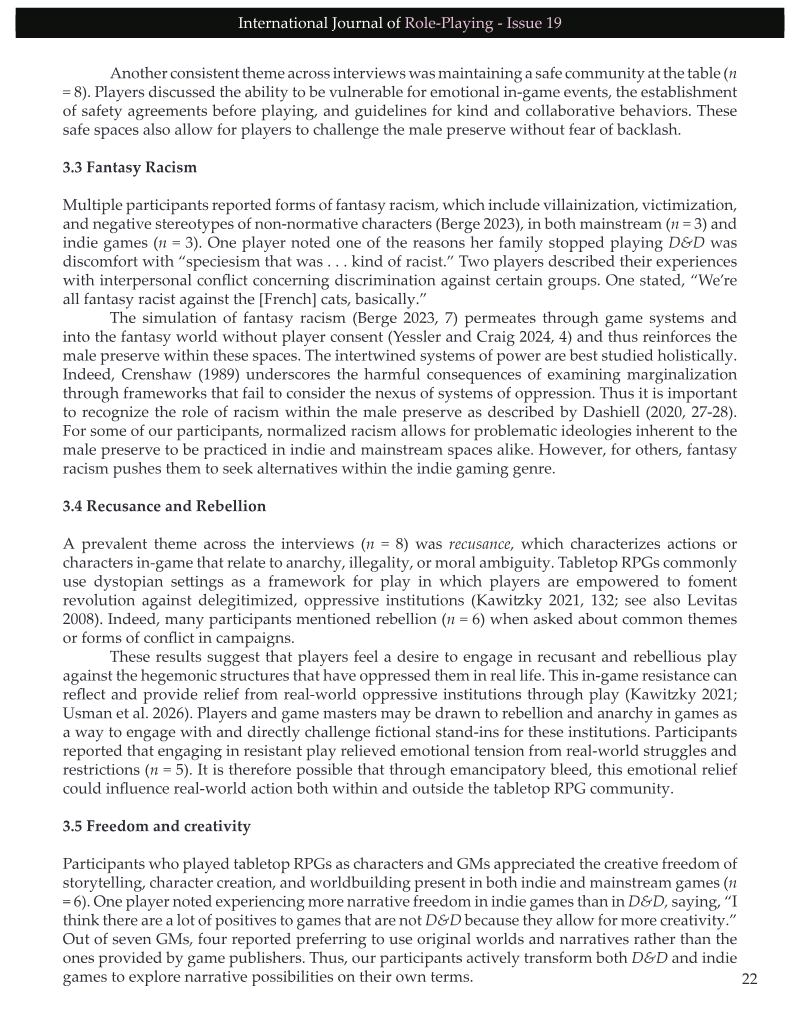
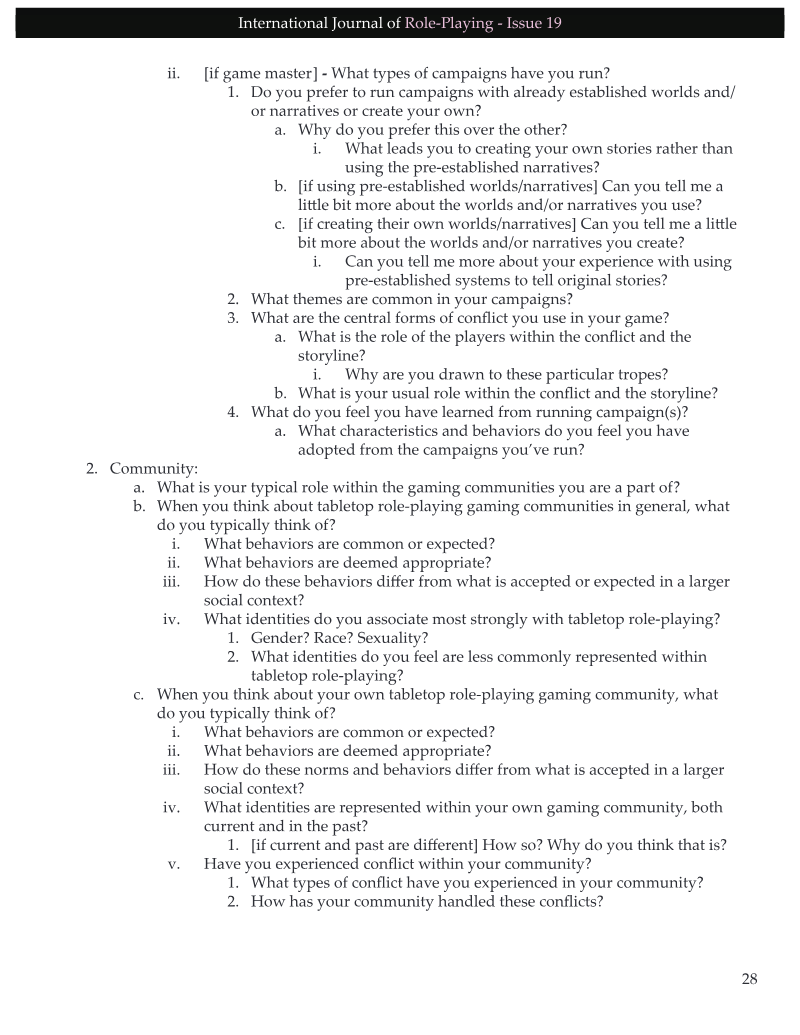
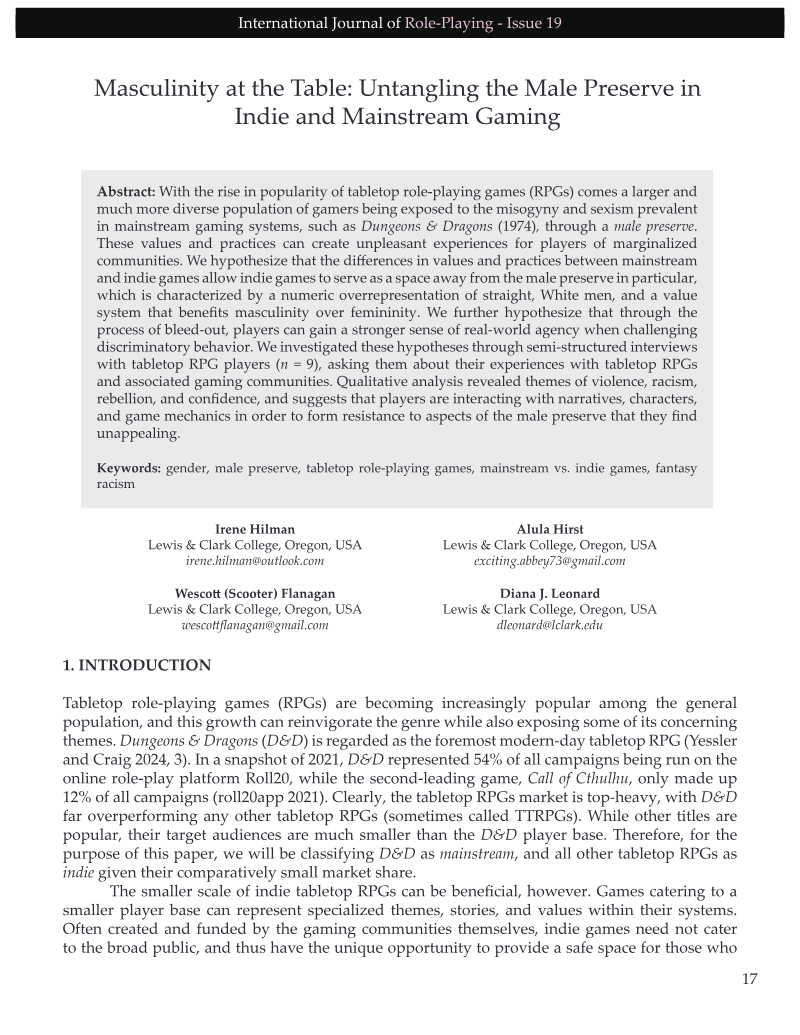
Masculinity at the Table: Untangling the Male Preserve in Indie and Mainstream Gaming
Tabletop role-playing games function as a contested cultural space where mainstream titles often reinforce traditional masculine norms, violence, and exclusionary power structures.
- Mainstream tabletop role-playing games, exemplified by Dungeons & Dragons, often reinforce traditional masculine norms, violence, and exclusionary power structures that marginalize specific player demographics.
- Players are actively migrating from mainstream systems to indie tabletop games that prioritize narrative freedom, inclusivity, and formal safety mechanics.
- Indie tabletop systems facilitate 'emancipatory bleed,' a process where participants use role-playing to address real-world challenges and build personal confidence.
Asteria and Neurodiversity in Role-Playing Games: Inclusion or Tokenism
The introduction of the character Asteria into the Dungeons & Dragons ecosystem serves as a critical case study for evaluating the efficacy of neurodiversity representation within fantasy role-playing games.
- The introduction of the character Asteria into Dungeons & Dragons has polarized the player base, with 44.4% positive sentiment and 28.1% negative feedback.
- Critical discourse surrounding Asteria’s neurodivergent representation generates 18% higher social media engagement than supportive commentary, indicating that inclusive design often acts as a catalyst for cultural friction.
- The industry faces a fundamental conflict between the demand for explicit neurodivergent representation and the preservation of creative autonomy in tabletop gaming.
Arcades on Wheels: The Materiality and Logistics of Itinerant Gaming in Socialist Czechoslovakia
This paper examines the traveling arcade of socialist Czechoslovakia as a mobile infrastructure operated by showfolk within the country's grey economy of tolerated private enterprise.
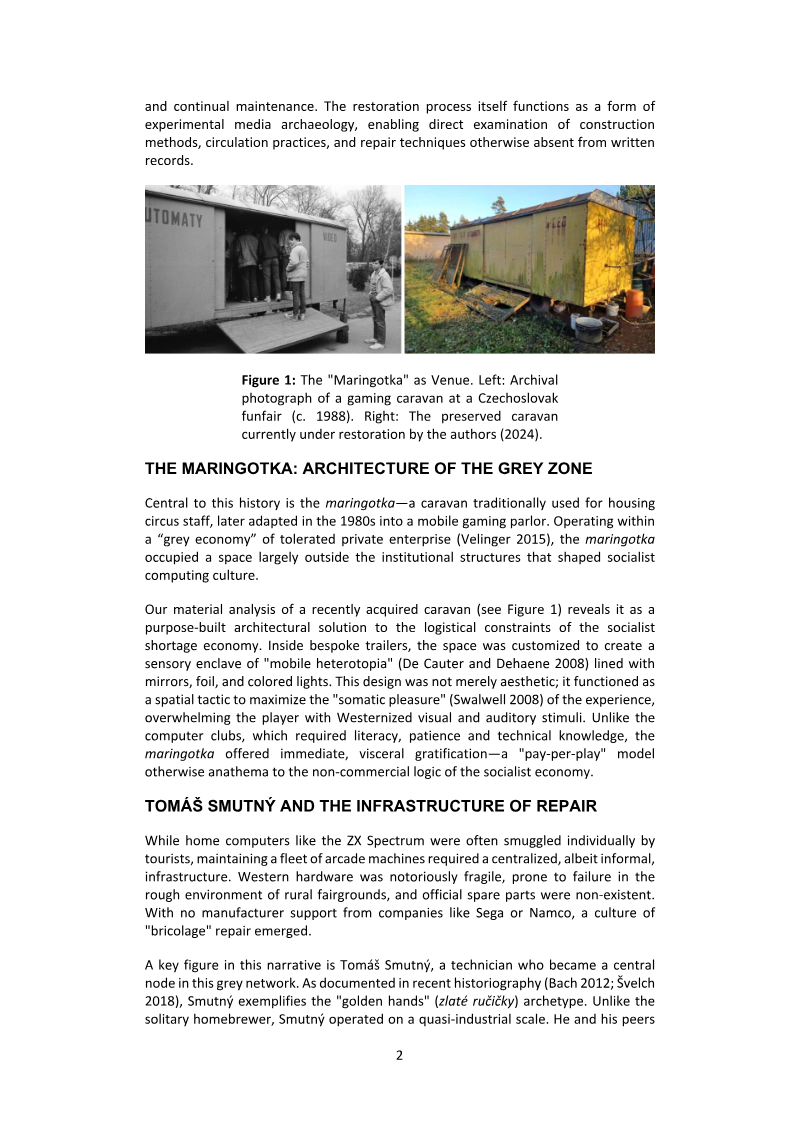
- The paper argues that the traveling arcade of socialist Czechoslovakia, centered on the 1980s maringotka funfair caravan, has been largely overlooked in histories that focus on homebrew programmers and state-sponsored computer clubs.
- Its evidence combines archival research (period photographs and press coverage), oral history interviews with former arcade operators, and material analysis of a preserved caravan the authors are restoring.
- The maringotka was a deliberately designed sensory space lined with mirrors, foil, and colored lights, offering immediate pay-per-play entertainment at odds with the non-commercial logic of the socialist economy.
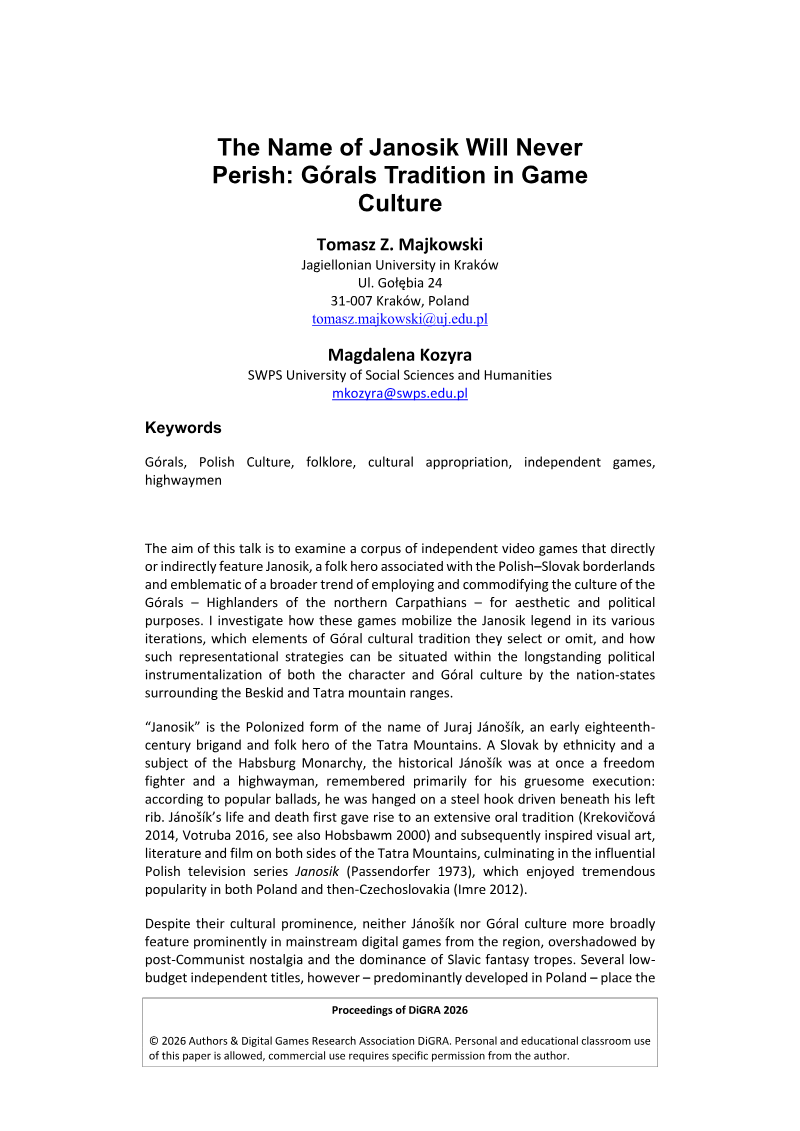
The Name of Janosik Will Never Perish: Górals Tradition in Game Culture
This paper examines a corpus of independent video games that feature Janosik, the folk hero of the Polish-Slovak borderlands, and considers how these works draw on Góral (Highlander) cultural tradition in the northern Carpathians.
- The paper is a qualitative, game-language analysis of independent video games featuring Janosik, the Polish-Slovak folk hero, and Góral (Highlander) tradition in the northern Carpathians, rather than a quantitative study.
- The authors argue that game portrayals of Janosik and Góral culture are shaped by nearly two centuries of appropriation by surrounding nation-states, including Polish, Slovak, Austro-Hungarian, and Third Reich discourses.
- The corpus includes Mirage (1994), Retrovibe (2020, with a 2024 sequel), Juro Janosik (2021, Slovak), and Hellish Quart (2021), which uses a Janosik analogue named Yendrek, alongside tabletop RPGs Corny Groń and Beyond Corny Groń.
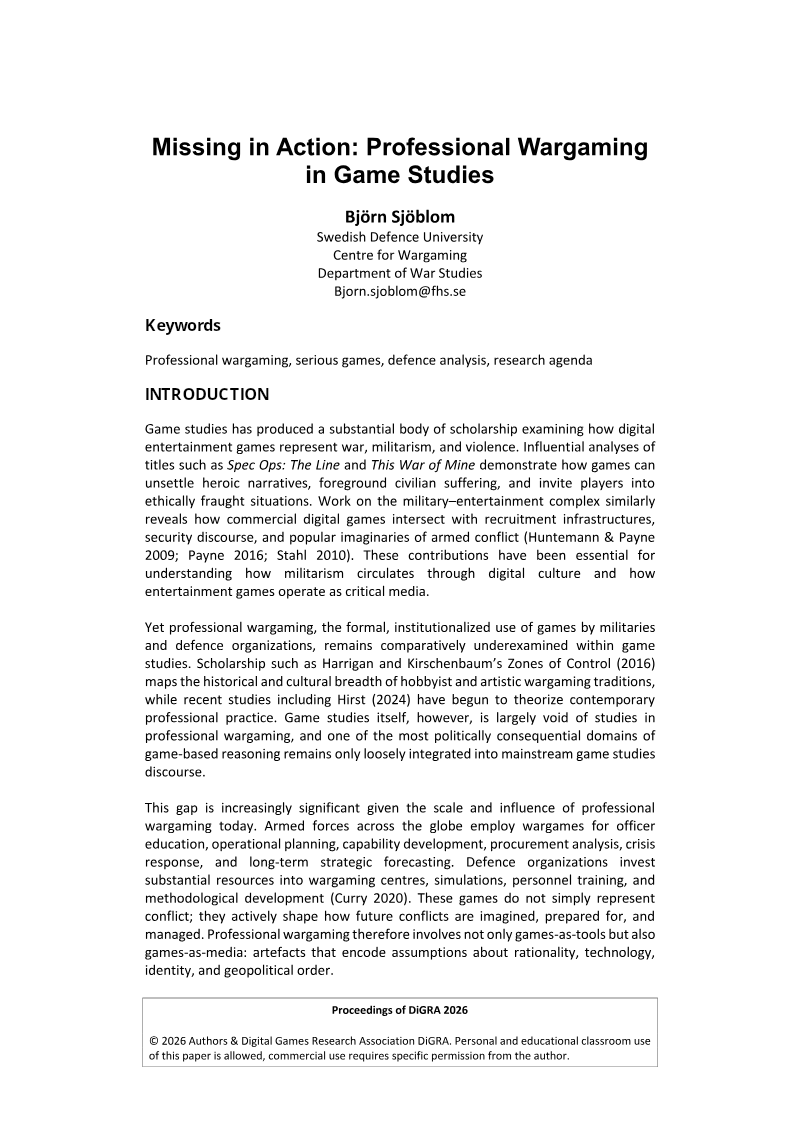
Missing in Action: Professional Wargaming in Game Studies
This paper argues that professional wargaming, the institutionalized use of games by militaries and defence organizations, is a major yet underexamined object of game studies inquiry.
- Professional wargaming, the institutionalized use of games by militaries and defence organizations, is identified as a major yet underexamined object of game studies, which has focused far more on entertainment games and the military-entertainment complex.
- The paper argues that professional wargames do more than represent conflict: they encode assumptions about rationality, technology, identity, and geopolitical order that shape how future conflicts are imagined, prepared for, and managed.
- The paper is an argumentative, agenda-setting intervention rather than an empirical study and presents no new data on any specific military institution.