2015
Company
Documents about 2015

R10 Announcement
The UK Games Fund has announced the successful completion of its tenth funding round, marking a significant milestone by surpassing 200 total projects supported since the initiative began in 2015.
- The UK Games Fund selected 48 independent studios and solo developers for its Round 10 funding cycle, marking a milestone that brings the total number of funded projects to over 200.
- Round 10 attracted over 110 applications from across the UK, with the majority of successful recipients beginning their funded work in January 2023.
- Applicants in this round could pitch for a full £25,000 grant or a tiered structure consisting of an initial £12,000 grant with the potential for an additional £18,000.

Estudio sobre el Consumo de Videojuegos entre la Población Adulta Española y en Familia
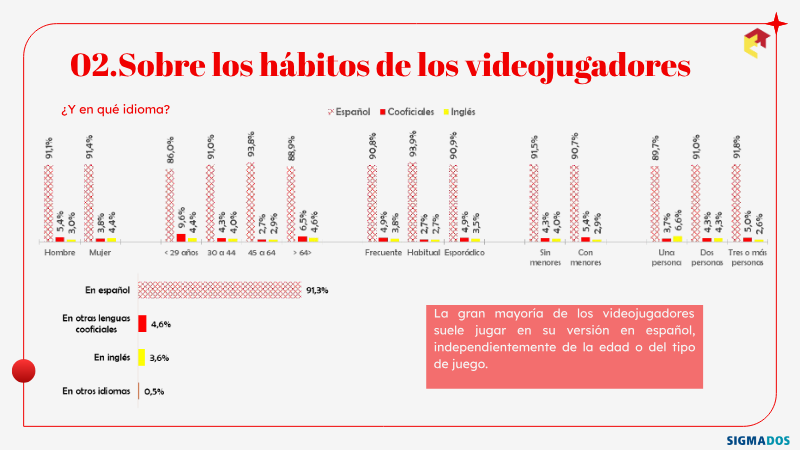
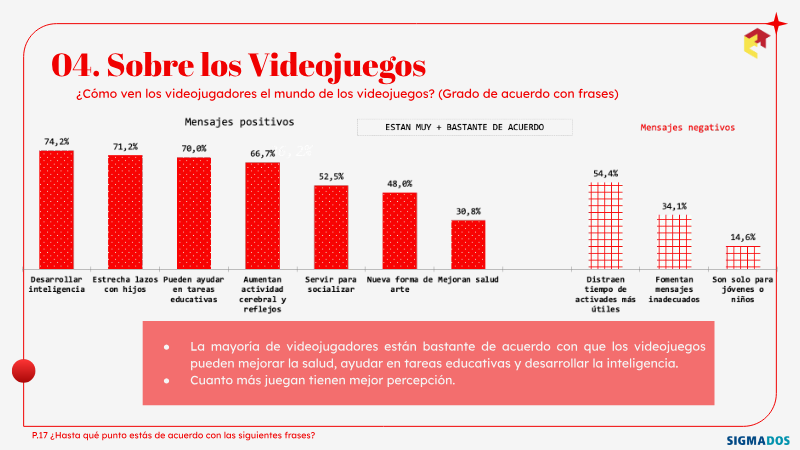
Este estudio de AEVI analiza los hábitos, preferencias y percepciones de los videojugadores adultos en España y su relación con el juego en familia, comparando los resultados con los de 2015.
- Shared family gaming in Spain has surged significantly, with nearly 80% of parents playing with their children in 2022 compared to just over 33% in 2015.
- Parental control adoption remains low, as only 39% of gamers use these tools, with 17.5% using them regularly and 22% occasionally.
- A significant portion of the gaming population is disengaged from safety measures, with over 40% of users never employing parental controls and nearly 20% reporting they are unaware of their existence.
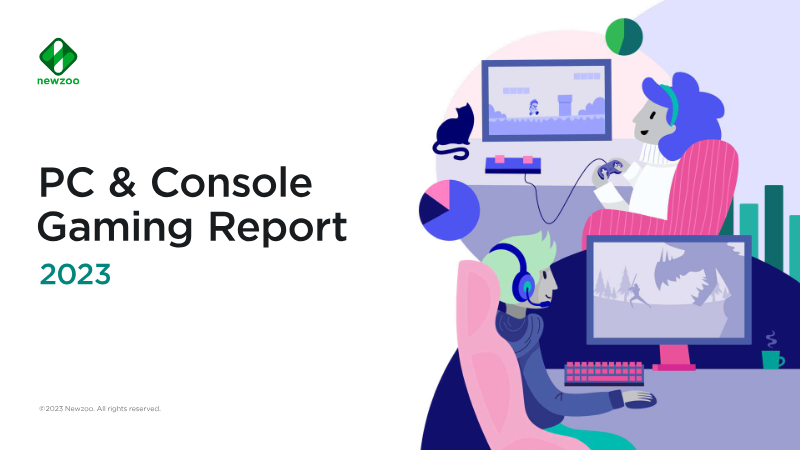
PC & Console Gaming Report 2023
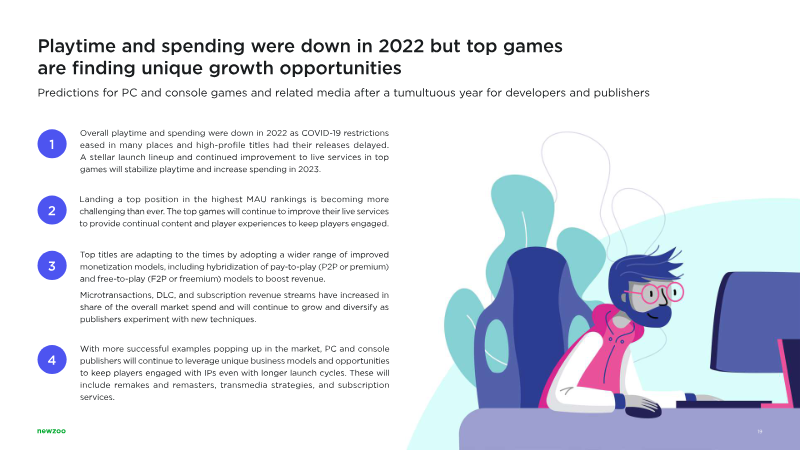
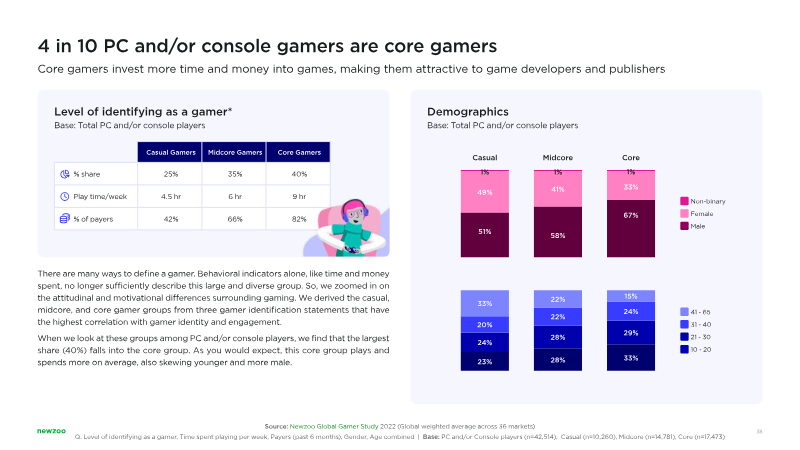
Newzoo's 2023 analysis of the global PC and console games market portrays 2022 as a corrective year after the pandemic boom.
- The PC and console market generated $92.3 billion in 2022, representing a 2.2% year-on-year decline that signals a stabilization toward pre-pandemic levels rather than a long-term downturn.
- Microtransactions and downloadable content now account for nearly 50% of total consumer spending, reflecting a fundamental industry shift from product-based sales to a service-oriented model.
- Engagement metrics saw a significant contraction in 2022, with total playtime dropping 15% and hardcore player activity falling by 37%.
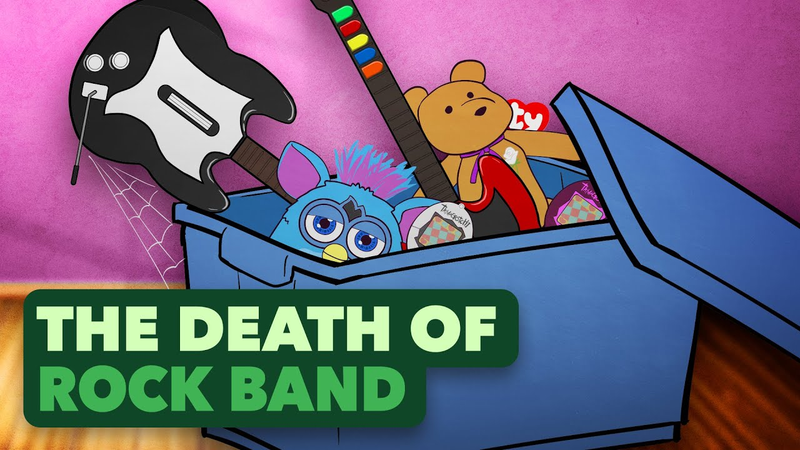
Rock Band: How a Genre Died in 5 Years
The rapid rise and collapse of the rhythm game genre between 2005 and 2010 represents a unique phenomenon in the video game industry, where a multi-billion dollar market segment effectively vanished within five years.
- The rhythm game genre collapsed between 2005 and 2010 due to extreme market oversaturation and a reliance on a hardware-centric business model that became unsustainable.
- Annual sales for the genre plummeted by 50 percent in 2009 as consumer demand for new plastic instrument peripherals evaporated.
- The market was diluted by a flood of spin-offs and band-specific titles, which eroded the appeal of the core experience and led to diminishing returns.

I Videogiochi in Italia nel 2016: Dati sul Mercato e sui Consumatori
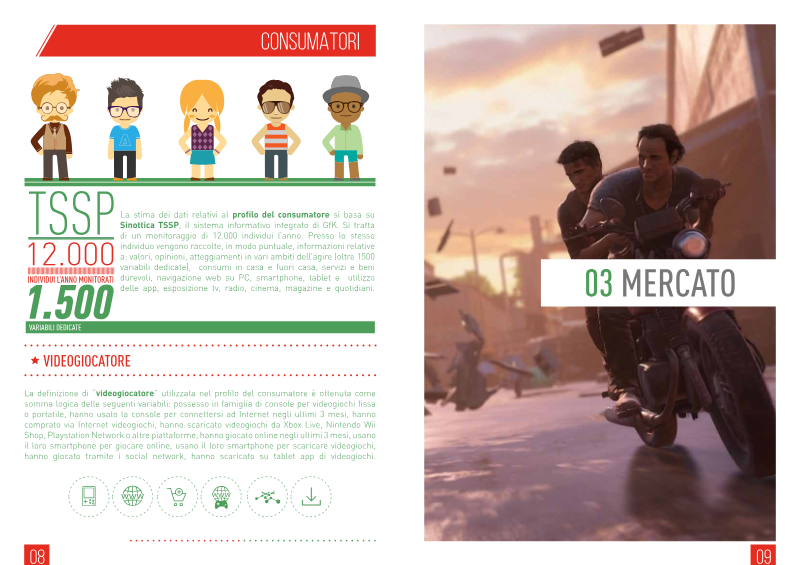
The 2016 market analysis of the Italian video game industry, published by the trade association AESVI, provides a comprehensive overview of the sector’s economic performance and consumer demographics.
- The Italian video game market generated over 1.03 billion euros in 2016, marking an 8.2% year-over-year growth.
- Software sales reached 636 million euros, accounting for 61.8% of total revenue and growing 11.9% compared to 2015.
- Digital software sales surged by 32.8% in 2016, now representing 45.6% of the total software market as physical sales declined by 1.1%.
Developer Satisfaction Survey 2021: Diversity in the Game Industry Report
The global game industry faces a persistent disconnect between its stated commitment to diversity and the lived experiences of its workforce.
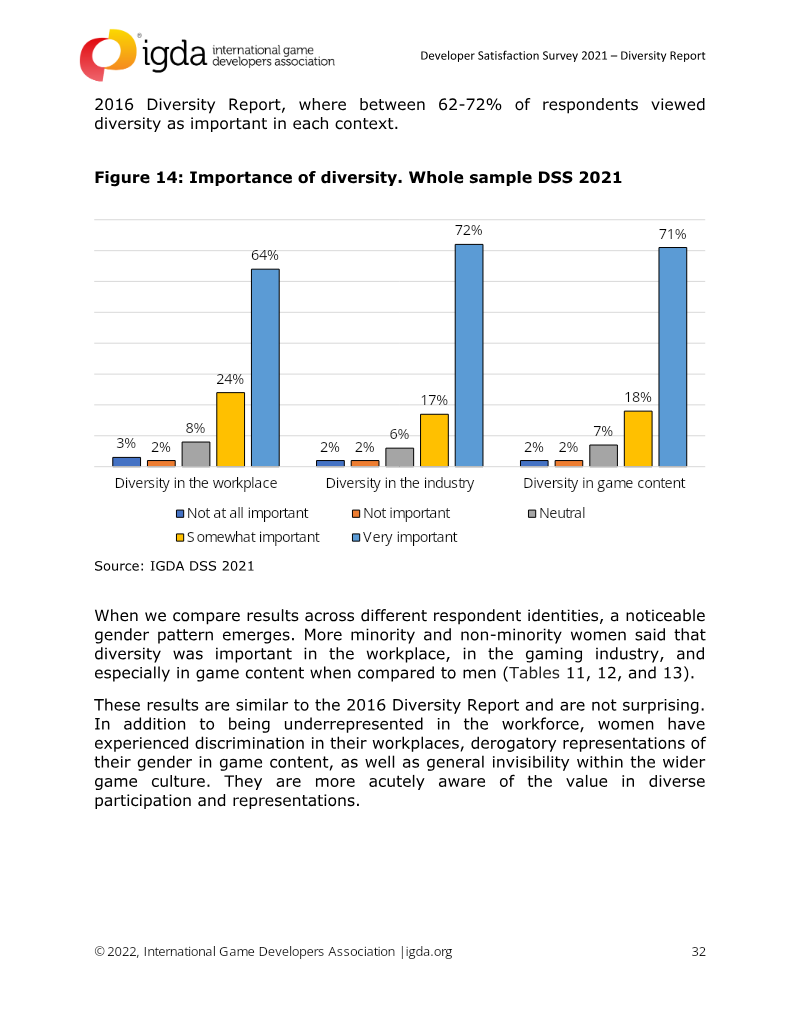
- While 90% of developers acknowledge that diversity is essential for industry innovation, the sector remains predominantly white and male, particularly in senior management and high-earning technical roles.
- 74% of surveyed developers report a lack of equal opportunity, indicating that current diversity-focused policies are often perceived as ineffective or are unknown to staff.
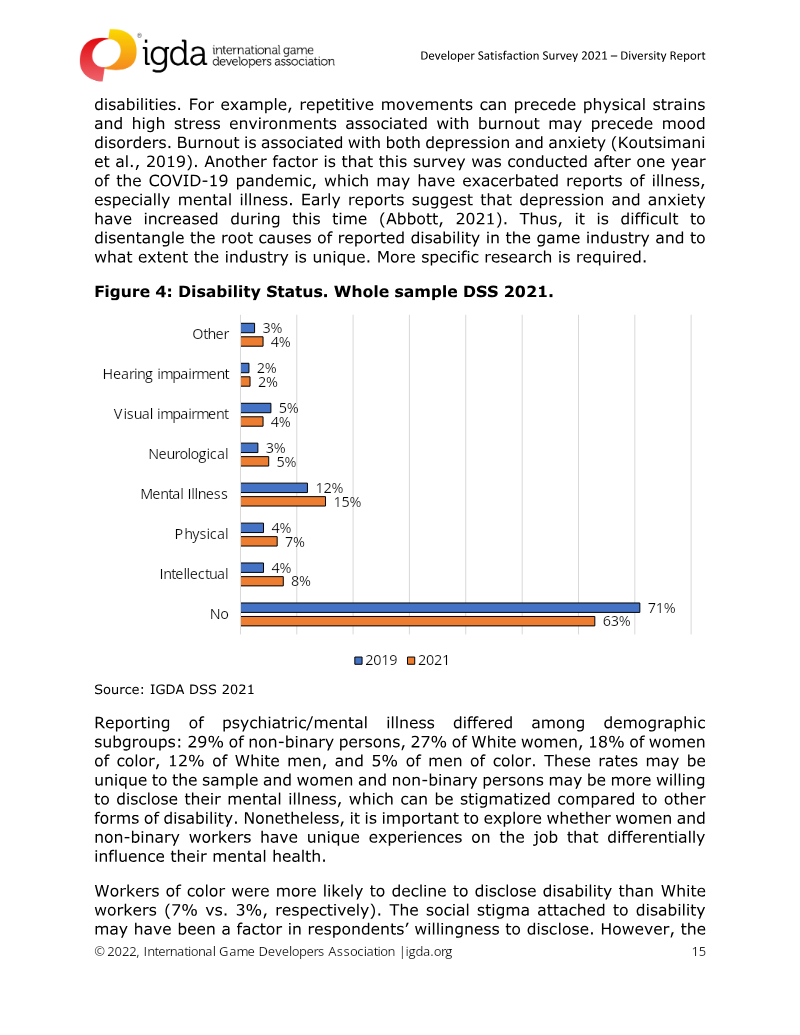
- Occupational segregation persists, as women and developers of color are disproportionately represented in precarious, freelance, or part-time roles rather than stable, high-level positions.

"War Never Changes." Gender Roles and the Transformative Potential for Role Reversal in Roleplay Games with Post-Apocalyptic Settings
Marie-Luise Meier's article examines how post-apocalyptic roleplaying games handle gender, arguing that the apocalypse's "reset" of society offers a rare opportunity to challenge hegemonic gender norms, an opportunity the genre rarely takes up.
- Marie-Luise Meier argues that post-apocalyptic games rarely exploit the genre's "reset" of society to challenge gender norms, and that most reinstate traditional hierarchies without critique while coding technology and science as male.
- Fallout 4 (2015) is analysed as reinforcing binary gender oppositions through its cyclical, nuclear-family-centred narrative, associating violence, heroism, and fatherhood with men and confining women to supportive or victim roles.
- Fallout 4's binary character creation, with gendered hairstyles and body options, is cited as enforcing a strict gender system through gameplay itself.

Chinese Console Market Revenues: 2021 Analysis
The Chinese console market experienced significant growth in 2021, surpassing $2 billion in total revenue for the first time.
- The Chinese console market reached $2 billion in revenue in 2021, marking a 17% year-over-year increase.
- Grey market channels dominated the industry in 2021, accounting for 79.6% of all console, game, and service revenues.
- The console player base grew by 18.3% in 2021 to reach 15.9 million users.
Hypercasual: Past, Present, Future
The hypercasual mobile gaming sector has evolved from a niche category of simple, ad-supported titles into a dominant industry force, accounting for over one-quarter of all mobile game downloads.
- Hypercasual games are defined by three core pillars: simple pick-up-and-play mechanics, a free-to-play model monetized via in-game ads, and the ability to achieve millions of downloads.
- The hypercasual market experienced massive scale, reaching 1.1 billion downloads between 2014–2015 and surging to 11 billion downloads during the 2018–2019 period.
- The industry has shifted from simple 'endless' gameplay to complex progression systems, with modern titles increasingly incorporating meta-elements like decoration and global leaderboards to improve retention.

£8 Million Funding for the UK Games Fund and Tranzfuser
The UK government has committed £8 million in new funding to support the nation’s early-stage independent video games sector over a three-year period.
- The UK government has committed £8 million in funding over three years to support the early-stage independent video games sector.
- Since its inception in 2015, the UK Games Fund has provided grants to nearly 200 early-stage game development studios to support the creation of original intellectual property.
- The funding supports the continuation of the Tranzfuser program, an annual competition designed to help graduates transition into long-term careers within the games industry.

The Impact of Kickstarter on Board Game Design
This paper, presented at DiGRA 2022 by Gordon Calleja of the University of Malta, examines how Kickstarter and similar crowdfunding platforms such as Gamefound have reshaped board game design, production, marketing, and distribution.
- Crowdfunding platforms such as Kickstarter and Gamefound have connected backers' purchasing power directly to designers, enabling games that traditional publishers would have rejected as lacking a market, being too costly to produce, or being insufficiently appealing.
- The paper argues this shift has weakened the influence of conventional gatekeepers (publishers, distributors, and to some degree reviewers) and disrupted the traditional three-tier distribution model, with changes that appear largely irreversible.
- Kickstarter has raised expectations for visual aesthetics and component quality, and these expectations shape design decisions from the earliest stages of ideation.



Prosthetic Metaphors, Rejection, and Representation in Games
This paper proposes that the prosthetic metaphor, long used in game studies to describe how players attach to avatars, can be sharpened by drawing on medical and disability scholarship about prosthetic rejection.
- The paper proposes using the medical concept of prosthetic rejection (non-use or minimal use of a fitted device) as an analytical lens for how players respond when virtual avatars do not fit them, refining the existing prosthetic metaphor in game studies.
- The authors use the survival game Rust as a case study, where a 2015 update randomly and retroactively diversified avatar skin tones, physical traits, and genitalia, provoking backlash from players accustomed to default white male avatars.
- Backlash was documented through press coverage and player reactions, including refund requests, negative reviews, and hostile forum messages, which the authors interpret as rejection in the medical sense.