2015
Company
855 documents in the library are about 2015, from writers such as DiGRA, PocketGamer.biz and game – Verband der deutschen Games-Branche e. V.. Each has a summary and key insights with the page they come from.
Connections
Each row is a game or company named alongside 2015, each column a document, oldest first. A mark means that document names it. Select a row to see those documents.
Key figures from the reports
Around 2015, participation in gambling (75.9% of Finns aged 10–75) and digital gaming (75.0%) reached near parity in the Finnish Player Barometer surveys (2009–2024).
DiGRA, 2026 · From Gambling to Gam(bl)ing: Population-Level Evidence of Changing Play Cultures in Finland
Fate/Grand Order has generated $4.8 billion in lifetime IAP revenue since its 2015 launch, maintaining its status as a top-grossing title despite a decline from its 2018 peak of nearly $700 million in annual revenue.
Udonis, 2026 · Fate/Grand Order: Revenue and Active Player Stats 2026
Chinese publishers now control 60% of the strategy genre revenue, a massive increase from 11% in 2015, driven by integrating hyper-casual mechanics into 4X strategy frameworks.
Deconstructor of Fun, 2026 · Is the Western mobile games industry losing to China?, p. 4
Development began in 2013 and faced significant financial hurdles, including a failed £25,000 Kickstarter campaign in 2015.
Games Industry Africa, 2026 · South African Indie Developer Releases Game After 13-Year Journey
Video game crowdfunding on Kickstarter reached approximately $26 million in total pledges in 2025, marking the highest annual total since 2015.
GameDiscoverCo, 2026 · What Worked for Video Game Crowdfunding in 2025
Documents about 2015

How Final Fantasy Went Old-School Again
Final Fantasy Resonance, released in 2026, represents a strategic pivot for Square Enix, reimagining the 2015 mobile gacha game Final Fantasy Brave Exvius as a traditional, premium console and PC role-playing game.
- Square Enix released Final Fantasy Resonance in 2026 as a premium console and PC reimagining of the 2015 mobile gacha title Final Fantasy Brave Exvius.
- The project successfully transitioned the mobile game into a traditional JRPG by removing free-to-play gacha mechanics and utilizing the company's signature HD-2D art style.
- The game achieved early commercial traction with over 26,000 concurrent players on Steam shortly after its launch.
Kemenekraf dan Tencent Bidik Peningkatan Kontribusi Gim Lokal yang Baru 7%
Indonesia's game industry generated US$1.3 billion in revenue in 2025 and created US$1.8 billion in value added, equivalent to 0.12% of national GDP, according to a white paper titled "The Video Game Industry: Unlocking the Next Level of Economic and Social Development in Southeast Asia," launched in Jakarta in October 2026.
- Kemenekraf and Tencent aim to increase the contribution of local game development and publishing, which currently stands at only 7% of Indonesia's game industry value added.
- In 2025, Indonesia's game industry generated US$1.3 billion in revenue and US$1.8 billion in value added, accounting for 0.12% of the country's GDP.
- The largest contributions to the Indonesian game industry's value added come from hardware and peripherals (47%), esports (24%), and retail (21%), with game development and publishing contributing only 7%.

Some New Things I Learned About Grand Theft Auto VI And Rockstar
The development of Grand Theft Auto VI represents a massive, decade-long undertaking characterized by extreme organizational growth and iterative design challenges.
- Rockstar Games has doubled its workforce from approximately 2,400 employees in 2018 to 4,700 today to support the massive scale of Grand Theft Auto VI development.
- The studio has shifted toward a highly structured, data-driven management style, exemplified by the art production team growing from 5–6 people during GTA V to 65 for the current project.
- Development began as early as 2015, with the project undergoing a strategic pivot to prioritize Red Dead Redemption 2 before integrating foundational systems like advanced NPC mechanics into the new title.

Why Grand Theft Auto VI Took 8+ Years to Make
The development of Grand Theft Auto VI represents a massive, multi-year undertaking that reflects the evolving complexities of AAA game production.
- Development of Grand Theft Auto VI began in earnest in 2019, following a 2015 conceptual phase that was paused to prioritize the completion of Red Dead Redemption 2.
- Rockstar Games scaled its workforce significantly during the project's lifecycle, growing from approximately 2,400 employees in 2018 to a projected 4,700 by 2026.
- A 2022 security breach involving leaked gameplay footage triggered a controversial return-to-office mandate, ending remote work flexibility for staff.

Oligopoly Go!
Game publishing has been consolidating since 2020, and the trend is not yet over. That is the central argument of this analysis, which opens a series on the games industry's structural transformation.
- The ten largest game publishers now control 56% of all publishing revenue, a significant increase from the 45% low recorded in 2020.
- The four largest game publishers hold 39% of the market, placing the industry in a concentration tier comparable to airlines and cell carriers.
- Industry concentration is projected to reach two-thirds of total publishing revenue by 2030, as larger firms continue to grow faster than the rest of the market.
Towards a Revised LM-GM Framework for Classroom Analysis: A Systematic Literature Review
This systematic literature review examines whether the Learning Mechanics–Game Mechanics (LM-GM) framework, introduced by Arnab et al.
- The LM-GM framework (Arnab et al., 2015), which maps pedagogical mechanisms onto game features, is judged flexible enough to serve as a cross-stakeholder baseline but lacks mature treatment of adolescent differences, classroom constraints, and teacher orchestration.
- Motivation is the review's central gap: LM-GM mappings without self-determination theory analysis may yield pedagogically coherent but motivationally inert games, especially for adolescents, who are highly sensitive to peer relatedness, performance comparison, and autonomy.
- A reanalysis by Lobo (2023) found that visible leaderboards and competitive scoring correspond to externally regulated engagement rather than intrinsic motivation, cautioning against relying on these features in adolescent classrooms.



A Tripartite Framework for the Co-design of an Awareness-raising Serious Game Addressing Visual Impairment: A Systematic Literature Review
This systematic literature review, conducted under PRISMA guidelines, examines how serious games addressing visual impairment are technologically designed and co-designed.
- The review of 26 studies (2015–2025) argues that co-design with visually impaired people is a communicational necessity, since their experiential knowledge is transformed and cannot be faithfully formalized without their active participation.
- Of the reviewed serious games for visual impairment, more than half do not specify their engines or software, suggesting technology functions mainly as a social mediator fostering bonds between players rather than as an end in itself.
- Design practices are unevenly adopted: 11 studies used top-down approaches, 6 used user-centered design, and only 8 adopted participatory co-design, motivating a proposed co-design method bringing together visually impaired experts, technical experts, and researchers.
Revisiting the Serious Game Classification and Definition
This paper, by Alice Thise of the University of Liège, revisits the theoretical foundations of "serious games" (SG), a term the author acknowledges is contested because it implies games are not serious by nature.
- The paper, a narrative review by Alice Thise (University of Liège) and a summary of a doctoral thesis chapter, adopts a subjectivist definition of play: play is defined by the player's perception, while objects designed as games remain games regardless of reception.
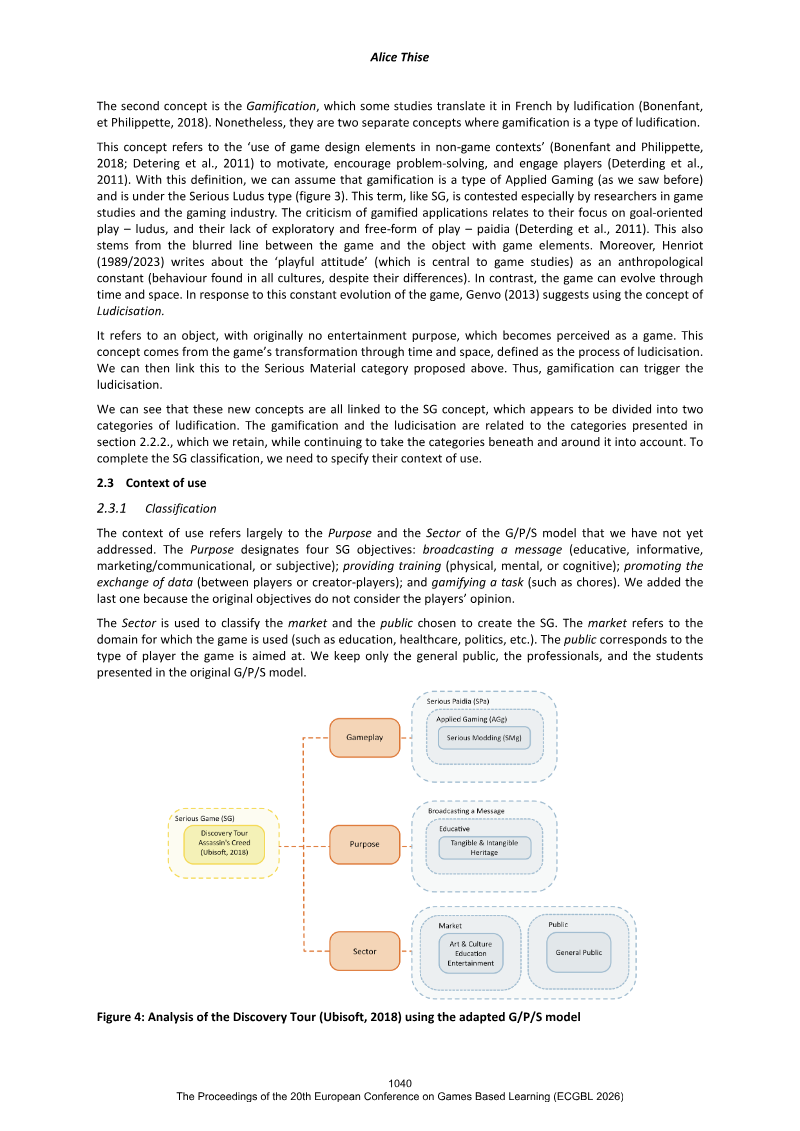
- The author proposes extending the Gameplay/Purpose/Sector model of Alvarez, Djaouti and Rampnoux (2012) with categories such as Serious Material and Serious Paidia, and introduces historical periods: Ancient, Retro, and the post-2002 Serious Games period.
- The paper revises the start of the Retro Serious Games period from 1972 to 1951, the date of an early research chess program, and argues that physical and phygital precedents such as Sun Tzu's Wei Hai and Sutherland's 1968 head-mounted display predate the digital emphasis common in the literature.
BeamNG.drive: The Biggest Driving Game Hit Nobody Analyzes?
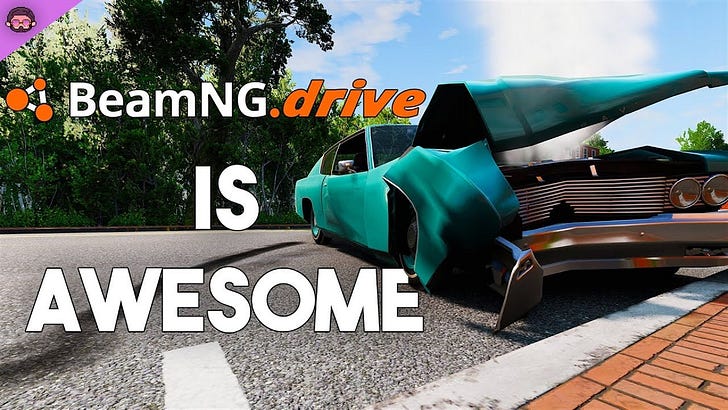
The analysis examines the sustained success of the vehicle simulation title BeamNG.drive, positioning it as a significant yet under-analyzed evergreen hit in the PC gaming market.
- BeamNG.drive has achieved an estimated $200 million in lifetime gross Steam revenue with over 10 million copies sold, including 1.3 million copies sold in the last 12 months alone.
- The game's success is driven by its 'soft-body physics' engine, which serves as both a consumer-facing vehicle simulator and an enterprise-grade tool for autonomous driving research via BeamNG.Tech.
- Community-driven User Generated Content (UGC) and modding are critical to the game's longevity, with third-party platforms hosting extensive libraries of real-world vehicle models that expand the game's appeal beyond its base offerings.

The Real Value of Licensed IP
The value of licensed intellectual property (IP) in the video game industry is often overstated as a guarantee of success.
- External IP is significantly more effective at amplifying success than preventing failure, as the bottom 25% of licensed games still underperform compared to the median original IP.
- External IP provides the greatest commercial uplift for games rated 'Very Positive' (4.51x median revenue) rather than 'Overwhelmingly Positive' (2.06x), suggesting the license is most effective for good—but not exceptional—titles.
- Accounting for typical royalty rates of 9–26% significantly erodes the revenue advantage of licensed IP, reducing the median performance uplift from a range of 1.52x–2.62x down to 1.22x–2.10x.
From Gambling to Gam(bl)ing: Population-Level Evidence of Changing Play Cultures in Finland
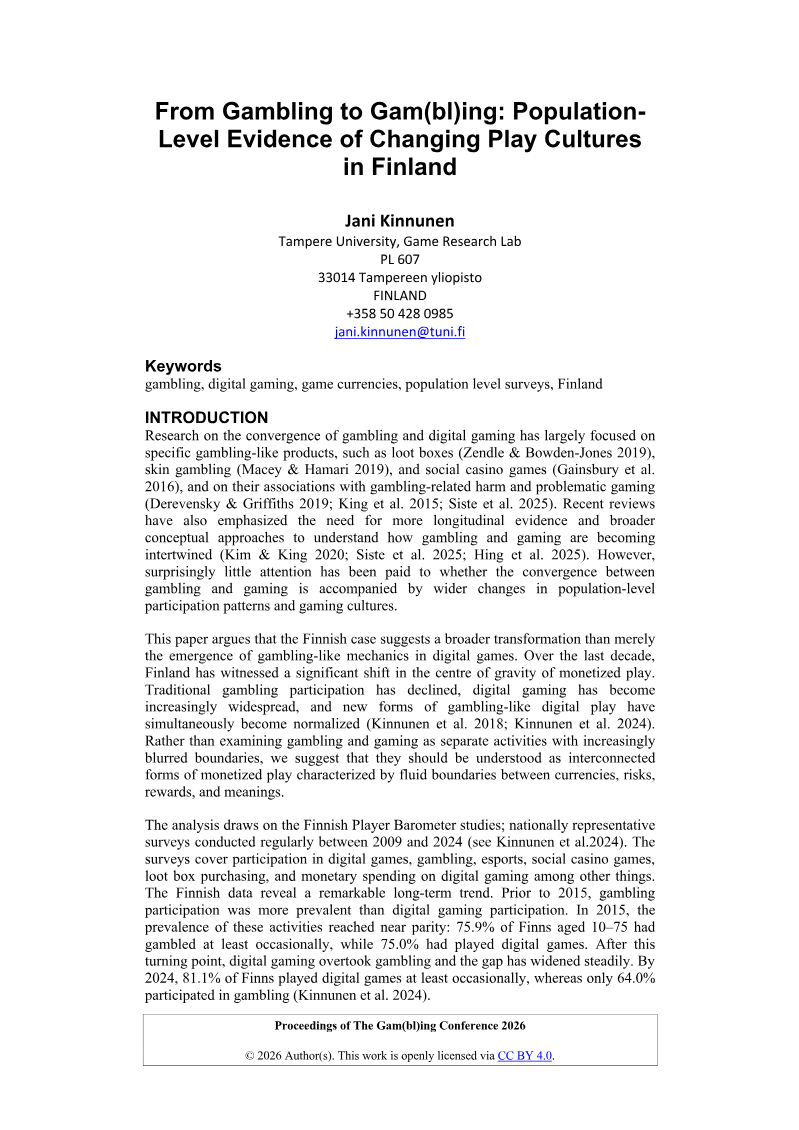
Kinnunen argues that the convergence of gambling and digital gaming should be understood not only as a matter of gambling-like mechanics entering games, but as a broader reorganization of monetized play at the population level.
- Around 2015, participation in gambling (75.9% of Finns aged 10–75) and digital gaming (75.0%) reached near parity in the Finnish Player Barometer surveys (2009–2024).
- Digital gaming has since overtaken gambling, reaching 81.1% of the population by 2024 compared with 64.0% for gambling.
- Gambling-like digital play has become mainstream: in 2024, 8.0% of respondents reported spending money on loot boxes, exceeding horse race betting participation (6.3%).

The Fall and Rise of Game Journalism
The gaming industry is currently experiencing a profound transformation in its information ecosystem, characterized by a sharp decline in traditional editorial journalism and a simultaneous shift toward independent, personality-driven reporting.
- The game journalism industry is in a sharp decline, losing approximately 800 specialist and mainstream reporters between 2024 and the first half of 2026.
- Platform operator power has surged significantly, with revenue from app stores, console marketplaces, and digital storefronts growing 191%—from $14 billion to $41 billion—over the decade leading up to 2025.
- The rise of AI-driven content and corporate cost-cutting has led to a proliferation of low-quality information, making it increasingly difficult for consumers to navigate the gaming market and identify relevant content.