Japan gaming industry reports and market data
190 game industry reports, presentations and talks about japan from writers such as PocketGamer.biz, CESA – Computer Entertainment Supplier's Association and Game Developers Conference, newest from 2026. Every document has a summary and key insights with the page they come from, and 1,759 charts and tables are extracted as data.
Key figures
Square Enix’s SD game revenue is heavily reliant on the contracting Japanese market, with flagship titles like 'FFVII Ever Crisis' generating 70% of their revenue domestically.
InvestGame, 2025 · Square Enix Next: That Excitement Once Again, p. 63
The company plans to adopt IFRS from FY2026.3, projecting a consolidated operating profit of ¥31.22 billion (IFRS), up from ¥27.00 billion (JGAAP) in FY2025.3, with the USA segment contributing ¥14.68 billion (IFRS) and Japan ¥18.18 billion (IFRS).
Round One Corporation, 2025 · FY2025.3 4Q Financial Results Presentation: Round One Corporation, p. 11
Domestic publishers maintain a dominant market position, capturing roughly one-third of total downloads and over 50% of all in-app purchase (IAP) revenue in Japan.
Sensor Tower, 2025 · Japan Game Market Insights 2025, p. 28
Japan generates 9.1% of global game revenue from only 2.2% of the global player base, with an average per-player spend of $223 compared to $145 in the UK.
Ukie, 2025 · UK Interactive Entertainment Japan Market Report 2025, p. 12
Over 80% of game developers with formal vocational or university education in Japan received a salary increase in 2024.
CESA – Computer Entertainment Supplier's Association, 2024 · ゲーム開発者の就業とキャリア形成 2024, p. 32
Documents
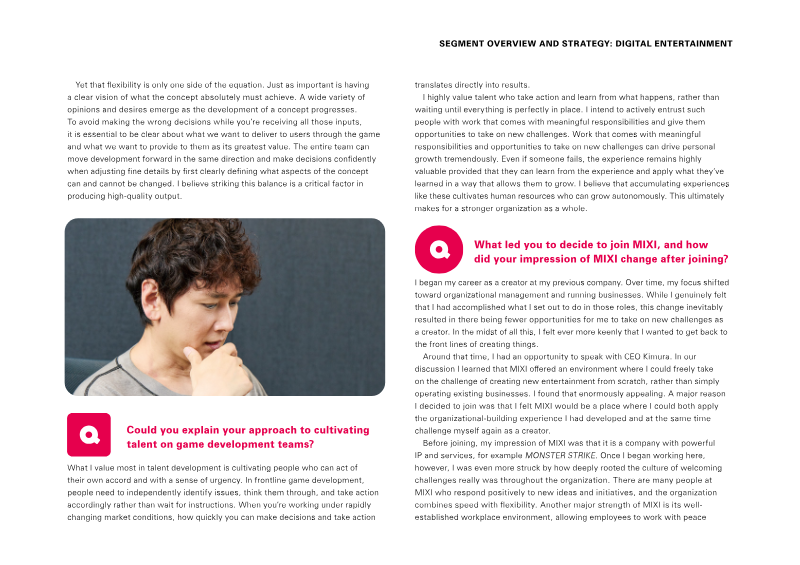
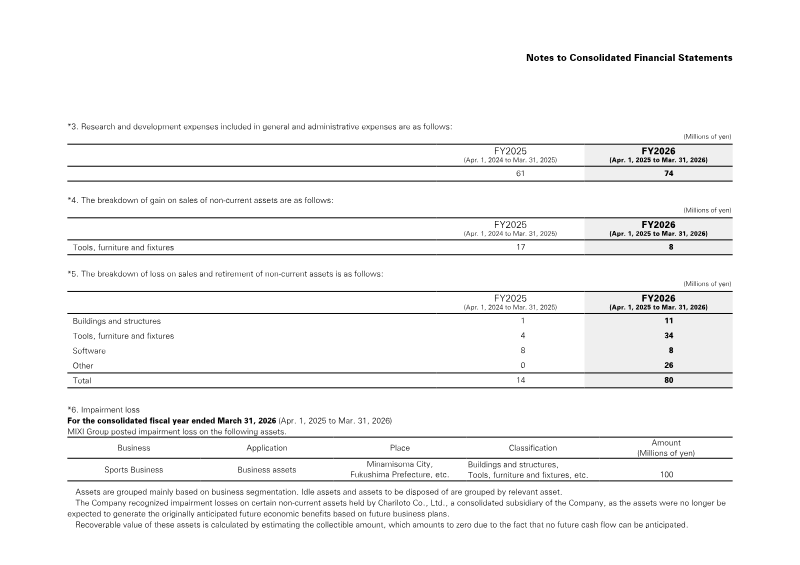
MIXI Integrated Report 2026
The MIXI Integrated Report 2026 details the company’s strategic transition into its "Third Founding" phase, a period defined by a pivot toward the "We-Time Economy."
- MIXI is prioritizing global expansion as a top management goal, noting that overseas sales accounted for only approximately 12% of total net sales in fiscal year 2026.
- The company is shifting its financial policy to return profits generated across all business segments to shareholders, moving away from a reliance on MONSTER STRIKE as the primary source of financial leverage.
- MIXI has introduced a medium-term 'Growth Strategy in the We-Time Economy,' focusing on creating economic value through shared experiences among families, friends, and fans.
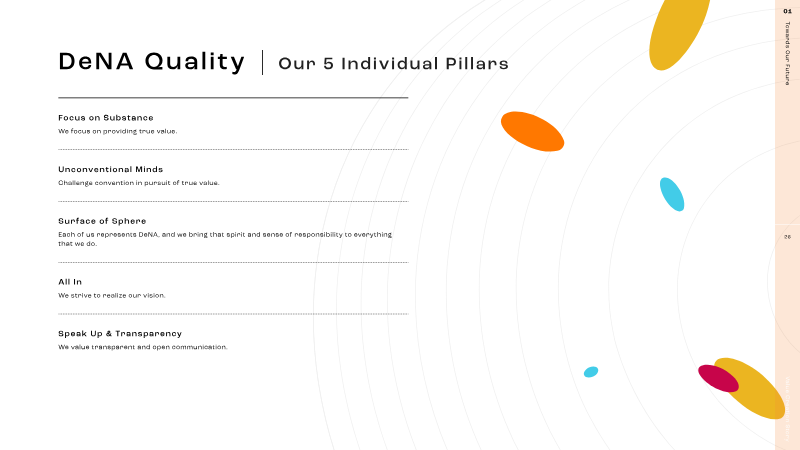


DeNA 2026 Integrated Report
DeNA is undergoing a fundamental strategic transformation to evolve into an "Eternal Venture," a model designed to generate a conglomerate premium through a cyclical ecosystem of business creation, growth, and divestment.
- DeNA is transitioning into an 'Eternal Venture' model, a conglomerate structure designed to cycle through business creation, growth, and divestment to maintain long-term agility.
- The 'AI-ALL-IN' strategy mandates full organizational adoption of proprietary AI readiness metrics and a transition to public cloud infrastructure to boost engineering output and operational efficiency.
- The company is diversifying its revenue base beyond gaming by leveraging growth in its sports and smart city business segments to offset volatility in healthcare and gaming.

The state of Japan's video game industry, plus how GTA 6 influenced Valor Mortis' $40 price point
Japan’s video game industry remains a global powerhouse, anchored by the enduring success of console giants like Nintendo and Capcom.
- Japan’s video game market generates $17 billion annually, with the $12 billion mobile sector facing increased competition from Chinese developers like Tencent and NetEase.
- PC gaming in Japan has more than doubled its market share since 2019, driven by pandemic-era consumer habits and increased publisher support.
- Lyrical Games is pricing its upcoming title, Valor Mortis, at $40 to position it as a high-value 'triple-I' alternative to massive AAA releases like GTA 6.

🐱 Meowdoku case study: Minesweeper + Cats + Sudoku. Take a 40-Year-Old Game, Add Cats, Make Millions
Meowdoku serves as a prime example of how established puzzle mechanics can be revitalized through thematic reskinning and aggressive user acquisition strategies.
- Meowdoku generates between $130,000 and $200,000 in daily revenue through a 100% ad-monetization model featuring interstitial ads, rewarded videos, and adaptive cooldowns.
- The game achieves significant scale with 400,000 daily downloads and 2 million daily active users.
- Publisher Beijing Lexing Shen utilizes a high-volume strategy across its portfolio, resulting in over 1 billion cumulative downloads and 70 million monthly active users.

eFootball vs EA FC, Apple Arcade stats, Stillfront, Queen, alt app stores, payments, more
The mobile games industry is currently experiencing significant shifts in monetization, platform accessibility, and regulatory oversight.
- Konami’s eFootball has achieved a highly effective monetization model in Japan, generating $915 million in lifetime revenue from 12 million downloads, resulting in a revenue-per-download figure exceeding $75.
- Regulatory pressure is mounting globally, with the UK’s Competition and Markets Authority expected to force Apple and Google to remove steering restrictions on payment systems by the end of the year.
- Apple Arcade functions primarily as a family-oriented platform, as data since its 2019 launch shows top-performing titles like Sneaky Sasquatch and Hello Kitty Island Adventure are non-hardcore, while titles targeting traditional gamers see minimal engagement.

TWIG #389: GTA 6 Pricing, Tencent Pulls Back from Japan, and Steam Machine Flops at Launch
The gaming industry is currently undergoing a significant pricing recalibration, anchored by the decision to set the standard edition of Grand Theft Auto 6 at $80 and its deluxe version at $100.
- Grand Theft Auto 6 is setting a new industry standard with an $80 base price and a $100 deluxe version, signaling a move beyond the previous $70 price ceiling for premium software.
- Tencent is retreating from Japanese studio acquisitions, indicating a cooling global M&A market that is pushing startups to explore management buyouts for liquidity.
- Queen Digital Entertainment closed following a $50 million loss, highlighting a shift toward data-driven project management and a move away from pedigree-based venture capital investments.

🌸 The Pikmin Bloom Anomaly: How a 5-Year-Old game just hit 5x downloads without UA
Pikmin Bloom has achieved a notable fivefold increase in downloads by prioritizing product-led growth over traditional user acquisition strategies.
- Pikmin Bloom achieved a 5x increase in downloads by shifting from traditional user acquisition to product-led growth strategies.
- The introduction of region-specific mechanics, such as weekly rotating mushroom locations, successfully drove organic discovery and persistent user engagement.
- The game has generated $85 million in lifetime revenue, establishing a stable niche as a casual alternative to more competitive titles like Pokémon GO.

How to maximize ad revenue in Tier 4 geos (+Japan bonus) by Felix Braberg
Maximizing ad revenue in Tier 4 markets, specifically India and Indonesia, requires a specialized approach to mediation stacks that differs significantly from Tier 1 strategies.
- Prioritize technical stability in Tier 4 markets by delaying ad loading until after SDK initialization and restricting ad requests to devices with at least 2GB of RAM to prevent ANR errors and crashes.
- In India, integrate InMobi as both a bidder and waterfall source, and utilize multiple Google Ad Manager (GAM) MCM resell partners to maximize exposure to AdX demand.
- Boost eCPMs in India by segmenting users based on device language and applying higher bid floors to English-language users.
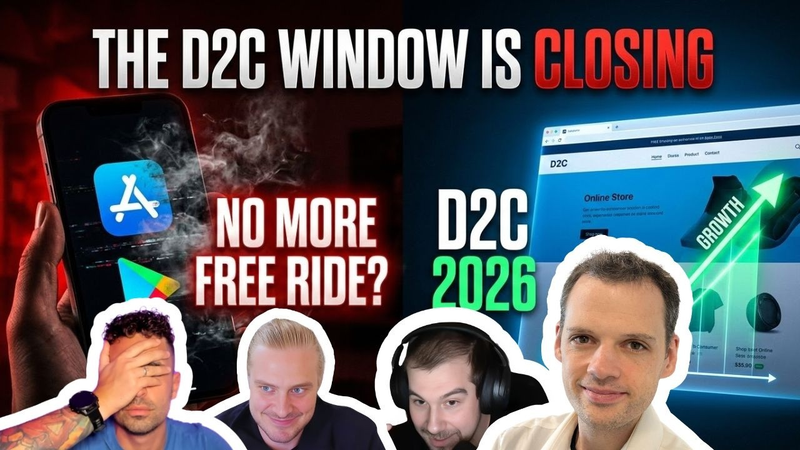
D2C Trends: Apple bringing back fees & Why is that a good thing!
The direct-to-consumer (D2C) model has emerged as a critical strategy for game publishers seeking to enhance profit margins and gain greater control over player relationships.
- Approximately 50 percent of surveyed game studios currently generate up to 20 percent of their total revenue through web-based D2C channels.
- Apple and Google are moving to implement platform fees on off-platform transactions globally, following precedents set in Japan and Brazil, effectively ending the current window of fee-free steering in the U.S.
- Publishers should treat web stores as permanent e-commerce infrastructure rather than temporary workarounds to ensure long-term profitability amidst the standardization of platform fees.

Ares' gameplan, Honkai: Star Rail drama, Moonton's Savvy sale, Rovio's write-down, DICE awards, more
The mobile games industry is currently navigating significant shifts in investment, corporate restructuring, and geopolitical influence.
- Savvy is in negotiations to acquire Moonton, the developer of Mobile Legends: Bang Bang, for approximately $7 billion, signaling a potential exit from mobile gaming for ByteDance.
- Sega recorded a $200 million write-down for Rovio, citing intense market competition and a lack of recent successful titles.
- Financial performance across the sector is polarized: AppLovin reported a 70% revenue increase to $5.48 billion and Krafton reached $1.2 billion in mobile revenue, while Embracer Group saw mobile game sales decline by 66%.

Square Enix Next: That Excitement Once Again
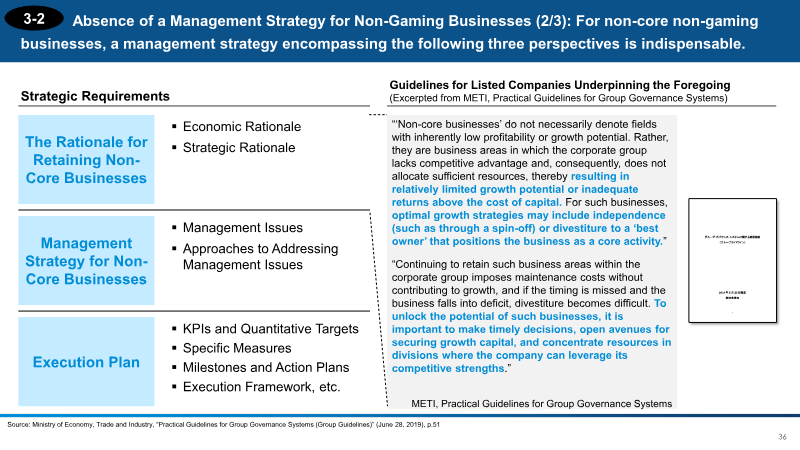
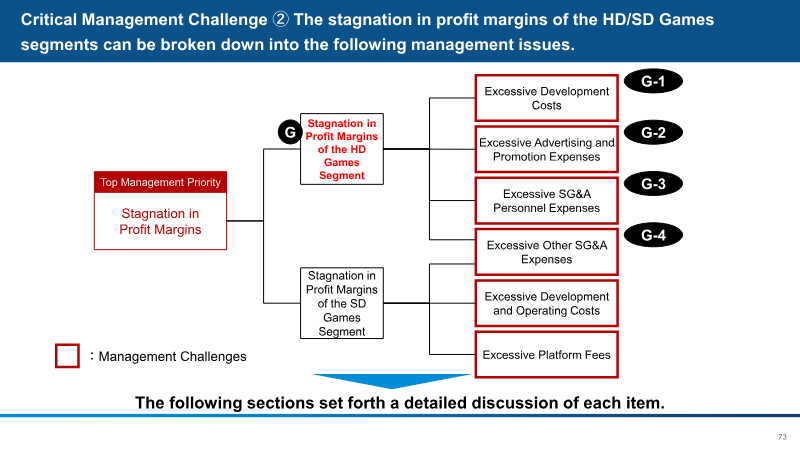
Square Enix’s recent performance review exposes a persistent decline in revenue growth and profitability over the past three years, with operating income falling 32% and ROE dropping 61%.
- Square Enix has experienced a significant financial decline over the past three years, marked by a 32% drop in operating income and a 61% decrease in return on equity (ROE).
- Core gaming segments are underperforming, with HD and SD game revenues falling 4% and 5% respectively, while MMO licensing remains the only growth driver at +11%.
- Operating margins for HD and SD segments remain inefficient at 35–40%, and SG&A costs exceed industry norms by 5–6 percentage points due to an oversized sales force.

⏰ D2C is the highest ROI strategy in mobile right now & the clock is ticking! Are you ready?
Direct-to-consumer monetization has emerged as the most effective strategy for mobile publishers seeking to maximize return on investment in the current digital landscape.
- Direct-to-consumer (D2C) web stores are currently the highest ROI strategy for mobile publishers, allowing them to bypass traditional platform fees and capture essential first-party data.
- Mobile developers should prioritize building independent web-based infrastructure immediately to secure revenue channels before platform policies become more restrictive.
- Google’s proposed settlement with Epic Games suggests a tiered fee structure, potentially replacing the standard 30% commission with a 5% processing fee plus a 9% or 20% service fee based on item type.