Sega Sammy Holdings
Game Co.26 documents
Documents
Financial15 pages
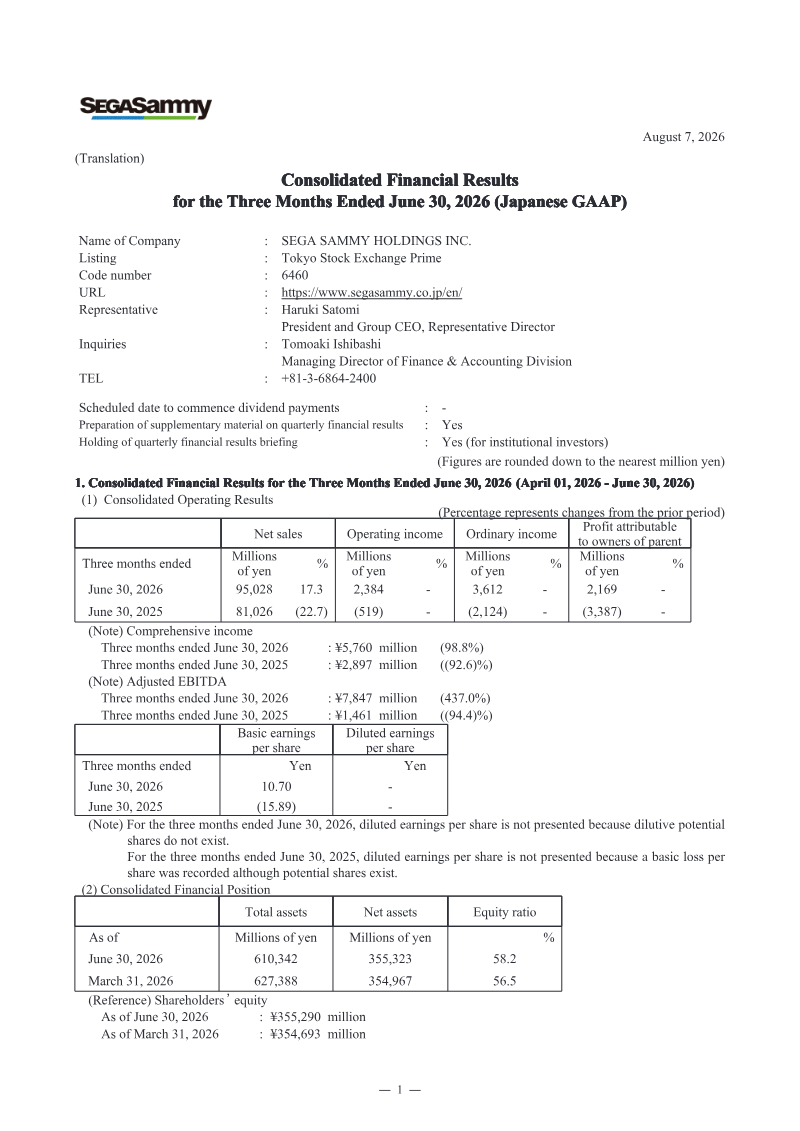
Consolidated Financial Results: Three Months Ended June 30, 2026
Sega Sammy Holdings Inc.’s consolidated financial results for the three months ended June 30, 2026, reflect a period of recovery and growth, characterized by a significant turnaround in operating performance compared to the same period in the prior year. The company reported net sales of ¥95,028 million, representing a 17.3% increase year-over-year. Operating income reached ¥2,384 million, a notable improvement from the ¥519 million operating loss recorded in the first quarter of 2025. Adjusted EBITDA also saw substantial growth, rising 437% to ¥7,847 million.
The company’s performance is categorized across three primary segments: Entertainment Contents, Pachislot & Pachinko Machines, and Gaming Business. The Entertainment Contents segment remained stable with net sales of ¥68,589 million, supported by consistent catalogue sales and strong performance in the AM&TOY area. The Pachislot & Pachinko Machines segment experienced a robust recovery, with net sales increasing 58.5% to ¥17,558 million, driven by the successful deployment of new titles and additional sales of existing products. Conversely, the Gaming Business segment saw a sharp increase in net sales to ¥8,034 million—largely due to the integration of acquisitions—though it recorded an operating loss of ¥1,798 million as the company continues to invest in platform migration and business revitalization.
Geographically focused on the Japanese market with global operations, the company maintains a solid financial position with an equity ratio of 58.2%. Management has reaffirmed its full-year forecast for the fiscal year ending March 31, 2027, projecting net sales of ¥510,000 million. The company continues to prioritize its Transmedia strategy to enhance intellectual property value while focusing on the long-term stabilization of its gaming division through platform efficiency and product diversification.
- Sega Sammy Holdings achieved a significant financial turnaround in Q1 2026, reporting ¥95,028 million in net sales, a 17.3% year-over-year increase.
- Operating income reached ¥2,384 million, reversing the ¥519 million operating loss recorded during the same period in 2025.
- The Pachislot & Pachinko Machines segment drove growth with a 58.5% increase in net sales to ¥17,558 million, fueled by new title deployments and strong existing product sales.
- Adjusted EBITDA surged 437% year-over-year to ¥7,847 million, reflecting improved operational efficiency.
- The Gaming Business segment reported ¥8,034 million in net sales but incurred an operating loss of ¥1,798 million due to ongoing platform migration and acquisition integration costs.
+1
Sega Sammy Holdings
Financial29 pages
Results Presentation: Q1 for the Fiscal Year Ending March 2027
Q1 for the Fiscal Year Ending March 2027 The market forecasts, performance outlooks, plans, strategies, and other forward-looking statements contained in this document are based on information available to the Company and the judgment of its management at the time this material was created. They do not constitute a guarantee of future performance.
- SEGA Sammy reported a strong Q1 FY2027/3 performance, with consolidated sales of 95.0 billion yen and operating income of 2.3 billion yen, exceeding initial expectations across all business segments.
- The Entertainment Contents business saw Q1 catalogue sales reach 9.7 billion yen, driven by the Persona series, with major new titles like 'STRANGER THAN HEAVEN' and 'Persona 4 Revival' scheduled for release from Q3 onward.
- The Pachislot & Pachinko segment performed strongly in Q1, with notable unit sales including 10,400 units for 'Smart Pachislot BIG DREAM THE GOLDEN PUSHER' and 3,400 units for 'A-SLOT+ Isekai Quartet BT'.
- The Gaming business experienced increased sales but a widened operating loss compared to Q1 FY2026/3, primarily due to the consolidation of GAN and Stakelogic into the P&L.
- PARADISE CITY in South Korea reported steady performance with record-high casino drop amounts in May 2026, though equity method earnings decreased due to one-time initial hotel expenses and reduced tax refunds.
+1
Sega Sammy Holdings
Financial6 pages
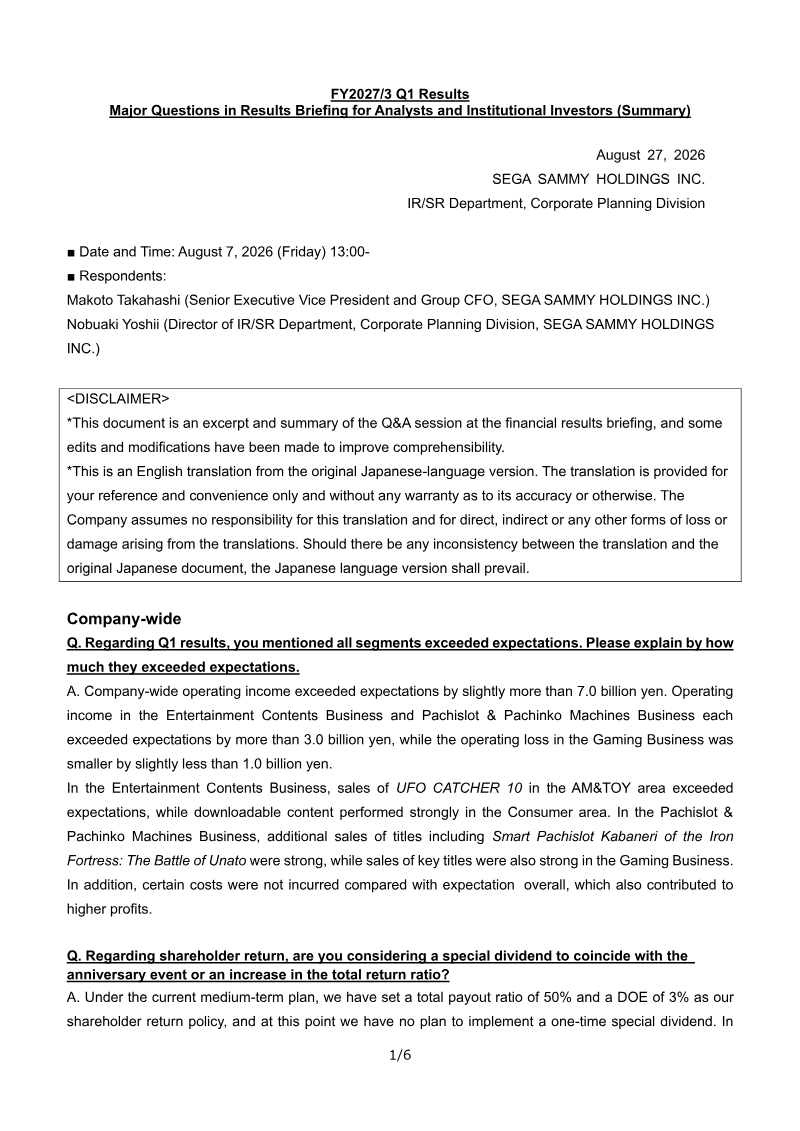
FY2027/3 Q1 Major Questions Regarding Financial Results
The financial results briefing for the first quarter of the fiscal year ending March 2027 outlines the performance of Sega Sammy Holdings across its core business segments. The primary objective of the session was to address analyst inquiries regarding the company’s financial outperformance, which saw consolidated operating income exceed initial expectations by more than 7.0 billion yen. This growth was driven by strong results in the Entertainment Contents and Pachislot & Pachinko Machines segments, alongside a narrower-than-anticipated operating loss in the Gaming Business.
Key findings indicate that the Entertainment Contents Business benefited from robust sales of arcade hardware and strong performance in downloadable content, despite a year-over-year decline in operating income due to the absence of one-time licensing revenue recorded in the previous year. The company is currently transitioning toward a unified global marketing structure and a simultaneous multi-platform release strategy for new titles. Meanwhile, the Pachislot & Pachinko Machines segment saw improved profit margins attributed to high demand for specific titles and increased sales of reel units. Management noted that while regulatory shifts regarding machine features are unlikely to impact short-term performance, they are expected to support long-term industry revitalization.
The Gaming Business, which operates primarily in the North American market, reported a smaller operating loss than projected, largely due to a higher-than-expected proportion of outright machine sales compared to the anticipated lease-based model. Regarding capital allocation, the company maintains its commitment to a 50% total payout ratio and a 3% dividend on equity (DOE), prioritizing a balance between growth investments and shareholder returns. The company continues to pursue a transmedia strategy, leveraging its intellectual property across games, video adaptations, and merchandise to maximize brand value globally.
- Sega Sammy Holdings exceeded initial Q1 FY2027/3 consolidated operating income expectations by over 7.0 billion yen.
- The Entertainment Contents segment is shifting to a unified global marketing structure and a simultaneous multi-platform release strategy for new titles.
- The Gaming Business in North America outperformed loss projections due to a higher-than-expected volume of outright machine sales rather than the anticipated lease-based model.
- Pachislot & Pachinko segment profit margins increased due to high demand for specific titles and higher sales of reel units, with management viewing regulatory shifts as a long-term industry benefit.
- Entertainment Contents operating income declined year-over-year due to the absence of one-time licensing revenue recorded in the previous fiscal period.
+1
Sega Sammy Holdings
Financial13 pages
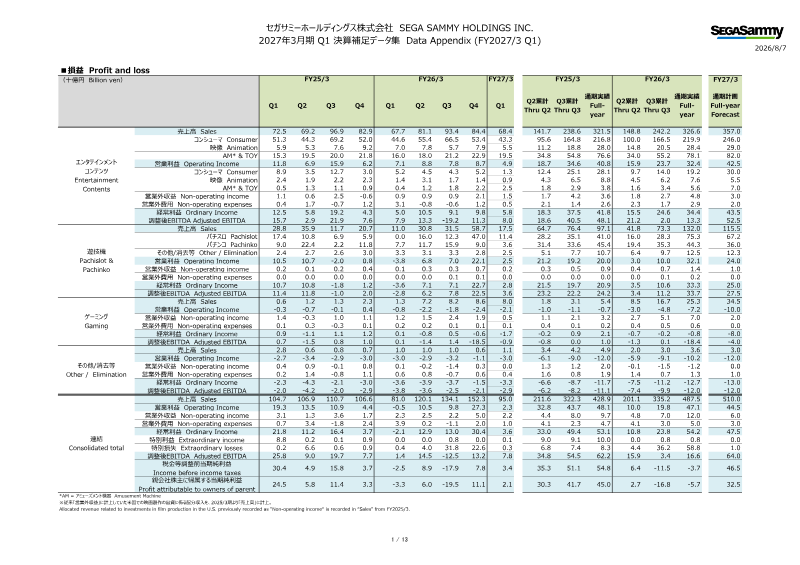
Data Appendix: FY2027/3 Q1
2027年3月期 Q1 決算補足データ集 Data Appendix (FY2027/3 Q1) 2026/8/7 (十億円 Billion yen) FY25/3 FY25/3 FY26/3 FY27/3 FY26/3 FY27/3 Q2累計 Q3累計 通期実績 Q2累計 ...
- Consolidated sales for FY2027/3 Q1 reached 148.8 billion yen, with a full-year forecast of 510.0 billion yen.
- The Consumer segment remains the primary revenue driver, contributing 100.0 billion yen in Q1 sales out of the 148.8 billion yen total.
- Operating income for the consolidated group in Q1 was 10.0 billion yen, significantly trailing the full-year target of 44.5 billion yen.
- Overseas sales remain a critical component of the business, accounting for 85.4% of total sales in Q1, with North America and Europe being the primary geographic markets.
- Paradise Sega Sammy reported Q1 sales of 291.4 billion KRW, with casino operations generating 238.2 billion KRW and attracting 202,000 users.
Sega Sammy Holdings
Financial29 pages
Results Presentation: Q1 Fiscal Year Ending March 2027
SEGA Sammy achieved a strong start to the fiscal year ending March 2027, with consolidated sales reaching 95.0 billion yen and operating income rising to 2.3 billion yen. These results, which exceeded initial expectations, were primarily driven by the robust performance of the Pachislot and Pachinko division. Key hardware releases, such as the Smart Pachislot BIG DREAM THE GOLDEN PUSHER, moved 10,400 units, while the Kabaneri of the Iron Fortress series maintained momentum with 40,900 cumulative units sold. This segment remains a cornerstone of the company’s current financial stability, with a clear strategy to sustain growth through upcoming titles like Lycoris Recoil and The Seven Deadly Sins 3.
While the consumer gaming division is currently in a transitional phase, it is positioned for significant expansion starting in the third quarter. The company is actively rebuilding its growth foundations through structural reforms aimed at increasing operational efficiency and prioritizing research and development. This strategic pivot is supported by a high-profile pipeline of upcoming consumer titles, including Persona 6, Crazy Taxi: World Tour, and Total War: WARHAMMER 40,000. These releases are intended to serve as the primary catalysts for long-term value creation.
The company’s broader outlook remains focused on executing its medium-term plan across its global gaming, amusement, and casino segments. By balancing the immediate, high-margin contributions from its Pachislot and Pachinko business with a disciplined, long-term investment strategy in its consumer software portfolio, SEGA Sammy aims to solidify its market position. The current trajectory reflects a commitment to diversifying revenue streams while leveraging established intellectual property to drive future performance throughout the remainder of the fiscal year.
- SEGA Sammy reported Q1 fiscal year 2027 consolidated sales of 95.0 billion yen and operating income of 2.3 billion yen, exceeding initial expectations.
- The Pachislot and Pachinko division remains the primary financial driver, led by 10,400 units sold of 'Smart Pachislot BIG DREAM THE GOLDEN PUSHER' and 40,900 cumulative units for the 'Kabaneri of the Iron Fortress' series.
- The consumer gaming division is currently in a transitional phase but is projected to see significant expansion starting in the third quarter of the fiscal year.
- Future growth in the consumer segment relies on a high-profile pipeline featuring 'Persona 6', 'Crazy Taxi: World Tour', and 'Total War: WARHAMMER 40,000'.
- Management is implementing structural reforms focused on operational efficiency and R&D prioritization to stabilize the consumer gaming business.
+1
Sega Sammy Holdings
Legal37 pages
Corporate Governance Report: Japan
Sega Sammy Holdings Inc. maintains a comprehensive corporate governance framework designed to maximize long-term stakeholder value through management efficiency, operational transparency, and rigorous oversight. The company’s central thesis posits that sustainable growth is best achieved by balancing robust capital efficiency with a diverse, skills-based leadership structure. By prioritizing an Audit and Supervisory Committee model, the organization ensures objective monitoring of business execution, bolstered by the direct jurisdiction of internal auditing departments and the active participation of seven independent external directors.
Financial performance and shareholder returns remain core pillars of this strategy, with the company targeting an average return on equity exceeding 10% through March 2027. To support these goals, the firm employs a shareholder-friendly policy featuring a 3% dividend on equity or a 50% total payout ratio. Transparency is further reinforced through proactive investor relations, including hybrid virtual meetings, early convocation notices, and extensive digital disclosures tailored to both domestic and international stakeholders. The company explicitly rejects anti-takeover measures, favoring instead a commitment to continuous improvement in risk management and resource allocation.
Human capital development serves as a critical component of the firm’s operational strategy, with significant investments directed toward workforce education and diversity initiatives. The organization has successfully met ambitious targets regarding female representation in management and multicultural talent acquisition ahead of schedule. By integrating these human capital goals with a governance structure that emphasizes performance-linked remuneration and continuous professional development for directors, the company fosters a culture of accountability. These practices, spanning the fiscal period through 2027, reflect a commitment to maintaining high standards of corporate integrity and operational excellence within the Japanese entertainment and gaming sector.
- Sega Sammy Holdings targets an average return on equity (ROE) exceeding 10% through March 2027.
- The company maintains a shareholder-friendly payout policy of either a 3% dividend on equity or a 50% total payout ratio.
- Governance is structured around an Audit and Supervisory Committee model, supported by seven independent external directors to ensure objective oversight.
- Sega Sammy explicitly rejects anti-takeover measures, opting instead to focus on risk management and efficient resource allocation.
- The organization has met its internal targets for female representation in management and multicultural talent acquisition ahead of the 2027 deadline.
Sega Sammy Holdings
Financial62 pages
Fiscal Year Ended March 2026: Results Presentation
Fiscal Year 2026/3 saw Sega Sammy’s revenue rise to ¥487.5 billion, driven by robust pachislot and Pachinko sales and the acquisition of two gaming companies. Despite higher top‑line growth, operating income fell to ¥47.1 billion because of a ¥58.8 billion extraordinary loss from goodwill impairments on Rovio and Stakelogic, resulting in a net loss of ¥5.7 billion. Adjusted EBITDA contracted sharply to ¥16.6 billion, though operating forecasts were met and sales are expected to climb further in FY2027/3; profits, however, will likely decline until the newly acquired gaming assets stabilize.
The balance sheet shows goodwill unchanged at ¥26.3 billion, with other intangible assets amortised over 4–20 years. Cash flow from operations rose to ¥25.9 billion, largely due to impairment and amortisation gains, while investing cash outflows of ¥22.5 billion reflected the acquisitions of GAN and Stakelogic, leaving a modest free cash flow of ¥3.4 billion.
Pachislot and Pachinko machine sales reached ¥132 billion, supported by flagship titles such as Smart Pachislot Hokuto No Ken and the new IP Tokyo Revengers. Operating income for this segment climbed to ¥32.1 billion, but a forecasted decline in FY2027/3 sales to ¥115.5 billion is anticipated, driven by fewer mainstay titles, a shift toward lower‑priced reel units, and rising semiconductor costs. The company expects new IP launches in the second half of FY2027/3 to offset this downturn.
Medium‑term projections now target cumulative adjusted EBITDA just under ¥110 billion, far below the original over‑¥180 billion goal, and a return on equity that will miss the 10 % benchmark. Sales are projected to exceed ¥500 billion for the first time since FY2007/3, yet adjusted EBITDA and ordinary income for FY2027/3 are expected to fall short of plan targets. Key challenges include underperformance of new free‑to‑play titles, launch delays, and the need to improve profitability from recently acquired assets.
Rovio’s post‑acquisition sales have underperformed, with Angry Birds 2 stabilising but remaining below prior levels. The strategy focuses on revitalising core titles, expanding the Angry Birds IP through film and licensing initiatives, and launching additional mobile games in China to restore earnings. Operational improvements, trans‑media expansion, and targeted IP development underpin the plan for steady growth.
Gaming‑machine sales continue to grow, reaching ¥8.3 billion in FY2026/3 with profitability across all profit levels. A strategic shift toward lease‑centric revenue is expected to drive medium‑to‑long‑term profits, despite a modest FY2027/3 sales forecast. Key titles such as the Railroad RICHES and Super Burst series maintain high utilisation, supporting strong casino revenue. The company is expanding its B2B footprint in the U.S., launching a next‑generation “V2” platform and pursuing social‑casino porting, while implementing proactive marketing and cost‑control initiatives across B2C and B2B segments.
Sega Sammy Holdings Inc. operates as a Nevada‑registered public company, with subsidiaries licensed to manufacture, distribute, and provide information services for gaming equipment in Nevada and other jurisdictions. Shareholders are subject to Nevada Gaming Authority rules, with similar regulatory constraints potentially applying elsewhere. Forward‑looking statements acknowledge uncertainties arising from economic, regulatory, and operational risks that could materially affect future performance.
- Sega Sammy reported a net loss of ¥5.7 billion for FY2026/3, driven by a ¥58.8 billion extraordinary loss from goodwill impairments on Rovio and Stakelogic, despite revenue rising to ¥487.5 billion.
- The company significantly lowered its medium-term adjusted EBITDA target to just under ¥110 billion, down from the original goal of over ¥180 billion, and expects to miss its 10% return on equity benchmark.
- Pachislot and Pachinko segment revenue reached ¥132 billion with ¥32.1 billion in operating income, but sales are forecasted to decline to ¥115.5 billion in FY2027/3 due to rising semiconductor costs and a shift toward lower-priced units.
- Rovio’s post-acquisition performance has underperformed, with the company now focusing on revitalizing the Angry Birds IP through film, licensing, and mobile game launches in China to restore earnings.
- Operating cash flow reached ¥25.9 billion, but heavy investment in the acquisitions of GAN and Stakelogic limited free cash flow to ¥3.4 billion.
+1
Sega Sammy Holdings
Financial6 pages
Full-Year Results for the Fiscal Year Ended March 2026: Major Questions in Results Briefing
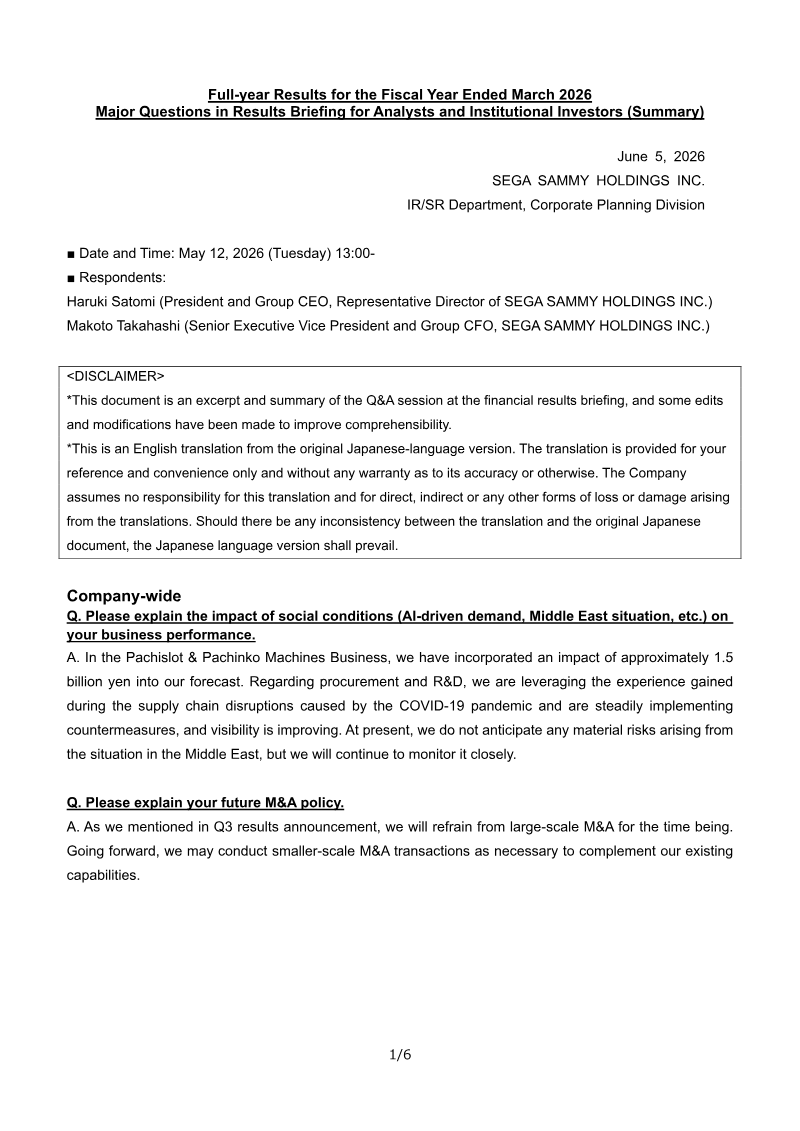
The briefing clarified Sega Sammy Holdings’ fiscal‑year 2026 performance and forward strategy amid evolving market conditions. Social factors such as AI demand and Middle East tensions were deemed manageable, with a 1.5 billion yen impact already factored into the Pachislot & Pachinko forecast; no material risks from Middle East events were anticipated. M&A activity will remain limited to small‑scale transactions, while the company continues to strengthen its content pipeline by releasing four major IP titles in FY2027/3, scheduled for the second half of the year to maximize full‑price sales. The firm highlighted a shift toward data‑driven pricing and promotion, leveraging AI to optimize global KPIs across Europe, North America, South America, Southeast Asia, and Africa. Repeat sales initiatives will be supported by anniversary events for Sonic (35th) and Persona (30th), as well as cross‑media projects such as the Sonic movie and transmedia expansions for Like a Dragon.
In gaming, the company expects FY2027/3 to be the bottom of losses for its Stakelogic unit, with a projected operating loss of 1.6 billion yen; structural reforms aim to reverse this trend by FY2028/3. The Gaming Business’s profitable segments—Gaming machine sales, GAN B2C, and PARADISE SEGASAMMY—will continue to drive earnings, while GAN B2B and Stakelogic receive targeted efficiency measures. PARADISE SEGASAMMY’s smart table development is positioned to reduce dealer training and operating costs, potentially expanding into international casinos. Overall, the company projects increased content production expenses in FY2028/3 due to a larger title slate and higher personnel costs, but anticipates corresponding profit growth from the expanded Full Game portfolio.
- Sega Sammy will launch four major IP titles in the second half of FY2027/3 to maximize full-price sales and drive revenue.
- The Stakelogic unit is projected to reach a loss bottom of 1.6 billion yen in FY2027/3, with structural reforms targeted to achieve profitability by FY2028/3.
- The company is implementing AI-driven pricing and promotion strategies to optimize global KPIs across five key regions, including North America, Europe, and Southeast Asia.
- Revenue growth in FY2028/3 is expected to offset rising content production and personnel costs as the firm expands its full-game portfolio.
- Growth in the Gaming Business will be anchored by PARADISE SEGASAMMY’s smart table technology, which aims to reduce operating costs and facilitate international expansion.
+1
Sega Sammy Holdings
Financial13 pages
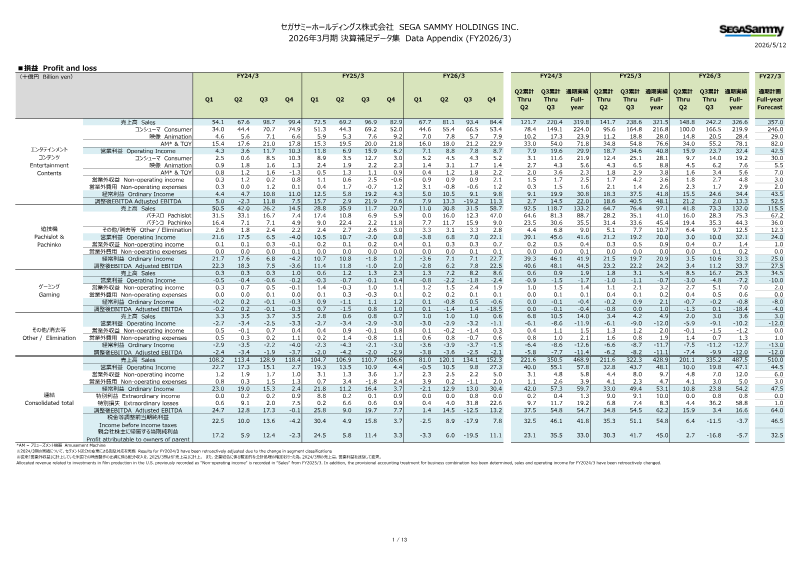
Data Appendix: FY2026/3
The analysis demonstrates a robust expansion of the company’s revenue and profitability over the FY24/3 to FY27/3 period, with total sales projected to climb from ¥54.1 bn in the first quarter of FY24/3 to ¥357.0 bn by FY27/3. This growth is largely driven by the consumer and entertainment segments, which account for roughly 70 % of overall sales. Operating income is expected to rise from ¥4.3 bn in FY24/3 Q1 to ¥78.1 bn by FY27/3, while adjusted EBITDA is projected to increase from ¥5.0 bn to ¥62.2 bn, underscoring improving profitability margins.
Segment‑level data reveal that consumer sales doubled over the period, whereas entertainment content and gaming experienced moderate gains. International markets consistently outperform domestic ones, with overseas sales maintaining a ratio above 60 % across all years. Within the gaming portfolio, flagship IPs such as the Sonic series saw a 20 % year‑over‑year increase in unit sales during FY26/3 Q1–Q3, and the War series grew by 15 %. Free‑to‑play titles added only one new launch and saw two cancellations, indicating a cautious approach to that segment. The casino division posted revenue growth from KRW 91.2 bn in Q1 FY24/3 to KRW 156.2 bn by the end of FY26/3, driven largely by a 30 % rise in casino sales and a 25 % increase in hotel revenue.
Pachinko and Pachislot performance metrics show fluctuating market share for the company, with sales shares ranging between 21 % and 24 % from 2023 to 2024. Prototype approval rates varied widely, from 21 % to 80 % for Pachislot and 23–34 % for Pachinko between 2023‑2025. Utilization shares declined modestly, with Pachislot utilization falling from 30.8 % in FY25/3 to 30.1 % in FY26/3, and Pachinko utilization dropping from 34.9 % to 23.8 %, suggesting a relative loss of market activity compared with competitors.
Overall, the data indicate sustained top‑line growth and improving profitability driven by strong international performance and a diversified product mix, while the company faces increasing competition in the Pachinko/Pachislot arena that may require strategic adjustments to maintain market share.
- The company projects significant financial growth from FY24/3 to FY27/3, with total sales rising from ¥54.1 bn to ¥357.0 bn and operating income increasing from ¥4.3 bn to ¥78.1 bn.
- International markets are the primary revenue driver, consistently accounting for over 60% of total sales throughout the reporting period.
- Consumer and entertainment segments represent 70% of total sales, with consumer segment revenue doubling over the three-year period.
- Flagship gaming IPs are performing strongly, evidenced by year-over-year unit sales growth of 20% for the Sonic series and 15% for the War series in FY26/3 Q1–Q3.
- The casino division experienced steady growth, with revenue increasing from KRW 91.2 bn in Q1 FY24/3 to KRW 156.2 bn by the end of FY26/3, supported by a 30% rise in casino sales and 25% in hotel revenue.
+1
Sega Sammy Holdings
Financial24 pages
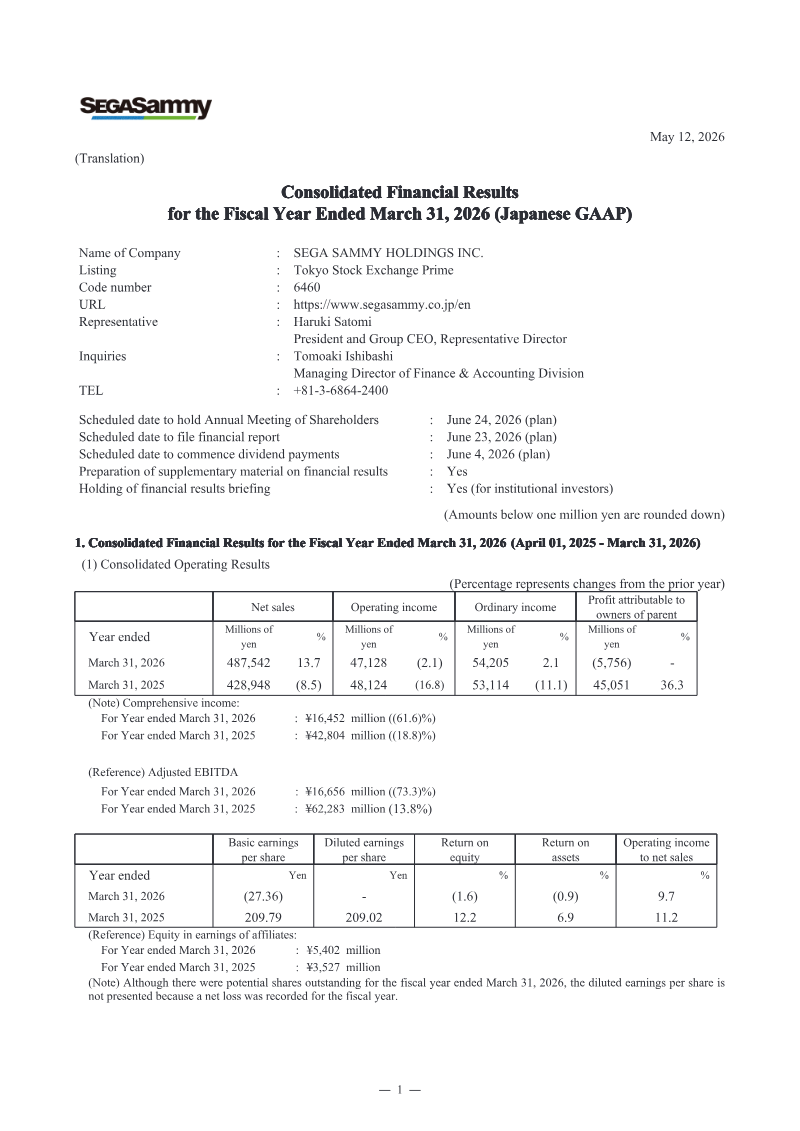
Consolidated Financial Results: Fiscal Year Ended March 31, 2026
Sega Sammy’s fiscal year ending March 31, 2026 delivered a mixed financial picture. Net sales rose 13.7 % to ¥487,542 million, driven largely by third‑party and U.S. film production income, yet operating income slipped 2.1 % to ¥47,128 million and the group recorded a net loss of ¥5.756 billion attributable to owners of parent. Adjusted EBITDA collapsed 73.3 % to ¥16,656 million, largely due to goodwill and intangible asset impairments from the acquisitions of Rovio, Stakelogic and GAN. Despite these losses, shareholder returns remained robust with ¥55 per share in dividends and a ¥20 billion share buy‑back, totaling approximately ¥31.4 billion in returns.
The Gaming segment experienced a sharp rebound in sales, with net sales up 35.9 % to ¥132.2 billion, largely from a 36 % increase in Pachislot & Pachinko and a 364 % surge in third‑party gaming sales. Ordinary income climbed 58.8 % to ¥33.3 billion, and adjusted EBITDA grew 38.8 % to ¥33.7 billion; however, the segment posted a substantial operating loss of ¥19.4 billion. Total assets fell by ¥17.4 billion, liabilities rose by ¥9.2 billion, and net assets declined by ¥26.6 billion, with cash and equivalents dropping to ¥154 million.
Capital efficiency measures included a ¥20 billion treasury stock cancellation and significant goodwill write‑downs—¥31.99 billion on Rovio goodwill and ¥18.05 billion on Stakelogic assets—resulting in a total goodwill write‑down of ¥28.71 billion. Net assets per share fell from ¥1,782.73 to ¥1,750.15, and basic earnings per share swung from a profit of ¥209.79 to a loss of ¥27.36, with no diluted EPS reported due to the net loss.
Looking ahead, management projects a 4.6 % revenue increase for FY 2027 but anticipates a 5.6 % decline in operating income, while maintaining its dividend policy. The company’s financial trajectory reflects a transition from growth‑driven sales expansion to a focus on restructuring and capital efficiency amid significant impairment losses.
- Sega Sammy reported a net loss of ¥5.756 billion for the fiscal year ending March 31, 2026, driven by a 73.3% collapse in adjusted EBITDA to ¥16,656 million.
- The company recorded significant impairment losses, including ¥31.99 billion in goodwill write-downs for Rovio and ¥18.05 billion for Stakelogic assets.
- Despite the net loss, the company maintained robust shareholder returns totaling ¥31.4 billion, comprised of ¥55 per share in dividends and a ¥20 billion share buy-back.
- The Gaming segment saw a 35.9% increase in net sales to ¥132.2 billion, yet it posted a substantial operating loss of ¥19.4 billion.
- Total net sales for the group rose 13.7% to ¥487,542 million, supported by growth in third-party and U.S. film production income.
+1
Sega Sammy Holdings
Financial71 pages
Results Presentation: Fiscal Year Ended March 2025
Fiscal year 2025/3 delivered a robust performance across the company’s core entertainment and gaming divisions. Total sales reached ¥468.9 billion, with operating income of ¥48.1 billion and a net profit attributable to owners of ¥45.0 billion, up 36 % from the prior year. The lift was largely driven by a 10‑point rise in extraordinary income from the sale of PHOENIX RESORT shares and strong repeat sales within the Entertainment‑Content segment, where operating income surged from ¥29.9 billion to ¥40.8 billion while new‑title revenue held steady at ¥33.5 billion. High‑margin downloadable content, licensing from CS titles and animation releases further amplified profitability.
Adjusted EBITDA is projected to climb from ¥54.7 billion in FY2024/3 to ¥62.2 billion in FY2025/3, reflecting increased sales and higher operating leverage across consumer and gaming businesses. The company announced a 50‑yen annual dividend, a ¥12 billion treasury‑stock acquisition, and the cancellation of 20 million shares to reinforce shareholder value.
Geographically, the company’s casino operations in Japan posted record revenue, while its hotel segment achieved a new occupancy high. The medium‑term plan targets cumulative adjusted EBITDA of ¥230 billion and an ROE above 10 % through FY2025/3‑FY2027/3, supported by portfolio optimization and enhanced returns. In trans‑media, Sonic IP generated a 140 % YoY rise in licensing revenue from the Sonic X Shadow Generations title and live‑action drama, with new releases slated for 2025‑26. The gaming arm expanded its IP portfolio and introduced gameplay innovations such as the Bonus Trigger for Pachislot, while acquiring Stakelogic to broaden its North American online footprint. Overall, the year’s results underscore sustained growth, strategic portfolio expansion, and a clear focus on shareholder returns.
- The company reported a net profit of ¥45.0 billion for FY2025/3, representing a 36% increase over the previous year.
- Operating income in the Entertainment-Content segment grew significantly to ¥40.8 billion, bolstered by high-margin downloadable content, licensing, and animation releases.
- Total sales reached ¥468.9 billion, with adjusted EBITDA projected to rise to ¥62.2 billion in FY2025/3, up from ¥54.7 billion in the prior year.
- Shareholder value initiatives include a 50-yen annual dividend, a ¥12 billion treasury-stock acquisition, and the cancellation of 20 million shares.
- Licensing revenue for the Sonic IP surged 140% year-over-year, driven by the 'Sonic X Shadow Generations' title and associated live-action media.
+1
Sega Sammy Holdings
Financial53 pages
Q3 Results Presentation: Fiscal Year Ending March 2026
Sega Sammy Holdings faces a pivotal fiscal turning point, projecting its first net loss in eleven years at 13 billion yen for the fiscal year ending March 2026. This downturn is primarily driven by 46.3 billion yen in impairment losses related to the acquisitions of Rovio and Stakelogic, which failed to meet performance expectations amid market volatility and regulatory shifts. Consequently, the company is suspending large-scale mergers and acquisitions to prioritize capital efficiency, initiating a 20 billion yen share buyback, and pivoting toward a more disciplined, data-driven operational model.
The company’s performance remains bifurcated across its diverse business segments. The Pachislot and Pachinko division continues to serve as a financial anchor, exceeding profit forecasts through the successful deployment of flagship titles like Smart Pachislot Tokyo Revengers and e Hokuto No Ken 11. Conversely, the Consumer segment has struggled significantly, hampered by the underperformance of new full-game releases and free-to-play titles, including Sonic Rumble and Football Manager 26. While the Animation and AM & Toy segments demonstrate steady growth and the Transmedia business shows promise in licensing, these gains have been insufficient to offset the broader digital and consumer-facing setbacks.
Moving forward, the strategic focus shifts from aggressive expansion to the optimization of core intellectual properties, such as Sonic and Angry Birds. Management is prioritizing the development of a repeatable system for hit production and enhanced community engagement to stabilize long-term profitability. By reallocating resources toward internal development efficiency and strengthening its B2B omnichannel strategy, the company aims to navigate current market challenges while maintaining its regulatory obligations across international gaming jurisdictions. This transition marks a deliberate move away from acquisition-led growth toward a model centered on sustainable, high-quality content delivery.
- Sega Sammy projects a 13 billion yen net loss for the fiscal year ending March 2026, marking its first annual net loss in eleven years.
- The company recorded 46.3 billion yen in impairment losses tied to the underperformance of its Rovio and Stakelogic acquisitions.
- In response to the financial downturn, Sega Sammy is suspending large-scale M&A activity to prioritize capital efficiency and is initiating a 20 billion yen share buyback.
- The Pachislot and Pachinko division is outperforming forecasts, driven by the success of titles like Smart Pachislot Tokyo Revengers and e Hokuto No Ken 11.
- The Consumer segment is underperforming due to weak results from new releases, specifically citing Sonic Rumble and Football Manager 26.
+1
Sega Sammy Holdings