Capcom
Game Co.11 documents
Japanese publisher/developer. Monster Hunter, Resident Evil, Street Fighter, Devil May Cry.
Documents
Financial17 pages
1st Quarter Financial Results: Fiscal Year Ending March 31, 2027
The first-quarter financial results for the fiscal year ending March 31, 2027, demonstrate strong growth for Capcom, driven primarily by the robust performance of its Digital Contents segment. The company reported a 55% year-on-year increase in net sales to 70.4 billion yen and a 67% rise in operating profit to 41 billion yen. These results align with the company's full-year projections, leading management to maintain its existing annual financial plan.
The Digital Contents business remains the primary engine of growth, contributing 54.6 billion yen in sales. This segment benefited from the successful launch of the new intellectual property PRAGMATA, which sold over 2.5 million units, alongside record-breaking catalog sales. The Resident Evil series continues to be a cornerstone of the company’s portfolio, with the latest title, Resident Evil Requiem, surpassing 8 million cumulative units sold. Digital sales, particularly on PC platforms, continue to dominate the revenue mix, accounting for the vast majority of consumer unit sales.
Other business segments, including Arcade Operations and Amusement Equipments, are performing according to expectations. The Arcade Operations division expanded its footprint to 62 locations, while the Amusement Equipments segment continues to leverage popular intellectual properties for its machine releases. The company’s broader strategy remains focused on maximizing the value of its core brands—such as Resident Evil, Monster Hunter, and Street Fighter—through global eSports initiatives, merchandise, and media adaptations. Despite potential volatility inherent in the entertainment industry, including fluctuations in exchange rates and shifting consumer demand, the company maintains a stable financial position with consistent investment in research and development to support its long-term growth objectives.
- Capcom reported a 55% year-on-year increase in net sales to 70.4 billion yen and a 67% rise in operating profit to 41 billion yen for the first quarter of the fiscal year ending March 31, 2027.
- The Digital Contents segment generated 54.6 billion yen in sales, driven by the launch of the new IP PRAGMATA, which sold over 2.5 million units.
- The Resident Evil series remains a primary revenue driver, with the latest title, Resident Evil Requiem, reaching 8 million cumulative units sold.
- Digital sales, particularly on PC platforms, continue to dominate the company's revenue mix and consumer unit sales.
- Management has maintained its full-year financial projections despite potential market volatility and exchange rate fluctuations.
+3
Capcom
Financial13 pages
Consolidated Financial Results: Three Months Ended June 30, 2026
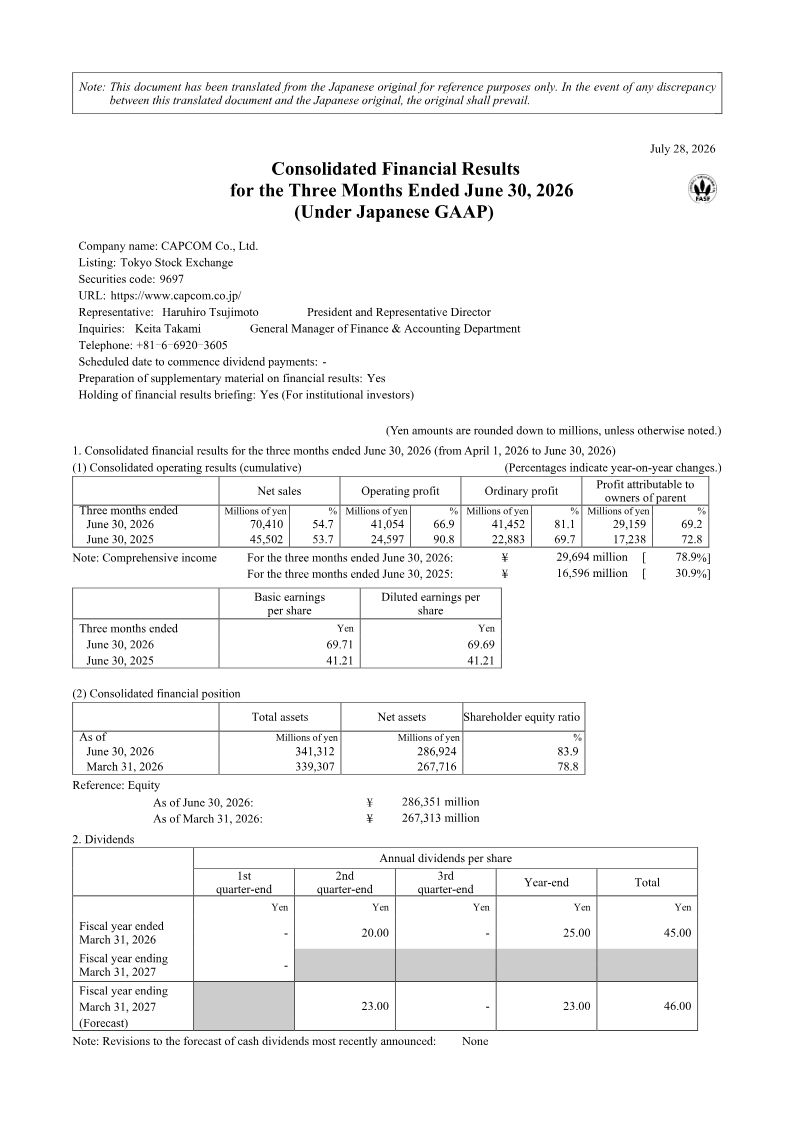
Capcom Co., Ltd. reported strong financial growth for the first quarter of the fiscal year ending March 31, 2027, covering the period from April 1, 2026, to June 30, 2026. The company’s primary objective during this period was to accelerate global digital sales and strengthen development infrastructure, including investments in artificial intelligence and proprietary engine technologies. These strategic efforts resulted in significant year-on-year growth across all major financial metrics.
Consolidated net sales reached 70,410 million yen, representing a 54.7% increase compared to the same period in the previous year. Profitability metrics also saw substantial gains, with operating profit rising 66.9% to 41,054 million yen, ordinary profit increasing 81.1% to 41,452 million yen, and profit attributable to owners of the parent growing 69.2% to 29,159 million yen. The company maintains its previously announced full-year forecast, projecting net sales of 210,000 million yen and an operating profit of 83,000 million yen.
The Digital Contents business served as the primary growth driver, achieving 54,648 million yen in net sales—an 83.0% increase year-on-year. This performance was fueled by the release of the new intellectual property PRAGMATA, which sold over 2.5 million units, and robust catalog sales totaling 21.26 million units. While the Arcade Operations segment saw a 20.6% increase in net sales, the Amusement Equipments and Other business segments experienced slight declines in revenue. The company’s financial position remains stable, with a shareholder equity ratio of 83.9% as of June 30, 2026. These results were prepared in accordance with Japanese GAAP, and the company continues to focus on long-term brand value enhancement through its multi-platform strategy and global esports initiatives.
- Capcom reported strong Q1 growth for the fiscal year ending March 31, 2027, with consolidated net sales rising 54.7% year-on-year to 70,410 million yen.
- Operating profit increased by 66.9% to 41,054 million yen, while profit attributable to owners of the parent grew 69.2% to 29,159 million yen.
- The Digital Contents segment drove performance with an 83.0% increase in net sales to 54,648 million yen, bolstered by the new IP PRAGMATA selling over 2.5 million units.
- Catalog game sales remained a significant contributor, totaling 21.26 million units during the three-month period ending June 30, 2026.
- The company maintains its full-year forecast of 210,000 million yen in net sales and 83,000 million yen in operating profit.
+2
Capcom

Financial42 pages
FY26/3 Earnings Summary: Mid- to Long-Term Growth Strategies
Capcom has achieved a significant milestone with thirteen consecutive years of operating profit growth, culminating in record-high consolidated sales for the fiscal year ending March 2026. This performance is underpinned by a robust digital-first strategy that effectively cycles new title releases alongside a high-performing catalog of legacy games. Looking ahead to the next fiscal year, the company maintains an aggressive growth trajectory, targeting a ten percent increase in operating profit and a total unit sales volume of 6.5 million, reflecting a sustained commitment to operational excellence and market expansion.
The core business philosophy centers on a flywheel model designed to maximize the long-term value of intellectual property across a global footprint spanning 244 countries and regions. By integrating consumer gaming with diverse touchpoints such as eSports, media adaptations, and amusement equipment, the company aims to scale its annual sales volume to 100 million units. This strategy relies on the continuous monetization of established franchises, ensuring that popular titles remain relevant and profitable long after their initial launch windows.
To support these ambitious mid- to long-term objectives, the company is investing heavily in human capital and technological infrastructure. Plans include expanding the developer workforce by over 100 personnel annually and fostering cross-generational collaboration to bolster creative output. Furthermore, the integration of generative AI into routine development workflows is intended to enhance operational efficiency, allowing teams to focus on high-value creative tasks. This growth is balanced by a disciplined capital allocation policy that prioritizes business reinvestment and employee compensation while maintaining a minimum 30 percent dividend payout ratio to ensure consistent value for shareholders.
- Capcom achieved record-high consolidated sales and thirteen consecutive years of operating profit growth for the fiscal year ending March 2026.
- The company is targeting a 10% increase in operating profit and 6.5 million unit sales for the upcoming fiscal year.
- The long-term growth strategy aims to scale annual sales volume to 100 million units by leveraging a global footprint across 244 countries and regions.
- Capcom plans to expand its developer workforce by over 100 personnel annually while integrating generative AI to improve development efficiency.
- The business model focuses on a flywheel approach that maximizes the long-term value of intellectual property through eSports, media adaptations, and amusement equipment.
+2
CapcomJul 2026

Financial41 pages
FY26/3 Earnings Summary and Mid- to Long-Term Growth Strategies
Capcom’s FY26/3 earnings marked the company’s strongest performance to date, with net sales reaching ¥1.95 bn and operating profit up 15 % year‑over‑year to ¥752 m. The growth stemmed from a “flywheel” effect: new IP releases, catalog sales, and digital distribution channels all contributed to a record 5.907 million cumulative units sold, up 13.9 % in volume. The company’s strategy for FY27/3 is to sustain this momentum, targeting a 10 %+ operating‑profit increase and expanding its retail footprint to 70 stores. Sales are projected at ¥2.09 bn, driven by quarterly releases of new IP titles and a focus on high‑margin franchises such as Resident Evil, Monster Hunter, and Street Fighter. A key pillar of the plan is a multi‑channel IP exploitation model that includes character licensing, media tie‑ins, eSports, and mobile extensions, with particular emphasis on emerging markets to push long‑term unit volumes toward 100 million.
Operationally, Capcom has broadened its development workforce from 2,842 in FY23 to an anticipated 3,180 by FY27, leveraging cross‑generational teams and a proprietary engine to enhance productivity. AI tools have reduced routine task time, freeing developers for creative work. Workforce diversity has improved, with female core‑role representation at 15.7 % and paternity leave uptake at 79.7 %. Capital allocation remains balanced, returning 30 % of cash to shareholders while investing heavily in R&D. The company’s projected operating margin for FY27/3 is 49.8 %, with a shift toward higher digital and online revenue streams, underscoring its commitment to sustainable growth across global markets.
- Capcom achieved record FY26/3 performance with net sales of ¥1.95 billion and a 15% year-over-year increase in operating profit to ¥752 million.
- The company projects FY27/3 sales of ¥2.09 billion and a 10%+ increase in operating profit, supported by a 49.8% operating margin target.
- Growth is driven by a 'flywheel' strategy of digital distribution and catalog sales, which pushed cumulative unit volume to 5.907 million, a 13.9% increase.
- Future growth relies on a multi-channel IP exploitation model for core franchises like Resident Evil, Monster Hunter, and Street Fighter, alongside an expansion to 70 retail stores.
- Capcom is scaling its development workforce to 3,180 employees by FY27 while utilizing AI tools to reduce routine task time and increase creative productivity.
+3
Capcom
Financial24 pages
Consolidated Financial Results: Fiscal Year Ended March 31, 2026
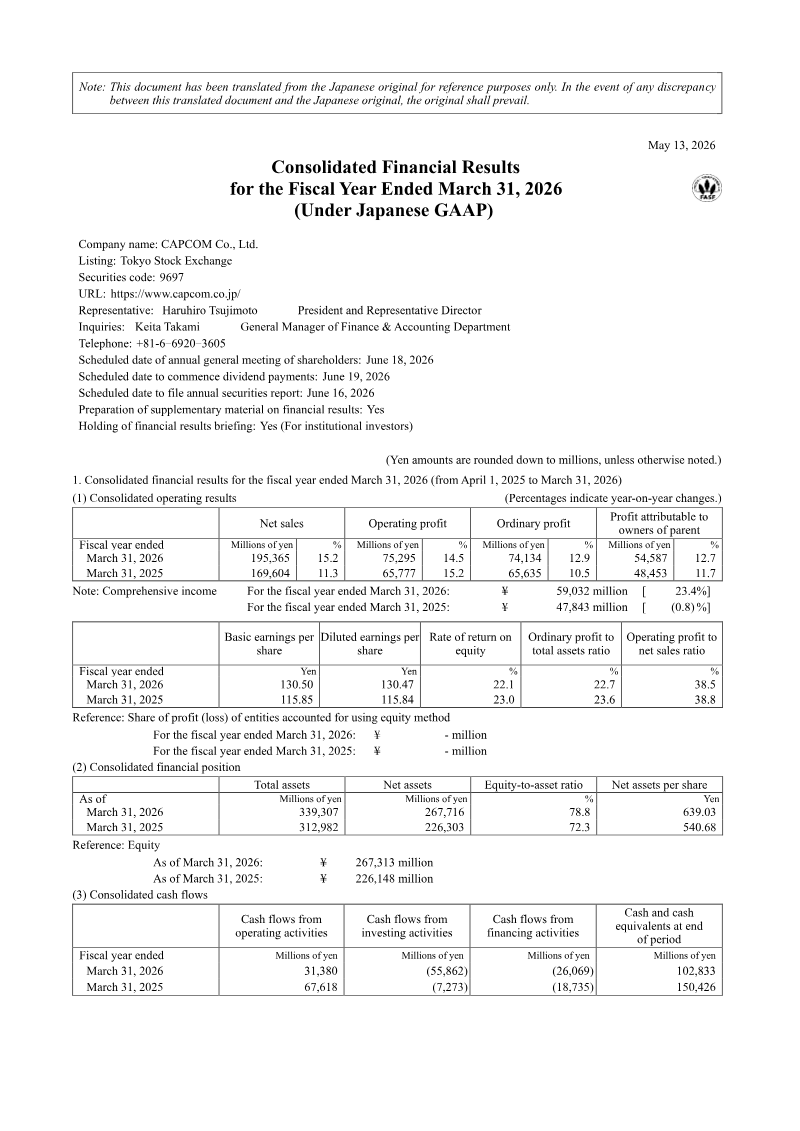
Capcom reported a robust fiscal year ending March 31, 2026, with net sales rising 15.2 % to ¥195,365 million and operating profit increasing 14.5 % to ¥75,295 million—its thirteenth straight year of profit growth. Total assets reached ¥339,307 million, giving an equity‑to‑asset ratio of 78.8 %. Operating cash flow stood at ¥31,380 million, while investing activities generated a net outflow of ¥55,862 million. The company distributed ¥17,048 million in dividends (34.5 % of sales) and projected 2027 net sales of ¥210,000 million with operating profit of ¥83,000 million.
Core Digital Contents and Other Businesses segments drove the performance. Digital Contents sales grew 13.9 % to ¥17,780 million and operating profit surged 49.7 % to ¥10,033 million, supported by long‑term hall operations, global esports events, and media initiatives such as Street Fighter 6 tournaments. Other Businesses sales climbed 25.2 % to ¥7,650 million and operating profit rose 46.7 % to ¥3,645 million, reflecting expanded media and ancillary revenue streams.
Operational metrics improved across the board. Net assets increased 8 % to ¥339 billion, largely from retained earnings and investment securities. The workforce grew to 3,976 employees with a 13 % rise in average annual salary. Paternity leave utilization reached 79.7 %, and the gender wage gap narrowed to 81.3 %. Equity rose from ¥217,768 million to ¥254,524 million, driven by a net profit of ¥54.6 billion and modest treasury‑share purchases.
Cash flow dynamics shifted, with operating cash flow falling from ¥67.6 billion to ¥31.4 billion due to higher working‑capital requirements and larger dividend and debt repayment outflows. Other comprehensive income increased to ¥226,303 million, largely from foreign‑currency remeasurements and share‑award adjustments. Overall, Capcom’s 2026 results demonstrate sustained profitability, expanding digital and media operations, and a strengthening balance sheet amid growing global fan engagement.
- Capcom achieved its thirteenth consecutive year of profit growth, with net sales rising 15.2% to ¥195,365 million and operating profit increasing 14.5% to ¥75,295 million for the fiscal year ending March 31, 2026.
- The company projects continued growth for fiscal year 2027, targeting net sales of ¥210,000 million and an operating profit of ¥83,000 million.
- The Digital Contents segment saw a 49.7% surge in operating profit to ¥10,033 million, driven by global esports initiatives and long-term hall operations.
- Other Businesses experienced significant expansion, with sales climbing 25.2% to ¥7,650 million and operating profit rising 46.7% to ¥3,645 million through diversified media and ancillary revenue streams.
- The company maintains a strong financial position with an equity-to-asset ratio of 78.8% and total equity increasing to ¥254,524 million.
+1
Capcom

Financial41 pages
FY26/3 Earnings Summary and Mid- to Long-Term Growth Strategies: Capcom
Capcom achieved a historic peak in FY26/3, reporting net sales of ¥1.95 billion and operating profit of ¥752 million—both up 15% year‑over‑year. The surge was driven by strong new‑title releases and catalog sales, particularly through digital channels, and marked the company’s highest cumulative unit sales at 5.9 million. Retail expansion reached 61 stores, including the first overseas Capcom Store in Taipei, underscoring a growing global footprint.
Looking ahead to FY27/3, Capcom targets more than 10% operating‑profit growth and ¥2.1 billion in sales, underpinned by a steady pipeline of new IP launches such as Pragma and an expanded catalog strategy. The company plans to release one new machine per quarter, aiming for 53 000 units across four titles—including Biohazard RE:3 and Resident Evil 7—while projecting net sales of ¥209 million and operating profit of ¥104 million. A key focus is deepening IP monetisation through e‑sports, media tie‑ins, and mobile extensions, with an expected 18% year‑over‑year increase in pachislo volume and intensified expansion into emerging markets.
The FY26/3 earnings report also highlights significant workforce growth, with an annual addition of over 100 developers and the integration of AI tools to enhance efficiency. Financially, net sales rose 14% YoY to ¥1,259 bn and operating profit increased 18% to ¥508 bn, while maintaining a strong cash position that balances shareholder returns, employee compensation, and reinvestment. Diversity metrics improved, with female core‑role representation at 15.7% and paternity leave utilization at 79.7%, reflecting a broader talent strategy aimed at sustaining long‑term innovation and market leadership.
- Capcom achieved record-breaking FY26/3 results with net sales of ¥1.95 billion and operating profit of ¥752 million, both representing a 15% year-over-year increase.
- The company targets continued growth in FY27/3, aiming for ¥2.1 billion in sales and a greater than 10% increase in operating profit.
- Growth is driven by a dual strategy of new IP launches, such as Pragma, and a robust catalog strategy that achieved 5.9 million cumulative unit sales in FY26/3.
- Capcom is expanding its physical footprint and hardware presence, reaching 61 retail stores globally and planning a quarterly machine release schedule targeting 53,000 units across four titles.
- The company is actively scaling its workforce and operational efficiency by adding over 100 developers and integrating AI tools into its development pipeline.
+2
CapcomMay 2026
Financial44 pages
1Q FY2025 Financial Results
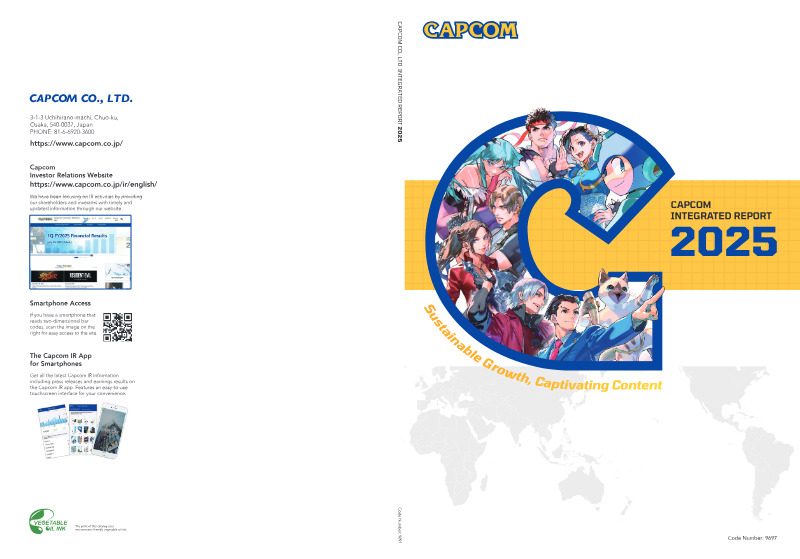
3-1-3 Uchihirano-machi, Chuo-ku, https://www.capcom.co.jp/ir/english/ We have been focusing on IR activities by providing our shareholders and investors with timely and updated information through our website. 1Q FY2025 Financial Results CAP July 30, 2025 (Wed.) IITE right for easy access to the site. right for easy access to the site. Get all the latest Capcom IR information including press releases and earnings results on the Capcom IR app.
- Capcom's net profit increased significantly, reaching 48,453 million yen in FY2025, a 303.8% increase from FY2020 and 732.4% from FY2015.
- The company's stock price has seen substantial growth, increasing by 432.3% from FY2020 to 3,664.00 yen in FY2025, and 1226.9% from FY2015.
- Capcom's R&D investment reached 49,496 million yen in FY2025, nearly doubling since FY2020 (191.5% increase) and FY2015 (195.6% increase).
- The Return on Investment (ROI) for R&D has improved significantly, reaching 132.9% in FY2025, up 44.6 percentage points from FY2020 and 91.1 percentage points from FY2015.
- Capcom is expanding its content reach through various initiatives, including the anime adaptation of Devil May Cry streaming on Netflix in April 2025, which led to over one million unit sales of Devil May Cry 5 in a month following a price reduction to $7.99.
+3
Capcom
Financial17 pages
3rd Quarter Report: Fiscal Year Ending March 31, 2026
This financial report details Capcom’s consolidated performance for the third quarter of the fiscal year ending March 31, 2026. The findings indicate significant year-on-year growth in both revenue and profit across all business segments, driven primarily by the sustained performance of catalog titles and strong results in the amusement equipment division. Net sales reached 115.3 billion yen, a 30% increase over the previous year, while operating profit rose 75% to 54.3 billion yen. These results place the company on a favorable trajectory to meet its full-year targets of 190 billion yen in net sales and 730 billion yen in operating profit.
The Digital Contents segment remains the primary driver of growth, with unit sales reaching a record 9-month high of 34.6 million units. Catalog titles accounted for 96.4% of these sales, underscoring the long-term value of core franchises such as Resident Evil, Monster Hunter, and Street Fighter. Notably, Monster Hunter Wilds surpassed 11 million cumulative units, while Resident Evil 4 and Street Fighter 6 continued to show steady growth. Digital sales now represent 94.1% of total units, with PC platforms alone accounting for over 55% of the volume. Geographically, overseas markets dominate the business, representing nearly 90% of total unit sales.
Beyond software, the Arcade Operations and Amusement Equipments segments reported double-digit growth. Arcade sales rose 12% following the opening of new stores and the expansion of specialty formats, while Amusement Equipments saw a 74% surge in net sales due to the strong performance of smart slot titles like Shin Onimusha 3. The company’s strategic outlook remains focused on leveraging its leading brands through upcoming releases such as Resident Evil Requiem and Monster Hunter Stories 3, alongside cross-media expansions including a new Devil May Cry anime and a live-action Street Fighter film.
- Capcom reported strong Q3 growth with net sales rising 30% to 115.3 billion yen and operating profit increasing 75% to 54.3 billion yen.
- The Digital Contents segment achieved a record 34.6 million unit sales, with catalog titles accounting for 96.4% of that volume.
- Digital distribution now comprises 94.1% of total unit sales, with PC platforms serving as the primary driver, accounting for over 55% of the volume.
- Overseas markets remain the company's primary revenue source, representing nearly 90% of total unit sales.
- The Amusement Equipments division saw a 74% surge in net sales, bolstered by the performance of smart slot titles like Shin Onimusha 3.
+1
CapcomFeb 2026
Financial13 pages
Consolidated Financial Results for the Nine Months Ended December 31, 2025 (Under Japanese GAAP)
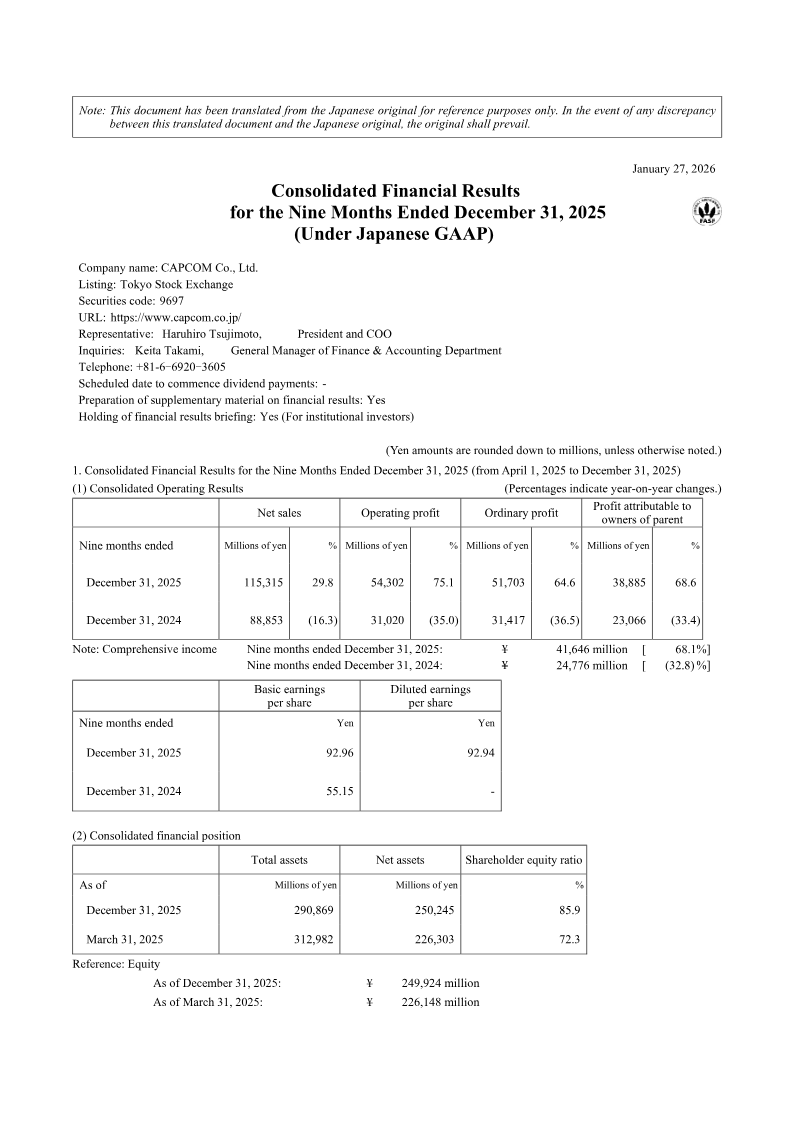
Capcom Co., Ltd. reported significant growth in its consolidated financial results for the nine-month period ended December 31, 2025. Net sales reached 115,315 million yen, a 29.8% increase year-on-year, while operating profit surged 75.1% to 54,302 million yen. This performance was driven by a robust human resources investment strategy and a focus on digital sales expansion within the global market. The company maintained its full-year forecast for the fiscal year ending March 31, 2026, projecting net sales of 190,000 million yen and an operating profit of 73,000 million yen.
The Digital Contents business remained the primary earnings driver, with unit sales increasing to 34.64 million units across 238 countries and regions. Performance was bolstered by the release of titles like Street Fighter 6 and Kunitsu-Gami: Path of the Goddess on new hardware, alongside strong catalog sales of the Resident Evil and Monster Hunter series. Notably, Monster Hunter Wilds surpassed 11 million cumulative units following its February 2025 release. The segment recorded net sales of 73,411 million yen, up 25.4% from the previous year.
Other business segments also showed positive momentum. Arcade Operations benefited from new store formats and experiential facilities, while the Amusement Equipments business saw a 73.5% increase in net sales due to the success of smart pachislo machines like Shin Onimusha 3. Additionally, the company leveraged its intellectual property through eSports tournaments, a new Devil May Cry animated series on Netflix, and preparations for a live-action Street Fighter film. Despite a decrease in total assets to 290,869 million yen due to lower cash balances and receivables, net assets rose to 250,245 million yen, supported by strong profit attributable to owners of the parent.
- Capcom reported significant nine-month growth ending December 31, 2025, with net sales rising 29.8% to 115,315 million yen and operating profit surging 75.1% to 54,302 million yen.
- The Digital Contents segment, the company's primary earnings driver, achieved 34.64 million unit sales across 238 regions, contributing 73,411 million yen in net sales.
- Monster Hunter Wilds reached 11 million cumulative units sold following its February 2025 release, while catalog sales for the Resident Evil and Monster Hunter series remained strong.
- The Amusement Equipments business saw a 73.5% increase in net sales, largely attributed to the success of smart pachislo machines such as Shin Onimusha 3.
- Capcom maintained its full-year fiscal forecast for March 31, 2026, targeting 190,000 million yen in net sales and 73,000 million yen in operating profit.
CapcomJan 2026
Financial44 pages
Capcom 1Q FY2025 Financial Results
Capcom’s strategic roadmap for the first quarter of fiscal year 2025 emphasizes a long-term transition into a global digital content powerhouse. The primary objective is to achieve 100 million units in annual game software sales by expanding brand penetration across 227 countries and regions. This goal is supported by a consistent financial performance marked by 12 consecutive years of operating profit growth and eight consecutive years of record-high profits. Central to this success is a "Single Content Multiple Usage" strategy, which leverages world-class intellectual property like Resident Evil and Monster Hunter across various media, including film, eSports, and location-based entertainment, to convert a potential global audience of 1.5 billion PC and console users into active fans.
The company’s financial health is characterized by high-margin digital catalog sales, which account for over 70% of annual units, and a robust operating margin of 52.1% within its core Digital Contents business. To sustain a target of 10% annual operating profit growth, Capcom is aggressively investing in human capital and infrastructure. This includes increasing the development workforce to over 2,800 personnel, raising starting salaries for new graduates to 300,000 yen, and expanding R&D facilities. Technological innovation remains a cornerstone of this growth, driven by the proprietary RE ENGINE and the development of the next-generation REX Engine to ensure high-quality, multi-platform releases.
Geographically, the strategy focuses on the "Global South"—including India, Brazil, and Southeast Asia—where digital distribution and PC platform expansion offer significant growth opportunities. Corporate governance has been further strengthened through a diverse board of directors, a performance-linked remuneration system tied to shareholder value, and a commitment to carbon neutrality by 2050. With a market capitalization exceeding 2 trillion yen and a disciplined shareholder return policy, the focus remains on creating a sustainable, virtuous cycle of high-quality content creation and global market expansion.
- Capcom aims to reach 100 million annual game software units by expanding its brand presence across 227 countries and regions.
- The company maintains a 52.1% operating margin in its Digital Contents business, with digital catalog sales accounting for over 70% of total annual units.
- Capcom has achieved 12 consecutive years of operating profit growth and eight consecutive years of record-high profits, currently maintaining a market capitalization exceeding 2 trillion yen.
- The 'Single Content Multiple Usage' strategy leverages core intellectual properties like Resident Evil and Monster Hunter across film, eSports, and location-based entertainment to target 1.5 billion potential PC and console users.
- To support a 10% annual operating profit growth target, the company is expanding its development workforce to over 2,800 personnel and increasing starting salaries for new graduates to 300,000 yen.
CapcomJul 2025

Financial15 pages
First Half Report: Fiscal Year Ending March 31, 2024
The primary aim is to present Capcom’s financial and operational performance for the first half of fiscal year 2024 and to reaffirm its full‑year guidance, emphasizing the accelerating contribution of digital content to overall growth. The half‑year results show a sharp rebound, with net sales reaching ¥74.9 billion, a 53 % year‑on‑year increase, and operating income climbing to ¥33.8 billion, up 55 % and delivering an operating margin of 45.2 %. Net income attributable to owners rose 57 % to ¥25.3 billion, while ordinary income grew 57 % to ¥36.2 billion, reflecting both higher sales and a ¥1.8 billion foreign‑exchange gain.
Segment analysis reveals that Digital Contents drove the bulk of the upside, posting ¥61.3 billion in sales—a 70 % surge—and generating ¥34.5 billion in operating profit, raising its margin to 55.4 %. Arcade Operations returned to profitability with a 25 % sales increase to ¥9.2 billion, while Amusement Equipment sales rebounded 88 % to ¥2.6 billion despite a modest decline in the most recent quarter. Other businesses contributed ¥1.6 billion in operating profit, maintaining a 32 % margin.
Game‑title performance underpinned the revenue lift. Street Fighter 6 surpassed 2.47 million units, and total consumer game sales rose to 22.6 million units, up from 21.3 million the prior year. Digital sales, including licenses,
- Capcom achieved strong growth in the first half of fiscal year 2024, with net sales rising 53% to ¥74.9 billion and operating income increasing 55% to ¥33.8 billion.
- The Digital Contents segment was the primary driver of performance, recording a 70% surge in sales to ¥61.3 billion and achieving a high operating margin of 55.4%.
- Total consumer game sales reached 22.6 million units, bolstered by the release of Street Fighter 6, which surpassed 2.47 million units sold.
- Net income attributable to owners grew 57% to ¥25.3 billion, supported by both operational gains and a ¥1.8 billion foreign-exchange gain.
- Arcade Operations returned to profitability with a 25% increase in sales to ¥9.2 billion.
+1
CapcomNov 2023