1 free read left. Create a free account for unlimited reading + AI research.
Create free account
Rock Band: How a Genre Died in 5 Years
Key insights
6 takeaways- 01The hardware-dependent model created significant financial risk, contributing to the bankruptcy of peripheral manufacturer Mad Catz following the failed 2015 revival of Rock Band 4.
- 02The rhythm game genre collapsed between 2005 and 2010 due to extreme market oversaturation and a reliance on a hardware-centric business model that became unsustainable.
- 03Annual sales for the genre plummeted by 50 percent in 2009 as consumer demand for new plastic instrument peripherals evaporated.
- 04Aggressive competition between publishers like Activision and EA resulted in 'walled garden' strategies that hindered cross-platform adoption and long-term viability.
- 05The market was diluted by a flood of spin-offs and band-specific titles, which eroded the appeal of the core experience and led to diminishing returns.
- 06Structural barriers to a genre comeback include the high cost of manufacturing specialized hardware, the decline of rock music in mainstream culture, and a fragmented development talent pool.
Ask AI about this video
Transcript
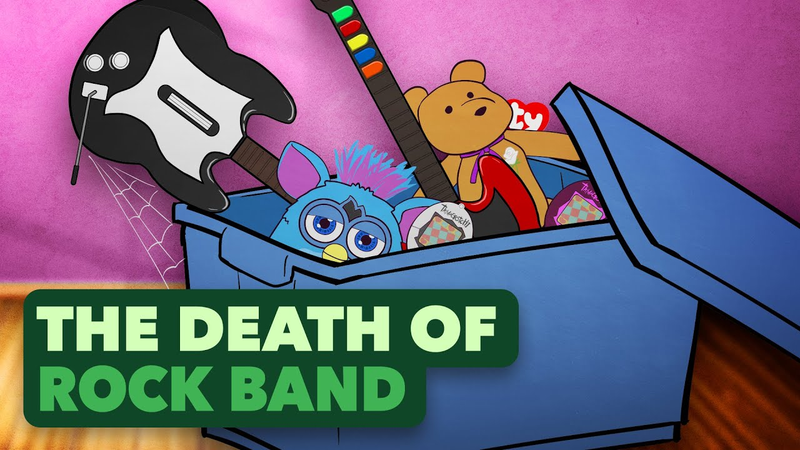
Hey everyone, got a super special episode for you today. Before it all to make sense, I need you to come back with me for a moment to the magical mystical world 2008. To a time when Flo Rida had the top single in the country, the economy was in a death spiral, and Twilight had just begun sparkling in our eyes. And it's in this time of uncertainty and consistent guest appearances by T-Pain that something unexpected was happening in the world of video games. Rock Band and Guitar Hero were blowing up the charts. Millions of plastic guitars were wailing everywhere as one, and the biggest bands in the world were desperate to get people yelling their songs at parties and in their homes. Heck, even Time magazine named the founders of Harmonix as two of the 100 most influential people in the world. But then, fast forward to today, and those toy instruments are silent in all of our closets collecting dust. Two multi-billion dollar franchises disappeared almost overnight. Within a half decade, Viacom bought one of the biggest rhythm game makers in the world for 175 million dollars and then sold it
back to them for 50 bucks. Mad Catz went bankrupt, and strangest of all, a genre died. In fact, this is perhaps the only time in game history that a style of play that was raking in money hand over fist not only poofed out of existence, but didn't spawn follow-ups, spiritual successors, or even folks trying to cash in on nostalgia. Within a span of 5 years, one of the biggest game genres in the world ceased to exist. So, what happened? Thanks so much to Ground News for helping this episode TO ROCK BAND! YOU KNOW, THERE'S AN OLD ADAGE IN THE GAMES INDUSTRY, "Peripherals don't sell." Toy guns, weird controllers, and even platform holder-backed endeavors like the Kinect and the PlayStation Move all always underperformed. But, for a few glorious years, this old saw was put to the test by people who answered the
question of, "Are you ready to rock?" with a resounding, "Hell, yeah." That is, of course, until it all fell apart. But, to talk about why, we have to travel even further in the way-back machine to 1999. Back then, a tiny, struggling company called Harmonix was coming into its fifth year without any major success. They'd recently cut their staff by 40% and were looking for a way to change their business before they went under. Luckily for them, though, Sony was looking for unique titles for its upcoming sequel to the PlayStation, aptly named PlayStation 2. So, Sony gave Harmonix $2 million to make a game called Frequency. This odd little rhythm racer-style game that's all about pressing buttons on a beat. Now, it was fairly well received by critics, but sales were kind of dismal. Crucially, though, the deal they made with Sony was fairly unique at the time, especially for a studio so small. Harmonix was allowed to own all of their tech and their IP. This allowed them to build up a better base of rhythm game tech than anyone else in the biz, at least in the West, which led them to the next step
toward their virtual rock empire. For after a sequel to Frequency called Amplitude that also didn't do great commercially, they were contacted by Konami. Yeah, remember when Konami used to make games? That was crazy. See, Konami had been doing well in the music game space for a while and wanted to bring that genre to the American market, but felt like they needed a Western developer to do it right. So, they hired Harmonix to build Karaoke Revolution, a game that not only I played to absolute death, I love that game so much, but that also let Harmonix take the first shuffling stride out of the world of simple press-the-button-on-the-beat games and got them building tech to use a microphone with modern consoles to get people to sing on pitch as well as on beat. Which brings us nicely into 2004 and 2005 and Red Octane. They were a hardware company who had become very interested in the rhythm arcade games that Konami was putting out in Japan. Particularly, they were looking at a title called Gitadora or Guitar Freaks. So, they offered to partner with Harmonix to build a home version for
international release. They would build the hardware and Harmonix would build the game. Together, they licensed a handful of popular rock songs and they were off to the races. Now, no one really thought it would work, but their dinky plastic guitars ended up flying off shelves and it turned into the must-have party game of the year. Celebrities and lucky interns who shall remain nameless were playing it on TV. Educators started talking about it as a whole new way to get a generation of young people interested in music. 2005 became the year of Guitar Hero and within a year, they'd release a sequel and the acquisition offers would start rolling in. Cut to June of 2006 and wanting to get in on the action, but lacking the hardware experience, Activision acquired Red Octane for a cool 99.9 mil. Following on the heels of that deal, Viacom, not wanting to miss out on the party and really just starting to get into the games business themselves, picked up Harmonix for 175 million dollars that September. But, the tricky thing was that the Guitar Hero license could only follow one company
and that was Red Octane. Though, Harmonix did have other plans. Plans for a bigger, bolder competitor. One that would utilize their experience from the karaoke revolution days and their patented rhythm technology to bring home the full band experience. And so, a little more than a year after Guitar Hero 2 was released, Harmonix hit the market with Rock Band. Or to put it another way that is perhaps more incendiary at the time, Rock Band dropped less than a month after the release of Guitar Hero 3. Shots fired. And it's around this point where things start to get even messier because this is where the toy instrument arms race begins. Plastic guitar mania is now in full swing and now there's competition. Rock Band is distributed by EA and Guitar Hero is an Activision product at this point. Of course, as we all know, there is no love lost between these companies, and both see the other one as drinking their milkshake. Each sale of one was seen by the other company as a potential sale they missed out on. So, both companies race to get more and more titles in their franchise on the market,
and to sign more and more bands for DLC. Then, by 2009, both franchises are seeing multiple spin-offs a year. We start to see things like Guitar Hero Van Halen and Lego Rock Band. The rhythm game space gets oversaturated, audiences and critics alike see these new releases as shameless cash grabs, and the market goes into freefall. Rhythm games do almost a 50% plunge in year-over-year sales. 50% and then there's the big one, DJ Hero. Now, to this day, you'll hear people from Activision defending DJ Hero, saying that it sold fine, but it didn't. It was projected to sell a million and a half units in the first quarter, and even aggressive estimates say it did only about half of that. Keep in mind, this was a game with new hardware, a whole new plastic toy to buy, which meant that when it didn't meet sales expectations, that was a lot of bulky fake DJ equipment sitting in warehouses and on store shelves. Within a year, RedOctane would be shuttered by Activision. Within two, Activision
declared they were done with Guitar Hero altogether. Viacom would sell off Harmonix for an undisclosed amount of money, but the Wall Street Journal speculated that it was $50. Granted, this isn't as mad as it seems, because basically they'd take all their debt with them, and Viacom would still get a huge write-off from the initial purchase. But still, 50 bucks. Now, Harmonix would eventually try to make another go of it, partnering with Mad Catz in 2015 for Rock Band 4, but this would leave Mad Catz stating in their financial reports that the sell-through was lower than the original forecast, resulting in higher inventory balances as well as low margins due to increased promotional activity with retailers, and then promptly declaring bankruptcy. Though to be fair, Mad Catz was already in pretty dire shape before that whole kerfuffle. Okay, so with all of that history said, what went wrong here? And why hasn't the fake instrument genre made a comeback? Well, there is a persistent rumor in the games industry that it was actually all a grand design by Activision. That at the height of the
Activision EA rivalry, Activision execs decided to tank the entire genre to deny EA a major revenue stream. But, as fun as that soundbite is, I think it's kind of simpler than that. Because hardware was where the money was on these games. Those plastic guitars, they sold for the price of an entire game. The markup was spectacular. But, as more and more people bought one of the many iterations of Guitar Hero or Rock Band, the less and less people needed new plastic instruments. So, the profits began to decline. This was also in the era where DLC began to really grow, and rhythm games were the DLC golden goose. Sure, licensing fees were a pain, but you could churn out DLC that people would actually buy. But, on the flip side of that, in the end, Activision and EA saw their products as walled gardens. Meaning they believed that players would only invest in one of the two franchises, because once you bought your favorite song in one, you wouldn't want to have to buy it all over again in the other. Meaning the more songs you had in one of the games, the less likely you were to switch franchises. Which, to be
fair, was probably at least somewhat true across the industry. Sure wasn't my house, anyway. So, they both raced to present the player with a better value proposition. They tried to get more songs, more expansions, more spin-offs out, so that players would buy their version. Which then, of course, led to the shovelware flood of rhythm games we mentioned earlier, which just destroyed the market for everyone. Oh, also the band-specific expansions, like The Beatles: Rock Band or the previously mentioned Guitar Hero: Van Halen, might have actually had a negative impact on the genre. Sure, they created exclusive content for their respective franchises, but even a group as widely popular as The Beatles has a smaller audience who wants to play their songs on plastic instruments than a game with a wide spectrum of hit songs will, which in turn could have possibly led a large segment of their audience to feel like they were being ignored or not being provided with content that they want and eventually tuning out. But when it's all said and done, it does probably just come down to people having all they wanted. As more folks collected instrument controllers, as more people
acquired the songs they actually wanted to play, there's just less and less you can actually sell. Plus once you've already signed Metallica and Nirvana and The Doors, you have to start digging deeper and deeper, signing bands that less and less people want and that less and less people get excited about. The well does eventually run dry. Then of course you have to start making things like DJ Hero to sell them new plastic and songs that wouldn't fit into the games you already made. Now all that still of course leaves us with the question, why isn't there a new successful version of Rock Band or Guitar Hero today? Well, while there's no definitive answers, we do have a few ideas. Maybe it's that the world's changed. In a day and age where we play everything over a wire, maybe there just isn't as much room for something that requires you to get four friends together to shout and thrash and wail on a plastic drum kit in one room. Maybe it's that rock is different today. The popularity of rock is sadly in decline and the type of big bombastic rock that makes the best Rock Band songs just isn't as much of a mainstay of pop culture as it once was. It might also be
that the developers have scattered to the winds, that there just isn't as much expertise out there to create these types of experiences and what expertise there still is is now sprinkled through a number of companies. Or it might be that a lot of publishers and platform holders are still wary of investing in new hardware plays. Given the supply chain issues in the world right now and how many big companies got burnt by their VR sales numbers, arguing that you want to make a game that requires a $50 plastic guitar might be harder than it once was. Lastly, some say it might just be that we've changed. That in a world of pandemics and instability, rocking out with friends on fake guitars seems too trivial to put time into. But personally, I refuse to believe that. Because A, some of my absolute favorite video game memories in my entire life have been playing Rock Band with friends. And B, I mean, just look at all the other trivial stuff we get up to on the internet today. There's no shortage of that, present company included. So, I'm going to knock that one off the list. The rest of them still possibilities. But now I'm curious. Would you, dear viewer, be interested in these sort of games if someone tried to
bring them back? Or should the games industry let this once hot burning rock simply fade away? Tell us what you think in the comments. And also, if you have a little extra time, what songs from the last 5 years you'd want to play most? Now, of course, everyone's musical wish list will be super subjective, much like all media we consume, which is fine most of the time. Until, of course, current events come up at the dinner table and things get dicey. Well, what if I told you there was a service you could use to help analyze where news stories shared by your kind of sort of out there uncle are actually coming from? For the uninitiated, Ground News is a first-of-its-kind website and app that lets you compare how news stories are being covered across the political spectrum, which can be super helpful when you're trying to navigate conflicting information, sensationalized coverage, and endless social media feeds. That way, you can be confident you're getting the whole story. Also, with their bias distribution chart, which I like to think of as a sort of Metacritic for news biases, you get to see where various media outlets you get your news from falls on the political spectrum. Plus, you can even compare headlines to see how phrasing changes between news outlets, which not only is fascinating, but can actually help you
find possible blind spots. And speaking of blind spots, they even have a blind spot feed, displaying stories you might be interested in that are underrepresented in the news you regularly consume. So, if you're looking for a better way to stay informed about current events around the world, check out Ground News by visiting ground.news/extracredits to download their free app. Then, not only will you have more information about where your news is coming from, you'll also be helping out our channel in the process, which for the record is always news we like hearing. Thanks so much. You know who's just the best? Ahmet Ziya Turk, Angela Valenciana, Arclight Games, Casey Musgraves, Dominic Valenciana, Joseph Blain, and Skyler Holmes. Thanks so much for your support, all.
Summary
The rapid rise and collapse of the rhythm game genre between 2005 and 2010 represents a unique phenomenon in the video game industry, where a multi-billion dollar market segment effectively vanished within five years. Driven by the success of Guitar Hero and Rock Band, the genre relied on a hardware-centric business model that prioritized the sale of plastic instrument peripherals. While these titles initially achieved massive cultural penetration, the market suffered from extreme oversaturation, characterized by a flood of spin-offs and band-specific titles that diluted the appeal of the core experience.
The industry’s decline was precipitated by a combination of factors, most notably the diminishing need for consumers to purchase new hardware once they already owned the necessary controllers. As the installed base of plastic instruments grew, profit margins tightened, and the aggressive competition between publishers—specifically Activision and EA—led to a "walled garden" strategy that discouraged cross-platform adoption. By 2009, annual sales for the genre plummeted by 50 percent. Failed attempts to revitalize the market, such as the introduction of DJ Hero and the 2015 revival of Rock Band 4, resulted in significant financial losses and, in the case of peripheral manufacturer Mad Catz, bankruptcy.
The genre’s failure to return is attributed to several structural and cultural shifts. Beyond the logistical challenges of manufacturing and distributing specialized hardware, the decline of rock music in mainstream pop culture and the fragmentation of the development talent pool have created significant barriers to entry. Furthermore, the industry remains wary of the high-risk, high-cost nature of hardware-dependent gaming. Ultimately, the genre’s collapse serves as a case study in market saturation, where the exhaustion of consumer interest and the limitations of a hardware-dependent business model rendered a once-dominant cultural force obsolete.















Comments