2015
Company
Documents about 2015

Stephen Reid Leaves Microsoft for Endless Foundation
Stephen Reid, a prominent figure in game-based learning, has departed Microsoft after a nine-year tenure to join the Endless Foundation as its vice president of learning.
- Stephen Reid has joined the non-profit Endless Foundation as vice president of learning after a nearly nine-year tenure at Microsoft.
- During his time at Microsoft, Reid served as the game-based learning lead and was instrumental in the creation and launch of Minecraft: Education Edition.
- Reid’s career at Microsoft began in 2015 as a creative consultant, followed by a transition to a full-time employee role in April 2020.
Will Your Steam 1.0 Launch Outpace Your Early Access Start?
This analysis examines the sales performance of games transitioning from Steam Early Access to a 1.0 full release, alongside an evaluation of Nintendo’s current corporate strategy.
- The median game experiences a 0.7x sales multiplier during its 1.0 launch window compared to its initial Early Access debut, meaning 1.0 launch sales typically trail the initial pre-release period.
- Performance variance is extreme: while the middle 50% of titles see multipliers between 0.35x and 1.35x, the top 5% of performers achieve multipliers exceeding 7.5x.
- Extended time in Early Access correlates with a lower 1.0 conversion ratio, as frequent updates and discounts tend to exhaust a game's existing wishlist before the official launch.

The Great Danish Playbook
The European video games industry is characterized by a paradoxical relationship between high cultural impact and a lack of long-term independent ownership.
- The European video games industry faces a structural vulnerability where successful studios like King, Supercell, and Guerrilla Games are frequently acquired by foreign conglomerates, leading to a decline in European-owned revenue between 2015 and 2019.
- To achieve long-term sustainability, the European sector must transition from its current role as an incubator for foreign acquisition to developing the infrastructure required to maintain independent ownership of its cultural exports.
- Denmark’s gaming ecosystem, which produced global hits like Subway Surfers, Hitman, and the Unity engine, utilizes a model of radical transparency and shared performance metrics to mitigate information asymmetries imposed by large tech platforms.

Mobile MOBA Games Market in 2026: Key Trends and Predictions
The mobile Multiplayer Online Battle Arena (MOBA) market as of 2026 remains a highly competitive, high-growth sector primarily driven by mid-core gamers.
- Honor of Kings remains the global revenue leader with over $10 billion in lifetime player spending and more than 300 million downloads, primarily driven by its dominance in the Chinese market.
- Mobile Legends: Bang Bang has established itself as the leading global MOBA outside of China, generating over $1 billion in revenue and surpassing 500 million all-time downloads.
- IP-based games are a major market driver, with 43% of the top 200 grossing games in the U.S. and up to 70% in China utilizing popular intellectual properties to attract players.
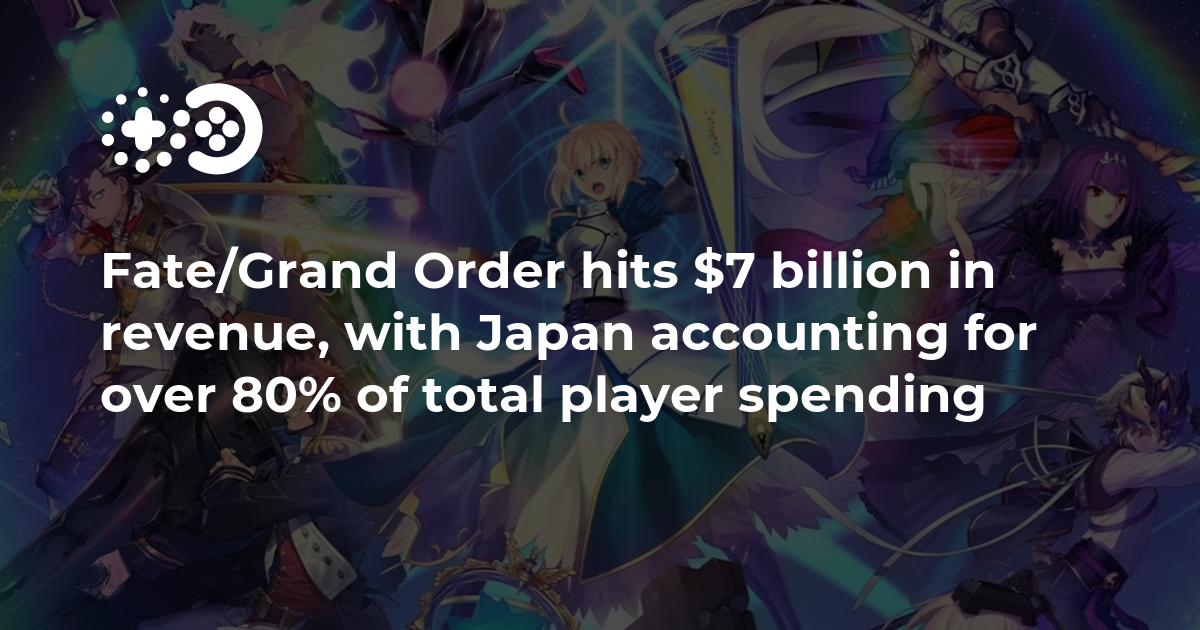
Fate/Grand Order Hits $7 Billion in Revenue: Japan Market Analysis
The mobile role-playing game Fate/Grand Order, published by Aniplex, has reached a significant financial milestone by surpassing $7 billion in lifetime player spending.
- Fate/Grand Order has surpassed $7 billion in lifetime global player spending eight years after its 2015 launch.
- The Japanese market is the primary revenue driver, accounting for 81.1% of the game's total global earnings.
- The title generated approximately $1.6 billion in revenue during the two-year period ending in August 2023, demonstrating sustained commercial viability.
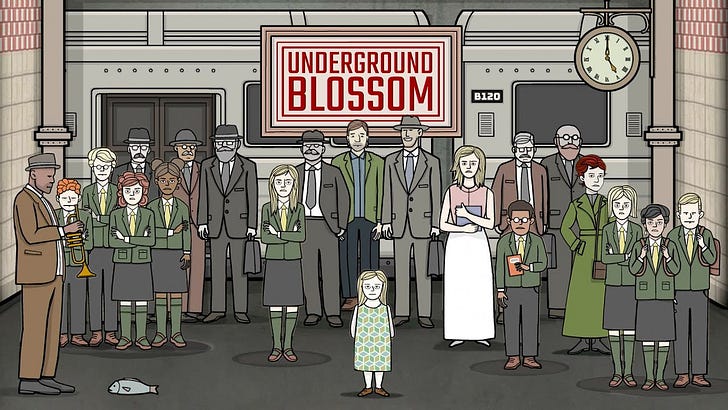
How Rusty Lake's 'Immersive Puzzle' Worlds Sell Millions
The success of independent studio Rusty Lake demonstrates how niche, atmospheric puzzle games can achieve massive scale through consistent world-building and community engagement.
- Rusty Lake has achieved over 75 million lifetime downloads across 15+ titles since 2015, successfully transitioning from free-to-play mobile origins to a premium-focused business model.
- PC platforms now drive 60% of Rusty Lake's premium sales, significantly outpacing mobile's 35% share.
- The studio’s recent releases demonstrate strong commercial viability for short-form narrative puzzles, with 'The Past Within' exceeding one million Steam units and 'Underground Blossom' selling 250,000 units in its first month.

Three Questions to: Tiny Roar on Their Partnership with AONIC
The Hamburg-based game development studio Tiny Roar, founded in 2015, has entered into a strategic partnership with the Swedish investor AONIC, which has become the studio’s majority shareholder.
- Swedish investor AONIC has become the majority shareholder of the Hamburg-based indie studio Tiny Roar as of July 2023.
- The partnership provides Tiny Roar with financial stability and access to an in-house publishing division within the AONIC collective.
- The deal allows Tiny Roar to shift its focus toward longer development cycles and increased budgets, moving away from the need to prioritize short-term survival projects.
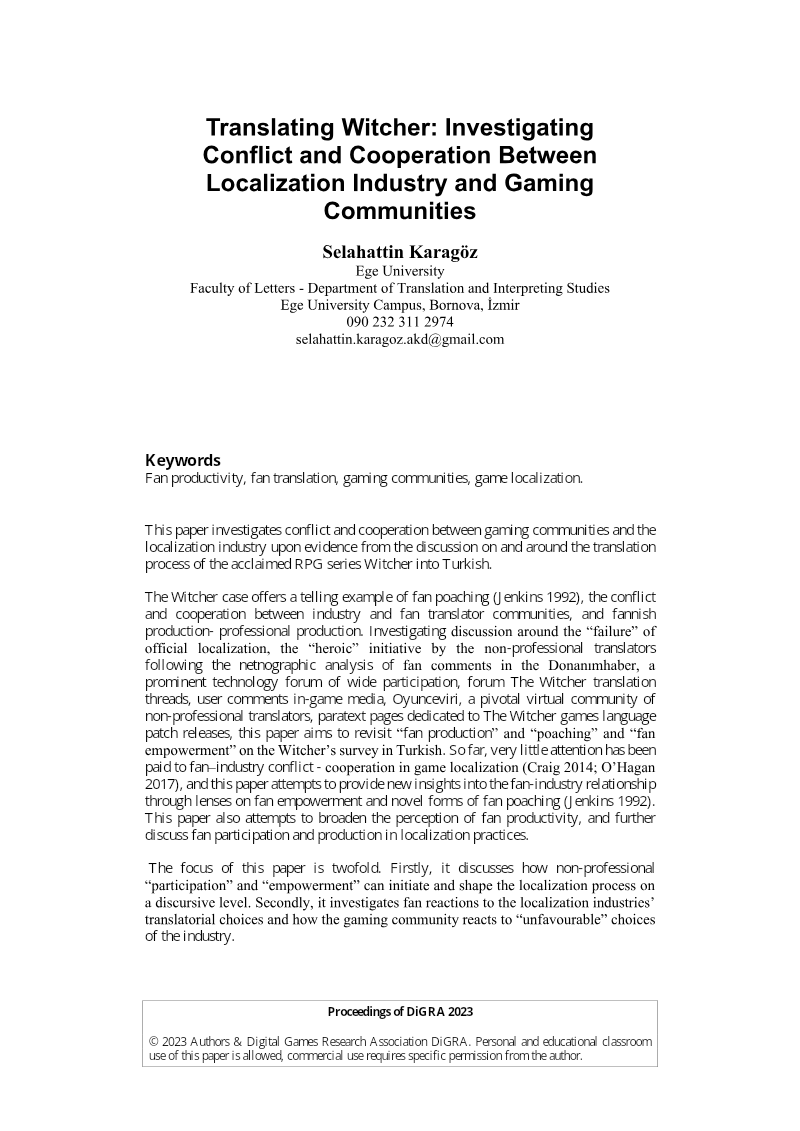
Translating Witcher: Investigating Conflict and Cooperation Between Localization Industry and Gaming Communities
This paper examines the tension and collaboration between fan communities and the game localization industry, using the Turkish localization of CD Projekt Red's Witcher series as a case study.
- The study uses the Turkish localization of CD Projekt Red's The Witcher series as a case study, drawing on Henry Jenkins' concept of fan poaching and frameworks of fan productivity and free labour to argue that gaming communities substantively shape localization practices.
- The first two Witcher games (2007 and 2011) were fan-translated in cooperation with the developer, which supplied documentation and script files, whereas The Witcher 3: Wild Hunt (2015) was localized by the professional studio 23 Studios after release without Turkish support.
- Community reaction to the official Witcher 3 Turkish translation was markedly negative, driven by practical objections such as replacing accepted terminology with more domesticated language and by a sense of betrayal that fans were bypassed despite their advocacy.
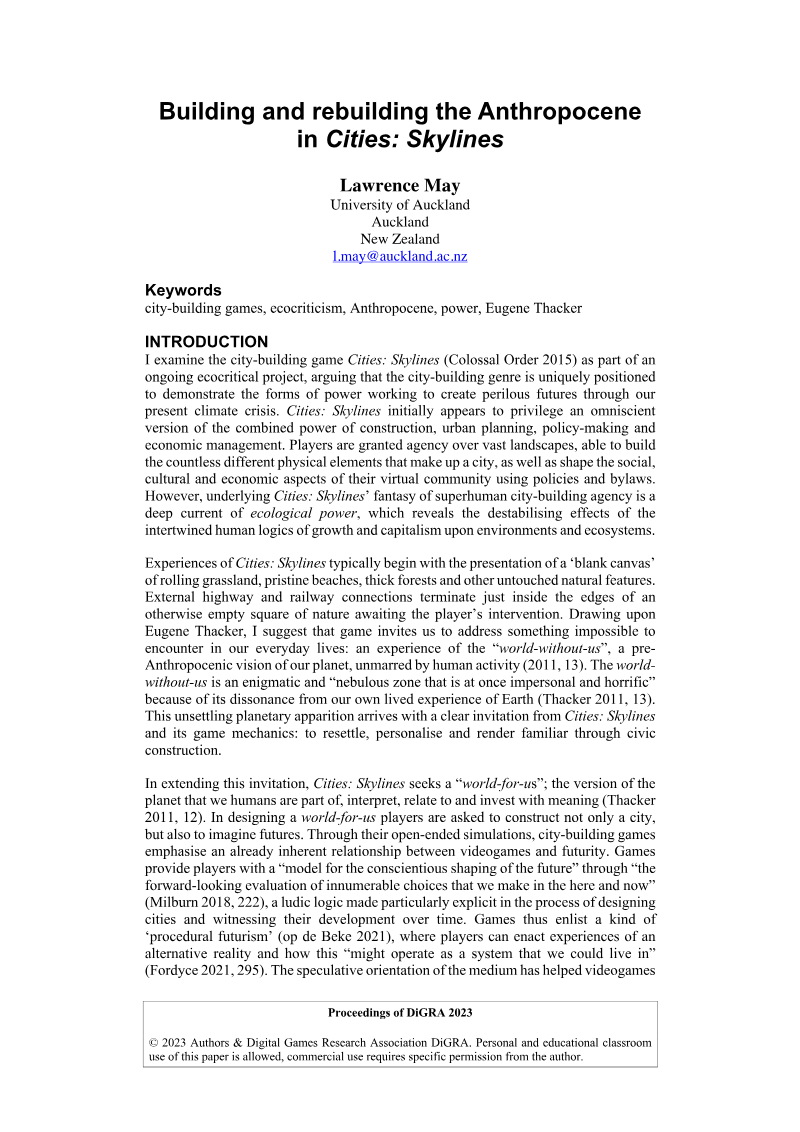
Building and Rebuilding the Anthropocene in Cities: Skylines
This paper examines the city-building game Cities: Skylines (Colossal Order, 2015) through an ecocritical lens, arguing that the genre reveals the forms of power driving the climate crisis.
- The paper argues that Cities: Skylines (Colossal Order, 2015) appears to offer omniscient control over city planning, but beneath this fantasy lies an ecological power in which growth and capitalist logics destabilise environments and ecosystems.
- Drawing on Eugene Thacker's 'world-without-us' concept, the analysis shows the game's pristine opening landscapes invite players to turn an impersonal planet into a personalised 'world-for-us' through civic construction.
- The central finding is that the game reproduces contemporary patterns of ecological power rather than offering alternatives, channelling players toward unsustainable and destructive engagements with nature.
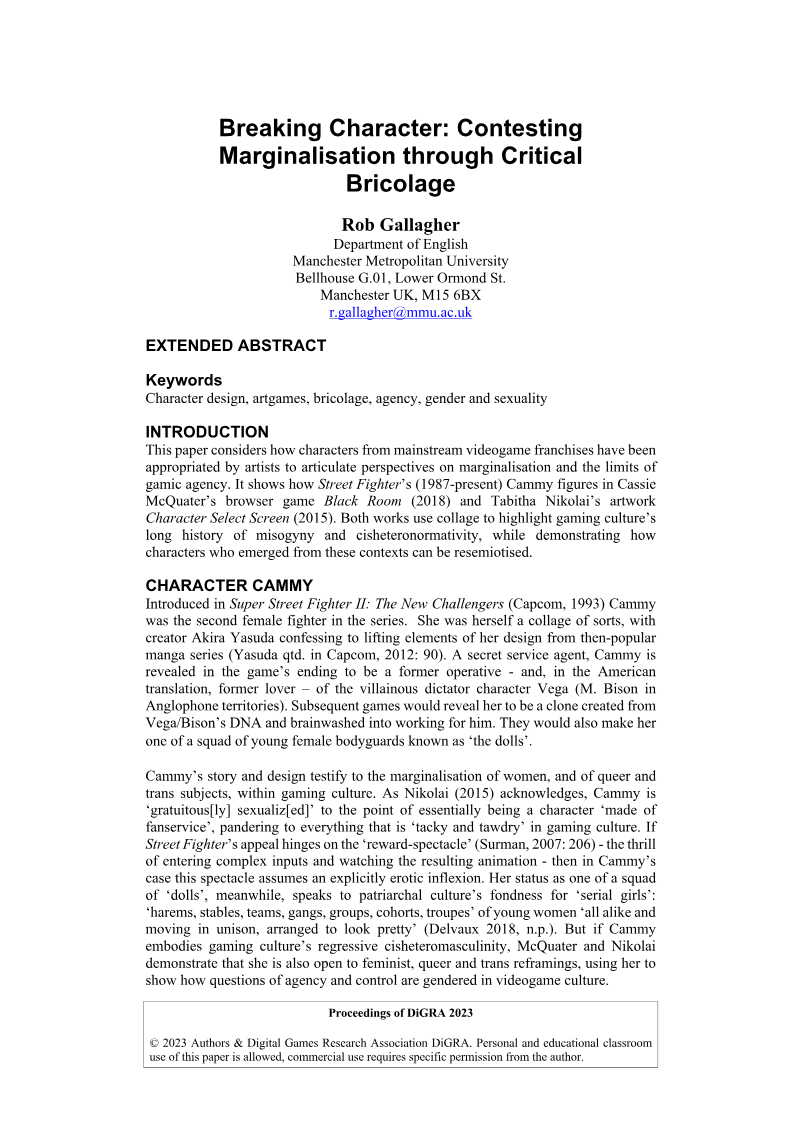
Breaking Character: Contesting Marginalisation Through Critical Bricolage
Rob Gallagher's paper examines how artists have appropriated characters from mainstream videogame franchises to comment on marginalisation, gendered representation, and the limits of player agency.
- Gallagher argues that artists such as Cassie McQuater (browser game Black Room, 2018) and Tabitha Nikolai (collage series Character Select Screen, 2015) reframe Capcom's Street Fighter character Cammy to expose gaming culture's misogyny and cisheteronormativity while opening her to feminist, queer, and trans readings.
- McQuater turns Cammy's attack animations into ornamental, non-playable gestures, freeing the character from the control of presumptively male players, though this shift can itself read as objectification.
- Nikolai frames Cammy's brainwashed-clone backstory as a vessel for a masculine consciousness, a move the paper reads as surfacing trans resonances and the anxieties games encode around passivity and control.

Back to the Mines: Mogul Games Group Will Become Galaxy Resources Limited
Mogul Games Group, an Australian-based esports entity, has announced a strategic pivot back to its original business focus of mining and mineral exploration.
- Mogul Games Group (MGG) is pivoting away from the esports industry to return to its original focus on mining and mineral exploration, rebranding as Lithium Galaxy Limited.
- The company has entered a binding agreement to acquire lithium and rare earth exploration projects located in Australia and Canada.
- Mogul Games Group failed to record a profit since its inception in 2015, accumulating a total lifetime loss of $35 million AUD despite multiple capital raises and an IPO on the Australian Securities Exchange.
FTC Fines Microsoft $20 Million for Collecting Children’s Personal Data
The Federal Trade Commission (FTC) has imposed a $20 million fine on Microsoft for violating the Children’s Online Privacy Protection Act (COPPA).
- The FTC fined Microsoft $20 million for violating the Children’s Online Privacy Protection Act (COPPA) by illegally collecting and retaining personal data from children under 13 on the Xbox platform between 2015 and 2020.
- Microsoft failed to obtain required parental consent during account creation and retained data from children even when parents did not complete the registration process.
- Until 2019, Microsoft used pre-checked boxes to automatically opt children into data sharing with advertisers and promotional content distribution.