5 documents matching your filters
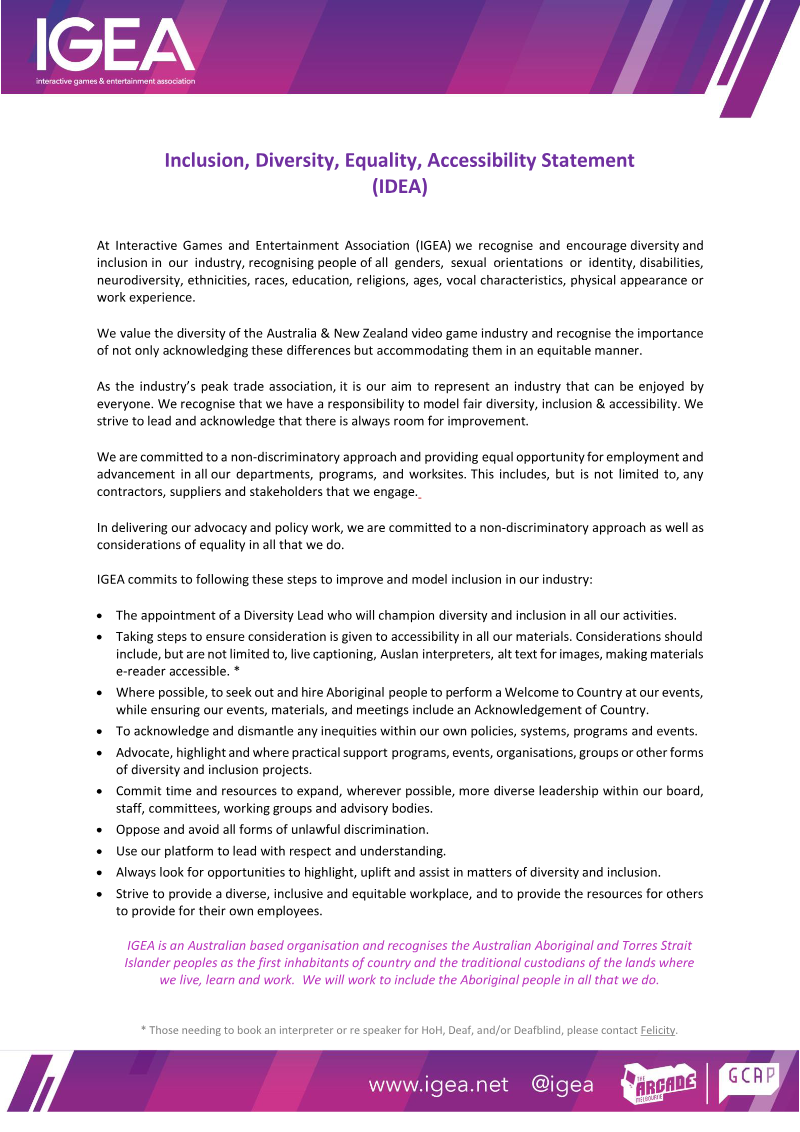
The statement articulates a commitment by the Interactive Games and Entertainment Association (IGEA) to foster inclusion, diversity, equality, and accessibility across the video‑game sector in Australia and New Zealand. It positions the association as the peak trade body responsible for modeling equitable practices and ensuring that the industry can be enjoyed by all participants, regardless of gender, sexual orientation, disability, neurodiversity, ethnicity, religion, age, or other personal characteristics. Key actions outlined include appointing a dedicated Diversity Lead, embedding accessibility features such as live captioning, Auslan interpretation, and alt‑text in all communications, and actively seeking Aboriginal participation for Welcome to Country ceremonies and Acknowledgement of Country protocols. The association pledges to audit and dismantle inequities within its own policies, expand diverse representation on its board and committees, and oppose any unlawful discrimination. It also commits to using its platform to promote and support external diversity initiatives, providing resources that enable other employers to create inclusive workplaces. The scope covers the entire Australian and New Zealand video‑game industry, encompassing IGEA’s staff, contractors, suppliers, and broader stakeholder network. While no empirical data or survey methodology is presented, the statement functions as a policy framework that sets measurable expectations for internal governance and external advocacy, signalling a strategic shift toward a more inclusive industry culture.
The Australian video games industry represents a vital economic sector, generating $339.1 million in revenue and supporting 2,465 full-time positions during the 2024 fiscal year. With 93 percent of revenue derived from international markets and over half of all studios anticipating continued income growth, the sector is positioned to evolve into a global powerhouse. The primary objective is to scale the industry to a $1 billion valuation by 2030, a goal that necessitates a strategic shift toward long-term policy frameworks, increased federal investment, and enhanced export support to facilitate international publisher partnerships and local intellectual property development. To achieve this growth, the industry requires a modernized regulatory environment that replaces fragmented, reactive policies with evidence-based standards. Current classification and online safety laws often impose disproportionate burdens on developers, hindering innovation. By streamlining these frameworks and reducing administrative red tape, the government can provide the certainty required for studios to scale operations. Furthermore, the industry advocates for a more integrated approach to public policy, specifically by leveraging "serious games" to address societal challenges and fostering closer alignment between government initiatives and the practical needs of game developers. Sustaining this trajectory also depends on addressing critical structural challenges, particularly regarding talent acquisition and capital access. The industry faces persistent talent shortages that demand improved migration pathways and a renewed focus on STEAM education to build a robust local workforce. By combining these educational and immigration reforms with targeted research and development incentives, Australia can foster a competitive ecosystem that attracts international investment while empowering domestic studios. Ultimately, the transition to a billion-dollar industry relies on a collaborative partnership between the public and private sectors to prioritize innovation, intellectual property protection, and sustainable economic development.
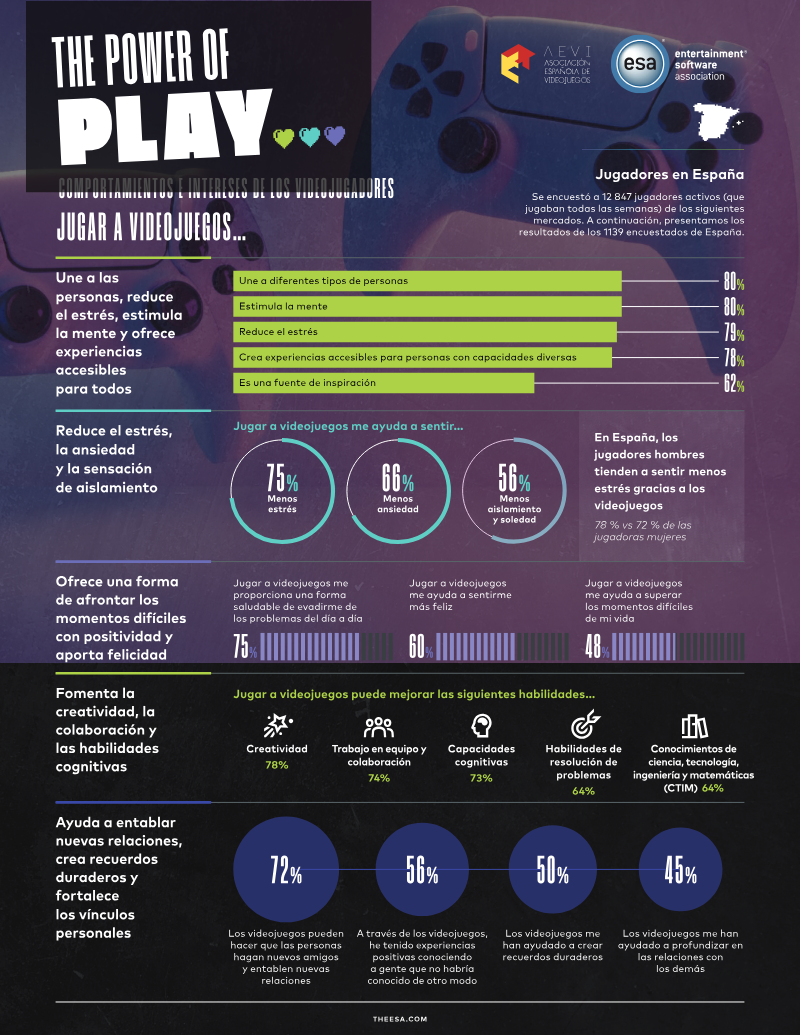
**Summary of “The Power of Play: España” (Survey of Spanish Video‑Game Players)** --- ## 1. Scope & Sample - **Population surveyed:** 12 847 active gamers (play ≥ once a week) across several markets. - **Spanish subsample:** 1 139 respondents (men + women) who answered the questionnaire. --- ## 2. Demographic Profile | Age group (years) | % of Spanish respondents* | |-------------------|---------------------------| | 16‑18 | 8 % (men) / 41 % (women) | | 19‑24 | 49 % (men) / 28 % (women) | | 25‑34 | 28 % (men) / 28 % (women) | | 35‑44 | – | | 45‑54 | – | | 55‑64 | – | | 65+ | – | \*The table in the original document mixes gender‑specific percentages; the numbers above reflect the most clearly reported figures. - **Gender split (overall):** Roughly equal, with a slight male majority in the 19‑24 bracket. - **Play mode:** 8 out of 10 male gamers (≈ 80 %) report playing **with other players online**. For women, solo play is still the most common, but a sizable minority also play online or in person. --- ## 3. Primary Motivations for Playing | Motivation | % of respondents (overall) | |------------|----------------------------| | **Fun / Entertainment** | 85 % | | **Stress reduction / relaxation** | 78 % (men) – 75 % (women) | | **Social connection (meeting new people, making friends)** | 62 % (men) – 55 % (women) | | **Escapism / coping with daily problems** | 28 % (men) – 48 % (women) | | **Feeling happier / more positive** | 75 % (men) – 60 % (women) | | **Creating lasting memories** | 45 % (men) – 35 % (women) | *Note:* The percentages are drawn from multiple overlapping questions (e.g., “Jugar a videojuegos me ayuda a sentir…”, “Reduce el estrés, la ansiedad, el aislamiento”). The highest‑scoring items are fun, stress relief, and social interaction. --- ## 4. Perceived Benefits ### 4.1 Psychological & Emotional - **Stress & anxiety:** 78 % of men and 75 % of women say gaming helps them feel **less stressed** and **less anxious**. - **Isolation:** 78 % of men and 72 % of women report a **reduction in feelings of loneliness**.
The Australian game development industry demonstrated resilience and stability during the 2024 financial year despite significant global economic headwinds. Total income generated by local studios reached $339.1 million, representing a minor 1.9% decrease from the previous year. Employment remained steady with 2,465 full-time equivalent workers, a marginal 0.3% increase. The sector is heavily export-oriented, with 93% of all revenue generated from outside Australia. Furthermore, 85% of studios focus on developing their own original intellectual property rather than work-for-hire projects. The industry landscape is characterized by a mix of emerging and established entities. While 56% of studios were formed within the last five years, a quarter of the sector consists of mature studios operating for a decade or more. Small businesses dominate the ecosystem, with 47% of studios employing five or fewer staff members. Geographically, Victoria serves as the primary hub, hosting 52% of head offices and 36% of the national workforce, followed by Queensland and New South Wales. Government support remains a critical pillar for the industry. The Digital Games Tax Offset, which passed in mid-2023, is already being utilized by 25% of respondents to fund new projects or expand existing ones. Despite this support, developers identified securing international and local publishing deals and attracting early-stage development funding as their primary challenges. The findings are based on a voluntary survey of 137 Australian game development studios conducted by Bond University on behalf of the Interactive Games & Entertainment Association. The data covers the period from July 1, 2023, to June 30, 2024. Looking ahead, the sector maintains a cautiously optimistic outlook, with 81% of studios predicting stable or increased revenue and 61% planning to hire new staff in the coming year.
The Australian Game Development Survey FY2023 reveals a maturing industry experiencing significant growth in both revenue and employment. Total income generated by local studios reached $345.5 million, a 21% increase over the previous year, while the workforce expanded by 17% to 2,458 full-time equivalent employees. This growth is largely attributed to increased federal and state government support, including the Digital Games Tax Offset (DGTO), which has bolstered developer confidence and attracted international interest. The sector is heavily export-oriented, with 87% of revenue derived from markets outside of Australia. While the industry is diversifying, it remains concentrated in the eastern states, with Victoria housing 29% of studios and 41% of the workforce. The ecosystem is characterized by a mix of established and emerging entities; 32% of studios have operated for over a decade, yet 45% are five years old or less, and 29% are currently developing their first title. Small businesses dominate the landscape, with 79% of respondents employing fewer than 20 people. Despite this upward trajectory, the industry faces notable headwinds. The primary challenges identified include difficulty hiring staff with specialized technical skills, attracting early-stage development funding, and securing international publishing deals amidst tightening global economic conditions. Nevertheless, 63% of studios intend to hire more staff in the coming year, and 68% predict continued income growth. The findings are based on a survey of 111 Australian game development studios conducted by Bond University on behalf of the Interactive Games & Entertainment Association (IGEA). The data covers the financial year from July 1, 2022, to June 30, 2023, and includes metrics on gender diversity, which showed an increase in the representation of women and gender-diverse individuals within the workforce.