10 documents matching your filters
The study aims to map the contemporary PC game distribution ecosystem and evaluate whether Steam functions as a de‑facto monopoly, while outlining alternative channels, associated risks, and growth opportunities for developers and publishers. It positions Steam’s dominance against emerging storefronts, physical media, and gray‑market platforms, offering strategic guidance for navigating a fragmented market beyond 2025. Steam’s market power is evident: 2024 revenue reached $10.8 billion and concurrent active users rose from 25.4 million in 2021 to 40.5 million by September 2025. Eighty‑eight percent of surveyed studios report that Steam delivers over 75 % of their revenue, with 37 % relying on it for more than 90 %. Consequently, 72 % of respondents view Steam as a monopoly and 53 % express concern over this reliance. Nonetheless, diversification is growing—48 % have launched titles on the Epic Games Store, a similar share on the Xbox PC store, while 10 % and 8 % have used GOG and itch.io respectively. Physical releases persist, with 32 % of developers still issuing boxed copies and 72 % of consumers indicating a continued appetite for them. Alternative distribution via e‑stores (e.g., Humble, Fanatical) and marketplaces (e.g., G2A, Kinguin) is gaining traction: 38 % of developers sell through e‑stores and 30 % through marketplaces. Seventy‑five percent anticipate at least a 10 % revenue uplift from these channels, and 80 % expect them to become
The game engine landscape is undergoing a significant transition as developers increasingly move away from proprietary, in-house solutions in favor of established third-party platforms. This shift is driven by the need for immediate development readiness, access to advanced graphical features like Nanite and Lumen, and the ability to leverage a broader, pre-trained talent pool. While custom engines historically dominated the industry, their market share has declined sharply over the last decade, falling to approximately 13% of new releases by 2024. Unreal Engine has emerged as the primary beneficiary of this trend, particularly among large-scale AAA studios. By 2024, Unreal Engine and custom engines collectively accounted for the majority of unit sales on Steam, with Unreal Engine 5 becoming the industry standard for high-fidelity projects. Conversely, Unity maintains a dominant position in terms of the sheer volume of games released, particularly within the indie and smaller-scale development sectors. However, Unity faces intensifying competition from smaller, specialized engines like Godot and GameMaker, which have captured a growing segment of the indie market. The analysis, which covers over 13,000 games released on Steam, utilizes proprietary tagging and estimation methodologies to track engine adoption trends. Data indicates that engine preference is heavily influenced by game scale and genre; high-graphics, large-budget titles skew heavily toward Unreal Engine, while strategy and simulation games remain strongholds for Unity. Looking toward 2030, the industry is expected to see continued consolidation as more studios abandon legacy in-house tools to mitigate the high costs of engine maintenance, further cementing the market dominance of third-party public engines.
The game engine landscape is undergoing a significant structural shift, characterized by the decline of proprietary in-house technology in favor of established third-party platforms. While custom engines historically dominated the industry, their market share has eroded substantially over the last decade, falling to approximately 13 percent of new releases by 2024. This transition is driven by the increasing complexity of modern development, which makes the maintenance of internal engines cost-prohibitive and less efficient compared to the immediate, high-fidelity capabilities offered by public alternatives. Unreal Engine has emerged as the primary beneficiary of this trend, particularly within the AAA segment. Following the release of Unreal Engine 5, the platform has successfully reclaimed market share lost during the pandemic, becoming the preferred choice for large-scale, high-budget productions. Conversely, Unity maintains a dominant position in terms of total volume of games released, particularly among indie and smaller developers, though it faces increasing competition from smaller engines like Godot, which has seen notable growth since 2020. Despite Unity’s high release volume, Unreal Engine and custom AAA engines continue to command a larger portion of total units sold, underscoring their prevalence in high-performing commercial titles. The analysis relies on data from over 13,000 games released on Steam, utilizing proprietary estimation algorithms and tagging methodologies to categorize engine usage by game size, genre, and unit sales. The findings indicate that while the choice of engine is often dictated by project scale—with smaller titles favoring Unity and larger, graphics-intensive projects gravitating toward Unreal Engine—the industry is moving toward a standardized ecosystem. As studios weigh the benefits of third-party support, talent accessibility, and advanced graphical features against the loss of proprietary control, the reliance on external engines is expected to continue its upward trajectory through 2030.
**Executive Summary – “The Importance of Wishlists” (VGI Report, 2025)** --- ### 1. What the Data Shows | Metric | Key Figure | Insight | |--------|------------|---------| | **Games surpassing 100 k wishlists at launch** | ~9 % (141/1 500) | Only a small minority achieve the “break‑out” threshold. | | **Correlation (wishlists ↔ Month‑1 sales)** | **r ≈ 0.70** (RSQ ≈ 0.49) | Strong overall link, but it spikes to **r ≈ 0.71** for games with **> 100 k wishlists**. | | **Top‑heavy distribution** | 1–2 % of titles > 1 M wishlists; > 90 % < 10 k | Success is heavily skewed toward a few blockbuster titles. | | **Genre performance** | Action/Adventure & RPG/Strategy → highest medians (≈ 180‑190 k) | Casual & MMO titles lag (median ≈ 70‑80 k) and rely more on post‑launch tactics. | | **Wishlist momentum** | Games that hit **100 k+** before launch have a **71 %** chance of strong month‑1 sales vs. **17 %** for < 100 k. | Momentum is a “crystal ball” for launch success. | | **Steam page creation timing** | 40 % of top performers publish 0.5‑1 yr before launch; 35 % publish > 1 yr early. | Early page creation gives sustained visibility and higher wishlist growth. | | **Pre‑launch wishlist accumulation** | 85 % of wishlists are collected **≥ 4 months** before launch. | The bulk of audience commitment happens well before the final countdown. | --- ### 2. Why Wishlists Matter 1. **Predictive Power** – Once a title crosses the 100 k‑wishlist threshold, its first‑month sales become far more predictable (≈ 71 % correlation). 2. **Marketing Leverage** – High wishlist counts signal strong community interest, making it easier to secure press coverage, influencer partnerships, and paid‑media spend. 3. **Resource Allocation** – Studios can prioritize titles with early wishlist momentum for larger launch budgets and store‑front promotion. 4. **Risk Management** – Low‑wishlist titles (≤ 10 k) have a 50 % chance of under‑performing, suggesting a need for contingency plans (e.g., extended beta, community events). --- ### 3. How Games Accumulate Wishlists | Tactic | Effectiveness (based on VGI data) | |--------|-----------------------------------| | **Early Steam page (≥ 6 months pre‑launch)** | +30 % average wishlist growth vs. late‑launch pages | | **Regular content drops (trailers, dev logs, screenshots)** | Each major trailer ≈ 10‑15 % spike in wishlist count (case: *Kingdom Come Deliverance 2* added ~0.2 M per trailer) | | **Early Access / Demo releases** | Boosts momentum for “core” genres; median increase ≈ 12 % | | **Community engagement (Discord, Reddit AMAs)** | Stronger post‑launch
Steam wishlists serve as a critical metric for predicting commercial success in the video game industry, functioning as a primary indicator of pre-launch momentum. Data analysis reveals that wishlist distribution is highly top-heavy, with a significant majority of games launching with fewer than 10,000 wishlists, while only a small fraction of titles achieve the 100,000-plus threshold required to reliably forecast a breakout performance. There is a strong 70% correlation between pre-launch wishlist counts and first-month unit sales, particularly for titles that surpass the 100,000-wishlist milestone. Genre-specific trends highlight that action and adventure titles consistently generate the highest levels of pre-release buzz, often benefiting from the brand equity and marketing budgets of AAA and AA publishers. Conversely, casual and MMO titles frequently rely on post-launch engagement, such as live updates and community building, rather than pre-release wishlist accumulation. Regardless of genre, the timing of a Steam page launch is vital; top-performing games typically establish their presence six to twelve months before release, utilizing a steady stream of trailers and development updates to build and maintain audience interest. The findings are based on an analysis of games launched on Steam from March 2024 onwards, utilizing proprietary estimation models and industry data. The research emphasizes that while wishlists are not a guarantee of success for every title, they act as a essential barometer for market interest. For developers and publishers, the data underscores that early visibility and sustained marketing efforts are necessary to reach the wishlist tiers that statistically correlate with long-term commercial viability.
Cooperative video games have emerged as a dominant force on the Steam platform, significantly overperforming relative to their total volume of releases. While only six percent of games launched in 2023 featured co-op mechanics, these titles accounted for thirty-six percent of all units sold. This trend has accelerated sharply in 2024, driven by massive breakout hits like Palworld and Helldivers 2. Market data indicates that Palworld alone represented nearly half of the forty million co-op units sold in the first half of 2024, illustrating a high concentration of success among top-tier titles. The commercial advantage of cooperative play extends across the entire industry spectrum, from major publishers to small independent studios. A typical co-op game sells approximately 40,000 units on Steam, compared to just 5,000 units for non-cooperative titles. Even the bottom quartile of co-op games performs twice as well as their single-player counterparts. For larger publishers, the segment offers substantial scale, evidenced by over one hundred co-op titles surpassing five million lifetime unit sales. This consistent outperformance suggests that social mechanics provide a higher floor and a significantly higher ceiling for commercial viability. The success of the genre is rooted in organic marketing and player psychology. Cooperative design naturally encourages word-of-mouth promotion, as players actively recruit friends to join their sessions. These games are characterized by high replayability and "memorable" moments that translate well to social media and live-streaming platforms. By creating shareable and streamable content, co-op games generate natural hype cycles that reduce the reliance on traditional advertising. Following a brief normalization period after the initial pandemic-driven surge, the current market trajectory confirms that social, team-based dynamics remain a primary driver of player engagement and revenue growth in the PC gaming sector.
The free-to-play (F2P) market on Steam represents a dominant but increasingly consolidated segment of the PC gaming industry. In 2023, F2P titles accounted for 51% of all player engagement hours on the platform, despite representing a small fraction of the total games available. This engagement is heavily concentrated at the top, with the 25 most popular titles capturing 88% of all F2P playtime. The market is characterized by significant stagnation among top performers; the average age of a top-ten F2P game is seven years, and only two new titles have successfully broken into and remained in the top ten over the last three years. Geographically, the F2P ecosystem is driven by three "Tier 1" territories—the United States, China, and Russia—which collectively account for nearly 40% of the global F2P player base. Success in this segment typically requires catering to at least one of these major markets. However, the traditional F2P model is facing new competition from a rising "middle ground" of premium titles priced between $20 and $40. Recent hits like Palworld and Helldivers 2 demonstrate that paid games with live-service elements can successfully siphon engagement away from purely free titles by offering high-quality experiences with modern monetization structures. The analysis utilizes data from the Video Game Insights platform, primarily measuring success through average concurrent users (CCU) and total hours played. The findings suggest that while the F2P market remains a massive engine for player engagement, the "winner-takes-all" nature of the segment makes it increasingly difficult for new entrants to displace established giants like Counter-Strike and Dota 2. Consequently, developers are finding success in hybrid models that combine upfront costs with long-term live-service support.
The analysis evaluates the free‑to‑play (FtP) segment on Steam, highlighting its dominant share of player engagement and the increasing difficulty for new titles to break through. In 2023, FtP games accounted for 51 % of total hours played on the platform, despite premium titles comprising the majority of releases. Engagement is highly concentrated: the top 25 FtP titles generate 88 % of all FtP activity, the top 10 capture roughly 70 %, and the top five hold nearly 60 % of concurrent users (CCU). Counter‑Strike 2 and Dota 2 continue to lead the charts, with eight of the ten highest‑CCU games in 2023 being FtP, while only one premium title (Rust) appears in the list. The market shows signs of compression as high‑quality premium and paid‑live‑service games erode FtP share. Between 2021 and 2024, premium titles priced $10‑$50 grew from 31 % to 37 % of total playtime, and flagship releases such as Elden Ring and Hogwarts have boosted the over‑$50 segment. Nonetheless, FtP titles remain older on average; the top ten FtP games have a mean age of seven years, and only two new entries (Call of Duty Warzone and Naraka: Bladepoint) have entered the top‑ten
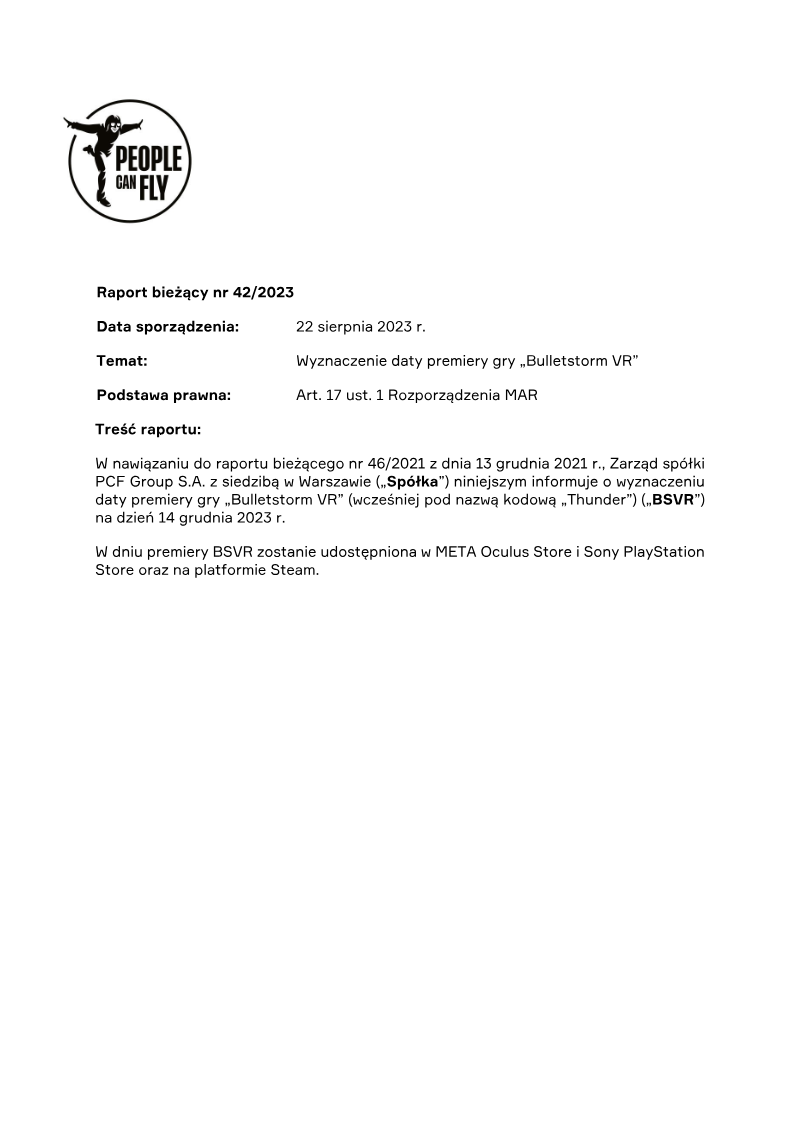
The report announces the official release date for the virtual‑reality title “Bulletstorm VR,” previously known by its code name “Thunder.” The announcement, issued by the board of PCF Group S.A. on 22 August 2023, confirms that the game will launch on 14 December 2023. Distribution channels include the META Oculus Store, Sony PlayStation Store, and Steam, ensuring multi‑platform availability across major VR ecosystems. The release decision follows a prior interim report dated 13 December 2021, indicating that the company has maintained a consistent communication cadence regarding its VR portfolio. The document cites Article 17(1) of the MAR Regulation as the legal basis for the disclosure, underscoring compliance with regulatory reporting requirements. No additional data on sales projections, target demographics, or regional rollout specifics are provided; the focus remains strictly on the release date and platform distribution. The concise nature of the communication suggests that the primary objective is to inform stakeholders, regulators, and potential consumers of the finalized launch schedule. The report’s brevity and formal tone reflect standard corporate disclosure practices for product release announcements within the gaming industry.
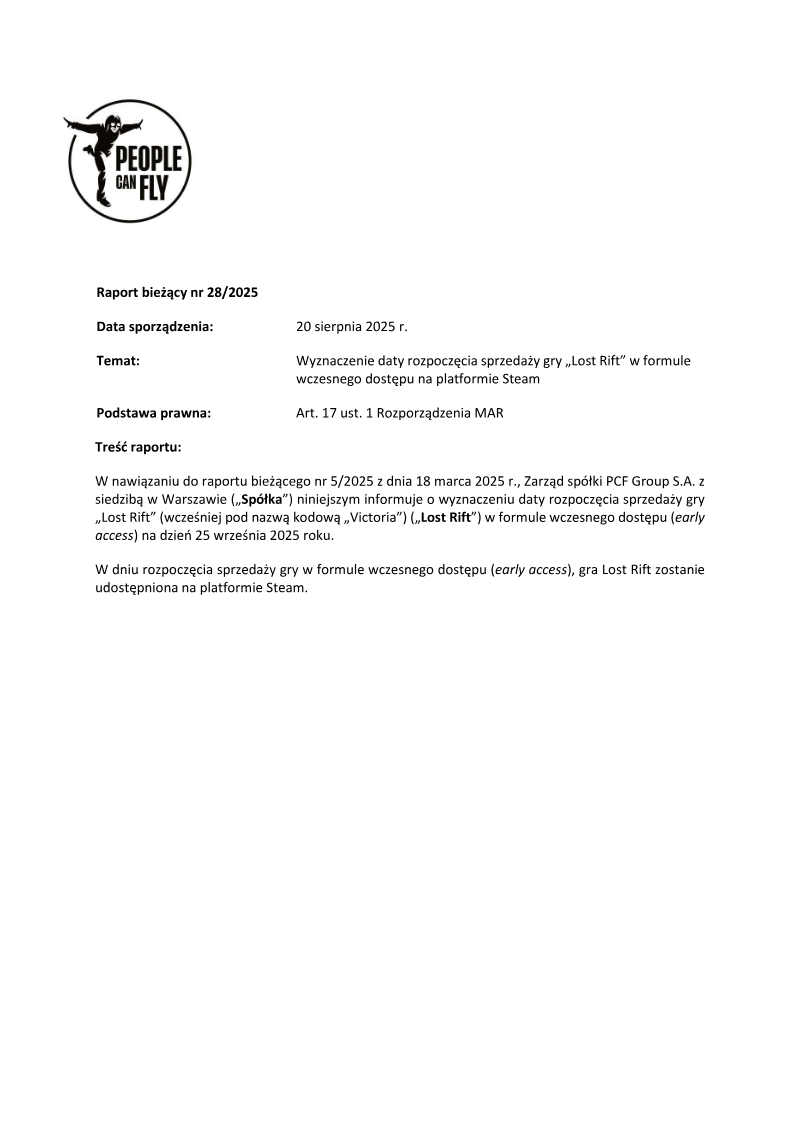
PCF Group S.A. has officially scheduled the early access release of its upcoming title, Lost Rift, for September 25, 2025. This announcement confirms the transition of the project, previously identified by the codename Victoria, into the commercialization phase on the Steam platform. The decision follows previous corporate disclosures regarding the development progress of the title, marking a significant milestone in the company’s current production pipeline. The release strategy focuses on the early access model, a common industry practice that allows developers to gather player feedback and refine gameplay mechanics while the title remains in active development. By leveraging the Steam ecosystem, the company aims to establish an initial user base and facilitate iterative improvements ahead of a potential full-scale launch. This move aligns with the company’s broader operational objectives for the 2025 fiscal year, reflecting a strategic shift from internal development to public market engagement. The scope of this release is global, as the Steam platform provides immediate international distribution for the title. The announcement serves as a formal regulatory update, ensuring transparency for stakeholders regarding the company’s product roadmap and revenue generation timelines. By setting a definitive date for the early access launch, the management team provides clarity on the project’s status and its readiness for public consumption within the competitive PC gaming market.