Game Development reports and market data
Documents
How to Build a Cross-Platform Franchise with Sola Saulenko, CMO of Pixonic
The evolution of the War Robots intellectual property from a mobile-exclusive title into a multi-platform franchise demonstrates the necessity of balancing creative intuition with rigorous, data-driven operations.
- Expanding a mobile IP to PC and console requires specialized marketing units and a shift away from traditional app store reliance, as these platforms operate under distinct user acquisition funnels and trust-building requirements.
- Successful cross-platform growth relies on a symbiotic integration of product, marketing, and analytics teams to ensure game mechanics and creative strategies remain aligned with player expectations.
- Prioritizing high-quality, actionable data from primary markets like the United States is more effective for franchise development than relying on traditional soft-launch models.
Atomic Scaling with Ludovic Bodin | Lessons From the Games Industry to the World!
Atomic scaling functions as a strategic business framework that adapts the high-performance operational models of successful gaming companies, such as Supercell and Valve, for broader commercial application.
- Organizations maximize productivity and financial growth by maintaining minimal team sizes, specifically autonomous cells of three to seven individuals led by collaborative pairs.
- The atomic scaling framework replaces traditional top-down management with a 3Ps and 3Rs methodology: People, Prediction, Playbook, Revenue, Reach, and Retention.
- High-frequency hypothesis testing, or prediction, requires employees to quantify expectations and measure them against real-world outcomes to replace unsubstantiated goal-setting.



The State of the European Game Industry: Unleashing Full Potential
The document, written by the Neogames Finland association with support from the European Games Developer Federation (EGDF) and commissioned by EIT KIC CCSI CLC NORTH, dated 1 February 2024, examines the state of the European game industry and recommends how to unleash its potential.
- The combined global turnover of EU game developer studios and publishers was EUR 18.3 billion in 2021, and the share of European game developer studios of the international games market was 11% in 2021, when the global games market was estimated to be EUR 165 billion.
- The authors state that the European game industry turnover should be well over EUR 40 billion by 2030 to maintain the EU's share of the global markets, more than twice its current size.
- The authors identify weak distribution and publishing as a key challenge, noting that the EU imports more games than it exports.

What Makes an Investable Founding Team with Maria Kochmola & Dara Leung & Phylicia Koh
Successful venture capital investment in the gaming industry hinges on a founder’s ability to balance visionary product development with disciplined business execution.
- Investor priorities shift from team composition and market conviction at the pre-seed stage to proven product-market fit, board governance, and financial metrics like burn rates at the growth stage.
- Founders must maintain transparency during fundraising, as the venture capital community shares information and will detect fabricated competition or inconsistent terms.
- Effective pitching requires a fluid, interactive communication style that is considered as critical to securing investment as the underlying product itself.
Building Great Liveops with Javier Barnes
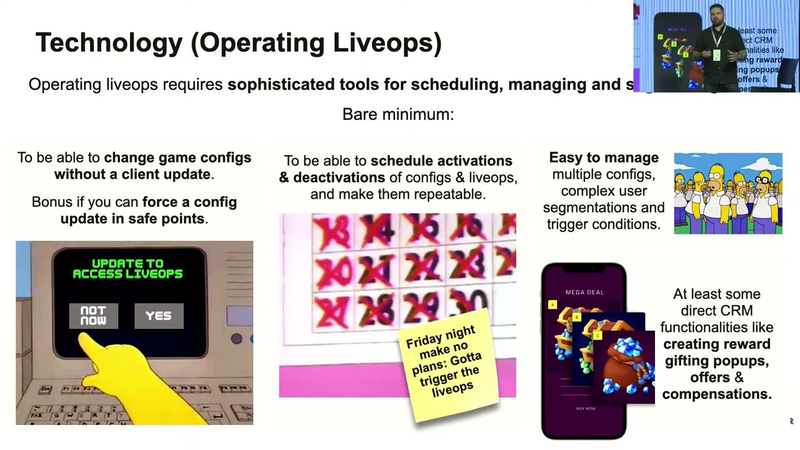
LiveOps serves as a critical engine for long-term game success, shifting the focus from simple monetization to a holistic strategy encompassing player engagement, retention, and user acquisition.
- Prioritize the development of remote configuration tools that enable real-time updates and player segmentation without requiring client-side patches to minimize technical debt and increase agility.
- Transition from manual, error-prone processes to robust, automated infrastructure to ensure system resilience and the ability to scale operations effectively.
- Adopt modular, reusable feature templates to maintain a consistent content cadence, prevent team burnout, and avoid player saturation.

Crafting an Unbeatable Game Thesis with Phillip Black
A game thesis serves as a strategic, logical argument for a game’s existence, moving beyond personal preference to provide a persuasive case for investors, publishers, and internal development teams.
- A game thesis functions as a strategic business proposition that justifies a project's existence to stakeholders by proving market viability and resource alignment.
- The framework requires answering five core questions: market size, specific opportunity, balance of innovation versus standards, content retention pipelines, and monetization hooks.
- Developers should hedge risk by adopting proven mechanics from successful industry titles while innovating in areas where competitors are limited by legacy constraints.
How to Catch the Next Big Fish with Laura Taranto of Big Fish Games
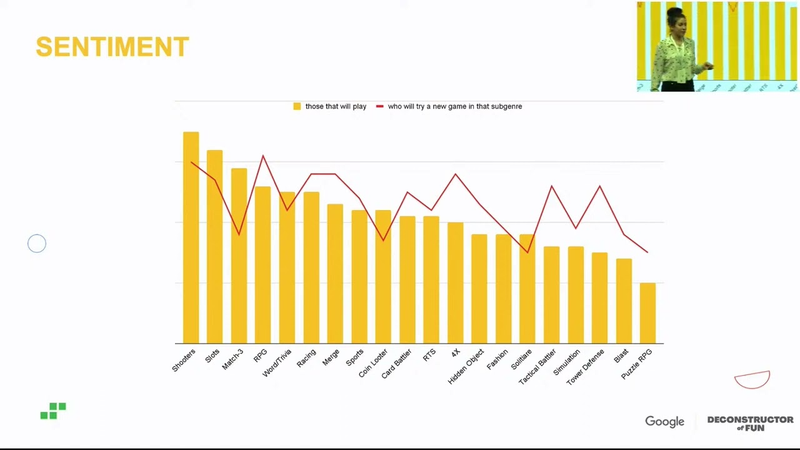
Developing a successful mobile game in a competitive, mature market requires a disciplined, three-pronged framework that integrates quantitative data, qualitative player sentiment, and internal domain expertise.
- Successful mobile game development requires a three-pronged framework that synthesizes quantitative data, qualitative player sentiment, and internal domain expertise to identify viable market opportunities.
- Studios should establish a clear North Star goal and accept high failure rates as an inherent part of the development cycle to ensure better resource allocation and stakeholder alignment.
- Quantitative metrics such as downloads, revenue, and ARPDAU are essential for identifying subgenre trends, but they must be balanced with player sentiment to uncover unmet needs and frustrations.
Launching Monumental Franchises with Supercell's Kasım Zorlu
In an increasingly saturated gaming market, the challenge of launching and sustaining monumental franchises requires a return to fundamental principles rather than a reliance on fleeting industry trends.
- Long-term franchise viability is driven by community-first marketing, where developers treat the player base as active contributors who shape the game's evolution rather than passive consumers.
- Mobile devices act as the primary hub for consumer decision-making, meaning that even for PC or console titles, failing to optimize communication for mobile screens is a critical strategic failure.
- Successful franchise management requires balancing long-term brand equity with short-term operational execution, regardless of whether the development team size is ten or one thousand people.
Fireside Chat: Thriving in the State of Survival: Affan Butt & Andy Zong
FunPlus founder and CEO Andy Zhong reflects on his 14-year tenure in the gaming industry, detailing the company’s evolution from a small startup to a global organization with 2,000 employees.
- FunPlus has scaled from a small startup to a global organization with 2,000 employees over its 14-year history.
- Strategy games are shifting from niche, core-focused titles to hybrid experiences that integrate mechanics from casual genres like tower defense to expand their addressable market.
- The company is diversifying its growth strategy by moving beyond traditional performance marketing through cross-platform expansion and mobile-first development.
The Future of Gaming is AI: Tomi Huttula, CEO Cosmic Lounge
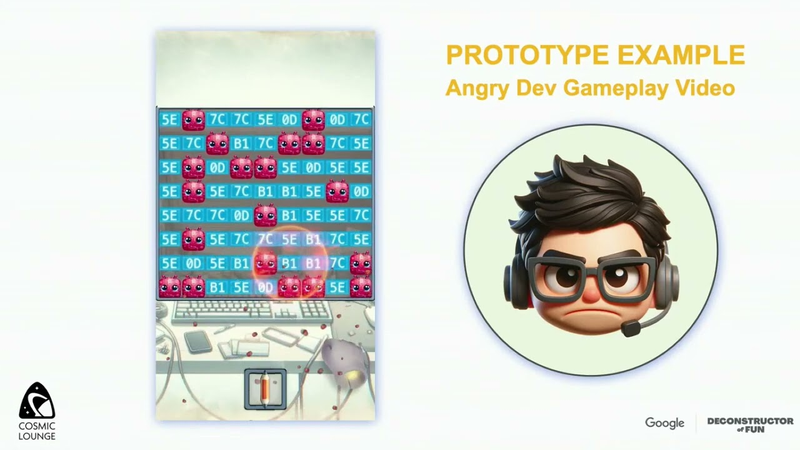
The integration of artificial intelligence into game development is fundamentally transforming the production lifecycle, particularly within the casual puzzle genre.
- AI-driven workflows, as implemented by Cosmic Lounge, can reduce production time for level creation and live operations by a factor of ten.
- Cosmic Lounge’s proprietary 'Puzzle Engine' uses a modular, data-driven architecture that allows AI to analyze mechanics and optimize levels based on performance data.
- AI tools enable designers to generate placeholder art and configure game logic in hours, removing the need for dedicated engineering or art resources during the prototyping phase.
"I Quit My Job To Make My Indie Game" — Full Time Game Dev Podcast Ep. 009
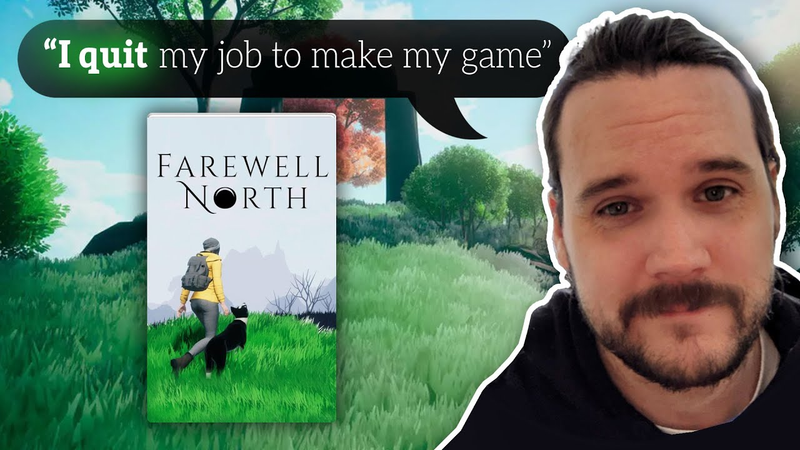
Transitioning from a long-term career in software engineering to full-time indie game development requires a strategic balance between creative autonomy and professional risk management.
- Solo developers should dedicate at least 50% of their time to marketing, as the increasing volume of game releases—reaching 14,000 titles on Steam in a single year—makes discoverability significantly more difficult.
- Predictable content creation on platforms like YouTube can provide a full-time income through sponsorships; securing 10,000 views per video can justify $500 to $1,000 per ad read.
- Publishers serve primarily to de-risk a project, allowing developers to trade a portion of potential revenue upside for financial security and professional support.
The Intricacies of Venture Capital Investments with Joakim Achren, F4 Fund
The venture capital landscape for gaming and consumer software is undergoing a significant correction, moving away from the high-burn, vanity-metric growth models that characterized the zero-interest-rate era.
- Venture capital investment in gaming has shifted from high-burn, vanity-metric growth models to a focus on early-stage, thesis-driven sustainability and profitability.
- Traditional mobile studio models are increasingly viewed as unfavorable by investors due to market saturation and prohibitively high user acquisition costs.
- Founders must now integrate marketing expertise directly into their core teams to prioritize organic distribution over reliance on paid user acquisition.
Writers
Games and companies
Games